

 Written by
 Reading time: 6 minutes
James Baldwin was an American writer and civil rights activist best known for his semi-autobiographical novels and essays dealing with the topics of race, politics, and sexuality. He was not only an important pioneer of the Civil Rights Movement but also one of the first writers to openly discuss these issues in the deeply conservative mid-20th century American society. Baldwin successfully intertwined the complex themes of identity, race, sexuality, and oppression in his raw and honest portrayals of society and in his beautifully tragic pieces, bringing awareness to them while defending values that are crucial, even today.
His life and relation with the American Civil Rights Movement
James Baldwin was born in Harlem, New York, in 1924 where he grew up in a Catholic family and developed an interest in writing in high school. In 1948, he moved to France as a way to evade the racism and homophobia he faced in his birth country and fully explore his art. There, he was able to separate himself from the segregated American society and, from an outside perspective, better write about his experience in this culture. During this time, he wrote some of his most famous novels and essays, including Go Tell It on the Mountain – inspired in his own childhood, portraying a young black boy’s experience trying to find his identity in a religious family and racist country -, Giovanni’s Room – that deals directly with homophobia as the protagonist struggles to accept himself and to commit to a passionate relationship -, Notes of a Native Son – Baldwin’s honest reflection on his relationship with his father among racial oppression – and The Fire Next Time – a powerful essay on race, power and justice that focuses specifically on the Civil Rights Movement.

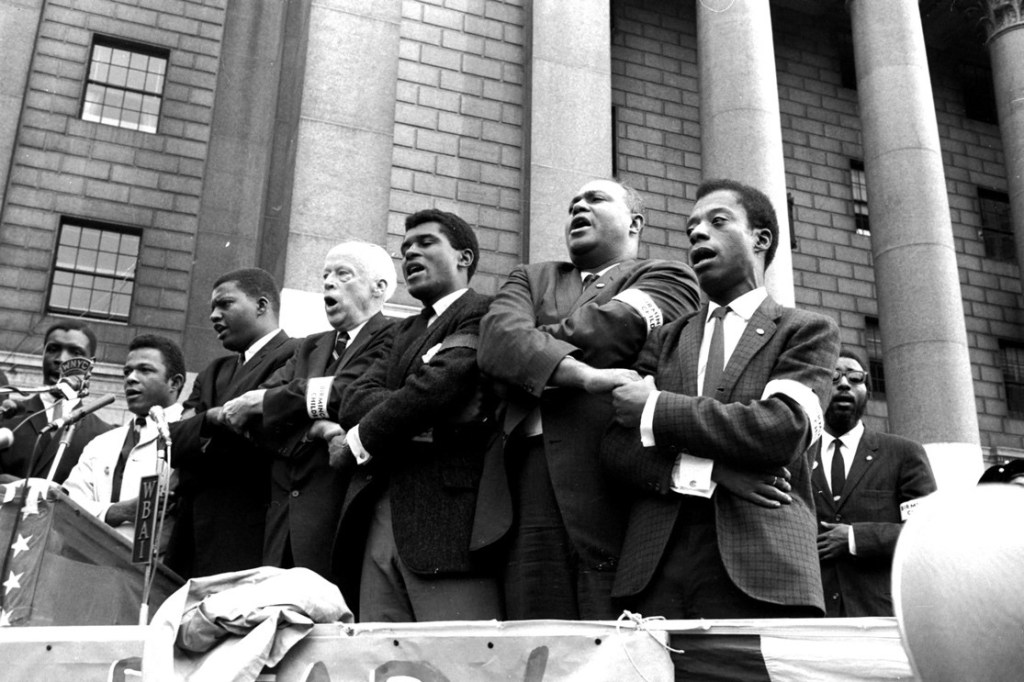
Baldwin became very active in the American Civil Rights Movement, often visiting America and becoming close friends with Martin Luther King Jr, Malcolm X, Nina Simone, among many other of its important figures. At this time, he branched out into other forms of expression, such as writing poetry and screenplays and giving speeches about his views on discrimination and freedom. While back in the United States, he worked as a college professor at the University of Massachusetts.
Baldwin died at the age of 63 of stomach cancer, in his home in Saint Paul de Vence, France, on December 1st, 1987. He left unfinished a manuscript, Remember This House, which would later inspire the critically acclaimed 2016 Raoul Peck film, I Am Not Your Negro.
Zooming into some of the themes explored in his works
As previously mentioned, one of the main themes he explored in depth in a panoply of his work was racial discrimination. He not only wrote from personal experience, but was also able to convey from an objective point of view, developing constructed arguments in his essays. For instance, in Go Tell it on the Mountain, his semi-autobiographical novel, Baldwin writes from the perspective of a young black boy, based on himself, but also about the members of his family and their lives in a profoundly prejudicial country, whereas in The Fire Next Time, the author objectively exposes the successes and failures of the Civil Rights Movement and the relations of power and race in the United States.
Furthermore, Baldwin was one of the first authors to write about homosexuality very openly. Indeed, in the 20th century, queer people were still extremely discriminated both legally and socially, having to hide in order not to suffer violent backlash. In this context, Baldwin’s novel Giovanni’s Room, published in 1956, was extremely controversial as it revolves around homosexuality and the stigma around it.
Finally, all of the themes present in Baldwin’s work come back to the notion of identity. Indeed, one of the particularities of his writing style was his ability to put inner turmoils into words. Go Tell it on the Mountain and Giovanni’s room are both illustrations of this, as they depict characters who are torn and struggling to find themselves in a world where parts of them are rejected. These deeply personal, human and raw representations of issues like racism and homophobia add depth and impact to the political dimension of his essays.
His impact in literature
James Baldwin was a trailblazer, being one of the first to openly discuss the social and political issues of the time without apprehension of backlash. His works started discussions on topics that were often considered taboo and inspired other artists to use their voice to bring forth awareness. As such, he is largely considered a pillar of African-American literature, being one of the first African American artists to have such an impact and becoming a representative for marginalized communities.
On top of this, he was a crucial actor in the Civil Rights Movement through his writing and speeches. This movement truly shook the status quo, and, without it, society would not have evolved the way it did. In his involvement with the movement, Baldwin took a pacifist standpoint on all the issues he discussed and rooted, above all, for justice, freedom and brotherhood: he took a clear stance against racial prejudice suffered by African American citizens, but also distanced himself from his friend Malcom X’s more radical ideas. Indeed, whereas the Nation of Islam was a separatist movement that deemed white people as immune to virtue, Baldwin stood for equality – “The dream, the sentiment is old (…) Only the color is new.”-, as he once wrote. Through his works, Baldwin impacted the artistic and intellectual traditions in American society and the simple but vital values he defended are still relevant in today’s society.
Conclusion
James Baldwin was one of a kind. He was not only a praised writer, with a lyrical, raw, and realistic style, but also a pioneer in African American culture and in the revolutionary Civil Rights Movement. His works had an immense impact on society at the time and represent an extremely valuable legacy.
Sources
- Go Tell It on a Mountain, Giovanni’s room and The Fire Next Time, by James Baldwin, Discourse Magazine, National Museum of African American History and Culture , USA Today

Marta Nascimento
 theawarenessnews.com