

 Written by
 Over the past two decades, digital technologies have become deeply embedded in everyday life. Smartphones, social media, and streaming services provide constant access to information, entertainment, and social interaction. While these tools offer undeniable benefits, researchers increasingly question how such continuous stimulation may influence the brain’s reward system. In particular, scientists have begun to examine how modern technologies interact with dopamine pathways, the neural circuits involved in motivation, learning, and reward processing.
Understanding this relationship is crucial, as the same biological mechanisms driving curiosity and goal-directed behavior may also make individuals vulnerable to compulsive digital habits.
The brain’s reward system
Dopamine is a neurotransmitter involved in the brain’s reward and motivation systems. Contrary to popular belief, dopamine is not simply the “pleasure chemical.” Instead, neuroscientists describe it as a signal that helps the brain anticipate rewards and learn from experiences. When individuals encounter a rewarding stimulus, dopamine activity increases, reinforcing behaviors that may lead to future rewards.
As neuroscientist Wolfram Schultz explains, dopamine neurons encode what is known as a “reward prediction error”, meaning they signal the difference between expected and actual rewards. This mechanism helps individuals learn which actions are worth repeating.
Importantly, the reward system evolved to support survival. Activities such as eating, social interaction, or exploration naturally stimulate dopamine release, reinforcing behaviors that historically increased the chances of survival and reproduction.
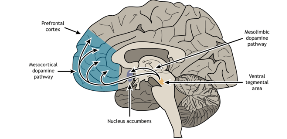
Figure 1: Simplified representation of the brain’s dopamine reward pathway, involving the ventral tegmental area, nucleus accumbens and prefrontal cortex. Source: Michigan State University.
How digital platforms capture attention
Modern digital platforms are designed to capture and maintain attention, often by leveraging the same reward mechanisms that drive learning and motivation. Social media notifications, scrolling feeds, and algorithmically curated content provide frequent opportunities for small rewards, such as receiving a message, discovering new information, or gaining social validation through likes and comments.
Behavioral scientists have noted that many digital products rely on attention-maximizing design strategies that exploit psychological vulnerabilities. On this note, technology companies often structure digital experiences to encourage repeated engagement, reinforcing habitual checking behaviors that can effectively sustain user engagement.
The power of variable rewards
One of the most powerful mechanisms involved in digital engagement is the concept of variable rewards. This principle originates from behavioral psychology, where experiments demonstrated that rewards delivered unpredictably tend to produce stronger behavioral responses than rewards delivered consistently.
According to behavioral design researcher Nir Eyal, social media platforms frequently rely on this mechanism, which resembles the dynamics observed in gambling systems. Each time users open an application, they may or may not encounter a rewarding stimulus: a message from a friend, a viral post, or new social feedback. Because the outcome is uncertain, the brain’s reward system becomes highly engaged, encouraging repeated checking behavior and a tendency to digital overconsumption, as reported by Stanford psychiatrist Anne Lembke. Over time, such repeated reward anticipation may reinforce habitual digital behaviors.
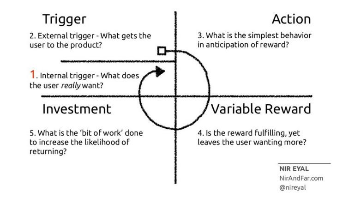
Figure 2: Representation of the variable reward cycle commonly used in digital platforms to encourage repeated engagement. Source: Nir Eyal.
Are our brains adapting to constant stimulation?
Researchers are still investigating whether constant digital stimulation may influence the sensitivity of the brain’s reward system. Some studies suggest that frequent exposure to highly stimulating digital environments could affect attention spans and reward sensitivity. Heavy smartphone and social media use has been associated with increased impulsivity, reduced sustained attention, and compulsive checking behaviors. These patterns resemble those observed in other forms of behavioral addiction, although the scientific community continues to debate the extent of the phenomenon. Psychiatrist Anna Lembke argues that modern environments provide unprecedented access to rewarding stimuli where people are subject to dopamine-overload, disrupting the balance between pleasure and pain.
However, it is important to emphasize that research in this area remains ongoing. Many scientists caution against overly simplistic interpretations of dopamine’s role, noting that human behavior results from complex interactions between biological, psychological, and social factors.
Digital habits and self-regulation
Despite concerns about excessive digital engagement, technology itself is not inherently harmful. Instead, the key challenge lies in how individuals and societies adapt to an environment rich in digital stimuli.
Researchers increasingly emphasize the importance of digital self-regulation, including strategies such as managing notifications, setting screen-time limits, or creating technology-free spaces during certain activities. These practices may help individuals regain control over their attention and reduce compulsive engagement patterns.
Understanding how digital environments interact with the brain’s reward system may therefore empower individuals to make more intentional choices about their technology use.
Conclusion
The rapid expansion of digital technologies has transformed how humans communicate, learn, and entertain themselves. At the same time, these technologies interact with deeply rooted biological systems that shape motivation and behavior.
By engaging the brain’s dopamine-based reward circuits, digital platforms can encourage repeated engagement and habit formation. While this interaction does not necessarily imply harm, it highlights the importance of understanding the psychological mechanisms underlying digital behavior.
As research in neuroscience and behavioral science continues to evolve, one question remains central: how can societies harness the benefits of digital innovation while preserving the ability to focus, reflect, and maintain healthy relationships with technology?
Sources:
- Schultz, W. (2016).
- Dopamine reward prediction error coding; Wise, R. A. (2004).
- Dopamine, learning and motivation; Alter, A. (2017).
- Irresistible: The Rise of Addictive Technology and the Business of Keeping Us Hooked; Lembke, A. (2021).
- Dopamine Nation: Finding Balance in the Age of Indulgence; Eyal, N. (2014).
- Hooked: How to Build Habit-Forming Products; Montag, C.; Diefenbach, S. (2018).
- Towards Homo Digitalis: Important research issues for psychology and the neurosciences at the dawn of the Internet of Things;

Margherita Ottavia Serafini
Writer
 theawarenessnews.com