 Written by
 We are born with a frantic, stuttering rejection of the motionless frame.
The history of the image is not merely a chronicle of what we have chosen to show, but a record of what we have refused to leave alone. To look at a blank wall or a silent screen and feel a rising, metallic tang of panic is to confront a fundamental tension: the suspicion that presence must be proven through the persistent interruption of the stillness. We do not build cathedrals, film three-hour epics, or smear oil across canvas merely to “express”; we do it because the unmarked space is a mouth, and the history of aesthetics is the history of trying to avoid being swallowed.
This is the hidden pulse beneath every shutter click and every brushstroke. It is a structural claustrophobia – a manic attempt to colonize the silence before the silence consumes the subject. From the gold-leafed ceilings of the Baroque to the light-polluted screens of the digital age, we are the architects of our own distraction, weaving a tapestry of sensory clutter to hide the fact that the medium itself is ultimately an empty container.
The Gilded Barricade: Rituals of Overload
In the 17th century, the Baroque period weaponized detail. To step into a cathedral from that era is to be assaulted by a visual fever: gold leaf, marble drapery, and angels spilling out of every cornice until the eye is bruised by the weight of stuff. This was a psychological fortress. If every square inch of the sanctuary is occupied, there is no room for the Great Silence to leak in.
We see this same behavior in the cinematic frame. When directors like Terry Gilliam or Peter Greenaway stuff the screen with rotting fruit, rusted gears, and overlapping textures, they create a visual ecosystem so dense that the viewer’s eye is denied a place to land. It is manic distraction elevated to a formal principle. If the eye never stops moving, the mind never has to settle on the terrifying possibility that the image is just a trick of light on a flat surface.
This is the art of the “Scream.” It is a violent assertion of presence. But in our era of 8K resolution and infinite CGI, we have moved beyond the Baroque into a kind of digital psychosis. We have pioneered a cinema of constant motion, a rhythmic strobe light designed to keep the consciousness from ever having to face its own reflection in the dark of the theater. We worship the resolution because we can no longer handle the reality of the grain.
The Anatomy of the Saboteur: Aesthetics of Starvation
If the need to fill is the addiction, then there is a contrary behavior in the history of the image that is far more dangerous: The Ascetic Sabotage.
There are those who look at the clutter of the world and find it dishonest. They believe that every gilded angel and every lens flare is a lie told to soothe the viewer. Their behavior is an act of “Visual Fasting.” They want to starve the eye until it is forced to see the bone. This is the root of the Dogme 95 movement – a collective of filmmakers who signed a “Vow of Chastity” to ban special effects, imported props, and directorial credits. They were attempting a cinematic exorcism, stripping away the “furniture” of the story to see what was left of the human animal when it had nowhere to hide.
Watching this work is not “peaceful”; it is an irritant. It triggers a physical restlessness. When a camera sits still for ten minutes on a woman peeling potatoes in the films of Chantal Akerman, or a painter like Agnes Martin spends years drawing near-invisible grids on massive canvases, the viewer is being asked to inhabit the stillness. This is the Metaphysical Confrontation. It reveals that the demand for “content” is actually a flight from the medium itself. The saboteur doesn’t want to give the audience a masterpiece; they want to give them the blankness, watching the spectator squirm until they find a way to inhabit the frame.
Hauntology: The Presence of Absence
There is a third state, perhaps the most unsettling of all, where the “nothing” isn’t empty, but crowded with what is missing. This is the realm of Hauntology, a concept bridging the gap between the physical space and the psychological ghost.
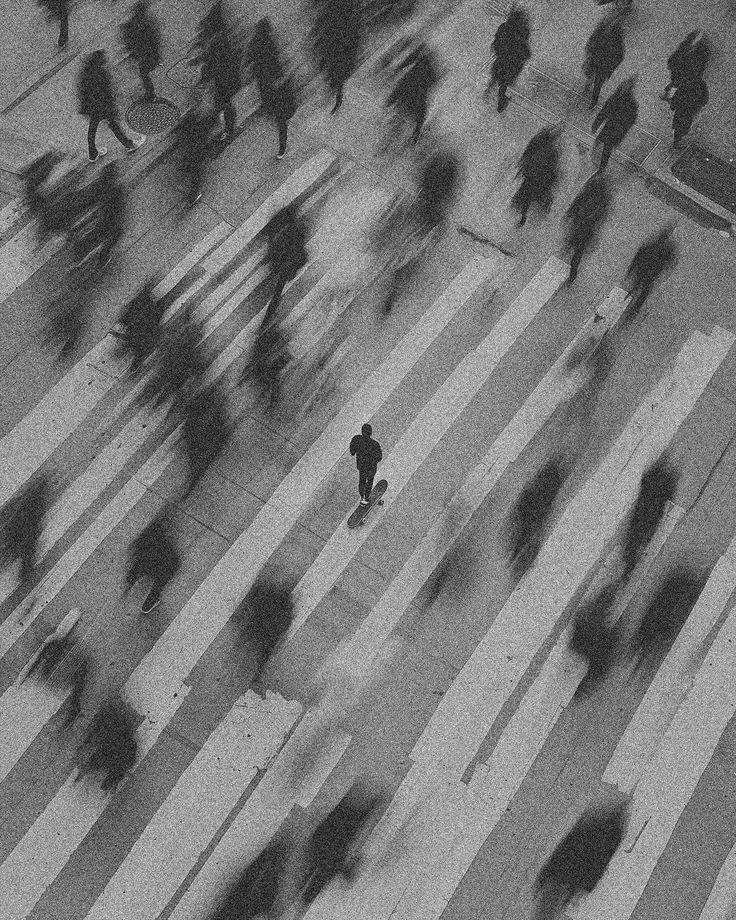
When we look at a “Liminal Space” – an empty mall at 3:00 AM, a playground in the fog, or the long-exposure photography of a city where the people have disappeared into a ghost-blur – the viewer does not see a lack of life. They see the failure of purpose. A mall is designed for a crowd; when the crowd is gone, the architecture itself becomes a scream of absence. The space is haunted by the functionality it can no longer fulfill.
In cinema, this is the wide shot where the character is rendered infinitesimal against an indifferent landscape. It is the “Empty Room” trope where the camera lingers just three seconds too long after a character has exited. Why do those seconds feel so heavy? Because the stillness is being allowed to breathe, and the realization dawns that the room was never actually “ours.”
The human brain is so allergic to the unmarked that it populates these spaces with “presences.” We invent monsters in the dark; we invent “vibes” in empty hallways. We would rather be terrified by a ghost than be bored by the silence. This proves that the mind is a pattern-seeking machine that will hallucinate a “something” just to avoid the unbearable weight of the “nothing.”
The Digital Shroud and the End of the “Real”
We must confront the modern iteration of this fear: the Infinite Scroll.
The internet is the ultimate masterpiece of the “Filled Space.” It is an expanse that can never be satisfied. Every second, hours of video are uploaded; every thumb-flick brings a new image, a new take, a new outrage. We have created a technological environment that ensures we will never, for the rest of human history, have to experience an “unmarked” moment.
But this has a profound effect on how we perceive the world. When everything is “filled,” nothing is “significant.” If the Baroque was a gilded fence built to keep the dark out, the Digital Age is a flood that has drowned the world. We see this in the rise of “Post-Internet” art – works that are intentionally over-stimulating, glitchy, and fragmented. They mirror the way our brains now function: a frantic, non-linear jumping from one piece of data to the next.
The raw truth is that we have become so accustomed to the noise that stasis now feels like a glitch. When a film dares to be slow, or a painting dares to be a single color, it is often dismissed as “pretentious.” But that label is frequently just a defense mechanism for things that make the viewer feel the silence. We have become like people who have lived in a construction site for so long that we can’t sleep unless there’s a jackhammer outside the window. We are addicted to the hum of the machine because it proves the system is still online.
Entropy and the Biological Imperative
Nature itself shares this horror. A patch of dirt, left alone, will eventually fill itself with weeds and decay. Life is a “cluttering” force; death is the ultimate “emptiness.” Perhaps the obsession with filling the frame is simply a mimicry of biological growth – an evolutionary reflex to prove that the creative act is still vital.
We see this in the “Land Art” of the 1970s, where artists like Robert Smithson moved tons of earth to create spirals in the desert. It was an attempt to impose a human “mark” on a landscape that was already perfect in its indifference. The art wasn’t just the spiral; it was the inevitable fact that the spiral would one day be washed away. This is the central paradox: we build these monuments of light and sound knowing they are sandcastles. But the act of building is the only way the creator knows how to say “I am here” to a universe that isn’t listening.
The Autopsy of the Frame
To look at the world through this lens is to perform an autopsy on human desire.
The Maximalist tries to build a heaven out of clutter, hoping one more detail will make them safe. The Ascetic tries to find truth by throwing the furniture out the window, hoping the “Nothing” will finally speak. The Hauntologist stands in the empty room and listens to the echoes, acknowledging we are just temporary tenants in a space that doesn’t know our names.
None of these behaviors are “right” or “wrong.” They are simply ways of coping with the fact that we are finite beings floating in an infinite expansion. The most raw realization is that the universe doesn’t care if we fill it. You can paint a thousand masterpieces, film a million epics, scroll through a billion images – the silence remains. It is the backdrop against which all our noise is measured.
The power of a great work – be it a Caravaggio painting where the shadows eat the figures, or a film like 2001: A Space Odyssey where the weight of space is the loudest character – is not that it “fills” the space. It’s that it frames it. It gives the silence a shape, a name, and a texture. It stops trying to hide the mouth of the abyss and lets the audience look inside.
Is the unmarked space a lack of life, or is it the only place where life has room to move? We spend our lives running from the “Nothing,” but it is the only thing that is truly ours. The noise belongs to the world, but the silence – the raw, unedited, terrifying silence- is the only place where the image stops performing and the truth begins.
Teresa Catita
Editor and Writer
 theawarenessnews.com