The Challenge of Renewables in the Energy Market 

Reading time: 8 minutes

Last month, the entire Iberian Peninsula experienced a surreal moment: a day without electricity, cut off from the rest of the world. Videos of the blackout quickly made the rounds online—many lighthearted and humorous—showing people taking to the streets, enjoying the unexpected break from technology, and drinking beers before the refrigerators got warm. 

But the event also sparked widespread speculation about its cause, which still remains uncertain. Among the many theories—though unconfirmed—one pointed to a largely overlooked issue: not the energy transition itself, but a specific and often neglected aspect of it—the non-dispatchability of renewable energy sources, and the challenges this creates for the entire energy market. 

Renewables and energy price volatility 

Renewable energy sources offer more than just an environmentally friendly alternative to fossil fuels. They also have the potential to enhance price stability in the electricity market. While fossil fuels are exposed to the volatility of international markets—often affected by geopolitical tensions, conflicts, or supply disruptions (such as the OPEC oil crises or the recent cuts in Russian gas exports)—renewables are locally produced and less susceptible to these external shocks. 

By diversifying the energy mix and reducing reliance on any single energy source, renewables help lower wholesale electricity prices, as shown by Cevik and Ninomiya (2023). But the benefits go beyond price levels: the increasing share of renewables in electricity production also reduces overall price volatility. In particular, it limits the extent to which spikes in fossil fuel prices—like those caused by sudden shortages or political tensions—can affect the broader energy market. This makes energy systems not only greener, but also more resilient and economically stable (Forrest and MacGill, 2013). 

The Role of Wind and Solar in Price Volatility 

Not all renewable energy sources are equal when it comes to price stability. It’s important to distinguish between dispatchable renewables—those whose output can be controlled, like hydroelectric power—and non-dispatchable or intermittent sources, such as wind and solar. To illustrate this, imagine a hydroelectric plant versus a wind farm. In a hydro plant, operators can regulate electricity production by controlling water flow. While it’s not completely immune to weather patterns, its output is largely predictable and controllable. 

Wind and solar energy, on the other hand, depend on weather conditions that are neither constant nor controllable. While forecasting technologies have improved, operators still cannot control when the wind blows or the sun shines. This unpredictability introduces greater volatility into the electricity market. 

Mohan et al. (2020) describe a phenomenon known as the “volatility cliff.” As the share of intermittent renewables increases, price volatility tends to rise. But beyond a certain threshold—what they call the cliff—this volatility can accelerate dramatically, leading to severe price swings and instability in electricity markets. This highlights the need to consider not just how much renewable energy we produce, but also what types and how they are integrated into the energy system. 

Figure 1 – Germsolar Thermasolar Plant in Andalusia, source Westend61 

Some Data on Spain and Portugal 

Looking at the Iberian Peninsula, Spain and Portugal form what is often referred to as an “energy island,” with relatively limited electrical interconnection to the rest of Europe. In 2024, wind and solar accounted for nearly 50% of the electricity mix in both countries, while renewables overall exceeded 60%. This is undoubtedly a significant achievement and a source of pride for the Iberian nations. However, such a high share of intermittent renewables also brings challenges. 

The first issue, as mentioned earlier, is volatility. Just two days after the well-known blackout, on April 30th, Spain’s electricity price jumped from €5.79/MWh to €31.83/MWh in a single day. Although Spanish prices have experienced sharper fluctuations in absolute terms in the past, this still represents an increase of over 450%—a reminder of the market’s sensitivity. 

The second issue is the mismatch between energy supply and demand, a challenge that is becoming more frequent with the growth of intermittent renewables. In 2024, Spain recorded 247 hours of negative electricity prices; Portugal, 196. Negative prices mean that producers are willing to pay to offload excess electricity they cannot store or use. As the share of wind and solar continues to rise, such episodes are likely to become more common. 

While this may seem like good news for consumers, in reality, it poses a serious problem for energy producers and investors. Uncertainty in revenues and the risk of selling electricity at a loss can deter investments in new renewable projects, paradoxically slowing down the green transition and the path toward decarbonization. 

Figure 2 – Energy Mix of Spain and Portugal, elaboration from Ember 

The Challenges 

These reflections lead us to consider the broader challenges that renewable energy brings to the energy sector—challenges that call for systemic reforms and improvements. 

First and foremost, as the share of renewables in the energy mix increases, it is crucial to simultaneously invest in energy storage technologies and grid-scale storage systems. These systems can help absorb excess electricity during periods of high renewable production and release it when production drops, directly addressing the problem of intermittency. However, such infrastructure is still expensive and complex to implement on a large scale. 

Second, a more integrated and interconnected European electricity grid is necessary. Enhanced cross-border interconnections would allow surplus energy from one country to be exported to another where it is needed, making the overall system more efficient, resilient, and less prone to localized imbalances. 

Third, we need to rethink and update the regulation of electricity market bidding systems. Current rules were designed for a fossil-fuel-dominated system and are increasingly unfit for a market where the marginal cost of renewable generation is often close to zero. Without reform, the current pricing mechanisms could undermine the profitability and long-term sustainability of renewable investments. 

The Delicate Balance of Decarbonization 

The challenge of decarbonization is a delicate one. A massive investment in renewable energy is not, in itself, a silver bullet—and, paradoxically, it can even become counterproductive if not accompanied by a broader reform of the entire energy system. A successful energy transition is not just about installing more solar panels or wind turbines; it’s about designing a system in which these technologies can function efficiently, sustainably, and reliably over time. 

The success of any well-intentioned initiative depends not only on its technical merits but also on its ability to remain attractive and sustainable over time. For renewable energy to remain appealing—not only to consumers but also to investors—it must offer price reductions, price stability, and long-term reliability. Maintaining this attractiveness requires thoughtful policy design, targeted incentives, and a regulatory framework that keeps pace with technological evolution and market dynamics. 


Sources: Aurora Energy Research, El Economista, Ember, Financial Times, …

Veronica Guerra 

Editor and Writer

The climate-conflict nexus: Why armed conflict should serve as a wake-up call for global energy-security concerns in a rapidly changing climate

Reading time: 7 minutes

A few days after the Russian invasion of Ukraine, the Intergovernmental Panel on Climate Change (IPCC)  released what has been deemed as “the bleakest warning yet”, in relation to the current state of our planet (Guardian 2022). We have often learnt that the wars of the 20th century were the product of mad autocrats, dangerous ideologies, or the long-term effects of the failed colonial experiment. The past few weeks have confirmed that the 21st century, despite all its modernization and westernization of societies, and even with the unimaginable danger of nuclear weapons as a supposed deterrent, has yet to see an end to armed conflict. The new wars of the 21st century, whether economic or military, have increasingly positioned natural resources, such as coal, gas or oil, as well as access to them, at the centre of the conflict. In the face of a rapidly changing climate, it is crucial that we begin to assess energy-security concerns within a broader climate-conflict nexus.

First, let us briefly outline two broad environmental economic approaches in relation to the discussion of the climate-conflict nexus here. The neo-Malthusian interpretation would suggest that from a position of environmental determinism, natural resource related conflicts are the inevitable result of population growth, resulting in an increased strain on domestic security concerns (Kahl 2018). Such an interpretation must, nonetheless, be contested by a more critical neo-classical approach, in which it is not just the scarcity, but the actual abundance of certain natural resources that precede the outbreak of conflict (Koren 2018). In this instance, distinct attention must be paid to local political structures that continue to inform decision making behind the management of such resources. 

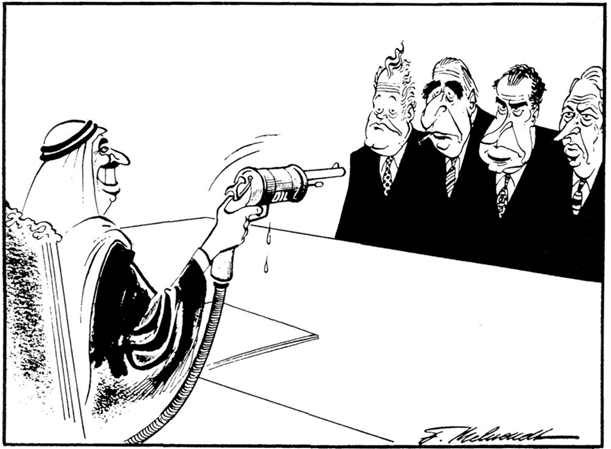
Figure 1: Western leaders blackmailed by OPEC during 1973 oil crisis” 1973 Cartoon by Behrendt on the oil crisis 
Source: CVCE

Policymaking in the west must face up to the increasingly alarming parallels between energy-security, associated with the access to natural resources for consumption (IEA 2022), and the risk of armed conflict. According to the United Nations Environment Programme, UNEP, around 40% of all interstate conflicts, over the last 60 years, have been related to natural resources, and the risk of conflict is doubled in the first five years (UNEP 2013). In the western world, energy-security concerns are generally manifested within the economic realm of sanctions or embargoes. However, in much of the developing global south, the harsh reality is that inter-communal and inter-state competition over resources has taken place in the form of violent conflict (UNEP 2013). To reduce the risk of emerging energy-security concerns becoming conflict threats, the west must transition towards more sustainable and alternative renewable energy systems in the medium and long-term, alongside diversifying more immediate short term energy requirements (Forbes 2022). History has taught us that major global energy transitions have often emerged from conflicts, such as the 1973-74 OPEC oil embargo. The latter resulted in new legislation for more efficiently run trucks and cars, a large reduction in oil as fuel in the electricity power sector, and new research into oil and natural gas alternatives (Forbes 2022). 

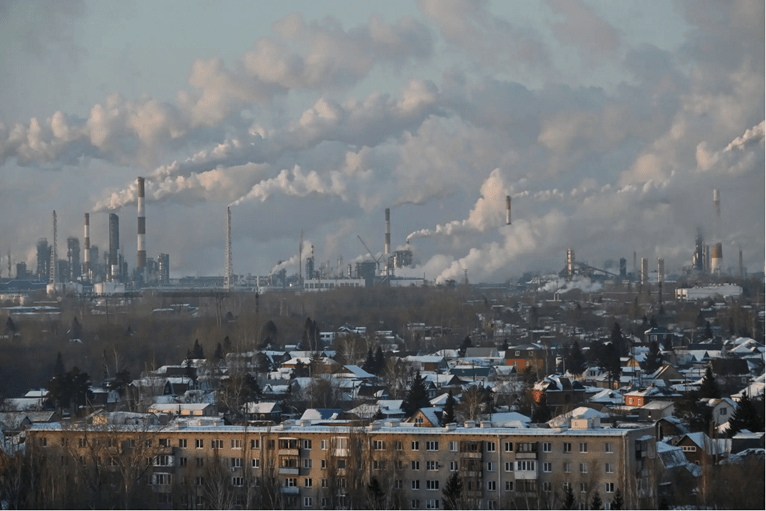
Figure 2: An oil refinery behind residential buildings in Omsk, Russia
Source: Alexey Malgavko, Reuters

Global energy-security concerns are of crucial significance in the context of global climate change, and the war in Ukraine should serve as a wake-up call for a more accelerated transition towards green energy, and departure from a dependence on fossil fuels. The current conflict has highlighted how fossil fuels can be used as both political and economic weapons of war, as demonstrated by the fact that Europe relies on Russia for 40% of its natural gas supply, or even America´s reliance on globally stable oil markets (Forbes 2022). Svitlana Krakovska, Ukraine´s lead climate scientist, who alongside her team was forced to exit the final review process of the aforementioned IPCC report, and instead head to a bomb shelter, believes the war is “a fossil fuel war” (Guardian 2022; Politico 2019). However, former energy advisor to Obama´s administration, Jonathon Elkind, has argued that “It´s a crude oversimplification to call this a fossil fuel war” (Guardian 2022), whilst still recognizing the significance of global oil and gas resources in the outbreak of the war. 

Though the conflict in Ukraine may not explicitly be a conflict over resources, the control over natural resources is increasingly at the forefront of contemporary geopolitical struggles, and climate change is serving as the invisible catalyst.

As argued by environmental correspondent Fiona Harvey, “Kremlin strategists are therefore keenly aware that in the longer term the global move to net zero threatens the whole basis of Russia’s economy and global influence.” (Guardian 2022). Climate change is forcing an extensive global change in energy systems. Russia, as a major global energy player, will surely be concerned about influencing such transitions, when considering that 40% of its federal budget is from oil and gas, comprising 60% of exports (Carnegie Europe 2022; DW 2022). 

Whilst armed conflict over resources seems to be a growing threat in the west, in many regions of the global south, it has long been a growing reality, especially in the regions that are the most vulnerable to the impacts of climate change. In 2007, Ban Ki-Moon, then UN Secretary-General, referred to the Darfur crisis and ongoing drought in Sudan as an ecological crisis and the “first climate change conflict” (Ki-Moon 2007). Such discourses often represent the relationship between climate change and conflict as one of direct causality. Contrary to a neo-Malthusian approach building on Homer-Dixon´s emphasis on environmental scarcity (Homer-Dixon 2010), it is not so much rainfall quantity but rather its unpredictability and uncertainty that has led to conflict in the region (Biasutti 2019). The same has occurred across the broader Sahelian Acacia Savanna, from Darfur to the Mopti River delta in Mali, where the early arrival of ethno-Arabic pastoralist herders on the land of ethno-African agriculturalist farmers, has resulted in violent conflict over recent years (Hiernaux, et al 2009). 

Reinforcing a neo-classical approach, the conflict also serves to remind us that, on a political level, weakened traditional political structures have also resulted in increased inter-communal conflict. In this instance, Dogon farmers have often found themselves backed by state policies through international funding, whilst Fulani herding communities have been left neglected, which in turn has resulted in heavy recruitment from emerging Islamist groups such as the Al Qaeda affiliated Macina Liberation Front MLF (Benjaminsen 2019; Raineri 2020).

Figure 3: A herder guarding his cattle
Source: African Center for Strategic Studies 2021

Long-standing cultural and political struggles may well be the most significant factors in the emergence of conflict in the Mopti river delta. Climate change, nonetheless, is indirectly accelerating the dynamics of these tense interactions through providing an added, and increasingly damaging pressure on the local farmer-herder environment and their resources. As with its growing influence on changing global energy-security struggles, relating to the conflict in Ukraine, climate change must be understood as an indirect, yet an incredibly significant player in the emergence of conflict in the Mopti region. Late last year the infamous Russian paramilitary organization, Wagner, entered Mali´s Mopti region, with the support of Russian armed forces (CSIS 2022). The provision of mineral and financial concessions in exchange for PMC (private military company) protection for a coup-proof regime is the exchange (CSIS 2022). The link between Russian PMC´s and access to rich natural resources is further evidenced by both the reported presence of Wagner associated geologists in the region, and PMC protection for Russian companies involved in mining activities in the region (CSIS 2022; Aljazeera 2021). 

If Russia´s invasion of Ukraine was a mean to further protect its energy-security concerns, through hoarding mineral and agricultural resources from Ukraine´s vast depository, this certainly resembles an already existing and more global trend. Russia should certainly not be singled out here. The United States, in particular, has long been waging warfare, both directly, and through proxy states, in asserting its own global energy dominance. Energy-security concerns have never been far from armed conflict, and climate change is increasingly narrowing the proximity of that relationship. 


Sources:

  • The Guardian, Carnegie Europe, DW, IEA, Politico, UNEP, Forbes, Aljazeera, CSIS, Africa Center, CVCE
  • Homer-Dixon, Thomas F. Environment, scarcity, and violence. Princeton University Press, 2010.
  • Biasutti, Michela. “Rainfall trends in the African Sahel: Characteristics, processes, and
  • causes.” Wiley Interdisciplinary Reviews: Climate Change 10.4 (2019).
  • Benjaminsen, Tor A., and Boubacar Ba. “Why do pastoralists in Mali join jihadist groups? A
  • political ecological explanation.” The Journal of Peasant Studies 46.1 (2019): 1-20.
  • Hiernaux, Pierre, et al. “Woody plant population dynamics in response to climate changes from
  • 1984 to 2006 in Sahel (Gourma, Mali).” Journal of Hydrology 375.1-2 (2009): 103-113.
  • Raineri, Luca. “Sahel Climate Conflicts? When (fighting) climate change fuels terrorism”
  • European Union Institute for Security Studies, December 2020.

Francis Braddell-Dawson