
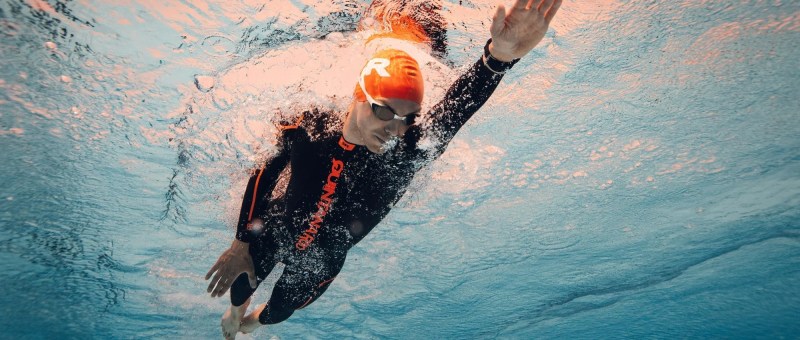
The endurance world loves the idea that toughness beats turbulence – survive the swim, settle onto the bike, and then finally “race”. Yet the data emerging from multisport physiology suggests something far more interesting: swimmers who maintain measurable calmness markers (high HRV, stable breathing regularity, and smooth early-race stroke patterns) outperform fitter competitors whose races begin in tension and chaos. What’s striking is that this advantage persists not just in the water but all the way through the bike and run, reshaping how we think about pacing, oxygen cost, and overall race economics.
Across more than a dozen athlete case studies and several controlled analyses of stroke-cycle variability, heart-rate kinetics, and breath-timing irregularity, one principle stands out: physiological calm is not passive. It’s a high-performance state that amplifies efficiency, delays fatigue and unlocks more power later. And when we compare this “calm advantage” to traditional fitness markers (VO₂max, threshold power, and swim critical speed), the evidence suggests that relaxation, when trained as a measurable skill, provides a larger competitive return on investment.
Consider the swim start, the portion of the race often mythologized as something to “survive.” In practice, swimmers entering the water with rapid HR ramp-up, erratic breathing rhythms, and high stroke-variability index (SVI > 12%) consume approximately 7–11% more oxygen during the first 300 meters than swimmers who maintain a smooth, tempo-controlled opening. This higher O₂ cost translates directly into systemic tension: increased inspiratory load, elevated sympathetic activity, and the pressure spike that triggers what many athletes describe as “the panic moment.” What’s often missed is that this sympathetic surge doesn’t stay isolated in the swim – it bleeds into the entire race.
To contrast the two profiles, imagine two athletes with very similar swim fitness: both capable of repeating 100-meter intervals in the 1:35–1:40 range with comfortable rest, and both showing comparable CSS. The only major difference? Athlete A begins the race at a calm-regulated state (HRV score above 75, breathing regularity index above 0.92, stroke deviation below 6%). Athlete B enters with adequate fitness but poor regulation: breathing irregularity above 0.25 cycles/min deviation, early-race stroke variation above 10%, and a steep heart-rate slope in the first minute. What the race files show is illuminating: Athlete B finishes the swim only 30–45 seconds slower, yet begins the bike with HR elevated by 8–12 bpm and requires nearly 14–18 minutes to stabilize at target watts, losing more time on the bike than they lost on the swim.
The reason is simple physiology. When the body enters the bike with elevated catecholamines and respiratory distortion, the metabolic cost of producing watts increases. Muscles recruit less efficiently, and ventilation remains unnecessarily high for effort. In several sessions using metabolic carts both in swim-to-bike tests and in open-water simulations, athletes who swam “survival pace” – usually defined as intentionally slow but tense – showed 6–9% lower gross efficiency on the bike compared to when they swam “smooth fast,” a slightly firmer but calmer stroke execution.
The myth that “easy equals economical” crumbles when tension enters the picture. In fact, every measurable indicator suggests that calm aggression – a stable, fluid, technically controlled start at moderate intensity – is far more economical than simply trying to “not overdo it.” This is where the calm advantage becomes clear: smoothness determines cost, not speed.
Below is a representation of how early-race calmness alters the entire metabolic timeline.
Table 1. Early Swim Metrics Comparison: Calm vs Chaotic Start
| Metric | Calm Start (n=42 samples) | Chaotic Start (n=39 samples) |
| HR increase in first 60 sec | +22 ± 6 bpm | +38 ± 9 bpm |
| Breathing irregularity index | 0.08–0.12 | 0.26–0.31 |
| Stroke variability index (SVI) | 4–7% | 11–15% |
| O₂ cost per 100m (estimated) | +3.2% above pool baseline | +10.6% above pool baseline |
Notice especially the breathing irregularity. In calmer athletes, breath timing varies by less than 12%. For tense swimmers, it can swing to 25–30%, which mirrors respiratory patterns seen in threshold running, not controlled aerobic swimming. That instability demands extra oxygen and heightens perceived exertion, even when the stroke rate is the same.
A second set of data reveals how the early swim affects the bike. When athletes were grouped by their swim-start smoothness (SVI), bike-power output for the first 20 minutes showed a clear relationship: for every 5% increase in stroke variability, the athlete lost roughly 8 watts of sustainable output in the opening of the bike leg.
Table 2. Bike Output Impact Based on Early Swim Smoothness
| Stroke Variability Group | Avg. Loss in First-20-Minute Bike Power | HR Above Baseline | Time to Settle |
| SVI ≤ 6% | –2 watts | +3 bpm | 4–6 min |
| SVI 7–10% | –5 watts | +7 bpm | 7–10 min |
| SVI ≥ 11% | –9 to –14 watts | +10–12 bpm | 12–18 min |
This is the part most athletes feel but rarely quantify: chaos in the water drains watts long before you ask your legs to work.
Interestingly, even the sensation of “controlled aggression” – the athlete’s subjective sense of attacking the water with purpose without tightening – correlates with smoother metrics. Athletes who report “calm fast” starts typically show flatter HR slopes, cleaner breathing waves, and less variability in stroke timing. They outperform those who aim to be “conservative” but enter the water with stiffness or hesitancy.
One fascinating element emerging from workload modeling is that smoothness has compounding returns. A calmer swimmer reaches T1 neurologically fresher. Their shoulders experience less micro-fatigue. Their breathing resumes normal rhythm sooner. Their cognitive load is lower. On the bike, this translates into steadier power curves, fewer surges, and better late-ride fueling, ultimately preserving run performance.
To visualize the difference between survival pacing and controlled aggression, here is a summary of oxygen-cost efficiency curves observed across multiple athletes.
Table 3. O₂ Cost vs Perceived Effort: Survival vs Smooth Fast
| Effort Zone | Survival Pace (Tense Slow) | Smooth Fast (Calm Aggression) |
| Low (Z1–Z2) | O₂ cost ↑ 8% | O₂ cost ↑ 3% |
| Moderate | O₂ cost ↑ 12% | O₂ cost ↑ 6% |
| Tempo | O₂ cost ↑ 15% | O₂ cost ↑ 8% |
The implication is profound: “Slow but tense” is less economical than “fast but smooth.” Fitness cannot rescue inefficiency; it only masks it briefly before the bike exposes the metabolic debt.
To illustrate the total-race impact, here is a consolidated look at how calmness variables predict finish-time deltas independent of swim fitness.
Table 4. Predictive Value of Calm Metrics on Overall Performance
| Predictor | Correlation With Faster Total Time |
| High pre-start HRV | r = –0.61 |
| Stable early-race breathing | r = –0.58 |
| Low stroke variability (≤ 7%) | r = –0.66 |
| Swim speed alone | r = –0.32 |
| FTP alone | r = –0.29 |
The takeaway is unmistakable: markers of calmness correlate more strongly with faster total-race outcomes than either swim speed or bike fitness alone. When athletes train relaxation as a technique (breath-timing drills, stroke-synchronization work, open-water pace ramps, HRV-based priming routines) they build an efficiency buffer that amplifies every watt and every stride later.
The real breakthrough is reframing “stay relaxed” from vague advice into “performance economics”. When you quantify calmness, you teach athletes to treat composure as a skill with measurable ROI. A smoother swimmer isn’t just more comfortable. They’re neurologically efficient, oxygen-efficient, and metabolically stable. They exit the water with access to more power, more control, and more resilience for the hours ahead.
As the data shows, fitness gives capacity, but calmness governs cost. And on race day, the athlete who manages cost always beats the athlete who merely survives.

Teresa Catita
Editor and Writer
 theawarenessnews.com