

We often hear that we cannot control what happens around us, but we can control how we react to it. This idea is one of the foundations of modern Cognitive-Behavioral Therapy (CBT), developed in the 1960s by psychiatrist Aaron Beck. By addressing both thinking and behavioral patterns, CBT has as its final aim to help patients become their own therapists. Supported by extensive scientific evidence, CBT has been shown to improve quality of life and functioning. The treatment analyzes the relationship between emotion, behavior, and cognition, with an emphasis on automatic thoughts, cognitive distortions, and underlying beliefs. From many points of view, CBT was strongly influenced by Stoic philosophy.
Origins And Core Ideas Of Stoicism
Stoic philosophy, whose school was founded in Athens around 300 BCE by Zeno of Citium, takes its name from the painted porch (stoa poikilê) of the Athenian Agora. It became prominent in the Roman period with philosophers such as Seneca, Epictetus, and Hierocles. In the Imperial era, Stoicism was associated with several prominent public figures: Seneca served as an advisor to Emperor Nero, and Marcus Aurelius was himself Roman Emperor from 161 to 180 CE.
Stoic philosophy was conceived as comprising three interconnected parts: physics (phusikê), logic (logikê), and ethics (êthikê). The central claims of Stoicism are: (a) virtue, identified with rationality and with a combination of wisdom, self-control, justice, and courage, is both a necessary and sufficient condition for happiness; (b) all human beings are able to develop virtue and happiness; (c) the emotions and desires of adult human beings depend directly on their rational beliefs.
The third claim is the most relevant to psychology. For the Stoics, external events such as illness, loss, or criticism are not in themselves good or evil. Negative emotions do not derive from the external environment, but from our own irrational assumptions about it: each passion can be described as an opinion or judgment, an assent given to an impression that something is good or bad when it is not. Epictetus summarized this principle in the Enchiridion: “Men are disturbed, not by things, but by the principles and notions which they form concerning things” (5). If emotions follow from judgments, then examining and correcting those judgments becomes a way of changing the emotions themselves.
From Epictetus to Beck: The Road to CBT
Stoicism emphasized the therapeutic role of philosophy. In the words of Epictetus, “It is more necessary for the soul to be cured than the body, for it is better to die than to live badly” (Fragments, 32). According to Robertson and Codd (2019), however, its therapeutic concepts were largely neglected until the beginning of the 20th century, when a rational approach to psychotherapy began to emerge, and were then temporarily eclipsed by Freudian psychoanalysis. They regained popularity from the 1950s, when they influenced the work of Albert Ellis on Rational Emotive Behavior Therapy (REBT). Ellis, who had read Epictetus, Seneca, and Marcus Aurelius in his youth, held that emotional disturbances are caused by our irrational beliefs about external events and not directly by the events themselves. Through Ellis’s writings, Beck was also influenced by the Stoic doctrine, and in 1976 he acknowledged that the philosophical underpinnings of cognitive therapy go back to the Stoics. CBT focuses on identifying and restructuring automatic thoughts and underlying beliefs, thus mirrors the Stoic idea that emotions can be changed by examining the judgments behind them.
Stoic Week: Putting Stoicism to the Test
Stoic Week, organized by Modern Stoicism and launched at the University of Exeter, is an international online and live project to test and practice Stoic exercises in order to measure their potential therapeutic effectiveness. Participants follow a daily program of exercises for seven days and complete well-being questionnaires before and after the week. Among those who completed the 2014 edition, average changes were as shown in Table 1.
| Satisfaction with Life | Flourishing | Positive emotions | Negative emotions | |
| Average Change | +16% | +10% | +11% | -16% |
Improvements of a similar magnitude were reported in the 2015, 2016, and 2017 editions, and the 2025 edition again reported gains across all major well-being measures. The element of Stoicism most associated with flourishing in the 2014 data was Stoic mindfulness, that is, continual attention to the nature of one’s own judgments and actions, a practice comparable to the monitoring of automatic thoughts in CBT.
What The Evidence Can (And Cannot) Tell Us
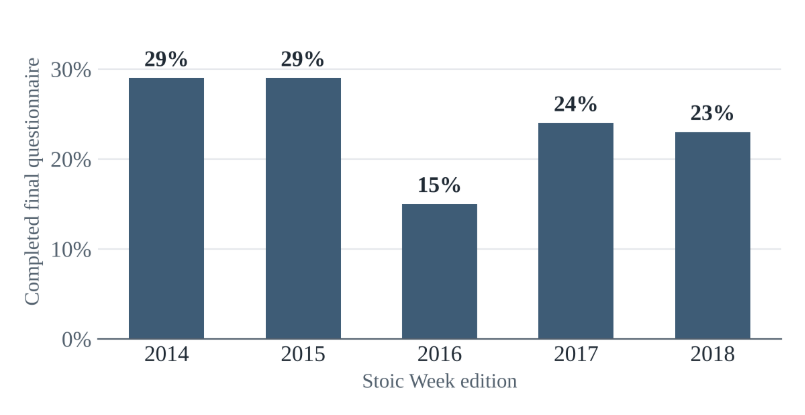
These results should be interpreted with caution. First, the data are self-reported and were collected without a control group, so the changes cannot be attributed with certainty to Stoic practice rather than to other factors. Second, participants are self-selected volunteers. Third, attrition is high: between 2014 and 2018 only 15% to 29% of those who began the program completed the final questionnaire (Figure 1), so improvements are measured only among those who persevered. The organizers themselves speak of “cautious confidence” regarding a causal link between Stoic attitudes and well-being, and acknowledge that further research is required (LeBon, 2014).
More rigorous evidence is beginning to emerge. In a randomized study of 45 high worriers allocated to three training groups, one of them an active control group, MacLellan and Derakshan (2021) found significant effects of Stoic training on rumination and self-efficacy, although the small sample calls for replication. Moreover, Robertson and Codd (2019) note that Stoicism is a philosophy of life rather than a therapy, and that some clients may not share its core values.
Conclusion
Stoicism and CBT share a central premise: emotional distress depends less on events themselves than on the judgments we form about them. Historical accounts trace this idea from Epictetus and Marcus Aurelius to Ellis and Beck, and from them to modern cognitive therapy. Initiatives such as Stoic Week associate Stoic practice with higher self-reported well-being, in particular with fewer negative emotions, and early randomized evidence points in the same direction. However, the available data rely largely on self-reports, lack control groups, and suffer from high dropout, while controlled studies remain small. Stoicism can therefore be regarded as a promising philosophy of life whose therapeutic value still needs to be tested in larger controlled trials, rather than as a proven alternative to evidence-based treatments such as CBT.
Sources: American Psychological Association, APA Division 12 (Society of Clinical Psychology). (2017). What is cognitive behavioral therapy? American Psychological Association; Sellars, J. (2023). Stoicism. The Stanford Encyclopedia of Philosophy; Corliss, J. (2024, June 5). What is cognitive behavioral therapy? Harvard Health Publishing; Chand, S. P., Kuckel, D. P., & Huecker, M. R. (2023). Cognitive behavior therapy. StatPearls Publishing; Robertson, D. J., & Codd, T. (2019). Stoic philosophy as a cognitive-behavioral therapy. The Behavior Therapist, 42(2); Epictetus. The Enchiridion (E. Carter, Trans.). The Internet Classics Archive, MIT; LeBon, T. (2014). Report on Exeter University “Stoic Week” 2014. University of Exeter; LeBon, T. (2017). Stoic Week 2017 report, part 3: The impact of Stoic Week and SMRT. Modern Stoicism; LeBon, T. (2018). Stoic Week 2018 report, part 3: Impact on well-being. Modern Stoicism; LeBon, T. (2025). Stoic Week 2025 report: Well-being, vitality, happiness. Stoicism Today; MacLellan, A., & Derakshan, N. (2021). The effects of Stoic training and adaptive working memory training on emotional vulnerability in high worriers. Cognitive Therapy and Research, 45, 730–744.

Margherita Ottavia Serafini

