Over the years, new inventions have usually impacted the world economy as well as the business environment, contributing to the so-called creative destruction. At this day and age, a new technology is about to revolutionize the way we interact with the digital world: it is the new generation of cellular network, also known as 5G. While it is true that this disruption has raised controversies regarding health issues, privacy and external political interference, the expected economic returns from the availability of mobile high-speed and low-latency connections are highly relevant, and should therefore be considered and assessed.
One of the most important and relevant impacts of this new technology is the increase in productivity derived from cost reductions or efficiency improvements, which are predicted to occur in virtually all economic sectors. For example, in industries that are directly linked with vehicles or machines of any kind that require human intervention, the possibility for remote control and monitoring of these assets allows for operational tasks to be performed by someone who is far away, thus reducing time spent and transportation costs.
Even in public administration benefits are expected, with high-speed connections allowing for faster responses of emergency services. Another case is the healthcare industry, in which the possibility for remote procedures, more effective monitoring of medical equipment and collection of data from wearable devices will reduce reduce costs and improve the quality of healthcare provided. Accordingly, this contributes to a healthier and more productive workforce, thus generating multiplying effects on the rest of the economy.
Overall, this expected increase in productivity reveals extreme importance, since it will enable a higher economic growth in the long-run.
Another positive impact foreseen from 5G is the ability to unlock the full potential of the Internet of Things. With the explosive growth in the number of connected devices and gadgets, existing networks are struggling to keep pace. Therefore, 5G’s high capacity is expected to allow seamless connections, with this product connectivity allowing firms to create and launch completely new business models, thus driving entrepreneurship and growth.
Furthermore, in remote regions where the installment of wired infrastructure is not economically viable due to low population density, 5G emerges as an alternative to offer these areas more reliable and higher quality internet connections than they currently have. This allows for the settling of businesses and job creation, with all the benefits associated with it. However, urban areas are predicted to be the first ones to receive the technology, meaning that this may only occur further in time.
At such a premature stage, forecasting the economic impacts of this novelty is a quite complex task. However, all in all, 5G is expected to bring a push to economic growth and prosperity for the countries that pursue the disruption, leaving behind, in relative terms, the nations that forego the opportunity. Therefore, this may be a major source of inequality between the richer countries, which are able to implement the technology, and the poorer nations that still have to employ a significant share of their scarce resources in satisfying more crucial and basic needs, and so contributing even more for the digital divide.
More than a mythological creature, a unicorn has gained a new application in this century – to designate privately-held startups with a value of over $1 billion. The majority of these companies are in the vanguard of their industry, building the path for a generation of new technologies, while being considered as a bellwether of future economic development. This unique expression was created by Aileen Lee, founder of venture capital fund CowboyVC, in her article “Welcome to the Unicorn Club”, where she proceeded to study software startups founded between 2003-2010, coming to the conclusion that only a mere 0.07% of these privately-held companies would ever reach the billion-dollar valuation, realizing that finding a firm with such characteristics was as difficult as finding a mythical unicorn.
Looking back at the first decade of this century, which was analyzed in the article that created the “unicorn” concept, billion-dollar startups were generated at a rate of four per year, which amounted to 39 unicorns in total. Furthermore, San Francisco was identified as the headquarters to the vast majority of unicorns (15), followed by New York (3) and, tied in third place, Seattle and Austin (2). Lastly, the most fertile industries for unicorns were e-commerce, consumer audience, software-as-a-service (SaaS) and enterprise software.
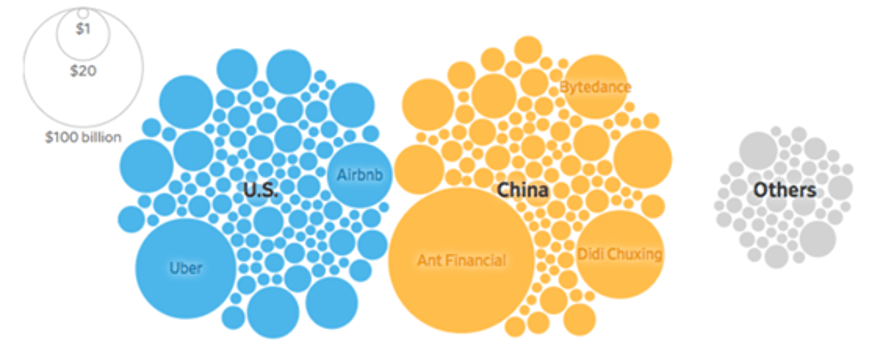
In only nine years, this landscape has changed immensely and China is to be held accountable. In 2018, a study conducted by Hurun revealed that Chinese unicorns were being conceived at a rate of one every 3.8 days, with the country owning up to 41.7% of the world’s unicorns, with a sum of 206, shortly followed by the USA, with 203 unicorns. The top three ecosystems were Beijing (82), San Francisco (55) and Shanghai (47), and the aggregated value of unicorns in the world sums up to a staggering $1.7 trillion. Lastly, the industries containing the largest percentage of unicorns are e-commerce, fintech, cloud and AI.
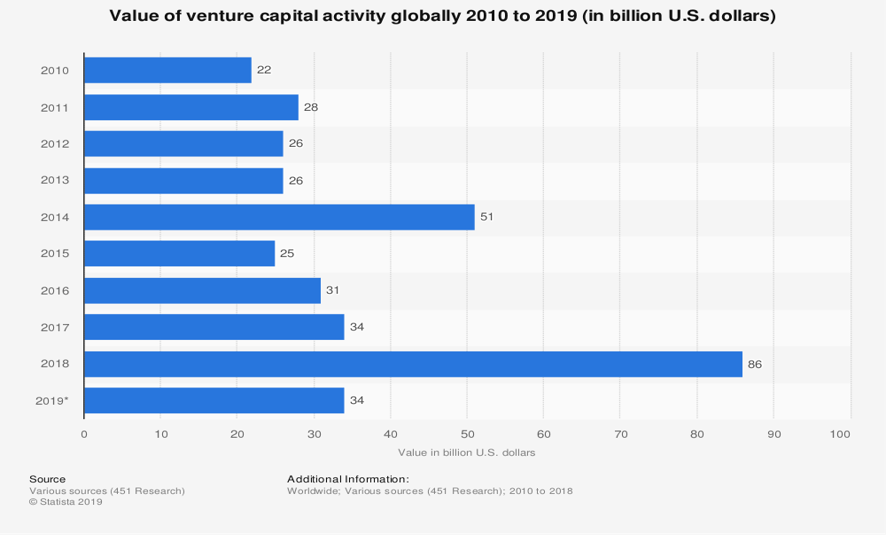
Aileen Lee mentioned disruptive technology as a conductor for the creation of unicorns. This inference still holds, as we evolve into a technology-dependant society that requires the expansion and automatization of various fields ranging from health to blockchain, which creates a need for constant technological breakthroughs and, consequently, fertilizes soil for innovative startups to blossom. Moreover, capital injection into these initiatives has been subject to exponential growth across the years through venture capital, that enables startups to raise private equity and ensure long-term growth, while allowing investors to potentially earn disproportionately high returns.
Why China?
As seen, the unicorn phenomenon was most prominent in the US but, recently, China has turned into the leading country. The fast economic growth and rapid modernization of the economy play a major role in the development of newly-founded companies.
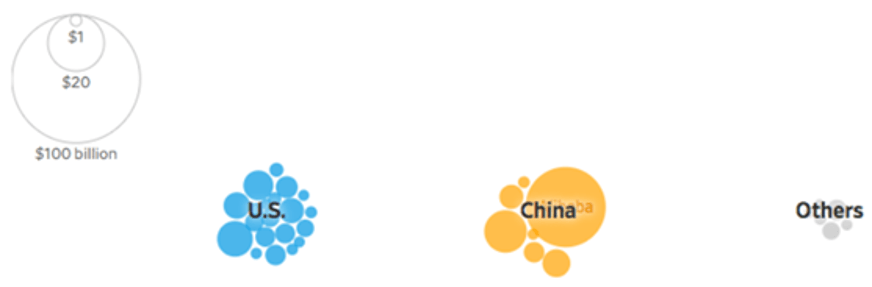
Privately held companies valued at $1 billion or more – 2012
Privately held companies valued at $1 billion or more – 2018
Source: Wall Street Journal
This massive growth was only made possible by the increased pace of technological innovation, as mastering the use of technology turned into the biggest source of competitive advantage for startups. In the particular case of China, around 40% of the unicorns are technology-driven, and the majority of them consider big data technology to be the biggest source of innovation and differentiation. Big data is especially relevant, as it allows tracking consumer habits and studying behaviors, thus improving overall marketing strategies adopted by the companies. This contributes to higher competitiveness and lower operating costs.
China’s capital market performance is also essential for the promotion of unicorns. The country’s capital usually arises from two forces – government policy and extremely diversified sources of financing channels. China, in particular, is living in a golden era of opportunities for startups who are looking for investors, as the CSRC (China Securities Regulatory Commission) is currently smoothing regulations for investment, hence attracting more unicorns based overseas to pursue their interests in the Chinese market. Apart from the Chinese government, the main global unicorn investors include the likes of Alibaba, Tencent and the venture-capital giant Sequoia, which has invested in 92 unicorns.
Some argue that the valuation of the Chinese unicorns might be inflated compared to the US, but the growth in investment in those firms has largely surpassed the values registered in American startups, which can be explained by the difference between the capital markets of both countries. The Chinese government ended up injecting a big dose of “Patriotism” in their market, directing resources specifically to make their firms more competitive, while the US opted for a more passive approach in terms of access to credit. Furthermore, the American system is more regulatory compared to the Chinese market, which facilitates investments in the oriental market when compared to the occidental one.
The following companies have not only been dominating the Chinese but also on a global scale, having conquered the title of China’s (and the world’s) most valuable unicorns, with a combined value close to 280 billion dollars (around 16% of all unicorns combined):
● Ant Financial: This fintech company, founded just 5 years ago, is currently the highest valued unicorn in the world, with a valuation of $150 billion. The startup was spun out by the Alibaba Group, it has as subsidiaries the world’s largest online payment platform (Alipay) and the largest money-market fund (Yu’e Bao). The company views itself as “dedicated to bringing to the world equal opportunities”, while being able to answer the financial needs of society, through the use and development of innovative technologies.
● Bytedance: Created in 2012 by Zhang Yiming, the internet technology enterprise gained importance through the development of AI platforms that informed and enhanced interactions between people all around the globe. Combined, all the apps and platforms of Bytedance have about 1.5 billion monthly active users (more than Instagram) as of July. Providing trustworthy information was what Zhang’s team had in mind when they created their most successful project “Toutiao”, which not only works as a news platform but, due to the complex algorithms used, is also able to provide a tailored feed to each individual user.
● Didi Chuxing: Finishing the top 3, the ride-sharing company serves approximately 550 million users in over 400 cities. The 7-year-old enterprise triumphed from the moment it was launched, reaching 55% of the smartphone-based taxi-hailing market only 1 year after its creation. The founder Cheng Wei did not settle for the Chinese market, having invested in Uber and Lyft, while expanding to Japan, Brazil, and Australia. Didi was also included twice in Fortune’s “Change the World” list.
The downturn
Despite having experienced rapid growth in the number of unicorns, China’s ability to incubate billion-dollar startups has plummeted in the first semester of this year. In the first six months of 2019, only 36 unicorns were fostered in China, corresponding to a 30% drop when compared to the same period in 2018.
The development of the Chinese tech industry has put the country in the crossfire of the trade war, with the Trump administration accusing China of intellectual property theft. In May 2019, the US blocked Huawei Technologies Co. from importing American materials, and is considering doing the same for a wide variety of startups. The trade war has affected valuable startups such as smartphone-maker Xiaomi Corp. and delivery company Meituan Dianping, who saw their stocks plunge after going public, which reinforced to investors that private-market valuations are disproportionate to their real value.
The deceleration of economic growth has resulted in uncertainty in the funding market, drying up venture capital. The second quarter of this year was marked by a 77% tumble in investments in China, which translates to $9.4 billion, contrasted with the $41.3 billion investment in the second quarter of 2018, a peak for the China venture deals. Meanwhile, venture deals in the US rose about 15% and investment in Europe climbed 32%, according to Preqin.
Source: Preqin (via Bloomberg)
The truth is that China had entered in a tech bubble, with the median tech enterprise valuation corresponding to about 31 times its EBITDA. Years of steep growth in tech investments resulted in enormous profits. Now, concerns regarding pre-IPO valuation recall the ones of the dotcom bubble. In 2017 and 2018, around 62% of venture-backed Chinese internet and software companies that filed for a public offer lost more than 30% of their values within the first 12 months after their listing.
However, valuations have not yet declined in China. The country’s startups have been resistant to down rounds (when a private company offers additional shares for sale at a lower price than had been sold for in the previous financing round). Meanwhile, venture firms are pivoting funding to alternative business models that require less capital, such as enterprise software.
This may simply be a time when Chinese venture capitalists are being more cautious, provided the volatile negotiations between Donald Trump and Xi Jinping with yet unpredictable results in the tech industry. All in all, whether the current downturn is just a setback or turns into the burst of a financing bubble depends on how venture investors, entrepreneurs and market regulators behave through this economic tension.
Sources:
Bloomberg
Preqin
Financial Times
Statista
Hurun
PwC
“Welcome To The Unicorn Club: Learning From Billion-Dollar Startups” by Aileen Lee
Crime and illicit activities exist since the beginning of the law-based society as we know it. In recent times, crime has taken a step forward in the way that, following the evolution of technology and the creation of private information networks, crime organizations found this technological revolution as a new approach to commit illegal actions. Cybercrime has developed massively in the last few years, evidenced by several cyber attacks and scandals that took place, in the Wikileaks case.
Cybercrime organizations, as Lazarus for example, intend to corrupt individual and collective networks, such as social media and bank accounts information systems. This activity is performed by Hackers, masters of computer handling and technological revolutionaries, that can work individually or for hacking organizations.
In 2012, The Wall Street Journal estimated loss to cybercrime to be $100M (although other reports placed that figure nearer to $1bn); Lloyds believed it to be $400M in 2015. In June 2017 the FBI reported losses had risen 24% in 2016 alone. A fundamental problem is that much of cybercrime goes undetected, causing regulators and financial services companies to change quickly, updating regulations and systems to improve detection rates and slowdown what is increasingly proving to be a cash cow for criminals
A recent case of cybercrime was the attack on SWIFT. Although it was stated that SWIFT provided a safe and reliable environment, over recent years, numerous hacks against SWIFT have been reported which has resulted in clients losing millions of dollars. Researchers have identified that a hacker group known as Lazarus were behind these hacks, linked strongly with North Korea. The attacks exploited vulnerabilities in the systems of member banks as the hacks allowed attackers to gain control of the banks’ legitimate SWIFT credentials. What’s more, these hacks can also implant malware which can remain hidden and allows a new resurgence of hacks later down the line. The hacks in 2015 and 2016 involved malware which issued unauthorized SWIFT messages which then concealed that the messages had even been sent. The malware, after moving the funds was designed to delete the database record of the transfers and basically leave the hackers to go undetected. A similar attack on Bangladesh’s central bank yielded $101m.
As U.S National Archives & Records Administration mentioned, “60% of companies that lose their data will shut down within six months of the disaster [i.e cyber attack].” Firms are becoming more aware of cyber risk and how destructive it can be. As a result, the number of firms contacting cyber insurance companies has been increasing and estimates suggest that the number will keep increasing in the future.
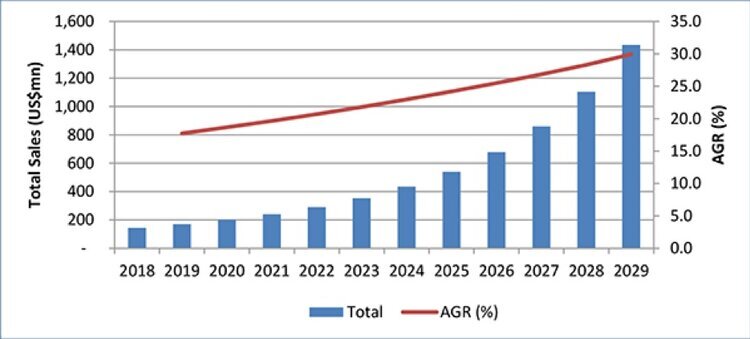
Forecast for sales of cyber insurance in South America. Taken from the cyber insurance market report 2019-2029
The role of Cyberwrite
Given the volatile environment around cybersecurity and consistently enhanced technology, Nir Perry, Cyberwrite’s CEO and founder, acknowledged a market failure in the cyber insurance industry, with its core in two great issues:
● Small and Medium-sized Businesses (SMBs) lack the capital to contact insurance companies and, consequently, the skills to defend from a cyber attack.
● The majority of insurance companies were not exactly “cyber experts”. Meaning that they lacked the technology to underwrite their customers with due accuracy and come up with the appropriate policy. So, at the end of the day, they failed to effectively provide assistance to its customers.
Therefore, in 2016, the Israeli company was founded with the aim of helping insurance companies increase their sales through enhanced risk profiling, with a primary focus on SMBs. They are not, however, a cyber risk consultant nor a cyber insurance company. The company is financially backed by American and Israeli angel investors, as well as global investors and accelerators such as Citibank, SpeedInvest, Plug and Play and around 500 startups.
Cyberwrite develops cyber-profiling with the aid of AI algorithms to institutions such as insurers or banks in order to assess a profile of cyber insurance risks and estimate the financial impact they are exposed to, while comparing with the benchmark in a one-page “human-readable” report. The report we used is in fact an actual report, only the company’s name was changed due to confidentiality. So, their report is divided into three parts:
Cyber Insurance Coverage scores: Cyberwrite compares the risk score of the company with the benchmark of the industry. The higher the score, the better. In Hooli´s case, their risk policy score is relatively low. From the report we can check how a large share of their risk score is explained by the lack of coverage regarding Business interruption, stolen records and data loss.
Describes the different types of cyber risk and compares with the industry benchmark
From this specific report we can see how the high risk in industry [whichever industry Hooli belongs to] and the regulatory risk (risk that a change in laws and regulations will materially impact a business) are the major source of Hooli´s cyber risk. The risk is ranked from A [no risk] to E [extremely high risk].
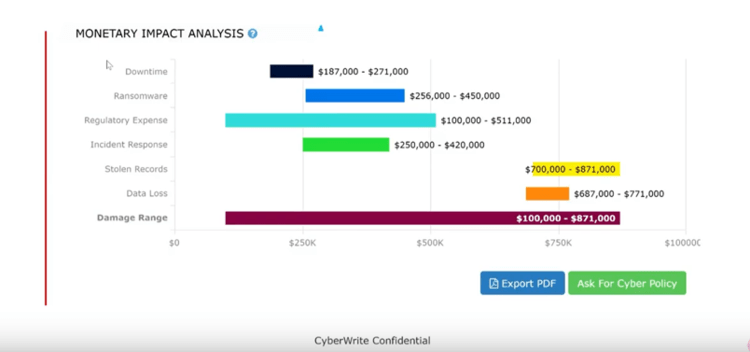
Provides a financial impact assessment (FIA) of a possible cyber attack.
Basically, it estimates in quantitative terms how much money the business has at risk. It also mentions the financial loss associated with each risk domain. The FIA is calculated through a simple questionnaire answered by the customer. Again, by checking Hooli´s FIA we can see how they can expect to lose from $100,000 up to $871,000 in case of a cyber attack. We can also check how a large share of this expected monetary loss is derived from the Regulatory expense. Which makes sense because, as we have seen before, Regulatory risk represents a large share of Hooli´s overall cyber risk.
It’s based on this FIA that customers can estimate how much they should pay to its insurance companies which is what, ultimately, increases cyber insurance sales.
To prepare this report, all Cyberwrite requires is the company’s name and its website. They then collect data from millions of sources all over the Internet in order to estimate the risk associated to the costumer.
This is a breakthrough in the cyber insurance industry, as it enables insurance companies to make a much more accurate estimate of how much to charge, making this market more accessible to SMBs. As a result, Cyberwrite has already received some important awards such as the UK Embassy’s British Award for Innovation in 2018 and was named a Cool Vendor in Gartner’s category “Cool Vendors in Insurance, 2018” being one in four insurtechs to ever receive this nomination.
Final comment
All in all, the insurance market is growing at a fast pace. Big budgets have been invested to ensure market-leading insurers are positioned at the forefront of change. It is estimated that approximately $1.7bn was spent in insurtech in 2016. A market that was previously known as change-averse is now developing rapidly with the aid of monetary expenditure and big data, which improves the creation and constant update of insurance models tailored to each business, as is the case of Cyberwrite. What we can expect is a continuous evolution of insurtech that is likely to improve market conditions for small and medium enterprises to emerge and grow and for big companies to continue thriving without safety constraints.
Web Summit was born in Dublin, Ireland. It was founded by Paddy Gosgrave (CEO), David Kelly and Daire Hickey. However, the Irish government wasn’t able to guarantee the conditions required by Paddy Gosgrave. Web Summit is, in fact, a huge event which requires infrastructures, public transports, Wi-Fi and price control practiced by the hotels. Because of that, the CEO started searching where was the best place to host the event and on the 23rd September of 2015, Paulo Portas and Paddy Gosgrave announced that the Web Summit would stay in Lisbon from 2016 to 2018 , with a chance to continue for two more years. However, on October of 2018, the Portuguese government announced that the event would remain in the country until 2028. When asked about his choice, Paddy Gosgrave said that it was the optimism of Portuguese entrepreneurs that made him decide to move Web Summit to Lisbon.
With this opportunity, Lisbon adapted itself to the event. For example, this year, as happened in the last editions, Lisbon’s metro offered 3 new vouchers (which includes Carris, Metro and CP) with big discounts in order to facilitate the access to Web Summit. The total amount to be invested on Web Summit from 2018 to 2028 is 110 million of euros (10 million per year).
However, the investment is expected to have return: for Leonardo Mathias, assistant secretary of state for Economics in 2015, at the time of the announcement made by Paulo Portas and Paddy Gosgrave, the expected return for Portugal was around 175 million euros. For António Costa, prime minister of Portugal, Lisbon receiving the Web Summit until 2028:
“Means much more than 30 millions of euros from a direct tax revenue. It also gives the image that Portugal can attract technological companies to create employment and better salaries.”
— António Costa
His words confirm the idea that this event is included in a national strategy called Startup Portugal, a set of 15 measures in order to support entrepreneurship launched in 2016.
2019 Edition
Talking about this year edition and starting by some of the speakers that will enlighten us, Huawei brings us its Deputy Chairman of the Board and Rotating Chairman: Guo Ping. Mr. Guo joined Huawei in 1988 and has served many roles in the company, including Rotating CEO. He’s a major figure from the Chinese giant and will surely talk about Huawei’s current point of reference: the approach to 5G. 5G could potentially offer higher download speeds, a much more stable internet connection and a larger capacity of app handling. It could also pave the way for several technologies such as improving the artificial intelligence in robots, automated cars and even holographic videos.
Furthermore, the CEO & Chairman of Verizon, Hans Vestberg will talk to us about the Eight Currencies, or eight performance attributes, that should be considered when implementing 5G in any device. These are through service deployment, mobility, connected devices, energy efficiency, data volume, latency and reliability. With its many potentials, it’s quoted as something that “doesn’t happen overnight” and the attributes could be seen as a blueprint for maximizing the potential of the 5G technology.
From the EU commission, comes its Commissioner for Competition and executive vice president for the next commission: Margrethe Vestager. Former Minister in Denmark and political leader of the Social Liberal Party, she is the main cause of the multimillion dollar fines against the giants of Silicon Valley like Facebook, Google and Apple. She promises an “Europe fit for the digital age”, enforcing more control over technological companies.
We also have from Amazon its Chief Technology Officer (CTO) and vice president: Dr. Werner Vogels. This former Lisbon resident is the man behind the success of the recent technological changes in Amazon, the Amazon Web Services, the multifunction cloud system that just made its first event in Portugal in Nova SBE.
Also virtual reality is going to be debated. With the rise of technological progress, the idea of an immersive 3D environment that puts a physical entity into an imaginary world sounded too good to be true for some, but with the success of devices such as the Oculus Rift, this idea has thrived. Meanwhile, the use of Augmented Reality, also known as AR, has also made adding information onto a simple photograph or video easy, with heavily used apps such as Snapchat and Pokémon Go being favorite smartphone apps according to the Google Play ratings.
The event will count with more than 1000 speakers and a lot of themes to be discussed. Web Summit will take place at the Lisbon International Fair (FIL) and Altice Arena, around the area of Parque das Nações. On the week before the event, prices ranged from 1500€ to 4995€.
From our part, we subscribe the message from professor and President Marcelo Rebelo de Sousa at the end of the last year edition of Web Summit:
“We are seeing xenophobia, intolerance, racism, closing of societies and economies, trade wars, closing of borders all over the world. I’s up to each of us to use the digital revolution for dialogue, for peace”
— Marcelo Rebelo de Sousa
For sure, Innovation (in economics, science, arts) is the way out to a better world.
Article Written By João Mário Caetano, João Diogo Rodrigues and Daniel Calado
The Brexit Campaign left Europeans at the edge of their seats. At the dawn of the conversation, the result was completely uncertain. Polls gave a solid 10% lead to the remain vote, however, there was a strong candidate in this referendum – “I don’t know”. This uncertainty was immune to traditional political advertising, which by using billboards and TV, failed to target specific audiences, feeling quite disconnected and generic. This void was what its online version came to fill. Online political advertising is the medium by which existing or insurgent parties and movements attempt to gather votes or increase their following through untraditional media forms, such as social networks or online ads.
In the upcoming referendum, do you think the UK will vote to…
Technological advancements have made social media and the internet in general the most accessible forms of mass-communication, creating fertile soil for the creation of targeted ads. Political parties took advantage of big data harbored by digital giants such as Facebook and Google to dig out the political concerns of billions of individuals,1 which allowed political parties to, better than ever, know the following things: the main topics of concern, which groups worry about them the worst, how these groups feel about the parties that currently address them, and, perhaps most importantly, the forms of media they are most susceptible to.
The European Union has seen an extreme growth in the use of online political advertising in the last half of the decade. In the UK, for example, spending on digital ads as a proportion of total ads increased from 1.7% in 2014 to 23.9% in 2015, reaching 42.8% in 2017.
This tool has become increasingly dominant in an ever-more polarized and competitive landscape, in which the traditional parties have started to come under threat by the insurgence of new movements, many of which wouldn’t have come into the spotlight if not for hefty media investments.
The association of microtargeted political advertising with the advent of new, extremist movements is not at all unreasonable. The rise of Alternative für Deutschland (AfD) in Germany, for example, can largely be attributed to an extensively developed social media micro-targeting strategy conducted with the help of Texas-based advertising firm Harris Media, who had successfully ran campaigns for Donald Trump and Marine Le Pen. 3 AfD managed to become, in a short time, the countries’ third political force, with 12.6% of votes in 2017’s national elections.4 Spanish party VOX, which gained 6.21% of votes in most recent elections,5 also had an aggressive online marketing strategy, having become the most followed Spanish political party on Instagram.6
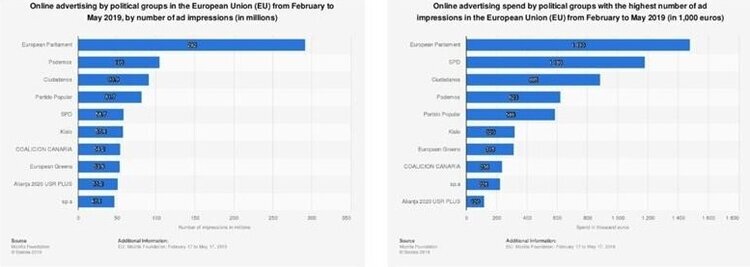
Interestingly, however, the highest investments in online political advertisements came not from these sunrise parties, but from traditional ones. As can be seen in the graphs below, the highest outreach and investments in online political advertising in 2019 came from traditional parties in countries such as Spain, who has yet to form government, and Germany, whose election results made a complicated coalition necessary. In fact, we can assume that this aggressive allocation of these parties’ sizeable advertising budgets aimed at opposing the imminent threat of new, populist movements and posed as an attempt at regaining political trust and credibility in the general audience, who with them has become out of touch.
Online advertising by political groups
However, there is a clear front-runner in the use of this media form – the European Parliament. In spite of, in principle, not making use of microtargeting, this shift to a more prominent online presence makes sense when faced with the enormous apathy towards EP elections shown by voters. In the 2014 elections, abstention won with a staggering absolute majority – 57.39%.7 This obviously worried the EP, who launched online programs such as This Time I’m Voting and multiple Instagram, Facebook and Twitter campaigns which did not go unnoticed. The extent to which this affected the decrease in abstention to 49.38% is,8 however, a matter of debate.
Nonetheless, this comes to show that online political advertising, due to its outreach, has the potential to be used towards more universal causes such as the need for political engagement and to raise awareness for environmental concerns, and less such as a tool of tailored manipulation. However, the statistics regarding the first presented example, the Brexit referendum, present a hard truth. In 2016, “Leave” groups spent £ 4.45 million in online campaigning and microtargeting, with “Remain” investments far behind at £1.91 million. This leaves room to wonder – had things been more balanced, would the outcome have been radically different?
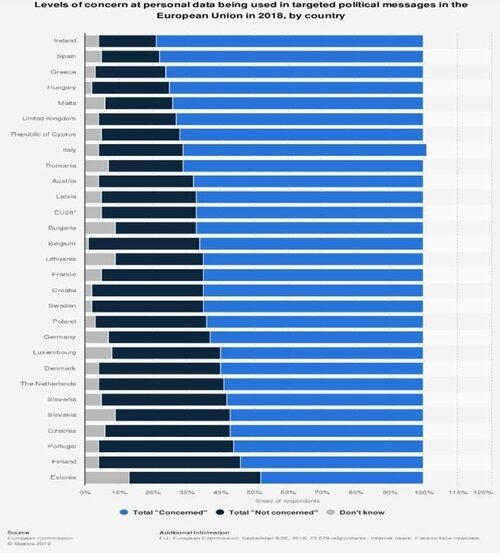
More recently, this year, Britain’s Future, a no deal Brexit group flaunted the highest number of political ads of any UK party, at an impressive 2.354 figure, meaning they had ads for every possible consumer. In addition, they spent 366 thousand pounds against Theresa May’s Brexit Deal on Facebook, money which has no known source. This comes to show the most pressing issue with this form of advertisement – regulation. As of September 2018, the European Commission approved a package which aims at protecting personal data in election times, in particular from foreign interference in national and European elections.9 However, even though 76% of Europeans view this as an imperative necessity,10 the organization has failed to assure transparency and to oblige online political advertising to follow the same rules as it’s traditional format. As of today, they have merely managed to advise national governments to “ensure citizens can easily recognize online paid political advertisements and communications” and “make information about [political parties’] spending for online activities on their websites” available, having passed no strong bill on the matter.
Big Brother has been watching us for quite a while now. He has all our life’s data stored in millions of databases. We know that. The problem is that now, he has started talking back.
Levels of concern at personal data being used in targeted political messages
Behind the mask of a concerned movement or party, we are manipulated into thinking that we are finally understood, and forget we are the victims of what is possibly humanity’s greatest publicity stunt. Although some more than others, Europeans are concerned that the use of their once-promising data is turning against them. The need for transparency is pressing, but the long-lasting effects of this capitalization on democracy is something only time will tell.






 Forecast for sales of cyber insurance in South America. Taken from the cyber insurance market report 2019-2029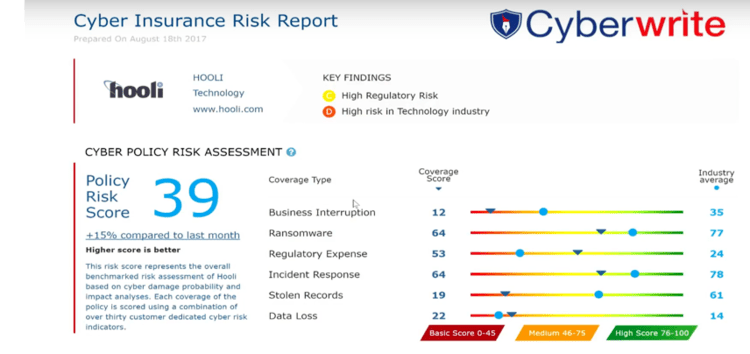








 theawarenessnews.com