

Economic Interdependence and Geopolitical Tensions in Northeast Asia
Introduction
China’s economy exceeded expectations, growing 5.3 per cent in the first quarter compared to the preceding year. Chinese businesses keep growing, after a boom in the mainland, bubble tea chains are eyeing stock market listings as they aim to expand overseas. The pace of China’s post-pandemic development should be a wake-up call for western manufacturers, writes Thomas Hale in the Financial Times. As this economic momentum accelerates, different perspectives on the way to deal with them arise, prompting questions about the role of economic cooperation in fostering interstate peace, particularly in the case of China.
Does economic cooperation lead to interstate peace in the case of China? In the differing International Relations theories, there are different approaches to this question; while liberal thinkers argue that the growth of economic interdependence between states can create pressures and incentives for states to pursue peace, realist thinkers have a more cynical approach.
An intensive trade culture and strong investment relations often lead to the interdependence of the regions involved and a more peaceful and stable environment. This is the case of Northeast Asia. However, this interdependence may also bring negative effects, such as the trade disputes between China and Australia, which arose from security and geopolitical issues. There are two major developments that depict the dynamic of economic integration and geopolitics of this region: The rise of China and the proliferation of regional trade agreements (RTAs).
Differing Perspectives and Expectations
As stated before, different theories take different approaches when it comes to interdependence between states and, namely, different expectations and perspectives in the case of the rise of China.
Former president of the US, Bill Clinton, a liberal voice, thought that China had to be brought inside the WTO (World Trade Organization) and that it was in the US’ interest to promote building prosperity and partnership with Asia. In order to get the China relationship right, it was necessary to increase the interdependence between the two countries: a more interdependent China would be a more cooperative China.
“The world will be a better place over the next 50 years if we are partners, if we are working together.” – Former President of the US, Bill Clinton
The realist counterargument against this policy is that the changing power position of China and the US will matter more than economic interdependence and democratic government. According to this approach, China will seek to use its power to expand its influence and control over its region, and perhaps the wider world. The rise of China – and its likely desire to dominate East Asia – will pose a fundamental threat to the United States in the near future.
“The best way to survive in this system is to be the biggest and baddest dude on the block. . . Nobody fools around with Godzilla.” – Political scientist John Mearsheimer, (Quoted in Nathan Swire, ‘Mearsheimer explores threat of China’, The Dartmouth, November 14, 2008)
Unravelling of China’s rise
China’s prosperity acted as an effective boost for regional growth due to the country’s rapid economic and technological growth. Nonetheless, this event also changed the power balance of the region, as China gained competitive power over other countries, ultimately resulting in increasing tensions.
The trade between China and the Association of Southeast Asian Nations has been increasing steadily. Since all these countries manage their relationship with China cautiously, this growth stresses the idea that an increased interdependence is highly linked with a sense of peace. Hence, as trade with China is crucial to the economy of these countries, they would avoid engaging in conflicts and anti-China policies.
However, and as stated before, this interdependency may lead to increasing tensions between the parties involved. Still following this example, although no government in the Asian-Pacific region has adopted a clear anti-China policy, there have occurred some sporadic anti-China riots in Indonesia, Malaysia, and the Philippines.

Proliferation of regional trade agreements
The rise of trade agreements, which create rules for trade and investment relations, reduces these risks by providing platforms to solve disputes, ultimately separating economic issues from security ones. In this context, the ASEAN free trade agreement was the pioneer, followed by bilateral and regional agreements. However, since relations between major players, like China, Japan, and Korea did not exist, their economic relations were prone to tensions.
Political conflicts and the trade systems
Countries often fail to separate their political conflicts from their already established trade systems. For instance, South Korea and Japan are still imposing trade barriers due to the Japanese invasion that occurred many years ago. In other words, limiting trade due to geopolitical issues.
A good example of this is the US vs China chip war. In a nutshell, this conflict arises from the US concern that the Chinese army could surpass the US’ (one) in terms of overall power if they have easy access to their chip production process. The chip production process was spread across the US and its allies. Although China has increasingly been settling production centers of its own, a key part of the chip had always to be imported from these countries. This resulted in a series of protectionist measures, in particular, Chinese businesses and individuals being unable to buy advanced chips without a specific license from the US government.
On the article “An agenda for regional economic and security cooperation” Yose Rizal Damuri comments that these countries “must do more”. He argues that the key is to address these problems under a regional framework, rather than bilaterally, with region-wide agreements such as the Regional Comprehensive Economic Partnership (RCEP). Meanwhile it is also crucial to address common regional and global challenges together, for example, energy transition. However, these should be complemented by covering emerging issues such as intellectual property and cross-border digital investment. As mentioned in the article, specific common projects increase trust, facilitating conversation on difficult issues and ASEAN may be a key driver of these initiatives.
ASEAN
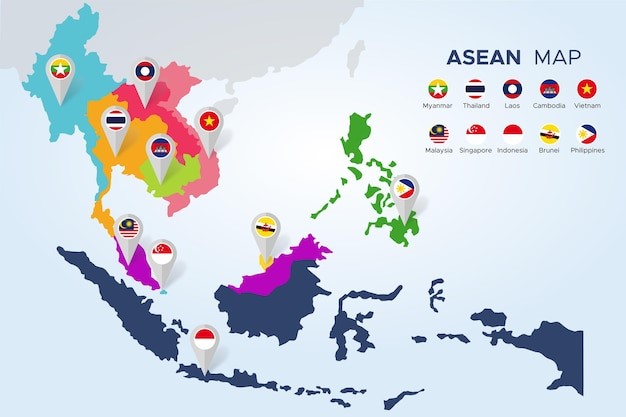
ASEAN, which is the Association of Southeast Asian Nations, is an intergovernmental organization that aims to promote economic and security cooperation among its ten members: Brunei, Cambodia, Indonesia, Laos, Malaysia, Myanmar, the Philippines, Singapore, Thailand, and Vietnam. The group has played a central role in Asian economic integration, joining negotiations to form the world’s largest free trade agreement, and signing six free trade deals with other economies in the region.
Nevertheless, the group’s impact remains limited due to a lack of strategic vision, diverging priorities among member states, and weak leadership. Their biggest challenge is said to be the development of a unified approach to China, since ASEAN countries are strongly dependent on China, and benefit a lot from this relationship. However, this relationship also limits their growth, thus, a balance between the advantages of trading with China and the risks from overdependency should be achieved. The aim of this would be not only to maintain peace but also to pave out a more resilient and sustainable economic future for ASEAN countries.
Looking ahead
So, what can these countries do? Some argue that the answer is to enhance diversification efforts – They can start by diversifying their trading partners which would mitigate the risks of their excessive reliance on China and would also create a viable alternative for businesses relocating from China. Strengthen trade agreements – An additional way of doing this would be to prioritize the intra- ASEAN trade and integrating supply chains. This would lead to diminishing dependence on imports for components and materials, for example in the sectors of electronics and cars.
Besides this, strategic trade relationships with other countries should be considered. This measure would not only grant ASEAN countries a greater access to significant markets such as Canada (for which there are ongoing negotiations to sign an agreement) but also, once again, promote trade diversification. Aligning China’s Foreign Direct Investment with sustainability – Interdependence with China cannot be abruptly broken, and it is important in maintaining peace. Following this rationale, as China’s FDI is important, ASEAN countries should ensure that these investments align with their sustainable growth goals, for example, transparency and accountability.
Conclusion
In summary, as China tries to steer a manufacturing-led revival of the world’s second-largest economy, the data from Beijing heightens Western concerns about Chinese competition. The opinions on how to approach this rising economy diverge, and the effects of interdependence are bittersweet. While on one side it may lead to peace and stability, since conflict is costly, on the other hand, it also provides room for disputes to emerge.
The ultimate consequence of this is the incapability to separate political issues from economic trade. There are many suggestions to address these matters under regional frameworks rather than country-to-country. To effectively do so, these agreements should be comprehensive including emerging potential causes of conflict, like the ASEAN.
Sources: Damuri, Y. R. (2022). An agenda for regional economic and security cooperation – East Asia Forum. East Asia Forum Quarterly: Volume 14, Number 4, 2022, 14(4), 5–7, Hawkins, A. (2023, July 5). Chip wars: how semiconductors became a flashpoint in the US-China relationship. The Guardian. Maizland, L., Albert, E., Hong, L., & Galina, C. (2023, September 18). What Is ASEAN? Council on Foreign Relations, Wester, S. (2023, November). Balancing Act: Assessing China’s Growing Economic Influence in ASEAN. Asia Society, XIA, M. (2018). “China Threat” or a “Peaceful Rise of China”? – New York Times. Nytimes.com, Hale, T. (2024, April 4). Manufacturers need to face up to new wave of Chinese competition. – Financial Times, Joseph Grieco, G. John Ikenberry, Michael Mastanduno (2024). Introduction to International Relations- Enduring Questions and Contemporary Perspectives

Catarina Franco
 theawarenessnews.com