
The End of the Unipolar World: Is A New Global Order Taking Shape?

Is the world entering a multipolarity era?

For roughly three decades following the collapse of the Soviet Union in 1991, the United States stood as the world’s unchallenged superpower. Political scientist Charles Krauthammer famously described this era as the “Unipolar Moment”, a period in which no other nation could rival American military, economic, or diplomatic reach. Today, that moment appears to be ending.

A convergence of forces (e.g., the economic ascent of China, the expansion of the BRICS bloc, shifting US foreign policy, and the growing assertiveness of the Global South) is reshaping the international order at a pace that few anticipated.

The Architecture of American Dominance

To understand what is changing, it is necessary to understand what it once was.

After the Cold War, the United States accounted for roughly 25% of global GDP, operated the world’s most powerful military by a significant margin, and anchored a network of international institutions (think of the United Nations, the World Trade Organization, and the International Monetary Fund) that largely reflected Western values and priorities. The US dollar became the world’s dominant reserve currency, giving Washington extraordinary leverage over the global financial system.

This period of unipolarity was not simply a matter of military might: it was a comprehensive structural dominance spanning economics, technology, culture, and governance.

The Rise of New Powers

That architecture is now under sustained pressure.

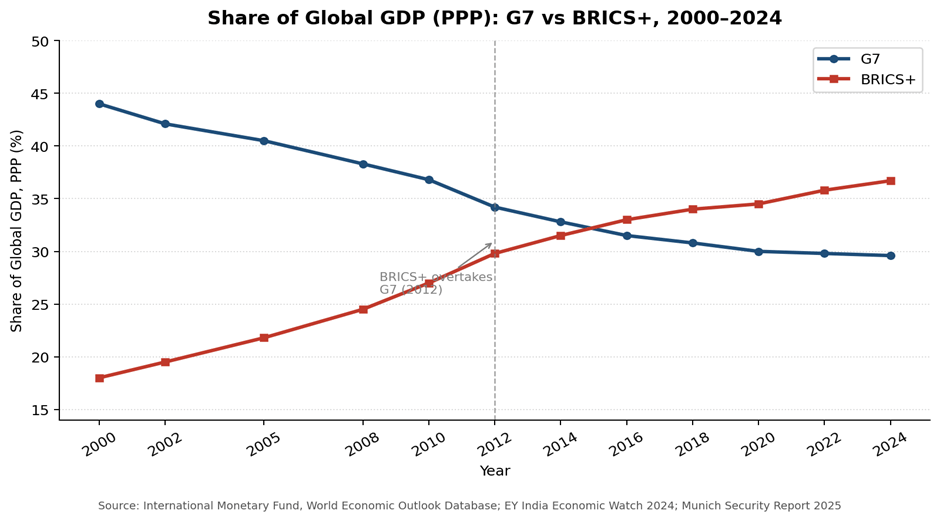
The most significant challenge comes from China, whose economy has grown from approximately $1.2 trillion in 2000 to over $18 trillion today, a rise from 4% to nearly 18% of global GDP. Simultaneously, the BRICS bloc (originally comprising Brazil, Russia, India, China, and South Africa) has expanded aggressively, and as of 2026 represents over 36% of global GDP measured in purchasing power parity (PPP), already surpassing the G7’s share of roughly 29.6%, according to IMF data.

This is not merely an economic story. The BRICS nations collectively account for approximately 40% of global trade, according to the Munich Security Report 2025, whose central theme was precisely “Multipolarization”. The report observed that an ongoing power shift toward a greater number of states vying for influence is clearly discernible, marking a decisive shift in the language of mainstream international security analysis. Beyond BRICS, middle powers including Turkey, Saudi Arabia, India, Indonesia, and Brazil are increasingly acting as independent actors rather than automatic supporters of the Western-led order. At the 2025 Munich Security Conference, 30% of speakers represented the Global South, a figure that would have been unthinkable a decade ago.

Figure 1. Share of Global GDP (PPP): G7 vs BRICS+, 2000–2024

Fracturing Alliances and US Foreign Policy

The second major driver of change is the United States itself.

The return of Donald Trump to the White House in January 2025 accelerated tensions already present within the Western alliance system.

Trump’s approach, characterized by tariff escalation, skepticism toward NATO burden-sharing, and unilateral diplomatic maneuvering, strained relations with traditional partners in Europe and Asia. Europe, long dependent on US security guarantees, responded by dramatically increasing defense spending, though analysts note it will remain reliant on American military infrastructure for years to come.

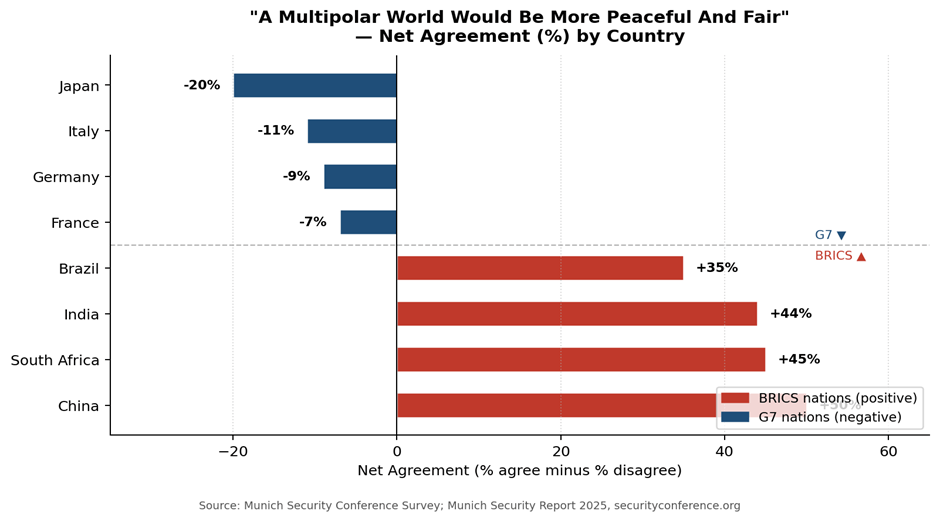
At the same time, a growing divergence is visible in how different parts of the world perceive the emerging order. Surveys conducted for the Munich Security Report 2025 found that majorities in G7 nations view the shift toward multipolarity with concern, fearing increased disorder and conflict. By contrast, large majorities in China (+50% net agreement), South Africa (+45%), India (+44%), and Brazil (+35%) believe a multipolar world would better address the needs of developing nations. The North-South divide has rarely been so sharply quantified.

Figure 2. “A Multipolar World Would Be More Peaceful and Fair”, Net Agreement (%) by Country.

The Dollar, The Military, And the Limits of Decline

The narrative of American decline is, however, contested by several analysts. Writing in Foreign Affairs in February 2026, analyst C. Raja Mohan argued that “the first year of Trump’s second term has punctured the narrative of American decline and the rise of multipolarity,” pointing to the US ability to intervene militarily, reshape trade rules, and push resolutions through the UN Security Council with limited effective resistance.

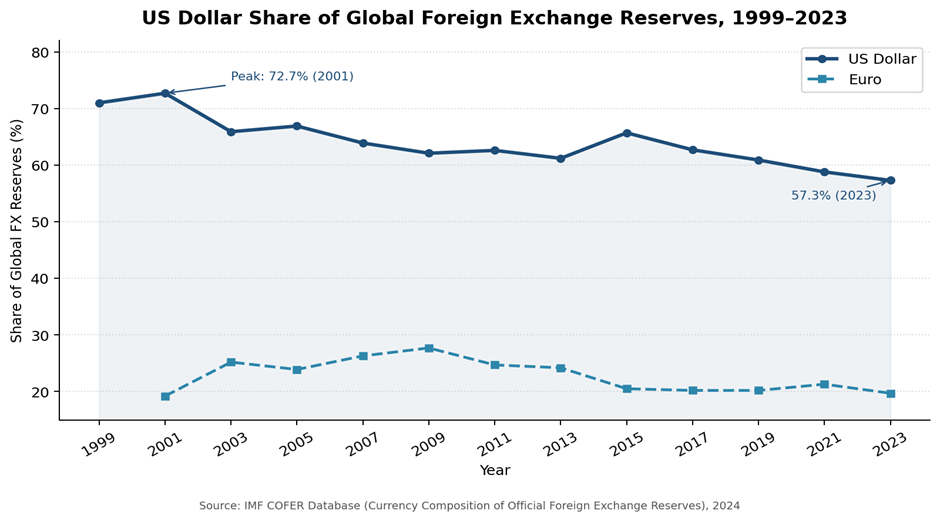
A key pillar of this argument is financial. The US dollar still accounts for approximately 57% of global foreign exchange reserves, according to IMF COFER data, down from a peak of nearly 73% in 2001, but still far ahead of any rival currency. The euro, its closest competitor, holds under 20%. Efforts by BRICS nations to launch an alternative reserve currency or payment system have so far failed to gain traction, with even the BRICS Development Bank continuing to operate primarily in US dollars. Beyond finance, the US continues to dominate the sectors most critical to 21st-century power: artificial intelligence, semiconductor technology, and advanced military systems. Russia, often cited as a pillar of a new multipolar order, has a GDP smaller than that of Italy and a narrow economic base heavily dependent on natural resource exports.

As the Munich Security Report 2025 concluded with notable precision: “Today’s international system shows elements of unipolarity, bipolarity, multipolarity, and nonpolarity. What you see depends on where you look.”

Figure 3. US Dollar Share of Global Foreign Exchange Reserves, 1999–2023

What Multipolarity Would Mean in Practice

Regardless of how the academic debate is resolved, the practical consequences of the current transition are already visible. Multilateral institutions are under strain: the WTO’s dispute resolution mechanism remains largely paralyzed, the UN Security Council is increasingly deadlocked, and global supply chains are fragmenting along geopolitical lines, a process known as “friend-shoring”, as nations prioritize strategic alignment over economic efficiency.

Some analysts see opportunity in this transition. Chatham House researcher Amitav Acharya has argued that a “multiplex” world order could emerge, one characterized by greater ideological diversity, more inclusive global institutions, and stronger regional governance. The inclusion of the African Union in the G20 in 2023 was cited as a potential sign of this more representative direction. The Munich Security Report 2025 cautioned, however, that without shared rules, multipolarization risks producing not a fairer world but a more conflictual one:

“Before our eyes, we are seeing the negative scenario of a more multipolar world materialize — a more conflictual world without shared rules and effective multilateral cooperation.”

Conclusion

The world of 2026 is no longer the world of 1995. While the United States retains unmatched military capability and continues to anchor the global financial system, its ability to set the terms of international order unilaterally has measurably diminished.

The rise of China and the BRICS bloc, combined with a more assertive Global South and an increasingly transactional US foreign policy, are producing a structural transition whose ultimate destination remains unclear. What is certain is that the rules, institutions, and alliances that defined the post-Cold War era are under revision and the outcome of that revision will shape the next several decades of global politics.

Sources

Munich Security Conference, Munich Security Report 2025 C. Raja Mohan, “The Multipolar Delusion,” Foreign Affairs, February 2026 ; Brandon J. Weichert, “The Unipolar Moment Is Over,” The National Interest, December 2025 (nationalinterest.org); Amitav Acharya, “The Decline of the West and the Rise of the Rest,” The World Today, Chatham House, December 2025 (chathamhouse.org); Centre for International Governance Innovation, “America’s Unipolar Moment Is Over” (cigionline.org); MD. Abir Mahmud Jakaria, “Global Power Shift: Is the United States Losing Dominance in the Emerging Multipolar World Order?” ResearchGate, February 2026 (researchgate.net); Indian Journal of Law and Legal Research, “The Rise of Multipolarity: Is the Unipolar World Order Officially Over?” February 2026 (ijllr.com); IMF, World Economic Outlook Database (imf.org); IMF, COFER Database — Currency Composition of Official Foreign Exchange Reserves (imf.org); EY India Economic Watch, “Can BRICS Play a Key Role in Shaping Future Global Economic Policy?” 2024 (ey.com); BRICS Brazil Presidency, “BRICS GDP Outperforms Global Average”

Rebecca Fratello 

Writer

Why Property Matters More Than Income 

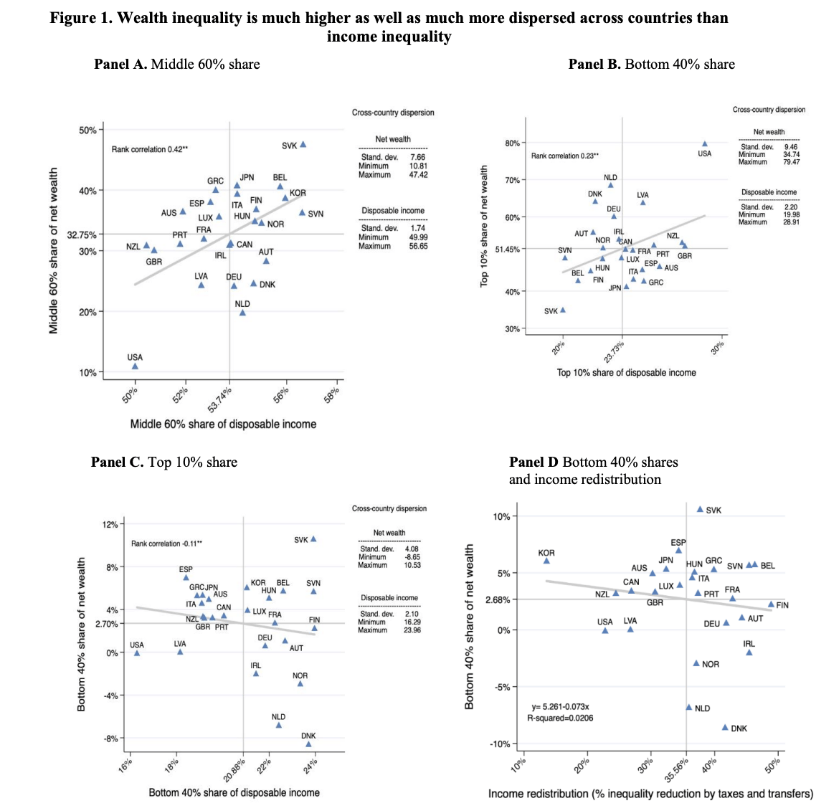
For a long time, inequality was mostly discussed in terms of income, jobs, and education. But in many rich countries today, the real difference is often about who owns property. Two households can earn similar salaries and still have very different futures if one owns a home and the other rents. Housing is no longer just a place to live. It is one of the main ways families build wealth, gain financial security, and pass advantages on to their children. Across OECD countries, wealth is much more unevenly distributed than income, the richest 10% of households own more than half of total household wealth on average, while the bottom half owns very little. 

Asset Inequality 

Income shapes what a household can afford today. Wealth shapes what it can survive, invest, and pass on tomorrow. This matters because wealth gives protection against unemployment, illness, rising prices, and economic shocks in a way that income alone often cannot. A household with a modest salary but a fully paid home may be much more secure than a household with the same salary, no assets, and high rent. Research on OECD shows that wealth inequality is greater than income inequality, and that housing makes up a large part of household wealth, especially for people outside the extremely richest groups. 

Housing is important because it is both something people need and something that can make them wealthier. Everyone needs a place to live, but people who own a home can slowly build value with it, benefit if house prices go up, and sometimes use it to borrow money. This gives housing a big effect on people’s financial security and future opportunities. That is why housing does not just show inequality but can also make it worse. 

Homeownership Creates Advantage 

Owning a home creates advantages in several ways. First, mortgage payments can gradually turn monthly housing costs into ownership. Rent, by contrast, pays for shelter but does not create an asset. Second, homeowners may benefit if the value of their property rises over time. Third, owning a home often brings more stability, since owners are usually less exposed to sudden rent increases or be forced to leave their home. Finally, housing wealth can later help pay for education, retirement, or children’s future home purchases. 

This means the gap between owners and renters increasingly looks like a class divide. Owners can build wealth while meeting a basic need. Renters usually cannot. Over time, that difference grows. A family that buys early may spend years building equity. A family that rents for the same period may face rising housing costs without gaining any asset in return. In this way, housing turns inequality from a matter of monthly income into a matter of long-term ownership. 

Why Buying A Home Is Getting Harder 

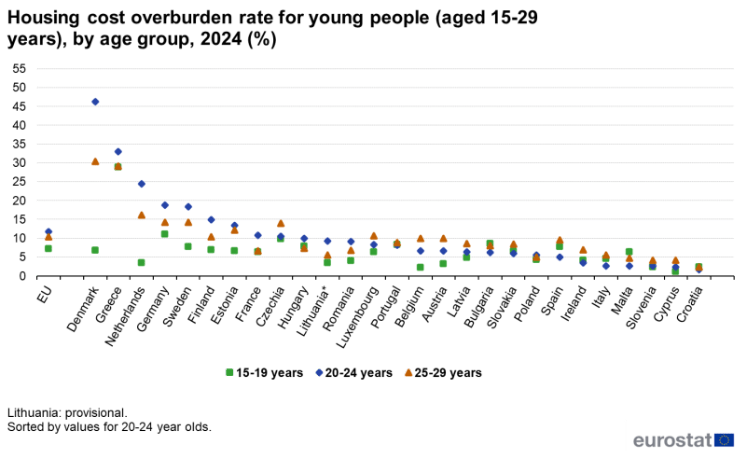
This would matter less if everyone had a fair chance to buy a home. But entering the housing market has become more difficult, especially for young people. House prices have risen sharply in many places. Down payments are harder to save for. Credit rules are often stricter. And high rents make saving even harder. Eurostat data shows that in some EU countries, young people spend a very large share of their income on housing.  

This matters because high rent does not only create pressure in the present, but it also reduces the ability to save for the future. The result is a cycle, those who already own homes benefit when prices rise and those who do not own face a higher barrier to entry every year. In this sense, the housing market often rewards those who are already inside it while making it harder for outsiders to enter. 

Figure 2 – Housing cost overburden by age group 

Inherited Wealth 

This is where the issue becomes generational. When homes become so expensive that wages alone are not enough to buy one, family wealth starts to matter much more. Parents may help with a down payment, give property directly, or leave an inheritance that makes homeownership possible. In that kind of system, access to property depends less on current income and more on whether someone’s family already owns assets. 

OECD evidence suggests this is not a small issue. In several European countries, a significant share of low-income homeowners got their homes through inheritance or gifts rather than through purchase alone. OECD research on inheritance also shows that wealth transfers tend to increase inequality, because the people who receive inheritance are often already better off.  

This does not mean income no longer matters. Salaries still affect daily life, access to credit, and the ability to pay a mortgage but income alone matters less when wealth already gives some people a head start. A good salary helps, but it may still not be enough to buy a home without family support. At the same time, a household with inherited property may enjoy more security and wealth growth than a renter with a higher income.  

The Political and Social Effects 

When property matters more than income, the effects go beyond money. Homeownership can shape access to better neighborhoods, better schools, more stability, and greater security in old age. It also affects politics. Existing homeowners often benefit from rising house prices and may oppose reforms that would lower them, even if those reforms would help younger or poorer households. 

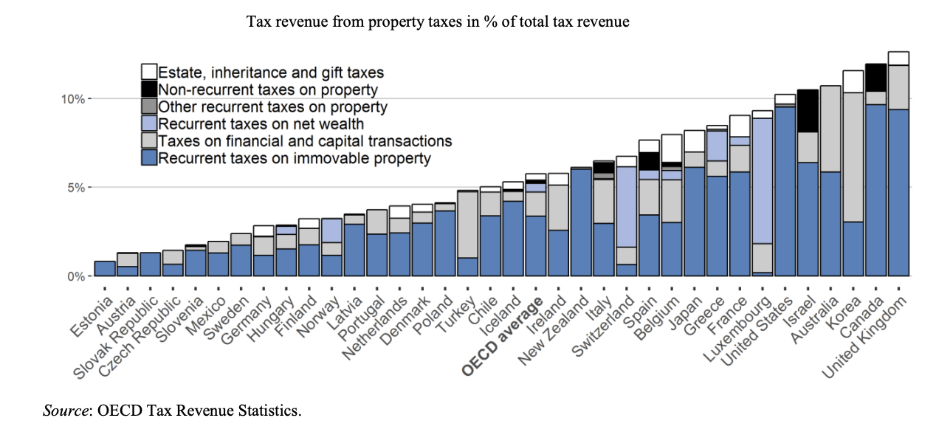
This helps explain why housing policy is so difficult. Building more homes, changing zoning laws, expanding social housing, or taxing property more effectively could improve access for people outside the market. But these policies may conflict with the interests of people who already own property. As the World Bank has noted, housing affordability is not only a social issue, but it can also reduce labor mobility and stop young people from moving to places where the best jobs are. 

Figure 3 – OECD countries have ample room to shift the tax burden towards property taxes 

Conclusion 

The class division today is not just between people with high salaries and people with low salaries. More often, it is between people who own property and people who do not. Housing is the clearest example, because owning a home can give families more than shelter, it can give them wealth, stability, and something to pass on to their children. As buying a home becomes harder, and more dependent on family support, inequality becomes more deeply rooted across generations. If this trend continues, what matters most may not be who earns the most, but who already owns something valuable. 

Sources:

Margarida Ferreira

Writer

Orbit Under Siege: The Economic Cost Of Space Militarization 

Global Infrastructure At Risk 

We rarely think about it, but the modern economy is tethered to the stars. The invisible signals from Global Positioning System (GPS) satellites do far more than guide your Uber. They provide the precise timing stamps that synchronize stock market trades, manage power grids, and authenticate banking transactions. 

This creates a terrifying fragility. If a conflict on Earth spills into space, it wouldn’t just be a military problem; it would be an economic cardiac arrest. Experts have long warned that attacking satellites is a double-edged sword because everyone, aggressor and defender alike, relies on the same physics to navigate, forecast weather, and communicate. We saw a preview of this chaos during the Russia-Ukraine war, where GPS jamming disrupted civilian flights and shipping across Europe. The reality is simple: the more we treat orbit as a battlefield, the more we risk the invisible infrastructure that keeps the world running. 

The Booming Market For Space Defense 

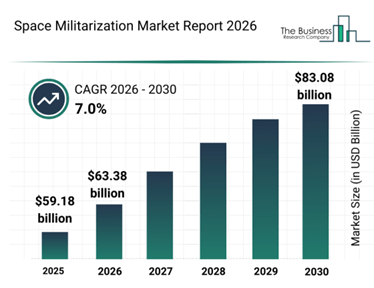
Space is no longer just a frontier for science; it is a massive market for defense capital. In the last five years, global military spending on space has doubled, hitting $60 billion in 2024

The forecast is clear: this is just the beginning. Analysts project the sector will grow to over $63 billion in 2026 and cross $83 billion by 2030

Forecasted growth of the global space militarization market from 2020 to 2030, based on recent projections.

This isn’t just about nations buying more hardware; it’s about fear. The United States Space Force alone requested nearly $40 billion for 2026, a 30% jump in a single year. But if you look closely at where that money is going, you’ll see a shift. Governments aren’t just building weapons to blow things up; they are desperately spending money to figure out how to keep their own lights on. 

The Shift To ‘Soft’ Warfare 

Military strategy in space is undergoing a quiet revolution known as “softwarization.” 

The logic is pragmatic. If you blow up a satellite with a missile (“hard kill”), you create a cloud of debris that could destroy your own satellites days later. It’s the orbital equivalent of setting off a grenade in a small room. Instead, nations are pivoting to “soft kill” tactics: jamming signals, blinding sensors with lasers, or hacking software. These methods can disable an enemy without turning low-Earth orbit into a graveyard. 

Investment is increasingly focused on enhancing resilience. For example, new GPS satellites are being deployed with military-grade encryption (M-code) to better withstand jamming. Furthermore, satellites are now being designed with artificial intelligence to enable “self-healing” or the ability to reroute data automatically if a component is attacked. This trend has been described by one general as a “race to resilience.” 

Debris: The Hidden Tax On Orbit 

The biggest threat to the space economy isn’t a laser; it’s junk. Decades of launches and reckless anti-satellite tests have left Low Earth Orbit (LEO) cluttered with shrapnel. 

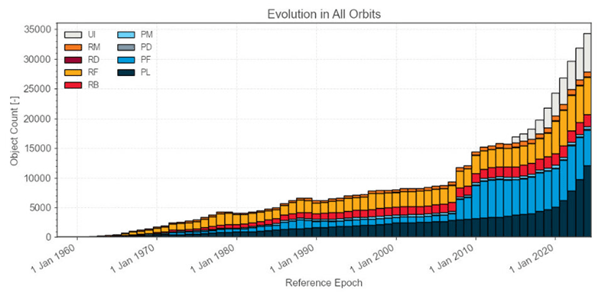
Today, surveillance networks track about 35,000 objects in orbit. Here is the scary part: only about 9,000 are active satellites. The rest, over 26,000 pieces, is lethal garbage traveling at 17,000 miles per hour. 

Number of tracked objects in Earth orbit over time. 

This creates a literal “congestion tax” for businesses. Satellite operators now have to burn precious fuel dodging debris, which shortens the satellite’s life and kills profit margins. Insurers are panicking, too, hiking premiums by 5–10% for missions in crowded orbits. 

The nightmare scenario is the Kessler Syndrome: a chain reaction where one collision creates debris that causes two more collisions, eventually turning orbit into an unusable wasteland. 

The chain reaction referred to as the Kessler Syndrome. 

With China (2007) and Russia (2021) having already conducted tests that spewed thousands of fragments into space, the environmental cost of this “war” is already being paid by every commercial operator. 

The Geopolitical Chessboard 

Every major power is playing a different game: 

  • United States: The U.S. is betting on “safety in numbers.” Instead of relying on a few giant, vulnerable satellites (“Battlestar Galacticas”), the Space Force is launching swarms of smaller, cheaper satellites. If an enemy shoots one down, the network survives. 
  • China: Beijing sees space as the ultimate high ground. Since its 2007 anti-satellite test, China has built an arsenal of lasers and jammers while launching its own BeiDou navigation system to ensure it doesn’t need American GPS in a fight. 
  • Russia: Lacking the budget to match the U.S. dollar-for-dollar, Russia plays the role of the spoiler. It focuses on asymmetric threats, jamming signals (as seen in Ukraine) and threatening to target commercial satellites that help its enemies. 
  • Europe: Europe has woken up. Realizing it relies too heavily on others, the EU launched a “Space Strategy for Security and Defence” in 2023. They are building secure communication networks (IRIS²) and a “European Space Shield” to protect their assets. 

Private Companies On The Frontline 

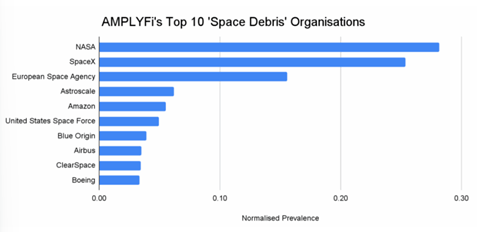
Perhaps the biggest change is who is involved. In the past, space war was for governments. Today, private companies like SpaceX (Starlink) and Maxar are on the front lines, providing communications and intelligence in active war zones like Ukraine. 

The most mentioned organisations in online media in the context of space debris, as determined by AMPLYFi’s analysis. 

This blurs the line dangerously. If a private satellite is helping an army, is it a legitimate military target? As corporations launch tens of thousands of new satellites, they aren’t just bystanders; they are active participants in a congested, contested domain. 

Conclusion 

Earth’s orbit is no longer a peaceful void. It is a busy, dangerous, and incredibly expensive industrial zone. The rush to militarize space risks destroying the very “commons” that our modern economy stands on. The next decade will decide whether we can manage this tension, or if we are hurtling toward a future where the skies above us are permanently closed for business. 

Sources: Fortune Business Insights; Research and Markets; Payload Space; World Economic Forum (WEF); U.S. Space Force Financial Management; SatNews; NOAA Space Weather Prediction Center. 

Rebecca Fratello 

Writer

Why Gender Pay Gap Data Mislead Us: Understanding The Dynamics Behind The Numbers 

Reading time: 8 minutes

The gender pay gap index is often perceived as a clear and straightforward indicator of inequality: the lower the gap, the more equal a society must be. Yet, when looking at European data, this assumption immediately breaks down. Countries widely recognized for their strong gender equality, such as Finland and Denmark, show some of the highest gender pay gaps in Europe, respectively of 16.8% and 14.0% in 2023. Conversely, Southern European countries, typically portrayed as less advanced in terms of labor equality, often show lower gaps, such as 2.2% in Italy, 5.1% in Malta and 8.6% in Portugal.

Figure 1: The unadjusted gender pay gap, 2023 (difference between average gross hourly earnings of male and female employees as % of male gross earnings). Source: Eurostat 
Figure 2: Gender Equality by Country, 2025. Source: World Population Review 

This counterintuitive pattern raises a key question: why do some of the most gender-progressive countries display such large pay gaps? 

Understanding the answer requires unpacking what the gender pay gap actually measures and how structural factors shape the interpretation of the data. 

A counterintuitive European puzzle: how labor participation affects the gender pay gap 

According to Eurostat, the gender pay gap represents the average difference between male and female hourly earnings across an entire economy. However, this “raw” indicator does not adjust for variables such as employment rate, seniority, working hours, occupation, or industry composition. As a result, countries with very different labor market structures can produce misleading pay gap figures. 

In the European context, Nordic countries display among the highest female labor participation rates in Europe. In Sweden and Finland, around 75-77% of working-age women are employed, compared to roughly 52% in Italy, according to the Eurostat data for 2021. This fundamental difference has two statistical consequences:  

(1) More women participate across many sectors, including high-paying but male-dominated private industries, where pay disparities are more apparent.  

(2) In low-participation countries, many women who would earn less or face structural disadvantages simply do not appear in the labor market statistics. 

This means that a “low pay gap” can reflect fewer women working, not more equal pay.

Figure 3: Female labor force participation rate in Europe, 2024 (the average for 2024 in the European countries was 54.19%.The indicator is available from 1990 to 2024). Source: The World Bank 

Structural factors shaping the gender pay gap  

A low pay gap may also reflect structural constraints, cultural norms, or barriers that discourage women from entering specific sectors, or even from participating in the workforce altogether. In Italy, for instance, women are underrepresented in high-earning private-sector roles but are comparatively overrepresented in stable public-sector professions, where pay scales are more regulated. This combination tends to compress wage differentials and therefore “artificially” decrease the gender pay gap. 

By contrast, in Nordic countries women participate across a wide range of sectors, including those with substantial wage dispersion. This results in a broader and more accurate representation of gender differences in earnings. 

In this sense as well, a low pay gap is not inherently a sign of gender parity. 

The role of part-time work and occupational segregation 

A third major factor explaining the higher gender pay gaps in Northern Europe is the prevalence of part-time employment among women. According to Eurostat, countries such as the Netherlands and Denmark have some of the highest female part-time rates in Europe, compared to Southern European countries like Portugal, Greece, or Spain. Part-time jobs tend to be paid less per hour, offer fewer opportunities for career progression, and limit access to high-responsibility roles. Although part-time work in these countries is often facilitated by supportive family policies and may be a voluntary choice, it nevertheless contributes significantly to the gender pay gap. 

This pattern results in greater salary divergence between genders, even in settings where equality norms are strong.

Figure 4: Part-time Employment in Europe, 2021. Source: Eurostat 

The Nordic Gender Equality Paradox: when generous policies widen the gap 

One of the most discussed phenomena in economic literature is the Nordic Gender Equality Paradox. Although, as previously mentioned, Nordic countries consistently lead global rankings on gender equality, research by the National Bureau of Economic Research (NBER) has shown that highly generous parental leave policies can unintentionally amplify long-term differences in earnings

In countries such as Sweden, Denmark, and Finland, parental leave systems are among the most comprehensive in the world. While these policies ensure high levels of family wellbeing, they often result in women taking longer leave periods than men, leading to a slower re-entry into the labor market. This does not suggest that generous welfare policies are harmful; rather, it highlights how well-intentioned reforms can produce unintended labor-market outcomes when uptake remains uneven across genders. 

In Nordic countries, despite continued efforts to encourage paternity leave, women still take the vast majority of parental-care responsibilities. This persistent imbalance shapes career progression and contributes to long-term differences in lifetime earnings trajectories. 

Why public perception gets it wrong 

Public understanding of the gender pay gap is often shaped by simplified narratives, headlines, or assumptions based on cultural stereotypes about specific regions. Surveys conducted by the Pew Research Center show that people tend to overestimate gender differences in some contexts and underestimate them in others. 

Many assume that Nordic countries must have both high labor equality and low pay gaps. While this is true in some dimensions, such as political representation, education, and labor participation, pay gaps capture a more complex picture involving sectoral structures, parental leave, part-time work, and long-term career dynamics. 

Similarly, countries with low pay gaps are often assumed to be more gender equal, even though low participation rates, lack of childcare infrastructure, or rigid labor markets may paint a very different picture. 

This disconnection between perception and reality underscores the importance of interpreting gender statistics with nuance and understanding what each indicator actually measures. 

Conclusion 

The gender pay gap is a useful measure, but understanding what underlies it is essential. As European data shows, a low gap does not automatically signal high equality, nor does a high gap inherently indicate poor conditions for women. Instead, the gender pay gap must be interpreted within the broader context of labor participation, occupational patterns, welfare policies, and family dynamics. 

Nordic countries exhibit higher raw pay gaps because their labor markets include almost all women, across all sectors, roles, and wage bands, and because generous parental leave policies influence long-term earnings. Southern European countries show lower raw gaps largely because fewer women work and those who do tend to be concentrated in more regulated sectors. 

A nuanced interpretation is therefore essential. Understanding the mechanisms behind the numbers allows policymakers, students, and future professionals to build a clearer picture of labor market inequalities. Only by looking beyond surface-level statistics can societies meaningfully address the structural causes of wage disparities and design interventions that move beyond appearances toward real equality. 

Sources: Eurostat; OECD; The World Bank; CEPR – VoxEU: The Nordic Model and Income Equality: Myths, Facts and Policy Lessons by Mogstad M., Salvanes K. G., & Torsvik G.; World Bank Group, Gender Data Portal; European Commission; The World Economic Forum, Global Gender Gap Report; The Economist: A Nordic Mystery; National Bureau Of Economic Research: The Child Penalty Atlas by Kleven H., Landais C., & Leite-Mariante G.; Pew Research Center, Global Attitudes on Gender Equality

Margherita Ottavia Serafini 

Writer

Zohran Mamdani: A New Order? 

Reading time: 8 minutes

Zohran Mamdani was recently elected as the first socialist mayor of New York City last month. The city of Wall Street, billionaires and neoliberal globalization has just chosen a man who ran on a platform of housing justice, public transit, and redistributing wealth. “This isn’t just about New York,” Mamdani said during his victory speech in Queens. “It’s about imagining a different kind of future” (The New York Times, 2025). 

NYC’s position as the United States’ largest city, and  one of the world’s financial centers, is a strange bedfellow for an openly socialist politician. Some claim Mamdani’s victory represents the end of the neoliberal order within its home, yet others see it as a temporary response to exhaustion and inequality. However, it has opened a cultural conversation that stretches across the nation.   

Mamdani outside a New York bodega. Credit: Getty Images 

A Socialist in Finance’s Capital 

New York has always been a paradox: the home of billionaires and of the homeless, of high art and unpaid internships. Its contradictions are almost part of its brand. Yet it has recently gone through rapid change. The global financial center of the 1990s, of hopeful entrepreneurs and mid-western dreamers who wanted to make it big, has been lost. In its place is an almost dystopian reality: crime, economic hardship for most, abusive rents with frozen salaries, and an air of tension and distrust of institutional change. Yet here was Mamdani.     

Mamdani, born outside the US to an immigrant family, has spent years advocating for tenants’ rights and public housing (Burgis, 2025). His campaign focused on simple and popular ideas like rent freeze, free public transport, and reorienting city budgets towards public welfare (Reuters, 2025). In many ways, his election is the culmination of a cultural shift rather than a sudden revolution. Young voters, especially those under 35, have grown tired of capitalism’s unfulfilled promises. Rising costs of living, precarious work, and the digital age have made “socialism” no longer sound like a dirty word for American citizens (Pew Research Center, 2022). But was this truly a vote for socialism? Or simply a rejection of what came before? 

Exhaustion and its Opportunity 

Political scientist Michael Sandel once wrote that “populism arises when people feel humiliated by meritocracy” (Sandel, 2020). In New York, that humiliation took the form of unaffordable rent, crumbling infrastructure, and the sense that “success” was something reserved for the already successful. Analysts at The Atlantic argued that Mamdani’s victory was not a pure ideological triumph, but a reaction to systemic fatigue (The Atlantic, 2025). After decades of centrist mayors managing the city like a corporation, voters simply wanted something different. 

Even Mamdani’s critics concede that his authenticity played a role. He biked to campaign events, and refused large corporate donations (The Guardian, 2025). Instead, he built a strong grassroots support, being present in communities, engaging with his support base directly, and being present. For many disillusioned citizens, he felt real. This presence helped bridge the gap between the voters’ perception of socialism. Mamdani’s win reflects that broader transformation. He talks less about class war and more about “belonging”. An emotional register that resonates in a fragmented digital age, especially with younger voters. 

According to The New Yorker, his speeches mix activist language with pop-cultural references, a blend that feels “as Brooklyn as it is Marxist” (The New Yorker, 2025). This approach has helped him reach not only traditional leftists but also creative professionals and students who see themselves as progressive but not radical.  

Mamdani at his election rally, November 2025. Credit: Victor Llorente for The New Yorker 

A Collapse or a Shift? 

Is this the collapse of neoliberalism? Probably not. Neoliberal logic of competition, privatization, individualism still runs deep in American institutions. But culturally, the conversation has shifted, at least in urban areas. Mamdani’s rise suggests that alternative narratives are gaining legitimacy, especially among younger generations who grew up during crises rather than booms. 

When news of Mamdani’s election started appearing, some warned of market instability. Yet the stock market barely moved (Bloomberg, 2025). Finance is apparently extremely pragmatic: as long as Mamdani doesn’t impose sudden regulation, Wall Street stays stable. So far, his administration has taken a targeted approach by ending some luxury tax breaks, introducing rent caps, and expanding public transport funding (City Journal, 2025). These policies are ambitious but far from revolutionary. 

The US is still the economic powerhouse of the West, yet it is more apparently buckling under its own weight. Political tension is the highest it has been in the last 50 years, and it seems like something is brewing. Yet at the same time, its liberal institutions function in a similar way to capitalism: they allow voters to set the stage. The liberal order is strong in that way, it allows slightly different political ideas to test themselves in localised regions, before reabsorbing them into the fold. Mamdani’s politics are more democratic than socialist, and will not break with the Democratic’s party line of liberal democracy. Instead, he will serve as a political counterpart to conservatives in Washington DC: the new wunderkind, the shining light for democrats to follow.  

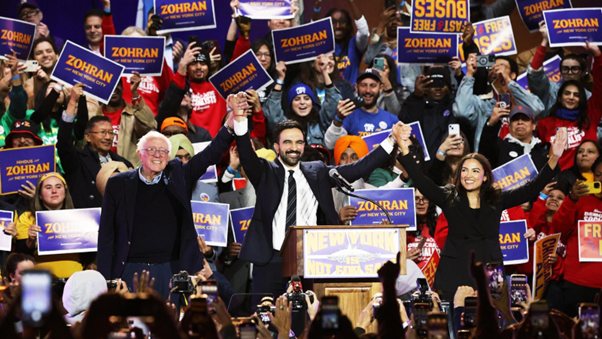
Bernie Sanders, Zohran Mamdani and Alexandria Ocasio-Cortez, the most prominent left-wing politicians of the Democrat Party, holding hands at a rally. Credit: ABC News 

Zohran Mamdani’s victory might not herald a new economic order, but it undeniably represents a new cultural mood: one where ideals of solidarity, justice, and public life are being reimagined. Can capitalism be “reformed” from within? Or must it be replaced by something else? Mamdani ‘s New York will prove a natural experiment for both questions. 

Sources:

Lucas Bernal  

Writer

Another War Arriving

Reading time: 8 minutes

Since the beginning of the year, relations between the United States and Venezuela have entered a particularly volatile phase. What began as U.S. efforts to counter alleged drug-trafficking networks operating out of Venezuela has escalated into a broader strategic standoff. Accusations, military posturing, and legal claims about sovereignty and intervention have sharpened the conflict and raised questions about international law, regional stability, and the future of U.S.–Venezuela diplomacy.

Image 1- Protest in Venezuela against U.S. actions. 

How the Crisis Started 

Since the beginning of his term, the Trump administration has linked Maduro’s regime to drug trafficking into the United States and the related problems these substances cause, such as crime and the growing influence of cartels. In 2020, during Trump’s first term, the Department of Justice issued a press release charging Nicolás Maduro and other senior Venezuelan officials with narco-terrorism, drug trafficking, and corruption. This shows that since his first term, Trump has associated Maduro with the drug trade and its consequences for the American population. This year, the White House decided to take more serious action regarding Venezuela. In August, Attorney General Pam Bondi decided to double the reward for information leading to Maduro’s arrest to $50 million. Soon after that, a stronger stance was adopted: an attack. On September 2, the U.S. Navy announced a strike on a vessel allegedly departing Venezuela and engaged in drug smuggling. The attack resulted in the deaths of 11 people and was seen as the first warning to Venezuela. Since then, the U.S. government has significantly expanded its operations in the Caribbean region, especially near Venezuela. For example, the Pentagon deployed an aircraft carrier group and other naval assets to the southern Caribbean as part of what the U.S. frames as “anti-narcotics operations.” 

The goals of the Trump administration 

As mentioned before, the U.S. describes the goal of this operation as a firm and protective stance against drug and crime cartels operating in the country. However, there might be other motives. Intelligence agencies—especially the National Intelligence Council—report that there is no conclusive evidence directly linking Maduro’s leadership to a centralized trafficking network. They also point out that Venezuela is neither a major cocaine nor fentanyl producer, nor a key transit point in narco-trafficking routes to the United States. This suggests that the White House has additional goals behind the operation. In addition to attempting to oust Maduro and push for regime change—intentions already hinted at publicly by the U.S.—two other motives stand out: asserting American strategic influence in Latin America and trying to gain leverage over Venezuela’s natural resources. The first comes from the growing Chinese economic and diplomatic involvement in the region. This has unsettled the Americans, and they have now adopted a new approach: align with Washington and receive benefits (as in Argentina’s case) or deviate and face costs, as happened with both Venezuela and, to some extent, Colombia. The second motive comes from suggestions that access to Venezuela’s vast oil and mineral resources is a secondary but key motive for this posture toward the South American country. For example, discussions allowing U.S. companies to regain access have appeared in reports surrounding the escalation. 

Image 2- Oil Reserves possessed by Venezuela

Venezuela’s reaction  

The Venezuelan government, led by Nicolás Maduro, has reacted strongly to all the U.S. moves and operations so far, treating them as a direct threat to national sovereignty and hinting at possible retaliation. Caracas has accused Washington of seeking regime change under the cover of a drug-war campaign. Seeing the need to be prepared, Venezuela is reportedly seeking military assistance from countries such as Russia, China, and Iran, requesting radar systems, aircraft repairs, and missile supplies to bolster its defenses. Maduro justifies these measures as necessary and has deployed warships, surveillance drones, and over 15,000 troops along Venezuela’s Caribbean coast and its border with Colombia. He has even called on civilian militias to enlist and train as part of a national defense posture, declaring, “In the face of this maximum military pressure, we have declared maximum preparedness for the defense of Venezuela.” Maduro also added that this was in response to the “eight military ships with 1,200 missiles and a submarine targeting Venezuela.” His Foreign Minister, Yván Gil, brought the matter to international forums, telling the United Nations that the U.S. deployment is “an illegal and completely immoral military threat hanging over our heads.” Caracas is thus positioning itself as being under siege by U.S. power, shifting the narrative away from drug trafficking and toward foreign aggression. He added that, according to UN data, only about 5% of cocaine exports allegedly pass via Venezuela, calling the U.S. narrative a “false narrative” aimed at regional destabilization. 

Image 3- Members of the Venezuelan army in a protest near UN headquarters in Caracas

International Reaction and Regional dilemma  

From the United Nations to Russia, these tensions have prompted a wide range of responses. The United Nations has repeatedly urged restraint by both the U.S. and Venezuela, warning that the military build-up and strikes risk regional peace and stability. For example, the UN noted that U.S. military deployments began in August 2025 and said any measure to counter trafficking must respect international law. In addition, at a UN Security Council meeting, multiple member states voiced concern; even some U.S. allies, such as France, Denmark, and Greece, joined the call for de-escalation and dialogue with Venezuela. Beyond the UN, both Russia and China have strongly condemned the U.S. military actions near Venezuela, calling them an “excessive use of force” and a violation of international law while reaffirming support for Venezuela’s sovereignty. Both countries maintain strategic energy and military ties with Venezuela, seeing the country as an important ally in the geopolitical chess of the region. Other reactions have come from the Caribbean states caught between support for U.S. anti-drug efforts and concern about militarization near their region. For example, Trinidad and Tobago’s Prime Minister aligned with U.S. security rhetoric, which drew both domestic support and regional unease. Brazil, for its part, is attempting a delicate balancing act: on one hand, it criticizes Venezuela’s democratic shortcomings (especially regarding elections and human rights), while on the other, it opposes external military intervention—such as by the U.S.—emphasizing sovereignty and the potential destabilization of the region. 

To sum up, the U.S.–Venezuela confrontation in 2025 has evolved from economic and diplomatic pressures into a much more confrontational and militarised phase. While the United States frames its actions as part of a fight against narco-trafficking and terrorism, Venezuela regards them as imperialistic and aimed at toppling the regime. With legal, military and diplomatic stakes rising, the risk of miscalculation or escalation is significant. All now turn to South America, a continent that has not seen an interstate military conflict since the 1990s, as it faces the alarming prospect of becoming the next front in this war-torn world. 

Sources:


Guilherme Mendonça  

Writer

Risk Repriced: How Political Instability Reshapes Market Confidence and Sovereign Costs 

Reading time: 8 minutes

When Markets Look At Politics 

We are used to thinking of financial markets as driven only by economic principles such as inflation, interest rate expectations, and growth forecasts. In this context, politics is background noise: unpredictable, difficult to quantify, and irrelevant to asset pricing. Yet this perception increasingly misrepresents reality. 

Political developments have become central to how markets interpret risk, reprice assets, and allocate capital.  

Nowadays, headlines from governments regularly trigger revaluations. Political uncertainty is growingly emerging as a source of volatility and a key determinant of sovereign borrowing costs. Every new cabinet announcement, legislative halt or budget negotiation is a signal investors have to price, quickly and with little margin for error.  

The uncertainty about future government actions may have a dual effect on market prices. In rare cases, it may represent policy flexibility against shocks. But in the majority of cases, it may actually reflect growing doubts about institutional resilience and future fiscal tracks. 

The market impact is clear: as stock prices respond to political news, political uncertainty leads to higher equity risk premium, increased asset correlation and consequently lower diversification benefits. 

To better understand how political turmoil can flow into financial markets, we can have a look at the most recent case: France. 

The French Distress 

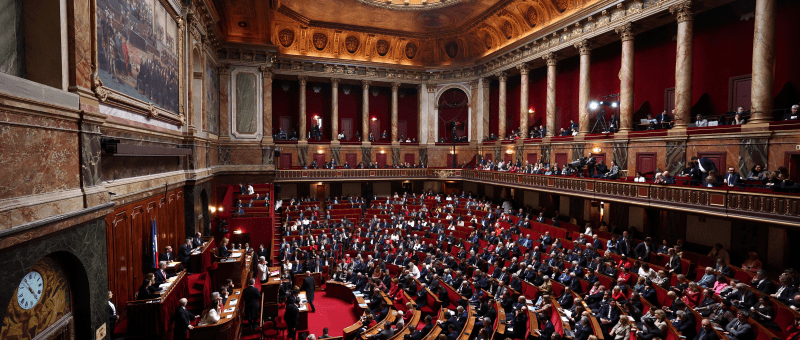
In October 2025, France dived into a serious political turbulence after the resignation of Prime Minister Sébastien Lecornu just one day after announcing his cabinet. It’s the collapse of the fifth prime minister in just two years, a statistic that points out not just instability but a deeper fracture in the French political system. 

Public surveys reveal despair, pessimism and distrust as the prevailing feelings in French citizens. Worrying symptoms representing the profound current democratic crisis, not even two years ahead of the next presidential election.  

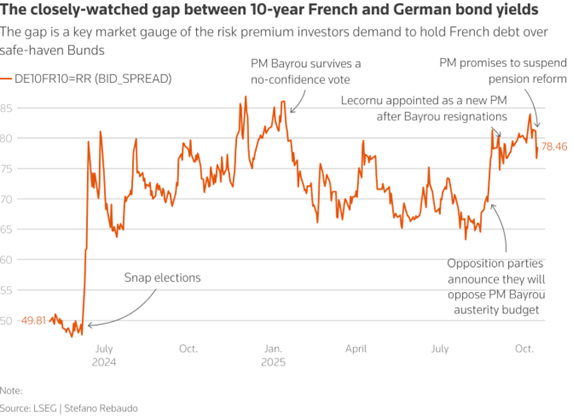
Financial markets, never known for patience but for how quickly they react, are clearly reflecting investors’ sentiment. Not surprisingly, French equity indices dropped, and bond markets did not do differently. For instance, yields on the 10-year French government bonds skyrocketed by 7-8 basis points, reaching around 3.58%.  The spread between French and German bond yields broadens as investors demand a premium for holding what they see as riskier sovereign debt.  

Figure 1: The yield gap widened sharply amid French political turmoil, reflecting rising investor risk premia on French debt. 
Source: LSEG via Reuters. 

The reason for this reaction? The answer is not that straightforward. No single event triggers the repricing by itself, but the clear loss of confidence in France’s fiscal policies plays an unequivocal role. The situation in France is getting complicated, both politically and economically.  

The general feeling speaks loud: France looks unable to find its way out of this malaise.  

Shifting Benchmarks 

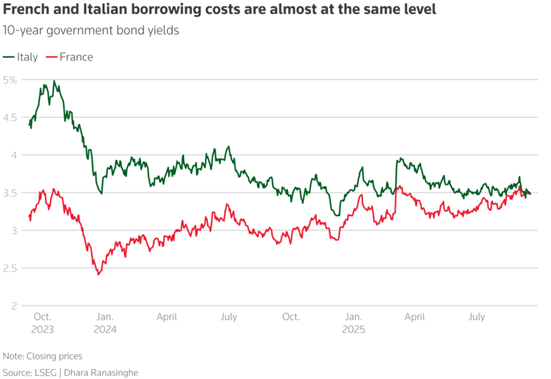
Historically, France was perceived as relatively safe within the Euro area bond markets. Italian bonds, instead, have been telling a different story so far. Yet, trends are changing.  

Figure 2: French (red) and Italian (green) 10-year government bond yields nearly converged in late 2025, reflecting France’s political turmoil (rising yields) versus relative stability in Italy (falling yields). Source: LSEG via Reuters. 

As French borrowing costs have risen, Italian yields have followed the opposite direction. This shows how perceptions around France, once considered a core market, and Italy, long seen as one of the weakest ones instead, have radically changed. Investors are concerned that France will not be able to improve its fiscal position due to its political instability, thus pushing up its bond yields. Different story for Italy, where relative political stability and downward debt forecast have caused its bond yields to decrease.  

But be careful. For some, the narrowing of the French-Italian bond spread has more to do with French fiscal and political distress than an improvement in Italy’s market.  

Italy has been afflicted by chronic problems that will take a long time to fix. We are still talking about the euro zone’s second-largest debt as a percentage of GDP after Greece, with a growth of the economy being obstructed by a concerning falling population and low female employment.  

Still, the convergence of French and Italian bond yields serves as a striking illustration of the implications of political stability and credible budgeting on investors’ confidence.  

Indeed, global investors nowadays look at governance quality in advanced economies pretty much as economic principles to adjust their required returns. 

Impact On Growth And Market Confidence 

Beyond market volatility, political instability carries important long-term economic costs. Empirical research on advanced economies has demonstrated that an uncertain politics can cause delayed investment decisions, hard policy execution, and undermined growth prospects. In fewer words, high levels of political instability can overall cause worse economic output. 

The reasons are pretty intuitive: when governments are fragile or policy direction is unclear, businesses and consumers lose confidence. Private sectors struggle to create expectations, while public institutions turn less effective in providing structural reforms.  

But as fragmented governments are not able to enact reform, public finances deteriorate. In France, the continuous change in leadership has paralysed the adoption of a new fiscal regime, delaying important decisions on expenditure and taxation. This creates a dangerous loop: as fiscal negligence decreases investor confidence, sovereign borrowing costs increase, which displace public spending, which in turn further constrains the ability to enact future reforms.  

France, for instance, has gone through five prime ministers in just two years, its national debt exceeding €3 trillion, and it seems unable to create a credible path towards fiscal balance.  

Figure 3: France holds the third-highest debt burden in the EU, after Greece and Italy, exceeding 110% of GDP. 
Source: Eurostat.

Globally, the political instability of an advanced economy as France can have both negative and positive spillover effects on other regions as well. On one hand, investors may require higher risk premiums also from other countries perceived as politically vulnerable. On the other hand, such instability may cause a flight-to-quality flows, as capital would flow towards safer bonds such as Germany Bunds or U.S. Treasuries.   

However, the coincident fiscal crises in multiple large economies, might result in a broader reallocation of global capital away from equities and emerging markets, thus potentially threatening global growth. 

Institutions such as the IMF and OECD have pointed out how political stability and consistent fiscal policies are not only priorities at the domestic level, but also the foundations of international market confidence and macroeconomic resilience. 

Conclusion 

What France is going through right now is not just a domestic drama. We are using this case as an understanding of what can be the costs of institutional fragility in a period of high debt and fiscal uncertainty. When governments and their reforms falter, consequences can be urgent: higher borrowing costs, downgraded credit ratings, eroded currencies, and constrained growth.  

If investors would once see political risk as background noise, now they price it in their models and we need to discuss it. The bond market has become a criterion of credibility, which rewards discipline and punishes obstructions.  

The message to policymakers is clear: good governance is capital. Stability, transparency, and consistency are no more mere abstract democratic values, but economic assets bringing yield. We are still in a post-pandemic context with high interest rates and insecurities, and policy incoherence is no longer tolerated. 

Preserving market trust is vital. Governments must now handle both budgets and expectations. Credibility can be the cheapest form of stimulus for those countries facing high debt and structural change. And as France is showing, once lost, it becomes the most expensive asset to restore. 

Sources: Reuters; Euronews; Financial Times; Fitch Ratings; Eurostat; LSEG via Reuters; IMF; OECD; ECB; Political Uncertainty and Risk Premia, by Lubos Pastor & Pietro Veronesi; European Journal of Political Economy; Political Instability and Economic Growth: Causation and Transmission, by Maximilian W. Dirks & Torsten Schmidt.

Rebecca Fratello 

Writer

US Aid Cuts Jeopardize Global HIV Prevention Efforts

Reading time: 3 minutes

In early 2025, the Trump administration implemented significant cuts to U.S. funding for HIV prevention programs, both domestically and internationally. These reductions have raised alarms among global health experts, who warn of potential setbacks in the fight against HIV/AIDS.

Impact on Global HIV Prevention

The U.S. President’s Emergency Plan for AIDS Relief (PEPFAR) has been a cornerstone in the global response to HIV/AIDS, providing two-thirds of international financing for HIV prevention in low- and middle-income countries. Since its inception in 2003, PEPFAR has saved over 26 million lives by investing in critical HIV prevention, treatment, care, and support programs across 55 countries.

However, a 90-day pause in U.S. foreign development assistance, initiated on January 20, 2025, disrupted these efforts. Although a waiver was issued to allow the continuation of life-saving humanitarian assistance, including HIV treatment, the pause created confusion and disrupted services at the community level. In Ethiopia, for instance, 5,000 public health worker contracts and 10,000 data clerk positions, crucial for HIV program implementation, were terminated.

The Global HIV Prevention Coalition warns that if U.S. funding is not restored, there could be an additional 8.7 million new HIV infections among adults, 350,000 among children, 6.3 million AIDS-related deaths, and 3.4 million additional AIDS orphans by the end of 2029.

Domestic Consequences

Domestically, the Centers for Disease Control and Prevention (CDC) has faced significant budget cuts, particularly in its Division of HIV Prevention. An analysis by amfAR indicates that increased funding to this division was associated with a nearly 20% reduction in new HIV infections across the U.S. between 2010 and 2022.

The proposed cuts threaten to reverse this progress. The CDC’s HIV prevention funding, which totaled about $1 billion in FY2024, supports state and local jurisdictions in conducting health surveillance and targeting communities effectively. Reductions in this funding could lead to increased HIV incidence, with negative implications for individual well-being, public health, and healthcare costs.

Organizational Restructuring and Layoffs

The administration’s broader restructuring efforts have also impacted HIV prevention. The CDC is undergoing a major reorganization, with several divisions, including those focused on HIV, set to become part of a new entity, the Administration for a Healthy America (AHA). This move follows significant downsizing, with the CDC workforce reduced by 3,500 to 4,000 through early retirements and layoffs.

Additionally, the Presidential Advisory Council on HIV/AIDS (PACHA) is being overhauled, with all members removed and no timeline provided for appointing new ones. These changes have raised concerns about the continuity and effectiveness of U.S. HIV policy.

Global Health Community’s Response

The global health community has expressed deep concern over these developments. UNAIDS Deputy Executive Director Christine Stegling emphasized that while treatment continuation is vital, prevention efforts are equally crucial to controlling the epidemic. She highlighted that the funding pause has led to the closure of many drop-in health centers and the termination of outreach workers’ contracts, depriving vulnerable groups of support.

The World Health Organization (WHO) also warned that prolonged funding cuts could reverse decades of progress, potentially taking the world back to the 1980s and 1990s when millions died of HIV each year globally.

Conclusion

The U.S. has played a pivotal role in global HIV prevention efforts. The recent funding cuts and organizational changes threaten to undermine years of progress, both domestically and internationally. Restoring and maintaining robust support for HIV prevention is essential to prevent a resurgence of the epidemic and to continue the global fight against HIV/AIDS.

Sources

https://www.reuters.com/business/healthcare-pharmaceuticals/trump-administration-plans-remove-all-members-hiv-advisory-council-2025-04-09

https://www.them.us/story/pepfar-hiv-aids-africa-marco-rubio-donald-trump

https://apnews.com/article/cdc-hiv-administration-for-a-healthy-america-8309109b91e6e4025878f335ea15dc96

https://www.ungeneva.org/en/news-media/news/2025/01/102724/unaids-welcomes-us-decision-keep-funding-life-saving-hiv-treatment

Afonso Freitas

Research Editor &Writer

Friendship and Social Capital

Reading Time: 5 minutes

Human Features as Capital? A brief history 

    In 1776, Adam Smith wrote, in An inquiry into the nature and causes of the wealth of nations, that “The acquisition of talents during education, study, or apprenticeship, costs a real expense, which is capital in a person. Those talents are part of his fortune and likewise that of society”. This idea might seem quite intuitive for an inhabitant of the world in the 21st century, and even the greenest economist would associate these words with the foundation of Human Capital.  

    However, until the last century, this concept was actually quite unpopular. As Theodore Shultz points out in Investment in Human Capital (1961), investment in human is not devoid of moral and philosophical issues. His words, “It seems to reduce man once again to a mere material component, to something akin to property”, are especially evocative, considering the 13th Amendment to U.S. constitution, which abolished slavery, had entered into force not even one century before.  

    With the advent of statistics and nation-level measurements in the period of WW2, researchers started to observe that increases in national output could not be fully explained by increases in physical capital. It became possible to link the accumulation of skills, capabilities and knowledge humans with these unexplained variations in growth.  

    Today, the World Bank defines Human Capital as “The knowledge, skills, and health that people invest in and accumulate throughout their lives, enabling them to realize their potential as productive members of society.” 

    But what aspects of the multifaceted human being are included in this definition? Reading further, the WB specifies: “Investing in people through nutrition, health care, quality education, jobs and skills helps develop human capital, and this is key to ending extreme poverty and creating more inclusive societies.”  

    Human Relationships as Capital  

      After accepting the “capitalization” of individual’s traits, a more recent step has been recognizing that humans are social animals, and therefore, their relationships are a fortune too. The concept of Social Capital generally refers to social relationships between people that have productive outcomes. In a nutshell, Portes (1998) explains it as “whereas economic capital is in people’s bank accounts and human capital is inside their heads, social capital inheres in the structure of their relationships”.  

      Social capital is for sure a peculiar form of capital: it does not reside in any individual entity, but it’s embedded in society, it lies in relationships, it’s rooted in networks. However, just like any other type of capital, it requires investment and maintenance to yield returns. 

      If defining the determinants of human capital is not an obvious task, defining those of social capital is even more challenging. The Institute for Social Capital indicates a range of dimensions including trust, togetherness, volunteerism, generalized norms, everyday sociability, and neighborhood connections.

      In essence, applying this theory, helping an old lady cross the street, having a neighbor who looks after your child when you’re sick, or trusting the police—all of these actions contribute to a web of reciprocity that will eventually benefit either the individual or the broader society. 

      Just as human capital was initially controversial, social capital was—and perhaps still is—a contested concept. For sure, its reputation increased after the publication of Making Democracy Work: Civic Traditions in Modern Italy by the political scientist Robert Putnam. Focusing on Italian regional governments, he found how government performance was strictly linked to traditions of civic engagement.  

      Friendship as Social Capital 

        Within this broader framework, friendship emerges as a particularly powerful and personal expression of social capital — one that not only supports emotional well-being but also shapes long-term economic and social outcomes. 

        If friendship is part of human capital, then it somehow has impacts that extend beyond the individual to society at large. And it might be more powerful than one can think. In a 2022 study on networks and friendships, Raj Chetty’s and colleagues found that education, racial segregation, education, and family structure were not as important as cross-class connections in determining upward social-mobility. In fact, among all observed components of social capital, friendship across socioeconomic lines was the only one driving mobility. Social cohesion and civic engagement, by contrast, did not seem to play a role.  

        The relationship between friends also shapes the social tissue of communities. In Bowling Alone, Putnam describes how American society, one strong and civic engaged, is now degrading through the whimsical metaphor of bowling. The evocation of many lonely bowlers, with a nostalgic comparison to bowling leagues playing together, reflects the individualist derive of society.  From this point of view, friendship and social interactions are a sort of public good, and not just a private comfort. The weaking of these relationships has consequences that go beyond individual loneliness, but undermine the health of society. 

        Relationships and Policy Makers 

          Friendships, connections, networks, and trust — they all contribute to both individual well-being and a healthier, more cohesive society. Yet we rarely hear politicians or policymakers address these topics directly. In an era where society is becoming increasingly individualistic, the case for investing in social capital becomes even more urgent. Urban planning, for instance, can be intentionally designed to promote cross-class connections and neighborhood friendships. The creation of public and recreational spaces that facilitate meeting and incentive people to socialize, promotion of sports and community strengthening activities can be impactful policies for boosting social capital. Reinvesting in friendships and ways of making them happen it’s not just about enhancing well-being, it’s a necessary step to rebuild a strong social fabric, that can sometimes be as important as and educated or healthy community. 

          Sources:

          Chetty, R., (2022). Social capital I: measurement and associations with economic mobility https://www.nature.com/articles/s41586-022-04996-4 

          Goldin, C. (2016). Human Capital. https://scholar.harvard.edu/files/goldin/files/goldin_human_capital.pdf

          Institute for Social Capital. https://www.socialcapitalresearch.com/literature/evolution/

          Putnam, R. D., Leonardi, R., & Nonetti, R. Y. (1993). Making Democracy Work: Civic Traditions in Modern Italy. Princeton University Press. https://doi.org/10.2307/j.ctt7s8r7 

          Putnam, R. D., “Bowling Alone: America’s Declining Social Capital” Journal of Democracy, January 1995, pp. 65-78. 

          Schultz, T. W. (1961). Investment in Human Capital. The American Economic Review, 51(1), 1–17. http://www.jstor.org/stable/1818907 

          World Bank: The Human Capital Project https://www.worldbank.org/en/publication/human-capital 

          Veronica Guerra

          Research Editor & Writer
          The Impact of Donald Trump’s Tariffs on Markets and International Trade 

          Reading Time: 5 minutes

          Tariffs have always been a contentious tool in global economic policy, and former President Donald Trump’s administration relied heavily on them to reshape America’s trade relationships. Trump’s approach to tariffs was characterized by the belief that they would protect American industries, reduce the trade deficit, and pressure foreign partners into negotiating more favorable deals for the United States. However, the actual effects of these tariffs have been complex and far-reaching, influencing everything from global supply chains to consumer prices. This article explores the potential and actual impacts of Trump’s tariffs on markets and international trade, offering examples, economic analysis, and perspectives from multiple sources. 

          What Are Tariffs and Why Did Donald Trump Use Them? 

          Tariffs are taxes imposed on imported goods. By making foreign goods more expensive, tariffs are intended to encourage consumers to buy domestic alternatives. Trump saw tariffs as a tool to reduce America’s trade deficit, particularly with China, and to protect domestic industries like steel, aluminum, and technology manufacturing. 

          Key Examples of Trump’s Tariffs: 

          • In 2018, Trump imposed a 25% tariff on steel imports and a 10% tariff on aluminum. 
          • In the same year, the administration slapped tariffs on $250 billion worth of Chinese goods, leading China to retaliate with tariffs on American products like soybeans, cars, and airplanes. 
          • In 2020, Trump threatened additional tariffs on European Union exports such as wine, cheese, and aircraft parts in retaliation for EU subsidies to Airbus. 

          How Tariffs Affect Domestic Markets 

          1. Higher Costs for Consumers 

          While tariffs target foreign producers, the actual cost burden often falls on domestic consumers. Importers pass higher costs onto consumers, making everything from cars to electronics more expensive. A study by the Federal Reserve Bank of New York estimated that by the end of 2019, Trump’s tariffs cost the average American household about $831 per year due to higher prices.  

          Example: When tariffs were imposed on washing machines in 2018, prices jumped nearly 12% within months, according to research published by economists at the University of Chicago and the Federal Reserve.  

          2. Disruption of Supply Chains 

          Many U.S. industries depend on imported components and raw materials. Tariffs on Chinese technology parts, for instance, disrupted the electronics and automotive sectors, which rely heavily on Chinese factories for affordable parts. This forced companies to either raise prices or absorb losses, weakening profit margins and investment. In the long run, some firms moved production out of China, but this led to higher transition costs and inefficiencies.  

          Impact on International Trade 

          1. Retaliatory Tariffs and Trade Wars 

          When the U.S. imposed tariffs, trading partners retaliated with their own tariffs. China targeted American agricultural exports, including soybeans, corn, and pork, hurting U.S. farmers who relied on the Chinese market. By mid-2019, U.S. agricultural exports to China had fallen by 53% compared to 2017. 

          Example: The American soybean industry suffered particularly harsh consequences. Before tariffs, China imported about $12 billion worth of U.S. soybeans annually. By 2019, that number dropped to under $3 billion. The U.S. government ended up subsidizing farmers to offset their losses, costing taxpayers billions. (Source: Bloomberg, 2019) 

          2. Erosion of Trade Alliances 

          Trump’s unilateral use of tariffs alienated key allies, including the European Union, Canada, and Mexico. When Trump imposed steel and aluminum tariffs, both Canada and the EU retaliated with tariffs on iconic American products, from Harley-Davidson motorcycles to bourbon whiskey. This strained long-standing trade relationships, particularly within the World Trade Organization (WTO) framework, which is built on predictable, rules-based trade.  

          Effects on Financial Markets 

          1. Market Volatility 

          Trump’s tariff announcements often led to immediate stock market swings. When tariffs on China were announced in March 2018, the Dow Jones Industrial Average plunged 724 points in a single day, reflecting investor fears of a full-blown trade war disrupting global economic growth.  

          2. Sectoral Winners and Losers 

          Some sectors benefited from protectionism, particularly domestic steel producers. However, industries reliant on steel (like automotive and construction) faced rising costs, eroding their competitiveness. Agricultural stocks, particularly in soybeans and pork, plummeted due to lost export markets.  

          Long-Term Economic Impacts 

          1. Reshoring vs. Offshoring Diversification 

          One goal of the tariffs was to bring manufacturing back to the U.S., a process called reshoring. Some companies did shift production, but many opted to diversify away from China to other low-cost countries like Vietnam, Mexico, and Thailand instead. This resulted in a fragmentation of global supply chains, increasing overall uncertainty.  

          2. Reduced Global Trade Growth 

          The uncertainty surrounding U.S. trade policy under Trump contributed to slower global trade growth. According to the World Bank, global trade growth fell from 5.4% in 2017 to just 1.1% in 2019, with tariffs playing a significant role.  

          Case Study: The U.S.-China Trade War 

          The most high-profile example of Trump’s tariff policy was the U.S.-China Trade War, which began in 2018. It involved escalating tariffs on hundreds of billions of dollars in goods on both sides. The conflict led to: 

          • Higher costs for American businesses and consumers. 
          • Reduced Chinese investment in the U.S.. 
          • A reshaping of Asian supply chains, with companies shifting production to Southeast Asia. 

          Ironically, despite Trump’s goals, the U.S. trade deficit with China actually increased in some sectors, as American companies stockpiled Chinese goods before tariffs took full effect.  

          Trump’s tariffs were a bold attempt to reset global trade dynamics, but the unintended consequences were significant. While they did pressure China into signing Phase One of a trade deal in 2020, they also: 

          • Raised prices for American consumers 
          • Hurt American exporters through retaliation 
          • Increased market volatility 
          • Weakened global trade growth 
          • Undermined trust in the international trade system 

          As the world moves with the Trump era, policymakers face the challenge of rebuilding stable trade relationships while addressing the legitimate grievances about unfair trade practices, especially concerning China’s industrial subsidies and intellectual property violations. Whether tariffs were the right tool for this job remains hotly debated, but their lasting impact on markets and international trade is undeniable. 

          Sources

          BBC, 2018; Peterson Institute for International Economics, 2020; Federal Reserve Bank of New York, 2019; Flaaen et al., 2019; Harvard Business Review, 2020; Congressional Research Service, 2020; CNBC, 2018; Reuters, 2018; Brookings Institution, 2020; Bloomberg, 2019; World Bank, 2020; Peterson Institute for International Economics, 2020.

          Afonso Freitas

          Research Editor & Writer