
Why Property Matters More Than Income 

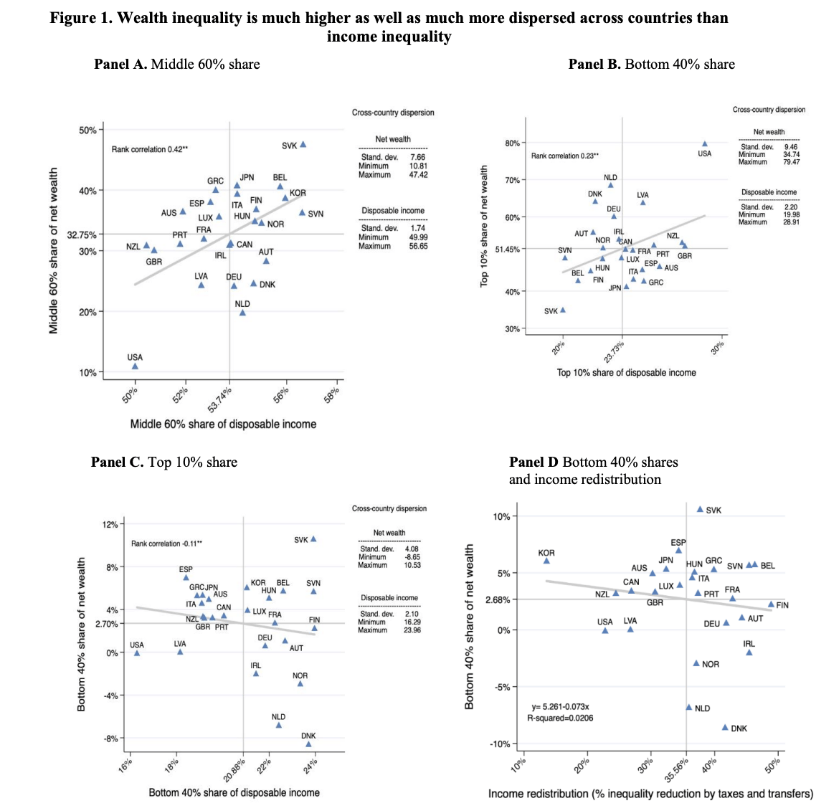
For a long time, inequality was mostly discussed in terms of income, jobs, and education. But in many rich countries today, the real difference is often about who owns property. Two households can earn similar salaries and still have very different futures if one owns a home and the other rents. Housing is no longer just a place to live. It is one of the main ways families build wealth, gain financial security, and pass advantages on to their children. Across OECD countries, wealth is much more unevenly distributed than income, the richest 10% of households own more than half of total household wealth on average, while the bottom half owns very little. 

Asset Inequality 

Income shapes what a household can afford today. Wealth shapes what it can survive, invest, and pass on tomorrow. This matters because wealth gives protection against unemployment, illness, rising prices, and economic shocks in a way that income alone often cannot. A household with a modest salary but a fully paid home may be much more secure than a household with the same salary, no assets, and high rent. Research on OECD shows that wealth inequality is greater than income inequality, and that housing makes up a large part of household wealth, especially for people outside the extremely richest groups. 

Housing is important because it is both something people need and something that can make them wealthier. Everyone needs a place to live, but people who own a home can slowly build value with it, benefit if house prices go up, and sometimes use it to borrow money. This gives housing a big effect on people’s financial security and future opportunities. That is why housing does not just show inequality but can also make it worse. 

Homeownership Creates Advantage 

Owning a home creates advantages in several ways. First, mortgage payments can gradually turn monthly housing costs into ownership. Rent, by contrast, pays for shelter but does not create an asset. Second, homeowners may benefit if the value of their property rises over time. Third, owning a home often brings more stability, since owners are usually less exposed to sudden rent increases or be forced to leave their home. Finally, housing wealth can later help pay for education, retirement, or children’s future home purchases. 

This means the gap between owners and renters increasingly looks like a class divide. Owners can build wealth while meeting a basic need. Renters usually cannot. Over time, that difference grows. A family that buys early may spend years building equity. A family that rents for the same period may face rising housing costs without gaining any asset in return. In this way, housing turns inequality from a matter of monthly income into a matter of long-term ownership. 

Why Buying A Home Is Getting Harder 

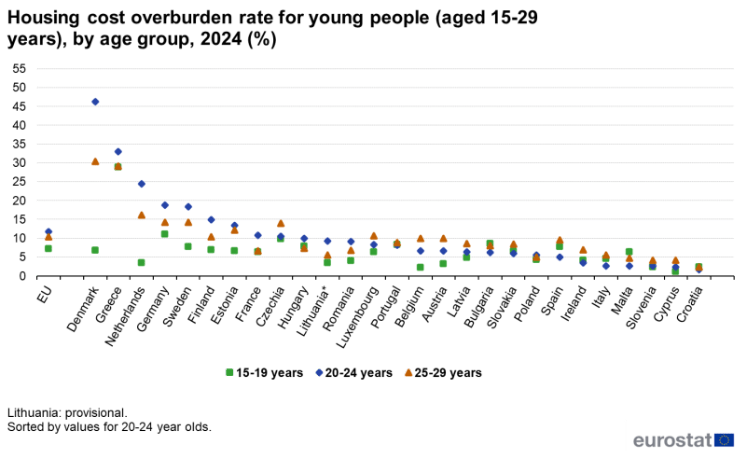
This would matter less if everyone had a fair chance to buy a home. But entering the housing market has become more difficult, especially for young people. House prices have risen sharply in many places. Down payments are harder to save for. Credit rules are often stricter. And high rents make saving even harder. Eurostat data shows that in some EU countries, young people spend a very large share of their income on housing.  

This matters because high rent does not only create pressure in the present, but it also reduces the ability to save for the future. The result is a cycle, those who already own homes benefit when prices rise and those who do not own face a higher barrier to entry every year. In this sense, the housing market often rewards those who are already inside it while making it harder for outsiders to enter. 

Figure 2 – Housing cost overburden by age group 

Inherited Wealth 

This is where the issue becomes generational. When homes become so expensive that wages alone are not enough to buy one, family wealth starts to matter much more. Parents may help with a down payment, give property directly, or leave an inheritance that makes homeownership possible. In that kind of system, access to property depends less on current income and more on whether someone’s family already owns assets. 

OECD evidence suggests this is not a small issue. In several European countries, a significant share of low-income homeowners got their homes through inheritance or gifts rather than through purchase alone. OECD research on inheritance also shows that wealth transfers tend to increase inequality, because the people who receive inheritance are often already better off.  

This does not mean income no longer matters. Salaries still affect daily life, access to credit, and the ability to pay a mortgage but income alone matters less when wealth already gives some people a head start. A good salary helps, but it may still not be enough to buy a home without family support. At the same time, a household with inherited property may enjoy more security and wealth growth than a renter with a higher income.  

The Political and Social Effects 

When property matters more than income, the effects go beyond money. Homeownership can shape access to better neighborhoods, better schools, more stability, and greater security in old age. It also affects politics. Existing homeowners often benefit from rising house prices and may oppose reforms that would lower them, even if those reforms would help younger or poorer households. 

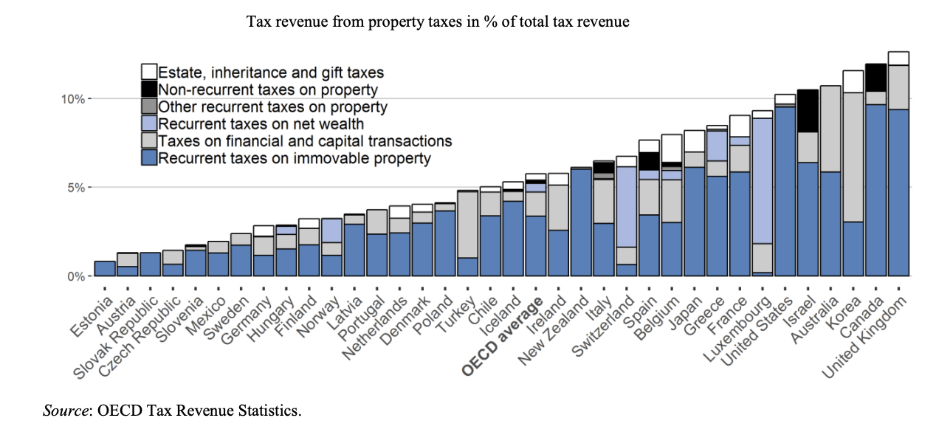
This helps explain why housing policy is so difficult. Building more homes, changing zoning laws, expanding social housing, or taxing property more effectively could improve access for people outside the market. But these policies may conflict with the interests of people who already own property. As the World Bank has noted, housing affordability is not only a social issue, but it can also reduce labor mobility and stop young people from moving to places where the best jobs are. 

Figure 3 – OECD countries have ample room to shift the tax burden towards property taxes 

Conclusion 

The class division today is not just between people with high salaries and people with low salaries. More often, it is between people who own property and people who do not. Housing is the clearest example, because owning a home can give families more than shelter, it can give them wealth, stability, and something to pass on to their children. As buying a home becomes harder, and more dependent on family support, inequality becomes more deeply rooted across generations. If this trend continues, what matters most may not be who earns the most, but who already owns something valuable. 

Sources:

Margarida Ferreira

Writer

M-pesa: How Mobile Money Transformed Financial Inclusion and Redefined Development Finance 

A Cash Economy Meets a Mobile Network

In 2007, M-Pesa was launched by Kenya, soon to become one of the most influential financial innovations in development economics. The platform was developed by Safaricom with support from Vodafone, with the aim of allowing users to send and receive money through basic mobile phones. A simple payment solution at first glance, but life changing at its roots.

Before M-Pesa, most Kenyans were under a cash-dominated and largely informal economy: bank branches concentrated in urban centres, restrictive documentation requirements, and minimum balance conditions excluding low-income households. For rural families, sending money often meant physically transporting cash or relying on informal couriers, both costly and risky.

M-Pesa was an alternative to this. Using SMS-based USSD technology, no traditional bank account was needed. Users could use basic mobile phones without internet connectivity, being able to deposit cash with local agents, store value electronically, and transfer funds instantly. In other words, it wasn’t a simple payment application, but a new layer of digital financial infrastructure.

Financial Inclusion as a Driver of Development

Financial inclusion has been theoretically and empirically demonstrated to be a catalyst for economic growth. By granting access to savings mechanisms, credit, and secure payment systems, households can smooth consumption, invest in education and healthcare, and manage economic risk. In other words, households are opened doors towards productivity and resilience.

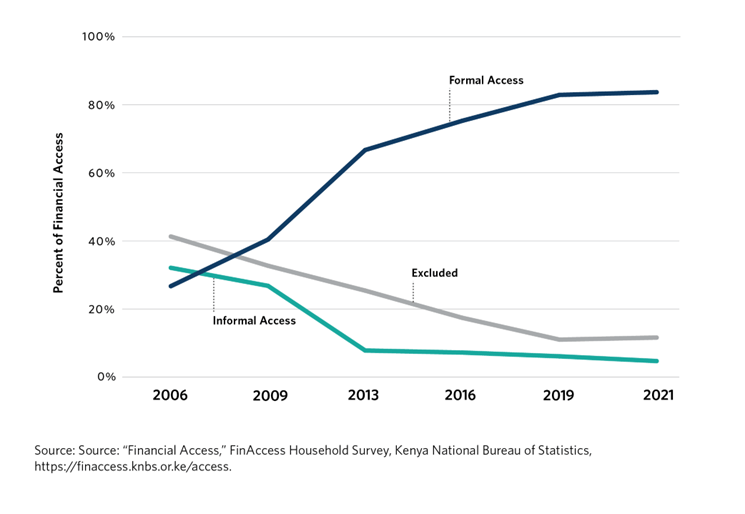
The traditional way in which Kenyans would manage their money was highly inefficient and vulnerable to theft or loss. But with M-Pesa, financial access started moving from informal networks to formal digital systems.

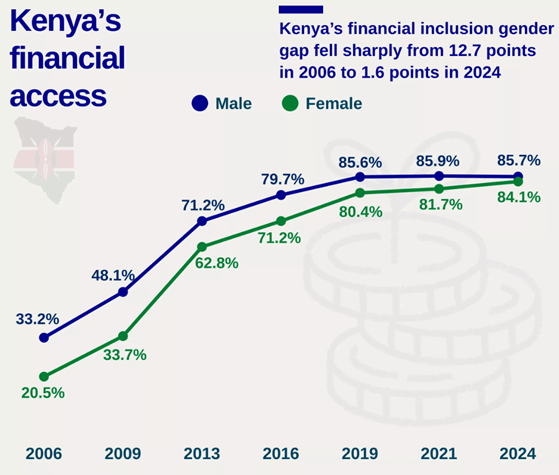
Financial Inclusion Measured by Access in Kenya (2006–2021).

Informal reliance and outright exclusion dropped, and as shown by data, digital finance brought millions of people into the formal system.

With M-Pesa, sending money became instantaneous and significantly safer. Migrant workers in urban centres could transfer funds to relatives in rural areas without intermediaries. According to research by Tavneet Suri and William Jack, access to M-Pesa lifted around 2% of Kenyan households out of extreme poverty between 2008 and 2014.

However, aggregate expansion tells only part of the story. The distribution of access across gender reveals a deeper transformation.

Share of Male and Female Adults (18+) Who Are Financially Included, 2006–2024.

The financial inclusion gender gap, which exceeded 12 percentage points in 2006, narrowed dramatically over time. For instance, M-Pesa’s impact was particularly determining for women. After obtaining access to mobile financial services, many of them evolved from subsistence agriculture to small-scale retail and entrepreneurial activities. Barriers to entry were reduced, hence expanding economic agency and participation across previously excluded groups.

These trends speak loudly. When remittances become reliable and affordable, labour mobility increases, local businesses gain liquidity, and households become more resilient to shocks. A true structural economic change. Digital financial infrastructure can therefore function as a quasi-public good, even when delivered by a private company.

Fintech Innovation in a Low-Income Context

Clearly, M-Pesa emerged from a developing economy responding to local constraints, definitely not a high-income technology. Hence, the system was designed for simplicity and scalability. USSD technology allowed even the most basic phones to participate in the digital economy.

From a fintech perspective, M-Pesa demonstrates the power of platform-based financial ecosystems. Over time, the service expanded beyond peer-to-peer transfers to include bill payments, salary disbursement, merchant services, savings accounts such as M-Shwari, and microcredit products. Hence, as other fintech cases, the platform soon evolved into an integrated financial ecosystem operating hand in hand with traditional banks.

This trajectory challenges classical assumptions in financial development theory. Conventional models often suggest that financial deepening requires the gradual expansion of banking institutions, physical branches, and formal credit markets. Kenya experienced a form of technological “leapfrogging,” bypassing intermediate stages by leveraging widespread mobile penetration to accelerate financial integration.

Such a leapfrogging effect has inspired similar systems across Sub-Saharan Africa and parts of Asia, including Tanzania, Ghana, and Bangladesh. In several African economies, mobile money accounts now outnumber traditional bank accounts. However, adoption rates remain uneven across the continent, reflecting differences in infrastructure, regulation, and market structure.

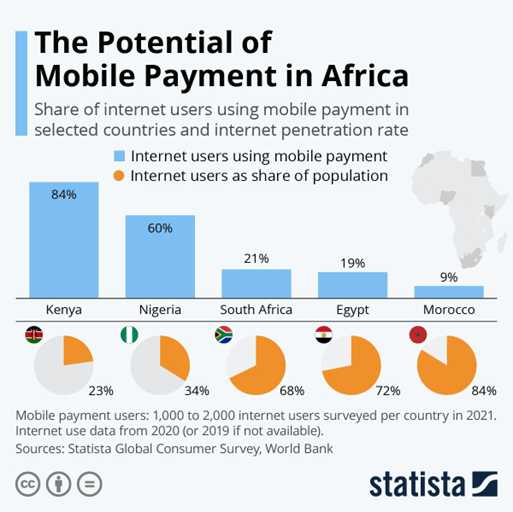
The Potential of Mobile Payment in Africa.

In particular, Kenya’s position within the African digital payments landscape shows both the scale of its transformation and the broader potential of mobile finance.

Macroeconomic And Structural Impacts

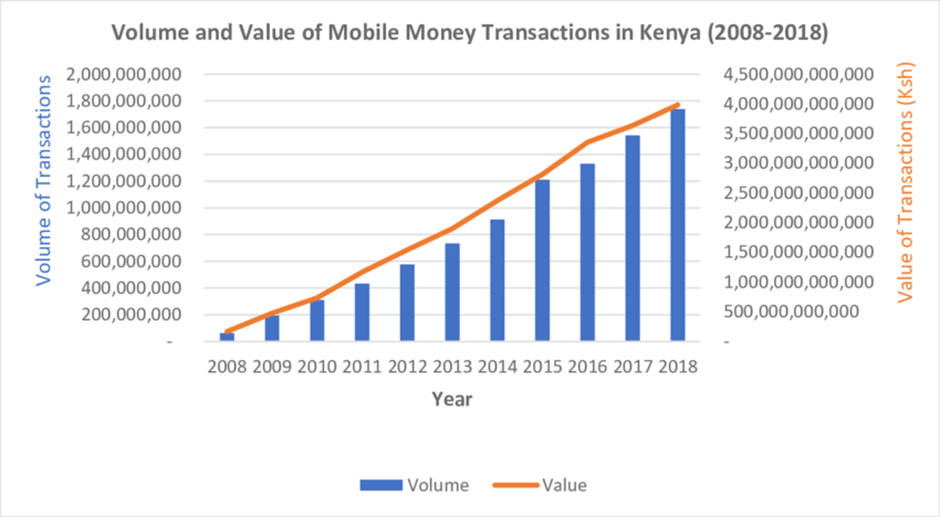
M-Pesa’s influence goes much beyond household-level outcomes. Over the past decade, both the volume and total value of mobile money transactions have increased exponentially, signalling the system’s growing macroeconomic significance.

Volume and Value of Mobile Money Transactions in Kenya (2008–2018).

The Central Bank of Kenya reports that mobile transactions now account for a substantial share of national GDP.

Moreover, digital transaction histories provide valuable data. Typically, in development economics, information asymmetry (where lenders lack reliable information about borrowers) constraints credit markets. But by creating digital financial records, mobile money platforms mitigate such a barrier. Thus, M-Pesa contributes to the formalisation of informal economic activity, increasingly including small-scale entrepreneurs into broader financial networks.

However, rapid expansion introduces regulatory complexities. Safaricom’s dominant position in the Kenyan market has raised concerns regarding competition and interoperability. It’s essential that policymakers balance innovation with financial stability, consumer protection, and data privacy safeguards. Digital infrastructure can promote inclusion, but it also concentrates power if regulatory frameworks do not evolve accordingly.

Challenges And Future Prospects

M-Pesa’s success has transformed it from a financial innovation into a pillar of Kenya’s economic infrastructure. With that scale comes new complexity. As mobile money underpins remittances, small businesses, and even public transfers, digital platforms increasingly carry systemic importance. Operational failures, cybersecurity risks, or governance weaknesses would now have economy-wide consequences.

Market concentration and data governance present additional challenges. Safaricom’s dominance strengthens network efficiency, yet it raises concerns about competition and interoperability. At the same time, vast volumes of transactional data improve credit access but intensify debates over privacy, surveillance, and algorithmic fairness. Financial inclusion must therefore evolve alongside regulatory capacity.

The broader lesson is that inclusion is not static. As fintech ecosystems become more sophisticated, digital literacy gaps and unequal access to technology risk creating new forms of exclusion. M-Pesa’s future will depend not only on technological expansion, but on institutional design, ensuring that innovation remains inclusive, competitive, and resilient.

In this sense, the Kenyan experience does not mark the end of a development story, but the beginning of a new policy frontier: how to govern digital finance as a public economic utility.

Sources: World Bank Global Findex Database; Central Bank of Kenya Annual Reports; Suri, T. & Jack, W. (2016), The Long-Run Poverty and Gender Impacts of Mobile Money, Science; GSMA State of the Industry Report on Mobile Money; Safaricom Annual Reports; MIT News; Financial Times; United Nations Development Programme.

Rebecca Fratello 

Writer

Is There An AI Bubble: A Structural Analysis 

As we conclude 2025, the debate around the “AI bubble” has clearly shifted from a mere discussion of technological potential to a worried interrogation of financial sustainability. After three years of persistent AI investments following ChatGPT’s launch, the sector is now going through slowing growth expectations, skyrocketed capital costs, and doubts around future profitability. 

Whether to the upside or downside, AI currently is and will be the main driver of the returns in the public equity market. But to allocate capital in the market, investors must feel confident that what is going on is not indeed a bubble burst.  

What Defines a Bubble 

A financial bubble happens when asset prices are substantially higher than their fundamental values. Investors go long (buy) when they believe an asset is undervalued, meaning it is priced under its fair price. But as prices keep rising, investors’ motivation changes, with the focus shifting from how much the asset is valued towards how much higher it can still go.  

To determine whether the current AI cycle represents a true financial bubble, we can evaluate it against the phases defined by Charles Kindleberger and Hynan Minsky. 

Displacement 

 
Everything starts from an innovation that fundamentally changes the perceived profit opportunities in a major sector. The launch of ChatGPT in late 2022 acted as the catalyst triggering a regime where technology was not simply considered a tool anymore, but rather a “New Era” of boundless productivity.  

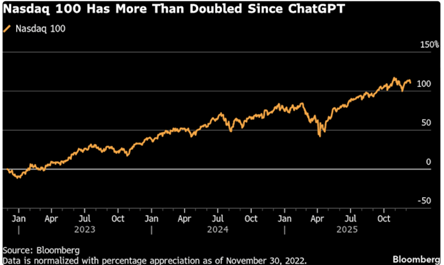
Nasdaq-100 market value growth. 

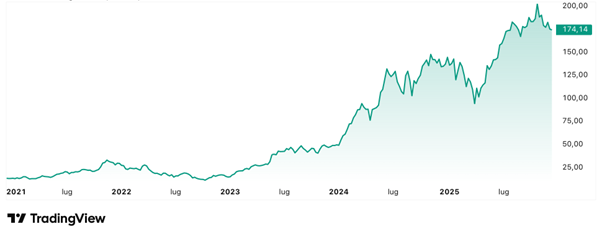
Over the last 5 years, NASDAQ-100 has delivered a total return of approximately 120.6%, representing a compound annual growth rate of 17.1%. An initial growth was driven by the post-pandemic digital shift, but the true catalyst was indeed the launch of ChatGPT. 

Boom and Euphoria 

Stability in this phase is officially destabilized. The sustained performance of AI leaders has been increasingly convincing lenders and regulators that the system was safe, leading to a weakening of credit discipline.  

By 2025, the most profitable four technology companies at the global level are borrowing at rates that we haven’t seen so far since the telecom bubble to build infrastructure for demand that potentially may never arrive.  

Only in 2025, Amazon, Google, Microsoft, and Meta invested over $400 billion on AI infrastructure, with current expectations according to Man Group of even $3 trillion over the next five years. Bain & Company estimated that to justify such CAPEX, such companies should generate $2 trillion in new AI revenue by 2030, literally a 100x increase from the current $20 billion baseline.    

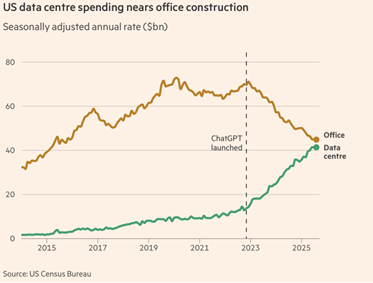
For example, since 2022, US investment has shifted away from typical office construction towards data centres, reflecting the rapid expansion in AI-driven infrastructure. 

US spending: Office construction vs. Data centre infrastructure

One of the biggest concerns about this is the change in strategy it deep down represents. The value of Big Tech was typically based on the ability to generate quick revenue growth at low costs, resulting in great free cash flows. However, their AI choices have now turned this model upside down. 

This level of investment is extraordinary. At its peak, the 5G telecom buildout deployed about 70% of operating cash flows. AI infrastructure is going in the same direction. Hyperscalers are trying to power their own workloads, while AI developers are trying to train large language models (LLMs). Hence, big tech stocks have risen, but if computing supply is limited by insufficient power, then the AI bubble could deflate.  

This bubble is indeed concentrated in such Magnificent Seven, which drive much of the S&P 500’s daily price moves. If their valuations fall, several portfolios will take a hint, even for people who think they are merely passively saving for retirement. 

Panic 

Analysts are keeping under control the Minsky Moment, that is the point where the system turns into a Ponzi scheme.  A Ponzi scheme can be thought of as a scam scheme that promises a high return with little risk to new investors, relying on the word-of-mouth spreading about the big returns earned by early investors. Ultimately, if the flow of new investments slows down, it becomes impossible to pay out those supposed profits. That is when the Ponzi scheme collapses.  

At this stage, borrowers cannot afford the repayment of their debt from current operations and must completely rely on rising asset prices to meet their obligations.  

If we look at the 2025 AI cycle, signs of a Minsky Moment include: 

  • Accounting Illusions: The systemic extension of GPU depreciation schedules from 3-4 years to 6 years, which potentially masks a $176 billion earnings impairment “time bomb”. 
  • Credit Signals: Rising costs in Credit Default Swaps (CDS) for firms like Oracle (which hit a record 1.26% spread) suggest that lenders are beginning to reassess the risk of CapEx-heavy balance sheets.    
  • The Funding Gap: A projected $1.5 trillion shortfall in the capital needed for data center buildouts between 2025 and 2028, forcing a dangerous reliance on private credit and high-yield debt to keep the cycle alive. 

This suggests that a “Panic” or “Profit-taking” phase could be triggered once a critical mass of investors realises that the forecasted 100x revenue growth will not materialise within the 2-3 year lifespan of the current hardware. 

Nvidia As Barometer 
 
Many look at Nvidia as the current market’s most reliable signal for whether the AI boom is grounded on reality or a fable of excess. We are talking about the main supplier of chips powering LLMs and data centres, hence its revenues are said to reflect actual AI spending. In other words, it is the heart of the AI infrastructure.  
 
The stock has indeed become a proxy for the health of the overall AI ecosystem. When Nvidia’s stock price surges, it supports the confidence that AI is a productive investment, but when it falls, it creates doubts about whether capital is invested faster than what revenues justify.  
 
No other company has benefited from AI spending than Nvidia. The stock, indeed, has surged alongside unprecedented GPU orders from cloud providers.  

Nvidia 5-years stock market price.

Key here is the chosen depreciation policy. Tech giants have lengthened their server lifespans on the books to six years. However, Nvidia’s products are made to be changed every year, making older chips obsolete and less energy-efficient.  

For Nvidia, the next steps will rely on execution rather than hype. Markets are already watching closely to see whether hyperscalers will keep their capex as depreciation costs increase, whether demand will expand beyond a few dominant players, and whether AI revenue growth can cover the scale of infrastructure investments.  

Big Tech Depreciation expenses growth. 

In particular, rising depreciation costs are pressuring buybacks and dividends, that is return for stockholders. In 2026, major actors as Meta and Microsoft are even expected to have negative free cash flows after accounting for shareholder returns.  
 

If Nvidia will maintain a positive performance against those questions, it may actually fade bubble fears. Otherwise, its share price will reflect a market that changes expectations. 

Conclusion 

If on one hand fears of an upcoming bubble may be premature, the era of unquestioned enthusiasm is fading away in front of our eyes. Most analysts are not expecting a dramatic collapse as with the dot-com bust. Nowadays AI leaders are far bigger, more profitable, and better capitalised than their late ‘90s counterparts. According to experts, what might actually happen, instead, is a change within the AI trade, with investors favouring companies that have clear cash flow generations and scalability, against historically expensively valued names relying on flawless execution. 

Sources:

Financial Times; Investopedia; Yahoo Finance; Bloomberg; Bain & Company; Business Insider; BBC; CNBC. 

Rebecca Fratello 

Writer

Risk Repriced: How Political Instability Reshapes Market Confidence and Sovereign Costs 

Reading time: 8 minutes

When Markets Look At Politics 

We are used to thinking of financial markets as driven only by economic principles such as inflation, interest rate expectations, and growth forecasts. In this context, politics is background noise: unpredictable, difficult to quantify, and irrelevant to asset pricing. Yet this perception increasingly misrepresents reality. 

Political developments have become central to how markets interpret risk, reprice assets, and allocate capital.  

Nowadays, headlines from governments regularly trigger revaluations. Political uncertainty is growingly emerging as a source of volatility and a key determinant of sovereign borrowing costs. Every new cabinet announcement, legislative halt or budget negotiation is a signal investors have to price, quickly and with little margin for error.  

The uncertainty about future government actions may have a dual effect on market prices. In rare cases, it may represent policy flexibility against shocks. But in the majority of cases, it may actually reflect growing doubts about institutional resilience and future fiscal tracks. 

The market impact is clear: as stock prices respond to political news, political uncertainty leads to higher equity risk premium, increased asset correlation and consequently lower diversification benefits. 

To better understand how political turmoil can flow into financial markets, we can have a look at the most recent case: France. 

The French Distress 

In October 2025, France dived into a serious political turbulence after the resignation of Prime Minister Sébastien Lecornu just one day after announcing his cabinet. It’s the collapse of the fifth prime minister in just two years, a statistic that points out not just instability but a deeper fracture in the French political system. 

Public surveys reveal despair, pessimism and distrust as the prevailing feelings in French citizens. Worrying symptoms representing the profound current democratic crisis, not even two years ahead of the next presidential election.  

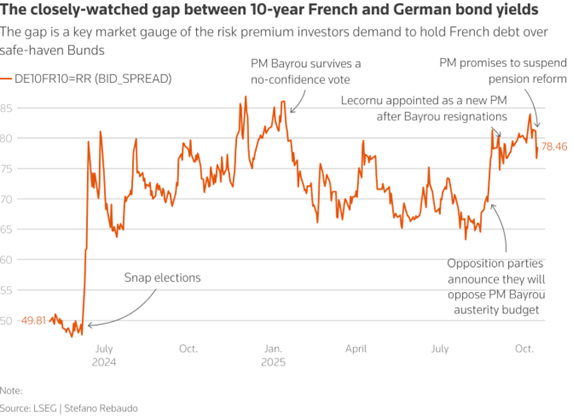
Financial markets, never known for patience but for how quickly they react, are clearly reflecting investors’ sentiment. Not surprisingly, French equity indices dropped, and bond markets did not do differently. For instance, yields on the 10-year French government bonds skyrocketed by 7-8 basis points, reaching around 3.58%.  The spread between French and German bond yields broadens as investors demand a premium for holding what they see as riskier sovereign debt.  

Figure 1: The yield gap widened sharply amid French political turmoil, reflecting rising investor risk premia on French debt. 
Source: LSEG via Reuters. 

The reason for this reaction? The answer is not that straightforward. No single event triggers the repricing by itself, but the clear loss of confidence in France’s fiscal policies plays an unequivocal role. The situation in France is getting complicated, both politically and economically.  

The general feeling speaks loud: France looks unable to find its way out of this malaise.  

Shifting Benchmarks 

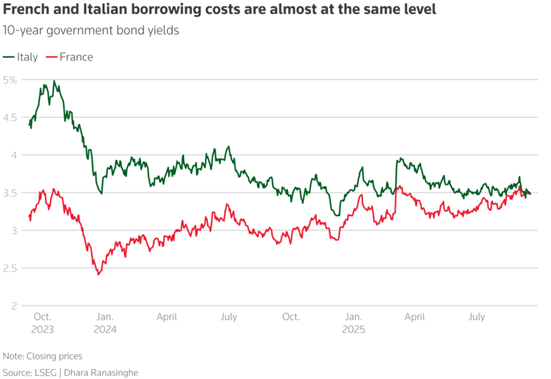
Historically, France was perceived as relatively safe within the Euro area bond markets. Italian bonds, instead, have been telling a different story so far. Yet, trends are changing.  

Figure 2: French (red) and Italian (green) 10-year government bond yields nearly converged in late 2025, reflecting France’s political turmoil (rising yields) versus relative stability in Italy (falling yields). Source: LSEG via Reuters. 

As French borrowing costs have risen, Italian yields have followed the opposite direction. This shows how perceptions around France, once considered a core market, and Italy, long seen as one of the weakest ones instead, have radically changed. Investors are concerned that France will not be able to improve its fiscal position due to its political instability, thus pushing up its bond yields. Different story for Italy, where relative political stability and downward debt forecast have caused its bond yields to decrease.  

But be careful. For some, the narrowing of the French-Italian bond spread has more to do with French fiscal and political distress than an improvement in Italy’s market.  

Italy has been afflicted by chronic problems that will take a long time to fix. We are still talking about the euro zone’s second-largest debt as a percentage of GDP after Greece, with a growth of the economy being obstructed by a concerning falling population and low female employment.  

Still, the convergence of French and Italian bond yields serves as a striking illustration of the implications of political stability and credible budgeting on investors’ confidence.  

Indeed, global investors nowadays look at governance quality in advanced economies pretty much as economic principles to adjust their required returns. 

Impact On Growth And Market Confidence 

Beyond market volatility, political instability carries important long-term economic costs. Empirical research on advanced economies has demonstrated that an uncertain politics can cause delayed investment decisions, hard policy execution, and undermined growth prospects. In fewer words, high levels of political instability can overall cause worse economic output. 

The reasons are pretty intuitive: when governments are fragile or policy direction is unclear, businesses and consumers lose confidence. Private sectors struggle to create expectations, while public institutions turn less effective in providing structural reforms.  

But as fragmented governments are not able to enact reform, public finances deteriorate. In France, the continuous change in leadership has paralysed the adoption of a new fiscal regime, delaying important decisions on expenditure and taxation. This creates a dangerous loop: as fiscal negligence decreases investor confidence, sovereign borrowing costs increase, which displace public spending, which in turn further constrains the ability to enact future reforms.  

France, for instance, has gone through five prime ministers in just two years, its national debt exceeding €3 trillion, and it seems unable to create a credible path towards fiscal balance.  

Figure 3: France holds the third-highest debt burden in the EU, after Greece and Italy, exceeding 110% of GDP. 
Source: Eurostat.

Globally, the political instability of an advanced economy as France can have both negative and positive spillover effects on other regions as well. On one hand, investors may require higher risk premiums also from other countries perceived as politically vulnerable. On the other hand, such instability may cause a flight-to-quality flows, as capital would flow towards safer bonds such as Germany Bunds or U.S. Treasuries.   

However, the coincident fiscal crises in multiple large economies, might result in a broader reallocation of global capital away from equities and emerging markets, thus potentially threatening global growth. 

Institutions such as the IMF and OECD have pointed out how political stability and consistent fiscal policies are not only priorities at the domestic level, but also the foundations of international market confidence and macroeconomic resilience. 

Conclusion 

What France is going through right now is not just a domestic drama. We are using this case as an understanding of what can be the costs of institutional fragility in a period of high debt and fiscal uncertainty. When governments and their reforms falter, consequences can be urgent: higher borrowing costs, downgraded credit ratings, eroded currencies, and constrained growth.  

If investors would once see political risk as background noise, now they price it in their models and we need to discuss it. The bond market has become a criterion of credibility, which rewards discipline and punishes obstructions.  

The message to policymakers is clear: good governance is capital. Stability, transparency, and consistency are no more mere abstract democratic values, but economic assets bringing yield. We are still in a post-pandemic context with high interest rates and insecurities, and policy incoherence is no longer tolerated. 

Preserving market trust is vital. Governments must now handle both budgets and expectations. Credibility can be the cheapest form of stimulus for those countries facing high debt and structural change. And as France is showing, once lost, it becomes the most expensive asset to restore. 

Sources: Reuters; Euronews; Financial Times; Fitch Ratings; Eurostat; LSEG via Reuters; IMF; OECD; ECB; Political Uncertainty and Risk Premia, by Lubos Pastor & Pietro Veronesi; European Journal of Political Economy; Political Instability and Economic Growth: Causation and Transmission, by Maximilian W. Dirks & Torsten Schmidt.

Rebecca Fratello 

Writer

The Interesting System of a Islamic Finance

“Those who consume interest cannot stand [on the Day of Resurrection] except as one stands who is being beaten by Satan into insanity. That is because they say, “Trade is [just] like interest.” But Allah has permitted trade and has forbidden interest. So, whoever has received an admonition from his Lord and desists may have what is past, and his affair rests with Allah. But whoever returns to [dealing in interest or usury] – those are the companions of the Fire; they will abide eternally therein.”

— Qur’an – Surah Al-Baqarah [2:275]

““O you who have believed, fear Allah and give up what remains [due to you] of interest, if you should be believers.”
And if you do not, then be informed of a war [against you] from Allah and His Messenger. But if you repent, you may have your principal – [thus] you do no wrong, nor are you wronged.

— Qur’an – Surah Al-Baqarah [2:278-279]

If you wish to hear the recitation of the verses, links are provided here: 2:275; 2:278; 2:279


These three quite ominous verses sum up, succinctly and clearly, what grim fate Allah has planned for those who deal in interest. However, it might be more accurate to say riba (ربا), rather than interest. Indeed, it could be argued that translations of the verses above which keep riba untranslated are more accurate. (Truthfully, any version of the Qur’an in English could be classified as unduly westernized.) This Arabic word’s original meaning is something along the lines of “increase”, “excess” or “addition” but is now primarily used to refer to the practice of interest or usury.


  • Some defend that riba doesn’t apply to all interest but, rather, only to unusually high interest-rates: usury. There is a lot of Islamic literature which equates riba with interest and that claims that there is a consensus amongst Muslim scholars that this is so.

There are many justifications given by religious scholars for the banning of interest by Allah, namely claiming that lending with interest is exploitative and that the lender/borrower relationship created undermines the spirit of brotherhood that should exist amongst Men. This religious ideal is not unique to Islam. Indeed, other Abrahamic religions have things to say about interest:

“Do not charge interest on the loans you make to a fellow Israelite, whether you loan money, or food, or anything else.”

Holy Bible – Deuteronomy [23:19]

Human beings’ innate fear of falling in eternally burning fires and our puzzling love for masochistic submission to an almighty father figure came together in the Muslim world to create a Sharia-compliant banking system commonly referred to as Islamic Banking. In broad terms, to be in accordance with Allah, Islamic banks must not receive nor pay interest and must not invest in or involve themselves with businesses which partake in haram (forbidden) activities, such as selling alcohol, pork, gambling, etc.

Now, the question lingering in everyone’s minds: “How do these institutions function?”

In Islamic Banking, the most common way of financing is what is called Murabaha. It is, essentially, a contract of sale in which the bank buys a good that its client needs and then sells it to him with a previously agreed upon mark-up cost. Say, for instance, that you need a new set of tables for your restaurant. The bank buys said set of tables from the table-maker at X€ and sells them to you at X+P€, an amount that you pay through deferred payments.

Imagem1.png

I don’t need a revelation from Allah to know that many of my esteemed readers are scratching their heads in utter confusion trying their hardest to understand how such a transaction amounts to anything different than paying interest on a loan. Is it just interest with extra steps? Indeed, this is a criticism which Murabaha-type financing receives in ample amount, implying, therefore, that it is not Shariah compliant. However, since this removes the much-frowned-upon aspect of “money generating money on its own” and involves specific commodities, supposedly, Allah is pleased. And so, in spite of its criticisms, Murabaha contracts are calculated to represent about 80% of total financing made by Islamic Banks.


transferir.png

Another type of financing contract that exists in Islamic finance is called Mudarabah which, contrary to Murabaha agreements, is broadly accepted as Shariah compliant. This method, which closely resembles venture capital financing, is a type of contract in which an agent provides the capital (called the rabb-ul mal (رب المال), literally “lord of money) to another agent, who invests it and operates the investment (called the mudarib). The mudarib has complete authority in operating and managing the investment. Profit after the repayment of the borrowed capital, when it exists, is split amongst both parties in a previously agreed-upon manner. On the other hand, if the project fails, the losses fall entirely on the rabb-ul mal, who will lose his invested capital.

Due to the very high risk that the rabb-ul mal faces, Mudarabah contracts contain covenants which protect him from negligence by the mudarib. However, the viability of this method of financing still suffers heavily from structural agency problems: the mudarib does not suffer from losses nearly as much as the rabb-ul mal. For the financier to be willing to take projects with higher risk, he will demand a higher profit share. However, this, in turn, diminishes the incentives that the borrower has to generate profits. And so, mechanisms that better align the incentives of both parties, like the ones used to align the incentives of shareholders and managers (for example shareholders voting to elect a Board of Directors), need to be incorporated to actually make this a practical way of financing.

A similar type of contract exists, called Musharakah, but where two or more parties pool capital for an investment and divide profits according to it.

There is a hadith in which prophet Muhammad says:

A dirham of riba which a man receives knowingly is worse than committing adultery thirty-six times.

Assuming that this is true, and that people, in general, don’t like adultery, then, it is no surprise that Islamic Finance continues to grow, with global assets exceeding $2000bn. However, its growth is not restricted to Muslim-majority countries. Many financial companies, like J.P.Morgan, now offer Sharia-compliant financial services and the United Kingdom is at the forefront of this industry’s growth in the west. With about 5% of its population being Muslim there are already 5 different, completely Islamic, banks operating in the U.K.

This is a topic whose surface I was only able to scratch in this article due to its surprising complexity. But, surely, its relevance will only increase as Islamic Finance evolves and migrates from the Muslim-majority countries to the rest of the world.