Friendship and Social Capital

Reading Time: 5 minutes

Human Features as Capital? A brief history 

    In 1776, Adam Smith wrote, in An inquiry into the nature and causes of the wealth of nations, that “The acquisition of talents during education, study, or apprenticeship, costs a real expense, which is capital in a person. Those talents are part of his fortune and likewise that of society”. This idea might seem quite intuitive for an inhabitant of the world in the 21st century, and even the greenest economist would associate these words with the foundation of Human Capital.  

    However, until the last century, this concept was actually quite unpopular. As Theodore Shultz points out in Investment in Human Capital (1961), investment in human is not devoid of moral and philosophical issues. His words, “It seems to reduce man once again to a mere material component, to something akin to property”, are especially evocative, considering the 13th Amendment to U.S. constitution, which abolished slavery, had entered into force not even one century before.  

    With the advent of statistics and nation-level measurements in the period of WW2, researchers started to observe that increases in national output could not be fully explained by increases in physical capital. It became possible to link the accumulation of skills, capabilities and knowledge humans with these unexplained variations in growth.  

    Today, the World Bank defines Human Capital as “The knowledge, skills, and health that people invest in and accumulate throughout their lives, enabling them to realize their potential as productive members of society.” 

    But what aspects of the multifaceted human being are included in this definition? Reading further, the WB specifies: “Investing in people through nutrition, health care, quality education, jobs and skills helps develop human capital, and this is key to ending extreme poverty and creating more inclusive societies.”  

    Human Relationships as Capital  

      After accepting the “capitalization” of individual’s traits, a more recent step has been recognizing that humans are social animals, and therefore, their relationships are a fortune too. The concept of Social Capital generally refers to social relationships between people that have productive outcomes. In a nutshell, Portes (1998) explains it as “whereas economic capital is in people’s bank accounts and human capital is inside their heads, social capital inheres in the structure of their relationships”.  

      Social capital is for sure a peculiar form of capital: it does not reside in any individual entity, but it’s embedded in society, it lies in relationships, it’s rooted in networks. However, just like any other type of capital, it requires investment and maintenance to yield returns. 

      If defining the determinants of human capital is not an obvious task, defining those of social capital is even more challenging. The Institute for Social Capital indicates a range of dimensions including trust, togetherness, volunteerism, generalized norms, everyday sociability, and neighborhood connections.

      In essence, applying this theory, helping an old lady cross the street, having a neighbor who looks after your child when you’re sick, or trusting the police—all of these actions contribute to a web of reciprocity that will eventually benefit either the individual or the broader society. 

      Just as human capital was initially controversial, social capital was—and perhaps still is—a contested concept. For sure, its reputation increased after the publication of Making Democracy Work: Civic Traditions in Modern Italy by the political scientist Robert Putnam. Focusing on Italian regional governments, he found how government performance was strictly linked to traditions of civic engagement.  

      Friendship as Social Capital 

        Within this broader framework, friendship emerges as a particularly powerful and personal expression of social capital — one that not only supports emotional well-being but also shapes long-term economic and social outcomes. 

        If friendship is part of human capital, then it somehow has impacts that extend beyond the individual to society at large. And it might be more powerful than one can think. In a 2022 study on networks and friendships, Raj Chetty’s and colleagues found that education, racial segregation, education, and family structure were not as important as cross-class connections in determining upward social-mobility. In fact, among all observed components of social capital, friendship across socioeconomic lines was the only one driving mobility. Social cohesion and civic engagement, by contrast, did not seem to play a role.  

        The relationship between friends also shapes the social tissue of communities. In Bowling Alone, Putnam describes how American society, one strong and civic engaged, is now degrading through the whimsical metaphor of bowling. The evocation of many lonely bowlers, with a nostalgic comparison to bowling leagues playing together, reflects the individualist derive of society.  From this point of view, friendship and social interactions are a sort of public good, and not just a private comfort. The weaking of these relationships has consequences that go beyond individual loneliness, but undermine the health of society. 

        Relationships and Policy Makers 

          Friendships, connections, networks, and trust — they all contribute to both individual well-being and a healthier, more cohesive society. Yet we rarely hear politicians or policymakers address these topics directly. In an era where society is becoming increasingly individualistic, the case for investing in social capital becomes even more urgent. Urban planning, for instance, can be intentionally designed to promote cross-class connections and neighborhood friendships. The creation of public and recreational spaces that facilitate meeting and incentive people to socialize, promotion of sports and community strengthening activities can be impactful policies for boosting social capital. Reinvesting in friendships and ways of making them happen it’s not just about enhancing well-being, it’s a necessary step to rebuild a strong social fabric, that can sometimes be as important as and educated or healthy community. 

          Sources:

          Chetty, R., (2022). Social capital I: measurement and associations with economic mobility https://www.nature.com/articles/s41586-022-04996-4 

          Goldin, C. (2016). Human Capital. https://scholar.harvard.edu/files/goldin/files/goldin_human_capital.pdf

          Institute for Social Capital. https://www.socialcapitalresearch.com/literature/evolution/

          Putnam, R. D., Leonardi, R., & Nonetti, R. Y. (1993). Making Democracy Work: Civic Traditions in Modern Italy. Princeton University Press. https://doi.org/10.2307/j.ctt7s8r7 

          Putnam, R. D., “Bowling Alone: America’s Declining Social Capital” Journal of Democracy, January 1995, pp. 65-78. 

          Schultz, T. W. (1961). Investment in Human Capital. The American Economic Review, 51(1), 1–17. http://www.jstor.org/stable/1818907 

          World Bank: The Human Capital Project https://www.worldbank.org/en/publication/human-capital 

          Veronica Guerra

          Research Editor & Writer
          The Impact of Donald Trump’s Tariffs on Markets and International Trade 

          Reading Time: 5 minutes

          Tariffs have always been a contentious tool in global economic policy, and former President Donald Trump’s administration relied heavily on them to reshape America’s trade relationships. Trump’s approach to tariffs was characterized by the belief that they would protect American industries, reduce the trade deficit, and pressure foreign partners into negotiating more favorable deals for the United States. However, the actual effects of these tariffs have been complex and far-reaching, influencing everything from global supply chains to consumer prices. This article explores the potential and actual impacts of Trump’s tariffs on markets and international trade, offering examples, economic analysis, and perspectives from multiple sources. 

          What Are Tariffs and Why Did Donald Trump Use Them? 

          Tariffs are taxes imposed on imported goods. By making foreign goods more expensive, tariffs are intended to encourage consumers to buy domestic alternatives. Trump saw tariffs as a tool to reduce America’s trade deficit, particularly with China, and to protect domestic industries like steel, aluminum, and technology manufacturing. 

          Key Examples of Trump’s Tariffs: 

          • In 2018, Trump imposed a 25% tariff on steel imports and a 10% tariff on aluminum. 
          • In the same year, the administration slapped tariffs on $250 billion worth of Chinese goods, leading China to retaliate with tariffs on American products like soybeans, cars, and airplanes. 
          • In 2020, Trump threatened additional tariffs on European Union exports such as wine, cheese, and aircraft parts in retaliation for EU subsidies to Airbus. 

          How Tariffs Affect Domestic Markets 

          1. Higher Costs for Consumers 

          While tariffs target foreign producers, the actual cost burden often falls on domestic consumers. Importers pass higher costs onto consumers, making everything from cars to electronics more expensive. A study by the Federal Reserve Bank of New York estimated that by the end of 2019, Trump’s tariffs cost the average American household about $831 per year due to higher prices.  

          Example: When tariffs were imposed on washing machines in 2018, prices jumped nearly 12% within months, according to research published by economists at the University of Chicago and the Federal Reserve.  

          2. Disruption of Supply Chains 

          Many U.S. industries depend on imported components and raw materials. Tariffs on Chinese technology parts, for instance, disrupted the electronics and automotive sectors, which rely heavily on Chinese factories for affordable parts. This forced companies to either raise prices or absorb losses, weakening profit margins and investment. In the long run, some firms moved production out of China, but this led to higher transition costs and inefficiencies.  

          Impact on International Trade 

          1. Retaliatory Tariffs and Trade Wars 

          When the U.S. imposed tariffs, trading partners retaliated with their own tariffs. China targeted American agricultural exports, including soybeans, corn, and pork, hurting U.S. farmers who relied on the Chinese market. By mid-2019, U.S. agricultural exports to China had fallen by 53% compared to 2017. 

          Example: The American soybean industry suffered particularly harsh consequences. Before tariffs, China imported about $12 billion worth of U.S. soybeans annually. By 2019, that number dropped to under $3 billion. The U.S. government ended up subsidizing farmers to offset their losses, costing taxpayers billions. (Source: Bloomberg, 2019) 

          2. Erosion of Trade Alliances 

          Trump’s unilateral use of tariffs alienated key allies, including the European Union, Canada, and Mexico. When Trump imposed steel and aluminum tariffs, both Canada and the EU retaliated with tariffs on iconic American products, from Harley-Davidson motorcycles to bourbon whiskey. This strained long-standing trade relationships, particularly within the World Trade Organization (WTO) framework, which is built on predictable, rules-based trade.  

          Effects on Financial Markets 

          1. Market Volatility 

          Trump’s tariff announcements often led to immediate stock market swings. When tariffs on China were announced in March 2018, the Dow Jones Industrial Average plunged 724 points in a single day, reflecting investor fears of a full-blown trade war disrupting global economic growth.  

          2. Sectoral Winners and Losers 

          Some sectors benefited from protectionism, particularly domestic steel producers. However, industries reliant on steel (like automotive and construction) faced rising costs, eroding their competitiveness. Agricultural stocks, particularly in soybeans and pork, plummeted due to lost export markets.  

          Long-Term Economic Impacts 

          1. Reshoring vs. Offshoring Diversification 

          One goal of the tariffs was to bring manufacturing back to the U.S., a process called reshoring. Some companies did shift production, but many opted to diversify away from China to other low-cost countries like Vietnam, Mexico, and Thailand instead. This resulted in a fragmentation of global supply chains, increasing overall uncertainty.  

          2. Reduced Global Trade Growth 

          The uncertainty surrounding U.S. trade policy under Trump contributed to slower global trade growth. According to the World Bank, global trade growth fell from 5.4% in 2017 to just 1.1% in 2019, with tariffs playing a significant role.  

          Case Study: The U.S.-China Trade War 

          The most high-profile example of Trump’s tariff policy was the U.S.-China Trade War, which began in 2018. It involved escalating tariffs on hundreds of billions of dollars in goods on both sides. The conflict led to: 

          • Higher costs for American businesses and consumers. 
          • Reduced Chinese investment in the U.S.. 
          • A reshaping of Asian supply chains, with companies shifting production to Southeast Asia. 

          Ironically, despite Trump’s goals, the U.S. trade deficit with China actually increased in some sectors, as American companies stockpiled Chinese goods before tariffs took full effect.  

          Trump’s tariffs were a bold attempt to reset global trade dynamics, but the unintended consequences were significant. While they did pressure China into signing Phase One of a trade deal in 2020, they also: 

          • Raised prices for American consumers 
          • Hurt American exporters through retaliation 
          • Increased market volatility 
          • Weakened global trade growth 
          • Undermined trust in the international trade system 

          As the world moves with the Trump era, policymakers face the challenge of rebuilding stable trade relationships while addressing the legitimate grievances about unfair trade practices, especially concerning China’s industrial subsidies and intellectual property violations. Whether tariffs were the right tool for this job remains hotly debated, but their lasting impact on markets and international trade is undeniable. 

          Sources

          BBC, 2018; Peterson Institute for International Economics, 2020; Federal Reserve Bank of New York, 2019; Flaaen et al., 2019; Harvard Business Review, 2020; Congressional Research Service, 2020; CNBC, 2018; Reuters, 2018; Brookings Institution, 2020; Bloomberg, 2019; World Bank, 2020; Peterson Institute for International Economics, 2020.

          Afonso Freitas

          Research Editor & Writer

          Regional economic and security cooperation 

          Reading time: 7 minutes

          Economic Interdependence and Geopolitical Tensions in Northeast Asia 

          Introduction 

          China’s economy exceeded expectations, growing 5.3 per cent in the first quarter compared to the preceding year. Chinese businesses keep growing, after a boom in the mainland, bubble tea chains are eyeing stock market listings as they aim to expand overseas. The pace of China’s post-pandemic development should be a wake-up call for western manufacturers, writes Thomas Hale in the Financial Times. As this economic momentum accelerates, different perspectives on the way to deal with them arise, prompting questions about the role of economic cooperation in fostering interstate peace, particularly in the case of China. 

          Does economic cooperation lead to interstate peace in the case of China? In the differing International Relations theories, there are different approaches to this question; while liberal thinkers argue that the growth of economic interdependence between states can create pressures and incentives for states to pursue peace, realist thinkers have a more cynical approach. 

          An intensive trade culture and strong investment relations often lead to the interdependence of the regions involved and a more peaceful and stable environment. This is the case of Northeast Asia. However, this interdependence may also bring negative effects, such as the trade disputes between China and Australia, which arose from security and geopolitical issues. There are two major developments that depict the dynamic of economic integration and geopolitics of this region: The rise of China and the proliferation of regional trade agreements (RTAs). 

          Differing Perspectives and Expectations 

          As stated before, different theories take different approaches when it comes to interdependence between states and, namely, different expectations and perspectives in the case of the rise of China. 

          Former president of the US, Bill Clinton, a liberal voice, thought that China had to be brought inside the WTO (World Trade Organization) and that it was in the US’ interest to promote building prosperity and partnership with Asia. In order to get the China relationship right, it was necessary to increase the interdependence between the two countries: a more interdependent China would be a more cooperative China.  

          “The world will be a better place over the next 50 years if we are partners, if we are working together.” – Former President of the US, Bill Clinton 

          The realist counterargument against this policy is that the changing power position of China and the US will matter more than economic interdependence and democratic government. According to this approach, China will seek to use its power to expand its influence and control over its region, and perhaps the wider world. The rise of China – and its likely desire to dominate East Asia – will pose a fundamental threat to the United States in the near future. 

          “The best way to survive in this system is to be the biggest and baddest dude on the block. . . Nobody fools around with Godzilla.” – Political scientist John Mearsheimer, (Quoted in Nathan Swire, ‘Mearsheimer explores threat of China’, The Dartmouth, November 14, 2008) 

          Unravelling of China’s rise 

          China’s prosperity acted as an effective boost for regional growth due to the country’s rapid economic and technological growth. Nonetheless, this event also changed the power balance of the region, as China gained competitive power over other countries, ultimately resulting in increasing tensions.  

          The trade between China and the Association of Southeast Asian Nations has been increasing steadily. Since all these countries manage their relationship with China cautiously, this growth stresses the idea that an increased interdependence is highly linked with a sense of peace. Hence, as trade with China is crucial to the economy of these countries, they would avoid engaging in conflicts and anti-China policies.  

          However, and as stated before, this interdependency may lead to increasing tensions between the parties involved. Still following this example, although no government in the Asian-Pacific region has adopted a clear anti-China policy, there have occurred some sporadic anti-China riots in Indonesia, Malaysia, and the Philippines. 

          Proliferation of regional trade agreements 

          The rise of trade agreements, which create rules for trade and investment relations, reduces these risks by providing platforms to solve disputes, ultimately separating economic issues from security ones. In this context, the ASEAN free trade agreement was the pioneer, followed by bilateral and regional agreements. However, since relations between major players, like China, Japan, and Korea did not exist, their economic relations were prone to tensions. 

          Political conflicts and the trade systems 

          Countries often fail to separate their political conflicts from their already established trade systems. For instance, South Korea and Japan are still imposing trade barriers due to the Japanese invasion that occurred many years ago. In other words, limiting trade due to geopolitical issues.  

          A good example of this is the US vs China chip war. In a nutshell, this conflict arises from the US concern that the Chinese army could surpass the US’ (one) in terms of overall power if they have easy access to their chip production process. The chip production process was spread across the US and its allies. Although China has increasingly been settling production centers of its own, a key part of the chip had always to be imported from these countries. This resulted in a series of protectionist measures, in particular, Chinese businesses and individuals being unable to buy advanced chips without a specific license from the US government. 

          On the article “An agenda for regional economic and security cooperation” Yose Rizal Damuri comments that these countries “must do more”. He argues that the key is to address these problems under a regional framework, rather than bilaterally, with region-wide agreements such as the Regional Comprehensive Economic Partnership (RCEP). Meanwhile it is also crucial to address common regional and global challenges together, for example, energy transition. However, these should be complemented by covering emerging issues such as intellectual property and cross-border digital investment. As mentioned in the article, specific common projects increase trust, facilitating conversation on difficult issues and ASEAN may be a key driver of these initiatives. 

          ASEAN 

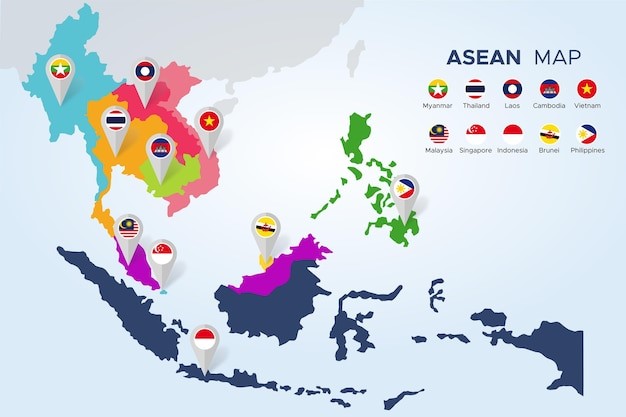
          ASEAN, which is the Association of Southeast Asian Nations, is an intergovernmental organization that aims to promote economic and security cooperation among its ten members: Brunei, Cambodia, Indonesia, Laos, Malaysia, Myanmar, the Philippines, Singapore, Thailand, and Vietnam. The group has played a central role in Asian economic integration, joining negotiations to form the world’s largest free trade agreement, and signing six free trade deals with other economies in the region.  

          Nevertheless, the group’s impact remains limited due to a lack of strategic vision, diverging priorities among member states, and weak leadership. Their biggest challenge is said to be the development of a unified approach to China, since ASEAN countries are strongly dependent on China, and benefit a lot from this relationship. However, this relationship also limits their growth, thus, a balance between the advantages of trading with China and the risks from overdependency should be achieved. The aim of this would be not only to maintain peace but also to pave out a more resilient and sustainable economic future for ASEAN countries. 

          Looking ahead 

          So, what can these countries do? Some argue that the answer is to enhance diversification efforts – They can start by diversifying their trading partners which would mitigate the risks of their excessive reliance on China and would also create a viable alternative for businesses relocating from China. Strengthen trade agreements – An additional way of doing this would be to prioritize the intra- ASEAN trade and integrating supply chains. This would lead to diminishing dependence on imports for components and materials, for example in the sectors of electronics and cars.  

          Besides this, strategic trade relationships with other countries should be considered. This measure would not only grant ASEAN countries a greater access to significant markets such as Canada (for which there are ongoing negotiations to sign an agreement) but also, once again, promote trade diversification. Aligning China’s Foreign Direct Investment with sustainability – Interdependence with China cannot be abruptly broken, and it is important in maintaining peace. Following this rationale, as China’s FDI is important, ASEAN countries should ensure that these investments align with their sustainable growth goals, for example, transparency and accountability. 

          Conclusion 

          In summary, as China tries to steer a manufacturing-led revival of the world’s second-largest economy, the data from Beijing heightens Western concerns about Chinese competition. The opinions on how to approach this rising economy diverge, and the effects of interdependence are bittersweet. While on one side it may lead to peace and stability, since conflict is costly, on the other hand, it also provides room for disputes to emerge.  

          The ultimate consequence of this is the incapability to separate political issues from economic trade. There are many suggestions to address these matters under regional frameworks rather than country-to-country. To effectively do so, these agreements should be comprehensive including emerging potential causes of conflict, like the ASEAN. 


          Sources: Damuri, Y. R. (2022). An agenda for regional economic and security cooperation – East Asia Forum. East Asia Forum Quarterly: Volume 14, Number 4, 2022, 14(4), 5–7, Hawkins, A. (2023, July 5). Chip wars: how semiconductors became a flashpoint in the US-China relationship. The Guardian. Maizland, L., Albert, E., Hong, L., & Galina, C. (2023, September 18). What Is ASEAN? Council on Foreign Relations, Wester, S. (2023, November). Balancing Act: Assessing China’s Growing Economic Influence in ASEAN. Asia Society, XIA, M. (2018). “China Threat” or a “Peaceful Rise of China”? – New York Times. Nytimes.com, Hale, T. (2024, April 4). Manufacturers need to face up to new wave of Chinese competition. – Financial Times, Joseph Grieco, G. John Ikenberry, Michael Mastanduno (2024). Introduction to International Relations- Enduring Questions and Contemporary Perspectives 

          Catarina Franco