
 Written by
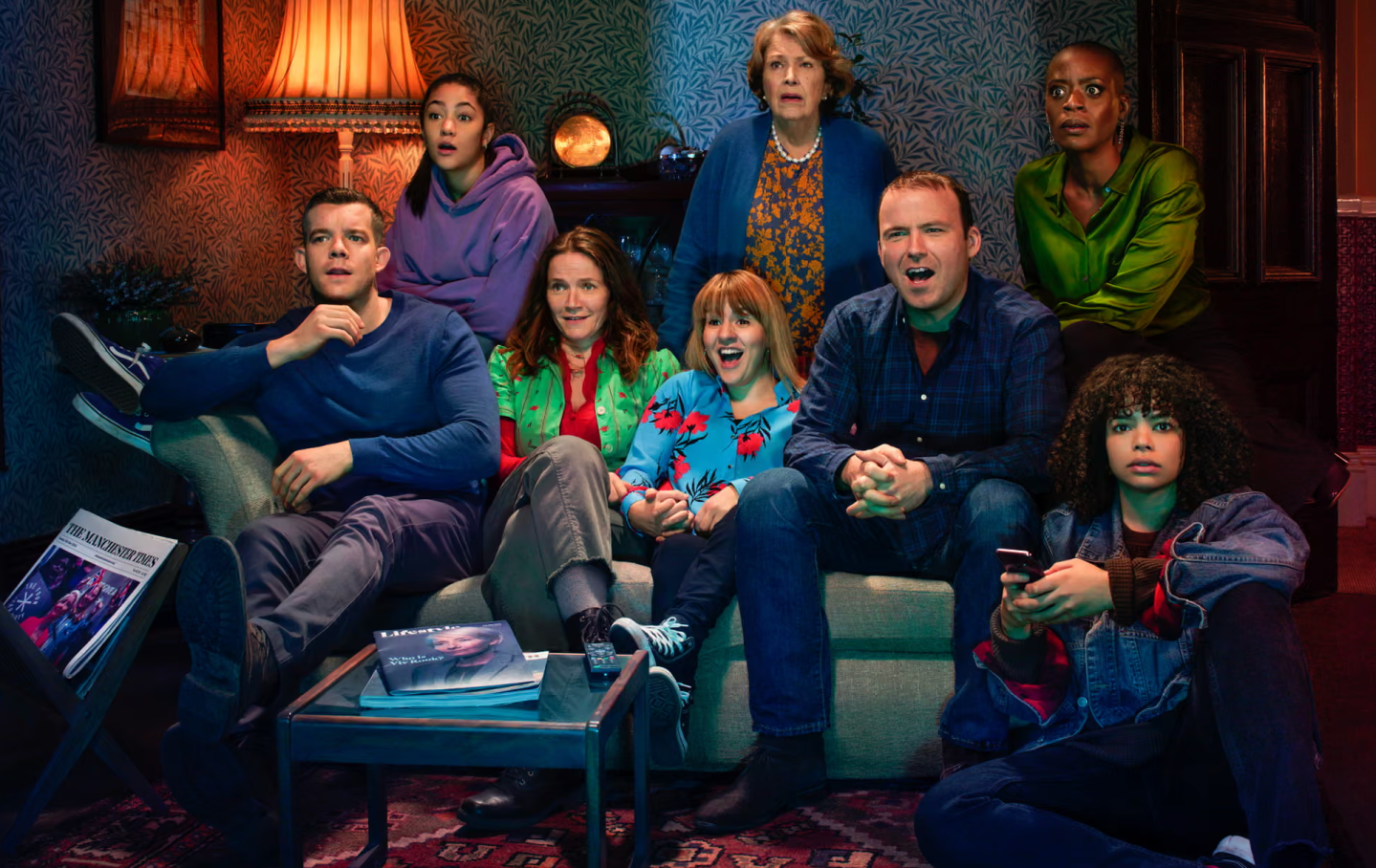
Image 1- The Lyons family
Broadcasted in 2019, the television series Years and Years functioned less as traditional science fiction and more as a sociological simulation. By extrapolating the geopolitical, technological, and economic data available at the end of the 2010s, the series constructed a near-future timeline that closely mirrors the stark reality of the 2020s. To ground these macro-level global crises, the narrative anchors itself to the Lyons family, an ordinary household whose members serve as micro-level case studies. Over a span of fifteen years, the series documents the family’s diverging reactions as they are directly impacted by unfolding historical events, experiencing everything from financial displacement and political radicalization to technological assimilation and refugee advocacy. Through a comparative analysis of the series’ fictional timeline and our contemporary global situation, it becomes evident that the broadcast was highly predictive. It successfully forecasted events such as the war in Ukraine, the death of Queen Elizabeth II in 2022, a second term for Donald Trump, and the sweeping rise of global populism. By analysing its correlation to our current reality, we can learn from the Lyons family’s reactions to these unprecedented societal shifts.
The Statistical Rise of Global Populism
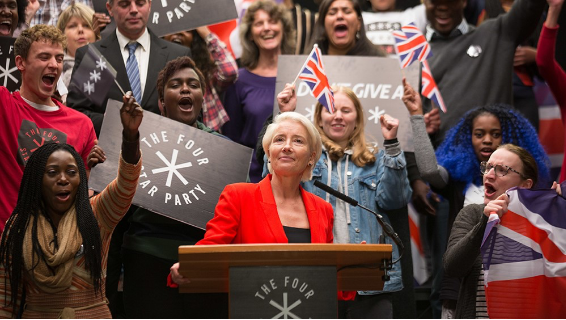
Image 2- Emma Thompson as Vivienne Rock
In Years and Years, the character Vivienne Rook embodies the rapid ascent of modern populist movements. Initially dismissed as a fringe, controversial entertainer, Rook leverages anti-establishment rhetoric and unfiltered broadcasting to bypass traditional political decorum, ultimately being elected Prime-Minister of the United Kingdom and securing immense executive power. When cross-referenced with real-world political data from the late 2010s through the 2020s, this fictional trajectory accurately mirrors the measurable global shift toward populist leadership. Data collected by prominent political science organizations, such as the Tony Blair Institute for Global Change and the Pew Research Centre, demonstrates a verifiable surge in populist electoral success during this period. The fictional trajectory mirrors reality: between 2018 and 2023, right-wing populist movements successfully transitioned from the political fringe to securing executive power in nations such as Italy, Argentina, and the Netherlands, while maintaining immense, disruptive electoral influence in the United States and France. Rather than an isolated anomaly, this trend reflects a broader, systemic reaction against globalization, economic stagnation, and institutional distrust. The narrative uses the Lyons family to illustrate how a populace fractures in response to this political shift. Rosie Lyons serves as the target demographic for populist messaging, feeling economically marginalized, she enthusiastically embraces Rook’s blunt, anti-establishment rhetoric, demonstrating how populism capitalizes on working-class disenfranchisement. Conversely, Edith Lyons represents fierce ideological resistance, dedicating herself to actively exposing the human rights abuses enacted by Rook’s administration. Perhaps most critically, the matriarch Muriel and her grandson Stephen illustrate the mechanics of complicity. Muriel’s attributes Rook’s rise to the everyday apathy and consumerism, small actions that most of society adopted that in the long run turned helped building this scenario. While Stephen’s eventual employment managing Rook’s secret immigration detention centres demonstrates how personal financial ruin can drive educated citizens to collaborate with extremist policies.
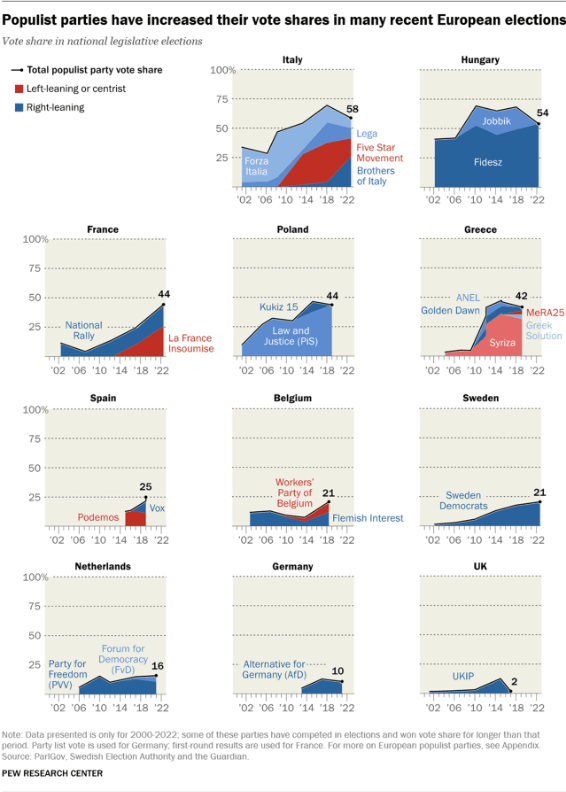
Image 3- Pew Research Center study demonstrating the predicted rise of populism
Geopolitical Escalation: The War in Ukraine
Continuing the analysis of the Lyons family, the series uses their experiences to map the human cost of severe geopolitical instability, most notably predicting the escalation of the Russia-Ukraine conflict. In the narrative, Daniel Lyons’ relationship with Viktor, a Ukrainian refugee fleeing persecution and conflict, serves to bring the abstract concept of war directly into the domestic sphere of an ordinary British family. Written in 2018 and aired in 2019, the show depicted a Russian military incursion into Ukraine that subsequently triggers a catastrophic, continent-wide displacement. When analysing geopolitical events from February 2022 onward, the series’ timeline stands as a strikingly accurate forecast of the massive humanitarian fallout that occurred.According to empirical data from the United Nations High Commissioner for Refugees (UNHCR), the real-world invasion displaced millions of citizens within weeks, closely mirroring the systemic European border crises and overwhelmed infrastructure depicted on screen. The show correctly anticipated that the ripple effects of such a conflict would not remain localized but would instead fundamentally alter international immigration policies and border security protocols across the continent. As noted in international security analyses following the real-world invasion: “The sudden displacement caused by the 2022 escalation created the fastest-growing refugee crisis in Europe since the Second World War, exposing the fragility of modern international asylum frameworks.” Furthermore, we can, on the micro-level analysis, watch the different approaches used by some members of the family to illustrate polarized societal responses to such crises. Daniel Lyons represents direct humanitarian empathy, his relationship with Viktor, a Ukrainian refugee fleeing persecution, highlights the desperate and often fatal lengths individuals endure to circumvent broken immigration systems. With a much different approach, his sister Rosie represents the growing societal apathy and distrust toward immigrants. Her character illustrates how economic disenfranchisement can lead ordinary citizens to embrace isolationist policies and reject global humanitarian responsibilities. Both these characters represent with precision the currentpolarized debate of this topic around the world.
Technological Assimilation: Artificial Intelligence
Finally, the series utilizes the youngest generation of the Lyons family to examine the profound sociological impact of exponential technological advancement. The character of Bethany embodies the concept of “transhumanism”—a growing desire to transcend the physical body by integrating cybernetic implants and, ultimately, uploading human consciousness to the cloud. Concurrently, the broader societal backdrop of the show depicts widespread economic anxiety as advanced algorithms rapidly displace traditional cognitive labour and professional services, this is an example that happened with the character Celeste, since her job as an accountant was taken by Artificial Intelligence. While full digital consciousness remains theoretical, the series’ depiction of severe workforce automation and the normalization of human-computer interfacing perfectly mirrors the explosive, disruptive growth of the modern Artificial Intelligence sector. According to the World Economic Forum’s Future of Jobs Reportand data from the Stanford University Artificial Intelligence Index, the real-world integration of generative AI (such as Large Language Models) has accelerated at an unprecedented rate since 2022, threatening millions of white-collar roles previously thought immune to automation. Furthermore, actual advancements in neurotechnology, such as successful clinical trials for brain-computer interfaces like Neuralink, demonstrate that the biological-technological merger desired by Bethany is actively transitioning from speculative fiction into medical reality. As highlighted in recent technological labour analyses, “The current acceleration of generative algorithms represents a fundamental restructuring of the global workforce, wherein cognitive automation will rapidly displace traditional roles while simultaneously demanding new, untested frameworks for human-machine integration.”
Ultimately, Years and Years transcends typical speculative fiction by operating as a data-driven sociological forecast. Through the grounded experiences of the Lyons family, the series provided a highly accurate, predictive model of the 2020s. The show successfully demonstrated that the cascading crises of our current decade, the surge of populist governments, the humanitarian catastrophe in Ukraine, and the disruptive integration of Artificial Intelligence, were not sudden anomalies, but the inevitable results of measurable 2019 data trends. By treating the series as a historical case study rather than mere entertainment, we can observe that predictive media serves as a vital tool for societal awareness. The polarized reactions of the Lyons family illustrate a deeply fractured society, yet they also highlight humanity’s inherent, relentless capacity for adaptation. While the societal norms we accept as common today may become entirely unrecognizable in the years ahead, the series proves that we are never truly flying blind, we can always catch a glimpse of what is approaching. The true warning of Years and Years is not that the future is predetermined, but that it is actively unfolding in the present, visible to anyone willing to critically observe the shifting realities of our society.
Sources:
- Years and Years TV series- BBC

Guilherme Mendonça
Writer

