 Written by
Image 1
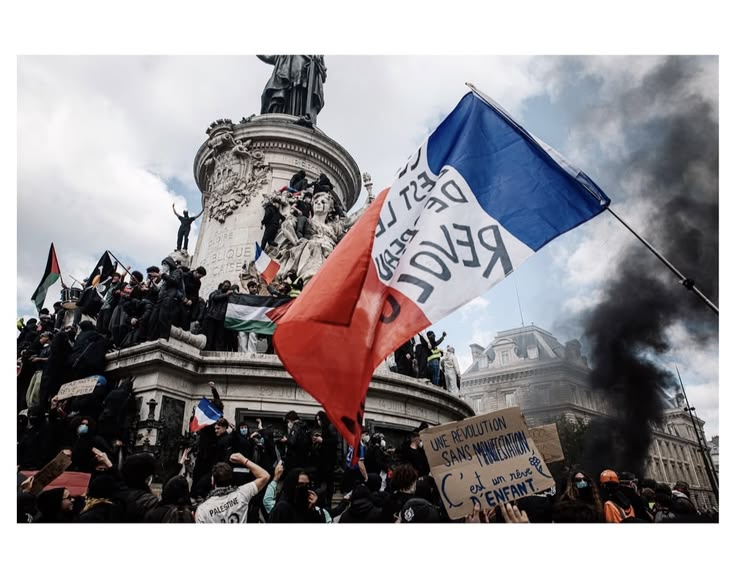
During the last month France made headlines, due to its student protests across the country. Media attention focused on the protests in the country, but there was also another factor sounding the alarms in France: its public finances. In the second quarter of 2026 the French public debt reached €3.6 trillion euros. That equals 119% of GDP, up from 115.6% a year earlier, according to INSEE, the national statistics office. This number makes France Debt-to-GDP ratio the third biggest in the European Union, only behind Italy (139.9%) and Greece (140.8%). High public debt, high deficits and high Bond Yield regarding public debt are all happening at the same in the country. All these indicators aligned with a great political division and public discontentment, create an alarmist screen of the future, not only regarding France, but also all Europe.
Financial Picture
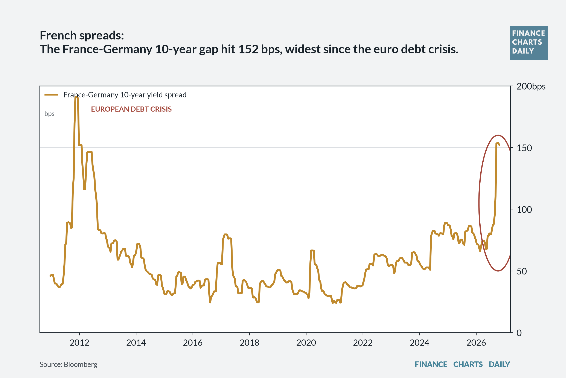
Image 2- French spread evolution
In the end of October, France´s 10-year Bond-Yield reached 5.1%, a 20-year high. While the spread, that measures the relation between French and German bonds of the same maturity, was in the same period 159 base points, meaning that France pays 1.59% more in annual interest than Germany to borrow for 10 years. With the third highest public debt in the European Union and paying such a high interest on it, it would be expectable for the French government to be reducing its deficit, which is also the third highest in the EU, being around 5%, in order to slow the pace of the debt increase and calm down domestic and foreign debt holders. And that is the French government goal, since it has presented a great number of measures to reduce it: the 2023 pension reform, which would increase the age of retirement from 62 to 64 years; the freezing of civil service hiring and reducing the headcounts of state agencies to lower the public wage bill; and tightening the criteria for unemployment benefits and scaling back corporate subsidies intended to boost employment. However, most of these measures, especially the reform pension, did not go through, due to both political deadlock and civil unrest. The French parliament right now is divided 3 blocks: the centrist block, led by the government parties and the president Emmanuel Macron; the far-right block, led by the “Rassemblement National” of Marine Le Pen; and the left block, led by Jean-Luc Mélenchon party “La France Insoumise”. Meaning that the government party does not have a majority in the chamber, obligating it to negotiate to the other two blocks that have been vocally critics of the proposed cuts.
Impact of 2027 elections
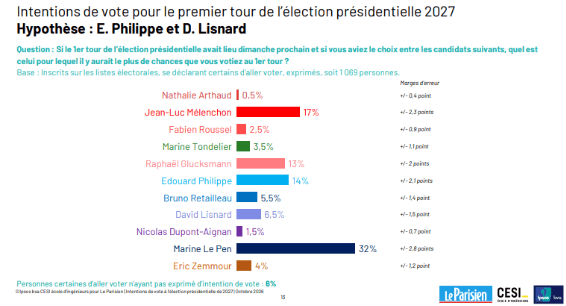
Image 3- Poll conducted by Ipsos on 21-22 October
On the next 18th of April, France is holding its 12th presidential election of the 5th republic. This election will end Macrons 10-year rule, having a huge impact both inside France but also outside, especially regarding the European Union. Whoever wins will have to deal with the consequences of a high debt and a divided country. Recent polls all suggest that Marine Le-Pen supported by her far-right party “Rassemblement National” will be the winner of the first round of the presidential election. A poll conducted by Ipsos between 21–22 of October, showed that Marine Le-Pen would get 33.5% of the vote intentions. In second place, heading to a Second round, was the far-left candidate Jean Luc Mélenchon with 17% of the intentions. Only with 14% and 13% were the more centrist candidates, centrist Édouard Phillipe, more aligned with Macron policies, and centre-left candidate Raphael Glucksman, respectively. These recent polls show that the probability of the election resulting in a second round between the far-left and the far-right are high at this moment. The possibility of a president coming from one of the political extremes, either the right or the left, will have huge impact in the country and in the world. Regarding public finances, Marine Le-Pen has target to reduce public debt to 112% of GDP by 2032, to achieve that she proposes cutting state agencies, reforming public procurement, and tightening immigration policies. She has pledged to bring the budget deficit below the 3% threshold by 2030. To enforce this, she proposes a constitutional “golden rule” to cap future deficits subject to a national referendum. However, economic analysts warn that executing these cuts while simultaneously funding her promised €69.3 billion in tax cuts (such as lowering VAT on energy) relies on highly optimistic interest rate and growth assumptions. If Mélenchon wins, the situation in public finances is expected to be even more dramatic, since his recently proposed 2027 counter-budget outlines €81.7 billion in new public spending, to fund higher wages, expanded social benefits, and public services. Despite massive spending increases, his platform claims it would reduce the deficit by roughly €25 billion, keeping it around 5% of GDP. This balance relies on offsetting expenditures with heavy tax increases on corporate profits, capital, and high-net-worth individuals. In addition, Mélenchon fundamentally challenges traditional debt metrics. To alleviate the debt burden, he has proposed converting the roughly €600 billion of French sovereign debt held by the European Central Bank (ECB) into perpetual, zero-interest bonds. ECB President Christine Lagarde and other financial institutions have rejected this strategy as illegal under EU treaties and highly destabilizing to investor confidence.
ECB response
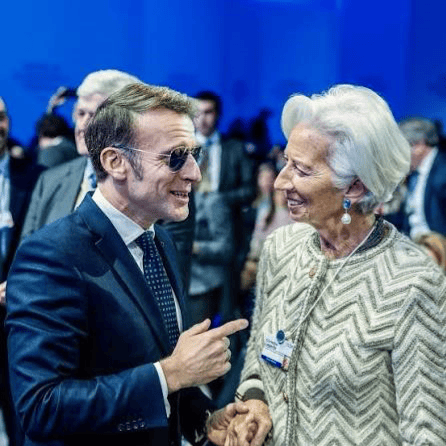
Image 4- Christine Lagarde and Emmanuel Macron during the World Economic Forum
If the current macroeconomic trend continues the European Central bank might have to step in. The ECB knows that if it must intervene is not going to be an easy situation and it may create the sentiment of crises in the euro area again. However, the central bank also knows that if does not intervene it will be a much worse situation, if France comes to a point of declaring default. If the spread between French and German bonds widens excessively, pushing past 300 basis points for example, or causes severe market disorder, the ECB would likely be forced to act to protect the single currency. This could involve deploying the TPI (Transmission Protection Instrument) to buy French bonds or pausing the bank’s current quantitative tightening program, or even, in a more extreme scenario a full bailout amid the European Stability Mechanism. Although the ECB can activate the TPI whenever sees the necessity to protect the euro area, its implementation success strongly lies in more restrained public spending and public reforms enhancing smaller deficits. Even more cooperation would be necessary to pass a bailout, since both the France parliament and the EU finance ministers would have to ratify a reduction in spending agreement. Meaning that even if these mechanisms are triggered, the French parliament would have to agree in passing these new measures, and in the current state it would be difficult to achieve any agreement. Even more difficult it will be if either Marine Le-Pen or Jean Luc Melenchon win, since both are campaigning for more forms of spending and rejecting reforms, like the pensions one. An intervention from the ECB would also probably come with opposition from other EU countries, like Germany, since chancellor Merz is facing strong opposition from AFD, a German far-right party whose main goal when created was to stop EU ballots to in dept economies. There is also the fear that if the intervention stops the bleeding, it severely weakens the market discipline needed to force politicians to cut spending. If the ECB absorbs the financial pain of France, other EU countries could have less incentive to balance the budget, potentially leading to even higher structural debt in the future and validating reckless fiscal policies., ending up in a spread sentiment of debt relaxation, that in a long-term would lead to a very difficult scenario.
To sum up, the next year is going to be crucial to France and the EU. An historical election, the alarming situation of the public finances and the continuous and violent protests are going to shape the country future, as well as the Eu one. Due to the possible impact of all these events and the possibility of a major euro area crisis, Portugal must be attentive to what’s going on and be prepared to all scenarios. France must be on the radar of all of us.

Guilherme Mendonça
Writer
Sources

