Living Under the Uncertainty of Brexit

Brexit: a brief recap

In 1975, Britain held its first referendum on membership, in which 67% of the electorate expressed a desire to stay in the European Economic Community.

In 2013, as part of a political gamble for power, David Cameron promised a national referendum on European Union membership. This referendum was ultimately held on 23rd June 2016 and 51.9% of the electorate voted to leave the EU.

With the public debate being somewhat poor and contaminated by all sorts of ‘alternative facts’, and with the design of the referendum itself being lackluster (pitting two highly vague concepts of ‘Leave’ and ‘Remain’ against each other), the Pandora’s box was opened.

Ever since that day, a nation that was once known for its attitude of stability, diplomacy, and moderation has become increasingly divided, volatile, and polarized. The traditional two-party system collapsed. For the past 3 years, the UK’s entire energy has been devoted to Brexit, and British politicians have had to learn the hard way the intricacies of the European project (something which they had refused to do for a long time). For proof, look no further than the fact that the UK was supposed to have left the EU by 29th March 2019, and more than half a year later is still a full member of the European club – struggling to secure yet another extension to its membership.

A soap opera of biblical proportions

If you are, like I am, an aficionado of politics and international relations, you may have spent the last years savoring popcorn and watching history unfold upon your eyes. You have watched David Cameron’s political bet backfire spectacularly, Theresa May’s deal see the biggest government defeat in decades (not once, not twice, but thrice), and Boris Johnson suspending Parliament, only to have the Supreme Court rule the suspension to be void and null of effect.

You have watched MPs rebelling against their own government and building cross-party coalitions; laws being passed to force the Prime Minister to request an extension of the UK’s membership in the EU; and that Prime Minister repeatedly threatening to de facto disrespect those laws. You have repeatedly thought that this saga could not get any wilder, only to have your expectations defied time and time again.

Life as an EU national in the UK

However, as entertaining as a real-life version of House of Cards may be for those watching in the continent and beyond, it is everything but fun for the nearly 4 million EU nationals residing in the UK.

The fact is, our livelihoods are very closely intertwined with the unfolding of this play. Guessing what comes next is no longer a matter of optional personal leisure, but a mandatory exercise of survival. Mocking the tea-loving version of Donald Trump is no longer amusing when you realize that, for all effects and purposes, that person is your Prime Minister.

Some can handle uncertainty better than others – but all of us need the basic assurances. The assurance that, no matter what happens, we won’t be kicked out of the country where we’ve decided to build our lives in. That we’ll continue to hold on to our job. That committing to a 1-year house renting contract is safe. That if the Government doesn’t reach a deal with the EU, we can continue to get the groceries and the medicine we need, instead of facing a run on stocks. That we feel we are welcomed residents and not temporary guests. That we’re part of a broader community, rather than pawns of a chess game.

Unfortunately, for an EU national living in the UK, those boxes have been hard to tick off lately. When in the other side of the Atlantic you have the leader of the free world ripping international agreements to shreds, and in your own nation you have a sitting Prime Minister unlawfully suspending Parliament and threatening to break the law, the most quintessential foundations of democracy are challenged. And when the fabric of society is stretched to that point, there is nothing you can take for granted.

For instance: in theory, EU nationals can apply to stay in the UK until 31st December 2020 if there is ‘no deal’, and until 30 June 2021 if both parties agree to a deal. In theory, if you get that status, you’re entitled to carry on living and working in the UK as if nothing had happened. But how can you be so sure that theory corresponds to practice when the Prime Minister does not even respect the basic principle of the rule of law?

gettyimages-543428774-2048x2048.jpg

That is precisely the kind of existential uncertainty EU nationals have been grappling with every day.

What comes next?

If Brexit were a drama, its climax would most likely be this upcoming Saturday, 19th October 2019.

This will be the day when we fully grasp the implications of the EU Summit, that will be held between the 17th and 18th October and decide the ultimate fate of the UK/EU relationship. It will also be the deadline of the Benn Act (which mandates the Prime Minister to seek an extension if he is unable to get a deal by then). It will furthermore be the first time the British Parliament seats on a Saturday since the Falkland War of 1982. And, finally, it will be the day of the People’s March, a protest demanding a second referendum.

With such an explosive cocktail of unprecedented happenings, what comes next is anybody’s guess. Will there be a deal or not? Will there be an extension or not? What will be the nature of an hypothetical extension? Will there be a general election? Will there be a second referendum? Will the Prime Minister break the law and be found in contempt? Will we get to the extreme situation of reaching the 31st of October and finding ourselves in a ‘limbo’, with the Prime Minister declaring the UK to be out of the EU, only to have the courts render that decision as void and null of effect days later?

Frankly, nobody knows. Not Boris, not Barnier, and certainly not me. The good (or bad) news is that we won’t have to wait much longer to find out.

A Very Brief Overview on U.S. Tariffs

Simply searching “Trump tariffs” on Google, at the moment of writing this article, presented me with a staggering amount of 149 000 000 results. At the same time simply searching “tariffs” yielded 92 700 000. This is both a testament to the strangeness of Google’s algorithm and to how much of a contentious issue this has turned into throughout the presidency of Donald Trump. We’ll take a short look at tariffs’ history in the U.S. and at some recent issues regarding them.

Shortly after the American Revolution, in a period from 1783-1789, states would often levy tariffs towards one another. However, in 1789, this was changed with the ratification of the Constitution of the United States which now did not permit those restrictions between states. In this Constitution it is stated that Congress has the power to: “…lay and collect taxes, duties, imposts and excises, pay the debts and provide for the common defense and general welfare of the United States”, and to “…regulate Commerce with foreign Nations, and among the several States, and with the Indian Tribes”.

It was exercising this power that the first major piece legislation after the ratification of the Constitution, known as the Tariff Act of 1789, was passed by Congress and signed into law by president George Washington. This Act served to address the government’s need of funding to pay off debts it had acquired during the Revolutionary War. It is worthy of note that the first individual income tax in the U.S. would only come into existence in 1861, and so, at the time, tariffs were one of the government’s primary source of revenue. It was also enacted in order to protect domestic industries struggling to compete with cheaper European goods, in the period after the war.

Perhaps the reader has heard in recent news that Mr. Trump’s recent tariffs were brought about by executive order. This would seem to be an overreach on part of the President. However, in the 20th century, two different pieces of legislation were enacted that gave the executive branch the ability to set tariffs, under certain conditions. They were the Trading with the Enemy Act and the Trade Expansion Act in 1917 and 1962, respectively. The former gives the president the ability to regulate all trade made between the U.S. and one of its enemies in time of war. But it was due to the latter that the infamous steel and aluminum tariffs were brought about in 2018. Indeed, this act gives the executive branch the authority to levy these restrictions on trade if “an article is being imported into the United States in such quantities or under such circumstances as to threaten or impair the national security.

George Washington once said something reminiscent of this:

A free people ought not only to be armed, but disciplined; to which end a uniform and well-digested plan is requisite; and their safety and interest require that they should promote such manufactories as tend to render them independent of others for essential, particularly military, supplies.

— George Washington

In itself, this reasoning is not at all devoid of merit: indeed, it would not be wise for the U.S. to depend solely on China for their supply of steel, a material of high importance for national security. What might be worrisome, though, is that this reasoning is very broad and prone to abuse. Furthermore, it is also worthy of note that the U.S, like the rest of the world, are nearly solely dependent on China for their supply of rare earths, which are crucial for a lot of technologies including those of high-end military gear. Indeed, in 2018, China extracted around 70% of the world’s rare earth supply for that year.

Some claim that Mr. Trump is simply catering to voters in the so-called Rust Belt, which was negatively affected by the decline of the coal and steel industries, and that this issue was merely disguised as a national security risk to avoid the troublesome and time-consuming bureaucracies of the legislative branch.

Undeniable, however, is the adverse impact such tariffs had and will have on other industries which use steel as an input. For example, General Motors closed several plants cutting around 14.000 jobs, claiming that the increased production costs, driven up by the tariffs, were among some of the reasons that lead to the downsizing.

Although the cascade of effects from this policy is still ongoing, there might be something to learn from looking at what happened to the economy after Mr. Barack Obama tariffed Chinese tire imports in 2009. A study from the Peterson Institute of International Economics calculated that the policy had a net effect of killing 2.531 jobs, considering their most generous estimate for the amount of jobs saved by the tariff.

Just like with Mr. Trump, some state that the former President’s policy was done in an effort to pander to his base. For example, the Republican Party’s nominee for the 2012 presidential election, Mitt Romney, wrote:

President Obama’s action to defend American tire companies from foreign competition may make good politics by repaying unions for their support of his campaign, but it is decidedly bad for the nation and our workers.

— Mitt Romney

We should be wary of our own tendencies to defend or to attack these policies (and any others, of course) based on tribalism and sheeplike party allegiances. Instead, we must aim to use the unbiased reasoning needed for successful and fruitful policy decisions.

Will You Let Others Decide For You? Get up off the couch and cast your vote

Being one of the biggest problems in today’s society, abstention, a notorious election procedure in which an electorate does not go to the ballots on election day, is undermining the whole political system across democratic countries.

Portugal has the most prepared generation of all time. It reached the best indicators in education, health and quality of life in its history. It has never had so many people with secondary and higher education. Still, Portugal has one of the highest abstention rates in Europe. Since 1975, these rates keep expanding unstoppably, with an abstention rate, in the 2019 European elections, bigger than any Portugal has ever seen, as reported by “Pordata”. If in the first years of the democratic regime the participation rates were among the highest in Europe, in the past few years the situation has reversed and today we present substantially low values compared to other European countries. Portugal bears further resemblance to emergent democracies in the soviet bloc, than democracies in Western Europe.

It is estimated that between 1996 and 2016, there were a million less voters in the Presidential elections and between 1995 and 2015 half a million fewer in the Parliamentary ones. Also, between 1995 and 2015, the 3 main parties lost approximately 1,3 million voters.

Some questions arise from these facts, such as “Why don’t the Portuguese exercise their right to vote?”“Should voting be mandatory?” or “Would electronic voting help decrease abstention?”. Therefore, we must understand which factors influence Portuguese participation, abstention, and which solutions would be effective in raising the participation rate, taking other examples throughout the world into account.

Abstention is a profoundly serious problem. The Portuguese democracy is at stake, as electors are progressively further away from politics and its agents. Populism is striking Europe and if it reaches Portugal it will be a large concern, as the country’s democracy is quite debilitated and it is at risk of being damaged.

It can be related to indifference and alienation of the voters and to a way of protest, but also to a decrease in the relevance of parties and syndicates, to the entry of young people in the voters’ group and their preference to discuss politics online, join public petitions and take part in protests, instead of showing their beliefs with their vote, and facing voting as a right rather than a civic duty.

Corruption and distrust in public institutions are among the many justifications of the alarming abstention rates as well. As a matter of fact, in 2018, Portugal was in 30th place in the Corruption Perceptions Index. If abstention is a way of protesting against corruption, it is gradually damaging democracy and undemocratic political systems are the perfect environment for the proliferation of corruption. That said, it is essential to break this vicious cycle.

A Portuguese group of political scientists, coordinated by the investigator João Cancela, concluded that rural areas are the ones where the participation rates are lower in the Legislative, Presidential and European elections. On the other hand, the opposite happens in the elections for the local authorities. Although, the lack of updates in the electoral roll can partially contribute to such inflated values in these areas.

It is high time for Portugal to rethink the way it addresses the electoral process. Portugal should analyze, discuss and adapt some of the successful measures applied around the world in order to invert this increasing tendency for the abstention. Otherwise, what should we expect from our democracy in the future?


Can compulsory voting be a solution?

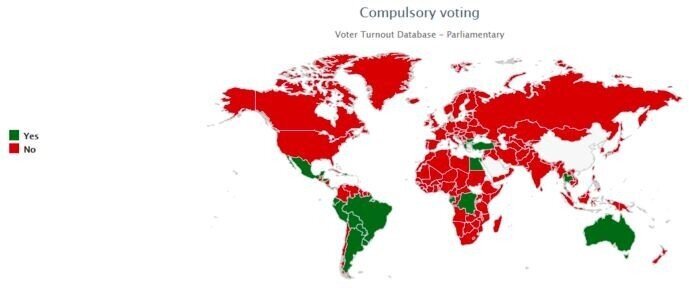
Why do the Latin American nation shave such a high rate of voter turnout, compared to many European countries and, especially, Portugal?

The answer is simple, and has nothing to do with great empathy between population and politicians. In fact, in most of these countries, compulsory voting has been adopted as an effective measure to mitigate abstention. But how have these countries come to this point?

The common view on the matter is that voting is a civil right, but some parties argue that it is instead a civic duty, just like paying taxes or serving in the military. Despite being somehow linked to a threat to freedom, this measure was adopted by many Latin American countries. Compulsory voting requires registered voters to actually vote, otherwise they will face some sort of penalty.


1 (1).jpg

This is a region of huge disparities that mainly arise from unequal income distribution and power imbalance. The people were (and still are) oppressed by the elites, who wanted to perpetuate and extend their power, but, being much more numerous, have been able to form powerful and diverse coalitions which threaten the power of the elites. In such a scenario, elites were obliged to concede some civil power and this explains the generalization of universal suffrage.

Compulsory voting is nothing more than an attempt carried out by both sides to conquer some kind of supremacy in the political game, once the referred sides perceived some potential in those who do not usually turnout in elections in these countries. Their main goal is to persuade this part of the population to vote on their ideas, so that they can succeed.

Despite not being exactly the goal of the political forces involved, compulsory voting brings some benefits to the democracy’s development process in these countries. In this regard, besides contributing to a more reliable representation of public opinion, as it covers the opinions of a wider range of population, compulsory voting forces politicians to adapt their speech to the (different) needs of more segments in societies. Its implementation undoubtedly represents a fair point when it comes to discuss ways of reducing abstention. This way, the legitimacy of those who govern is more evident, contributing to more stability in politics.


What about the Nordic Measures?

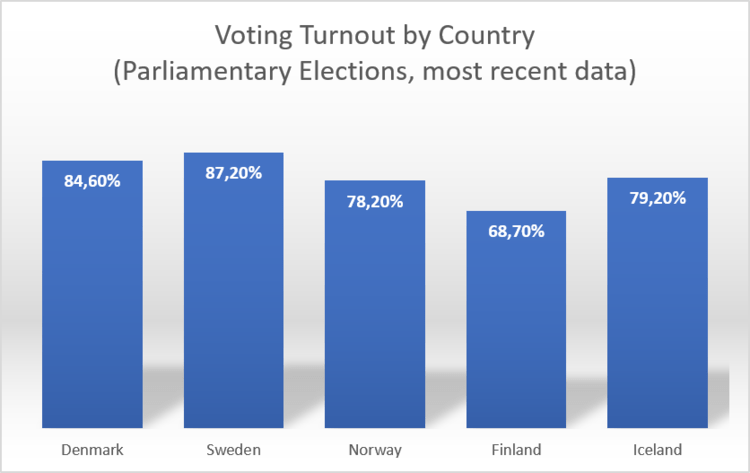
One of the reasons why abstention is so low in Nordic countries can be attributed to transparency. Denmark is tied for first in Transparency International’s corruption index, and the rest of the Nordic countries aren’t far behind. Finland and Sweden are tied for third, Norway is tied for fifth and Iceland is tied for 12th . Given these countries have low levels of political corruption and their government decisions are unambiguous, people feel more encouraged to vote. But still, this factor does not completely explain the low abstention rate:


2 (1).png

“A striking feature of all three countries was the level of public commitment to monitoring and promoting voter turnout, seeking innovative ways to engage with younger voters and tracking voting patterns. This is borne out, for instance, in the number of multi-stakeholder initiatives dedicated to promoting youth turnout, with academics, government ministries, and municipalities joining forces (and budgets) to experiment with new ways of reaching young voters.”

— Celia Davies, an associate editor from Edinburgh, was awarded a Churchill Fellowship to research voter turnout in Denmark, Sweden and Iceland. Her objective was to generate policy recommendations for the UK, where voter turnout has been dropping for decades.

For instance, Denmark has a mock polling system in their schools. Their students go through these just as they would for the official ones, and see the outcome. This way, they get to experience how elections work and are incentivized to learn about the parties and their proposals. Sweden is adopting a similar programme as well.

Nordic countries also introduced other innovative ways to simplify the voting process, such as polling hubs in stations, online voting and automatic voting registration.


How can we overcome abstention?

After this analysis, we present some solutions that might help fighting this problem. Firstly, we should make voting registration easier. Either by enabling automatic registration or by making it possible for voters to register at the day of the election. Another possibility would be to allow people to vote at any poll in the country. Finally, the implementation of online voting could be explored. Therefore, reducing bureaucracy and making the voting process more flexible seem to be key factors.

afonso.botelho.jpeg Afonso Botelho Ana Mota.jpeg Ana Mota

Behind the Portuguese Miracle

As is commonly known, the Portuguese economy has been appearing to turn itself around quite remarkably in the last 5 years.

The unemployment rate in Portugal has been going down considerably, being now at 6.3%. The unemployment rate reached its peak of 16.2% in 2013 after a big economic slowdown due to the international crisis of ‘08, that led to the sovereign debt crisis in Europe [PORDATA].

At present times, Portugal’s unemployment rate is at 6.3% [STATISTICS PORTUGAL].  Portuguese wages also appear to be improving, the minimum nominal wage went up from €485 per month in 2014 to €600 in 2019 [PORDATA]. In the past 5 years, the average Portuguese nominal monthly wage went up from €1,120.4 to €1,170.63 [Gabinete de Estratégia e Planeamento].

Not so long ago, GDP growth in Portugal was negative and now is higher than the European Union’s average. In 2012, GDP growth in Portugal was -4.0% and in 2018 was recorded to be 2.1%, higher than the EU´s growth of 1.8% [Banco de Portugal]. It is expected that in future years Portugal´s GDP growth will continue to surpass Europe´s average growth.

Portugal´s budget balance in past decades has been a dreadful number to look at, it has always been negative and since 2008 has reached incredibly low numbers, coming to a very big trough of -11.2% of GDP in 2010 [EUROSTAT]. However, outstandingly, Portuguese deficit had a big upturn in the past recent years. In 2018, deficit was only 0.5% of GDP and according to the Portuguese government and it is forecasted to be 0.2 % of GDP in 2019 and the budget balance is expected to have a surplus of 0.3% in 2020.

Looking at this numbers, one would think the Portuguese economy is growing at quite an outstanding pace for a developed country after suffering such a hard-economic recession. One would also think that the Portuguese economy has showed the capability to turn itself around. However in order to understand this big “economic upturn “, one needs to look beyond the appealing numbers and analyze the “not so great“ numbers behind them.

Portugal´s Nominal GDP was around €201 billion in 2018, the highest number since 2011 [INE]. However, Portugal´s nominal public debt is already at 252 billion euros, the highest ever on the history of Portugal [Banco de Portugal].

In the present economic cycle, interest rates have been something to worry less and less about since they have been going down on most bonds and in some they are even negative. Currently the Portuguese yield curve is in negative territory until 8 years of maturity. Portugal´s budget balance has certainly benefited from this, since interest expense has gone down outstandingly in the past year. In August 2019 interest on public debt on 3 years bonds was -0.43%, on 5 years bonds was -0,262 % and on 10 years bonds was 0,2 % [Bloomberg].

Tax revenues in Portugal are higher than in the past two decades, being 35,4% of GDP [INE]. Although wages are higher, so are taxes, especially indirect taxes, creating amongst the people an illusion of higher consumer power than reality upholds.  

Noticing the outstanding growth of tax revenues and the big decrease on interest expense, the big improvement on the Portuguese budget balance doesn´t seem that miraculous anymore. 

Even though deficit is now lower and GDP is higher, public debt keeps growing at an outstanding pace. This economic cycle in which interest rates are negative or extremely low hasn´t come to stay and once it leaves it will generate a big financing problem. Since taxes are the government’s main revenue and are as high as they can be there will be no sustainable way to finance the Portuguese economy when interest rates rise.

In an open economy like the Portuguese’s, fiscal revenues tend to be very elastic and expenses quite rigid. In 2008/2009 after the recession, tax revenue went down 14%, and if there is another slowdown in the economy most likely fiscal revenues will go down extremely. The big problem Portugal faces is that in a recession, current expenses will remain pretty much the same or even increase due to jobless claims and therefore deficit will tend to increase.

Still it is questionable how a country that has been increasing its debt year after year has also been decreasing its public investment. Portugal´s public investment has gone down on average 12.28% in the past three years, showing that Portugal is not generating future sustainable income [INE].

It is safe to say, that even though Portuguese economy looks as if it has turn itself around, Portugal´s economy is without a helmet and once it trips the fall is bound to be a hard one.