
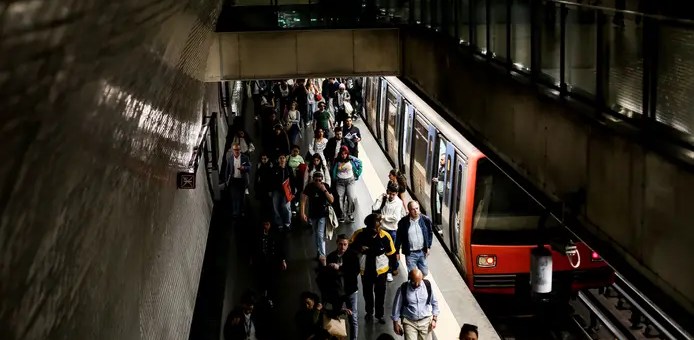
For nearly three million people spread across the Lisbon Metropolitan Area (AML), getting from home to work is rarely simple, and getting there on time is never guaranteed. While there have been efforts to improve public transport, promote sustainability, and modernize infrastructure, progress has often been slow and uneven. At the same time, the region continues to struggle with congestion, inequality in access, and structural inefficiencies that hinder its long-term development. As Lisbon grows into a more dynamic capital, attracting tourists, digital nomads, and investment, its mobility system is increasingly under pressure to evolve.
This article explores the key challenges shaping urban mobility in the AML, combining structural analysis with the lived reality of daily commuters navigating an increasingly strained system.
A Growing Metropolitan Complexity
The Lisbon Metropolitan Area is home to nearly three million people, spread across 18 municipalities on both sides of the Tejo River. While the city of Lisbon itself is relatively compact, the surrounding suburbs (such as Amadora, Sintra, Almada, and Loures) have experienced significant population growth over the past decades. This expansion has led to a classic metropolitan challenge: people live far from where they work.
For many residents, this translates into long, multi-modal commutes that are not only time-consuming but also unpredictable. A typical journey from Sintra or Margem Sul into central Lisbon can easily exceed one hour each way, particularly when connections fail or services are disrupted. What appears on paper as an integrated system often feels fragmented in practice.
The Dominance of Private Cars
Despite policy efforts, private cars remain deeply embedded in Lisbon’s mobility structure. This reflects gaps in public transport reliability, coverage, and convenience.
When you can’t count on your train running on time, when buses are overcrowded and connections are poorly synced, the car becomes the “safe” option: not because people love sitting in traffic in IC19 or the 25 de Abril Bridge, but because at least the delay is somewhat predictable.
This creates an obvious feedback loop: more cars mean more congestion, more congestion makes bus routes slower, slower buses push more people into cars, and the loop repeats itself.
The Metro: A Network That Stopped Growing
Lisbon’s public transport system has improved in affordability and integration due to the Navegante pass, but its operational reality remains inconsistent.
A great example is the metro system. Despite being the backbone of urban mobility, it has not opened a new station in 10 years. Expansion projects, such as the Circular Line and the Red Line extension to Alcântara, face repeated delays and funding uncertainties (just recently was announced an extra €48M for the Circular Line, which was supposed to be open by 2023), raising doubts about their timelines and effectiveness.
At the same time, ongoing works, while necessary, have created disruptions across the network. The construction of the future Santos station, for example, has led to recurring service interruptions affecting both metro and rail connections in the Cascais line.
The planned Circular line introduces another layer of controversy: once it’s running, it will break the current direct connection between Odivelas and the city center, forcing passengers to change lines at Campo Grande. While the project aims to improve overall network efficiency, it risks concentrating even more pressure on an already busy interchange. For daily commuters, this means an additional transfer, longer travel time and more crowding at a station already running close to its limit at peak hours.
The Rail Experience: Daily Frictions
For many commuters, the real test of Lisbon’s mobility system lies in its suburban rail lines.
On the Cascais Line, modernization has been ongoing for several years, aiming to improve infrastructure, electrification systems, and long-term service quality. However, the process itself has caused recurring disruptions, including partial closures, replacement bus services, and timetable instability.
Similarly, on the Sintra Line, the busiest in the country, commuters have experienced declining service frequency in routes to and from Rossio during peak hours, from 10 to 15 minute intervals, making trains and platforms ever more crowded as the suburban population continues to grow.
These aren’t simple inconveniences. For regular commuters, a missed train cascades into a late arrival, a missed meeting, a stressed morning. On top of these disruptions, recurrent strikes affecting CP services turn the suburban rail network into complete chaos.
Housing Pressures and Mobility Inequality
Urban mobility in Lisbon cannot be understood without considering housing dynamics. As central Lisbon became unaffordable, people moved to the periphery. Now the periphery is becoming unaffordable too, pushing people even further out: into longer commutes, more strained networks, and further from the services they use. The transport system absorbs the consequences of failed housing policy decisions, and it also creates a clear divide: those who can afford to live closer to the center enjoy shorter, more reliable commutes, while others face longer, more uncertain journeys.
Mobility, in this sense, becomes a marker of inequality, both in time and in quality of life.
Governance and Execution Gaps
One of the most persistent challenges in Lisbon’s mobility system is not the lack of plans, but the difficulty of executing them. Large-scale projects, like the planned metro expansion, the new airport and the third crossing of the Tejo continuously face delays due to governance problems, legal challenges and inconsistency in funding.
At the same time, coordination between municipalities and transport operators remains inconsistent, leading to fragmented solutions rather than a cohesive metropolitan strategy.
Potential Paths Forward
From the perspective of someone who uses public transport daily, improving urban mobility in Lisbon requires consistent, targeted improvements:
Prioritize reliability over expansion: Before building new lines, ensuring that existing services run frequently and on time would have an immediate impact on users’ lives.
Stabilizing ongoing projects: Minimizing disruptions during infrastructure works, like in the Cascais line, should be a priority to maintain user trust.
Better frequency management: Increasing peak-hour frequency on high-demand lines like Sintra would reduce overcrowding and improve system efficiency.
Integrated planning: Transport, housing, and urban development policies must be aligned to reduce commuting distances rather than simply accommodate them.
User-centered design: Decisions about routes, transfers, and infrastructure should reflect how residents actually move through the city and their necessities.
Transparent timelines: Clear communication about delays and project timelines can help rebuild trust in public transport institutions.
Conclusion: A System in Transition
Urban mobility in the Lisbon Metropolitan Area has stopped being just an infrastructure problem. It has become a question of direction and at this point, patching things up as they break isn’t keeping pace with how much the region has grown and how complex it’s become.
For the people using the system every day, the frustration isn’t that nothing is being built. It’s that what gets built doesn’t always translate into a better experience. Every delayed train, every overcrowded platform, every unnecessary transfer erodes something that’s hard to rebuild once it’s gone: the basic trust that public transport will do what it’s supposed to do. And without that trust, even the most ambitious plans risk falling flat.
The choice that Lisbon faces isn’t really complicated to describe, but it’s hard to execute. Keep reacting to problems as they pile up, or commit to a system that works consistently, for everyone, not just for those who can afford to live close enough to the center to make it work. That means new infrastructure, yes, but more than that it means reliability, coordination, and honesty about what’s been promised and what’s been delivered.
Because in the end, urban mobility is about shaping how people live, work, and access opportunities. If Lisbon wants to remain a competitive, inclusive, and sustainable city, it cannot afford to remain stuck in motion.
Sources: Agência Lusa; CP – Comboios de Portugal; Público; European Comission; Lisboa Secreta; HERE Urban Mobility Index; INE – Instituto Nacional de Estatística; SIC Notícias

Nuno Cançado
Writer