
 Written by
On 4 November 2026, UNESCO and UNICEF published new figures that are difficult to absorb: more than 2.6 million Afghan girls have been denied access to secondary education since 2021, and 53% of primary-school-age children in Afghanistan remain outside formal general education. These are among the most severe education restriction figures on record for any country. But behind the humanitarian headline is an economic story that rarely gets the same attention.
Afghanistan is the only country in the world where girls are legally barred from secondary and higher education. What began as a restriction on secondary schooling in September 2021 has since reached universities and most forms of paid employment. The question this article asks is not only what Afghan girls are losing, but what the Afghan economy loses with them.
Five Years Of Educational Restrictions
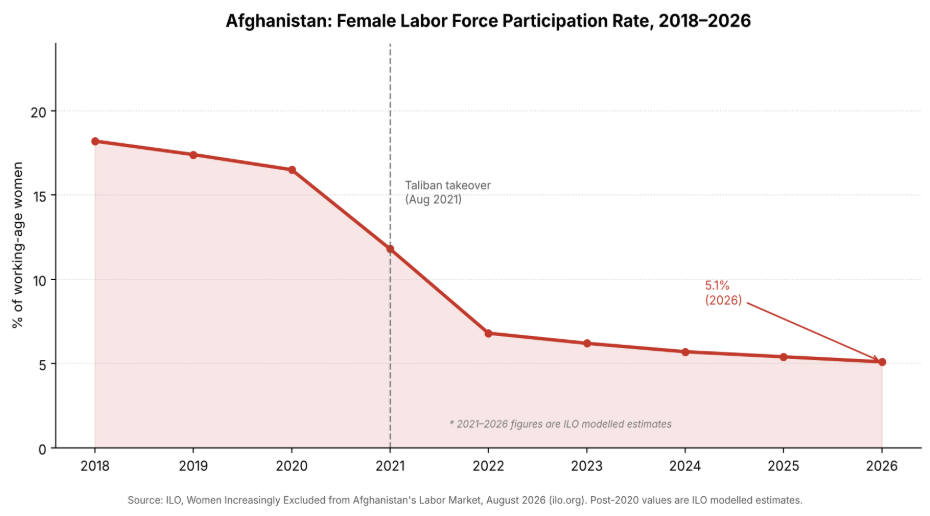
Figure 1. University enrollment in Afghanistan, 2020 vs. 2026. Source: UNESCO / Times Higher Education, 2026. Total figures; decline reflects the December 2022 women’s ban alongside displacement and economic contraction.
The restrictions have come in stages, each one closing off what remained. When the Taliban returned to power in August 2021, girls’ secondary schools were shut down within weeks, in September. In December 2022, the ban was extended to universities, removing what had been the last remaining pathway into higher education. By 2026, female enrollment in higher education has effectively reached zero.
The scale of the institutional disruption is reflected in total enrollment data. Afghan universities enrolled approximately 430,000 students before the takeover; by 2026, that figure stood at around 208,000, a decline of approximately 52%. This drop reflects multiple factors, including the December 2022 women’s ban, displacement, and economic contraction, and cannot be attributed to any single cause. Beyond higher education, the same logic of exclusion has been applied to the civil service and most formal employment, narrowing women’s economic participation to its lowest recorded level. These restrictions did not emerge from economic calculation: they coexist with poverty, displacement, and inadequate infrastructure, but they represent a distinct and deliberate policy choice layered on top of those pre-existing challenges.
The Economic Consequences Of Educational Exclusion
The labor-market data tells a stark story. The International Labour Organization (ILO) estimates Afghanistan’s female labor force participation rate at 5.1% in 2026, the second lowest in the world, down from approximately 16.5% in 2020. These post-2020 figures are ILO modelled estimates rather than direct survey observations, but they are consistent across multiple ILO publications. This is not the kind of decline that happens slowly, through structural shifts or demographic trends. It is what a deliberate removal of women from education, employment, and public life looks like in the data.
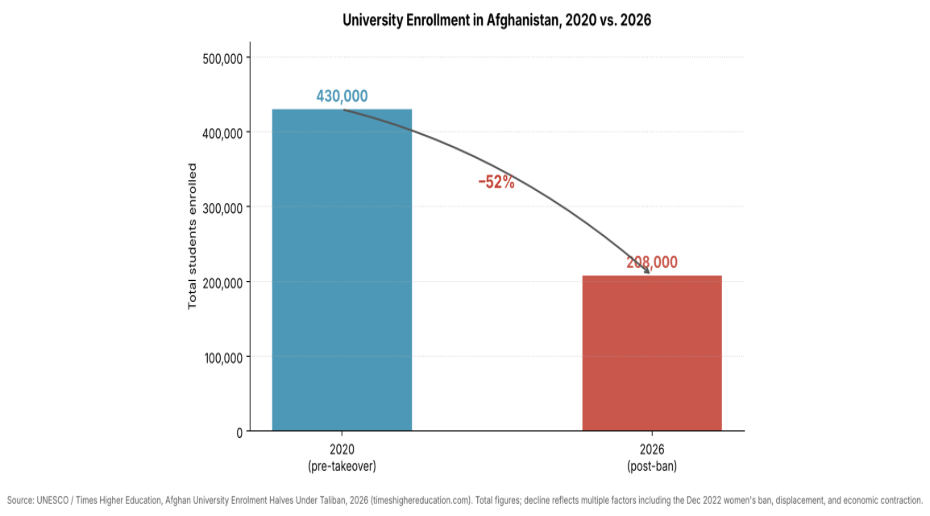
Figure 2. Afghanistan female labor force participation rate, 2018–2026. Source: ILO, Women Increasingly Excluded from Afghanistan’s Labor Market, August 2026.
UNICEF’s April 2026 analysis puts the cost at approximately $84 million per year in lost economic output. For one of the world’s poorest economies, that figure alone is striking. But it almost certainly understates the real damage. Education is the primary driver of long-run productivity in any economy, and the returns compound: women who complete secondary school earn, on average, nearly double what those with no schooling earn, and their children are significantly more likely to be educated in turn. Remove that cycle, and you are not just slowing growth. You are dismantling the mechanism that produces it.
UNESCO projects that the continued suspension of women’s higher education could result in potential losses reaching $9.6 billion by 2066 under the study’s assumptions. While long-range projections carry inherent uncertainty, the economic logic is straightforward: an economy that systematically excludes half its population from education does not simply grow more slowly, it narrows its capacity to grow at all. Afghanistan’s GDP per capita was already among the lowest in Asia before 2021. The restrictions compound pre-existing constraints rather than operating in isolation from them.
A Growing Gap In Essential Services
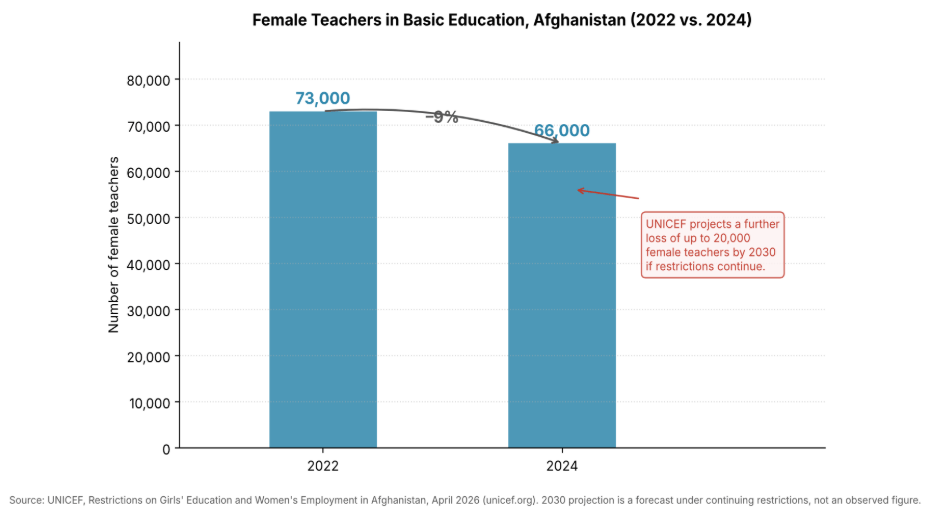
Figure 3. Female teachers in basic education, Afghanistan, 2022/2024 and projected 2030. Source: UNICEF, Restrictions on Girls’ Education and Women’s Employment in Afghanistan, April 2026.
Nowhere is the impact more tangible than in healthcare and education. The number of women in basic education has already fallen by more than 9%, from nearly 73,000 in 2022 to around 66,000 in 2024. UNICEF projects that Afghanistan could lose up to 20,000 women teachers and 5,400 female health workers by 2030 if current trends continue. These are not abstract projections: they describe services that will not be delivered to people who have no alternative.
These are not simply workforce statistics. In many Afghan communities, cultural norms mean that female patients will not consult male doctors, and that girls can only be taught by women. As female health workers and teachers exit the system, the populations they served go without services entirely. The pipeline that would train their replacements has been closed. Women’s representation in the Afghan civil service fell from 21% to 17.7% between 2023 and 2025 alone, accelerating the institutional capacity loss.
What makes this particularly hard to reverse is the feedback loop it creates. Fewer educated women means fewer female teachers, which means fewer girls can remain in whatever schooling still exists, which means fewer educated women in the next generation. The World Bank estimates that globally, failing to educate girls could represent up to $30 trillion in lost lifetime earnings. In Afghanistan’s case, the losses do not simply accumulate over time: each cohort of excluded girls becomes a generation that cannot train the one after it.
Alternative Education And International Responses
In the spaces left by the formal system, alternatives have taken shape. Community-based education programs, often run by NGOs and sometimes operating covertly, have worked to keep girls learning beyond grade six. The November 2026 UNESCO-UNICEF report records approximately 5,300 of these community-driven classes, serving around 162,000 learners, 64% of whom were girls. Digital and remote platforms have expanded what is possible in urban areas, though Afghanistan’s connectivity remains among the lowest in the region. This is why the 53% figure refers specifically to children outside formal general education: some instruction continues, but it reaches a fraction of those excluded, often in precarious conditions.
The reach of these alternatives, however, remains narrow. Community programs are unevenly distributed, chronically underfunded, and vulnerable to interference. Digital access is largely confined to Kabul and a handful of other urban centers, leaving rural girls, who make up the majority of those excluded, almost entirely unreached. On the international side, conditional aid and diplomatic engagement have both been tried, and neither has produced any reversal of the bans. Several countries and multilateral organisations have reduced funding to Taliban-controlled institutions; development economists have been divided on whether this helps or simply compounds the harm to the population it is meant to protect.
Conclusion
What the data makes clear is that the costs of Afghanistan’s education restrictions are not future abstractions. They are measurable, compounding, and already accumulating. The $84 million annual output loss will grow as fewer educated women enter the workforce. The $9.6 billion projection for 2066 carries the uncertainty of any long-range estimate, but the direction of travel is not contested. The shortfall in female teachers and health workers will likely widen further if younger cohorts cannot access the training needed to step into those roles.
What no estimate can fully capture is what Afghanistan would look like had these restrictions never been imposed — a generation of women educated, employed, and contributing to a country that badly needs their labor. That gap, between what is and what could have been, may turn out to be the most consequential economic choice Afghanistan makes in this century. How long current policies remain in place, and whether younger generations ever regain access to education and work, will shape the country’s development trajectory for decades to come.
Sources
UNESCO and UNICEF, Afghanistan’s Education System Facing Deepening Crisis for Both Girls and Boys, 4 November 2026, unicef.org/afghanistan; UNICEF, More Than 2.6 Million Afghan Girls Have Been Denied a Secondary Education Since 2021, August 2026, unicef.org; UNICEF, Restrictions on Girls’ Education and Women’s Employment in Afghanistan Could Lead to Loss of Over 25,000 Professionals, April 2026, unicef.org; ILO, Women Increasingly Excluded from Afghanistan’s Labor Market, August 2026, ilo.org; Times Higher Education, Afghan University Enrolment Halves Under Taliban, 2026, timeshighereducation.com; UNESCO, Limits on Women’s Education in Afghanistan Will Likely Further Weaken School Quality, August 2026, al-monitor.com/originals; World Bank, Returns to Education and Female Labor Force Participation, worldbank.org; UNDP, Marginalizing Women a Major Curb on Afghan Economy, undp.org

Rebecca Fratello

