
 Written by
On 3 November 2026, hours before the polls closed in the US midterm elections, traders on Kalshi and Polymarket gave the Democratic Party a 94% chance of winning the House of Representatives and about 75% for the Senate, according to The Block. The Democrats won both. Prediction markets have grown from a niche into a source of information followed by investors and central banks, and they have also become one of the most disputed questions in financial regulation.
What Is A Prediction Market?
A prediction market allows users to trade event contracts: agreements that pay a fixed amount if an event happens and nothing if it does not. For example, a contract on whether the Fed cuts rates in December pays $1 if the cut happens. If it trades at 40 cents, the market is pricing a 40% probability. The price moves with every piece of news, and users can sell their contracts before the outcome is known, just like a share.
Unlike a bookmaker, which sets the odds and takes the other side of every bet, a prediction market works as an exchange: users trade with each other, and the platform earns mainly from fees.
The two largest platforms have different histories. Kalshi has been registered since 2020 as an exchange with the Commodity Futures Trading Commission (CFTC), the US derivatives regulator. Polymarket was built on cryptocurrency technology and, after paying a $1.4 million penalty to the CFTC in 2022 for operating without registration, served mainly users outside the United States until it bought a licensed US exchange and was allowed back in late 2025.
From Elections To Everything
According to the Pew Research Center, these platforms became famous during the 2024 US presidential election, when politics made up about 90% of trading on Kalshi and 65% on Polymarket. Since then, contracts have expanded to interest rates, inflation, geopolitics and, above all, sport. Its data also show that combined monthly volume on the two platforms grew from about $2 billion in mid-2025 to $53 billion in July 2026, when the FIFA World Cup was being played.
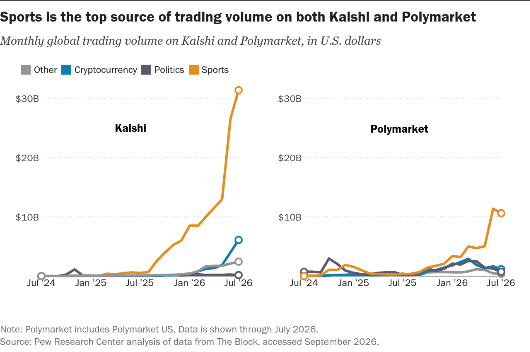
Figure 1: Monthly trading volume on Kalshi and Polymarket by topic (Source: Pew Research Center, September 2026)
A Signal For Markets And Politics
Supporters argue that the main value of these prices is that they offer a real-time measure of expectations. Unlike a survey, a market price changes within minutes when news arrives, and traders who are wrong lose money.
A study published by the Federal Reserve Board in February 2026 tested this on Kalshi’s markets for interest rates and inflation. It found that the most likely outcome priced on Kalshi had matched the Fed’s rate decision by the day of every meeting since 2022, and that its forecasts of headline inflation were more accurate than the consensus of professional forecasters compiled by Bloomberg. As the authors put it, prediction markets “can serve as a valuable complement to existing forecast tools.”
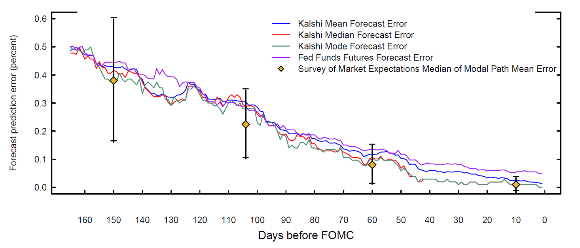
Figure 2: Errors of Kalshi, survey and futures forecasts of the Fed’s rate decision before each meeting (Source: Federal Reserve Board, February 2026)
Financial markets have taken notice. In October 2025, Intercontinental Exchange (ICE), the owner of the New York Stock Exchange, invested up to $2 billion in Polymarket and became a global distributor of its data as sentiment indicators for institutional investors.
The signal is not perfect. The same Fed study warns that some contracts are traded by only a few users and that markets tend to overstate some risks, like higher inflation and unemployment.
When The Signal Comes From Insiders
Prices are informative because people with information trade on them, and sometimes that information should not be traded. In April 2026, the US Department of Justice charged an Army soldier with using classified information about the operation to capture Nicolás Maduro to bet on Polymarket: about $33,000 in bets allegedly turned into a profit of around $410,000. Similar suspicions followed the US and Israeli strikes on Iran in late February 2026: according to Al Jazeera, a group of Polymarket accounts opened that month bet on Iran-related events shortly before the attacks, and one of them earned more than $500,000 in a single day.
Political information can be just as valuable. In August 2026, the CFTC fined a former White House teleprompter operator about $172,000 for trading on Kalshi contracts on which words President Trump would use in his speeches, after reading the prepared remarks in advance. In November, the CFTC ordered Kalshi to stop offering these contracts.
The economist Henry Manne argued as early as 1966 that allowing insiders to trade makes prices incorporate new information faster. Critics answer that it rewards those who leak secrets, at the expense of ordinary users who have no such information.
Who Regulates The Future?
In the United States, betting is regulated by each state, while derivatives are supervised by the CFTC. Kalshi argues that its contracts are swaps under federal law, which state gambling laws cannot reach. So far, most federal appeals courts have disagreed: one sided with Kalshi in New Jersey, while three allowed Maryland, Nevada, Ohio and Tennessee to apply their gambling laws. New Jersey has asked the US Supreme Court to settle the question. In this dispute, the CFTC has taken the platforms’ side: in October 2026 it proposed classifying event contracts as swaps and sued Utah to stop it from applying its gambling laws to them.
Europe has been more uniform, treating these platforms mainly as gambling. In January 2026, Portugal’s gambling regulator, the Serviço de Regulação e Inspeção de Jogos (SRIJ), ordered Polymarket to be blocked, and the French regulator, the Autorité Nationale des Jeux (ANJ), did the same in July. According to the ANJ, Germany, Belgium, Italy, the Netherlands and Poland have also restricted the platform. Even where these contracts count as financial instruments rather than bets, the European Securities and Markets Authority (ESMA) has stated that they fall under the existing bans on selling binary options to retail investors.
Conclusion
Prediction markets turn opinions about the future into prices. Their advantages are speed and, on some questions, an accuracy comparable to professional forecasts, which is why investors and central banks follow them. Their costs are the risks of gambling without the protections of the licensed market, and new opportunities to profit from secret information. Whether they are a financial tool or a form of betting will likely be decided by the US Supreme Court and by European regulators. Until then, the answer depends largely on where the user lives.
Sources
Pew Research Center; Federal Reserve; Intercontinental Exchange (ICE); The Block; U.S. Department of Justice; Al Jazeera; Insider Trading and the Stock Market, by Henry Manne; U.S. Courts of Appeals; Supreme Court of the United States; Commodity Futures Trading Commission (CFTC); SRIJ; ANJ; European Securities and Markets Authority (ESMA)
Theme: Finance

Riccardo Ruggeri
Writer

