
WHO WERE THE NEANDERTHALS?

Neanderthals, scientifically Homo Neanderthalensis, the most similar species to Homo sapiens, have long been imagined as aggressive and intellectually inert creatures, roaming the earth and throwing stones and sticks everywhere. However, in the last few decades, studies have led many to believe that there is much more to be said about these early humans. Not only did they possess many cognitive abilities, but they also originated the earliest rudimentary forms of sacred rituals and art.  

 The oldest known Neanderthal fossil is estimated to be 430 thousand years old. It was found in the Atapuerca Mountains, in Spain, and consists of the skull of a man whom archaeologists called “Miguelón”. On the other hand, the most recent traces of their lives date back to 40 thousand years ago. Hence, it is assumed that they existed during that time.  

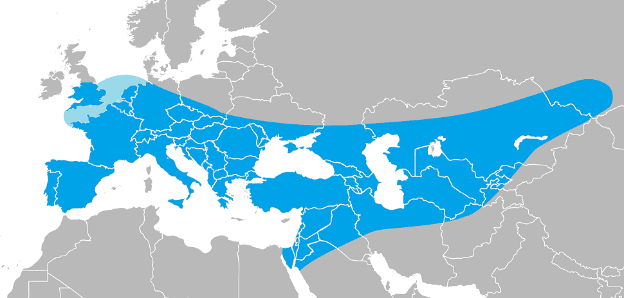
 Spain and other European countries are not the only ones that were once home to these prehistoric humans. Because they lived through glacial and interglacial periods for millennia, this might have been a driving force for searching for food and warmer temperatures, leading to migration. Consequently, it is possible to find traces of their existence from Portugal to Central Asia, not only in fossils and artifacts, but also in ourselves: almost every European and Asian citizen carries up to 4% of their DNA.  
 What did they look like? 

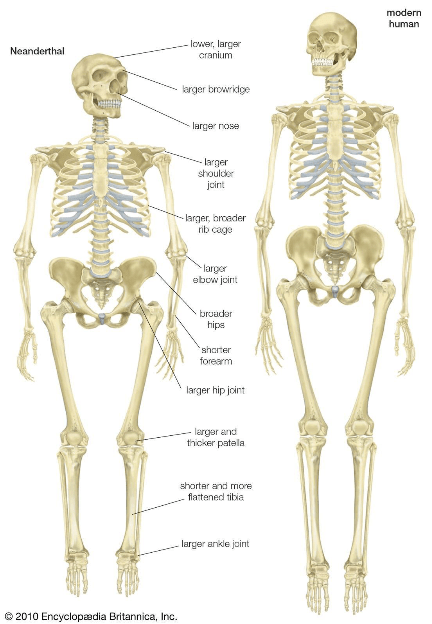
 While Homo Sapiens’ physiology enables us to run at high velocities and move nimbly compared to some other similar species, Neanderthal´s attributes were a little bit different. They were shorter, heavier, with smaller and wider limbs and torsos. Their muscular mass was much more prominent, providing high levels of strength and resistance in the wild world. This also allowed them to preserve more heat in their bodies, something essential to survive in cold temperatures during the glacial ages. Besides, as they evolved in Europe and in central Asia, where the climate was harsher than in Africa (where Homo Sapiens came from), it is believed that these physical characteristics developed to guarantee adaptation in these areas. Their faces also had wider noses that helped the air be heated before reaching the lungs and jaw bones that grew forward until late adolescence.  
 How were their minds? 

 Neanderthal´s brains were also very characteristic, being the same size or larger than modern human ones. Bigger parts were allocated to vision and body movement and control. This also explains why their eyes were wider and their vision was better.Nevertheless, minor areas were directed at social cognitions. Consequently, their interactions were probably not as rich and didn´t play as an important part in their lives as in Homo Sapiens´.  So, they didn´t build big social networks, preferring to live in small groups. This is beneficial in some cases, for example, the need to collaborate and take care of many members is not incessant, which could facilitate decision-making and movement from place to place. However, exchanging information, passing downknowledge through generations, and building some sort of culture are essential activities to lead populations to prosper and evolve throughout history. When that didn´t happen, extinction became easier and more common.  

 What did they eat and what did they do? 

 Living in a time where agriculture was nowhere in sight, hunting and gathering what was found in Nature was probably the major occupation of Neanderthals. Even though they have been imagined killing beasts like mammoths and sabretooth tigers, that idea is not entirely correct. Professor John Speth, from the University of Michigan, stated: “Neanderthals were not hypercarnivores; their diet was different.” Studies show that one common habit was letting large quantities of meat putrefy, hoping that it would attract mostly maggots, which are much easier to collect and consume. Besides, these little beings were a great source of protein, fat, and amino acids. Tubers, fruits, seeds, and plants as well as cannibalism contributed to their omnivorous diet.  

 Neanderthals used many small objects to serve various purposes in their daily activities. Items such as axes, scrapers, carved rocks, and burins helped with hunting and domestic tasks. Fire was already a controlled element, through techniques such as percussion with flint and pyrite. It contributed to body heating and cooking tasks. Flaking techniques assisted them in manufacturing clothing from animal skins, bones, and fur.  

What did they create? 

 Notwithstanding, these sorts of items were also used with a symbolic meaning. Neanderthal remains that carried necklaces with eagle talons as pendants, as well as shells and feathers, have been found across more than 20 places in Western Europe. It is common that the objects that everyone carried meant something about their lives or role in the social group and were a tool for non-verbal communication. This also reveals that burial rituals could be practiced. In France, in a cave called La Chapelle-aux-Saints, in 1908, an untouched skeleton was discovered. More recent excavations concluded that the depression where it was found had been altered 50 000 years ago to bury this man or woman. That way, it remained protected from weather-related smoothing and animals.  

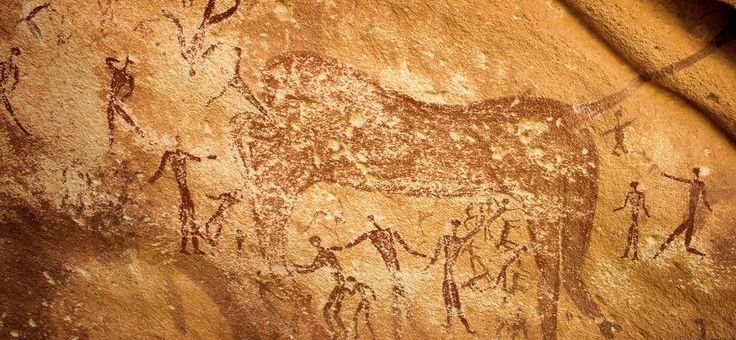
 In many cases, not only bones were found, but also paintings on the walls.  

In three different spots in Spain, after analyzing their pigments, researchers concluded that the paintings were at least 65 000 years old, being the oldest ones in the whole world. This raised a question: why were the first ever cave paintings found in Europe, rather than in Africa, where Homo Sapiens appeared? Besides, it is known that the first modern humans arrived in Europe around 50 000 to 40 000 years ago. More recently, in 2018, it was concluded that other artworks in Cueva de los Aviones, were at least 115 000 years old. This left scientists with one possible answer: Neanderthals were also artists. This raised various debates, where many started defending that they were not as different from Homo Sapiens as it was thought. Moreover, prejudice regarding their level of cognitive capacities, where modern humans crown themselves as being the smartest species of all time, might be led by presumption and not by real facts.  

 How did they become extinct? 

 Neanderthal’s extinction occurred around 40 000 years ago. Several theories have emerged to justify this fact. Many defend that this is simply nature running its course, since 99.9% of all species that ever existed have disappeared. Curiously, this prehistoric human extinction coincided with the migration and expansion of Homo Sapiens outside of Africa. Many experts claim that this extinction happened due to the competition and violence between the two species. Maybe Neanderthals had worse weapons to defeat the modern man or lost in the search for food and shelter. Perhaps, as they lived in smaller gatherings, they couldn’t procreate as much. Nevertheless, other theories suggest that instead of being violence the reason for their extinction, it was sex. Inbreeding between the two species might have caused a reduction in sexual relations between Neanderthal´s, which made their populations become smaller until they were outnumbered by Homo Sapiens. Another hypothesis is that a thousand-year cold snap that occurred around 40 000 years ago may have caused their population´s decline.  

  Conclusion 

 All in all, Neanderthals were far more complex and capable than the stereotypical image that has long defined them. Rather than viewing them as inferior, it may be more accurate to see them as different, yet remarkably similar to us. Whatever the reasons for their disappearance, their legacy did not entirely disappear, as traces of their DNA still live in human populations. There will forever be endless questions regarding their lives, the answers to which are timelessly buried in the past, and in the mute land they once walked on.  

Sources for the text 

https://www.nationalgeographic.com/history/article/who-were-the-neanderthals

https://www.nationalgeographic.com/history/article/neanderthals-extinction-homo-sapiens

https://anthrosource.onlinelibrary.wiley.com/doi/full/10.1111/aman.13654

https://www.britannica.com/topic/Mousterian-industry

https://www.nationalgeographic.com/culture/article/130911-neanderthal-fashion-week-clothes

https://www.nationalgeographic.com/culture/article/131216-la-chapelle-neanderthal-burials-graves

https://www.nationalgeographic.com/science/article/neanderthals-cave-art-humans-evolution-science

https://www.nationalgeographic.com/environment/topic/climate-change

https://www.pnas.org/doi/10.1073/pnas.1808647115

https://www.nationalgeographic.com/science/article/news-neanderthal-teeth-nursing-seasons-stress

https://www.nhm.ac.uk/discover/news/2022/october/neanderthal-extinction-maybe-caused-sex-not-fighting.html

https://www.britannica.com/topic/Neanderthal~

https://www.nhm.ac.uk/discover/who-were-the-neanderthals.html

https://humanorigins.si.edu/evidence/human-fossils/species/homo-neanderthalensis

https://europe.factsanddetails.com/article/entry-814.html

https://www.science.smith.edu/climatelit/disappearance-of-the-neanderthals-c-40000-bp/

Sources for the images 

https://www.worldhistory.org/image/5958/geographical-range-of-neanderthals/

https://www.britannica.com/topic/Homo-sapiens/Bodily-structure

https://www.theguardian.com/science/2012/apr/18/favourite-science-writing-sleeping-neanderthals

https://www.theguardian.com/artanddesign/2018/feb/23/neanderthals-cave-art-spain-astounding-discovery-humbles-every-human

Júlia Lobão

Writer

Another War Arriving

Reading time: 8 minutes

Since the beginning of the year, relations between the United States and Venezuela have entered a particularly volatile phase. What began as U.S. efforts to counter alleged drug-trafficking networks operating out of Venezuela has escalated into a broader strategic standoff. Accusations, military posturing, and legal claims about sovereignty and intervention have sharpened the conflict and raised questions about international law, regional stability, and the future of U.S.–Venezuela diplomacy.

Image 1- Protest in Venezuela against U.S. actions. 

How the Crisis Started 

Since the beginning of his term, the Trump administration has linked Maduro’s regime to drug trafficking into the United States and the related problems these substances cause, such as crime and the growing influence of cartels. In 2020, during Trump’s first term, the Department of Justice issued a press release charging Nicolás Maduro and other senior Venezuelan officials with narco-terrorism, drug trafficking, and corruption. This shows that since his first term, Trump has associated Maduro with the drug trade and its consequences for the American population. This year, the White House decided to take more serious action regarding Venezuela. In August, Attorney General Pam Bondi decided to double the reward for information leading to Maduro’s arrest to $50 million. Soon after that, a stronger stance was adopted: an attack. On September 2, the U.S. Navy announced a strike on a vessel allegedly departing Venezuela and engaged in drug smuggling. The attack resulted in the deaths of 11 people and was seen as the first warning to Venezuela. Since then, the U.S. government has significantly expanded its operations in the Caribbean region, especially near Venezuela. For example, the Pentagon deployed an aircraft carrier group and other naval assets to the southern Caribbean as part of what the U.S. frames as “anti-narcotics operations.” 

The goals of the Trump administration 

As mentioned before, the U.S. describes the goal of this operation as a firm and protective stance against drug and crime cartels operating in the country. However, there might be other motives. Intelligence agencies—especially the National Intelligence Council—report that there is no conclusive evidence directly linking Maduro’s leadership to a centralized trafficking network. They also point out that Venezuela is neither a major cocaine nor fentanyl producer, nor a key transit point in narco-trafficking routes to the United States. This suggests that the White House has additional goals behind the operation. In addition to attempting to oust Maduro and push for regime change—intentions already hinted at publicly by the U.S.—two other motives stand out: asserting American strategic influence in Latin America and trying to gain leverage over Venezuela’s natural resources. The first comes from the growing Chinese economic and diplomatic involvement in the region. This has unsettled the Americans, and they have now adopted a new approach: align with Washington and receive benefits (as in Argentina’s case) or deviate and face costs, as happened with both Venezuela and, to some extent, Colombia. The second motive comes from suggestions that access to Venezuela’s vast oil and mineral resources is a secondary but key motive for this posture toward the South American country. For example, discussions allowing U.S. companies to regain access have appeared in reports surrounding the escalation. 

Image 2- Oil Reserves possessed by Venezuela

Venezuela’s reaction  

The Venezuelan government, led by Nicolás Maduro, has reacted strongly to all the U.S. moves and operations so far, treating them as a direct threat to national sovereignty and hinting at possible retaliation. Caracas has accused Washington of seeking regime change under the cover of a drug-war campaign. Seeing the need to be prepared, Venezuela is reportedly seeking military assistance from countries such as Russia, China, and Iran, requesting radar systems, aircraft repairs, and missile supplies to bolster its defenses. Maduro justifies these measures as necessary and has deployed warships, surveillance drones, and over 15,000 troops along Venezuela’s Caribbean coast and its border with Colombia. He has even called on civilian militias to enlist and train as part of a national defense posture, declaring, “In the face of this maximum military pressure, we have declared maximum preparedness for the defense of Venezuela.” Maduro also added that this was in response to the “eight military ships with 1,200 missiles and a submarine targeting Venezuela.” His Foreign Minister, Yván Gil, brought the matter to international forums, telling the United Nations that the U.S. deployment is “an illegal and completely immoral military threat hanging over our heads.” Caracas is thus positioning itself as being under siege by U.S. power, shifting the narrative away from drug trafficking and toward foreign aggression. He added that, according to UN data, only about 5% of cocaine exports allegedly pass via Venezuela, calling the U.S. narrative a “false narrative” aimed at regional destabilization. 

Image 3- Members of the Venezuelan army in a protest near UN headquarters in Caracas

International Reaction and Regional dilemma  

From the United Nations to Russia, these tensions have prompted a wide range of responses. The United Nations has repeatedly urged restraint by both the U.S. and Venezuela, warning that the military build-up and strikes risk regional peace and stability. For example, the UN noted that U.S. military deployments began in August 2025 and said any measure to counter trafficking must respect international law. In addition, at a UN Security Council meeting, multiple member states voiced concern; even some U.S. allies, such as France, Denmark, and Greece, joined the call for de-escalation and dialogue with Venezuela. Beyond the UN, both Russia and China have strongly condemned the U.S. military actions near Venezuela, calling them an “excessive use of force” and a violation of international law while reaffirming support for Venezuela’s sovereignty. Both countries maintain strategic energy and military ties with Venezuela, seeing the country as an important ally in the geopolitical chess of the region. Other reactions have come from the Caribbean states caught between support for U.S. anti-drug efforts and concern about militarization near their region. For example, Trinidad and Tobago’s Prime Minister aligned with U.S. security rhetoric, which drew both domestic support and regional unease. Brazil, for its part, is attempting a delicate balancing act: on one hand, it criticizes Venezuela’s democratic shortcomings (especially regarding elections and human rights), while on the other, it opposes external military intervention—such as by the U.S.—emphasizing sovereignty and the potential destabilization of the region. 

To sum up, the U.S.–Venezuela confrontation in 2025 has evolved from economic and diplomatic pressures into a much more confrontational and militarised phase. While the United States frames its actions as part of a fight against narco-trafficking and terrorism, Venezuela regards them as imperialistic and aimed at toppling the regime. With legal, military and diplomatic stakes rising, the risk of miscalculation or escalation is significant. All now turn to South America, a continent that has not seen an interstate military conflict since the 1990s, as it faces the alarming prospect of becoming the next front in this war-torn world. 

Sources:


Guilherme Mendonça  

Writer

Friendship and Social Capital

Reading Time: 5 minutes

Human Features as Capital? A brief history 

    In 1776, Adam Smith wrote, in An inquiry into the nature and causes of the wealth of nations, that “The acquisition of talents during education, study, or apprenticeship, costs a real expense, which is capital in a person. Those talents are part of his fortune and likewise that of society”. This idea might seem quite intuitive for an inhabitant of the world in the 21st century, and even the greenest economist would associate these words with the foundation of Human Capital.  

    However, until the last century, this concept was actually quite unpopular. As Theodore Shultz points out in Investment in Human Capital (1961), investment in human is not devoid of moral and philosophical issues. His words, “It seems to reduce man once again to a mere material component, to something akin to property”, are especially evocative, considering the 13th Amendment to U.S. constitution, which abolished slavery, had entered into force not even one century before.  

    With the advent of statistics and nation-level measurements in the period of WW2, researchers started to observe that increases in national output could not be fully explained by increases in physical capital. It became possible to link the accumulation of skills, capabilities and knowledge humans with these unexplained variations in growth.  

    Today, the World Bank defines Human Capital as “The knowledge, skills, and health that people invest in and accumulate throughout their lives, enabling them to realize their potential as productive members of society.” 

    But what aspects of the multifaceted human being are included in this definition? Reading further, the WB specifies: “Investing in people through nutrition, health care, quality education, jobs and skills helps develop human capital, and this is key to ending extreme poverty and creating more inclusive societies.”  

    Human Relationships as Capital  

      After accepting the “capitalization” of individual’s traits, a more recent step has been recognizing that humans are social animals, and therefore, their relationships are a fortune too. The concept of Social Capital generally refers to social relationships between people that have productive outcomes. In a nutshell, Portes (1998) explains it as “whereas economic capital is in people’s bank accounts and human capital is inside their heads, social capital inheres in the structure of their relationships”.  

      Social capital is for sure a peculiar form of capital: it does not reside in any individual entity, but it’s embedded in society, it lies in relationships, it’s rooted in networks. However, just like any other type of capital, it requires investment and maintenance to yield returns. 

      If defining the determinants of human capital is not an obvious task, defining those of social capital is even more challenging. The Institute for Social Capital indicates a range of dimensions including trust, togetherness, volunteerism, generalized norms, everyday sociability, and neighborhood connections.

      In essence, applying this theory, helping an old lady cross the street, having a neighbor who looks after your child when you’re sick, or trusting the police—all of these actions contribute to a web of reciprocity that will eventually benefit either the individual or the broader society. 

      Just as human capital was initially controversial, social capital was—and perhaps still is—a contested concept. For sure, its reputation increased after the publication of Making Democracy Work: Civic Traditions in Modern Italy by the political scientist Robert Putnam. Focusing on Italian regional governments, he found how government performance was strictly linked to traditions of civic engagement.  

      Friendship as Social Capital 

        Within this broader framework, friendship emerges as a particularly powerful and personal expression of social capital — one that not only supports emotional well-being but also shapes long-term economic and social outcomes. 

        If friendship is part of human capital, then it somehow has impacts that extend beyond the individual to society at large. And it might be more powerful than one can think. In a 2022 study on networks and friendships, Raj Chetty’s and colleagues found that education, racial segregation, education, and family structure were not as important as cross-class connections in determining upward social-mobility. In fact, among all observed components of social capital, friendship across socioeconomic lines was the only one driving mobility. Social cohesion and civic engagement, by contrast, did not seem to play a role.  

        The relationship between friends also shapes the social tissue of communities. In Bowling Alone, Putnam describes how American society, one strong and civic engaged, is now degrading through the whimsical metaphor of bowling. The evocation of many lonely bowlers, with a nostalgic comparison to bowling leagues playing together, reflects the individualist derive of society.  From this point of view, friendship and social interactions are a sort of public good, and not just a private comfort. The weaking of these relationships has consequences that go beyond individual loneliness, but undermine the health of society. 

        Relationships and Policy Makers 

          Friendships, connections, networks, and trust — they all contribute to both individual well-being and a healthier, more cohesive society. Yet we rarely hear politicians or policymakers address these topics directly. In an era where society is becoming increasingly individualistic, the case for investing in social capital becomes even more urgent. Urban planning, for instance, can be intentionally designed to promote cross-class connections and neighborhood friendships. The creation of public and recreational spaces that facilitate meeting and incentive people to socialize, promotion of sports and community strengthening activities can be impactful policies for boosting social capital. Reinvesting in friendships and ways of making them happen it’s not just about enhancing well-being, it’s a necessary step to rebuild a strong social fabric, that can sometimes be as important as and educated or healthy community. 

          Sources:

          Chetty, R., (2022). Social capital I: measurement and associations with economic mobility https://www.nature.com/articles/s41586-022-04996-4 

          Goldin, C. (2016). Human Capital. https://scholar.harvard.edu/files/goldin/files/goldin_human_capital.pdf

          Institute for Social Capital. https://www.socialcapitalresearch.com/literature/evolution/

          Putnam, R. D., Leonardi, R., & Nonetti, R. Y. (1993). Making Democracy Work: Civic Traditions in Modern Italy. Princeton University Press. https://doi.org/10.2307/j.ctt7s8r7 

          Putnam, R. D., “Bowling Alone: America’s Declining Social Capital” Journal of Democracy, January 1995, pp. 65-78. 

          Schultz, T. W. (1961). Investment in Human Capital. The American Economic Review, 51(1), 1–17. http://www.jstor.org/stable/1818907 

          World Bank: The Human Capital Project https://www.worldbank.org/en/publication/human-capital 

          Veronica Guerra

          Research Editor & Writer