Big Brother is watching us. Should we be scared he has started talking?

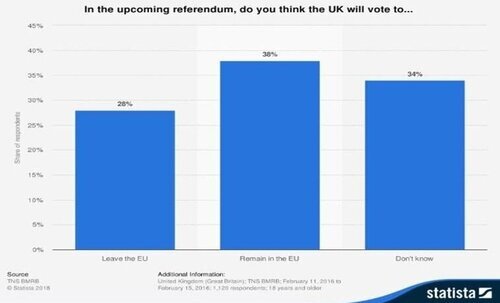
The Brexit Campaign left Europeans at the edge of their seats. At the dawn of the conversation, the result was completely uncertain. Polls gave a solid 10% lead to the remain vote, however, there was a strong candidate in this referendum – “I don’t know”. This uncertainty was immune to traditional political advertising, which by using billboards and TV, failed to target specific audiences, feeling quite disconnected and generic. This void was what its online version came to fill. Online political advertising is the medium by which existing or insurgent parties and movements attempt to gather votes or increase their following through untraditional media forms, such as social networks or online ads.


In the upcoming referendum, do you think the UK will vote to…In the upcoming referendum, do you think the UK will vote to…

Technological advancements have made social media and the internet in general the most accessible forms of mass-communication, creating fertile soil for the creation of targeted ads. Political parties took advantage of big data harbored by digital giants such as Facebook and Google to dig out the political concerns of billions of individuals,1 which allowed political parties to, better than ever, know the following things: the main topics of concern, which groups worry about them the worst, how these groups feel about the parties that currently address them, and, perhaps most importantly, the forms of media they are most susceptible to.

The European Union has seen an extreme growth in the use of online political advertising in the last half of the decade. In the UK, for example, spending on digital ads as a proportion of total ads increased from 1.7% in 2014 to 23.9% in 2015, reaching 42.8% in 2017.

This tool has become increasingly dominant in an ever-more polarized and competitive landscape, in which the traditional parties have started to come under threat by the insurgence of new movements, many of which wouldn’t have come into the spotlight if not for hefty media investments.

The association of microtargeted political advertising with the advent of new, extremist movements is not at all unreasonable. The rise of Alternative für Deutschland (AfD) in Germany, for example, can largely be attributed to an extensively developed social media micro-targeting strategy conducted with the help of Texas-based advertising firm Harris Media, who had successfully ran campaigns for Donald Trump and Marine Le Pen. 3 AfD managed to become, in a short time, the countries’ third political force, with 12.6% of votes in 2017’s national elections.4 Spanish party VOX, which gained 6.21% of votes in most recent elections,5 also had an aggressive online marketing strategy, having become the most followed Spanish political party on Instagram.6

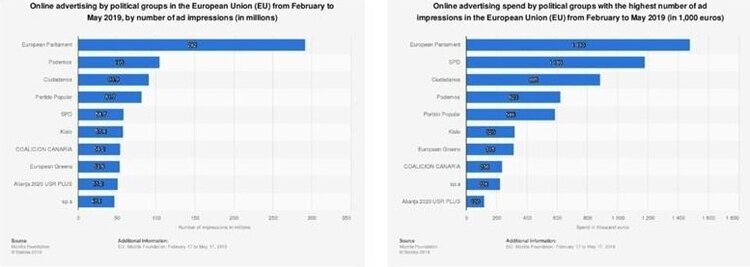
Interestingly, however, the highest investments in online political advertisements came not from these sunrise parties, but from traditional ones. As can be seen in the graphs below, the highest outreach and investments in online political advertising in 2019 came from traditional parties in countries such as Spain, who has yet to form government, and Germany, whose election results made a complicated coalition necessary. In fact, we can assume that this aggressive allocation of these parties’ sizeable advertising budgets aimed at opposing the imminent threat of new, populist movements and posed as an attempt at regaining political trust and credibility in the general audience, who with them has become out of touch.


Online advertising by political groupsOnline advertising by political groups

However, there is a clear front-runner in the use of this media form – the European Parliament. In spite of, in principle, not making use of microtargeting, this shift to a more prominent online presence makes sense when faced with the enormous apathy towards EP elections shown by voters. In the 2014 elections, abstention won with a staggering absolute majority – 57.39%.7 This obviously worried the EP, who launched online programs such as This Time I’m Voting and multiple Instagram, Facebook and Twitter campaigns which did not go unnoticed. The extent to which this affected the decrease in abstention to 49.38% is,8 however, a matter of debate.

Nonetheless, this comes to show that online political advertising, due to its outreach, has the potential to be used towards more universal causes such as the need for political engagement and to raise awareness for environmental concerns, and less such as a tool of tailored manipulation. However, the statistics regarding the first presented example, the Brexit referendum, present a hard truth. In 2016, “Leave” groups spent £ 4.45 million in online campaigning and microtargeting, with “Remain” investments far behind at £1.91 million. This leaves room to wonder – had things been more balanced, would the outcome have been radically different?

More recently, this year, Britain’s Future, a no deal Brexit group flaunted the highest number of political ads of any UK party, at an impressive 2.354 figure, meaning they had ads for every possible consumer. In addition, they spent 366 thousand pounds against Theresa May’s Brexit Deal on Facebook, money which has no known source. This comes to show the most pressing issue with this form of advertisement – regulation. As of September 2018, the European Commission approved a package which aims at protecting personal data in election times, in particular from foreign interference in national and European elections.9 However, even though 76% of Europeans view this as an imperative necessity,10 the organization has failed to assure transparency and to oblige online political advertising to follow the same rules as it’s traditional format. As of today, they have merely managed to advise national governments to “ensure citizens can easily recognize online paid political advertisements and communications” and “make information about [political parties’] spending for online activities on their websites” available, having passed no strong bill on the matter.

Big Brother has been watching us for quite a while now. He has all our life’s data stored in millions of databases. We know that. The problem is that now, he has started talking back.

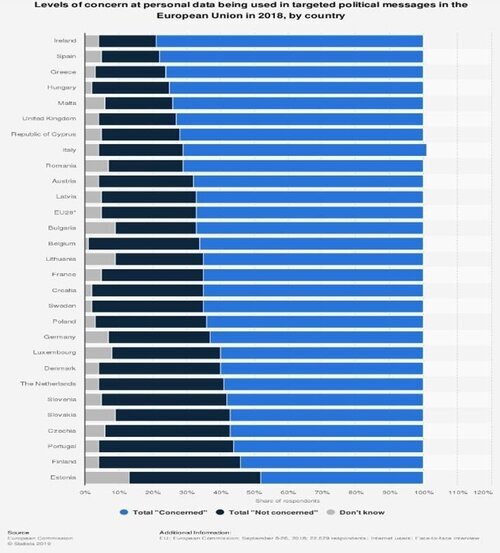
Levels of concern at personal data being used in targeted political messagesLevels of concern at personal data being used in targeted political messages

Behind the mask of a concerned movement or party, we are manipulated into thinking that we are finally understood, and forget we are the victims of what is possibly humanity’s greatest publicity stunt. Although some more than others, Europeans are concerned that the use of their once-promising data is turning against them. The need for transparency is pressing, but the long-lasting effects of this capitalization on democracy is something only time will tell.

Who will survive? Fintechs, traditional banks or both?

Do Revolut or N26 sound familiar? They are some of the most known fintechs in Europe. Both present themselves as alternatives to the traditional banking sector. The first is from the United Kingdom and the latter is based in Germany.

If you’re Portuguese, you are probably familiarized to MB Way and have heard about PPL Crowdfunding, a crowdfunding platform as its name suggests.

Fintech’s are revolutionizing modern banking, among other financial services.

Briefly, “fintech” stands for financial technology and represents the term used to name companies that exploit technological advantages to provide more efficient, lower cost and more user-friendly financial services.

Revolut is maybe the most known example of a fintech unicorn [term used to name tech companies valued above $1 billion].

Without a physical presence (it doesn’t have any bank infrastructure like Barclays or BBVA), this fintech is able to provide most of the financial services offered by the big banks at a lower cost and with a more user-friendly interface. You may transfer money between two different country-based banks without any intermediation fees for example. In this case, the United Kingdom’s based unicorn is clearly a Competitive Fintech Venture as it competes with the traditional banking sector.

Another type of fintech is what may be called a Collaborative Fintech Venture: this kind of company aims instead at complementing the traditional financial services. An example of these ventures is the MB Way service, provided in Portugal by SIBS, a company mainly held by the national big banks. It initially enabled consumers to easily transfer money between different bank accounts, using only the client’s phone number. This way, consumers have an additional feature linked to their bank account and are therefore more pleased with their banking services.


So, should the big banks feel threatened by fintechs?

Fintech is creating opportunities for customers and businesses alike, Bank of England Governor Mark Carney said.

“In the process, however, it could also have profound consequences for the business models of incumbent banks,” said Carney. So, should the big banks feel threatened by fintechs?

The BoE, in its 2017 stress test, said the tested major banks (HSBC, Barclays, Lloyds, RBS, Santander UK, Standard Chartered and Nationwide) concluded that they could withstand continued low growth and fintech competition without making big changes to their business models or taking on more risk.

[Reuters] However, the BoE stated that the fintechs’ competition could cause “greater and faster disruption” to these banks’ business models than even these institutions project.

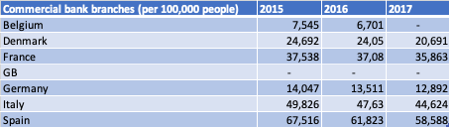
Number of commercial bank branches in Europe (per 100,000 people)Number of commercial bank branches in Europe (per 100,000 people)

Also, as digital payments gain terrain over the use of bank notes and coins, the ATM network in these same countries has dropped on average 2.5% since 2015, which leaves room for fintechs in the payments’ sector, like Stripe, based in San Francisco. Stripe started as a service to help small online sellers process payments and now serves tech giants like Amazon and Microsoft. It now presents other products, like a credit card issuing technology and its latest valuation, dated from Jan. 2019 was $22.5 billion.

As shown by Revolut, fintechs may weaken the relationship between customers and the banks. “For instance, in the future, it may be possible for a customer to manage their finances with only minimal direct engagement with their banks.” This will certainly make it harder for banks to maintain their high margins and profits.

Moreover, as digital banking wins over the traditional one, bankers as we know them are also at risk. According to the World Bank, the number of commercial bank’s branches per 100,000 people in developed countries like Belgium, France, Denmark, Germany, Italy or Spain have dropped an astonishing average of 5.9% since 2015 (to the last recorded year-worthy of data), which coincides with the foundation year of Revolut.

To cope with this already existing and growing competition, the big banks have to take one of two alternatives: to design on their own innovative alternatives and technologies that bring more value to customers as fintechs do; or to integrate these upcoming firms in their ecosystem, as it may be easier for these start-ups to be more agile and disruptive than for the “too big to fail” banking institutions. Otherwise, if these financial organizations also show themselves as “too big to innovate”, they are condemned to fail, to be replaced and outperformed by the upcoming fintech companies or even by big technological conglomerates like Apple, who are rapidly taking over some financial services (e.g. Apple Pay).

One thing is for sure: this competition will certainly benefit consumers and possibly even the whole economy, in which the new blockchain technology may have a relevant role to play.