
 Written by
On October 17, 2026, the city hall of Limoges burned. In Marseille, dozens of shops were looted. In Paris, the Marianne statue, France’s symbol of the Republic, was graffitied and tear gas hung over the boulevards. By the end of the night, 1,800 people had been arrested and over 500 police officers and firefighters were injured. Between 550,000 and 800,000 people had taken to the streets across France. This was not a revolution. It was a receipt, presented with interest, for years of eroded wages, record fuel prices, and a government asking ordinary people to fund a €54 billion austerity program while TotalEnergies paid record dividends.
France is the most dramatic flashpoint, but it is not alone. Across the world in the autumn of this year, workers and citizens are mobilizing at a rate not seen in decades, from the banking halls of Mumbai to the transport hubs of Rome; from the factory floors of Istanbul to the classrooms of Los Angeles. This is not a coincidence. It is the predictable economic consequence of years of real-wage erosion, and in the most acute cases, it is no longer stopping at the picket line.
By 2025/2026, the OECD reported that real wages in advanced economies remained, on average, 4.2% below their early-2021 levels. The International Labour Organization’s Global Wage Report confirmed that real hourly earnings had grown by just 0.1% worldwide over the preceding twelve months. Workers had been patient. Now, they are mobilizing.
GLOBAL PHENOMENON WITH LOCAL FACES
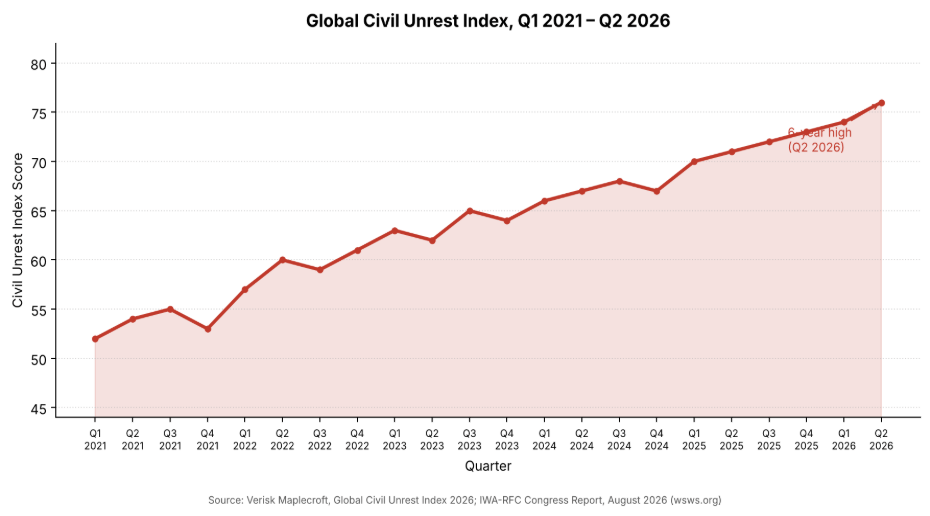
The data from Verisk Maplecroft’s Global Civil Unrest Index tells the story visually: the index hit a six-year high in Q2 2026, driven not only by geopolitical tensions but by organized labor action. The breadth of the strike wave is striking in itself. It spans industries, banking, transport, manufacturing, education, healthcare, and continents. Each country has its own trigger, but the underlying economics are the same.
In India, the United Forum of Bank Unions (UFBU), representing employees of the State Bank of India, Punjab National Bank, Union Bank of India, and Bank of India, announced an indefinite strike beginning October 26, 2026. Their demands: a revised wage structure, a five-day working week, and opposition to performance-based pay schemes that they argue undermine job security. This is no fringe movement; these are the backbone institutions of one of the world’s fastest-growing economies.
In Italy, the strike calendar for October 2026 alone reads like a sector-by-sector indictment of wage stagnation. Milan’s ATM public transport workers struck on October 9; a general regional strike across Tuscany shut down rail, local transport, and contractors on October 14; national school staff walked out on October 16 demanding a 20% pay increase and an end to precarious fixed-term contracts; and a nationwide general strike of public and private employees is called for October 30. Earlier in the year, a national transport strike on January 31 had already paralyzed airports, railways, and urban transit, with union federations CGIL and UIL citing wage erosion from years of inflation. In Germany, a country not typically associated with industrial unrest, 1.5 million working days were lost to strikes, the highest figure since 2015, as the powerful IG Metall and Verdi unions pressed employers in automotive and public services for above-inflation settlements.
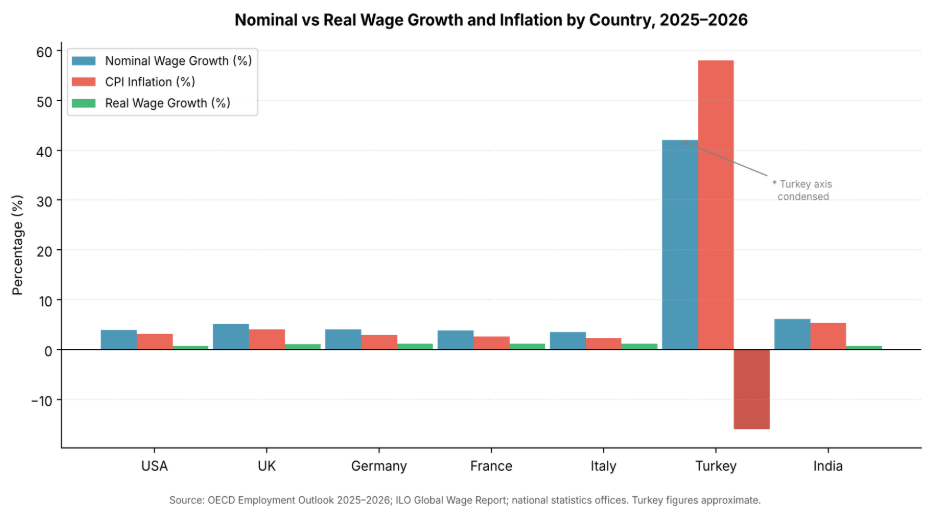
Turkey presents perhaps the most extreme case. With inflation running above 58%, the TÜRK-İŞ confederation mobilized 600,000 public sector workers in strikes that began in August 2025 and continued into 2026. Even nominal wage increases of 40% failed to keep up with the pace. In Argentina, major unions called a nationwide strike in February 2026 against President Milei’s austerity program. In the United States, the Boeing machinists’ strike saw 33,000 workers walk out, and education workers staged rolling actions in Los Angeles and several other cities.
THE ECONOMICS BEHIND THE UNREST
The chart above makes the financial logic of the strike wave immediately legible. In every country shown, nominal wages have failed to outpace inflation, sometimes dramatically so. Real wage growth is negative or near-zero across the board in advanced economies, and catastrophically negative in Turkey. Workers are not demanding raises out of greed; they are demanding the restoration of purchasing power they have already lost.
This matters for macroeconomics in ways that go beyond labor relations. When a critical mass of collective bargaining agreements is renegotiated upward to compensate for past inflation losses, the risk of a wage-price spiral re-emerges. Central banks, which have spent the last three years fighting inflation with higher interest rates, now face a new threat: that successful strikes could embed inflation expectations into multi-year wage contracts, making their job considerably harder. The European Central Bank and the Bank of England have both flagged “wage catch-up dynamics” as a key upside risk to their inflation forecasts for 2026/2027.
There is also a productivity dimension. Strikes are costly, not just for employers, but for whole economies. Industries disrupted by strike action face output gaps, supply chain delays, and investor uncertainty. In Germany, where the automotive sector is already grappling with the structural transition to electric vehicles and increased Chinese competition, sustained industrial action adds another layer of vulnerability at a critical moment.
Yet the same economists who worry about strike-driven inflation also acknowledge the structural argument for higher wages. Decades of data show that labor’s share of national income has been declining in most advanced economies since the 1980s. The post-pandemic inflation shock simply made the gap visible to workers in a way that annual wage statements had obscured. In this sense, the strike wave is not just a symptom of the current moment; it is a delayed reckoning with structural trends that have been building for a generation.
WHAT THE NUMBERS TELL US
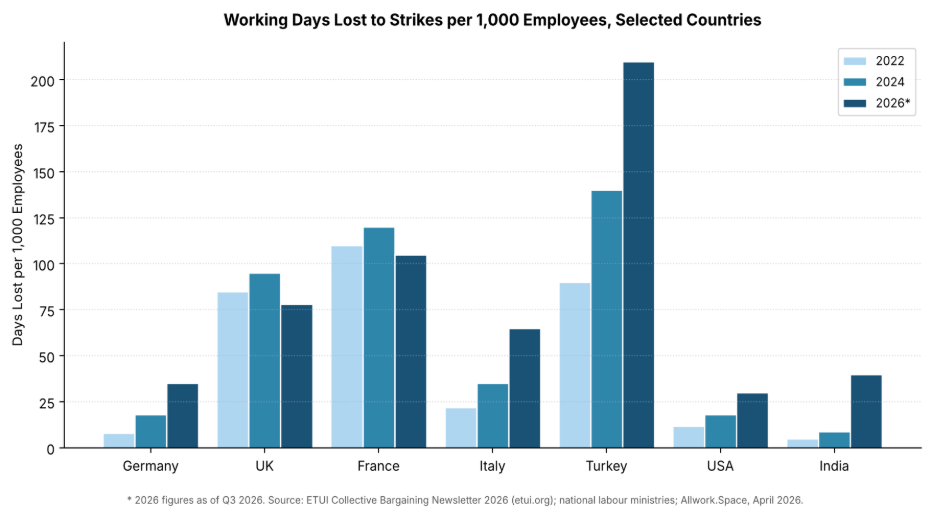
The third chart tracks working days lost per 1,000 employees across key economies over three moments in time: 2022, 2024, and 2026. The trend is unmistakable. Germany, Italy, India, and Turkey all show sharp upward trajectories into 2026. Turkey’s figure is exceptional in magnitude, but the directional story is consistent everywhere. Even the USA, where union density has fallen to historic lows and the legal framework for strikes is more restrictive than in Europe, show a meaningful increase, reflecting the resurgence in organizing across sectors like logistics, tech support, and manufacturing.
France is the starkest illustration of what happens when the strike mechanism alone fails to produce results. What began in September 2026 as student protests over teacher shortages and crumbling school infrastructure rapidly merged with broader cost-of-living fury, record diesel prices at €2.41 per liter, a poverty rate hitting 15.4% (its highest on record), and GDP growth forecast at just 0.4% for the year. The government of Prime Minister Lecornu, meanwhile, is pursuing €54 billion in budget cuts while France’s 2026 deficit stands at 5.4% of GDP, the highest in the eurozone.
On October 17, an estimated 550,000 to 800,000 people took to the streets nationwide. The march was largely peaceful, but violence followed: city hall in Limoges was set on fire, dozens of shops were looted in Marseille, the Marianne statue in Paris was graffitied, and over 1,800 people were arrested. More than 500 police and firefighters were injured. Human rights lawyers described some protesters’ injuries, including a lost hand and a broken jaw. CGT-led strikes at TotalEnergies refineries had already begun days earlier, with workers pointing to the company’s record dividend payouts as their real wages fell. President Macron is expected to address the nation, but with a divided Parliament and 2027 elections approaching, the political space for concession is narrow.
The echoes of the Gilets Jaunes (Yellow Vests) of 2018/2019 are deliberate and explicit. The trigger then was also fuel prices and a perceived tax system that protected capital while squeezing workers. The difference in 2026 is that the movement has been broader from the start; students, unions, retirees, and industrial workers are marching together. On November 5, all five major union confederations: CFDT, CGT, FO, UNSA, and FSU, have called a nationwide day of action, a unity that is itself historically rare. France is no longer a country on the edge of unrest; it is at the center of it.
CONCLUSION
The global strike wave of 2025/2026 is best understood as an economic correction mechanism, workers and citizens using the leverage available to them to reclaim purchasing power lost during the inflationary surge. Where governments and employers have not responded, the pressure has escalated beyond organized labor into the streets. For finance students and market observers, the implications are concrete: France’s unrest has already pushed its ten-year bond yields above 4.5%, their highest since 2008, as markets price in political risk alongside fiscal risk. Watch Italy’s upcoming general strike for signals about the Meloni government’s fiscal room to manoeuvre; watch France for whether the coalition of all five major unions holds; watch India’s banking sector negotiations as a test for one of the world’s most systemically important financial systems; watch Turkey as the cautionary extreme of what inflation and wage conflict left unresolved ultimately produce.
“Workers do not go on strike because they are irrational. They go on strike because the alternative, accepting a permanent reduction in living standards, is worse.” The economics of 2026 are proving that statement right.
The return of the strike is not a crisis of labor relations. It is a crisis of distribution, and it will not be resolved until the gap between wages and prices is closed. How that closure happens, and who pays for it, will shape monetary policy, corporate earnings, and political landscapes for years to come.
Sources
ILO Global Wage Report 2026; OECD Employment Outlook 2025/2026; Verisk Maplecroft Civil Unrest Index 2026; ETUI Collective Bargaining Newsletter 2026; IWA-RFC Congress Report August 2026; Allwork.Space Strike Activity Trends April 2026; The Economic Times on the UFBU bank strike October 2026; Reuters on Turkish workers’ strikes 2025/2026; Financial Times on Germany strikes 2026; Quotidiano Nazionale on Italian strike calendar October 2026; Al Jazeera on the Paris protests October 18 2026; The Nation on France’s cost-of-living crisis September 28 2026; Sortiraparis on Paris strikes October 8 2026; ECB Economic Bulletin 2026; Bank of England Monetary Policy Report August 2026

Rebecca Fratello

