
 Written by
A Loan Without A Bank
Imagine a mid-sized company that needs around a hundred million euros to buy a competitor or to finance a new project. Twenty years ago, it would most likely have borrowed from a bank: companies of this size were usually too small to issue bonds on public markets, so bank loans were their main way to borrow. Today, there is a good chance the company goes to an investment fund instead. The fund negotiates the loan directly, keeps it until it is repaid, and has no depositors behind it: its money comes from pension funds, insurers and other investors.
This is private credit, one of the fastest-growing sectors of global finance. This article explains what it is, why it grew so quickly, why it is so much larger in the United States than in Europe, and why regulators are following it closely.
What Is Private Credit?
The International Monetary Fund (IMF) defines private credit as lending in which specialised non-bank financial institutions, such as investment funds, lend to companies. Unlike a bond, the loan is not traded on public markets. Unlike a traditional bank loan, it is not funded by customer deposits.
The typical borrower is a middle-market company. The US Federal Reserve describes these as firms with annual revenues between $10 million and $1 billion (often, according to the IMF, too large or risky for banks but too small for public debt markets), and notes that most private credit loans go to companies backed by private equity firms. According to the IMF, these borrowers tend to carry more debt than companies that borrow through leveraged loans or public bonds.
Almost all private credit loans have floating interest rates, so the cost for the borrower moves with central bank rates, instead of being fixed for the whole duration of the contract. Borrowers accept higher interest costs in exchange for speed, flexibility, and confidentiality, while investors receive higher returns. According to J.P. Morgan, direct lending returned about 9% a year between 2014 and 2024, compared with 5.5% for leveraged loans and 5.2% for high-yield bonds. The trade-off is liquidity, because these loans cannot easily be sold before they mature.
From Niche To Trillions
According to the Bank for International Settlements (BIS), outstanding private credit loans worldwide grew from around $100 billion in 2010 to over $1.2 trillion in 2024. The IMF estimated the market at about $2.1 trillion in 2023. However, the two figures measure different things: the BIS counts only loans already made and not yet repaid, while the IMF also includes money that investors have committed to funds but that has not yet been lent.
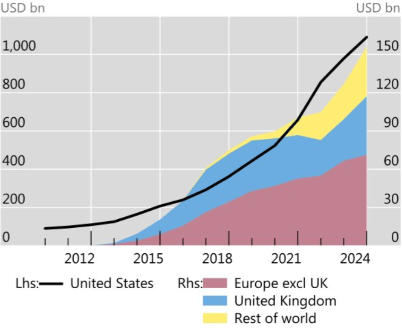
Figure 1: Total volume of outstanding private credit loans by region (BIS, March 2025)
Two developments after the 2008 financial crisis explain much of this growth. First, as the BIS puts it, “post-crisis banking regulation likely reduced banks’ willingness to lend to risky firms.” Second, a long period of very low interest rates pushed pension funds and insurers to look for higher returns. Private credit funds stepped into the space that banks had left.
Why America Dominates
The BIS calculates that the United States accounts for over 87% of outstanding private credit, while Europe (excluding the United Kingdom) accounts for about 6% and the United Kingdom for about 3 to 4%. Canada accounts for most of the remainder.
One reason is the structure of corporate finance. European companies rely much more on bank loans than American ones. According to the Banque de France, debt securities such as bonds made up only 10% of the debt financing of European non-financial companies in 2024, compared with 28% in the United States. In the euro area, private credit funds managed roughly €100 billion in 2025, according to the European Central Bank (ECB), and around 70% of the private credit received by euro area companies comes from funds based outside the euro area.
The Warning Signs
In 2024, the IMF reported that more than one-third of private credit borrowers had interest costs exceeding their current earnings, and that private loans are valued using risk models (often updated only once per quarter) rather than market prices, which makes losses harder to see. The report concluded that “immediate financial stability risks from private credit appear to be limited”, but called for closer supervision because of limited data on leverage and on the links between funds, banks and investors.
In autumn 2025, two US bankruptcies brought these concerns into the headlines. In September, Tricolor, a subprime car lender, and First Brands, an auto parts supplier, collapsed. US prosecutors allege that both had pledged the same assets to more than one lender, and that First Brands had over $9 billion in liabilities but only $12 million in cash. First Brands’ founder and his brother were charged with fraud in January 2026, and the defendants are presumed innocent. JPMorgan lost $170 million on Tricolor, and its CEO Jamie Dimon warned: “When you see one cockroach, there are probably more.” Both companies also borrowed from banks and through invoice financing (a mechanism of selling unpaid invoices for cash in advance), so no single lender could easily see how much they really owed. Still, the ECB describes them as defaults linked to private credit markets, and they increased scrutiny of lending outside the traditional banking system.
Pressure In 2026
Pressure in 2026 came first from investors asking for their money back. BCRED, Blackstone’s private credit fund, is not listed on a stock exchange: investors can only sell their shares back to the fund, which normally buys back up to 5% of its shares per quarter because its loans cannot be sold quickly. In the first quarter, requests reached 7.9%, and Blackstone met them all, helped by $400 million from the firm and its employees. In the next two quarters, they rose to about 10%, and the fund applied the 5% limit. This is exactly the liquidity risk the IMF warned about in 2024: funds holding loans that cannot be sold quickly, while offering regular withdrawals, can face more exit requests than they are able to meet.
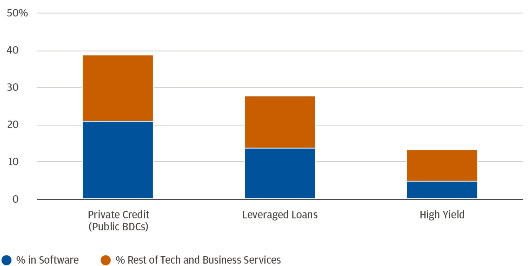
Figure 2: Share of loans to software (blue) and other technology and business services (orange), by type of credit (J.P. Morgan, March 2026)
Loan values have also declined: a Reuters analysis of 44 US business development companies (BDCs) found that their portfolios were valued at 97.57% of cost at the end of June 2026, down from 99.25% at the end of 2025. Markdowns were most frequent among loans to software companies, whose business models could be disrupted by artificial intelligence, and private credit is particularly exposed to this sector: about 21% of listed BDC loans go to software companies, against 14% for leveraged loans and 5% for high-yield bonds (Figure 2). Defaults, however, remain moderate: according to J.P. Morgan, the private credit default rate was about 2.5% in March 2026, broadly in line with historical norms. In Europe, direct exposures are limited: the ECB estimates that euro area insurers hold about €211 billion in private credit (2.3% of their assets), banks €62.5 billion (0.2%) and pension funds €52 billion (1.4%). Besides, it judges that private credit alone is unlikely to threaten euro area financial stability at present.
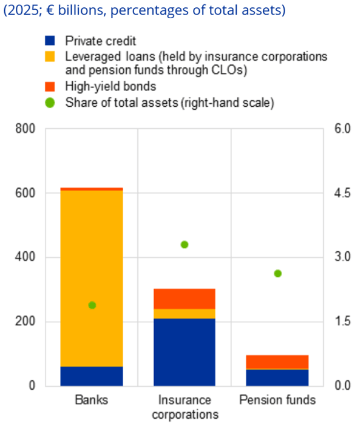
Figure 3: Direct exposures of euro area entities to private credit and leveraged debt markets
(ECB, May 2026)
Conclusion
Private credit has grown from a niche into a major source of financing for mid-sized companies, especially in the United States, filling part of the space that banks left after 2008. Its main advantages are speed, flexibility, and higher returns; its costs are lower transparency and liquidity. The industry still expects the sector to grow: in a PwC survey of more than 120 private credit managers conducted in early 2026, over 80% expected their allocations to increase over the following year, and PwC’s base case forecast is that the market could grow from over $2 trillion in 2026 to $3.4 trillion by 2030. However, as the BIS points out, private credit has not yet gone through a full credit cycle, which is why regulators continue to follow it closely.
Sources
International Monetary Fund (IMF); Bank for International Settlements (BIS); Federal Reserve; European Central Bank (ECB); Banque de France; J.P. Morgan Private Bank; PwC; U.S. Department of Justice; Reuters; Morningstar; Banking Dive
Theme: Finance

Riccardo Ruggeri
Writer

