
China at a crossroads: when will it be too late?

China will strengthen green and low-carbon policies and regulations with a view to strictly control public investment flowing into projects with high pollution and carbon emissions both domestically and internationally”. These were the words of President Xi Jinping in 2014. Later on, in July 2019, China committed to “update” its climate target “in a manner representing a progression beyond the current one”. Furthermore, it also vowed to publish a long term decarbonization strategy by next year.


But can this nation live up to the promises?

Indeed, China made an effort in promoting green development: in 2015,  it increased its wind power capacity by over 30 gigawatts, becoming the number one leader in this parameter.

In that same year, China saw a huge growth in solar power production, moving into first place, surpassing the previous solar leader, Germany.
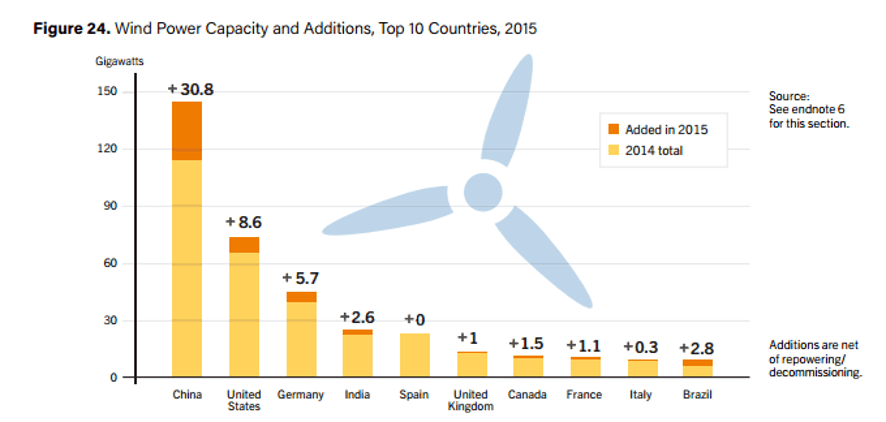
China has been the world’s leading country in electricity production for renewable energy sources, according to Global Commission on the Geopolitics of Energy Transformation, establishing itself as a global pacemaker in driving a domestic decarbonization agenda.

On the one hand, tension arises upon the fact that the country finances clean energy, representing 11% of its budget spent on electric power generation. On the other hand, investment in coal production amounts to a total of 36% of the Belt and Road Initiative. [1]

Conflicts of interest have emerged between the promise to reduce coal production and the fact that it has been one of the biggest contributors to the growth in the power sector. In fact, China is responsible for 51% of coal’s global demand as well as 46% of its global production – if the country continues to go down this path, its reliance on coal will not fall not even close to the promised value.

  • Demand-side: China’s coal consumption has been growing at a slower rate and not necessarily declining. It could indeed be said that Chinese coal demand has been relatively flat for a few years now, but it has not been falling in the absolute sense.

  • Supply-side: Coal power generation has been rising at 6% per year and China has reached 1.76 billion tonnes of this fossil fuel in the first half of 2019 – which represents a 2.6% increase from the same period last year.

On top of that, China’s financial institutions are providing $36 billion in funding to build coal power plants outside the country.

A unit-by-unit analysis of all global coal plants under development, based in 2018, shows that Chinese investment has had a significant increasing role in supporting and funding new coal plants in international markets as shown in the image below:
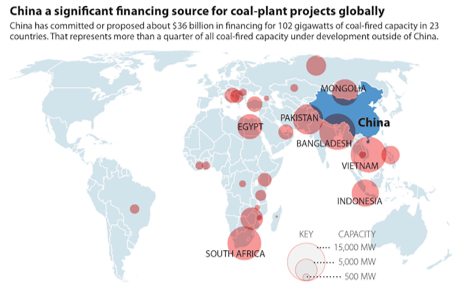

Source: Global Coal Plant Tracker (July 2018) IEEF analysis

Source: Global Coal Plant Tracker (July 2018) IEEF analysis

Moreover, Chinese financial institutions and corporations have agreed to fund over one-quarter of the 399 gigawatts (GW) of coal plants currently under development outside China. This comes at a time where many financial institutions such as the World Bank are shifting away from the coal industry.

According to research organization Climate Action Tracker (CAT) China’s actions and policies are highly insufficient to meet the challenge of holding global warming below even 2ºC, let alone the Paris Agreement limit of  1.5ºC.

As the world’s leading greenhouse gas emitter, CAT also predicts that China’s emissions will rise at least until 2030, at a point which is likely to be too late to curb the country’s impact on climate change.

Nonetheless, another question arises: will China be able to successfully decrease its coal production so fast as it pledges?

With Beijing’s push to reduce coal burning, nearly 13 million households in northern China have switched to electric or gas-heating since 2016.

In 2017, when northern China experienced the biggest ever campaign to replace coal with natural gas it was reported that, in Beijing alone, 140,000 households, across 336 villages bid farewell to coal.

In addition, the toughest restrictions ever on industry were also put in place, from mid-November to mid-March: 15 key cities had to cut steel manufacturing output by 50% which was a big improvement regarding environmental changes, since over 71% of the steel produced uses coal. Also, aluminium production was cut by 30 % as the energy for its digestion plant is derived from steam raised by using coal.

Despite the major decline in atmospheric pollution in those areas and the decrease in the national coal capacity, the rushed measures caused serious problems, since China’s infrastructures were not prepared for this significant change.

Since there was not enough time to install the gas pipes underground in Shijing, they were left above ground causing safety risks for civilians.

Furthermore, widespread reports from the winter of 2016 disclosed heating problems caused by failures to complete the switch to gas on schedule. As a result, some schools in rural zones had no heating, given that coal-fired boilers had been removed before natural gas pipes were installed. Similarly, in Linfen, a village located in Shanxi, had a 155 square kilometer “no coal zone” where residents had to remove coal stoves and they were not even allowed to keep coal at home – yet no alternative heating was provided, despite sub-zero temperatures.

Also, market-wise, as many firms and industries were highly dependent on coal, these restrictions placed them on the verge of shutting down. Eventually, gas heating increased, resulting in supply shortages and causing inadequate heating for many households.

All in all, the world’s success in bringing down global warming is dependent on China’s action, the world’s largest carbon emitter.

Yet, it appears that China’s interests are ebbing as its economy slows. Combined with an ongoing trade war with the United States as well as  Trump Administration’s withdrawal from the Paris Agreement, this economic slowdown has reduced China’s enthusiasm to lead in this global battle. The aforementioned is no excuse for China to forgo a leading role in the fight against global warming. Indeed, embodying the “torchbearer” may be the country’s best bet for a sustainable transition to a stronger and low-carbon economy.

[1] The Belt and Road Initiative (BRI) development strategy aims to build connectivity and co-operation across six main economic corridors encompassing China and: Mongolia and Russia; Eurasian countries; Central and West Asia; Pakistan; other countries of the Indian sub-continent; and Indochina, quoted from  OECD Business and Finance Outlook 2018


Sources: The World Economic Forum, The New York Times, Climate Change News, The Diplomat, Forbes, Institute for Energy Economics & Financial Analysis, Reuters, Chinadialogue, OECD

Risk: Are we “Picking up nickles in front of a steamroller?”

When we think about risk usually we do not associate it with biology. “It’s another parameter to consider when making an Investment” – is what we tell ourselves. We tend to perceive risk as an external factor internal to the asset or portfolio we are analysing and not to us. And why is that? Why do we associate risk to an irrational set of things when its existence is solely our making?


Picture7.png

Risk is a very hard concept to define. Some perceive it as being the unpredictability of our returns whilst others are more inclined to defining it as the loss we suffer when we don’t choose the safe bet. Whatever is the real risk definition it surely has lead to absolutely catastrophic situations. Elise Payzan-LeNestour, a behavioral scientist in the field of neurofinance, made an interesting experiment to test whether risk behavior comes from human incapability of perceiving it or human recklessness of taking it either way. In the final stages of her experiment she asked around 400 students to play a game called “The Bowman Game”. The students had to choose between two options: skip – the safe bet – or bet – the risky choice. If they chose to bet, the bowman could hit the mark, and they would win 2$, or miss it, and they would lose 40$. Also, there were two different types of bowmans: a novice – more likely to miss the mark – and an expert – more likely to hit it. After collecting all the experiment data, Elise discovered that students were actually very smart in the understanding whereas their bowman was a novice or an expert.

However, she also concluded that even when the bowman was a novice, 40% of the students took the risk of losing 40$ either way. With this, Elise was able to extrapolate to the financial market and conclude that, even though we are perfectly aware of the risks of choosing to gamble instead of the safe option, “we are greedy and lack self-control” in the sense that we evaluate those risks and still accept them when the perfectly rational choice would be to back away and choose safely.

After this discovery, Elise went deeper and associated our human need for this risky gamble to our brain functions, finding the culprit in Dopamine, a hormone triggered by potential reward opportunities.


Picture8.png

The presence of this greed makes us put our necks on the line without backup plans or emergency exits. Taking these risks can lead to the loss of irreplaceable or non-recoverable resources, not only financially but also environmentally, for example. Our overconfidence on the market that never goes down is lost when it inevitably does and the public money goes down the drain. When we are taking part in an investment and building a continuous flow of renewable income we have to be aware of the notion of risk and of how it is not exterior to us but actually very much correlated to our reasoning and individuality. Joe Wiggins, winner of the Brian Abel-Smith Prize for outstanding performance at MSc in Behavioural Science at the London School of Economics, tells us that when we manage a set of financial assets, the risk lies as much on the asset’s trading market performance as on how frequently we check our portfolio, our individual incentives, our differences and our past experiences, to name a few. The possibility to trade at any given moment in time makes public equity investments more risky than private ones where we are less faced with price fluctuations and so have less emotional reaction. In sum, the risk of making bad decisions is lower since the immediate forces are less known. On investment, Wiggins states, “We can think of this as our erratic perception of risk continually shifting our personal discount rates”.


Picture9.png

Risk goes beyond the convention of possible capital loss, it goes far from being only related to the asset or market characteristics, it lies much more on the human conscious action to ignore the possible (maybe less probable) consequences of losing it all. Behavioral Science & Economics alerts for the need to find tools able to deter investors from taking actions with possible “collapsing economy side-effects” because with risk “surely you will be harmed, you don’t know when, but surely you will”, says Elise Payzan-LeNestour.  Investors shouldn’t continue to be rolled over for picking up nickels.

Sources:

  • Ted Talks

  • Behavioural Investment

Surprise mechanics: Payment as the new Default

Inertia, a word that makes all the difference. We might be uncertain, the decision might be difficult or we might not even care, we simply follow the recommended or pre-set, and without understanding we are under the influence of default opinions. In a simplified way, default options are pre-defined or recommended courses of action established before any reaction from the decision maker. Even though it can look scary and invasive when presented in a more theoretical perspective, the truth is that examples of this phenomenon are immersed in our reality. They are in our phones in the form of strange ringtones, alarm sounds or even pulse notification lights, they are in the way we pay our purchases and even in the games we play.

Picture4.png

The industry that will be subjected to a more detailed analysis will be the video-game industry which has been startled by an increasing concern with changes in defaults and the way it influences gamers as economic agents. Default, by principal, is all over gaming from subscriptions that renew automatically to more technical details – such as the way games adapt to the user’s individuality.

Nevertheless, the increasing concern is related to the way these practises have become more aggressive and privacy-breaking as a new, premium source of purchases. Since the past generation of video games (that existed and dominated the market between 2004 and 2011- Playstation 3, Xbox 360 and Nintendo Wii) the cost of producing games has increased in an almost exponential rate, tendency which has been aggravated by the required usage of more expensive technologies and techniques. Games are no longer pixelated images, they are fotogenic forms of interactive art and as such require more and more production time and impose proportionally complex cost structures to firms. This is illustrated by the almost unimaginable and gigantic production costs. Let’s use as an example 2015’s game of the year, “The Witcher 3” (Image 1). Its production costs were around 81 million dollars and it took about three and a half years to produce it. As reasonable as it might seem, it puts a lot of pressure on companies, and here is the catch, because of a strong and rigid market structure firms are not able to increase the consumer-end price of their product and so they have to find other ways to do it. They found that if they could incentivize their customers to spend more money inside the game having already purchased it, games would become more profitable. As a consequence practices, such as microtransactions, DLCs (downloadable content) and loot boxes, appeared. First they were used in mobile games – as “Candy Crush” – where users had incentives to spend real world money in the game in order to accelerate progression. Since they proved to be effective, they were moved to “triple AAA” games with high budgets and lots of marketing.

Picture5.png

The most apparent way of how invasive it became is by comparing it to gambling. The most recent cases of such facts are EA’s games like “Star Wars battlefront 2” that had its progression based on loot boxes that could be purchased using real world money or “2k’s 2k20” that had explicit slot machines inside the game (the image 2 illustrates such practise). Recently, this practice has become so invasive that governments felt the necessity of intervening in order to understand if such behavior is not harming consumers. In the end, it all falls into the British government asking EA’s and King’s representatives about these practices and possibly unethical behavior.

To sum up, and making use of the EA’s representative words, “surprise mechanics” represent a shift in the default of this industry from a more consumer friendly to a more aggressive consumption, incentivizing industry, that in its attempt to overcome the pressure created by the market’s structure, has been moving closer and closer to gambling. Consequently, it has been accused of creating structures that focus increasingly more in getting money out of their customers and less in providing value added. As governments started to worry and fans stopped buying these games, the industry is again trying to adapt. Games as a service are proof of this reaction. But until when will we have to sustain and tolerate such economic behavior that set defaults that are no longer recommended actions and are now predefined payments?

The November 2019 Spanish Elections: What to Expect

In December 2015, the conservative Popular Party’s government of Mariano Rajoy, while it won the general election, lost its absolute majority in the Congress of Deputies and had the party’s worst result since 1989. From that year onwards, no party has been able to form a long-lasting government. This political instability has led Spain to hold its fourth general election in four years tomorrow. Will this election finally relieve Spain from the ongoing period of political crisis?

April’s Elections


Image 1: Pedro SanchezImage 1: Pedro Sanchez

A minority government, Pedro Sanchez’s Spanish Socialist and Worker’s Party (PSOE) took office in June 2018, following a motion of no confidence1 that took down the government of Mariano Rajoy. The ousted prime-minister’s Popular Party (PP) was involved in a corruption scandal involving several of its high-ranking members, leading to a severe drop in its popularity. However, Sanchez called for a new general election in April of this year, after he failed to gather support in the Congress of Deputies to pass his budget for 2019.

In the last elections, the PSOE gathered a substantial 29% of the votes, but although it was the party’s first win since 2008, it was short of a majority to govern2. Vox, a far-right party opposing unrestricted migration and multiculturalism, won 10% of the votes and entered the Chamber of Deputies for the first time. The Popular Party (PP) met a historical defeat (16.7% of the votes).

Since the PSOE failed to win an absolute majority in the Chamber of Deputies, it needed backing from other parties. Once again, Sanchez’s inability to secure support this time to form a government is what led to the new November 2019 elections. He called for the elections after failed discussions with Unidas Podemos (UP), a coalition of left-wing parties and Sanchez’s most obvious choice, after disagreements over government ministers and the amount of involvement of the UP in the new government.


Polls: analysis of most likely results 

The latest polls by the Office for Social Studies and Public Opinion (GESOP) for the newspaper El Periòdic d’Andorra suggest that we will not see a significantly different political landscape with the November elections, and even report increasing fragmentation, with a smaller win for the PSOE at 26.8%. The PP is expected to see its share of the vote increase to 19.9% after successfully stealing votes from Ciudadanos, a center-right party who surprisingly gathered 16% of the votes in the April elections, and will now see its share more than halved, with the polls predicting a result of 7%. The far-right party VOX is met with a significant increase and should obtain 15.6% of the vote.

Más País, a new far-left splinter party, founded on September 25th, has decided not to run in the constituencies where it could not gather enough support to win seats but could contribute to the loss of seats by other left-wing parties, such as PSOE and UP. Más País is expected to obtain 2.6% of the votes, which has led to the further decrease of the far-left coalition Unidas Podemos to 13% of the vote.

All in all, the PSOE wins without an absolute majority, and probably with fewer seats in the Cortes. The PP will come second, followed by the UP. Ciudadanos will suffer a considerable decrease in votes and seats, as Vox will achieve the opposite. Regarding regionalist and nationalist parties, we do not expect meaningful changes from the previous results.


Graphic 1Graphic 1

What’s next? 

After the elections, we can expect that King Felipe will ask Pedro Sánchez to be the next Prime Minister, and a new round of negotiations among the parties will follow. In order to be PM, Sánchez needs the majority in the Cortes3 to be able to win the investiture vote or at least have most of the opposition MPs abstain during that vote. As for now, it is not expected that those negotiations will produce a different outcome than the ones that followed the elections in April. 

PSOE’s best hope to achieve a majority in parliament is to partner with regionalist parties and the left-wing coalition UP. Even though this might be plausible in mathematical terms, the disagreement points between the PSOE and UP from the last round of negotiations are still valid, making achieving a different outcome unlikely. It does not seem that left-wing parties are ready to make the necessary concessions: the UP wishes to have some ministers of their own, whereas the PSOE wants to form the government alone but backed by parliamentary support. Furthermore, Sánchez recently pointed out that even if an agreement had been reached to form a PSOE-UP government, it would have crumbled during the Catalonian crisis, amid which the UP and its Catalonian coalition Comú Podem have criticized the government’s actions and police intervention. The PSOE is also dependent on the unlikely event that the PP and Ciudadanos do not vote against Sánchez’s investiture. This seems improbable, as the Catalonian crisis accentuated the parties’ differences, and total support from the moderate right-wing opposition to a socialist minority government in the Cortes seems to be an almost unimaginable scenario.  

Without concession, diplomacy and statesmanship, the path to a stable government will be hard to find.

Either a PSOE minority government will be formed, unable to count with a majority and likely to fall at the first difficulty, or Spain will have to face yet another General Election in a few months.  


Image 2Image 2

1 Vote about whether a person in a position of responsibility (government, managerial, etc.) is no longer deemed fit to hold that position.

2 It won an absolute majority in the senate for the first time since 1989, but to govern, they would need 175 out of 350 seats in the Chamber of Deputies

3 Bicameral legislative chambers of Spain – Congress of Deputies and Senate.


Sources:

  • El Periòdic

  • Wikipedia

  • BBC News

  • The Guardian

  • Vox 

Article Written By:

Ana Catarina Salgado

Ana Maria Terenas

Christian Weber

João Maria Sande e Castro

Rui Ramalhão

Libra – Facebook’s New Currency

Facebook is set to launch a new cryptocurrency called Libra next year in early 2020. This new currency will allow its 1.7bn users to make financial transactions online from their mobile phone without a bank account, the company claims.

In early 2018, Facebook was accused of compromising over 50 million users’ data, having to pay $5bn for Cambridge Analytica privacy violations. This has been the largest levy ever imposed over a technology company by the Federal Trade Commission. Stocks plunged 20% and the company’s value dropped by $120bn.

Later on this year, Facebook announced that it is going to have a new cryptocurrency and financial infrastructure powered by blockchain technology, a series of immovable record of data that is managed by cluster of computers not owned by any single entity, which aims to provide and facilitate global transactions.  The company will have a new blockchain division ran by David Marcus, former president of PayPal and current head of the Libra project.

Zuckerberg and his team were initially able to gather 28 organizations for this new currency, such as Uber, MasterCard, Farfetch and Vodafone among many others. Thereby, they created the “Libra Association”, a non-profit organization, headquartered in Geneva, Switzerland, working to support financial inclusion worldwide. Each member funded the project with a minimum of $10bn. The association will focus on the reserve management, ensuring stability obtained by having a cluster of valuable assets composed by the dollar, the euro, the Japanese yen, the British pound and the Singapore dollar, with 50 percent, 18 percent, 14 percent, 11 percent and 7 percent, respectively.

The price stability will be the main differentiator from its cryptocurrency’s peers. It won’t have a fixed exchange rate, although it won’t be as volatile as, for example Bitcoin (another cryptocurrency run by blockchain technology). The reserve will amount around $200bn, an actual low number when looking into the financial markets.

Calibra will also complement this project, being the first product that introduces a digital wallet for the Libra, expected to launch in 2020. It will be available in apps like Messenger and WhatsApp, but it will also have its own app. It is claimed that it will have strong protection and be able to keep the user’s money information safe, although there is concern going around since the company’s history in data privacy is somewhat hazardous.  As previously mentioned, Facebook claims that the new cryptocurrency will reach the unbanked. You’ll just need to have a smartphone in order to send Libra instantly.


Problems might arise…

People who actually study the unbanked in the Federal Deposit Insurance Corporation have noticed that more than one third of the population concerned didn’t have enough money to open a bank account. This is something that is not solved by simply opening an online bank account. Almost half of the adults in the world don’t have an active bank account and these numbers worsen in developing countries and amid women, data released by the World Bank. So if this is the reality, will these people have access to a fully working smartphone? Even if they do, will they have digital means to buy Libra Coins?

Well, the certainty we have is that big companies like Apple, Google, Amazon and Microsoft have not yet signed up for the project, as well as banks. Mainly due to uncertainty going around future regulation that might be imposed by the authorities in order to secure central banks’ “monetary sovereignty”. Lawmakers and regulators in the U.S. have already raised concerns over this initiative. French Economy and Finance Minister already stood out saying France won’t allow the authorization of Libra into European soil given the issues inherent to the situation. China also considers Libra as a direct threat and is developing its own Central bank’s digital currency to meet the challenge imposed.

Facebook, however, has already stated that “people will increasingly trust decentralized forms of governance” (statement by David Marcus). The head of the Libra Association has already responded to the threats this project might have against financial institutions, playing down concerns over a potential disruption to monetary policies by the central banks. The reason of this being the fact that the Libra reserve contains multiple currencies, which makes Libra the one affected and not the other way around, he justifies, also adding that in case there is a currency crisis, they might decide whether or not to keep the certain currency in the basket.

Libra is designed to run on top of existing currencies, and claims the 1:1 backing of traditional currencies requires an equivalent value in government reserve in order for Libra to exist. “As such, there’s no new money creation,” Marcus tweets. He has also completed the statement saying that regulation should be created. Nevertheless, Facebook is maintaining the release date unchanged setting the launch for 2020.

Wait… Zuckerberg’s company knows the barriers they have to face to get the project launched. Most attacks to the Libra have to do with the technology and trust issues. The CEO himself has had a meeting with Donald Trump in order to discuss regulations, and how it will protect users’ data. The G7 nations have already formed a task force to look into concerns about cryptocurrencies, mainly the Libra. The firm’s own problems don’t lay solely on the decision of lawmakers, as this project has no “significant prior experience with digital currency or blockchain technology”. If problems are not settled, the digital currency might never launch.

One thing is certain, if Facebook is able to further develop and launch these cryptocurrency, they will centralize their platform users into their brand and profit from it. They may be able to use private information to personalize advertisements, their main source of income ($16.6bn at the end of last year), and eventually build a huge network of people around Zuckerberg’s empire. But first, they will have to overcome regulation and privacy hurdles. For now, because of the big controversy, some of the main companies involved the project have recently announced their withdrawing from supporting Libra, as it is the case of PayPal, eBay, MasterCard and many others.

Veni, vidi, Salvini: Consequences of the migration crisis in Italy

A Hungarian border fence built to stop migration flows, threatening the future integrity of Schengen. A founding member of the European Union, until very recently in the hands of far-right nationalists. A Mediterranean graveyard of 18,989 migrants who’ve drowned attempting to cross since 2014.

Facts don’t lie: more than poor, Europe’s handling of the migration crisis has been outright catastrophic.

Italy is always on the forefront whenever talking about the European migration crisis which started in 2014, both regarding the mass numbers of immigrants arriving at their shores and their controversial migration policies. Matteo Salvini is an unavoidable figure, steering Italy’s course on migration for over a year. It’s easy to point the finger at Salvini’s arguably inhumane practices. Nevertheless, Salvini is mostly a product, rather than the cause, of the lack of an effective European-wide response on migration.

With Salvini ousted from power in September, it’s important to reflect on his rise and migration policy, the real impact of immigration and what Europe can do to correct its past mistakes.

Salvini Ascending


Imagem1 (2).png

Discontent towards Europe was undoubtedly a major driver to Salvini’s successful result in the 2018 general election. Migration, although pivotal to that discontent, isn’t alone in making Italians increasingly critical of Brussels.

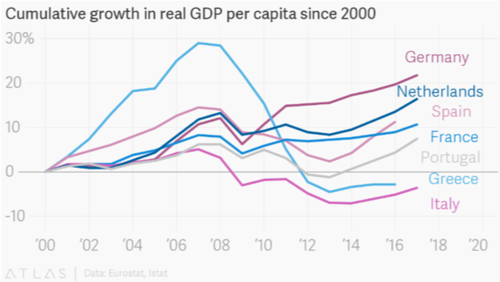
Italy has faced a long period of stagnation since the beginning of the century, with real GDP per capita having decreased 3% since 2000, leaving Italy behind relatively to its European peers. The role of the single currency in this stagnation is debatable, but this period of low growth coincides with the introduction of the euro in 1999. Many Italians blame it for their stagnant economy and Salvini has often used this anti-euro sentiment to his benefit. His slogan for the 2014 European elections was ‘Basta Euro’ (‘No More Euro), also campaigning against Brussel’s fiscal rules in 2018.

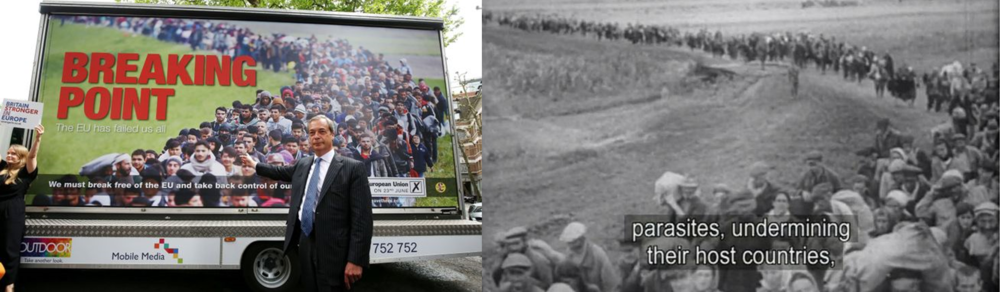
Italy has also faced en masse immigration, with a total of 656,040 migrants arriving to its shores since 2014. Simultaneously, anti-immigrant propaganda and fake news have swept the continent, fuelling hatred and mistrust towards foreigners. During the referendum campaign, Brexiteer Nigel Farage presented an anti-immigration billboard bearing a striking resemblance to a Nazi propaganda movie which described immigrants as ‘parasites undermining their host countries’ (Image1). In 2018, Orbán’s government sponsored a European-wide video, unfairly correlating refugees with the terrorist attacks across Europe. Even today, Ursula von der Leyen’s controversial choice to name the migration portfolio ‘Protecting our European way of life’ isn’t helping in preventing Europeans from regarding migrants as a threat.


Image 1: Nigel Farage presenting his anti-immigration billboard (left) and Nazi propaganda movie (right)

Image 1: Nigel Farage presenting his anti-immigration billboard (left) and Nazi propaganda movie (right)

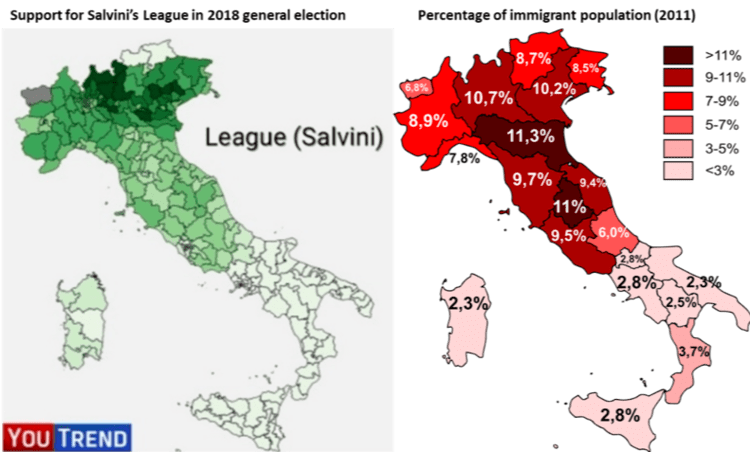
The impact of this xenophobic rhetoric is difficult to measure. Coincidentally or not, however, the regions with a higher percentage of immigrant population were the ones where Salvini gained most support in 2018.


Imagem1 (3).png

The European Union, nonetheless, isn’t without blame in turning Italians against immigrants. Its current legislation on migration and asylum, the Dublin Regulation, defines that the first Member-State to which an asylum seeker arrives is solely responsible for their asylum application, giving all other Member-States the right to deport a refugee back to their EU country of arrival. Consequently, this places an unfair burden on border countries such as Italy, even though countries such as Germany receive more asylum applications. This has caused 24,000 deportations back to Italy from other EU countries between 2013 and 2018. Despite the EU recognising this as a major flaw, the reform of Dublin has been stuck in the Council since the crisis started, where the Visegrád Group (Hungary, Poland, Czech Republic and Slovakia) are blocking any reform which involves mandatory relocation quotas, refusing to host any refugees. The lack of a common European stance on migration left Italy with the full burden of dealing with this issue.

This sent Italians a clear message: if they were the ones responsible for all refugees arriving at their shores, they would no longer allow refugees to land. The path was open for someone with a hard stance on migration to step in.

Salvini Takes Action


image-asset.png

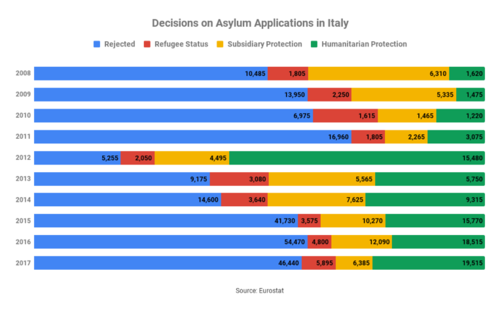
Salvini took office as Deputy Prime Minister and Interior Minister in June 2018 and his impact on Italy’s migration policy was highly noticeable. He quickly announced the closure of Italian ports to migrant vessels. 44,260 asylum requests were rejected. He shut an asylum centre in Sicily, one of the largest in Europe. He announced fines reaching €50,000 to rescue ships entering Italian waters. In September 2018, the Italian government approved the ‘Salvini Decree’ which, among other measures, removed the possibility of asylum applications being granted for ‘humanitarian protection’, which has been in recent years the most granted asylum type. This would greatly increase the number of rejected asylum applications and an estimated 670,000 immigrants would be living irregularly in Italy, essentially giving the Italian government the right to repatriate them.

Dismistifying Immigrants


image-asset (1).png

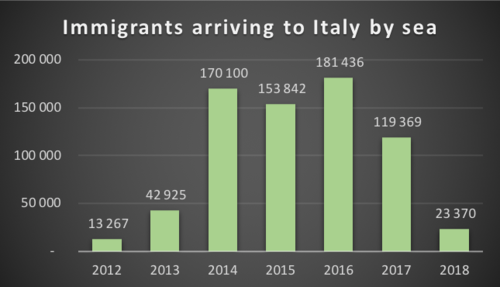
But are Italians and other Europeans right to fear the ‘invasion’ of immigrants? Public perception of immigrants often doesn’t correspond to reality. For instance, despite the sharp fall of 80% of immigrant arrivals by sea to Italy between 2017 and 2018 (partially due to Salvini’s measures), studies show that 51% of Italians still think this number is not decreasing. Moreover, an average Italian thinks that 26% of the country’s population is foreign, while the true figure is 9.5%.

It is also vital to distinguish between a regular immigrant and a refugee. A refugee is fleeing rather than voluntarily moving. These words are often used interchangeably but, in 2016, only 34% immigrants arrived to Italy due to humanitarian crises, while the others deslocated to Italy either for family reunification (45.1% of cases) or to look for better life conditions and employment.

Immigrants common desire for social mobility might explain their higher rate of entrepreneurship when compared to national residents in many European countries (although no data is available for Italy, the Global Entrepreneurship Monitor estimates this rate to be 12.5% for immigrants and 8.6% for national residents in the UK, 2017).

However, this is not the only way in which immigrants contribute towards their host country’s economy. An aging Europe desperately craves for rejuvenated workforce to sustain its social welfare systems, which are being stretched to their limits. Due to their younger age, in Italy, in 2008, 73.3% of immigrants belonged to the working-age population, compared to only 62.3% of Italians. Consequently, despite in the short-run receiving more in social benefits than they contribute with taxes, in the long-run their net contributions are positive, since they have a long working life ahead of them. In 2014, taxes paid by immigrant workers bore the cost of 600,000 pensions.

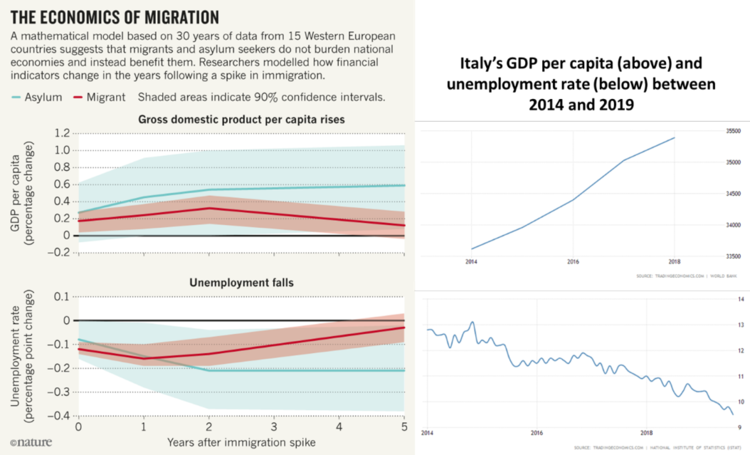
Studies also show that immigrants ultimately benefit the economy, decreasing unemployment and raising GDP per capita. While this verified in Italy since mass immigration began, it’s hard to quantify their contribution towards this, since it coincides with a period of overall economic recovery in Europe.


Imagem1 (4).png

On the other hand, less than 15% of non-EU immigrants in Italy have tertiary education. This results in more than 70% of them being employed as low-wage manual workers, which can cause salary degradation and competition with underqualified national workers, which often causes social tensions and feelings of resentment against immigrants.

Another preconceived idea is that refugees don’t make an effort to adapt to local culture and language. However, a 2014 study shows that 60% of refugees living in Italy had an advanced knowledge of Italian.

Second Chance

The ousting of Salvini presents a chance for Europe to show Italians it can smoothly integrate, absorb and redistribute immigrants in a better fashion than displayed so far.

A quick reform of the ineffective Dublin Regulation is desperately needed. This, however, will be difficult as the Visegrád group remains reluctant in accepting mandatory relocation quotas. A temporary solution is being discussed. Germany and France would each automatically accept 25% of arriving immigrants, with Italy only keeping 10% to compensate for recent years. Other EU countries, including Portugal, are also available to join this scheme. In return, Italian premier Conte has agreed to reopen the ports.

Many EU politicians have also called for EU-funded asylum centres in North Africa and Middle East. This would reduce the number of war-fleeing refugees risking the life-threatening Mediterranean crossing and the migrant pressure on southern European countries. A reinforcement of FRONTEX, the European Border and Coast Guard, which is severely understaffed, is of paramount urgency to combat illegal human trafficking and reduce the number of drownings.

There’s also too much media depicting refugees as dangerous criminals which must be countered, namely by raising public awareness and sensitivity towards their desperate situation. This has proven effective in the past, as is the case of the photograph of the dead Syrian infant found on the shore of western Turkey. When Aylan Kurdi’s picture became viral four years ago, the Swedish Red Cross saw a ten-fold increase in recurring monthly donations to their fund for Syrian refugees.

Despite overcoming the peak of the immigration crisis, Europe still needs to find a way to deal with this issue properly. Only a strong demonstration of solidarity and cooperation will prove to Italy that there’s no need for them to elect an ultra-nationalist again. Europe has been given a second chance to show it can do better. There might not be a third.

A New Stage of Saudi-Iranian Confrontation

Ever since the Saddam Hussein regime fell in Iraq in 2003, Iran been slowly expanding its sphere of influence, which now encompasses much of what it is called Middle-East. In Lebanon, the Iranians have the proxy group Hezbollah, which functions as a party/parallel administrative entity/military group. In Syria, the Assad regime relies heavily on Iranian support, a help which has allowed the government to remain in power despite the civil war, and even allow them to recover lost ground. In Iraq, the Americans ousted Saddam, only for the shias (a sect of islam), which had been persecuted by him, to take power and begin their own authoritarian like rule. Finally, we have Yemen in which the Iranians are covertly funding and supplying weapons the Houthis rebels.

All these proxy groups rely heavily on Iran, which is seen as the Defensor of all the shias and uses that image as well as its resources to support such groups. This, in turn, gives Iran a tremendous amount of influence in the countries in which these proxies operate.

However, most of the sunni (the most popular sect of islam) countries in the region don’t see this growing Iranian influence with good eyes, as it jeopardizes their own influence and security (some of these countries have large shia minorities that would like to oust their sunni overlords).

As such, a coalition has been created to counter this growing Iranian influence, which is being spearheaded by Saudi Arabia. All this clash of interests and hostilities have effectively turned the Middle East for the ground of a Saudi-Iranian style cold war, in which the two sides never use direct confrontation, using instead proxy groups.

One big example of this is Yemen (where this article will be focused). In Yemen, the Saudis have been supporting the Yemeni government, and the Iranians, the shia affiliated Houthis rebels, which has resulted in a brutal civil war which has largely been overshadowed in the media. The civil war started in 2015. Divisions in the country had existed for decades, if not hundreds of years (Yemen, due to its mountainous configuration, has never been a very unified country, lacking the social cohesion and sense of national identity; people identify themselves more with the tribe or community rather than the country).

In very brief overview, the Houthis took over Sana’a, the capital, and large parts of the country, meaning the Yemeni government only controls the southern coastlines making Aden its new capital. Not even Saudi direct intervention with airstrikes, tanks and combat unites has pushed back the Houthis.

However, in the mist of this growing Iranian power, the greatest adversary to Iran is actually the US, which does not want a hegemonic power in the Middle East that could challenge its influence. Because of this, the Americans have mounted a coalition of countries that, even though they don’t see eye to eye, have the same objective: push back against Iran (it’s important to be noted that these countries don’t have any public affiliation nor official agreement).

In Syria and Southern Lebanon, the Israelis are countering Hezbollah and striking Iranian military assets, and in Yemen, the Saudis and the UAE are directly involved. Thus, the Iranian sphere of influence is not yet secure and has been attacked on all sides, which means Iran may seek alternative ways to beat back the coalition, and has identified the weakest link in it: Saudi Arabia. The kingdom is experiencing internal divisions following the reforms and actions of crown prince Salman. Moreover, the country has come rely almost exclusively on oil revenues to maintain the different factions content, and needs the expected funds of the Saudi Aramco (believed by many to be the most valuable not public company) projected IPO to  finance the economic reforms in the kingdom, which will completely restructure the society, and are absolutely necessary to ensure the survival of the Saudis in a post-oil economy.

With this in mind, in the 19th of September a drone strike or missile strike (no one really is sure of the used instruments) occurred against two separate crude oil refineries belonging to Saudi Aramco. The nature of the attacks means that no one can tell where the projectiles came from (giving large plausible deniability to the author). In the aftermath of the attacks, the Houthis rebels took credit for them, however, the strikes where carefully planned with exact precision and advanced weapons, capabilities not demonstrated in the past from the Houthis, which are not known to even possess projectiles capable of breaching Saudi air defences.

A more plausible author is Iran, which possesses all the required tools to conduct such an attack, and the obscure nature of these provide the necessary deniability.

The attacks have made the Saudis delay the IPO, in order to recover the damaged assets, as well as restore the investor confidence. Nonetheless, some loss of the last is inevitable, meaning the value of the IPO will decrease, as it has been exposed to just how vulnerable the assets are. With these attacks, the Iranians have damaged Saudi Arabia and exposed the biggest weakness in the American led coalition, and cornered the Trump administration. Trump cannot seat heddle, risking emboldening Iran and its proxys to carry out more of such attacks. However, Trump cannot risk a direct military confrontation in the mist of the election cycle either. A confrontation that could lead to a costly war where many lives would be taken, and risk the world’s oil supply, which could trigger the next recession.

So, the Americans are cornered, and are expected to resort to more economic sanctions and cyber-attacks, however, these will likely not have the necessary deterring effect. This all means that we are likely to see more of such attacks in the future, which will surely weaken Saudi Arabia and thereby allowing Iran to strengthen their sphere of influence.

All in all, these attacks mark a new strategy of countering its foes by Iran, and mean a new stage for the Saudi-Iran cold war where the Saudis continue to come short to their rival, which now smells blood and will likely take advantage of Saudis’ weaknesses, thereby ensuring the survival of its sphere of influence allowing Iran to be closer to their hegemonic desire.

Web Summit: the biggest entrepreneurship, technology and innovation conference in Europe.

Web Summit was born in Dublin, Ireland. It was founded by Paddy Gosgrave (CEO), David Kelly and Daire Hickey. However, the Irish government wasn’t able to guarantee the conditions required by Paddy Gosgrave. Web Summit is, in fact, a huge event which requires infrastructures, public transports, Wi-Fi and price control practiced by the hotels. Because of that, the CEO started searching where was the best place to host the event and on the 23rd September of 2015, Paulo Portas and Paddy Gosgrave announced that the Web Summit would stay in Lisbon from 2016 to 2018 , with a chance to continue for two more years. However, on October of 2018, the Portuguese government announced that the event would remain in the country until 2028. When asked about his choice, Paddy Gosgrave said that it was the optimism of Portuguese entrepreneurs that made him decide to move Web Summit to Lisbon.

With this opportunity, Lisbon adapted itself to the event. For example, this year, as happened in the last editions, Lisbon’s metro offered 3 new vouchers (which includes Carris, Metro and CP) with big discounts in order to facilitate the access to Web Summit. The total amount to be invested on Web Summit from 2018 to 2028 is 110 million of euros (10 million per year).

However, the investment is expected to have return: for Leonardo Mathias, assistant secretary of state for Economics in 2015, at the time of the announcement made by Paulo Portas and Paddy Gosgrave, the expected return for Portugal was around 175 million euros. For António Costa, prime minister of Portugal, Lisbon receiving the Web Summit until 2028:

“Means much more than 30 millions of euros from a direct tax revenue. It also gives the image that Portugal can attract technological companies to create employment and better salaries.”

— António Costa

His words confirm the idea that this event is included in a national strategy called Startup Portugal, a set of 15 measures in order to support entrepreneurship launched in 2016.

2019 Edition

Talking about this year edition and starting by some of the speakers that will enlighten us, Huawei brings us its Deputy Chairman of the Board and Rotating Chairman: Guo Ping. Mr. Guo joined Huawei in 1988 and has served many roles in the company, including Rotating CEO. He’s a major figure from the Chinese giant and will surely talk about Huawei’s current point of reference: the approach to 5G. 5G could potentially offer higher download speeds, a much more stable internet connection and a larger capacity of app handling. It could also pave the way for several technologies such as improving the artificial intelligence in robots, automated cars and even holographic videos.

Furthermore, the CEO & Chairman of Verizon, Hans Vestberg will talk to us about the Eight Currencies, or eight performance attributes, that should be considered when implementing 5G in any device. These are through service deployment, mobility, connected devices, energy efficiency, data volume, latency and reliability. With its many potentials, it’s quoted as something that “doesn’t happen overnight” and the attributes could be seen as a blueprint for maximizing the potential of the 5G technology.

From the EU commission, comes its Commissioner for Competition and executive vice president for the next commission: Margrethe Vestager. Former Minister in Denmark and political leader of the Social Liberal Party, she is the main cause of the multimillion dollar fines against the giants of Silicon Valley like Facebook, Google and Apple. She promises an “Europe fit for the digital age”, enforcing more control over technological companies.

We also have from Amazon its Chief Technology Officer (CTO) and vice president: Dr. Werner Vogels. This former Lisbon resident is the man behind the success of the recent technological changes in Amazon, the Amazon Web Services, the multifunction cloud system that just made its first event in Portugal in Nova SBE.

Also virtual reality is going to be debated. With the rise of technological progress, the idea of an immersive 3D environment that puts a physical entity into an imaginary world sounded too good to be true for some, but with the success of devices such as the Oculus Rift, this idea has thrived. Meanwhile, the use of Augmented Reality, also known as AR, has also made adding information onto a simple photograph or video easy, with heavily used apps such as Snapchat and Pokémon Go being favorite smartphone apps according to the Google Play ratings.

The event will count with more than 1000 speakers and a lot of themes to be discussed. Web Summit will take place at the Lisbon International Fair (FIL) and Altice Arena, around the area of Parque das Nações. On the week before the event, prices ranged from 1500€ to 4995€.

From our part, we subscribe the message from professor and President Marcelo Rebelo de Sousa at the end of the last year edition of Web Summit:

“We are seeing xenophobia, intolerance, racism, closing of societies and economies, trade wars, closing of borders all over the world. I’s up to each of us to use the digital revolution for dialogue, for peace”

— Marcelo Rebelo de Sousa

For sure, Innovation (in economics, science, arts) is the way out to a better world.

Article Written By João Mário Caetano, João Diogo Rodrigues and Daniel Calado

The Eurozone Crisis: Not Even Past

Nearly ten years have passed since the eurozone was on the brink of collapse. In a moment where enthusiasm for the euro and the European project has climbed, as Europeans find a strange form of solidarity in the face of Brexit, it is easy to forget that for a few months in 2011 and 2012, the eurozone seemed to be about to fall apart.

Although the onset was sudden, the fragilities that were exposed on the eurozone crisis went far from unnoticed until then. In fact, in the lead-up to the introduction of the euro, in 1999, many prominent economists, among them Milton Friedman, judged the move towards the single currency as a mistake. Friedman wrote that it would “exacerbate political tensions” as divergent economic shocks would lead to difficulties in setting a eurozone-wide monetary policy stance. History would only prove him right.

Arguably, the eurozone’s troubles started even before its conception, as credit conditions between its members converged in antecipation of the euro’s introduction. As can be seen in the graph below, this was reflected in the government bond yields: by 2001, Greece paid out the same interest as Germany on its newly-emitted debt. The implied probability of default for the two countries was the same.


Source: OECD

Source: OECD

Although this may seem preposterous with the benefit of hindsight, at the time this was not seen as such a concerning development. There was a belief that in general, governance across the eurozone was becoming more similar, with countries being subject to the same incentives.

A development that could be in particular singled out was the elimination of currency risk. As countries like Greece no longer had control over the currency their debt is denominated on, and the “No Bailout” clause of the Maastricht treaty prevented the ECB from financing any particular country’s debt, eurozone members could no longer pay off their debt resorting to the printing press. This somewhat reassured investors, as they assumed this would force governments in the single currency area to adopt responsible fiscal policies.

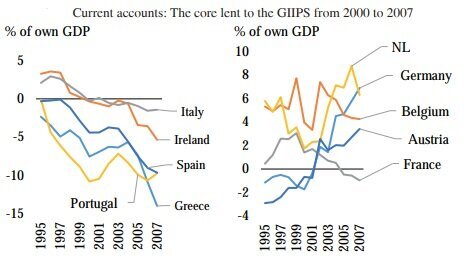
As credit conditions converged in the early years of the monetary union, there began an outflow of capital from the core of the euro area to the periphery. This can be seen from the graph below, which shows the current account balances of select eurozone countries in the period in question.


core+lent+to+the+GIIPS+from+2000+to+2007.jpg

Source: WEO

Although it may seem surprising today, these flows of credit were contemporarily seen as success, as they were in accord with what economic theory predicted for convergence: the richer nations, where the returns on capital were lower, would lend to the poorer nations, which would catch up in terms of productivity as a result.

But any apparent real convergence was merely illusory, and these imbalances had perverse consequences.

Much of the investment in peripheral economies was squandered on non-traded sectors, such as construction, fueling housing booms, and government consumption. Since there was little build-up of export capacity, there was little hope of ever repaying external debt.

There was also a resulting widening of the competitiveness gap. As the credit boom in the peripheral countries of the eurozone resulted in an expansion of the construction industry, among others, excess demand for labour fueled above average wage inflation. Ironically, instead of promoting convergence among economies, the supposedly healthy imbalances were actually accentuating existing differences.

At this point, it might be important to note that unlike what is commonly believed, the core root of the crisis was not necessarily public debt. In fact, if we look at the figure above, we can see that in 2007 Ireland and Spain’s public debt-to-GDP ratios were actually far below Germany’s, which stood at 63.7%.


3.png

These two countries, however, saw instead excessive accumulation of private debt. This materialized in the form of excessive bank lending: for example, Irish banks had assets worth seven times the GDP of Ireland in 2007. This private debt also fueled housing bubbles, which made public debt ratios look better than the underlying conditions were, as significant chunks of GDP were based on highly speculative construction. These liabilities later overflowed into the governments’ balance sheets, as banks went bankrupt and had to be propped up by sovereigns.

In light of these excesses, it was a matter of time until all this leverage unraveled. In October 2009, the new Greek government revealed that the government deficit was much higher than previously thought. While the draft target set by the European Commission in 2008 for 2009 was a deficit of 1.8% of GDP, the final figure ended up being 15.6% of GDP. At this point, financial markets understandably started to panic about Greece’s ability to pay off its debt. The Greek spread over the German Bund started to climb.

Greece, in a last ditch attempt to save itself from ruin, agressively engaged in austerity measures, cutting spending and raising taxes, but this worked against its purpose. As the fiscal stance became more contractionary, economic growth, already feeble, slowed, and creditors started losing faith in Greece’s ability to repay. The spread kept getting higher, and the first bailout became inevitable.


4.png

But would have avoiding austerity saved Greece? It is all too easy to don a pair of rose-tinted glasses and argue that avoiding austerity would have kept growth in Greece steady and led to a sustainable debt position. But the counterfactual is not available, and it is as easy to argue that avoiding a more restrictive fiscal stance would have equally worried investors, who would be concerned about a lack of concrete steps towards debt sustainability. Eventually this would also prevent Greece from rolling over its public debt.

Restructuring the debt would also work only to a point. A significant amount of Greek debt was held by banks of other faltering eurozone countries, such as Italy and Spain, and debt relief could have brought over the edge those already fragile banking systems. Furthermore, a third of Greek public debt was held domestically, and as such a restructuring would also lead to demand-side drags on the economy.

Greece’s membership of the eurozone was critical in how the crisis escalated. If Greece still had control over its currency, it could simply devalue it, lightening the real burden of debt and bringing its current balance closer to equilibrium. Crucially, Greece also had no lender of last resort, as the ECB was bound by the Maastricht “No Bailout” clause. If the introduction of the euro were accompanied by a greater degree of federalism, this might not have been a problem, as there would be income transfers from the core of the eurozone through the action of automatic stabilisers.

Fearing the eurozone would unravel if nothing was done, the EU called on the IMF in order to provide for a first bailout of Greece in early 2010. While there were doubts from the IMF that the resulting arrangement was sustainable, it provided €30bn of financing, with other eurozone members providing a further €80bn.

As this happened in Greece, investors started to worry about the credit they were extending to other periphery countries. Their reluctance to extend financing translated into a rise in other countries’ borrowing costs. This was the so-called “sudden stop” that brought the eurozone to a halt. Portugal and Ireland soon needed bailouts of their own. Later, private sector involvement in subsequent bailouts made things even worse, as the losses forced on private bondholders increased the intensity of the capital flight.

At the core of the market panic was an apparent self-fulfilling crisis, with two internally consistent equilibriums. In the first “good” equilibrium, bondholders believe debt is sustainable, and therefore interest payments remain low, debt being then manageable. In a second “bad” equilibrium, bondholders start to doubt the sovereign’s ability  to repay, and escalating rises in interest payments might mean debt is no longer sustainable. In traditional economies, a lender of last resort, the central bank, which is always willing to buy the sovereign’s debt, ensures the “good” equilibrium is the one to prevail. In the eurozone the “No Bailout” clause prevented this.

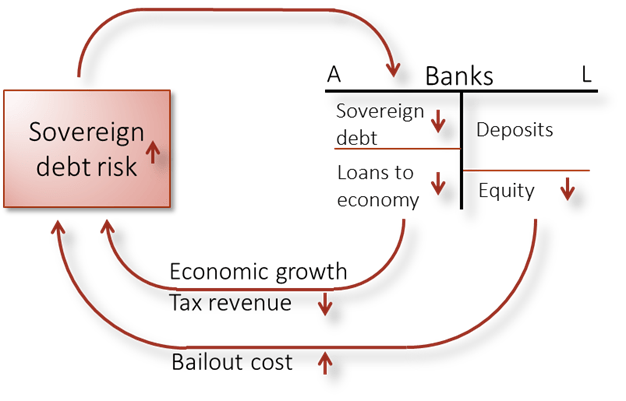
Equally relevant was a mechanism known as the “bank-sovereign doom loop”, which was crucial in the spread of the crisis to countries that had low public debt but large current account imbalances. Through this process, illustrated in the following diagram, failing banks have to be bailed out by the government, which leads to a deterioration of its fiscal position. As domestic banks tend to hold a disproportionate amount of home country bonds, this has a negative impact on their balance sheet. Gradually, both the situation of the country’s financial system and that of its sovereign become precarious. Concerningly, this issue has hardly been solved in the wake of the crisis, even though it could be solved by the simple introduction of a joint eurozone bond, as core countries complain of moral hazard problems.


5.png

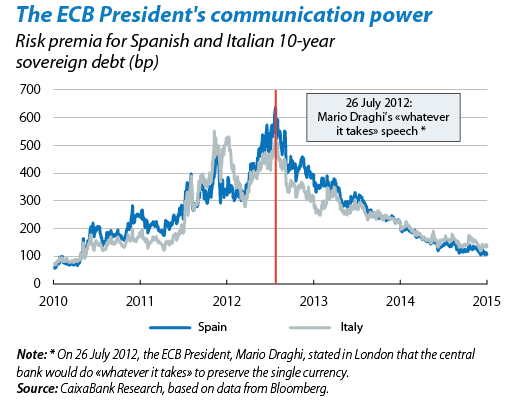
As the spreads of even supposedly safe countries like Belgium and France began to climb precipitously, Mario Draghi decided to take an unconventional turn in terms of policy. Pledging to do “whatever it takes to save the euro”, he announced the Outright Monetary Transactions (OMT) program, which allowed the ECB to purchase government bonds of countries in distress. The program implied a very strict conditionality, with any countries joining the program being required to enact domestic reforms. This was done to allay concerns by core economies that peripheric countries would be allowed to ‘free-ride’ on the ECB, avoiding doing painful reforms. Even then, the program was legally challenged in the German constitutional court, as it was believed to breach the “No Bailout” clause. Thankfully, this was unsuccessful.

Ultimately, the true testament to the OMT’s success is that it has never been used. As soon as it was announced (its announcement coincided with the “whatever it takes” speech; see graph), spreads over the eurozone area started to drop. This ended up marking the beginning of the long road to recovery.


6.png

Nonetheless, the cleavages both exposed and exacerbated by the crisis seem to be here to stay, as Friedman ominously predicted more than two decades ago. Given the recent slowdown in eurozone growth, Draghi pushed the ECB towards restarting Quantitative Easing (QE), its large-scale program of liquidity injection into the bond market. The same core economies that long have run current account surpluses have opposed the move, citing not-so-new concerns on easy money being a deterrent of reform in southern economies.

The restart of the QE program also brings new problems, as the ECB already holds significant portions of debt of eurozone countries, and is required to hold less than 33% of each. Although increasing the limit is a possibility, it might put the ECB on the difficult position of being a majority debtholder of eurozone governments. This could be easily solved if countries like Germany and Netherlands, where the ECB is closest to its imposed limits due to their low amount of debt, used the fiscal space they have available to provide a much-needed stimulus for the eurozone. But they seem loth to do so. Only recently, Annegret Kramp-Karrenbauer, Germany’s apparent chancellor-in-waiting, defended the country’s commitment to balanced budgets even in the face of an economic slowdown.

With Draghi now leaving his post, and Lagarde taking over, it is all too easy to hail this as a watershed moment where the eurozone finally casts off any lingering reminder of the crisis. But this would be a mistake. Europe’s economic dysfunction seems here to stay, and the shadow of the crisis will long hang over Europe.

This article was written in partnership with the Nova Investment Club.

Developing Development Economics

It was not that long ago when development economics was underrated and not recognised by the classical economists as a worth studying field. The issue was that the macroeconomists who were interested about these subjects always focused on one specific country, such as South Korea, and tried to understand what had driven it to outperform other economies. Meaning that they acknowledged what led to each countries’ development, but they could not implement that in another place, due to the fact that the conditions in each case study were unique and intrinsic to the countries’ features, so they could not be replicated on another location.

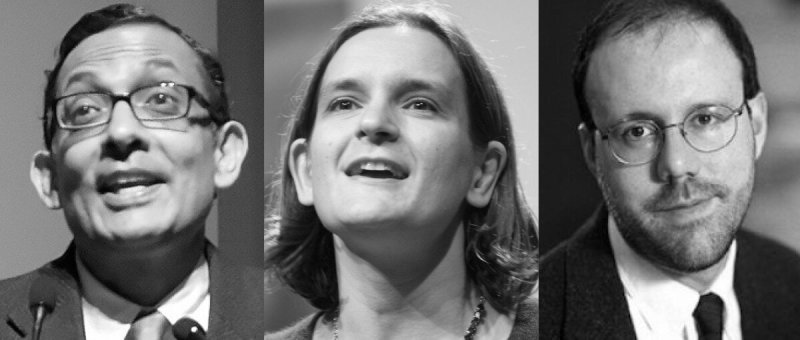
This has changed since figures like Esther Duflo, Michael Kremer or Abhjit Banerjee stranded their position on the world of development economics.

Previous studies on development economics had a major flaw that prevented them from discovering the most efficient treatments to ultimately eradicate poverty, across all fields, such as health, education, corruption, among others. By studying a specific countries’ case, economists were never fully able to state whether an intervention had a causal effect on the combat against poverty or not, even if it such relation was heavily supported by economic theory. The reason behind that is the lack of a counterfactual effect – economists were incapable of observing the outcome in the case that individuals had not benefited from the intervention previously made. Without directly observing a counterfactual effect, conclusions on previous studies about economic research were most likely biased from previous economic theory already conducted, and no causal effect could be stated.

Aiming to overcome this handicap in economic research, these economists borrowed a key tool from clinical medicine: the Randomized Controlled Trial (RCTs).

In order to be able to conduct causal inference, they took a brand new approach to economic research that, very simply put, was characterized by the following:

• The creation of a treatment/intervention that, supported by economic theory and empirical evidence, is believed to be able to diminish poverty in a certain field

• The collection of a random sample within the same field, to which half, randomly assigned, would benefit from the treatment – the Treatment Group -, whereas the other half would perform as the Control Group, not receiving any treatment.

Basically, the creation of this control/base group of individuals was what ultimately able these economists to be Nobel Prize winners. Having a Control Group randomly assigned enables economists to observe the so wanted counterfactual effect of an intervention, giving their studies enough strength to conduct causal inference, and this was crucial for the advancements on development economics discoveries.


“The Miracle of Microfinance? Evidence from a Randomized Evaluation” was a study conducted by Duflo, Banerjee, (two out of the three Nobel Prize Winners), Glennerster & Kinnan (2013) that perfectly exhibits the power of RCTs.

Microfinance has created big enthusiasm and hope for fast poverty eradication. Through the lending of microloans, it was believed that small enterprises would be able to grow and expand, and therefore generate welfare at an individual level in the developing world. However, the above study concluded that microcredit generated no changes in any of the development outcomes that are often believed to be affected by microfinance, including health, education, and women’s empowerment. This study was conducted on a sample of 104 slums in India, where half of it was randomly selected to benefit from a loan product from a particular microfinance institution, whereas the other half received nothing. As such, given the strength of an RCT, it was enough to ultimately refute economic theory, proving that, in reality, microfinance has no impact at all. This study is just one, among many others, that serves as an example to explain the strength that RCTs have when stating economic conclusions and results.

As such, by conducting RCTs, we are treating development economics exactly as the science it actually is. When in a sample of mice, half of it receives a drug whereas the other receives nothing, with the goal of discovering cures for illnesses, scientists and doctors are using RCTs. However, one might think: is it ethical to treat individuals, or small enterprises, merely as guinea pigs from a scientific experience?

Accordingly, many authors and researchers have been criticizing the RCTs approach to conduct economic research. One of the first studies using RCTs was done in Kenya in the 1990s, whose goal was to increase school attendance through the eradication of parasitic worms in children. Despite the great results this paper generated, one cannot forget that these results came at the expense of many children not benefiting from free deworming pills, only because they were unlucky enough to be in one of the schools which were part of the Control Group of the experiment. As such, it is fair to argue that ethics should have a higher role in economic research, and that the poorest cannot be seen from economic researchers merely as experimental subjects from their experiments.

However, the flip side of the coin regards the effectiveness of RCTs. The strength of its results is enough to compensate the unlucky parties of the Control Groups, since in the long-run the Control Group will also be better due to the intervention. They claim that, only because of the results of RCTs, the lives of the worst-off people around the world will be improved.

Nevertheless, despite the divergence of opinions that RCTs are creating, there is no doubt that this approach is truly disrupting development economics research, and the world in general. And the fact that these three development economists were finally recognised by the community is a sign of the changing times we are living.