THE DIARY OF A FRANCHISEE: THE ROLLERCOASTER OF OWNING A FRANCHISE

Reading time: 8 minutes

Owning your own business is often portrayed as the ultimate dream—the idea of being your own boss, setting your hours, and building something from the ground up. But ask any entrepreneur, and they will tell you the truth: starting a business is a nerve-wracking, all-consuming roller coaster. There’s excitement, sure, but also sleepless nights, long hours, and the constant pressure of wondering, “Will this succeed?”. 

Now imagine doing all of that with a blueprint already handed to you—a business model that is proven, with marketing plans, a recognized brand, and a support system in place. It sounds easier, right? This is the appeal of opening a franchise. 

THE STRUCTURE OF A FRANCHISE: A FRAMEWORK FOR SUCCESS 

pasted-image.jpeg

Franchising has a long history, and its model has revolutionized the way businesses grow and expand. One of the earliest examples of franchising can be traced back to the mid-19th century with the Singer Sewing Machine Company. Isaac Singer, needing a way to distribute his sewing machines across a vast and varied geography, developed a model that allowed local agents to sell and service machines under the Singer name. This early form of franchising set the stage for what we see today—an agreement where a franchisor (the company) licenses its brand, systems, and processes to a franchisee (the local business owner) in exchange for fees, usually including an initial investment and ongoing royalties. 

Today’s franchise model is a powerful engine for business expansion. According to the International Franchise Association (IFA), there are over 792,000 franchise establishments in the U.S. alone as of 2023, contributing nearly $825 billion to the U.S. economy. The franchise industry employs approximately 8.5 million people in the U.S., demonstrating its vast economic impact. For someone looking to get into business ownership, it offers a way to mitigate some of the risks involved in starting a business from scratch. 

THE COSTS AND COMMITMENT 

Just like any business venture the first step (and perhaps the scariest one) is the investment, these vary with the brand. For example, opening a fast-food franchise like McDonald’s can require an initial investment ranging from $1 million to $2.2 million, including franchise fees, real estate costs, and equipment. On the other hand, a lower-cost franchise like Subway may require a starting investment of $100,000 to $300,000. 

However, the financial commitment does not stop at the initial investment. Franchisees must also factor in ongoing expenses, such as royalty fees, which typically range from 4% to 12% of gross revenue, depending on the franchise. For example, Subway charges an 8% royalty fee on sales, while McDonald’s charges a 4% fee. These fees, while providing brand support, can feel like an ongoing burden, especially during the early months when cash flow is tight. 

The responsibilities of the franchisee do not end here. In fact, the real work begins, that is: recruiting employees. Even when franchisors provide training materials and operational guidelines, it is more challenging than expected. The U.S. Bureau of Labor Statistics estimates that the average employee turnover rate in the restaurant franchise industry can be as high as 150%, meaning that, on average, a franchisee will replace their entire staff more than once per year. 

REALITY CHECK FOR FRANCHISEES 

One of the hardest parts of being a franchisee is balancing the autonomy of owning your own business with the restrictions imposed by the franchisor. You are not fully in control. If a corporate decision impacts your business negatively, whether it is a new product that does not resonate with your local market or a pricing structure that customers do not favor — you have little recourse. A 2021 Franchise Business Review survey found that 33% of franchisees felt their franchisor did not give them enough flexibility to adapt to their local market conditions. 

THE REALITY OF PROFIT MARGINS 

To better understand the economic realities of franchising, it is important to look at profit margins. In many franchise models, especially within the food industry, profit margins are typically low, sometimes ranging between 5% and 10% after all expenses are paid. That means if your franchise generates $500,000 in annual revenue, your net profit could be as low as $25,000 to $50,000 after deducting expenses like royalties, rent, labor, and supplies. 

Many franchisees often assume that the support and brand recognition will automatically lead to strong profit margins, but the reality is more nuanced. Franchise Business Review reports that while 51% of franchisees earn more than $100,000 annually, nearly 25% of franchisees report that they earn less than $50,000 per year. This gap highlights that not all franchises are equally profitable, and success depends heavily on a variety of factors such as location, industry, and management. 

One of the key reasons franchises can be attractive is the lower failure rate compared to independent businesses. According to FranData, franchises tend to have a 90% success rate after five years, compared to a 50% success rate for independent businesses. However, while franchisees benefit from the franchisor’s support, they still need to navigate significant financial and operational challenges. 

WHY SOME FRANCHISES FAIL 

Despite the established brand, business model, and support from franchisors, some franchises still fail. While a franchise system provides a proven blueprint, there are various reasons why a franchise might not succeed, both from an economic standpoint and operational missteps. 

Having interviewed former franchisees of the fast-food industry, I was able to get first-hand information on their experience, where the struggles of owning a franchise came with full force. Some of the factors that helped fast-track the steady decline of the fast-food restaurant can be summarized into 4 factors: location, COVID-19, inflation and perhaps the naivety in inexperience of working with franchisors. 

Location is one of the most critical factors in the success of a franchise. According to Franchise Direct, 30% of franchise failures can be attributed to poor location choice. Even if the brand is strong, if the franchisee opens in an area with low foot traffic or poor demographics, it can struggle to generate enough revenue to cover fixed costs. Most of the time, franchisors assign the franchisee with a set location that was chosen by realtors and the franchisors to better ensure success. However, the guides are not exempt from making mistakes, thus the franchisees must pay that price. In addition, rent, labor, and supply costs can quickly eat into profits, and some franchisees find it difficult to stay afloat, particularly in competitive markets. The COVID-19 pandemic illustrated this starkly, with many franchisees facing unprecedented drops in revenue while still needing to pay royalties and maintain costly leases. Many franchisees struggled with expensive ingredients and the franchisor’s mandatory promotions, which didn’t always lead to increased profits. Moreover, economic downturns, like the 2008 financial crisis, can severely impact franchises. Even if the overall brand is strong, reduced demand makes profitability harder to achieve. 

It is crucial for Franchisee-franchisor’s relationship be at least cordial. Disagreements over decisions like marketing, product introductions, or pricing can cause tension, especially when franchisees feel the franchisor’s strategic outlook does not fit their local market. A 2021 survey found that 33% of franchisees felt they lacked the flexibility needed to adapt locally, leading to frustration and legal disputes. 

Finally, some of these franchisees end up suffering from success. Franchisors may push for more units without providing adequate support, leading to underperforming stores. Quiznos is an example, expanding to 5,000 locations, but collapsing due to poorly performing stores, leaving only about 200 locations by 2023 as franchisees battle with high costs. 

MANAGING EXPECTATIONS AND FINDING SUCCESS 

Despite the struggles, there is a reason so many people still choose the franchise route. According to FranData, franchises tend to have a success rate of 90% after five years, compared to a 50% success rate for independent businesses. The support system, while sometimes restrictive, can provide stability, especially if the franchisor is strong and responsive to franchisee feedback. 

CONCLUSION: THE FRANCHISE LIFE 

Franchising is not a version of stress-free entrepreneurship, it is the real deal and must not be underestimated. In the end, the life of a franchisee is about balance, as these should have to balance the support of the franchisor with the challenges of day-to-day operations. Most importantly aspiring franchisees must balance their vision for the business with the limitations of the franchise model


Sources: International Franchise Association (IFA), McDonald’s Franchise Information, Subway Franchise Information, Franchise Business Review, FranData, Franchise Times, Franchise Direct, Franchise Business Review 

Alegra Maza

Survivorship bias: the omnipresent skewer of decisions 

Reading time: 7 minutes

Survivorship bias is a cognitive shortcut that takes place when the successful or surviving part of a group is mistaken for the whole group, due to the invisibility of the group’s failures. A common example of survivorship bias is the assumption that older buildings and architecture were much more durable and stable as suggested by the common saying “they don´t make them like they used to”. This assumption fails to acknowledge that only the sturdier buildings have survived into the present while the rest, the majority, have been destroyed or replaced. A contributing factor to this erroneous belief is the fact that we haven’t experienced the durability or, in this case, the survivability of modern buildings: presently, we are surrounded by both good and bad quality construction; the former will be preserved in time while the latter might not, just like with the older ones.  

When we “miss what we’re missing” is how author David McRaney describes the survivorship bias. Indeed, if failures are invisible, successes are in the spotlight, and we not only fail to acknowledge that the failures might have held useful information, but we fail to acknowledge their existence altogether. 

This bias is harmful due to how common it is and how easily it affects decision making. Furthermore, it affects a myriad of sectors ranging from business and finance to science, and even medicine. During the Covid 19 pandemic for instance, healthcare systems struggled to keep up with testing which might have skewed survival and death rates. Medical studies are also more often performed on stronger and younger patients who survive initial diagnoses, as weaker patients are less likely to survive long enough to participate in them, leading to overestimations of successful outcomes.  

When thinking about research, it is obvious how error-inducing this bias is. Indeed, to be effective, research must be thorough and take into account as many variables as possible. More specifically, statistics rely on surveys and analysis of populations and, to be accurate, they have to put together groups that fully represent them. The survivorship bias skews researchers into only looking at a subset of those populations, leading to incomplete research. Similarly, when making decisions without analyzing all the available data, individuals will automatically not be making the best choices for themselves. 

Background 

A study that took place during WW2 has become the prototype of survivorship bias.  

For context, Abraham Wald was born in 1902 in what was then the city of Klausenburg in the Austro-Hungarian Empire, today’s Cluj-Napoca in Romania. He developed an interest and talent for mathematics and went on to study the subject at the University of Vienna. He later moved to the United States to work at the Austrian Institute for Economic Research. Then, during World War II, Wald joined a classified program that assembled statisticians to focus on military research and strategy to help in the war, the Statistical Research Group (SRG). 

At the time, the military came to the SRG with data on the placement of enemy bullet holes on planes that had come back from battle, represented by the red dots in the image below. The first conclusion reached was to install more armor in the areas where the planes were getting hit the most. However, Wald pushed the group to do the opposite: since the planes being analyzed were the ones that had come back from battle, the areas in more need of protection were the ones without apparent bullet holes, the ones where the planes that did crash must have been shot. Thus, the missing bullet holes were on the missing planes. This is where the notion of survivorship bias was first coined. In fact, the decision to reinforce the areas of the planes ridden with bullets failed to consider that the planes being looked at were the ones that made it back safely, the ones that survived. While the others’ perceptions had been distorted by the survivorship bias, Wald overlooked it and was instrumental in the reinforcement of the aircraft.  

Had it not been for him, the group would have made a major mistake despite the stakes being so high, which illustrates how much bias affects decision making. 

Diagram used to represent the bullet holes on the aircrafts that came back from battle 
Abraham Wald

Survivorship bias in the business world 

Survivorship bias has also crept into the business and finance environment and is apparent in various situations.  

The first instance is the glorification of successful businesses and people. Every now and then, we hear an inspiring story about how some college dropouts became millionaires. Concrete examples are Steve Jobs, Mark Zuckerberg, Bill Gates, all of whom quit university and went on to become part of the richest people on the planet. Their fame has made them into inspirations and examples to follow. However, chances of becoming a millionaire after dropping out of college are rare. In fact, according to Ramsey Solutions’ National Study of (American) millionaires in 2024, 88% of millionaires graduated from college. Furthermore, the success of the examples above tends to be attributed solely to hard work, when in reality, for every successful college dropout, there are thousands who are not as lucky despite equivalent ambition. Moreover, variables such as luck, timing, networks and socioeconomic background also play a significant part in the path to success. 

A similar example involves what are called “unicorn start-ups”. This term, coined by venture capitalist Aileen Lee in 2013, refers to a private startup company valued at over one billion dollars. Examples of unicorn start-ups are Uber Technologies Inc, Airbnb and Space X. People venturing into the business world often strive to one day find or create start-ups as the latter, in particular unicorns like the ones above, are viewed as the archetypes of success and entrepreneurship. At the same time, according to Forbes, 8 in 10 startups will fail within the first year of operation and unicorn start-ups got their name from their statistical rarity. 

Looking up to and trying to emulate success stories is an example of survivorship bias and its consequences. Firstly, it drastically limits the knowledge and awareness needed to have a chance of actually succeeding by leaving out important voices, the voices of failures which are vital in understanding successes. To quote author David McRaney again, “The advice business is a monopoly run by survivors”, only their advice and stories are deemed relevant. Secondly, it leads to overly high degrees of optimism which can influence risk-prone decisions. Finally, it suggests causation from correlation by creating the illusion of certain patterns: dropping out of college does not necessarily put you on the path to becoming a millionaire even though a few millionaires did so. 

Studies on mutual funds are perhaps the most famous example of survivorship bias in the business world.  A mutual fund is an investment fund that pools money from investors to purchase stocks, bonds, and other assets and securities. When looking at mutual funds, studies tend to only include ones that currently exist and fail to show data on funds that no longer do. Funds cease to exist in the case of mergers and acquisitions but also during restructuring and poor performance. This failure to count lost funds leads to misleading positively biased results that do not actually depict the returns realized by all mutual funds, since funds that close cause a negative return that is not considered. 

Finally, marketing campaigns can also transmit biased information. Indeed, many rely on attractive figures in terms of client satisfaction and durability of the product: “90% of people loved the product!”. These figures are not necessarily biased or false, but it is important to look at their sources and the factors they consider: these include the sample size and composition and for how long the product was used. For instance, the study might have been set up for success by only using the testimonies of regular and loyal customers.  

How to avoid the bias 

Knowing about its existence and understanding how it can influence and impact our judgement is already a huge step in trying to avoid bias. Being selective of data sources, always striving to see the bigger picture and practicing critical thinking are other ways of fighting against it. Since it is present in so many different situations, awareness of the bias can already lead to better and more informed decisions, from financial investments and ventures to medical and scientific conclusions, but also common opinions and values.  

Conclusion 

Survivorship bias is omnipresent in our everyday life, impacting our decisions and opinions. 

However, it is not the only bias and many others like the anchoring, availability and confirmation biases also guide our conduct every day. Although it is impossible to be immune to them altogether as they are unavoidable cognitive occurrences, being aware of them and their significance is enough for a more informed point of view in a variety of subjects and, in particular, decisions as an economic agent. 


Marta Nascimento


Sources: 

“Survivorship Bias – the Decision Lab.” n.d. The Decision Lab. https://thedecisionlab.com/biases/survivorship-bias

Team, Cfi. 2024. “Survivorship Bias.” Corporate Finance Institute. May 24, 2024. https://corporatefinanceinstitute.com/resources/career-map/sell-side/capital-markets/survivorship-bias/

Penguin Press. 2018. “Abraham Wald and the Missing Bullet Holes – Penguin Press – Medium.” Medium, June 17, 2018. https://medium.com/@penguinpress/an-excerpt-from-how-not-to-be-wrong-by-jordan-ellenberg-664e708cfc3d

Solutions, Ramsey. 2024. “The National Study of Millionaires.” Ramsey Solutions. October 3, 2024.  https://www.ramseysolutions.com/retirement/the-national-study-of-millionaires-research#:~:text=Eighty%2Deight%20percent%20of%20millionaires,38%25%20of%20the%20general%20population.&text=And%20over%20half%20(52%25),13%25%20of%20the%20general%20population

TEDx Talks. 2015. “Missing What’s Missing: How Survivorship Bias Skews Our Perception | David McRaney | TEDxJackson.” https://www.youtube.com/watch?v=NtUCxKsK4xg. 

Gratton, Peter. 2024. “Survivor Bias Risk: What It Is, How It Works.” Investopedia. September 18, 2024. https://www.investopedia.com/terms/s/survivorship-bias-risk.asp

Peachman, Rachel Rabkin. 2024. “America’s Best Startup Employers 2024 Methodology.” Forbes, March 8, 2024. https://www.forbes.com/sites/rachelpeachman/2024/02/21/americas-best-startup-employers-2024-methodology/#:~:text=Anyone%20who%20has%20worked%20at,fail%20in%20the%20long%20run

 “Whatever it takes” to bring Europe back from the dead?  

Reading time: 8 minutes

A look into the integration and competition concerns of the Draghi Report 

“Europe faces a choice between exit, paralysis, or integration” – Mario Draghi 

Unlike many of us perceive, European integration is far from figured out.  

In practical terms, integration is all-around. From the euro to the European Court of Justice, touching on more simplistic aspects such as the citizen’s identification as Europeans. On the other hand, macro shocks like the Sovereign Debt Crisis might be able unveil more sensitive aspects of this fragile social, economic and political commitment, for example, by leading us to question whether European countries should pay for each other’s debt.  

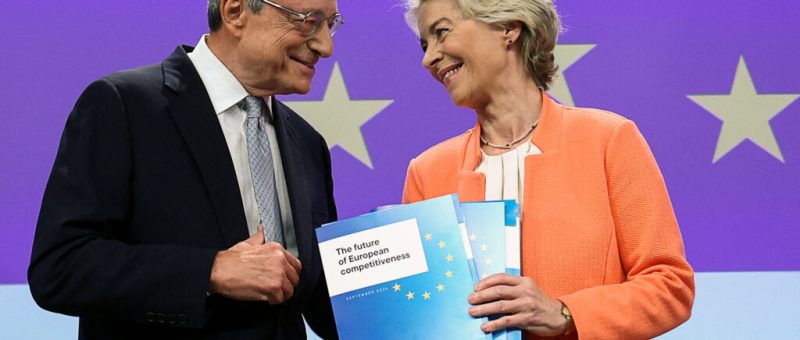
So, how much integration is too much integration? Mario Draghi, former Italian prime minister and president of the European Central Bank (ECB) brings this issue back to the fore with the release of his 400-page report on European competitiveness. There, Draghi identifies a rather plain and apparently sensible solution for its stagnation: cooperation and coordination. The former president of the ECB calls for an additional annual €800bn in investment, paired with a profound policy redesign to foster the European’s assertiveness in global competition. For many, a courageous punch full of truth, while for others, a political disaster.  

This article will further delve into the specific intricacies of the mediatic Draghi’s Report, while dissecting the competition dilemma that Europe faces and intertwining them with the pervasive message of integration throughout report. Thus, alluding to the question of whether it exists a trade-off between resilience in global position and the core of current European values. 

Nicolas Tucat, AFP 

Background 

The idea that the European Union is falling behind the United States, China and other advanced economies, when it comes to competitive edge, has been abiding for a while now.  

The report dedicates a fair number of pages exploring the evolution of these dynamics. For instance, the gap in GDP level at constant prices is said to be widening, from 15% in 2002 to 30% in 2023. When measured in Purchasing Power Parity (PPP), it amounts to 12%. The gap growth is more sluggish when translated into per capita terms, but the authors claim is still significant, rising from 31% in 2002 to 34% today. The catalyzers for these disparities are precisely differentials in productivity: About 70% of the gap in per capita GDP with US at PPP is explained by lower productivity levels in the EU. 

2024, The future of European competitiveness – Part A 

On the other hand, the European Union is the proud face of some of the lowest levels of inequality, reportedly disclosing rates of income inequality around 10 percentage points below the ones evidenced in the United States (US) and China. It also surpasses these countries when it comes to life expectancy at birth, low levels of infant mortality, and education. In fact, its education systems allow a third of adults to have completed higher education. The EU is also the world leader in sustainability, environmental standards and progress towards the circular economy. (2024, The future of European competitiveness – Part A).  

Plans had already been forged to deal with this issue of modest competition efforts across the European landscape. In November 2023, Ursula von der Leyen delivered her annual State of the Union speech, where she presented the main lines of action for the European Commission for the next year. Von der Leyen dedicated around a third of her speech to reshaping the EU’s economy, but the headline announcement was, precisely, Draghi’s Report. (2023 Foy) 

Proposals 

The report identified three main areas of action: The first is closing the innovation gap with America. According to the report, emerging technologies are still underdeveloped in the EU, not by lack of ideas or competence, but because of structural blocks, in the form of said inconsistent and restrictive regulations. Europe must focus on easier access for researchers when it comes to the commercialization of ideas, joint public investment in breakthrough technology or even investment in infrastructure to lower the cost of developing AI. Furthermore, training and adult learning should be at the core of the agenda.  

The second area for action is combining decarbonization with competitiveness, by reforming Europe’s energy market, so that end-users can benefit from a competitive clean energy price, supporting industries that allow for decarbonization (e.g. clean tech and electric vehicles), while jointly promoting green industries.  

The third area is increasing security and reducing dependencies. This vector of action is a result of the political turmoil instituted by the geopolitical instability. The EU is called to build a true “foreign economic policy”, by establishing coordination mechanisms in trade agreements and direct investment, ensuring stock of specific critical goods and devising industrial partnerships to establish robust supply chains.  

To add on to this, the article takes a more thorough look at some more specific recommendations that have been particularly featured within the mediatic space, as the ones where it may be more difficult to achieve political consensus towards.   

Competition Policy  

“There is a question about whether vigorous competition policy conflicts with European companies’ need for sufficient scale to compete with Chinese and American superstar companies” – Draghi’s Report 

A controversial point of discussion encompasses the question of competition policy enforcement, particularly mergers. EU antitrust policy has long been praised for protecting against abuses of dominant position. However, the report claims that this might be compromising the forging of European world-beaters, instead of only preserving competition within the EU (2024, Financial Times). In practical terms, this can be translated into the concern that European firms won’t be able to compete with significant global firms.  

To achieve this, the report suggests an increased weight of the innovation factor in the assessment of mergers, by allowing higher market share concentration if this were to produce the development of new technologies by the merging firms. Of course, this might raise concerns regarding the misuse of this type of defense on a merger deal, allowing for a situation in which firms might commit to innovation only for the possibility of acquiring increased market power. So, Draghi suggests making companies showcase measurable levels of investment that can be tracked in the years following merger approval. The commission might, for instance, require companies to provide data on pricing or investment.  

What is more, it is proposed a less stiff approach towards collaboration between rival corporate executives, with the argument that coordination might be necessary to maximize investment in research, or technological standardization (2024, Foy & Espinoza). 

The report also recommends defining telecoms markets at the EU level – as opposed to the Member State level. To exemplify, a merged telecoms group could function in an almost monopolistic setting in individual countries, if their market share across the entire single market was less than 40 percent, which serves as a threshold for merger policy (2024, Foy and Espinoza). 

These last measures have been subject to much mediatic scrutiny. On a paper published in Vox EU, the professors Tomaso Duso, Massimo Motta, Martin Peitz and Tommaso Valletti expressed their concerns regarding the telecom policy recommendations provided by the report. They claim that “They propose a broader, EU-wide market definition, which would artificially de-concentrate the relevant market, thereby making intra-national mergers appear no longer problematic on paper”, which ultimately creates the possibility to accept mergers that would be detrimental to European businesses and consumers. 

Integration 

Draghi claimed that the new “industrial strategy for Europe” would cost approximately €750- €800bn, which corresponds to 4.4-4.7 percent of EU GDP. Large amounts of money should be placed on joint funding key projects, such as innovation, as well as other European “public goods” —such as defense procurement, cross-border grids or common energy infrastructure. 

Another concern expressed in the report points to the levels of financial fragmentation of the capital markets of the EU. Its integration is seen as an essential procedure towards the introduction of economic momentum that would allow for the development of the investments needs.  

With the case of banking fragmentation, the report reminds us of the incomplete implementation of the Banking Union. While the unified supervision aspect is solidified, Europe has failed to implement a common debt insurance scheme, and the single resolution authority lacks a financial backstop. One of the proposed actions to facilitate this process is the creation of a common safe asset, particularly, the report appeals to “issue common debt instruments to finance joint investment projects that will increase the EU’s competitiveness and security.” However, it also established that a necessary condition for this to happen would be that “the political and institutional conditions are in place”, which can signify an impediment.   

Moreover, the report asks for the extension of qualified majority voting (QMV) in the Council of The European Union, such that voting subject to QMV would be elongated to more areas, or even generalized, implying the end, or at least, reduction of the veto power under unanimity voting.   

The difficulty here lies exactly in gaining political momentum to implement such reforms. In fact, the German finance minister Christian Lindner has already spoken on the matter, dismissing the Draghi’s suggestion to raise additional common debt to fund breakthrough innovation: “Each individual EU member state must continue to bear responsibility for its own public finances”. (2024 Hall). Eelco Heinen, finance minister of the Netherlands, said that “Europe has to grow, and I totally agree with that. An economy will grow if you reform (…) more money is not always the solution.”.   

Conclusion 

To conclude, the Draghi Report could represent either a turning point for Europe or just another document to be archived and forgotten about in the years to come. And although it may not be translated into policy action, at least for the time being, it has the power to ignite the public discussion back to “After all, what is the Europe that we want?” 


References: Dragui, Mario. 2024. “Mario Draghi outlines his plan to make Europe more competitive”. The Economist.  https://www.economist.com/by-invitation/2024/09/09/mario-draghi-outlines-his-plan-to-make-europe-more-competitive

Draghi, Mario. 2024. The future of European competitiveness: Part B | In-depth analysis and recommendations. European Comission. https://commission.europa.eu/document/download/ec1409c1-d4b4-4882-8bdd-3519f86bbb92_en?filename=The%20future%20of%20European%20competitiveness_%20In-depth%20analysis%20and%20recommendations_0.pdf

Draghi, Mario. 2024. The future of European competitiveness: Part A | A competitiveness strategy for Europe. European Comission. https://commission.europa.eu/document/download/97e481fd-2dc3-412d-be4c-f152a8232961_enfilename=The%20future%20of%20European%20competitiveness%20_%20A%20competitiveness%20strategy%20for%20Europe.pdf

Foy, Henry. 2024. “Why Draghi went for broke in calling for €800bn of new EU spending”. Financial Times.  https://www.ft.com/content/76e8458d-3eb7-46d3-8d9c-42d524d60800

The Editorial Board. 2024. Whatever it takes to boost European competitiveness”. Financial Times.  https://www.ft.com/content/a87af4c4-5e5f-44a8-88a5-9a4037a16d19

Foy, Henry and Ian Johnston. 2023. “The EU’s plan to regain its competitive edge”. Financial Times. https://www.ft.com/content/124b4cdb-deb9-49a0-b28d-d97838606661  

Foy, Henry, Javier Espinoza, and Paola Tamma. 2024. “Mario Draghi confronts the EU’s merger police”. Financial Times.  https://www.ft.com/content/515d5a42-a760-42f1-9afa-89d4dcdc2a99

Duso, Tomaso,  Massimo Motta, Martin Peitz , and Tommaso Valletti. 2024. “Draghi is right on many issues, but he is wrong on telecoms”. Vox EU. https://cepr.org/voxeu/columns/draghi-right-many-issues-he-wrong-telecoms

Hall, Ben. 2024. “Will Mario Draghi’s masterplan get the momentum it needs?”. Financial Times. https://www.ft.com/content/a5e1264c-4004-440e-b3d9-2e130a68853

Maria Francisca Pereira

Financial literacy: The overlooked one 

Financial literacy springs as a cornerstone of responsible and efficient financial management and entails one’s capacity to comprehend financial concepts to make informed decisions regarding money, budgeting and investment.  

Typical household activities like going to the supermarket for monthly shopping. This simple action encompasses numerous integral financial concepts, such as budgeting, basic asset pricing, and price variation, that is, inflation. In accordance with the ubiquity of such concepts in one’s everyday life, statistics conducted amid the Plano Nacional de Formação Financeira for “Todos Contam”, show that around 81% of Portuguese respondents evidence concern about household budgeting and personal finances. However, despite its relevance, many individuals still struggle with basic concepts, such as inflation, as more than one in three people in the EU do not understand how inflation erodes their purchasing power. 

Why is it important? 

As introduced, financial concepts are ever-present in daily lives as these serve as a safeguard against excessive borrowing, unforeseen expenses, and foster conscious financial planning and stability. Financial literacy is a fundamental competency for families to sustainably improve well-being and quality of life, even more so when assessing the current inflation rate variations and, consequently, increased interest rates and decreased household purchasing power.  

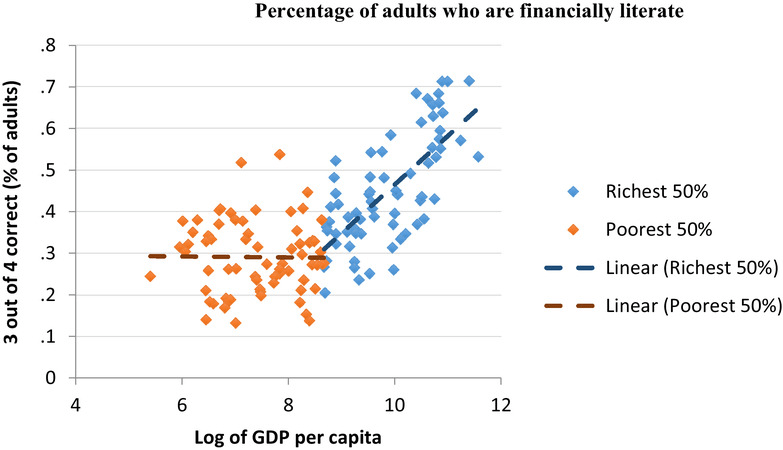
A solid understanding of concepts such as the link between interest rates and bond prices, asset diversification, and time value of money, is associated with improved management of household savings and investments. Conducted studies show that households which hold more financial knowledge have greater tendencies to, for instance, allocate resources more efficiently, plan retirement savings, and contain debt (Demertzis at al. 2024). This relationship raises the question of whether wealth derives from general financial literacy or the opposite. Well, by using GDP per capita as a proxy for income, a positive relation between income and financial literacy is displayed among the richest 50% countries and around 48% of the variation in financial literacy rates can be explained by differences in income across countries (Kapper et al. 2024). However, the same is not evidenced in the poorer half of countries, where a correlation is not shown.  

Source: S&P Global FinLit Survey and World Bank–World Development Indicators (http://data.worldbank.org) 

Furthermore, as the world experiences a rapid technological development, digital literacy also plays a role in financial decisions being made, as overwhelming amount of information is progressively more accessible for the public. This heightens the risks of navigating the digital financial landscape and further increases the vulnerability of less informed groups, including the youth and elderly. As Eurostat’s data reveals that, in 2022, the average age at which young people left their parents’ home was 26.4 years. Coupled with this, in recent years, there has been a striking surge in the promotion of young individuals accounting for their own financial decisions, with the 3rd conducted inquiry on Portuguese Literacy, for Plano Nacional de Formação Financeira in 2020, indicating a significant increase, from 20% in 2015 to around 45% in 2020 of people ranging from 18 to 24 years old. This emerging trend suggesting that younger generations are assuming financial decisions progressively earlier, further emphasizes the importance of financial literacy, and the fundamental impact its lack of could have in these generations’ life. 

Financial Knowledge in Portugal   

Financial literacy not only encompasses knowledge, but also practices in accordance. In Portugal, financial literacy stages a rather complex picture since, while efforts are being developed to improve literacy, challenges impose themselves which foment the need for more comprehensive educational initiatives. These, for example, include Portugal’s position in financial literacy as 26th in 2023’s Eurobarometer, surpassing only Romania. Despite this lagging position in performance, Portugal is 13th in OCDE/INFE’s inquiring (out of 39 countries), 7th regarding financial attitudes and habits and 21st in terms of financial knowledge. The latter explains an existing deficit financial literacy when it comes to financial numeracy, computation of compound interest and the importance of asset diversification. Additionally, as formerly tackled, the digital age has brought its own set of challenges, namely regarding information overload and unfiltered misinformation, from which Portugal is no exception. 

Addressing these challenges requires a multifaced approach whereby financial concepts should not only be taught but applied effectively as well. Despite Portugal’s lack of literacy, there is still optimism in initiatives such as “Digital Financial Literacy Strategy for Portugal”, designed with support from the OECD and the European Commission, bringing about meaningful change, by providing low-income families, middle-aged individuals and young adults crucial skills and fundamentals to enhance their quality of life and financial health. 

Financial Knowledge in the European Union 

More than a decade ago, indicators of financial literacy established low financial knowledge among a large world share, even in countries with well-developed financial markets, such as European Union (EU) countries (Lusardi and Mitchell 2011 cited in Demertzis et al. 2024). However, the will of refining financial literacy has rose globally.  

In 2021, the European Commission (EC) carried out a survey that aimed to access the level of financial knowledge of the EU population. Demertzis et al. 2024 show that, on average, just over 50 percent of the respondents answered correctly to at least three of the five knowledge questions, suggesting that financial knowledge continues to be low despite the increased interest in it. Particularly, only one in five respondents correctly answered questions regarding the relationship between interest rates and bond prices, on average. In this context, it is also relevant to state the presence of a gender gap in financial knowledge, such that more men than woman answer at least three out of five questions correctly, with 18 percentage points of difference, on average in the European Union. This study also assesses that more financial knowledge is linked to higher financial inclusion, as EU countries with higher levels of financial knowledge have greater percentages of adults saving with and borrowing from financial institutions.  

A graph with a pink circle and a pink circle

Description automatically generatedBruegel based on European Commission (2023a) 

Over-Indebtedness: Private, Public, Global  

Most commonly, over-indebtedness refers to the situation in which the monthly earnings of a family are not enough to contemplate both essential expenses and the credit instalments, implying a lack of space for savings. In such a situation, it is said that families face a high debt burden. Besides the obvious hazards of excessive debt, that are translated into reduced living standards, it can be detrimental to the mental health of individuals, thus affecting personal relationships and stimulating isolation. According to experts, here, the role of financial literacy becomes particularly evident, not only as a prevention mechanism, but also as a key first step into debt-freedom.  

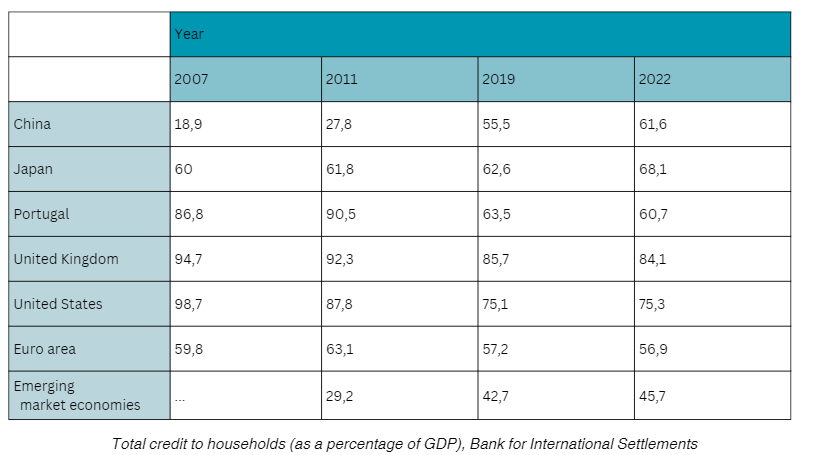
According to the OECD database, household debt (all liabilities of households that require payments of interest or principal by households to creditors, as a percentage of net household disposable income) has been registering a negative trend in Portugal since 2011, despite a slight increase in 2020 at the hand of the global pandemics. Total credit to households as a percentage of GDP as also been diminishing since the period around the Sovereign Debt Crisis, with Portugal foll  owing the EU area movement. On the other hand, emerging economies have been registering a great increase in the credit to households.  

Household debt, OECD 

Excessive amount of private debt is not only a concern for individuals, but also for the whole economy. There is evidence that private “credit booms” many times culminate in either financial crisis or economic underperformance (Dell’Ariccia et al. 2012). Until the Great Recession in 2008, policy paid limited attention to the situation. The economic intuition for the question of underperformance is that when private debt is high, agents divert a large portion of their income to the payment of interest and principal on that debt, ending up spending and investing less. High debt can make borrowers more reluctant to spend or take on more debt. Additionally, there is research that establishes a link between private and public debt, such that the excess of the first systematically turns into more of the second, regardless of whether the credit boom resulted in a crisis or a more orderly deleveraging process (Mbaye et al. 2018).  

“Finanças Para Todos” 

With the conviction that university poses a fundamental role in providing services to the civil society, “Finanças Para Todos” comes as free training program on the subject of financial literacy, with a particular focus on low income and lower education individuals. Throughout five enlightening sessions, diversified speakers cover subjects that go from family budget to investment and retirement. Created with the contribute of Nova SBE Finance Knowledge Center, “Finanças Para Todos” has now registered around eleven thousand applications, with its second edition counting with more than two thousand online participants and almost than five hundred on a presential regime (on the Nova SBE campus).  

Additionally, there are many online resources available, from articles to videos or even interviews, always keeping in mind the ever-present goal of raising awareness to the subject of financial literacy while demystifying finance theory and enhancing the importance of conscious and informed decision-making.  

The Nova Awareness Club was very pleased to have joined two sessions, so as to get a better grasp on the intricacies of each session, the dynamics of the program and the strong class interaction, as well as extend our financial education, that many times lacks a more practical component.  

To conclude, as economic landscapes evolve, promoting a financially literate population becomes increasingly imperative as it paves the way for prosperity and financial security among families. 

From the supermarket aisles to the corridors of academic institutions, the impact of financial literacy acutely resonates not only with households’ lifestyles, but with the broader economic landscape. As the world navigates the complexities of private and public debt, digital footprint and global economic trends, the need for further investment on financial literacy across countries grows progressively evident to ensure a financially sustainable future. 

Maria Francisca Pereira

Madalena Rosário

Microfinance Interventions and Their Impact on Women´s Empowerment and in Developing Countries 

What is Microfinance? 

Microfinance is a financial service that provides small loans, savings accounts, insurance, and other financial products to individuals who typically lack access to traditional banking services. It targets low-income individuals, particularly in rural and underserved areas, who may not have collateral or a credit history to qualify for loans from commercial banks. It has gained attention as a tool for inclusive finance and sustainable development, with initiatives implemented worldwide to expand access to financial services for marginalized and vulnerable populations. The service has the potential to empower individuals, particularly women, by giving them the means to create livelihoods, build assets, and improve their standard of living. Thereby, it aims to alleviate poverty by providing financial resources to support income-generating activities, such as starting or expanding small businesses, purchasing livestock or equipment, or investing in education and healthcare.  

How can it be bearer of importance to women? 

Its relevant and important for women’s empowerment, especially in rural areas, due to several reasons, such as financial inclusion, economic empowerment, poverty alleviation, social impact, and risk mitigation.  An undeniable proof of that is the fact that by 2006 microfinance services had reached over 79 million of the poorest women (Daley-Harris 2007 cited in ILO 2008). 

Financial inclusion  

Women, particularly in developing countries, often face barriers to accessing formal financial services such as bank accounts, loans, and savings. Microfinance provides them with access to financial resources that they may not otherwise have, empowering them to participate in economic activities and make financial decisions. 

Economic empowerment 

Microfinance enables women to start or expand small businesses, generate income, and become economically self-sufficient. By providing them with loans, savings accounts, and other financial services, microfinance helps women to invest in income-generating activities, improve their livelihoods and support their families. 

Poverty alleviation  

Women constitute a significant proportion of the world´s poor population. Microfinance programs specifically targeting women can contribute to poverty alleviation by providing them with the means to lift themselves out of poverty. By investing in women’s economic activities, microfinance helps to create opportunities for income generation and asset accumulation, ultimately improving their living standards. 

Women´s Empowerment 

Access to financial resources through microfinance can enhance women’s autonomy and decision-making power within their households and communities. As women become financially independent, they gain greater control over household finances, education, healthcare, and other important aspects of their lives. This empowerment can lead to positive social outcomes, such as improved gender equality and women´s rights. 

Social impact  

Investing in women’s economic empowerment through microfinance can have broader social benefits. Studies have shown that when women have control over household income, they tend to prioritize spending on the well-being of their families. Consequently, microfinance programs targeting women can have ripple effects on community development and poverty reduction. 

Risk Mitigation 

Women often face greater financial vulnerability due to factors such as lower incomes, limited access to formal employment, and social and cultural constraints. Microfinance can help mitigate these risks by providing women with financial tools to cope with emergencies, smooth consumption and build resilience against economic shocks. 

Microfinance in developing countries 

Microcredit programs have been implemented in developing countries such as Bangladesh, India, or Cambodia since 1976 and its relevant to understand if and how it’s a beneficial initiative. To answer this concerns, it was conducted a study focused on the development of microfinance programs in Ethiopia and how it changed the lives of who was targeted. Ethiopia is known for being one of the poorest and underdeveloped countries (68.7% of the population, 82,679 thousand people in 2021, is multidimensionally poor while an additional 18.4% is classified as vulnerable to multidimensional poverty, 22,076 thousand people in 2021). 

For the past two decades, microfinance institutions have held significant sway as a pivotal development initiative in Ethiopia. The genesis of this movement and its subsequent expansion in the country can be traced back to the enactment of legislation postulated after the 1996 proclamation. This legislative milestone stands as a cornerstone in the inception and evolution of microfinance across this country. Notably, there has been a steady escalation in female engagement within the microfinance sphere. All microfinance enterprises share a unified aspiration towards ameliorating poverty and fostering the economic empowerment of women.  

The main aim of the inquiry is to analyse the impact on microfinance programs on women´s economic empowerment. A sample of 346 women that were clients of those initiatives were questioned and examined for a deeper understanding of the debate in question. With the help of tools such as multiple regression and sampled t-test data analysis, was revealed that age, marital status, education level, credit amount, and number of trainings have a significant impact on women’s economic development. 

The results of the paired sample t-test unveiled noteworthy disparities in mean values pre- and post-engagement with microfinance services, particularly concerning income, asset accumulation, and savings. Microfinance interventions evince a discernible positive impact on women’s economic empowerment, manifesting through augmented independent income streams, heightened asset portfolios, and increased monthly savings. Furthermore, the investigation underscored the constructive role of microfinance in nurturing women’s entrepreneurial acumen and fostering their exposure to business opportunities. 

Despite this article being more focused on the effects of microfinance in developing countries, because of how the impact is noticeable, it’s also important to emphasise the fact that also it has also reached and in a growing scale, developed countries, like Spain, that you can read more about in one of the links in the references focused on the Barcelona case. 

Conclusion 

Overall, by addressing the unique financial needs and challenges faced by women, microfinance plays a crucial role in promoting women´s economic empowerment, reducing poverty, and advancing gender equality with the help of its programs that promote an inclusive and sustainable development. Also, it has been proven to be beneficial to countries in development, being a fundamental tool for growth, prosperity, and equality of opportunity. 

References: 

ILO. 2008. “Small change, Big changes: Women and Microfinance”. Geneva, ILO.  wcms_091581.pdf (ilo.org) 

Leight Lebos, Jessica. 2022. “How microfinance supports livelihoods in developing countries”. Kiva. Consulted in 01/05/2024. https://www.kiva.org/blog/how-microfinance-supports-livelihoods-in-developing-countries 

Lorenzo Vidal, Raquel, and Julia Soler Agustí. 2017. “Microcredit in the developed countries: the case of Barcelona”. https://migrant-integration.ec.europa.eu/sites/default/files/2019-10/EWI05-Microcreditinthedevelopedcountries_thecaseofBarcelona.pdf 

Mengstie, Belay. 2022. “Impact of microfinance on women’s economic empowerment”. J Innov Entrep 11 (55). https://doi.org/10.1186/s13731-022-00250-3 

Raid, Dr. Moodhi, Nisar Ahmad, Dr. Hisham Alhawal, and Dr. Jumah Ahmad Alzyadat. 2023. “Impact of Microfinance on Poverty Alleviation in Developing Countries: The Case of Pakistan”. http://dx.doi.org/10.2139/ssrn.4402017 

Laura Casanova

Understanding Ponzi Schemes: A Tale of Investment Fraud

Reading time: 6 minutes

Ponzi schemes have a notorious history of preying on investors’ desires for quick and substantial returns. From the infamous exploits of Charles Ponzi in the 1920s to modern-day scandals like that of Bernard Madoff, these fraudulent schemes have left a trail of financial devastation in their wake. In this article, we delve into the intricate workings of the first Ponzi scheme, exposing its goals, deceptive mechanisms and exploring their profound implications.

What is a Ponzi Scheme and How they Work?

At its core, a Ponzi scheme is an investment scam that relies, not on genuine business activities or profits, but on the funds provided by new investors. Named after Charles Ponzi, who famously executed such a fraud in the 1920s, these schemes are dangerously seductive as they promise high returns with little to no risk, appealing to the financial desires of almost any investor. However, underneath the attractive facade lies a fundamental deception: no real investment is taking place.

The mechanism of a Ponzi scheme is relatively straightforward. Initially, the organizer will collect money from new investors by promising them a lucrative return on their investment. Instead of engaging in any legitimate business activities or investments, the organizer uses the money from incoming investors to pay returns to earlier participants. This cycle continues with new investors funding payouts to earlier ones.

This system depends entirely on a steady flow of new investments. Without it, the scheme cannot continue because there are no actual profits being made. The moment it becomes challenging to attract new investors, or when too many participants attempt to withdraw their funds, the scheme collapses.

The Origin of Ponzi Scheme

The origin of the term “Ponzi scheme” traces back to Charles Ponzi, whose early 20th-century scam involved exploiting the pricing of International Reply Coupons (IRCs). Ponzi discovered that IRCs could be bought at a lower price in Europe and redeemed in the U.S. for a higher value of postage stamps, theoretically allowing him to profit from the arbitrage.

Figure 1: International Reply Coupons

Encouraged by this discovery, Ponzi started soliciting funds from investors in 1919, promising them a 50% profit within 45 days, and established the Securities Exchange Company to manage these investments. Initially, Ponzi paid early investors using the funds from new investors, creating the illusion of a successful business venture. As word of these high returns spread, more and more people were drawn to invest, and Ponzi’s operation seemed to thrive, rapidly escalating as investments grew from $5,000 to millions of dollars within months.

This exponential growth was marked by Ponzi’s ability to pay initial investors promptly, which further fuelled the trust and influx of new funds.

The Unravelling of Ponzi’s Scheme

Charles Ponzi’s scheme, initially perceived as a rapid path to wealth, quickly revealed its inherent flaws due to logistical challenges and the sheer impossibility of leveraging International Reply Coupons for promised returns. To sustain the investments made with the Securities Exchange Company, a staggering 160 million postal Reply Coupons would need to be in circulation; however, only about 27,000 were actually available. It was becoming increasingly clear that Ponzi could not deliver on his promises.

Figure 2: Charles Ponzi

The intense scrutiny by The Boston Post, led by Richard Grozier and aided by financial journalist Clarence Barron, played a critical role in exposing the scheme. Barron’s investigation revealed a stark discrepancy between the number of coupons needed to fulfill Ponzi’s promises and the actual number available, illustrating not only the operational impossibility, but also raising significant ethical questions about the legitimacy of exploiting governmental mechanisms for profit. This damning revelation began to unravel the truth behind Ponzi’s spectacular claims.

Postal inspectors, unable to reconcile Ponzi’s promised returns with the actual volume of International Reply Coupons in circulation, grew increasingly suspicious. Despite lacking concrete evidence of fraud, their investigations cast a shadow over Ponzi’s enterprise. Meanwhile, a series of exposés by The Boston Post shed light on the dubious nature of Ponzi’s operations, triggering panic among investors.

Facing mounting pressure, Ponzi attempted to reassure investors by offering to halt new investments during an audit. However, this gesture backfired, sparking a wave of withdrawals, and ultimately exposing Ponzi’s insolvency. With regulators closing in and banks freezing his accounts, Ponzi’s empire crumbled. Ponzi’s investors were practically wiped out, receiving less than 30 cents to the dollar. They lost about $20 million in 1920 dollars (approximately $230 million in 2023 dollars).

Despite being acquitted in two state trials, Ponzi was convicted in a February 1925 trial, receiving an additional seven to nine years behind bars. While out on bail, Ponzi returned to his fraudulent activities in Florida, earning himself a jail term for violating securities laws before vanishing during an appeal process. After being located months later, he was extradited back to Boston to finish his sentence before being deported to Italy on October 7, 1934.

Ponzi Scheme Legacy

Ponzi pioneered a business model that inspired numerous imitators, each promising lucrative returns through seemingly ingenious investment strategies. The allure of quick and substantial profits led many to overlook the inherent risks and ethical dilemmas inherent in such schemes.

In Portugal, the most well-known Ponzi scheme is that of Dona Branca. Maria Branca dos Santos promised monthly returns of 10% to those who entrusted her with their savings. These interest rates far exceeded those offered by the banking system, earning her the nickname “Banqueira do Povo” (Banker of the People). By the end of the 1980s, after she began failing to meet payments, she was sentenced to 10 years in prison for aggravated fraud.

Bernard Madoff orchestrated the largest Ponzi scheme in history, originating from Wall Street. It involved at least $17.3 billion in investments with guaranteed returns unrelated to market performance, which, despite triggering numerous complaints to U.S. regulators, only collapsed in 2008. Madoff is serving a 150-year prison sentence after pleading guilty in 2009. The proceedings estimate losses of $65 billion for the victims.

Ponzi’s Scheme Takeaways

In the intricate tapestry of financial markets, Ponzi schemes stand out as cautionary tales of unchecked greed and deceptive promises. The unravelling of Ponzi schemes serves as a sobering reminder of the importance of robust regulatory frameworks and diligent oversight. It underscores the need for investor education to empower individuals with the knowledge to discern between legitimate investments and fraudulent scheme.

By fostering transparency, accountability, and resilience within our financial systems, we can mitigate the risks posed by Ponzi-style operations. Through collective efforts to fortify regulatory measures and enhance investor awareness, we can strive towards a future where the promise of prosperity is built on a foundation of integrity and trust.


Sources: National Post Museum, EisnerAmpers, Jornal de Negócios

Beatriz Gomes

Regional economic and security cooperation 

Reading time: 7 minutes

Economic Interdependence and Geopolitical Tensions in Northeast Asia 

Introduction 

China’s economy exceeded expectations, growing 5.3 per cent in the first quarter compared to the preceding year. Chinese businesses keep growing, after a boom in the mainland, bubble tea chains are eyeing stock market listings as they aim to expand overseas. The pace of China’s post-pandemic development should be a wake-up call for western manufacturers, writes Thomas Hale in the Financial Times. As this economic momentum accelerates, different perspectives on the way to deal with them arise, prompting questions about the role of economic cooperation in fostering interstate peace, particularly in the case of China. 

Does economic cooperation lead to interstate peace in the case of China? In the differing International Relations theories, there are different approaches to this question; while liberal thinkers argue that the growth of economic interdependence between states can create pressures and incentives for states to pursue peace, realist thinkers have a more cynical approach. 

An intensive trade culture and strong investment relations often lead to the interdependence of the regions involved and a more peaceful and stable environment. This is the case of Northeast Asia. However, this interdependence may also bring negative effects, such as the trade disputes between China and Australia, which arose from security and geopolitical issues. There are two major developments that depict the dynamic of economic integration and geopolitics of this region: The rise of China and the proliferation of regional trade agreements (RTAs). 

Differing Perspectives and Expectations 

As stated before, different theories take different approaches when it comes to interdependence between states and, namely, different expectations and perspectives in the case of the rise of China. 

Former president of the US, Bill Clinton, a liberal voice, thought that China had to be brought inside the WTO (World Trade Organization) and that it was in the US’ interest to promote building prosperity and partnership with Asia. In order to get the China relationship right, it was necessary to increase the interdependence between the two countries: a more interdependent China would be a more cooperative China.  

“The world will be a better place over the next 50 years if we are partners, if we are working together.” – Former President of the US, Bill Clinton 

The realist counterargument against this policy is that the changing power position of China and the US will matter more than economic interdependence and democratic government. According to this approach, China will seek to use its power to expand its influence and control over its region, and perhaps the wider world. The rise of China – and its likely desire to dominate East Asia – will pose a fundamental threat to the United States in the near future. 

“The best way to survive in this system is to be the biggest and baddest dude on the block. . . Nobody fools around with Godzilla.” – Political scientist John Mearsheimer, (Quoted in Nathan Swire, ‘Mearsheimer explores threat of China’, The Dartmouth, November 14, 2008) 

Unravelling of China’s rise 

China’s prosperity acted as an effective boost for regional growth due to the country’s rapid economic and technological growth. Nonetheless, this event also changed the power balance of the region, as China gained competitive power over other countries, ultimately resulting in increasing tensions.  

The trade between China and the Association of Southeast Asian Nations has been increasing steadily. Since all these countries manage their relationship with China cautiously, this growth stresses the idea that an increased interdependence is highly linked with a sense of peace. Hence, as trade with China is crucial to the economy of these countries, they would avoid engaging in conflicts and anti-China policies.  

However, and as stated before, this interdependency may lead to increasing tensions between the parties involved. Still following this example, although no government in the Asian-Pacific region has adopted a clear anti-China policy, there have occurred some sporadic anti-China riots in Indonesia, Malaysia, and the Philippines. 

Proliferation of regional trade agreements 

The rise of trade agreements, which create rules for trade and investment relations, reduces these risks by providing platforms to solve disputes, ultimately separating economic issues from security ones. In this context, the ASEAN free trade agreement was the pioneer, followed by bilateral and regional agreements. However, since relations between major players, like China, Japan, and Korea did not exist, their economic relations were prone to tensions. 

Political conflicts and the trade systems 

Countries often fail to separate their political conflicts from their already established trade systems. For instance, South Korea and Japan are still imposing trade barriers due to the Japanese invasion that occurred many years ago. In other words, limiting trade due to geopolitical issues.  

A good example of this is the US vs China chip war. In a nutshell, this conflict arises from the US concern that the Chinese army could surpass the US’ (one) in terms of overall power if they have easy access to their chip production process. The chip production process was spread across the US and its allies. Although China has increasingly been settling production centers of its own, a key part of the chip had always to be imported from these countries. This resulted in a series of protectionist measures, in particular, Chinese businesses and individuals being unable to buy advanced chips without a specific license from the US government. 

On the article “An agenda for regional economic and security cooperation” Yose Rizal Damuri comments that these countries “must do more”. He argues that the key is to address these problems under a regional framework, rather than bilaterally, with region-wide agreements such as the Regional Comprehensive Economic Partnership (RCEP). Meanwhile it is also crucial to address common regional and global challenges together, for example, energy transition. However, these should be complemented by covering emerging issues such as intellectual property and cross-border digital investment. As mentioned in the article, specific common projects increase trust, facilitating conversation on difficult issues and ASEAN may be a key driver of these initiatives. 

ASEAN 

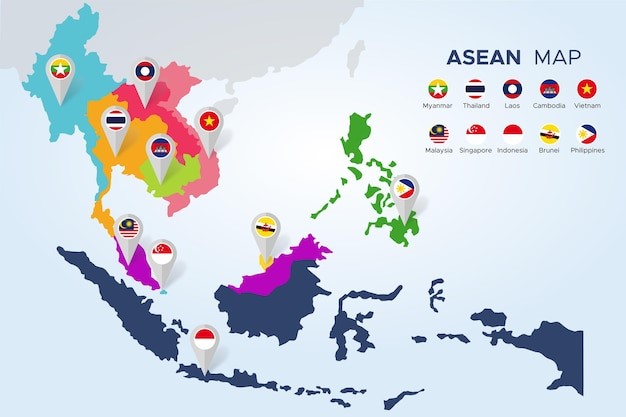
ASEAN, which is the Association of Southeast Asian Nations, is an intergovernmental organization that aims to promote economic and security cooperation among its ten members: Brunei, Cambodia, Indonesia, Laos, Malaysia, Myanmar, the Philippines, Singapore, Thailand, and Vietnam. The group has played a central role in Asian economic integration, joining negotiations to form the world’s largest free trade agreement, and signing six free trade deals with other economies in the region.  

Nevertheless, the group’s impact remains limited due to a lack of strategic vision, diverging priorities among member states, and weak leadership. Their biggest challenge is said to be the development of a unified approach to China, since ASEAN countries are strongly dependent on China, and benefit a lot from this relationship. However, this relationship also limits their growth, thus, a balance between the advantages of trading with China and the risks from overdependency should be achieved. The aim of this would be not only to maintain peace but also to pave out a more resilient and sustainable economic future for ASEAN countries. 

Looking ahead 

So, what can these countries do? Some argue that the answer is to enhance diversification efforts – They can start by diversifying their trading partners which would mitigate the risks of their excessive reliance on China and would also create a viable alternative for businesses relocating from China. Strengthen trade agreements – An additional way of doing this would be to prioritize the intra- ASEAN trade and integrating supply chains. This would lead to diminishing dependence on imports for components and materials, for example in the sectors of electronics and cars.  

Besides this, strategic trade relationships with other countries should be considered. This measure would not only grant ASEAN countries a greater access to significant markets such as Canada (for which there are ongoing negotiations to sign an agreement) but also, once again, promote trade diversification. Aligning China’s Foreign Direct Investment with sustainability – Interdependence with China cannot be abruptly broken, and it is important in maintaining peace. Following this rationale, as China’s FDI is important, ASEAN countries should ensure that these investments align with their sustainable growth goals, for example, transparency and accountability. 

Conclusion 

In summary, as China tries to steer a manufacturing-led revival of the world’s second-largest economy, the data from Beijing heightens Western concerns about Chinese competition. The opinions on how to approach this rising economy diverge, and the effects of interdependence are bittersweet. While on one side it may lead to peace and stability, since conflict is costly, on the other hand, it also provides room for disputes to emerge.  

The ultimate consequence of this is the incapability to separate political issues from economic trade. There are many suggestions to address these matters under regional frameworks rather than country-to-country. To effectively do so, these agreements should be comprehensive including emerging potential causes of conflict, like the ASEAN. 


Sources: Damuri, Y. R. (2022). An agenda for regional economic and security cooperation – East Asia Forum. East Asia Forum Quarterly: Volume 14, Number 4, 2022, 14(4), 5–7, Hawkins, A. (2023, July 5). Chip wars: how semiconductors became a flashpoint in the US-China relationship. The Guardian. Maizland, L., Albert, E., Hong, L., & Galina, C. (2023, September 18). What Is ASEAN? Council on Foreign Relations, Wester, S. (2023, November). Balancing Act: Assessing China’s Growing Economic Influence in ASEAN. Asia Society, XIA, M. (2018). “China Threat” or a “Peaceful Rise of China”? – New York Times. Nytimes.com, Hale, T. (2024, April 4). Manufacturers need to face up to new wave of Chinese competition. – Financial Times, Joseph Grieco, G. John Ikenberry, Michael Mastanduno (2024). Introduction to International Relations- Enduring Questions and Contemporary Perspectives 

Catarina Franco  

To Moral Hazard or Not to Moral Hazard?  

It would be possible to end poverty in the United States, at least in theory. Using a pure means-tested transfer system, the authorities could compensate each individual in the amount remounting the difference between the poverty line value and their income. This would cost only 131 billion dollars, about one-sixth of the value cost of the Social Security program (Using the U.S. Bureau of the Census 2019). The problem is that such computation doesn’t account for the Moral Hazard implications that come with benefit guarantees, as Jonathan Gruber points out in his book Public Finance and Public Policy (2019, Chapter 17).  

What happens is that this program may have a way of disincentivizing work to some extent, as it can motivate people slightly above the poverty line to stop working to receive the full benefit without substantially having to lower their consumption. Thus, increasing the number of people receiving the benefits, along with the policy’s costs

This phenomenon, named Moral Hazard, largely studied by economists, constitutes a change in people’s behavior provoked by the acquisition of insurance, either literally or figuratively speaking. In economics, this event usually leads to inefficient allocations of resources since it induces individuals to have a consumption different from the optimal level. The most common examples of Moral Hazard situations are observed in public policy, such as in the scenario described above, with insurance-related issues, such as health insurance or car insurance, and even during the Great Recession, the topics for the discussion in this article.  

Illustration by Christoph Niemann, The New Yorker 

Moral Hazard in Public Policy  

There are multiple applications of this concept within the realm of insurance in public policy. Unemployment, disability, injury, retirement, and poverty, appear as somewhat unpredictable situations against which agents want to be insured. If one is to think about it, much of the population seeks to smoothen their consumption throughout life. This can be translated into preferring to pay a fixed amount in insurance premiums so as to benefit from compensation in the face of an adverse event, like job loss, in such a way that consumption does not brutally fall.  

Here, Moral Hazard usually conveys disincentives to work: Take the example of Unemployment Insurance (UI), that functions as a means of compensating individuals if they lose their jobs. If the payment amounted to 100% of workers’ salaries, people would not have the incentive to seek employment throughout the duration of the benefit, which would ultimately lead to a lower-than-optimal provision of labor in the economy. Additionally, much of the workforce would have an incentive to stop working, adding up to the costs of the program. This is why not only UI but also schemes that cover these and other types of adverse events often do not contemplate full insurance. Instead, they try to weigh out the consumption smoothing ability that the program carries with its Moral Hazard costs.  

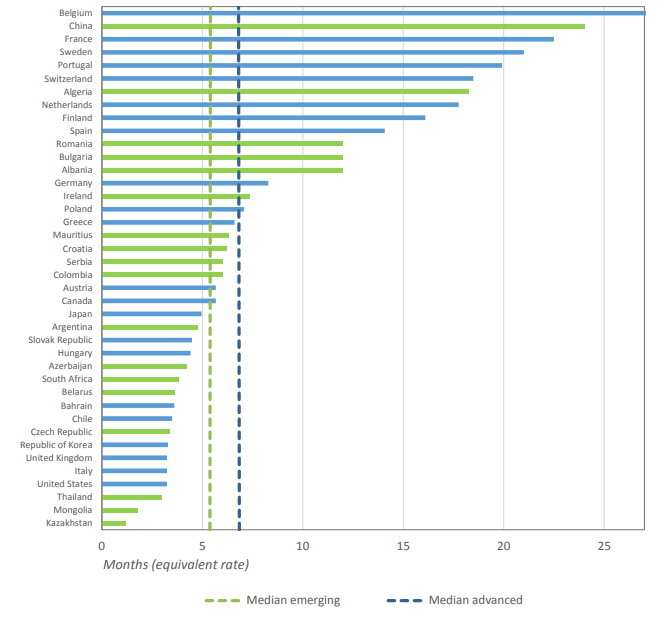
Countries may choose different schemes of Unemployment Benefits, depending on their internal policies. According to the Figure, it can be pointed out that the United States provides one of the lowest financial disincentives to return to work and constitutes one of the countries with a lower maximum amount for the duration of the benefits program (Figure 2). On the other hand, in most European countries the disincentive is more substantial and the threshold for the benefits is higher.  

Fig.1 – Financial disincentive to return to work (2023, OECD Data) 

Fig. 2 – Maximum duration of unemployment benefits at an equivalent rate (2019, ILO) 

Moral Hazard in Health Insurance  

Once again, insurance (in the health case) promotes consumption smoothing when faced with an adverse event (sickness). Its importance relates to the fact that it facilitates necessary treatments without the injured having to carry out major payments.  

Yet, another common means for Moral Hazard to manifest itself is through health insurance, which can comprise two types: Ex ante and ex post Moral Hazard. The first one illustrates cases where individuals have less incentive to indulge in activities that reduce the risk of sickness or illness (e.g. smoking), when insured, whereas the last comprises a circumstance in which insurance beneficiaries are less likely to limit the use of healthcare when sick (e.g. going to consultation because of a cold).  

When provided with health coverage, individuals may be more prone to seek medical care for minor conditions or undergo unnecessary procedures. This overutilization can strain healthcare resources, and lead to inefficiencies in the delivery of care. Additionally, it can drive up costs for insurers, leading to greater insurance premiums.  

However, would it be unreasonable to assume this increase in healthcare utilization can come from the actual need for medical care?  

“Too Big to Fail”: Moral Hazard in the Great Recession 

Moral Hazard is not only present in the daily life of the average person but also in the most pressing global financial crises. The most prominent example being the 2008 Financial Crisis. In the years leading up to this crisis, the United States had evidenced an exponential increase in housing prices, stemming from factors such as the accessibility of credit, lower interest rates, and permissive lending standards. This allowed a significant number of subprime borrowers to obtain mortgages, bundled by Financial Institutions to form Mortgage-Backed Securities (MBS) and Collateralized Debt Obligations (CDO) which were posteriorly sold to international investors with higher credit ratings.  

Why did Financial Institutions engage in such risky lending practices? 

Credit rating agencies played an instrumental role in the crisis by assigning high ratings to MBS and CDO, prompting a false sense of security about the degree of risk of these securities. This is where Moral Hazard comes in, as the financial institutions involved operated in accordance with the misbelief that they were “too big to fail” (Stewart McKinney, 1984). This entailed the expectation that, because of financial institutions’ vitality to the economy, regulating authorities would not allow them to fail due to the systemic risk that could influence the course of the global environment. Thus, these continued to operate with disregard for possible unfavorable outcomes so, when housing prices peaked and proceeded to decline in 2006, borrowers defaulted on their mortgages, leading to a collapse in the value of MBS.  

The losses caused a domino effect in the financial sector and major financial institutions faced bankruptcy, with long-lasting effects on the global economy prompting a significant need for regulatory reforms. One measure was the Dodd-Frank Wall Street Reform which implicates more strenuous capital and liquidity requirements for banks with at least $50 billion in assets, and the Consumer Protection Act in the US to further protect financial activity in the country. Its provisions included the Volcker Rule, which argues that banks that take on hazardous risks should not be government-subsidized and aims at constraining banks from using their own money to trade securities, rather than depositor money. The latter faced opposition as many of the institutions that integrated this failure did not take on deposits and would not have been subject to such rules. 

So, are authorities able to contain Moral Hazards? 

Silicon Valley Bank (SVB), a bank with assets totaling $209 billion in late 2022, according to the Federal Deposit Insurance Corporation, collapsed one week after being listed on Forbes’ America’s Best Banks List, making the sour transition from one of the best American banks, into the second-largest bank failure in US history.  

This unfortunate occurrence sprang from the large amount of deposits with scarce cash held by the bank, with which SVB would buy treasury bonds and other long-term debts that have low returns and risk. However, as the Federal Reserve increased interest rates to combat inflation, SVB’s bonds became riskier and, thus, saw a stark decline in value which prompted mass customers to withdraw funds, leading to its collapse.  

It is also argued that this failure started before the Federal Reserve’s regulations, with the overturn of the Dodd-Frank Act whose requirements were relived in 2018 by former President Donald Trump. This was done through the Economic Growth Regulatory Relief, and Consumer Protection Act, according to which the law increased the threshold to $250 billion. Thus, another instance of moral hazard lies with the bailout provided to SVB, raising concerns regarding other banks’ propensity to take risks. It is, therefore, of great importance to acknowledge the dichotomy faced by the Federal Reserve when weighing price stability and financial stability, since interest rates, despite being conventionally perceived as a powerful strategy to stabilize inflation, can rapidly escalate to become a trigger for Moral Hazards within the financial sector, rooting global financial instability. 

Policy implications  

Evidently, public policy applications of Moral Hazard come with implications. Many economists focus their work on the design of these. With the UI, policymakers try to balance the consumption smoothing benefits of the insurance with its Moral Hazard costs, which depend on the magnitude and predictability of adverse events. For example, retirement is a rather predictable event, so people may prepare in advance. On the other hand, unemployment is considered of low magnitude, meaning that some may be able to self-insure. The functioning of both Disability Insurance (DI) and Workers’ Compensation (WC) goes along those lines, which ultimately impedes these programs from offering full coverage. 

Poverty alleviation programs, as mentioned in the introduction, also carry Moral Hazard concerns. In such a case, there are policies designed to try to make sure that everyone who needs the benefit gets it and those who do not don’t, although this might be difficult. There are some instruments impregnated in society to try to regulate this, such as ordeal mechanisms, that make welfare programs somewhat unattractive to guarantee that only the population that necessitates benefits from them. For example, the long lines in soup kitchens.   

In 2010, President Barack Obama signed the Patient Protection and Affordable Care Act, often referred to as the Affordable Care Act (ACA) or Obamacare. This legislation aimed to extend health coverage to millions of uninsured Americans by expanding Medicaid, establishing health insurance exchanges, and introducing various health-related provisions. The ACA sought to make health insurance more accessible and affordable. It offered premium tax credits and cost-sharing reductions to individuals with lower incomes. However, the Act may also have exacerbated existing moral hazards within the health insurance industry, as Sean Ross discusses in his article (2023). Some of the provisions included the mandatory coverage of some essential benefits, the obligation to buy insurance, provided with an exemption for low-income citizens, and restricting prices. However, in such a scenario, one should also consider the fairness argument for the existence of programs that lower the efficiency of an economy. At the end of the day, it is a trade-off.  

Illustration by Andrew Grossman, IAS 

Conclusion 

From work disincentives to devastating financial crises, moral hazards’ ever presence within a country’s economy underscores the intricacy in policy making towards a balance between social welfare and economic efficiency. While initiatives such as healthcare or social benefits aim to mitigate disparities, moral hazard reminds governments of the complexity implicit in policymaking and surfaces the question introduced in this article: To moral hazard or not to moral hazard? 

References  

Aklin, Michaël, and Andreas Kern. 2019. “Moral Hazard and Financial Crises: Evidence From American Troop Deployments.” International Studies Quarterly (Print) 63 (1): 15-29. https://academic.oup.com/isq/article/63/1/15/5290056 

Asenjo, Antonia, and Clemente Pignatti. 2019. Unemployment insurance schemes around the world: Evidence and policy options. ILO Working Paper no 49 (October): 20-24 https://www.ilo.org/wcmsp5/groups/public/—dgreports/—inst/documents/publication/wcms_723778.pdf 

Dewan, Shaila. 2012. “Moral Hazard: A Tempest-Tossed Idea” The New York Times. February 25, 2012. https://www.nytimes.com/2012/02/26/business/moral-hazard-as-the-flip-side-of-self-reliance.html 

Duggan, Wayne. 2023. “A Short History of the Great Recession.” Forbes Advisor, June 21, 2023. https://www.forbes.com/advisor/investing/great-recession/ 

“Financial Crisis and the Ethics of Moral Hazard on JSTOR.” n.d. Www.Jstor.Org. https://www.jstor.org/stable/24575743 

Gruber, Jonathan. 2019. Public Finance and Public Policy, 6th Edition, Chapters 14, 15, 17. New York: Worth Publishers 

OECD (2024). Financial disincentive to return to work (indicator). https://data.oecd.org/benwage/financial-disincentive-to-return-to-work.htm#indicator-chart  

Ross, Sean. 2023. The Affordable Care Act Affects Moral Hazard in the Health Insurance Industry. Investopedia. 2023. https://www.investopedia.com/ask/answers/043015/how-does-affordable-care-act-affect-moral-hazard-health-insurance-industry.asp  

Stiglitz, Joseph. 2023. “Silicon Valley Bank’s Failure Is Predictable – What Can It Teach Us?” The Guardian, March 13, 2023. https://www.theguardian.com/business/2023/mar/13/silicon-valley-bank-failure-svb-collapse 

SVB: US Regulators Have Generated a ‘Moral Hazard.’” n.d. The Banker. https://www.thebanker.com/SVB-US-regulators-have-generated-a-moral-hazard-1679645486 

Team, Investopedia. 2023. “How Did Moral Hazard Contribute to the 2008 Financial Crisis?” Investopedia. October 26, 2023. https://www.investopedia.com/ask/answers/050515/how-did-moral-hazard-contribute-financial-crisis-2008.asp 

The Economist. 2017. “How The 2007-08 Crisis Unfolded.” The Economist, June 8, 2017. https://www.economist.com/special-report/2017/05/04/how-the-2007-08-crisis-unfolded 

Madalena Martinho do Rosário

Maria Francisca Pereira

Reddit’s IPO: Was The Buzz Really Worth The Hype? 

Reading time: 7 minutes

INTRODUCTION 

The debut of a company on the stock market through an Initial Public Offering (IPO) is a momentous occasion that captivates the attention of investors, business enthusiasts, and the wider public. The excitement surrounding an IPO is palpable, driven by a convergence of factors that elevate it beyond mere financial transactions to a symbol of innovation, growth, and opportunity. From the allure of exclusive investment opportunities to the potential for substantial returns, and from media attention to the economic impact and innovation potential of newly public companies, the commotion of an IPO transcends traditional market dynamics to embody the spirit of entrepreneurialism. All aspiring companies want to be the next Saudi Aramco or Alibaba, however, this time, we will take a deeper look at Reddit. Was the buzz worth the hype? 

A BRIEF HISTORY OF REDDIT 

First and foremost, Reddit operates as a platform where registered members can submit content, such as text posts or direct links, and engage in discussions through comments. The content is organized into “subreddits,” which cover a wide range of topics, from niche hobbies to global news. What sets Reddit apart is its emphasis on user-generated content, fostering a sense of belonging and authenticity among its users. 

In 2005, Reddit was created by two programmers from Virginia University, Steve Huffman and Alexis Ohanian, in the aftermath of attending a lecture by programmer-entrepreneur Paul Graham, leading to Huffman taking charge of coding the site, using Common Lisp, and launching Reddit in June of that year. As the platform gained traction, Christopher Slowe was welcomed onboard and eventually merged with Aaron Swartz’s company, Infogami. Swartz played a crucial role in revamping Reddit’s software by implementing his web framework, web.py, thus leaving a lasting mark on Reddit’s technical evolution and the broader web development community.       

The following year, Reddit was swiftly acquired by Condé Nast Publications for a raging sum ranging from $10 million to $20 million, thus, prompting the team to relocate to San Francisco. Afterward, both Huffman and Ohanian departed Reddit’s helm in 2009. Since then, Reddit gained operational independence from Condé Nast in 2011 and many years as well as CEOs later, the original co-founder, Huffman, returned as the Chief Executive Officer. 

REDDIT’S REVENUE SOURCES 

Reddit earns money primarily through advertising, premium memberships, and partnerships

When it comes to advertising, Reddit has a unique system that allows advertisers to target specific subreddits or communities, making it attractive for those aiming to reach niche audiences. These offer both managed and self-serve ad options, with prices varying based on the audience targeted. In recent years, Reddit’s ad revenue has seen significant growth, with increasing projections indicating substantial earnings: about $119 million in ad revenue in 2019, which skyrocketed the following year by 52.4%, to $181.3 million. 

Picture 1: Reddit’s co-founders Steve Huffman and Alexis Ohanian 

Reddit Gold, a premium membership, offers users extra features and benefits for a fee. This includes an ad-free experience and several other perks. The revenue from these memberships has been steadily increasing, showing that users are willing to pay for additional benefits. For example, in 2021, about 344,000 Reddit users brought in a staggering value of $17.21 million in revenue for the platform, considering that in 2020 it had only generated 12.38 million. Moreover, Reddit partners with other companies to provide sponsored content and promotional opportunities, thereby assisting the company in generating revenue while also offering value to its users. 

THE IPO BUZZ: EXCITEMENT AND EXPECTATIONS 

The IPO buzz can be traced back to 2021. However, one of the main reasons why this IPO gained so much attention was due to the introduction of AI.  

Reddit disclosed its plans to allow third parties to access its data for purposes like training artificial intelligence models, as the company has already entered into data licensing agreements worth $203 million. From these agreements, Reddit anticipates earning at least $66.4 million in revenue this year. 

Additionally, Reddit has partnered with Google, allowing Google’s AI products to utilize Reddit data to enhance their technology. This collaboration underscores the growing importance of original human-generated content, particularly, as AI-generated content becomes more prevalent on a day-to-day basis. 

THE INITIAL IPO: TRIUMPHS AND CHALLENGES 

On the morning of March 21, 2024, Reddit debuted on the stock market with the ticker symbol RDDT

Reddit Inc.’s shares surged an astonishing 48% above their initial public offering price, which reflected the investors’ enthusiasm for the company’s futures secured around artificial intelligence. The San Francisco-based firm’s stock closed at $50.44 each on Thursday in New York, following a successful offering where the company and some of its shareholders raised $748 million, pricing it at the top end of the marketed range. Furthermore, Reddit’s IPO now stands as the fourth largest on a US exchange, demonstrating a revival in the market for initial public offerings after a two-year sluggish period. This successful listing is expected to encourage other tech companies that had delayed their plans to go public. 

With a fully diluted valuation nearing $9.5 billion, Reddit falls just short of the $10 billion mark it achieved in a 2021 funding round. Analysts, including Mandeep Singh, senior industry analyst for Bloomberg Technology, had suggested even before pricing that Reddit could be valued at as much as $10 billion. 

Reddit’s IPO pricing implied an enterprise value-to-sales multiples positioned between Meta Platforms Inc.’s higher multiples of eight times and the lower multiples of smaller digital advertising peers like Snap Inc. and Pinterest Inc., according to Singh. He emphasized that investors are willing to pay for growth, particularly given Reddit’s accelerated growth in the past six months, making a strong case for a premium valuation. Hence, it is worth mentioning that Reddit’s IPO surpasses notable listings in September by US tech firms Instacart and Klaviyo Inc., both of which raised substantial amounts. 

THE FALL: UNFORESEEN OBSTACLES AND MARKET VOLATILITY 

Following a report by Hedgeye Risk Management suggesting Reddit Inc.’s stock should decline by about 50%, Reddit shares experienced their largest one-day drop since their trading debut. The stock fell 11% on Wednesday, closing at $57.75 per share, its lowest since March 22. While Reddit shares had surged more than 90% since the IPO on March 21, Hedgeye deemed the stock “grossly overvalued” and recommended it trade closer to its IPO price of $34. 

Reddit is set to report its first-quarter 2024 results in late May. While Hedgeye anticipates positive momentum in the first report, they caution potential weaknesses in future reports, particularly expecting a slowdown in user and revenue growth in the second half of 2024 and the first half of 2025. The company also disclosed in a corporate filing that Huffman (the CEO) sold 500,00 of his shares and that the Chief Operating Officer, Jennifer Wong, sold 514,000. Furthermore, Bloomberg interviewed Omar Abbasi, a 34-year-old software engineer in the Bay Area, who received a job offer, partly due to his unpaid work as a moderator for Reddit’s gaming communities. However, he declined the offer, citing concerns about the risk involved, drawing a parallel with Facebook’s stock stagnation post-IPO in 2012. Abbasi’s views and worries are most likely shared with many others. 

Picture 2: Reddit Inc market data on 03/04/2024 

CONCLUSION 

In a nutshell, it is still not clear if the buzz was really worth the hype, considering that the market is showing volatile behavior. Nevertheless, it is worth noting that Reddit posted a net loss of $91 million last year, while still having more than $700 million of cumulative losses. Therefore, the company has to make some drastic changes for their situation to turn around. Furthermore, it is remarkable that this website is very community-oriented. In fact, Reddit’s most loyal users were able to buy 8% of the shares at IPO price, but users could prove tricky to monetize since there’s opposition to intrusive advertising. Hence, Reddit has a difficult ride ahead in trying to appease their tight-knit community of “redditers” and manage to make a profit. 


Sources: Business Insider; Bloomberg; Financial Times 

Alegra Maza

Is It Morally Correct to Separate Art from its Artist?

Reading time: 7 minutes

Separating art from the artist is a concept that refers to the idea of appreciating or evaluating a work of art independently of the personal characteristics, actions, or beliefs of the artist who created it. This concept arises from the recognition that an artist’s personal life, behaviour, or views may not be associated with their artistic output. And that the value or merit of a work of art should be assessed based on its own qualities rather than the character or actions of the creator.

Some people believe that art stands on its own and has its intrinsic meaning, which is not impacted by an artist’s actions. They find it easy to enjoy the work put out by artists whose actions they disagree with, treating them as two separate entities. Other people will say it’s impossible and morally incorrect to bear the idea of said separation, saying that art fundamentally must reflect the artist’s beliefs and ideas, that being an artist is a deeply intimate experience, and to remove an artist from their creations, is to decontextualize their work and leaves it devoid of meaning. Another worry is that if we are too rigorous towards which art to consume, we would be reduced to a very limited number of creations.

Where did “separate the art from the artist” come from?

From a historical standpoint, the idea of separating art from the artist was first introduced under the New Criticism of the early 20th century, a time when English literature was heavily analysed and prioritized over classical literature.

The New Criticism was a formalist Movement in literary theory that dominated American literary criticism. It emphasized close reading, particularly poetry, to discover how a work of literature functioned as a self-contained, self-referential, aesthetic object. The method of New Criticism is a close reading and concentrates on such a formal aspect as rhythm, theme, imaginary metaphor, etc.

The essence of New Criticism lies in the analysis and interpretation of literature solely through the text itself, without considering the influence or intentions of the author, or the historical and cultural context that might have shaped the work.

Examples of influential people with controversial histories

Chris Brown

Musician Chris Brown has been known and talked about for his documented history of violence towards women, and, in 2009, musician and businesswoman Rihanna was a victim of his abuse. Since then, assault and battery charges (battery is a criminal offense involving unlawful physical contact, distinct from assault, which is the act of creating apprehension of such contact) have been recurrent in the last several years of his public image, particularly accusations from women who have filed police reports against the singer and dancer.

Despite his violent actions and behaviour toward women, Brown releases music regularly. This type of situation made some people ponder if they should keep on streaming Chris Brown´s songs because by supporting his career and ability to create more content they are directly benefiting him.

Caravaggio

Caravaggio’s “Judith Beheading Holofernes,” 1599

This painting, like many others by Caravaggio, is probably familiar to most. The Baroque artist is renowned for his grim and violent depictions, such as the one represented above. However, Caravaggio´s notoriety extends beyond his artwork. In the early 17th century, he faced trial at least 11 times for various offenses.

His life was marked by a pattern of recklessness and conflict. As his fame grew, so did his reputation for indulging in vices such as drinking, gambling, and brawling. Between 1598 and 1601, he faced legal troubles for yielding a sword without a permit, assaulting a man with a stick, and allegedly attacking another with a sword. Additionally, he found himself embroiled in a bitter rivalry with fellow painter Giovanni Baglione, who accused Caravaggio of hiring assassins to kill him.

The artist´s run-ins with the law were numerous and varied. He was taken to court for acts ranging from throwing a plate of artichokes at a waiter to breaking a window shutter in his rented room. He even spent time in prison for offenses like pelting stones at policemen and verbally abusing a woman and her daughter. Then, in May 1606, he killed a man named Ranuccio Tomassoni.

This type of action makes one question whether they should worship his art and be indifferent to what was previously expressed or take a stand against such faults and not contribute to his further recognition as an artist and person.

Rex orange county

The 25-year-old British singer and songwriter, whose real name is Alex O´Conner and is well known for being the creator of songs that touch and inspire his fans carrying them through dark phases, was charged with sexual assault accusations by a woman who alleges he assaulted her in London on six separate occasions in two days, leaving some fans devastated. Some of them, who had tattoos in honour of some of his songs, stepped forward and claimed their disappointment in social media “My heart immediately broke for the alleged victim,” Kayla Ellis told BuzzFeed News “I started crying almost instantly because I knew nothing was going to be the same after hearing this.” Eventually, the charges were dropped due to lack of evidence, but during that time, die-hard fans were struggling with separating the art from its artist, especially the ones that shared they had been through similar experiences related to sexual abuse.

R. Kelly

Chart-topping R&B singerRobert Sylvester Kelly had, for more than two decades faced allegations of sexual and child abuse. In 2022, Kelly was convicted of three child pornography charges of enticing a minor.  He was sentenced to serve 31 years imprisonment in a combination of concurrent and consecutive sentences.

He was convicted of child sexual abuse in a second federal trial in Chicago and faced charges due to sexual misconduct charges in Minnesota.

Some examples of people who came forward are Tracy Sampson, who sued R. Kelly, accusing him of inducing her “into an indecent sexual relationship” when she was 17. The woman, a former intern at Epic Records, said she was “treated as his personal sex object and cast aside”. Patrice Jones is a woman from Chicago who claimed he impregnated her when she was underage, and that she was forced to have an abortion.

In June 2002 he was charged over child abuse videos. He was charged with 21 counts of making child sexual abuse videos involving various sexual acts. In 2002-2004 arrest prompted further charges. Kelly was charged with further 12 counts of producing child sexual abuse images in Florida, where he was arrested at his holiday home.

Additionally, allegations depicted an organized effort from the singer and his associates to recruit and transport underage girls over state lines for illegal sexual purposes, including the production of child sex abuse images, as well as conspiracy to obstruct justice by destroying evidence and bribing or threatening witnesses.

There are several reasons why people might choose to separate art from the artist:

Artistic appreciation, some individuals believe that the intrinsic qualities of a work of art, such as its aesthetic beauty, technical skill, or emotional impact, should be evaluated independently of the artist´s attributes or behaviour. Artistic legacy, in cases where an artist’s personal conduct or beliefs are controversial, separating art from the artist may allow the artwork itself to be preserved and appreciated for its cultural or historical significance, even if the artist’s reputation is tarnished. Artistic freedom, being able to absorb art independently can also support the idea that artists should have the freedom to express themselves creatively without fear, censorship, or judgment based on their personal lives and beliefs.

Conclusion

For some people, in modern days, it´s unbearable to shy away from accusations, trials, and skeletons in closets, as we become ubiquitous in the media. This debate made the term cancel culture (the mass withdrawal of support from public figures or celebrities who have done things that aren’t socially accepted today) emerge. Cancel culture is adopted by those who find it hard to manage the difference between art and its creator. They state that we, as consumers, can have a momentous impact and can no longer claim ignorance of what is constantly in plain sight, leading us to the question that plots this article, is it morally correct to separate the art from the artist?


Sources: New York Post, BBC, Biography, RollingStone, English Literature Zone

Laura Casanova