Demystifying Turn of the Tide 

Turn of the Tide is everywhere. The new Portuguese Netflix show, which is beating national records, proclaimed its spot in the world’s top ten non-English shows of Netflix the previous week. The series created by Augusto Fraga follows the life of Eduardo (José Condessa) and his friends: Sílvia (Helena Caldeira), Carlinhos (André Leitão) and Rafael (Rodrigo Tomás), whose lives transform with the arrival of a ton of cocaine to their quiet village, Rabo de Peixe.  

The launch of the seven episodes has brought back discussion about the events that inspired the TV series, unveiling forgotten journalistic work that aimed to demystify and portray the case and its repercussions. 

Rabo de Peixe is situated on the north coast of the island of São Miguel, in Azores, and more specifically, in the municipality of Ribeira Grande. In 2001, the village’s main activity was fishing, and nowadays, it continues to be a prominent source of economic activity.  

2001 was also the year in which a Sun Kiss 47 yacht that was carrying on board more than 500 kg of 80% pure cocaine appeared on the scene of the peaceful village. Antonio Quinci, an Italian drug dealer, was transporting its cargo from Venezuela to Spain and, on its way, was forced to make an unprogrammed stop in the island of São Miguel because of damages on the rudder. Aware of the fact that it would be impossible to go directly into the harbor due to the content in its possession, Antonio decides to hide the contraband in a cave in Pilar da Bretanha and pick it up later.  

The police investigation stated that the bales of cocaine were bound by an anchor beneath the water and tied by fishing nets and chains, but as the waves started to pound the inlets, the netting securing the bales unraveled. Suddenly, dozens of packages were spreading throughout 70 kilometers of coast, having many people reporting it back to the authorities, and some not. 

Initially a fisherman discovers the hiding place for some of the drugs and alerts the authorities, which eventually leads to many more substantial information from the citizens. In the end of the operation the authorities reported a total amount of marginally less than 500 kg of cocaine, the value that stayed on the official record. However, many believe that number to be inaccurate and that due to the complexion of the boat, it should be way larger.  

All of a sudden, statements about the uses of the cocaine that wasn´t apprehended were circulating all over the island. Nowadays, many of the stories that reach us are more of combination of fact and fiction. Small drug dealers multiplied, and the drug became more accessible: From small beer glasses filled with the drug and selling packets of cigarettes full of cocaine (500 escudos) to stupider claims, such as frying meat with the powder instead of flour. 

That spike on the offer of drugs augmented the number of overdoses for a while, taking the hospitals into a state of alarm. There were claims that almost every day someone would enter the hospital in a delusional state, mostly because of a mixture of cocaine with opposite effect drugs, as heroine or tranquilizers.  

Still working on finding the cocaine that remained on the island, the police came across a package hidden under a fake hall on a yacht, which lead them to Antonio Quinci. Two weeks after his arrest, Antonio climbed the prison wall into freedom, and jumped into a waiting scooter. The guards didn´t end the rescue because they were afraid of accidently shooting the citizens passing by. But can one really escape from an island? Fifteen days after, with the hope of catching him becoming fairly low, the fugitive was found: Two cops went to a house where there was suspicion of a man being in possession of cocaine, and while inspecting the hen house, they found Antonio. The convicted went back to jail, where he would end up serving a sentence of ten years in Coimbra.  

The effects that the case had on the island cannot be measured. Some lived it through stories and through friends, having no direct impact on their lives. However, the events have certainly introduced an addiction that, otherwise, wouldn’t find a way of prospering on that island in Azores.  

Webgrafia:

Matthew Bremner, Blow up: how half a tonne of cocaine transformed the life of an island, The Guardian https://www.theguardian.com/society/2019/may/10/blow-up-how-half-a-tonne-of-cocaine-transformed-the-life-of-an-island

Macarena Lozano, Rebeca Queimaliños, translated by Heather Galloway, Snow blind: how half a ton of cocaine destroyed a tiny Portuguese island, El País https://english.elpais.com/elpais/2017/12/08/inenglish/1512720697_264543.html

Luís Ribeiro, Quando a coca deu à costa, Visão https://visao.pt/atualidade/sociedade/2023-05-26-uma-equipa-de-reporteres-da-visao-estava-em-rabo-de-peixe-quando-a-coca-deu-a-costa-e-fez-a-reportagem/

Carolina Amado, Rabo de Peixe lembra cicatrizes, mas “nunca a comunidade se sentiu tão abraçada”, Público Rabo de Peixe lembra cicatrizes, mas “nunca a comunidade se sentiu tão abraçada” | São Miguel | PÚBLICO (publico.pt)

Francisca Pereira

INVESTING IN GOOD FAITH: THE ISLAMIC FINANCIAL SYSTEM 

Reading time: 8 minutes

 Have you ever looked at something, and imagined what it would be like if it were… different? Say, what would the education system look like without the written word, or arithmetic without the concept of zero? Or what would the financial system be without interest? Many centuries ago, in Europe and all the Christian world, collecting interest was forbidden by the Church on the grounds of immorality, being universally recognized as a sin – the sin of Usury.  

Nowadays, the official stance of most western nations with respect to interest is significantly different – not only is it not condemned, but is actually regarded as a vital part of our economies. And it definitely is. It is impossible to imagine how our current financial system would ever work without this tool. Interest is a crucial part of loan taking, house buying, and savings. Politicians talk about it, economists worry about it, investors use it to generate returns. The concept of interest is inseparable from the concept of money itself. In most of the world, at least. 

Like the Catholic Church once did, some still consider interest to be immoral, or simply impossible to reconcile with their religious beliefs. Such is the case of the Islamic Faith.  

THE ISLAMIC VIEW 

Before we look at how this financial system is different from the main one, it is worth spending some time understanding its foundations.

  Text Box

A member of the Islamic community is supposed to comply with certain rules and guidelines, living their lives according to the teachings of the Faith in order to lead a moral life. To this code of conduct, we call Sharia (or Shari’ah) Law. Sharia is a complex subject. It requires interpretation of the will of God, something that has divided humankind for millennia. We are not likely to solve it in 1400 words. It is not the purpose of this article to explore the religious and legal complexities of Muslim-majority countries. Sharia law exists, and millions of people in the world follow it. Our focus is on how Sharia, and by extension the individuals that try to guide their actions by it, think of financial transactions

The Institute of Islamic Banking and Insurance states the objectives of Islamic Financial Transactions (i.e. Sharia compliant financial transactions) as follows: 

  • To be true to the Sharia principles of equity and justice
  • Should be free from unjust enrichment
  • Must be based on true consent of all parties; 
  • Must be an integral part of a real trade or economic activity such as a sale, lease, manufacture or partnership. 

The first three points can be considered more or less subjective – what constitutes equity, injustice or true consent are open for debate. Interesting as that debate may be, it falls out of our scope today. Let us then look at the fourth point. 

Sale, lease, manufacture and partnerships are no strangers in the traditional financial system. The key is the one missing – can you spot it? That’s right – debt! Debt-based instruments, so common in traditional financing, don’t have the same centrality in its Sharia compliant counterpart. Why is that? Well, we’ve stated the reasoning before: the Islamic Financial System absolutely prohibits paying/receiving “any predetermined, guaranteed rate of return”, that is, interest.  

Text Box

But why does the Islam forbid someone to be compensated for departing from their capital for a period? Doesn’t it recognize the Time Value of Money (the notion that having money right now is more valuable than the promise of the having money in the future)? As a matter of fact, it does! The difference is in understanding what constitutes capital. Ask any non-Islamic banker, investor or economist, and they will almost surely tell you that money is capital – a production factor, something that can be used to create more wealth. Islamic thinking draws a line: money is only seen as potential capital. It is only considered actual capital when it is employed in an actual productive activity together with other resources. Simply put, money sitting still is not productive, so you are not entitled to any compensation for lending it to someone who will actually put it to use. 

PRINCIPLES AND INSTRUMENTS 

So, what can actually be done inside this system? Well, any activity that complies with some basic principles

As previously discussed, interest (riba) is forbidden. It is regarded as an “unjustifiable increase of capital whether in loans or sales”. This is the central principle ruling mutual dealings. Borrowers and lenders should equally share the profits and risks – profits are a symbol of a successful enterprise, while interest is a cost independent of success, only on the side of the borrower. A supplier of funds is not a creditor, but an investor. Since money has no purpose unless tied to a real asset, speculation and gambling (maysir) are forbidden. Uncertainty or asymmetrical information (when one of the intervenients possesses information that the other one has no access to) are also prohibited in any transaction – contracts are sacred, and agents have a duty to disclose all relevant information beforehand. Hoarding is also not permitted, as well as trade in forbidden commodities (pork, alcohol, dealings with casinos, etc.).  

Many instruments that are present in the traditional financial system are also used by the Islamic Financial System. The most basic ones, which can then be combined to create more complex products, are cost-plus financing, profit-sharing, leasing, partnership and forward sale

APPLICATIONS 

As you can see, Islamic Financing is no more than a selection of the financial instruments and products that comply with certain religious and, especially, moral principles. If you think about it, it is not so different from how a food restriction works – if you and your friends go to dinner, the vegan friend will order something with no meat, the one with a seafood allergy will probably not get the shrimp, and some may choose to get water instead of wine or other alcoholic drink. And, of course, you are perfectly free to order a salad if you’re not vegan, or to ask for no peanuts in your dessert even if you have no allergy. And you are equally free to partake in a Sharia-compliant financial transaction, whether you are a Muslim or not

People can invest in an Islamic Financial Product regardless of their faith 

Islamic finance has been growing, and not only inside the Muslim Community. Its principles appeal to many, and it does have some advantages over the traditional system: as interest is forbidden, predatory loans can’t happen at all; income and wealth are more equally distributed, as every intervenient receives a part of the profits, regardless of how much capital they had at the beginning of the enterprise; speculation is forbidden, meaning the system is not so exposed to market bubbles (goodbye, 2008-like financial crisis!); and it is significantly more transparent and accessible. Many argue that it can help lift many out of poverty, especially if combined with ideas like Microfinancing. These characteristics indicate that Islamic Finance may be better equipped for sustainable development, a point that may prove to be of great importance in the years to come.  
Of course, it has some significant disadvantages too: it does not provide funds for all businesses (religious prohibitions prevent it from dealing with pork, alcohol and gambling firms) and, for all its efficiency in allocating resources to businesses with a greater chance of success and encouraging money to be fueled into real and productive activities, it can be argued that it does not maximizes investment profits (as interest is not charged). 

There is another detail that is worth pointing out: Islamic Finance comes with a moral compass (or at least a baseline). Whether this is a positive thing or not will probably depend on the degree to which you agree with the moral principles it is rooted in, but it is, undoubtedly, a point of difference between this system and the traditional one. 

The islamic Financial System serves millions of people worldwide

It is easy for some to look at the presented characteristics and to regard this system as limiting. We cannot argue it may not be limiting, but it is so in order to provide an option that answers the needs of millions of people, who do not wish to compromise their faith in exchange for a piece of wealth. Different cultures have different approaches, and we live in a wonderfully differentiated world. Imagine how boring it would be otherwise. 


Sources: Institute of Islamic Banking and Insurance, Corporate Finance Institute, Investopedia, World Bank, Blossom Finance, Wikipedia 

Joana Brás

Leonor Cunha

The never-ending discussion on CEO compensation 

Reading time: 7 minutes

CEO compensations are again a motive of discussion, as inequality rises: 

Chief Executive Officers’ (CEO) compensations are once again the topic of the moment, with several news coverages reporting increases in the earnings of the ultimate day-to-day firm managers, in the last year of 2022.  

For example, Dara Khosrowshahi, Uber Technologies Inc.’s CEO saw a total increase in compensation of 22% in the last year alone, culminating in a total payment of $24.3 million. According to the report issued by the Securities and Exchange Commission, his payment was composed of a $1 million base salary, stock awards of around $14.3 million, $5.9 million in options, a $2.9 million bonus and a “symbolic” $170 thousand compensation for personal travel and security costs. James Gorman’s salary, CEO of Morgan Stanley, rose 13% to $39.4 million, of which $1.5 million in base salary, $7.5 million in a cash bonus and stock awards of $30.4 million. According to Reuters, these numbers reflect a ratio of 274 to 1 when comparing Gorman’s pay to the median pay of an employee in 2022, an increase from the previous year’s ratio of 255 to 1. American CEOs of oil companies experienced a large growth in their pay checks as well, as their record profits were driven by the increase in energy prices, with ExxonMobil’s CEO, Darren Woods, having a 52% raise in his payment of $35.9 million. However, the same cannot be said for the median oil company worker, who saw a decline in the average salary, with those of Exxon seeing a decrease of 9% to a total yearly salary of $171,582. Moreover, just this week, Alphabet and Google’s CEO, Sundar Pichai, was reported to earn $226 million, which included stock awards of $218 million. This represents more than 800 times the annual pay of a median employee and it is subject to controversy and outrage as the company has been cost-cutting with their employees through layoffs that have already started, following Google´s plan to cut 12,000 jobs, representing around 6% of its total workforce. 

These numbers express a growing concern in today’s society, with the rising disparity between CEO’s average salary and the median worker. In fact, in June 2022, the Institute for Policy Studies released a study including the top 300 publicly traded US firms, in which it was concluded that the average pay gap between CEO and median worker jumped to 670 to 1, an increase of 31%, from 2020’s 604 to 1. In total, 49 firms had ratios higher than 1,000 to 1, signalling that, for each dollar the median employee received, the company’s CEO would earn more than $1,000. Furthermore, in more than a third of surveyed companies, the median worker salary did not keep up with inflation

Figure 1: Aggregated CEO-to-worker compensation ratio for the 350 largest publicly owned companies in the U.S. from 1995 to 2021

Figure 2: Ratio between CEO and average worker pay in 2018, by country

However, such large differences in pay do not occur in every country. There are cross-national differences which relate to the culture of the country in question. Indeed, the average US executive compensation is significantly higher than that experienced in Europe or Asia. This relates to the fact that Asian countries, like Japan, favour group rewards while others, such as China, value other aspects more highly, namely promotions or potential political careers. Nevertheless, for the sake of exemplification, in this article, the US will be used as a case study. 

The agency problem as a potential explanation: 

To truly comprehend where these differences arise from, one must start by understanding what an agency is.  An agency is a contract by which one party, the principal, grants authority to another party, the agent, to act on his behalf in a particular matter. Consequently, the agent – which may be a CEO – is expected to act in the best interests of the principal – in this case, the shareholders – and, normally, is not held liable for his actions as long as he acts under his fiduciary duty. However, an agency problem occurs due to the separation that exists between the management and shareholders, such that both parties’ interests are not aligned, with CEOs potentially acting in their self-interest due to several reasons, like imperfect contractability or the fact that actions are not perfectly observable. In order to mitigate this problem, many times CEOs are attributed compensation that is related to their firm’s performance, such as stock options or golden parachutes to align incentives. 

The medium-class lifestyle seems more and more distant: 

To say that things are not going well in the United States and many other advanced countries is an understatement. Discontent is widespread in these parts of the world, namely in the US, displaying the world’s most severe corporate inequality, in which the gap between a company’s highest and median pay – known as its pay ratio – should not be as sky high. 

Income inequality has resulted in a substantial gap in society, making it more challenging for individuals to attain a middle-class standard of living. This divide not only demoralizes the workforce but also shrinks the chances for billions of people to earn a liveable wage. Moreover, income inequality is a deterrent to economic growth, as it is estimated to reduce demand by 2-4%. Adding to that, the accelerated inflation rate, which will have the most significant impact on low-wage earners, emphasizes the necessity for businesses to prioritize policies that elevate the average worker.  

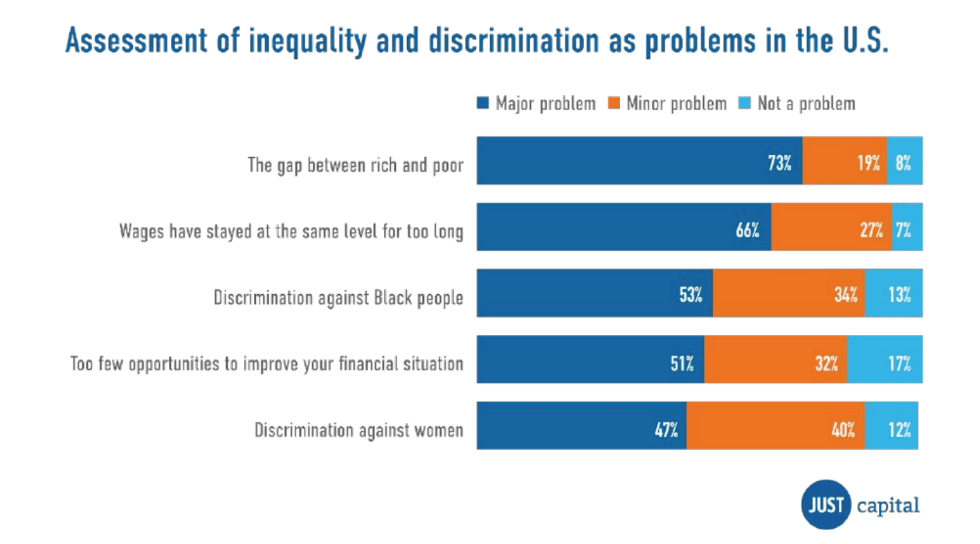
A significant majority of Americans (close to 75%) view the economic disparity between the wealthy and the less affluent as a critical issue, and their concerns are well-founded: income inequality ratios between the highest and lowest percentiles have been steadily rising over the past five decades. Americans have thus an informed sense that there is a misalignment in the proportion of exorbitant CEO pay vis-à-vis lower-wage workers. Relatedly, a majority of Americans (66%) recognize wage stagnation as a significant issue, and slightly over half (51%) feel that there are not sufficient prospects to improve their financial status. Roughly half of Americans also recognize wage discrimination against Black individuals and women as significant problems.  

Figure 3: Assessment of the inequality and discrimination as problems in the U.S.

What can be done?: 

The CEO compensation issue needs to be addressed, and companies should consider limiting the pay of their top executives to prevent it from growing excessively. Such a cap could have positive effects on the workforce if the excess compensation is redistributed among them. A recent study by the Financial Times revealed that capping CEO pay could help alleviate financial insecurity among low-wage workers. For instance, if the top 110 publicly traded US companies were to set a $1 million limit on their CEO pay, workers in these companies could potentially receive an additional $400 per month

Lawmakers in seven US States are collaborating to propose higher taxes for wealthy individuals and corporations in their respective state legislatures. Many of the new proposals suggest taxing the overall wealth of the rich, not just their annual income. In 2021, ProPublica released a report based on leaked tax documents from wealthy individuals, revealing how they evade paying income tax. The report showed that, in some instances, the wealthiest billionaires avoid income tax altogether by accumulating wealth through stock and property ownership, which are taxed at lower rates than income. As part of his budget proposal last spring, US president Joe Biden introduced a 20% “wealth tax” at the federal level, which would apply to an individual’s total income, including growth in assets, such as stocks.  

According to Sarah Anderson of the Institute for Policy Studies, companies should not view measures to reduce income inequality as punitive, but rather as potentially beneficial for them. Anderson believes that narrowing income gaps can actually improve a company’s bottom line by motivating employees and ensuring they feel fairly rewarded. She suggests a fair ratio of 25:1, where the median pay at a company should be $200,000 if the CEO earns $5 million. Companies have the option to reduce CEO pay, increase worker pay, or pay higher taxes, which can then be used to address inequality in other ways. 

All in all: 

The message from the public is clear: corporate leaders, including CEOs, have a responsibility to address income inequality in America by prioritizing worker wages and financial sustainability. Nobel prize winner Joseph E. Stiglitz emphasizes that paying taxes is the first element of corporate social responsibility. 

To build fairer economies, it is crucial to ensure that the lowest-paid workers can meet their basic living costs. Americans believe that companies can contribute to this by raising their minimum wages to a decent pay. 


Sources: MarketWatch, Reuters, The West Australian, The Guardian, CNN Business, BBC, Financial Times, Institute for Policy Studies, ProPublica, Grenness, Tor; “The Impact of National Culture on CEO Compensation and Salary Gaps Between CEOs and Manufacturing Workers” in ResearchGate 

Hannah Ribeiro

Pedro Teixeira

Brexit delays shorten the fuse in Northern Ireland 

Brief context: the Troubles 

From the late 1960’s until the late 1990’s, the historically contested region of the United Kingdom, Northern Ireland, experienced decades of sectarian tensions and constant politically driven violence known by many as the Troubles. These conflicts were motivated by disagreements between the Protestant loyalists, who wished to remain a part of the UK, and the pro-secession Catholics, who fought for the union of Northern Ireland (NI) with the Republic of Ireland (ROI), resulting in the death of more than 3500 people throughout the years.  

In 1998, the Good Friday Agreement was signed, managing to attenuate the tension between the dominant protestant parties and the catholic minority. This settlement established a power-sharing government, in which the two sides served together, facilitated disarmament, and even abolished the border checks between NI and the ROI. Since then, Northern Ireland has made remarkable progress and, twenty-five years later, it was commonly understood that the former period of violence and instability was put behind in history. 

The Good Friday Agreement

Is this too good to be true? What happened since? – Brexit  

Recently, Brexit has thrown a wrench in the peace process: the twenty-fifth anniversary of the Good Friday Agreement has been overshadowed by the Brexit-related trade impasses, which prompted increasing doubts in the region’s hard-won gains. Furthermore, the newly set trade and border arrangements have brought discontent among Protestants, sparking newfound concerns and buried conflict

In Northern Ireland, about 56% people voted in favor of staying in the European Union, with the Democratic Unionist Party being the only major Northern Irish party to support the separation. The majority of votes were clear on their motives, since the EU was directly involved in the funding of reconciliation programs, amounting to almost 2 billion euros since 1995. 

Following the vote for Britain to leave the EU, many questioned what new agreements were to come regarding trade and customs, but one question in particular gathered the most interest and concern: What was going to happen between NI and ROI, to the only land border between the two separating blocks? The UK had two choices: either draw the border in the island of Ireland, returning to a hard border between the once in conflict regions and threaten the Good Friday Agreement, or draw it in the Irish Sea, effectively separating NI from the rest of the UK. Despite Boris Johnson claiming that there would be no checks on goods going from NI to Great Britain (GB), the government ultimately decided in favor of the latter, creating the Northern Ireland Protocol.  

Issues on the agreement quickly arose as it became clear that this decision was not supported by the NI’s Democratic Unionist Party (DUP) and the European Research Group (ERG) – a group of British Brexiter members of parliament –, criticizing what they understood to be too many checks and the continuous jurisdiction of the European Court of Justice over NI, pressuring the government for a renegotiation. Nevertheless, negotiations stalled for years, with successive governments failing to come to a resolution. It came as a surprise, therefore, when Rishi Sunak’s government announced that it had reached a deal with the EU in the form of the Windsor Framework

Democratic Unionist Party
European Research Group( ERG)

The new compromise established regulations for green lanes – goods moving from GB to NI, requiring only minimal checks – and red lanes – goods moving from GB and through NI to the ROI, requiring the whole range of checks imposed by the EU. Moreover, agreements were reached regarding the democratic deficit between the regions. Previously, NI was subject to not only present but also future EU regulations, with the understanding being that if the region would maintain access to the block’s single market, it would have to comply with its rules. Under the new accord, however, roughly 1700 pages of EU regulations would not be enforced in NI, meaning only some 3% “strictly necessary” rules would be applicable in the province. The deal also gives NI an emergency break option, the Stormont brake, under which changes to EU agricultural, goods, and customs rules can be vetoed by the northern Irish assembly if expressed “in a detailed and publicly available written explanation” why the rule has a significant impact on NI’s citizens’ everyday life. Under those circumstances, the rule would be suspended, and it would be up to a joint UK and EU committee to renegotiate the directive.  

Even after significant progress, both sides were seemingly unwilling to budge further. While the Sinn Féin Social Democratic and Labor Party expressed optimism, NI’s other major party, the DUP, expressed doubts, insisting there was “still some work required” as some concerns revolving the ECJ remained unattended. They were quickly joined by the ERG that said they would not support a deal that allowed a role for the ECJ. Ursula von der Leyen was also quick to clarify that the ECJ would remain the final arbiter of the EU law.  What role would the ECJ have if the Stormont brake were to be, in the eyes of the EU, unjustly activated, remains unclear. 

What comes next? 

If Sunak’s government can convince the EU to waiver the jurisdiction of the ECJ in NI and convince the DUP to agree to the new conditions, the deal would be finalized, and the issue resolved. Nevertheless, this looks extremely unlikely, as not only would the EU likely be adamant on the ECJ’s role to maintain EU rules and jurisdiction in place, but the DUP has historically given little concessions over their idea of complete separation of the UK from the European block of 27. This leaves the government with two options: scrap the deal – appeasing Brexiters, though leaving the issue unresolved, and irking along the way both the EU and the British public that are increasingly fed up with the Brexit movement – or move forward with the deal – effectively relying on the British labor party votes to approve it in the parliament, though irritating the other major political party – the conservative parliamentary party. 

As was the case for its two predecessors, many predict that the government will follow the first option. Nevertheless, if Sunak can break the trend, there is a chance for the deal separating the UK from the EU to finally reach its conclusion


Sources: HISTORY, Council on Foreign Relations, Intelligencer, NBC News, Associated Press News, BBC News, Brookings, Reuters, Customs4trade, The Guardian, European Commission 

Manuel Rocha

Madalena Zarco

Commons: Tragedy or Comedy? 

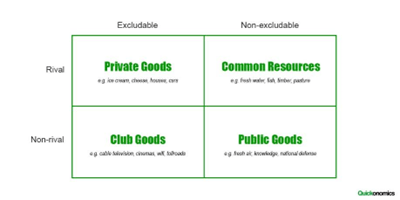
The four categories of goods, given their degree of excludability and rivalry

Definition “rivalrous and non-excludable goods”. Big words. And what do they mean, exactly? Well, let’s break it down. First, excludability: an excludable good is a good/resource that someone can bar (or limit the access to) other people from using. Second, rivalry. Despite the name, rivalrous goods are not the ones that lose their temper when their football team is losing. Rivalry simply means that if one person uses the good, someone else will either have less of the good to use or be unable to use it at all. Think of the shirt you are (presumably) wearing now: while you wear it, no one else can. Music, for example, is just the opposite – if someone is listening to a song, there won’t be any less of the same song for others to hear (unfortunately, in some cases). With these 2 characteristics, we divide goods into 4 categories: private goods, the excludable and rivalrous ones; club goods, excludable but non-rivalrous; public goods, neither excludable nor rivalrous; and the ones we will be focusing on, the non-excludable and rivalrous goods, the commons

So, common goods are the ones that everyone has access to (or at least it would be hard to block anyone from using them), while also being diminished with every utilization, that is, there is progressively less quantity available the more they are used. Now, you may recognize this description as the one of most natural resources: fish in the sea, mineral deposits, the shells at the beach…Consequently, it is easy to see the problem that arises from these characteristics: their sustainability

THE TRAGEDY 

The Tragedy of the Commons. Despite the rather theatrical name, it is neither a Shakespearean play nor a Mexican soap opera (we’ve checked). 

This Tragedy is an economic term coined in 1968 by Garrett Hardin to describe the phenomenon of over-exploitation of common-pool resources: users of the common good behave opportunistically, seeing the resource as “free”, since they cannot be excluded from it, so they reap all the benefits without taking in the costs, which ultimately leads to depletion.   

The extinct dodo

We do seem to have a tendency to explore every resource we can until thorough extinction (I mean, when was the last time you saw a dodo around?), with no regard for their long-term (or even short-term) sustainability. The rationale is rather simple: if it belongs to everyone, it belongs to no one, so you should be quick to grab as much as you can before it’s over. 

The problem with this is, as we’ve seen, the risk of depletion. And this is not merely childish or selfish behavior. This is, in fact, very standard rational economic behavior. Every user can be immediately better-off by taking more than what is sustainable to take, so they do it, until inevitably the resource is gone. Individuals have no direct incentive to behave sustainably. Sustainability is often in the best interest of a community, but not necessarily of a single person. See the problem?  

NEED A SOLUTION? ELIMINATE THE PROBLEM 

This is the standard economics’ layout of the issue – and standard economics presents a solution. Think of a small forest, of around 30 trees, and 3 lumberjacks. Every year, in the spring, the lumberjacks come and take down trees to sell the wood. Now, the forest is capable of regenerating: if they leave at least 3 trees standing, next year 30 will be there again (it’s a very mathematically exact forest). What would be optimal? Easy, right? Each lumberjack could take down 9 trees, and all could come back next spring to get more. But each one has an incentive to outperform the others, sell a lot of wood and get rich. So, each takes as many trees as they can, leaving none in the forest. How can we prevent this?  

The forest and lumberjacks’ metaphor

Whatever we do, the good will not magically become non-rivalrous, but we can do our best to make it excludable. In other words, if the problem arises from collective ownership of the resource, then the solution is surely to change that ownership form. One way to do this is to effectively switch ownership to the government, who then regulates who has access and how much of the resource can be consumed. In our magic forest example, this would mean passing a law stating that each lumberjack could take no more than 9 trees every year. 

It should be noted that this solution requires some form of enforcement – a surveillance authority to ensure regulations are upheld, as well as a penalty in case of breach of the system. These are usually provided, or at least legitimized, by the same governmental authority that controls the resource. 

Such top-down, centralized solutions suffer from certain inherent problems, namely rent-seeking (one entity trying to gain some profit without further contributing to the productivity of the system – like governmental officials trying to collect bribes from the citizens to grant them access to the resource), principal-agent conflicts (when there is a conflict of interest between the citizens and the agent meant to act in their behalf, like the government representative) and knowledge issues (the government may not be fully accurately aware of the needs of the population). 

If state control is not the ideal answer, then maybe we should go in the opposite direction: privatization. Maybe each person could be given a part of the resource to explore (say, each lumberjack is given a certain amount of trees), and trade between themselves, so that each gets the best deal they can potentially obtain. 

If state ownership is not the solution, how about privatization?

Unfortunately, this is not a perfect solution either. Besides the physical impracticability of dividing up some of these goods, there is again the issue of enforceability. Besides, this solution comes with a problem at the very beginning: each person is given a part of the resource to exploit – but… given by whom? Often enough, such a project of privatization requires a government taking control of the resource and then assigning its exploration as it sees fit. So, at its very core, this solution is not so different from the first. Both rely on a higher authority defining and enforcing regulations to limit the use of the common good. They follow a very simple logic: if commons are so tragically doomed, then our efforts should focus on tackling their core characteristics, what makes them common goods in the first place.  

So far, we have looked at the problem and formulated solutions assuming this is how individuals act when faced with a resource to share. But do we always have the behavioral standards of a preschooler? Thankfully, no. In fact (poor dodos aside), we are actually very capable of collectively managing common resources. 

OSTROM’S THEORY 

In 2008, economist Elinor Ostrom was awarded the Nobel Prize in Economic Sciences (becoming the first woman to receive it). The reason? Her breakthrough research on common-pool resource management.  

Elinor Ostrom

Ostrom took a different approach to the problem. Hardin had looked at common goods and their rivalrous and non-excludable nature and tried to explain their over-exploitation based on standard economic theory’s behavior predictions: people behave selfishly and without considering others or the future; therefore, the Tragedy is only natural. Ostrom, on the other hand, decided to start from observation, not from assumptions. And what did she discover? Examples, many in fact, of sustainable management of a common-pool resource! This real-life examination allowed her to arrive at a new theory. In all these successful cases, the management was done by the local communities! Yes, the solution was right there in the name all along.  

So, all we need to do is to leave common goods alone, trusting local communities to handle the matter? Great! Economics is so easy (…said any economics freshman right before their first midterm season…). The theory is, of course, slightly more elaborated.  

Ostrom laid down a set of conditions under which local community management – what she called management through collective action – of common resources can be optimal

  1. Define clear boundaries of the common resource 
  1. Rules governing the use of common resources should fit local needs and conditions 
  1. As many users of the resource as possible should participate in making decisions regarding usage 
  1. Usage of common resources must be monitored 
  1. Sanctions for violators of the defined rules should be graduated 
  1. Conflicts should be resolved easily and informally 
  1. Higher-level authorities recognize the established rules and self-governance of resource users 
  1. Common resource management should consider regional resource management 

Let’s think of what this looks like in the previous 30-trees-for-3-lumberjacks example: 

First, the community should clearly set down who the resource is meant for. By community, we mean the people who live and work within the ecosystem the forest in inserted in – a village where the lumberjacks live, the market they trade on. The group allowed to explore the resource is the lumberjack professionals – they are the ones who make their livelihoods from the forest. It should also be clarified how much of the resource can be taken, and the lumberjacks should take part in the rule making. The people in the village know better than anyone how the forest works: they know at least 3 trees must be left for the forest to regenerate, and have an interest in its sustainability, and the lumberjacks want to reap the benefits of its exploration. Besides, people are more likely to comply with rules they helped write themselves. Of course, the forest must be monitored, and if someone takes more than their share they must be punished by the community. But this punishment should be gradual – not immediately banning, but warning, sanctioning and informal social condemnation (the offender should feel ashamed to break the rules). If there is any disagreement regarding the forest, it should be able to be resolved quickly, in an informal way. The community should also feel assured that their rules will not be overturned by a higher authority. Lastly, they should remember that the forest does not stand alone. It is part of a larger system that should be had in mind, so that resources are explored in a way that does not hurt the rest of the system. 

CONCLUSION 

Common-pool resources management is a puzzling subject. They can be invaluable tools for the subsistence and development of local communities, or they can be consumed to extinction in a heartbeat. Ostrom’s Co-operative Collective Action Management Theory is a clever and helpful way to think about sustainability, one of the greatest challenges of our century. Her work proves observation and context are important tools for economic research, perhaps the most important ones.  


Sources:Investopedia, Wikipedia, Harvard Business School, American Enterprise Institute, Aeon, Corporate Finance Institute 

Leonor Cunha

Joana Brás

The Collapse of SVB: A Cautionary Tale for the Financial Sector 

Growing concerns on the stability of the financial sector 2023 has seen a wave of bank failures, from Credit Suisse in Switzerland to Signature and Silicon Valley Bank (SVB) in the United States (US). These recent collapses of prominent banks have sparked concerns about the stability of the financial sector, leading to a surge in Google searches for “financial crisis” not seen since 2008.  Given the already-present fears of a recession, the collapses only added to the public’s anxiety, shaking consumer confidence in the economy. While the situation is unsettlingly familiar, the uncertainty and fear of contagion remain daunting. This latest banking crisis highlights the potential side effects of financial disarray and underscores the need for swift and effective intervention to restore stability. To exemplify the bank failures and bankruptcy, this article will focus on the case of SVB.  

A perfect combination of events leads the “bank of start-ups” to collapse 

Known as the “bank of start-ups”, especially for those in the tech sector, California-based SVB was established in 1983, with the mission of helping “individuals, investors and the world’s most innovative companies achieve their ambitious goals”, counting as their clients start-ups and tech companies of the likes of Shopify or Insight Partners. In 1988, they went public through an IPO on Nasdaq and, in 2008, they went international. But how did a bank that was the 16th largest bank in the United States, reporting, in Q4 for 2022, $212B in assets, $342B in total client funds and $74B in total loans, collapse on the 10th of March? 

Silicon Valley Bank

The short answer to this question revolves around the typical suspect when referring to the failure of banks: bank runs, which are a self-fulfilling prophecy. However, in the case of SVB, it can be seen as a perfect combination of events which led to this disastrous outcome. The first motive can be linked to the Federal Reserve’s decision to increase interest rates to fight the increasing inflation rates, which are corroding American consumers’ purchasing power. This macroeconomic environment would lead SVB’s long-term investments in government bonds to be eroded as SVB had $21 billion invested with an average yield of 1.79%, as they had been purchased when interest rates were near the zero-lower bond. In comparison, currently, a 10-year Treasury bond has a yield of around 3.9%. Simultaneously, startups were raising fewer rounds of venture capital investment, due to the current economic environment, which decreased the amount of deposit inflows and increased the outflows. So, SBV’s cash decreased, such that the bank had a lower amount of resources to finance its operations. Consequently, in order to raise funds, SVB resorted to the sale of their government bonds. However, as they were yielding a lower interest than those that investors had access to if they bought directly from the government, this led SVB to sell a portion of said bonds at a discount to compete with the competitive market, resulting in a loss of $2 billion. The ultimate blow to SVB’s credibility would be the capital raise announcement, resulting in a generalised panic amongst SVB’s depositors, as more than 90 percent of them exceeded $250,000 in guaranteed Federal Deposit Insurance Corporation (FDIC). At the end of last year, according to the Wall Street Journal, SVB had over $150 billion in uninsured deposits. Fear led to large withdrawals, with depositors pulling out $42 million, in just one day alone. Consequently, SVB’s stock plummeted.  

To avoid a widespread panic and broader contention, despite appearing that SVB’s problems spilt over to Signature Bank, the government intervened in the form of California regulators shutting the bank down and placing it in receivership under the FDIC with SVB’s senior managers, including its CEO, Greg Becker, being removed. SVB’s collapse has been deemed as the 2nd largest in American history, only losing to Washington Mutual which collapsed in the 2008 Financial Crisis. Furthermore, in an unusual decision, the FDIC agreed to guarantee all SVB deposits, even those above the $250,000 per account threshold.  

SVB stock price performance month-to-date in US dollars
Annual nº of US commercial bank failures and total associated assets

What else is being done? 

Deputy Treasury Secretary, Wally Adeyemo, sought to reassure the public about the health of the banking system after the sudden collapse of SVB, in an exclusive interview to CNN, stating: “Federal regulators are paying attention to this particular financial institution and when we think about the broader financial system, we’re very confident in the ability and the resilience of the system”. In reality, the 2008 financial crisis prompted stricter regulations in the United States and around the world. In response, regulators imposed more rigorous capital requirements on American banks, with the aim of preventing the collapse of individual banks from having a ripple effect on the wider economy and financial system. 

Following the collapse of SVB, federal regulators acted promptly to mitigate depositors’ losses and restore trust in both the banking system and the broader economy. To achieve this, they put into effect a series of measures aimed at reassuring the public and bolstering confidence in the financial sector. The government introduced a program called the Bank Term Funding Program (BTFP) – a lender of last resort facility- which serves as a safety net for financial institutions. This program, which is backed by the Federal Reserve, provides loans to banks, credit unions, and other deposit-taking institutions in times of need. The loans can last for up to one year and enable these institutions to meet the needs of their depositors without having to resort to selling their high-quality securities at short notice.

Discount Window Borrowing

Another way the government relied on to regulate the financial industry differently was through a discount window, a facility that offers banks the option to borrow cash on a permanent basis, typically for short periods, such as a few days or weeks. From March 9 to March 15, borrowing at the discount window escalated from $4.6 billion to $152.9 billion, before declining to $88.2 billion by March 29. However, the decrease was mostly offset by augmented borrowing through the BTFP. 

Numerous banks overseas borrow and lend in U.S. dollars. Although foreign central banks possess the capability to print their own currencies, like Euros, Yens, and British pounds, to lend to their struggling banks, they do not have the authority to print U.S. dollars. In response to the Global Financial Crisis, the Federal Reserve initiated a sequence of agreements with foreign central banks, whereby it would exchange U.S. dollars for foreign currencies with other central banks. On March 19, 2023, the Federal Reserve announced that it would conduct daily swaps at least until the end of April to enhance the efficacy of the swap lines.

In the end, the FDIC’s race to find another bank willing to merge with SVB to safeguard unsecured deposits was successful as First Citizens Bank purchased SVB’s remaining assets, deposits, and loans. 

Conclusion 

Bank failures like this have happened before—there were more than 550 banks shut down between 2001 and the start of 2023. But this one was particularly newsworthy due to its dimension, being the second-largest bank failure in US history. 

There is now less anxiety about the stability of the banking sector due to the significant regulatory reforms put in place after the crisis in 2008 and the steps taken by the Federal Reserve following the collapse of SVB to improve confidence in the banking system and prevent future banking failures. The risks of broader contagion are thought to be limited for now but, even if a recession occurs, analysts don’t think it would be as long lasting as the Great Recession. 

According to Mike Mayo, a senior bank analyst at Wells Fargo, back in the prior crisis “Banks were taking excessive risks, and people thought everything was fine. Now everyone’s concerned, but underneath the surface the banks are more resilient than they’ve been in a generation.” 


Sources: The Economist, TIME, Silicon Valley Bank, Wall Street Journal, CNN, The American Prospect, CNN Business, Investopedia, Brookings, Expresso 

Hannah Ribeiro

Pedro Teixeira

Teachers: Fight for a better life 

Reading time: 6 minutes

Introduction

October 5th, 2022, marked the 112th anniversary of the implantation of the portuguese Republic, with the president and the prime minister attending the official Lisbon town hall ceremonies. This time, however, as a small protest of educators and instructors gathered near the country’s political power, attention began to rise for the day’s second vital symbolism – the world teachers’ day.  

Brief History:

The portuguese education system has been on shaky grounds ever since the 2008 financial crisis, with the government markedly cutting its funding between the years of 2011 and 2015, making Portugal the OECD country where teachers’ salaries dropped most significantly, and where the number of students per teacher rose most predominantly.  

Through the years, there have been significant uprisings over the teaching conditions in Portugal. 2013 saw high school teachers boycott the national student evaluation period, with direct repercussions on access to higher education, protesting against mandatory weekly working hours rising from 35 to 40. It was also a way to contest the delay in including teachers in the “special mobility” government program in which they would stop being allocated to a school district hundreds of kilometers away from their place of residence. 2018 also saw notable unrest in the streets of the capital, as educators demanded a renegotiation of their contracts that had been “frozen” ever since the beginning of the financial crisis, more than 9 years prior. 

While instructors’ teaching conditions have ever so slightly improved since the worst days of the budget crisis – with salaries finally being (partially) unfrozen, the firing spree coming to a close, and finally breaking the increasing number of students per professor trend – unsatisfaction remained strong. Most notably, as per 2016, Portugal was still below the education spending average of both OECD and EU countries.  

In what ended up to be a small gathering, the 2022 5th of October protest saw pre-school and primary school teachers advocating for a rehauling of the “Estatuto da Carreira Docente”, the set of regulations that governs the career progression, working conditions, and professional rights and obligations of teachers and educators in Portugal. Teachers, however, promised to increase the pressure. Not waiting for the end of the year, December 17th saw a staggering 20 to 25 thousand teachers from all across the country rallying, with “Teachers fighting are also teaching” and “Teachers united will never be defeated” phrases multiplying in the crowd. Calling for the chance for school principals to be able to choose their teaching staff regardless of professional graduation, the absence of service time count that has been frozen, and penalties on retirement after 36 years of service, teachers, under the “STOP” union, announced a strike “for an undetermined amount of time”

Current situation:  

Continuous discontent for the state in which the education system has been for years culminated in some of the biggest teachers´ protests in memory. In February, once more under “STOP”, an estimated 150 thousand teachers took to the streets to demand better pay and a more democratic and decentralized school management system.  

Teacher’s protests in Lisbon, February 2023

The uprising continued through March, in which thousands of teachers, under “Already, here we are again” banners, paraded in Lisbon in protest against government proposals for a new recruitment and placement regime and the lack of openness to negotiate old claims such as the recovery of service time. In what heavily focused on the precariousness of the teaching profession, known for the “carrying their houses on their back” slogan due to the frequent job relocations, even teachers’ children and students came to the rally in support.  

The struggles with the impacts of the strikes have led the ministry of education to request a formal assessment of the legality of the procedures of “STOP”. It was confirmed that, despite the previous warnings made regarding strikes being legal, the execution was, in fact, dubious. Furthermore, the “Procuradoria-Geral da República” (PGR) issued comments questioning the legality of the “self-service” strike established by “STOP”, claiming to have been an “abusive” practice. Teachers have challenged these claims and accused the ministry of education of depriving them of the right to strike and protest for better working conditions. 

Ultimately, these occurrences, coupled with the increased and continuous discontent of teachers for not having their needs met, have managed to amplify the already heightened levels of tension between the two parties, making any prospect of a resolution between the government and teachers appear increasingly remote.  

What are the social implications of the movements?  

As dimensions around the strikes and protests augment exponentially within the sector, opposing opinions and positions on the matter in discussion begin to gain force, in what could jeopardize its original cause. Some professionals working in the sector recently began to view the movement as “extremist” and disagree with the way labor unions have gone about their complaints, with many arguing it to be counterproductive. Opinions are evenly divided among the portuguese people, with studies conducted informing that half the population being sampled displays support for teachers, while the other half argues that the demands are unrealistic and excessive. 

The union societies in charge have, recently, announced strikes that can affect evaluation meetings, in which grades are discussed and attributed to students per trimester. This intensification is, mainly, due to the lack of concessions on the government´s side, namely to solve the issues regarding the allocation of teachers to schools.  

Thus, questions regarding the future of the education system arise: What are the implications for students looking to apply for a higher education degree? What about students in primary school who need to learn how to read and write? What about students with special needs? Inequality and compromised evaluations are at stake and, despite being sympathetic towards the cause, parents are concerned with the future of their children.  

To combat these valid concerns about the education system and on-going disputes, teachers agreed to strike during extraordinary hours of service and non-academic endeavors at schools. 

So, do teachers have a chance at having their demands met? 

A few days after the demonstrations, a big battle was won by teachers as the government approved the new regime for the recruitment of teachers and academic personnel which has been negotiated for at least five months. However, the primary goal of compensating educators for the career freeze endured for six years, having not allowed for career development, remains elusive

Upon the current public manifestation for better working conditions and job satisfaction among teachers, one additional concern comes to light: the lower academic pursuits for teaching positions.  

In addition to the decreasing engagement with the profession itself, these public disputes only strengthen the newfound priority for the government within its educational systems: find solutions for the lack of professionals – as reflected in the aggravation in the number of students without a teacher in at least one subject from 60 thousand to 80 thousand in October 2022. Therefore, both parties involved will need to tread carefully to not dispirit aspiring teachers and professors even more. Considering this issue, what demands may be met with the current discussions, and can they succeed in making the job more attractive for prospective future teachers? 

The government has not yet agreed to entirely make up for the frozen years in professors’ careers. This does not mean that the government will not support teachers, since it was already stated that the asymmetries caused by the instance are set to be corrected and two years will be compensated. Additionally, modifications in the recruitment process in schools will also be dealt with to target precarity among teachers and reduce the distance between home and the school in which they are allocated. There is still, however, much discontent with the measures and the strikes do not appear to see an end to the tunnel just yet

Final thoughts:   

The overall consonance is that the value attributed to teachers is below par. The demands for better conditions and support for teachers are seen as valid, as these professionals compose the first pillar of society. Unlike other professions, where lack of services can be countered with outsourcing of foreign employees or alternate closing of businesses, in the teaching market these solutions are not viable. Nevertheless, there is room for innovation in the sector, as demonstrated by the adaptive measures put into practice during the COVID-19 period. 

It should be of utmost importance to guarantee the continuation and satisfaction of workers within such an instrumental function of society. As Portugal remains in the tail end of most education indicators within the EU, from number of students per teacher to early dropout rates, the government should look at these massive protests with concern.  


Sources: Observador, SIC Notícias, FENPROF, Expresso, PÚBLICO, Diário de Notícias, Jornal de Negócios, Governo de Portugal 

Madalena Zarco

Manuel Rocha

Halfway: a look at SDG progress so far

Reading time: 6 minutes

Wouldn’t it be nice to live in a world with no poverty, no discrimination, clean energy, and peace for all mankind? Fear not, such a world is in the making! Well, at least in its planning stage… 

In 2015, the UN adopted the SDGs, Sustainable Development Goals, as a “universal call to action to end poverty, protect the planet, and ensure that by 2030 all people enjoy peace and prosperity”. Together they represent 17 goals, 17 areas of action, each interconnected, all contributing to power-sustained social, economic, and environmental development, particularly for those who are furthest behind. 

We gave ourselves 15 years to accomplish all of this. Right now, we are roughly midway through this ambitious deadline. How are we doing so far?  

Meeting the goals

The 17 SDGs are divided into 169 targets. Meet the targets, and we meet the Goal they belong to. Seems easy, right? Let’s take a look as to how much we have accomplished up until now… 

The question that now presents itself is whether or not we are currently up to date. Well, the truth is that when the goals were first agreed upon, no one thought of the possibility of a pandemic of the caliber of the Spanish Flu or the Plagues of many centuries ago imposing a worldwide lockdown and an almost total shutdown of the world economy. Oops. Or that one of the largest suppliers of grain in the world would be invaded by its neighbor with imperialistic tendencies, who happened to be the top energy supplier to several European countries. Double oops. Or that the Taliban would return, the USA would drop out of the Paris Agreement for a few years, or… You get the picture. The last few years have been filled with “once in a lifetime” and “unthinkable” events, that, due to their unpredictable nature which has made them unable to be accounted for in advanced, have hindered progress in an already superhuman task. 

Every year, the UN releases a report reflecting the respective SDGs’ progress. Unfortunately, the 2022 report has some not-so-fantastic news… 

Checking the numbers

Progress on each Goal, and on each of its individual targets, is tracked by 232 unique indicators, whose new version was launched in 2018. If we want to know how far down the road we are, those are the numbers we should be looking at. 

According to the previously mentioned Sustainable Development Goals Report of 2022, the COVID-19 pandemic was the event that had the greatest impact on the progress in all SDGs. And, of course, largely not in a positive way.  

Take the 10th SDG – Reduced Inequalities, for example: The pandemic caused the first increase in between-country income inequality in a generation! Indeed, for the first time in this generation, the gap between rich and poor countries widened, instead of decreasing, as it had been the pattern in the past years. Between 2017 and 2021, inequality in country incomes rose by 1.2%, while the projection with no COVID would have been a 2.6% decrease. Another 4 years of progress were wiped out in the 1st SDG – No Poverty. 2020 marked the first time in the 21st century where the working poverty rate actually rose, from 6.7% to 7.2%. It may not seem like a big change, but those tiny 0.5 percentage points represent 8 million additional workers who crossed the line into poverty (close to the current total population of Portugal!). To add to the problem, widespread high inflation, coupled with the Ukraine War, are most definitely not helping the recovery, with many significantly sized economies having been affected due to a large dependency on Ukrainian grain and/or Russian energy. The Russian invasion threw Europe and its surrounding areas into disarray, sending waves of repercussion throughout the world.  

If poverty rates are not doing well, it should come as no surprise that world hunger is following in its path. Hunger is particularly troubling in young children. Have you ever heard of stunting? It is the impaired growth and development of children due to malnutrition, meaning that a child simply does not have enough food to adequately grow, bearing lasting consequences in health and cognition. In 2020, 149.2 million children under the age of 5 suffered from stunting. The SDG agenda aimed at a 50% reduction in this number by 2030 – that appears to be an impossible feat unless the rate of decline doubles, which, given rising food prices and inequalities, doesn’t seem likely. Think of how this impacts the future. World Health (SDG 3 – Good Health and Wellbeing) will surely suffer, adding to the setback we already saw during COVID (which, as a disease, primarily impacted health). 

But let’s not be so gloomy! If the pandemic had such an impact, the solution should be as simple as directing all effort towards recovery, and reversal of the impact will follow, right? Unfortunately, it is not that easy. Efforts to recover economically imply a heavier reliance on cheap energy, resource exploration, and production, much of it highly polluting. In 2021, as the economy re-heated, so did the planet: energy-related CO2 emissions were the highest ever. SDG 13 – Climate Action progress is stumped. Countries are not contributing the yearly 100 billion they committed to for climate action (less than 80% of the goal is met). And just because the world is recovering, it doesn’t mean everyone is doing so at the same rate. Progress on the 9th SDG – Industry, Innovation and Infrastructure is mixed: total global manufacturing caught up with the setback from the crisis, but Least Developed Countries (LDC) still haven’t! The Sustainable Development Goals seem to have been left behind amidst recovery efforts. 

But not all is bad news. The 17th SDG – Partnerships for the Goals, has seen some progress, although not in all fronts. Official Development Aid reached an all-time high in 2021 (largely from COVID-related aid). Internet access and use also saw a significant increase during the pandemic. Pleas and efforts towards Global Peace grew as well, although the balance for the 16th SDG – Peace, Justice, and Strong Institutions is largely negative: we are seeing the largest number of violent conflicts since World War II, thus reflecting hardly any progress towards peaceful coexistence. 

Is there still hope?

These news are definitely rough to hear. All the progress we were making, the difficult yet sure steps we were taking towards our ultimate goal of a better world, were wiped out in just a couple of years. So, one may start to wonder, is it still worth it? The SDGs were already immensely ambitious, and the setbacks of recent years seem to mean we will not be able to achieve them, and definitely not by 2030. Should we just give up? 

Hey, not so fast! Just because we’re falling behind, doesn’t mean we can’t finish the race. Setting a high bar means incredible high results, even if you never reach the mark exactly. The SDGs are not just a wish, they’re the standard the members of the United Nations hold themselves to. Even if we fall short of perfection, we have an obligation to continue to strive towards it. 

In 2015, countries committed themselves to improve the world. The task requires all citizens to embrace that mission, and the Sustainable Development Goals are the targets we should aim for to accomplish it. So go ahead. Spread the message. Act. Change the World. 

You can find the 2022 Sustainable Development Goals Report here.  


Sources: United Nations, United Nations Development Programme, OECD, Our World in Data, World Health Organization, SDG tracker.

Joana Brás

Leonor Cunha

Olympics Boycott 

Reading time: 6 minutes

Several sanctions have been imposed upon Russia due to the unprovoked and unjustified invasion of Ukraine a year ago, on the 24th of February 2022, which initiated the ongoing war that is estimated to have killed so far over 7,100 civilians and 200,000 soldiers. As a consequence, Russia has been the target of sanctions aimed at weakening its economy, such as the European Union’s ban on imports of oil and coal, on the export of ammunition and military vehicles, and on the SWIFT ban for 10 Russian banks, among others.  

With little over a year before the Paris Summer Olympics, a political question looms over the event: will Russian athletes be able to compete? At the beginning of the war, the International Olympic Committee (IOC) encouraged their ban from international competitions. However, more recently, this decision appeared to be partially reversed.  The IOC did in fact impose sporting sanctions on both Russia and Belarus, which included the prohibition of athletes of both nations to represent their countries – a decision deemed to be “non-negotiable” – but they would still be allowed to participate in the diverse competitions and events as “neutral athletes” – as justified through the following phrase: “No athlete should be prevented from competing just because of their passport”. As a response, Ukrainian president Volodymyr Zelensky stated that the terrorism could not be “covered up with some pretended neutrality or white flag”. 

On the one hand, 40 countries, including Ukraine, Poland and the United States, have adhered to the boycott of the Games if Russian athletes are allowed to participate. On the other hand, the IOC states that this action would be a violation of the Olympic charter, as it mandates the countries to send athletes and that “As history has shown, previous boycotts did not achieve their political ends and served only to punish the athletes of the boycotting countries”. A fact to remember is that the 2024 Olympics, under normal circumstances, would see the return of Russian athletes competing under the Russian flag, after their 2-year ban due to doping. 

The Olympic Games go all the way back to Ancient Greece, with the first written evidence being from 776 BC, showing the measurement of time in Olympiads – equivalent to the duration between each edition of the Games. Back then, they were held every 4 years to honour the god Zeus through various activities ranging from music and singing to the discus throw. However, they were eventually banned by Roman Emperor Theodosius I and were not revived until the 19th century. After several attempts due to the lack of coordination between countries, the first Olympic Games of the modern era, in 1896, would revisit its originating country, having been held in Athens. Through the link of sport and culture, the Olympic Games have as principle the construction of a better world through sport without discrimination, leading to the development of physical and mental qualities. 

Going back in time 

Athens, 1896 Olympic Games

Since then, the Games have developed throughout the years with women starting to compete in the 1900’s Paris Games. Yet, only in the London 2012 Games would women be able to compete in all sports of the programme. The 1904’s St. Louis Games saw the first known disabled person to compete, with the 1912 Games being the first to have competitors from all 5 continents. 1936 saw the Games being broadcasted for the first time, but, as a result of being held in Berlin at such a turning point in history, they ended up serving as a way to disseminate propaganda of the Nazi regime. Having been cancelled in the meantime due to two World Wars and postponed because of the COVID-19 pandemic, the upcoming Games are expected to take the stage in Paris next year. 

Politics & The Olympics 

Although the Olympic Games have been widely viewed as a success, uniting people from diverse nations to celebrate various sporting events, they have not been immune to controversies. Some critics have accused the Olympics of allowing politics to infiltrate what was intended to be a neutral environment, with territories such as China, Brazil and Russia leveraging the event’s favourable image to boost their own international image whilst often engaging in questionable human rights and environmental practices. More crucially, however, the Games have also had a long history of politically charged boycotts. 

Following the World Wars, the 1956 Melbourne Summer Olympics marked the first great challenge to the modern Olympics, as the first attempts to boycott began to rise, with states from Europe, Africa and Asia choosing not to send their athletes to the event. Protesting the Soviet Union’s quash of Hungarian attempts of independence, Spain, The Netherlands, and Switzerland skipped the event, eventually joined by Egypt, Iraq, Lebanon. At the same time, Cambodia was protesting the Israeli invasion of the Sinai Peninsula and the People’s Republic of China the participation of Taiwan in the global event as an independent country.  

Tensions remained high in the lead up to the 1964 Tokyo edition, as Indonesia mounted a competing sports competition for the emerging economies, GANEFO, calling the Olympics and the International Olympic Committee “an imperialist tool”. In response, Indonesia was temporarily banned from the IOC and GANEFO participants were barred from attending the Olympics. The Tokyo edition also marked the start of South Africa’s 28-year ban, following the country’s segregation policies and refusal to send multiracial teams to the event. The Cold War incited yet another wave of boycotts, as the opposing superpowers avoided each other’s Games, with a record 65 nations refusing to participate in the 1980 Moscow Summer Olympics, leaving it with the lowest number of participating federations in almost 30 years.  

Soviet gymnast rehearsing for the opening ceremony in the 1980 Moscow Olympics

Despite the numerous attempts, many still question the point of political challenges to Olympic participation as there has rarely, if ever, been a significant political shift as a result. Hungary only gained independence more than 30 years after the first boycott in their support, the Suez Canal crisis still happened, emerging nations eventually all embraced the “imperialist” Games and South Africa´s Apartheid still lasted for almost 3 decades in spite of their ban.  

Conclusion 

While many can agree that a protest in one of the biggest stages in the world can certainly bring awareness to these issues, most had already been widely covered by the media by the time the issue reached the sporting world. The efforts’ lasting impact, sadly, has only been leaving national athletes to wait for 4 more years to follow their dreams, and a permanent dent on the Olympic legacy. With the Russian-Ukrainian conflict on its first-year anniversary, and with the Paris 2024 Olympic preparations well underway, calls for boycotts have been rising once again. The question now raised is whether in an effort to show solidarity for the Ukrainian people we are letting history repeat itself by penalizing Russian athletes for the ongoing war their president has started.  


Sources: Statista, BBC News, Radio Free Europe/ Radio Liberty, International Olympic Committee, RTP, BBC Sport, NPR, Paris 2024, HISTORY, The New York Times, Britannica 

Hannah Ribeiro

Manuel Rocha

Xingjian Detention Camps – The dark side of China’s treatment of Uyghurs

Reading time: 7 minutes

In 2017, satellite images captured strange looking buildings in Xingjian, China, quite unlike any other typical infrastructure in the region. At first glance, they resemble schools or hospitals, but once we zoom in these images, high walls and watch towers are visible as well, exposing a much darker truth. Deemed by the Chinese government “re-education camps”, – after multiple attempts of trying to deny their existence – these more than 380 detention camps in Xingjian are estimated to be holding prisoner more than 1 million people.

Satellite image of one of the re-education camps

Who are the 1 million people detained?     

The Xingjian region has been under China´s control since 1949, after being independent twice for a short time. For centuries, it was known for its strong agricultural activities and trade, having been part of the silk road. Today, this region is responsible for the largest natural gas production in the country. 

In Xingjian live more than 11 million Uyghurs, a minority ethnic group of Muslims that have their own language and tradition and that culturally identify themselves with the surrounding countries of central Asia. 

Uyghurs in mosque

China views the religious beliefs of Uyghurs as extremist and separatist, using as an argument the terrorist attacks that occurred in 2013 and 2014, planed by extremist Uyghurs. For this reason, and rooted on a fear of losing the Xingjian territory to separatist Uyghurs, the Chinese authorities defend that the camps are a necessary tool to stop the terrorism and the separatist movements in the area. These assumptions are considered by the rest of the world as an unfair generalization that revolves on the denomination of all the Uyghur people as extremists. 

NYTimes reveled, in 2019, documents that exposed military orders coming from the Chinese government that incentivize Xingjian´s troops to act without mercy: “We must be as harsh as them”, “and show absolutely no mercy”, “Freedom is only possible when this “virus” in their thinking is eradicated, and they are in good health”. 

What is happening to the Uyghur community?

From Xingjian come all sort of accounts from the community, disclosing religious-motivated detentions, assaults, interrogations, and torture. Those who are sent to the camps are admitted and not just re-educated as claimed.

In social media, requests to find missing family members are multiplying and sometimes, when clamors become too loud to be silenced, the answer arrives in the form of a phone call from said missing family members, nervously asking to never being contacted again, fearing the repercussions.

Even outside the camps, the Uyghurs that are still free are yet being constantly monitored by security cameras in the streets with facial recognition and with QR codes in the entry of buildings and police stops being put in place applying to just this minority. 

In 2017, men were forbidden from using long beards and women from using the hijab, being also prohibited to teach their religion to children or give them names of Islamic origin. 

Uyghurs using the hijab and the police controlling them

In 2021, Uyghur women revealed that they are forced to use birth control as an attempt to decrease the numbers of the Uyghur population. Indeed, according to Association Press, the government subjects hundreds of thousands of Uyghur women to pregnancy tests, sterilizations and abortions. 

Restrictions on this minority´s freedom also include trips inside and out of Xingjian. Moreover, reports from civil servants and university students claim that they are forbidden from conducting many religious practices, such as fasting during Ramadan or going to mosques – which are being gradually destroyed in the region.

Having come across reports of ex-detainees, western social media channels have been exposing the practices used in the re-education camps, especially BBC. This in turn has gathered the attention of the Chinese government, which promptly accused the news channel of spreading fake news, blocking their broadcasts in the country, with the justification that they need to stop with their occidental propaganda.

Images of these camps that are shared inside the country are strictly controlled by the government. In the official government records the Uyghur minority appear happy, followed by the statement that the Uyghurs come to the camps by free choice, because they want to learn and work to achieve better economic status – a very different story from the one that reaches us from international media of the likes of BBC…

What is really happening inside these camps?

Firstly, Uyghurs are forced to learn mandarin – which is the least of their concerns. Among some witnesses that BBC gathered, one of them said: “After almost five months in the Karamay police cells, between interrogations and random acts of cruelty – at one stage I was chained to my bed for 20 days as punishment, though I never knew what for – I was told I would be going to “school””. 

Between these statements of ex-detainees, some of them reported having been victims or having witnessed systematic episodes of rape, sexual abuse, and torture. According to BBC, “An ex-detainee, Tursunay Ziyawudun, said she received injections until she stopped menstruating and was repeatedly beaten on her lower stomach during interrogations”. 

Protest in favor of Uyghurs

            Furthermore, an investigation of NYtimes revealed the existence of Uyghur workers being exposed to forced labor practices in some factories, such as in solar companies and in the production of face masks (“Chinese solar companies tied to use of forced labor”, “China is using Uyghur labor to produce face masks”).  

            All in all, the majority of ex-detainees is unanimous in their assessment and retelling of China´s approach to the Uyghur minority: “their goal is to destroy everyone”. 

Ripples in the rest of the world

According to a coalition of organizations for Uyghurs rights, one in each 5 items of clothing that we wear has its origin in forced Uyghur work. Besides, 20% of the cotton produced in the world comes from Xingjian, and 17 brands – amongst which we have Nike, Apple, Adidas, Coca Cola and Amazon – were accused of using this cotton on their products. 

 On the other hand, H&M showed some displeasure about the treatment that the Uyghurs are receiving, and the possibility of forced work being used in the cotton fields did not please the brand. China reacted to H&M immediately: a lot of Chinese websites have stopped showing the brand´s products, resulting in a loss of around 135 million euros for the company, just in the first semester of 2021.

China is not without allies, however, as 37 other countries postulated in a written letter their support in favor of China, vouching for the important role China plays in the international cause of human rights. On the other hand, a different position in regards to China´s treatment of human rights is expressed by the UK and Europe, that together with other 27 ONU member states, including the US and Canada, have taken a stand accusing China of genocide and promising not to stop fighting for this minority´s freedom. 

This conflict has resulted in sanctions from both sides. From China´s side, five European MPs were forbidden from entering Chinese territory. In response, Canada, the US and the UK have joined forces with the EU to apply sanctions against China and its allies.

The story of the youngest person arrested

Rahile Omer, detained in a re-education

Rahile Omer was only 15 years old when she was arrested by the Chinese authorities. The accusation process began when she was just 14, in Xingjian. Having been identified and classified by the security cameras in the streets as a “type 12 person” – someone connected to an existing police case – a target was set on the girl. According to police records, they found out that Rahile´s mother was serving six years in prison for disturbing the “social order”, after being accused of following extremist religion practices. By attachment, her father was deemed a “type 12 person” too, leading to his detention and subsequent admittance in one of the re-education camps in 2017. Assuming Rahile to be a dangerous person due to her connection to her parents, she was sent to a detention camp as well, at the mere age of 15. 

Conclusion

Last century, during World War II, the world watched as numerous atrocities were committed against a community because of their religious beliefs, different customs and appearance, and how they were imprisoned in camps where the majority would meet their end. Now, albeit in a different context, a similar pattern of discrimination against a minority is happening again in concealment, with mistakes from history being repeated. 

Unfortunately, this is far from the only case of discrimination of minorities and violation of human rights that is happening right now all over the world. In a way, globalization has brought about new challenges and setbacks, where global powerful brands and consumers are willing to close their eyes to various violations of human rights if it benefits them.

Can we call this evolution if there are still people being harmed because of their religious beliefs, way of living and exaggerated generalizations of the actions of a few to a whole community?


Sources: Observador, BBC, New York Times

Inês Pedroso