
Female Exodus: Why U.S. Women Are Leaving The Labour Market 

Reading time: 8 minutes

Since January 2025, more than 400,000 women have been leaving their jobs in the U.S., the steepest decline in over 40 years for mothers of young kids.  

A female exodus that is dangerously erasing years of hard-won advances women made, particularly coming out of the pandemic, when flexible work policies enabled unprecedented labour participation rates.  

Remote Work Trends And The Post-Covid Peak 

On the wave of lockdowns, in May 2020 pandemics pushed almost 40% of employed Americans into working remotely. An undeniable jump, if we consider that just 3 years earlier only about 9-10% of workers would be reported working remotely. Later on, as offices reopened, that number fell, dropping to around 5.2% by September 2022 for those working remotely due to COVID.  

However, remote work itself did not disappear. The pandemic left a mark in the labour market, as by early 2024 about 22.9% of U.S. employees were still teleworking. This shows how post-pandemic remote-hybrid work remained definitely more common than it was before, despite not reaching the emergency peak of 2020. 

Figure 1: Share of employment by gender in occupations that can be performed remotely. 
Source: U.S. Census Bureau and USDOL/ETA 

Flexibility, Remote Work, and Women’s Labour Force Participation 

Historically, women have been overrepresented in roles more adaptable to remote work, such as education, administration, and knowledge-based services. Thus, it is not surprising that when flexible work options arose, many women would capitalise on them.  

For both men and women, the possibility of working remotely decreased the likelihood of dropping out of work. But this effect was more visible for women. In fact, prime-age women’s labour force participation (ages 25-54) reached record levels in the U.S., hitting around 77-78% in 2023.  

Figure 2: Labor force participation of U.S. prime-age women (1982–2025), by age of youngest child. Mothers with children under 5 peaked at 71% in 2023, then dropped to 68% in 2025. 
Source: The Hamilton Project, Brookings. 

A Brookings analysis pointed out that since 2020 the group witnessing the fastest growth in labour force participation were those mothers with children under 5 years old. For most, indeed, remote and hybrid schedules created a bridge between work and family responsibilities, particularly also among highly educated or married women. Flexibility would not just retain workers, it actually unblocked participation from those groups previously precluded by rigid schedules.  

But numbers speak loud: nowadays, something is changing.  

Unaffordable Childcare and Caregiver Burnout 

What is happening in front of our eyes is a clear childcare crisis. The stress and pressure to manage both career and childcare leave women overwhelmed and exhausted. In the U.S., many women struggle to find affordable childcare in a country with one of the highest costs in the world, often 30% or more of an average family’s income.  

Figure 3: Cost of infant care as a share of median income across U.S. states in 2024. Darker shades indicate higher financial burden. 
Source: Economic Policy Institute, via CNN.
 

Instead, countries such as Germany and Estonia have subsidised childcare, pushing down costs to near zero for many families. But many American mothers feel they have little choice but to quit their jobs. Similar story in the UK, where a recent survey has revealed that 43% of mothers revealed they had considered leaving their jobs due to childcare expenses.  

Years of underinvestment and the end of expiration of pandemic-era subsidies are leaving American childcare supply in crisis. Women who have fought for their careers are now forced to drop out to preserve their mental health and family well-being.   

Return-to-Office Mandates and Lost Flexibility 

In January 2025, President Donald Trump ordered federal employees back in-person five days a week, despite many had remote work arrangements and some had even moved far away from their offices. Major private employers, such as Amazon and JPMorgan, followed the same wave.  

It’s not a coincidence that women’s participation in the workforce is falling as flexibility disappears, says Julie Vogtman, senior director of job quality for the National Women’s Law Center. 

Yet, return-to-office policies are not proven to make companies more productive. For instance, one 2024 study Van Dijcke, Gunsilius, and Wright of resumes at Microsoft, SpaceX, and Apple found that return-to-office policies led to an exodus of senior employees, which posed a potential threat to competitiveness of the larger firm. In other words, employers are losing talented workers, whose skills and institutional knowledge are difficult to replace. A talent drain that can even weaken the overall economy’s productivity and innovation.  

To worsen things, women don’t feel respected in some workplaces, perceiving a clear cultural shift. Many have reported feeling less valued at work, with few diversity initiatives and a post-pandemic reversion to old norms.  

It’s a pure storm of fading flexibility, harsher office demands and eroded support systems.  

A McKinsey research suggests that women are even more likely to take on a lower-paying job if it implies benefits such as remote working and flexible schedules. If this trend increases, it will leave women disproportionately affected.  

Furthermore, as women leave their jobs, the Trump administration is looking for ways to encourage women to get married and have more children, so as to slow down the country’s decline in birth rate.  

Global Perspectives: Policies Matter 

“The U.S. is the only advanced economy that’s had declining female labor force participation in the last 20 years, and a lot of that is because of lack of social safety net and caregiving supports” – Kate Bahn 

Globally, about half of all women participate in the labour force, with huge regional disparities persisting.
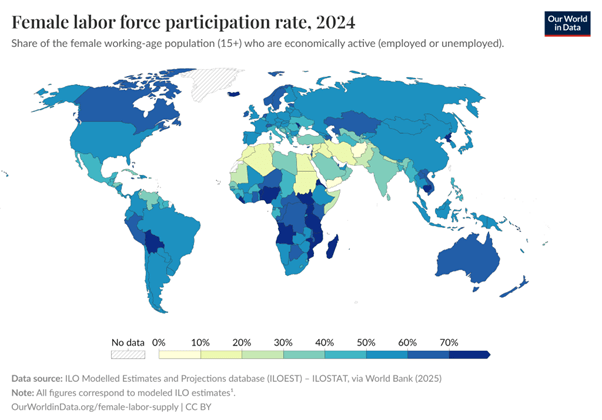
Figure 4: Female labor force participation worldwide in 2024. Darker regions show higher shares of working-age women in the labor force, with stark contrasts between regions like Scandinavia and South Asia. 
Source: Our World in Data (2025), ILO Estimates. 

Deliberate policies have allowed women’s workforce participation to rise or held steady in many wealthy nations. Nordic countries like Iceland and Sweden lead in female employment, with gender gaps among the smallest in the world and a women’s participation rate of around 63-70%.  

These countries differ from the U.S. as they heavily invest in affordable childcare, generous parental leave, and flexible schedules. Even the UK, Canada, and China have recently improved childcare subsidies or free preschool hours to push mothers to work. France and the Netherlands have high part-time options keeping women in the labour force, whereas Japan is pushing for “women economics” incentivising female employment.  

On the other hand, countries that like the U.S. lack supportive policies see women pressed to choose between work and family, a choice that an emancipated society shouldn’t have.  

Conclusion 

Women leaving the workplace is not merely a personal or isolated decision. We are talking about a systematic problem depending on a complex interplay of societal norms, organisational practices and individual circumstances.  

Factors such as work-life balance, career progression opportunities, social norms and expectations shape many women’s career decisions. Understanding the multifaceted nature of this trend is essential for designing effective strategies to retain and support women, ultimately benefitting the overall society and economy.  

Sources: Bureau of Labor Statistics; Time Magazine; Allwork.Space; The Washington Post; University of Kansas (The Care Board/CBS News); Brookings Institution; Federal Reserve (FEDS Notes); World Economic Forum; Institute for Women’s Policy Research; KPMG; The Economist; The Hamilton Project; The New York Times; McKinsey Global Institute; Our World in Data; Qureos; Return to Office and the Tenure Distribution, Van Dijcke, Gunsilius & Wright, arXiv (2024) 

Rebecca Fratello 

Writer
Risk Repriced: How Political Instability Reshapes Market Confidence and Sovereign Costs 

Reading time: 8 minutes

When Markets Look At Politics 

We are used to thinking of financial markets as driven only by economic principles such as inflation, interest rate expectations, and growth forecasts. In this context, politics is background noise: unpredictable, difficult to quantify, and irrelevant to asset pricing. Yet this perception increasingly misrepresents reality. 

Political developments have become central to how markets interpret risk, reprice assets, and allocate capital.  

Nowadays, headlines from governments regularly trigger revaluations. Political uncertainty is growingly emerging as a source of volatility and a key determinant of sovereign borrowing costs. Every new cabinet announcement, legislative halt or budget negotiation is a signal investors have to price, quickly and with little margin for error.  

The uncertainty about future government actions may have a dual effect on market prices. In rare cases, it may represent policy flexibility against shocks. But in the majority of cases, it may actually reflect growing doubts about institutional resilience and future fiscal tracks. 

The market impact is clear: as stock prices respond to political news, political uncertainty leads to higher equity risk premium, increased asset correlation and consequently lower diversification benefits. 

To better understand how political turmoil can flow into financial markets, we can have a look at the most recent case: France. 

The French Distress 

In October 2025, France dived into a serious political turbulence after the resignation of Prime Minister Sébastien Lecornu just one day after announcing his cabinet. It’s the collapse of the fifth prime minister in just two years, a statistic that points out not just instability but a deeper fracture in the French political system. 

Public surveys reveal despair, pessimism and distrust as the prevailing feelings in French citizens. Worrying symptoms representing the profound current democratic crisis, not even two years ahead of the next presidential election.  

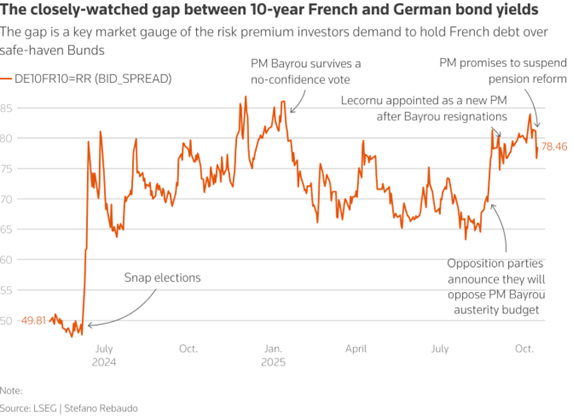
Financial markets, never known for patience but for how quickly they react, are clearly reflecting investors’ sentiment. Not surprisingly, French equity indices dropped, and bond markets did not do differently. For instance, yields on the 10-year French government bonds skyrocketed by 7-8 basis points, reaching around 3.58%.  The spread between French and German bond yields broadens as investors demand a premium for holding what they see as riskier sovereign debt.  

Figure 1: The yield gap widened sharply amid French political turmoil, reflecting rising investor risk premia on French debt. 
Source: LSEG via Reuters. 

The reason for this reaction? The answer is not that straightforward. No single event triggers the repricing by itself, but the clear loss of confidence in France’s fiscal policies plays an unequivocal role. The situation in France is getting complicated, both politically and economically.  

The general feeling speaks loud: France looks unable to find its way out of this malaise.  

Shifting Benchmarks 

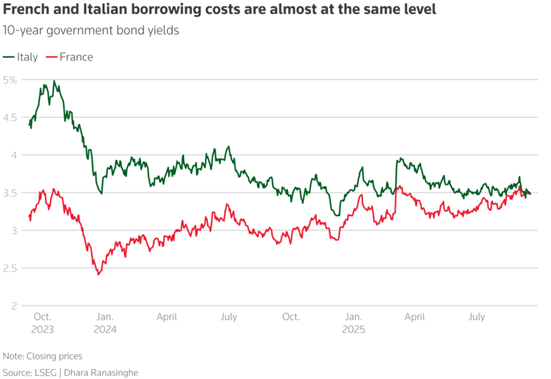
Historically, France was perceived as relatively safe within the Euro area bond markets. Italian bonds, instead, have been telling a different story so far. Yet, trends are changing.  

Figure 2: French (red) and Italian (green) 10-year government bond yields nearly converged in late 2025, reflecting France’s political turmoil (rising yields) versus relative stability in Italy (falling yields). Source: LSEG via Reuters. 

As French borrowing costs have risen, Italian yields have followed the opposite direction. This shows how perceptions around France, once considered a core market, and Italy, long seen as one of the weakest ones instead, have radically changed. Investors are concerned that France will not be able to improve its fiscal position due to its political instability, thus pushing up its bond yields. Different story for Italy, where relative political stability and downward debt forecast have caused its bond yields to decrease.  

But be careful. For some, the narrowing of the French-Italian bond spread has more to do with French fiscal and political distress than an improvement in Italy’s market.  

Italy has been afflicted by chronic problems that will take a long time to fix. We are still talking about the euro zone’s second-largest debt as a percentage of GDP after Greece, with a growth of the economy being obstructed by a concerning falling population and low female employment.  

Still, the convergence of French and Italian bond yields serves as a striking illustration of the implications of political stability and credible budgeting on investors’ confidence.  

Indeed, global investors nowadays look at governance quality in advanced economies pretty much as economic principles to adjust their required returns. 

Impact On Growth And Market Confidence 

Beyond market volatility, political instability carries important long-term economic costs. Empirical research on advanced economies has demonstrated that an uncertain politics can cause delayed investment decisions, hard policy execution, and undermined growth prospects. In fewer words, high levels of political instability can overall cause worse economic output. 

The reasons are pretty intuitive: when governments are fragile or policy direction is unclear, businesses and consumers lose confidence. Private sectors struggle to create expectations, while public institutions turn less effective in providing structural reforms.  

But as fragmented governments are not able to enact reform, public finances deteriorate. In France, the continuous change in leadership has paralysed the adoption of a new fiscal regime, delaying important decisions on expenditure and taxation. This creates a dangerous loop: as fiscal negligence decreases investor confidence, sovereign borrowing costs increase, which displace public spending, which in turn further constrains the ability to enact future reforms.  

France, for instance, has gone through five prime ministers in just two years, its national debt exceeding €3 trillion, and it seems unable to create a credible path towards fiscal balance.  

Figure 3: France holds the third-highest debt burden in the EU, after Greece and Italy, exceeding 110% of GDP. 
Source: Eurostat.

Globally, the political instability of an advanced economy as France can have both negative and positive spillover effects on other regions as well. On one hand, investors may require higher risk premiums also from other countries perceived as politically vulnerable. On the other hand, such instability may cause a flight-to-quality flows, as capital would flow towards safer bonds such as Germany Bunds or U.S. Treasuries.   

However, the coincident fiscal crises in multiple large economies, might result in a broader reallocation of global capital away from equities and emerging markets, thus potentially threatening global growth. 

Institutions such as the IMF and OECD have pointed out how political stability and consistent fiscal policies are not only priorities at the domestic level, but also the foundations of international market confidence and macroeconomic resilience. 

Conclusion 

What France is going through right now is not just a domestic drama. We are using this case as an understanding of what can be the costs of institutional fragility in a period of high debt and fiscal uncertainty. When governments and their reforms falter, consequences can be urgent: higher borrowing costs, downgraded credit ratings, eroded currencies, and constrained growth.  

If investors would once see political risk as background noise, now they price it in their models and we need to discuss it. The bond market has become a criterion of credibility, which rewards discipline and punishes obstructions.  

The message to policymakers is clear: good governance is capital. Stability, transparency, and consistency are no more mere abstract democratic values, but economic assets bringing yield. We are still in a post-pandemic context with high interest rates and insecurities, and policy incoherence is no longer tolerated. 

Preserving market trust is vital. Governments must now handle both budgets and expectations. Credibility can be the cheapest form of stimulus for those countries facing high debt and structural change. And as France is showing, once lost, it becomes the most expensive asset to restore. 

Sources: Reuters; Euronews; Financial Times; Fitch Ratings; Eurostat; LSEG via Reuters; IMF; OECD; ECB; Political Uncertainty and Risk Premia, by Lubos Pastor & Pietro Veronesi; European Journal of Political Economy; Political Instability and Economic Growth: Causation and Transmission, by Maximilian W. Dirks & Torsten Schmidt.

Rebecca Fratello 

Writer

Friendship and Social Capital

Reading Time: 5 minutes

Human Features as Capital? A brief history 

    In 1776, Adam Smith wrote, in An inquiry into the nature and causes of the wealth of nations, that “The acquisition of talents during education, study, or apprenticeship, costs a real expense, which is capital in a person. Those talents are part of his fortune and likewise that of society”. This idea might seem quite intuitive for an inhabitant of the world in the 21st century, and even the greenest economist would associate these words with the foundation of Human Capital.  

    However, until the last century, this concept was actually quite unpopular. As Theodore Shultz points out in Investment in Human Capital (1961), investment in human is not devoid of moral and philosophical issues. His words, “It seems to reduce man once again to a mere material component, to something akin to property”, are especially evocative, considering the 13th Amendment to U.S. constitution, which abolished slavery, had entered into force not even one century before.  

    With the advent of statistics and nation-level measurements in the period of WW2, researchers started to observe that increases in national output could not be fully explained by increases in physical capital. It became possible to link the accumulation of skills, capabilities and knowledge humans with these unexplained variations in growth.  

    Today, the World Bank defines Human Capital as “The knowledge, skills, and health that people invest in and accumulate throughout their lives, enabling them to realize their potential as productive members of society.” 

    But what aspects of the multifaceted human being are included in this definition? Reading further, the WB specifies: “Investing in people through nutrition, health care, quality education, jobs and skills helps develop human capital, and this is key to ending extreme poverty and creating more inclusive societies.”  

    Human Relationships as Capital  

      After accepting the “capitalization” of individual’s traits, a more recent step has been recognizing that humans are social animals, and therefore, their relationships are a fortune too. The concept of Social Capital generally refers to social relationships between people that have productive outcomes. In a nutshell, Portes (1998) explains it as “whereas economic capital is in people’s bank accounts and human capital is inside their heads, social capital inheres in the structure of their relationships”.  

      Social capital is for sure a peculiar form of capital: it does not reside in any individual entity, but it’s embedded in society, it lies in relationships, it’s rooted in networks. However, just like any other type of capital, it requires investment and maintenance to yield returns. 

      If defining the determinants of human capital is not an obvious task, defining those of social capital is even more challenging. The Institute for Social Capital indicates a range of dimensions including trust, togetherness, volunteerism, generalized norms, everyday sociability, and neighborhood connections.

      In essence, applying this theory, helping an old lady cross the street, having a neighbor who looks after your child when you’re sick, or trusting the police—all of these actions contribute to a web of reciprocity that will eventually benefit either the individual or the broader society. 

      Just as human capital was initially controversial, social capital was—and perhaps still is—a contested concept. For sure, its reputation increased after the publication of Making Democracy Work: Civic Traditions in Modern Italy by the political scientist Robert Putnam. Focusing on Italian regional governments, he found how government performance was strictly linked to traditions of civic engagement.  

      Friendship as Social Capital 

        Within this broader framework, friendship emerges as a particularly powerful and personal expression of social capital — one that not only supports emotional well-being but also shapes long-term economic and social outcomes. 

        If friendship is part of human capital, then it somehow has impacts that extend beyond the individual to society at large. And it might be more powerful than one can think. In a 2022 study on networks and friendships, Raj Chetty’s and colleagues found that education, racial segregation, education, and family structure were not as important as cross-class connections in determining upward social-mobility. In fact, among all observed components of social capital, friendship across socioeconomic lines was the only one driving mobility. Social cohesion and civic engagement, by contrast, did not seem to play a role.  

        The relationship between friends also shapes the social tissue of communities. In Bowling Alone, Putnam describes how American society, one strong and civic engaged, is now degrading through the whimsical metaphor of bowling. The evocation of many lonely bowlers, with a nostalgic comparison to bowling leagues playing together, reflects the individualist derive of society.  From this point of view, friendship and social interactions are a sort of public good, and not just a private comfort. The weaking of these relationships has consequences that go beyond individual loneliness, but undermine the health of society. 

        Relationships and Policy Makers 

          Friendships, connections, networks, and trust — they all contribute to both individual well-being and a healthier, more cohesive society. Yet we rarely hear politicians or policymakers address these topics directly. In an era where society is becoming increasingly individualistic, the case for investing in social capital becomes even more urgent. Urban planning, for instance, can be intentionally designed to promote cross-class connections and neighborhood friendships. The creation of public and recreational spaces that facilitate meeting and incentive people to socialize, promotion of sports and community strengthening activities can be impactful policies for boosting social capital. Reinvesting in friendships and ways of making them happen it’s not just about enhancing well-being, it’s a necessary step to rebuild a strong social fabric, that can sometimes be as important as and educated or healthy community. 

          Sources:

          Chetty, R., (2022). Social capital I: measurement and associations with economic mobility https://www.nature.com/articles/s41586-022-04996-4 

          Goldin, C. (2016). Human Capital. https://scholar.harvard.edu/files/goldin/files/goldin_human_capital.pdf

          Institute for Social Capital. https://www.socialcapitalresearch.com/literature/evolution/

          Putnam, R. D., Leonardi, R., & Nonetti, R. Y. (1993). Making Democracy Work: Civic Traditions in Modern Italy. Princeton University Press. https://doi.org/10.2307/j.ctt7s8r7 

          Putnam, R. D., “Bowling Alone: America’s Declining Social Capital” Journal of Democracy, January 1995, pp. 65-78. 

          Schultz, T. W. (1961). Investment in Human Capital. The American Economic Review, 51(1), 1–17. http://www.jstor.org/stable/1818907 

          World Bank: The Human Capital Project https://www.worldbank.org/en/publication/human-capital 

          Veronica Guerra

          Research Editor & Writer