A Modern Tale of Cultural Genocide

Uighurs are a Turkic-speaking Muslim minority from Central Asia. Most of them live in the autonomous province of Xinjiang, in China, while smaller communities can be found in neighbouring countries. Recently leaked Chinese government documents shed light on serious human rights violations performed on the province’s Uighur population, and on the high-scale brutal repression of minorities in China, notably regarding its “re-education” internment camps.


Historic overview

In 1933, Uighurs acquired their own nation, the Islamic Republic of East Turkistan, which would then be later taken over by Chinese forces. The province came under Chinese rule in 1949, following the country’s civil war and instauration of the communist regime. Even though it is officially “autonomous”, there is in fact no self-rule by its inhabitants, firmly controlled by Beijing as any regular province. Many see this as a form of “colonization” of the province and its population. Since its annexation, Xinjiang’s history has been marked by recurrent discrimination against its largest ethnic group, the Uighurs. Mao’s “Great Leap Forward” singled out both ethnicity and religion as obstacles to communist society. The regime prioritized Xinjiang’s economic development and incentivized  large-scale immigration of Han Chinese, China’s largest ethnic group, to the province. In 1949, the Han represented only 6% of Xinjiang’s population, whereas now it constitutes no less than 40%, according to Chinese official statistics. During the same period, the percentage of Uighurs in the province decreased from 72% to 46%.

The latter have been protesting since the beginning of Chinese rule, becoming more vocal from the 90s onwards. Economic discrimination favouring the Han Chinese as well as religious discrimination measures against Islam were at the root of the protest movements which escalated into violence. The recent wave of unrest begun in July 2009 with the Urumqi riots, the capital of Xinjiang, after the Shao guan incident, where at least two Uighurs were murdered by Han Chinese after the alleged rape of a Han Chinese woman by a Uighur. The riots resulted in 200 deaths reported by the Chinese, although independent sources claim higher numbers. In 2014, various terrorist attacks were blamed on Uighur separatists by the government, serving as a catalyst for the current phase of persecution.


Never-ending repression

Through excessive repressive policies, the government stripped the Uighur population of basic freedoms and human rights. Between 2012 and 2017, the security budget doubled in China, while it tripled in Xinjiang. The province became a “police-state”, monitored by one of the most restrictive and intrusive high-tech surveillance systems ever deployed by a state against its own people. The Uighur population lives in fear, constantly tracked through their phones or by facial and voice recognition cameras. More than being controlled, it is seeing its religion being crushed. The attack on Islam materializes itself in the ban of religious associated clothing and grooming, such as  headscarves and long beards,  halal food, and even  giving “Islamic-sounding” names to new-borns. Mosques have been closed or demolished. Religious instruction or speaking any language other than Mandarin at school is strictly prohibited. Uighurs are also victims of tight travel restrictions; their passports were taken away for “safe-keeping”. As their most brutal measure, Chinese government officials resorted to the unthinkable in the 21st century:  reallocating at least one million Uighurs into internment camps.


Area of new security facilities built in Xinjiang province, 2011-2018. Source: BBC

Area of new security facilities built in Xinjiang province, 2011-2018. Source: BBC


Inside the camps

China first denied their existence, but new information has come to light, making the truth irrefutable. Labelled by the Chinese government as “re-education centres” to “eliminate extremist thoughts”, these compounds could easily be prisons. Characterized by high-security features such as watchtowers, barbed wire, and guardrooms, they seem far from being simple schools. Masses of Muslims, including children, disappeared into these facilities which started being set up in 2017.

Why are so many being arrested? Most have been convicted of no crime or faced no trial. In fact, the mildest behaviour can lead to landing in a camp – a woman reported being arrested for as little as having WhatsApp on her phone – and performing any type of religious associated conduct, such as praying, risks getting you interned. Once inside, Muslims are forced to sing songs about the Communist Party, recite laws, and spend long hours studying Mandarin. They are reformatted to lose sight of their cultural identity. Living in precarious conditions, they wear uniforms and up to ten people sleep in the same room, not knowing when they will return home. The length of the “re-education courses” is getting longer and being released becoming rarer. Eye-witness reports from former detainees who managed to flee abroad, detail a non-stop routine of exercise, brainwashing, physical and mental abuse, and even torture.

Facilities also hold thousands of children, separating families. They are forced to speak Mandarin and wear the country’s traditional outfits. Although officials deny it, they are in fact aware of how family separation affects the children’s mental stability, as psychological training is offered in the facilities. Two of the things most central to Uighur culture – faith and family – are being systematically crushed. Accounts of family members disappearing without warning are widespread. Leaked documents reveal how the police should handle questions from students returning home. Policemen are advised to tell them they are in a “training school” from which they cannot leave. Students are also to be told their behaviour could either shorten or extend their relatives’ detention.


What is China’s goal?

The Chinese Communist Party regards any sign of discontent as a threat to both territorial integrity and the regime, claiming the “schools” are a response to decades of sporadic separatist violence from the Uighur population. Moreover, it claims the camps are a “preventive measure” – government officials claim they can predict who is likely to commit a crime, thus making the camps a tool to return the citizens as “law-abiding people”.

However, China’s strong grip on Xinjiang is also largely economically rooted. Home to most Uighurs, the province is not only rich in energy resources such as coal and natural gas, but it also at the centre of one of China’s most ambitious projects to date, the Belt and Road Initiative (BRI). A trillion-dollar spending plan, the BRI aims to strengthen trade, infrastructure, and investment links between China and an estimated 65 countries. Xinjiang sits on one of the main economic corridors of the BRI, so control of this region is crucial to its success, leading China to turn it into a high-tech police state and paint the Uighurs as a separatist and extremist threat.

Xinjiang map. Source: Bloomberg.

Xinjiang map. Source: Bloomberg.


International Response

Denying wrong-doing and urging foreign countries to stop interfering in its internal affairs, China has given limited access and insight to journalists and foreign diplomats as to what is happening in Xinjiang. However, international coverage, such as by the New York Times, or more recently by the International Consortium of Investigative Journalists (ICIJ), has exposed hundreds of Chinese government documents, increasing public awareness around China’s human rights abuse towards minorities. This resulted in an international outcry from the western world.  This past July, 22 countries including the UK, Germany, France, Japan and Australia, condemned the Chinese government’s actions and urged it to stop the repression against Uighurs and other minorities. In that same month, 37 primarily authoritarian countries wrote a letter to the President of the UN Human Rights Council and the UN High Commissioner for Human Rights expressing their support for China’s treatment of Uighurs, even defending Beijing’s remarkable achievements in the field of human rights”. Amongst these countries were many predominantly Islamic countries such as Saudi Arabia, Algeria, and Jordan. This perhaps surprising behaviour may be linked to fears of being left out of the massive infrastructure investments China has been financing across the world as part of its BRI initiative. Even Kazakhstan, the second-highest Uighur populated country, has supported Beijing, all in dread of economic repercussions from China.

The US House of Representatives has overwhelmingly passed a Uighur Human Rights Policy Act bill to counter the minority’s repression in China, calling on President Trump to impose sanctions on China over the human rights violations in Xinjiang. Furthermore, the release of the leaked documents led Secretary of State, Mike Pompeo, to call on China to “immediately release all those who are arbitrarily detained and to end its draconian policies that have terrorized its own citizens in Xinjiang.

China’s internment camps remain in many ways a mystery to the rest of the world, as a lot of their activities are still unknown. Uncertainty surrounds the future of the Uighur population, and the country’s large economic and political influence limits the efficiency of international action. Now aware of a cultural genocide happening right before our eyes, the western world stands powerless. For now.

Sources: BBC, The Economist, Vox, CNN, Wikipedia, Washington Institute, France 24, CSIS, The Guardian, The New York Times

#block-yui_3_17_2_1_1582539270461_35976 .sqs-gallery-block-grid .sqs-gallery-design-grid { margin-right: -20px; }
#block-yui_3_17_2_1_1582539270461_35976 .sqs-gallery-block-grid .sqs-gallery-design-grid-slide .margin-wrapper { margin-right: 20px; margin-bottom: 20px;

Culture, Language and Colours: How culture affects the decision-making process?

Have you ever thought about why we perceive Germans to be a precise people? Or why we consider the Chinese to be math geniuses? In a world where we tend to assume everyone thinks the same as we, members of the Western world, do, and ignore the potential effects of culture, you might be surprised as to just how powerful some of these small differences can be.


Most times, when we think about the decision-making process, we immediately think about the bounded nature of our minds. However, there are actually three sets of factors that have influence over our decisions.

They include (1) the features of the decision, (2) the situational factors and (3) the characteristics of the decision-maker.

The features of the decision concern how we are prepared to take them, how the situation is framed and how the options are ordered. The situational factors are related with time constraints, social pressure and other phenomena of this kind. The characteristics of the decision-maker include their age, gender, personality, social class and even their culture.

The first two sets presented are the ones that are discussed and studied the most, while the latter is sometimes ignored.


Culture has tremendous effects on many aspects of our lives,  even affecting some of the mental shortcuts we intuitively take. Therefore, it’s easy to realise the importance of understanding its impact over us. This is also  where it gets strange because, when we look at data, we realise that most research on decision making was made in Western countries such as the US: 96% of the samples in these studies come from countries that only represent 12% of the world’s  population. Moreover, the population of these regions live under special circumstances, their countries are democratic, and the population has high living standards and is highly educated. This enforces the idea that the samples we usually consider may not represent the entire world. This way, we are, in an implicit way, assuming that, cognitive biases are universal and operate in similar ways despite the different cultures, for instance. This is the reason why theories in cognitive psychology almost never consider culture as a factor. Again, we assume that the way we think is universal. However, recent studies might have shown the opposite.

Recent cross-culture research shows that culture can affect some of the most basic psychological domains such as visual perception, moral reasoning and self-concepts. Even though this kind of research is limited, it is proving itself to be extremely beneficial as it may allow us to unravel the deepest foundations of our behaviour.

It might seem natural to assume that people all over the world would perceive colours in the same way. Nevertheless, studies have found that colour categorisation may vary depending on the language – the way we formulate colour categories is connected with the linguistic terms used to describe them.

For example, the population of the Himba tribe (a tribe of around 50,000 people living in northern Namibia) have difficulties in distinguishing between green and blue, since their language only has one word for both colours. In contrast, another interesting example is tied to the way the Russian language has a different term for a lighter and darker tone of blue. This differentiation allows Russian speakers to categorise and distinguish colours faster than English speakers.


Another study has shown that culture and even age may affect even more basic aspects, like visual perception.

Image 1: The Müller-Lyer arrows

Image 1: The Müller-Lyer arrows

The Müller-Lyer arrows is an optical illusion where the line in the top arrow appears longer than the bottom one, despite both being the same length. The study found that the illusion is stronger to young American people and that almost disappear for the members of the San forager tribe (that live in the Kalahari Desert), for instance. A possible explanation for this is that American people tend to live in more urban areas, with straight lines, square corners and right angles, whereas forager tribes live in a more irregular environment. This greater exposure to rectangularity may lead Americans to be more susceptible to the illusion.

If simple things like colour categorization and visual perception vary significantly from culture to culture, what can we say about more complex psychological processes? Even though we do not have an answer, simple cross-culture studies found meaningful differences that question the way the world and our behaviour are perceived.  Their importance is increased when we consider that most of the samples- people from western countries- may represent outliers that by consequence ignore the profound differences created by our cultural context.


interculturel.jpg

The Renewable Energy Sources Act: From words to actions

Karl Marx once said that, until now, philosophers limited themselves to interpret the world; however, the goal is to change it. And change is necessary –human beings reached the current state of evolution due to their capacity to adapt and overcome.

Nowadays, people (or at least their vast majority) are concerned with climate change and all its associated consequences, such as the melting of ice caps, rising sea levels, the extinction of species, or still the increasing frequency of natural disasters. We’ve made estimates and we’ve searched for solutions–once again, we looked at innovation for a way out. Now, it’s our job to act rather than to react.

The fight against climate change must include a shift towards renewable energies. The possibility of substituting fossil fuels with energy harnessed from wind, sun, earth and water creates lots of expectations but also lots of opportunities. The problem remains, however, of how to make these energies accessible, cheap and efficient – and this is why the German example is worth highlighting.

In 2000, Germany launched the Renewable Energy Sources Act, or EEG (Erneuerbare-Energien-Gesetz), a set of laws that consisted in a feed-in tariff (a transfer made to households and businesses that use renewable energies to generate their own electricity) in order to ‘enable the energy supply to develop in a sustainable manner in particular in the interest of mitigating climate change and protecting the environment, to reduce the costs to the economy and not least by including long-term external effects, to conserve fossil energy resources and to promote the further development of technologies to generate electricity from renewable energy sources’ (Renewable Energy Sources Act, 2014). This scheme replaced the Electricity Feed-in Act (1991), the first green electricity feed-in tariff in the world that was contested by the European Court of Justice, who considered it an illegal threat to competition (article 87 EC Treaty).

Consequently, in 1999, Hermann Scheer and Hans-Josef Fell developed the EEG legislation. This law imposed on grid operators the obligation to prioritise the purchase of electricity generated exclusively from hydrodynamic power or wind, solar radiation or geothermal energy, instead of nuclear power, gas or coal. Besides this, grid operators should pay compensations to producers based on the technology used and quantity of energy purchased, giving producers a feed-in tariff with a duration of 20 years in which they could guarantee the return of their investment. The trick here, in order to avoid the same scrutiny by the European Court of Justice, was that, in contrast with the 1991 Electricity Feed-in Act, those payment were not considered public subsidies because they didn’t derive from taxation but from a surcharge on consumers that shared the expenses – so, there was no charge in Germany’s public finances. The EEG also foresaw a regular decrease in the feed-in tariffs (known as ‘degression’) as technologies became more cost-efficient.

The EEG legislation has been reviewed over the years and suffered some changes in 2004, 2009, 2012, 2014 and 2017.


IMPACT

Since the EEG legislation was enforced in 2000, the cost of photovoltaic systems decreased by 50% in 5 years. In relation to the coverage of renewable energy, the initial target for Germany was for 12.5% of its electricity production to derive from renewable sources by 2020. In 2007 it already covered 14.7%. In 2014 it covered 27.4% and in 2018 this value was at 37.8%. Currently, the target for 2050 is at least 80%. From data obtained from the period between 1990 and 2015, it’s visible that wind was the renewable source that most contributed towards Germany’s green transition in regard to gross generation of electricity.


gross generation of electricity by source in germanygross generation of electricity by source in germany

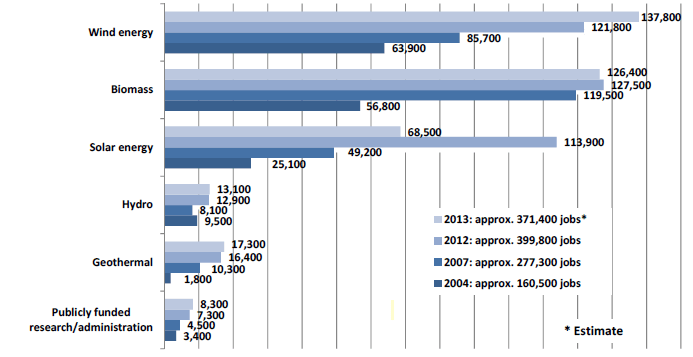
Besides this, thousands of long-lasting jobs have been created from these clean sources of energy – wind was the source that employed most people, more than doubling the amount of jobs created between 2004 and 2013, followed by biomass and solar. Usually, the abrupt transition to renewable energy leads to fears of some loss of jobs, which has strong impact on public opinion. However, the data shows that the transition to renewable energies demonstrates huge potential in creating more jobs than it destroys.


publicly funded research administrationpublicly funded research administration

Nowadays, in Germany, renewable energy can compete with fossil fuels, even when taking into account the cost of transport of such energy and the costs associated to the building of the infrastructure required for its production. In the case of renewable energy, the cost per kilowatt per hour depends on many natural factors, such as amount of wind and hours of sunlight, but they are all, on average, below $0.11/kWh, with onshore wind and geothermal being the cheapest (both $0.03/kWh), whereas biomass and offshore wind are the most expensive ($0.09/kWh and $0.11/kWh, respectively). Coal represents a cost of about $0.13/kWh and nuclear energy around $0.09/kWh.

This bet on renewable energy turned out to be very profitable for Germany. The cheaper production of energy allowed the country to be much more competitive in terms of electricity prices, until recently enforcing its position as a net exporter of energy over the years. France, Austria and Netherlands are the most common destinies of German energy.


ACCEPTANCE

The EEG legislation could be considered a social and economic success – it has increased the use of renewable energy while raising awareness about pollution, created thousands of jobs, and allowed Germany to become profitable in this sector. This success is further demonstrated by the attempt of other countries (as, for example, Brazil) to copy the feed-in tariff in order to accelerate their transition to renewable energies.

On the 8th of May 2016, there was a point during the day in which Germany was guaranting 87% of the energy being consumed by the entire country at that specific time from renewable sources. The production was so high that producers were obliged to offer free energy to consumers in order to drain the electricity.

However, the EEG is far from perfection and has been criticized many times to this day. The biggest grievance against this law was the high levels of feed-in tariff support. This position gained the support of the European Commission in 2014 (even though, until this day, the EC defends that ‘well-adapted feed-in tariff regimes are generally the most efficient and effective support schemes for promoting renewable electricity’) and led to some modifications in the legislation. In 2014, it was adopted what is known as the EEG 2.0., in which the compensation rates ceased being defined by the government to becoming defined through auctions.

This auction system was criticized too. In 2012, estimates pointed out that almost half of the renewable energy capacity in Germany was owned by citizens through energy cooperatives and private installations. According to the critics, the auction system would harm these kinds of producers, threatening all the development allowed by the original EEG legislation.

Today, Germany wants to obtain between 80% and 100% of the electricity consumed within its territory through renewable sources by the end of 2050. This path won’t be easy in a country where big coal plants are still the main source of energy, even after all those efforts of transition. In July 2019, Germany became, for the first time in almost two decades, a net importer of energy.

Once again, capacity to adapt and overcome is required.

#block-yui_3_17_2_1_1581875946965_36281 .sqs-gallery-block-grid .sqs-gallery-design-grid { margin-right: -20px; }
#block-yui_3_17_2_1_1581875946965_36281 .sqs-gallery-block-grid .sqs-gallery-design-grid-slide .margin-wrapper { margin-right: 20px; margin-bottom: 20px; }

The Russian Way of Taxes

…and the future of tax collection worldwide

Russia’s Federal Tax Service, by the hand of the agency’s executive Mikhail Mishustin, has revolutionized the tax administration and developed a technology that will presumably be the future of tax collection worldwide. It consists in a digital and real-time system, which allows Russian officials to receive the data regarding every registered transaction that occurred in the country within 90 seconds after it took place.

The phenomena of ageing population is pressuring governments around the globe, as it is substantially enlarging the expenses with healthcare, social care and pensions. Alongside, the major tech enterprises have been discovering the way of shifting profits around the world and avoiding corporate taxes. In order to tackle these issues and raise funds to face increasing expenses and decreasing revenues in the sector of direct taxes, the Russians have decided to bet in the collection of indirect taxes, mainly in VAT.

Value Added Tax, VAT, is a broad consumption-based tax assessed on the value added to goods and services. This tax is now present in more than 165 countries and represents approximately 20 per cent of all global tax revenues per year.

But, in two main areas, VAT is subject of fraud: firstly, some traders don´t pay the taxes they owe on their sales and go missing, leaving authorities without collecting what legally belongs to them; secondly, customers collude with sellers to buy goods and services without receipt, with the purpose of avoiding VAT being charged to the final consumer.


Mikhail Mishustin

Mikhail Mishustin

To overcome fraud, or at least its majority, and prevent tax evasion and corruption, Russia developed and establish cutting-edge technology. Every retailer had to buy a new cash register, linked securely to the Federal Tax Service’s data centers, and was obliged to register every single transaction. The technology, through the use of Artificial Intelligence, is able to find patterns and spot businesses’ suspicious activity, for example if companies are registering less sales than expected because they are making cash transactions off the record, and even monitor the tax officials and their collection rates to detect corruption. This system also enables the government to control the number of sales and the prices of goods and services and provides national statistics, being inflation one of the most important.

However, there is still the wish to extend the system to the informal economy. Individuals just have to sign up to a smartphone app and what they owe will automatically be deducted from their bank accounts. Tax officials are, of course, relying in the fact that most people want to be clean and don´t want to get in trouble with the government. Even though “The Russian way of taxes” has all the advantages mentioned above, it is actually more directed to shopkeepers than to oligarchs, as corruption is still quite present in Russia’s society. Yet, this policy helped raising revenues significantly and also helped cleaning the system.

The leader of the global tax consulting at EY, Chris Sanger, says: “The benefits of technology for tax authorities in indirect taxes may well overweight the problems it brings in the direct tax system”.

Like Russia, there were many other countries that adopted the real-time data in tax collection, with the intention of reducing tax evasion and corruption. Portugal was one of those countries, an early starter. The shopkeepers’ cash registers are connected to the tax authorities’ systems too, but Portugal added other incentives. If consumers add their personal tax number to the electronic receipt, they can get a 15 per cent deduction on the VAT paid from their annual income tax assessment as well as becoming eligible to win a monthly lottery, which price is usually a brand-new luxury car. Through this incentive strategy, consumers are more likely to pay VAT and so ensure that retailers do the same.


Chris Sanger

Chris Sanger


Although many consider this is the future of tax collection worldwide, others believe that this will never be possible to implement in more mature democracies, due to the principles of privacy and data protection. The public is quite skeptical to accepted immensely intrusive state technology. OECD is trying to draw core standards at least for its state-members, aiming at securing data and preventing it from being misused.

For reflection purposes, it is feasible to leave the question: Will people actually be worried about their privacy and their personal information or, in another way, are they worthy to claim these rights when they share their private lives with the big tech companies?

Misleading Business Improvement

A 15% growth from June 2018 to June 2019 may seem like a great deal for any food retail chain. At least if you are not in Angola, where inflation is a big component of the economy. Although this indicator is now around 17%, it reached a peak of 42%, between 2016 and 2018, according to Trading Economics.

When compared to the Euro, the Kwanza (Angola’s currency) depreciated almost 40% in relation to the previous year. In 2018, one euro bought 290 Qwanzas, whereas nowadays it buys around 395.

Given this, a 15% rise in nominal terms does not reflect an excellent real growth, which may in fact even be negative.

Bearing this in mind, are these growth rates in Angola that bad? 


The Angolan Civil War

The Angolan Civil War

To answer this question correctly, one has to travel back in time. Angola was highly affected by two main wars: the war for independence from Portugal in the 1960s and 1970s, and the civil war, which ended in 2002. During almost four decades of political instability, Angola’s economy was stagnated, remaining one of the poorest countries in the world, despite its abundance in natural resources.

At the beginning of the 21st century, the government reformed and improved social and political institutions and Angola’s economy started growing fast. Although with high inequality and corruption, its GDP grew exponentially, and Angola became one of the fastest growing countries in the world. However, its prosperity depended strongly on oil exports revenues, which are very vulnerable to changes in the international oil prices.

During the European financial crisis, developed countries slowed down their demand for petroleum. Coincidentally, during that phase, new oil sources were discovered, so its supply increased without any international entity watching over. For these two reasons, the price of a barrel of crude in the international market decreased abruptly and Angola’s oil export revenues halved.

The overall balance of the country started decreasing a lot in 2012 and became negative in 2013, which means that Angola was losing reserves and borrowing from the rest of the world. This is translated into a negative current account and a surplus in the financial account.

Consequently, since the end of 2014, the country is experiencing a recession, dragging thousands of businesses into bankruptcy.


On the one hand, during a crisis, people who lived with less than 1 dollar per day do not lose a lot of purchasing power, because they already had none. Moreover, the richest 20% who, in this country, hold 50% of the income, do not struggle. As a matter of fact, their fortunes usually increase.

However, on the other hand, the picture is a little bit different for the middle class. As Angola used to be a Portuguese colony, this class is made up mostly by Portuguese people inhabiting there, who are the ones balancing the economy. When the crisis hit its peak, around 200 000 expatriates returned home, decreasing Angola’s domestic product. In 2015, around 60 thousand work posts were extinguished, the majority being related to construction and oil exploration. It represented not only a great loss to the government (less money earned in visas, taxes…), but also to the private sector (less money spent in leisure, shopping, rents…).

One cannot stress enough this last one, since a one-bedroom apartment rent was around 5 000 dollars per month and the resident had to pay for the entire year in January.


Moreover, the informal sector constitutes a huge part of Angola’s economy. This is usually closely tied with poverty, yet this sector did not shrink during the economic upturn in the first decade of the century. Actually, this sector became more productive and started to cover various activities: from water supply to transportation. Some developing countries are so used to these kinds of markets, that a sales boost is highly noticeable when the country improves. For the past few years, during the oil exportation crisis, the informal sector remained. These are bad news for the retail business, since food and beverages are easy products to trade informally. In 2018, 80% of existing soft drinks were sold in these markets. 

To sum up, it is accurate to argue that reaching the growth rates aforesaid is pretty good.


Porto de Luanda

Porto de Luanda

This is true, especially when almost all of the food sold in formal markets in Angola is imported and travels by sea for 3 long months, so companies have to predict the client’s necessities well in advance.

When there is a problem with transportation, supermarkets simply run out of stock and rely on the sales of non-perishable products. This would not be an issue if the government made serious inroads against corruption, providing local producers with financial support, given that the country is known for its fertile soils and rich raw materials.

Will this picture change? 

According to the Corruption Perceptions Index 2018, created by Transparency International, an organization dedicated only to public sector corruption, Angola is one of the worst countries regarding this matter. The country assumes place number 165 out of 180, where number 1 is the cleanest country (Denmark) and 180 is the most corrupt one (Somalia). The failure to control this problem is affecting all Angolan taxpayers, including businesses.

Boosting sales, even in nominal terms, is an excellent achievement in a country where the majority of the population lives in one of the following two scenarios:

either they do not have a roof to sleep under or they travel on a private airplane to spend their money elsewhere.


18830768_770x433_acf_cropped.jpg

Sources:

  • Trading Economics

  • World Bank
  • Transparency International

Wealth: to tax or not to tax?

There has been a topic marking all the debates throughout America in the past few weeks: the proposals of two Democratic candidates, Elizabeth Warren and Bernie Sanders, regarding a tax on wealth. Their proposals, coupled with all the recent articles and book releases about rising inequality all across the world, has been the hot topic on top of the table (better said, on top of the House).


Bernie Sanders and Elizabeth Warren

Bernie Sanders and Elizabeth Warren

A tax on wealth consists of a tax on the net wealth a person holds – that is, their assets minus their debts. Assets may include, for instance, bank deposits, real estate, financial securities, personal trusts, jewellery, or even a Picasso Painting. However, according to Bernie Sanders’ proposal, this tax would only be applied to people with a net worth value above $32 million, whereas candidate Warren would impose a tax on wealth only for values above $50 million.

They believe this is a much-needed source of revenue in order to ensure public health care for every American citizen. 


There have been many countries adopting similar forms of wealth taxes. However, according to records, most of these countries have already dampened its usage. Only three out of the twelve European governments that implemented this tax in the 1990s continue relying on its revenues.

Furthermore, the numbers regarding tax revenue are not encouraging. The country that collects the most revenue from a tax on wealth is Switzerland, where its wealth tax revenue amounts to 3.1% of GDP. The other two countries, Norway and Spain, show really modest values, ranging between 0.2 and 0.8 percent of GDP.

The reasons provided by these countries are based on the fact that it is too costly to implement such a tax policy, due to the difficulty in assessing and evaluating the stock of assets each person owns, from personal effects and durable goods to future pension rights. Besides this, the OECD found clear evidence of the tax evasion and avoidance that is expected following the implementation of such policy.


Additionally, studies based on past experiences showed that, as this tax is calculated based on the difference between assets and debt, people were encouraged to borrow and invest in exempted assets and in assets that were hard for the government to identify. Farms and small businesses, artwork and antiques, forests and non-profit organizations are all examples of assets exempted from a tax on wealth.

The concerns of Senator Warren and other policymakers regard the ‘concentration’ of wealth in a small number of individuals. But the truth is that their wealth is mainly dispersed across the economy in productive business assets and, looking just at billionaires, only 2 percent of their wealth is accounted for by their homes and personal assets, such as cars, jewellery, and artwork.


Greg Mankiw

Greg Mankiw

Economist Greg Mankiw suggested a model in which there were only capitalists and workers. His findings showed that people should support taxes on wages, but not on capital. The reason is that the supply of capital is elastic or responsive to taxation – not entirely realistic -, such that setting a tax equal to zero would generate increased savings and boost investment. Consequently, worker productivity and wages would rise and, in the long run, the after-tax wages of workers would be higher under this policy rather than under a policy of imposing taxes on capital. From an average workers’ point of view, it is beneficial for the wealthy to maximize their savings and reduce consumption.


Still, the question remains:

How can we have a tax system that does not penalize beneficial wealth accumulation but also distributes the tax burden equitably? How do we ensure that the rich pay a fair share of taxes while simultaneously not discouraging savings? 

Many have been the countries and cities, from Chile to Lebanon, appealing and begging for a more equal treatment and more egalitarian policies from their governments. For the sake of social harmony, tackling this issue is as urgent as it is to reach a consensus regarding climate change policies. However, wealth taxes may not be the right way to achieve the so-called general equilibrium.


Sem Título.jpg

Sources:

  • Business Insider

  • National Public Radio

  • CATO Institute

China’s Grand Strategy: The Belt and Road Initiative

The acute awareness of a new world being knitted together has helped prompt plans for the future that will capitalise on and accelerate the changing patterns of economic and political power. Chief among these is the Belt and Road Initiative (BRI), President Xi’s signature economic and foreign policy, which uses the ancient Silk Roads and their success as a matrix for Chinese long-term plans for the future.

Since the project was announced in 2013, nearly $8 trillion have been promised to infrastructure investments, mainly in the form of loans to around 1,000 projects in 65 countries.

Some believe that the amount of money that will be ploughed into China’s neighbours and countries that are part of the BRI over sea – Maritime Silk Road – and land – Silk Road Economic Belt – will eventually multiply several times over to create an interlinked world of train lines, highways, deep water ports and airports that will enable trade links to grow even faster and stronger. In the meantime, the IMF issued a warning, in 2017, regarding the credit bubble, stating that the debt levels were not so much of a concern but rather a real danger.

China’s BRI was decided when the new leadership faced the combined pressure of the economic slowdown, US pivot to Asia and the deterioration of the relations with neighbouring countries after the 2008 Global Financial Crisis.

The continental economic belt focuses on the connectivity between China and Europe through Central Asia, and also between China, the Persian Gulf and the Mediterranean through Central and Western Asia. In addition, the maritime road aims to link China’s seaports to the South China Sea, the Indian Ocean and Europe.


1.jpg

The BRI’s five major goals are claimed to be: promoting policy coordination, facilitating connectivity, unlimited trade, financial integration and people-to-people bonds. The sectors in which the BRI has focused more time and effort are oil and gas, diversified industrial products and financial services, as shown in the chart below.


chinas belt and road priorities.pngchinas belt and road priorities.png

Dealing with the ‘new normal’

Serious challenges to the Chinese economy account for the most important drivers of the BRI. After the Global Financial Crisis and experiencing high-speed growth, the Chinese economy has slowed down since 2012 and entered the state of a ‘new normal’. China’s engine is cooling down, yet it continues to rack up one of the fastest rates of economic growth in the world. Given its enormous scale, this translates into substantial additions in absolute terms. In 2019, China added the equivalent of the entire Australian economy to its GDP. Nevertheless, the efficacy of China’s government stimulus has been waning.

Each renminbi of economic stimulus that the government pumped into the economy delivered less in actual GDP growth than in the past. The rise in ICOR (Incremental Capital-Output Ratio) – the amount of money the government needs to put in to yield a unit of growth – meant that economic stimulus was, in other words, getting more expensive.

china's gdp cooling.png


china credit squeeze.png

Two major problems that the Chinese economy carries, which can be partially solved by the trade generated from the BRI, are overcapacity and excessive foreign exchange reserves.

The problem of overcapacity is not only in labour-intensive traditional industries, such as steel and cement sectors, but also in the so-called high value-added emerging industries, including new energy sectors. Overcapacity has kept the growth rate down, which makes it urgent to find alternative oversea markets.

Excessive foreign exchange reserves were mostly caused by the large-scale stimulus package, as high as $586 billion, and further imbalance of the economy. The accumulation of excessive foreign reserves reflects worsening external imbalance, though it is also an upside factor to an emerging economy facing the risks of global adjustment. China’s foreign exchange reserve has rapidly increased to $4 trillion in recent years and about $1.4 trillion was invested in the purchase of US treasury bonds. Undoubtedly, this development is not sustainable and China’s economic leaders face severe political and economic pressure in tackling this issue.

In order to increase efficiency, China needs to find more exits for such large amounts of resources.

Studies made by Think Tanks such as the Asian Development Bank have shown that there is huge demand for infrastructure in Asian developing economies which is not largely met with existing multilateral and regional development financing institutions. It is believed that there is huge space for mutual cooperation between China and Asian economies on infrastructure investment, which is the reason why so many Asian developing countries have signed up for the two Chinese initiatives.


Debt vulnerability in BRI countries

As anticipated, BRI spans at least 65 countries with an announced investment as high as $8 trillion for a vast network of transportation, energy and telecommunications infrastructure connecting Europe, Africa and Asia. It is an infrastructure financing initiative for a large part of the global economy that will also serve key economic, foreign policy, and security objectives for the Chinese government.

Yet, important questions arise on sustainably financing the initiative within BRI countries and how the Chinese government will position itself on debt sustainability. Infrastructure financing, which often entails lending to sovereigns or the use of a sovereign guarantee, can create challenges for sovereign debt sustainability. When the creditor itself is a sovereign, or has official ties to a sovereign as China’s policy banks do, these challenges often affect the bilateral relationships between the two governments.

Even though China’s plan sounds like a brilliant idea to fix its own problems, it is not all sunshine and rainbows. There is a concern that debt problems will create an unfavourable degree of dependency on China as a creditor. Increasing debt, and China’s role in managing bilateral debt problems has already exacerbated internal and bilateral tensions in some BRI countries, such as Sri Lanka and Pakistan. Washington-based Center for Global Development raised serious concerns about 8 nations receiving BRI financing, namely Pakistan, Tajikistan, Maldives, Laos, Mongolia, Montenegro, Djibouti and Kyrgyzstan. These nations’ mounting debt to China puts their economies at risk of potential widespread default.

immediate+marginal+impact+of+BRI+lending+pipeline.jpg

In Sri Lanka, citizens have regularly clashed with police over a new industrial zone surrounding Hambantota Port. Many argue that Chinese financing has led to a debt trap in Sri Lanka where the Hambantota Port project performed poorly once it was operationalised, operating at a loss. Consequently, on December 2017, the Sri Lanka Ports Authority renegotiated a deal with China Merchant Port Holdings (CM Ports), where CM Ports injected $1.1 billion for an 85% stake and a 99-year lease.


chinese investment in the china-pakistan economic corridor.png

In Pakistan, Chinese officials openly appealed to opposition politicians to embrace the construction of the China-Pakistan Economic Corridor (CPEC), which is BRI’s ‘flagship project’ to bolster ties between Beijing and Islamabad.

The CPEC is the only corridor that links China to one single country – Pakistan, comprising an important trade route to China, particularly because of the country’s location between China and its energy suppliers in Africa and the Middle East, enforcing China’s huge energy appetite.

Pakistan may have taken more than what it was expecting when it took China’s loans. The country’s Prime Minister is fighting to keep the economy afloat and some are worried that Pakistan’s debt to China may ultimately hurt those efforts. The total value of CPEC projects is currently estimated at $62 billion.

The Belt and Road Initiative is President’s Xi’s most ambitious foreign and economic policy initiative. Much of the recent discussion has concerned the geopolitical aspects of the initiative. There is little doubt that the overarching objective of the project is to help China’s neighbouring countries become more closely tied to Beijing. However, there are many concrete and economic objectives behind BRI that should not be obscured by a focus on strategy.

Additionally, the lack of political trust between China and some BRI countries, as well as instability and security threats in others, are considered obstacles which have to be taken deeply into account when designing an action plan.

Finally, despite ad hoc approaches to the treatment of debt problems, there are some signs that Chinese officials are moving toward greater policy coherence and discipline when it comes to avoiding unsustainable debt.

Merkel – A Legacy Part I

In the last year and a half, Germany has been under two periods of a quasi-recession (a technical recession would happen if their quarterly GDP growth rate was negative for two consecutive quarters). But which long-term legacy will Merkel leave as Germany’s first female Chancellor?

German Legacy

A substantial number of Germans see Merkel as the saviour of the economy. Her economic reforms reduced unemployment to the low levels of the 1980’s, cut public spending and saw GDP grow by over a fifth over the past decade. However, her 2015 open borders policy was deeply unpopular in the eyes of her party’s electorate, many of which found refuge in the right-wing and Eurosceptic party Alternative für Deutschland (AfD), now the third-largest political party in the Bundestag and the main party of the opposition (the centre-left Sozialdemokratische Partei Deutschlands (SPD) is the second-largest party in the Bundestag, although it is not part of the opposition because it is part of the governing coalition).

According to a poll done in March 2019, 52% of Germans are satisfied or very satisfied with how Merkel is governing the country, but only 30% are pleased with what her government has achieved. The numbers are reasonably good for her centre-right party, even though it is polling 6.9% lower than in 2017 and 15.5% lower than in 2013.

To make matters more serious, if an election was to take place today, the current ruling grand coalition between CDU and social democrats SPD (both historically either the main opposition or governing party) would fall short of an absolute majority. The CDU, while still the favourite to win the general election of 2021, could have the worst electoral result in its history (31% in 1949). However, the decline in the opinion polls of Angela Merkel’s party is a consequence of the low popularity of her likely successor and current head of the CDU, Annegret Kramp-Karrenbauer, to whom polls attribute a 37% approval rating.

The other historical governing party, the SPD could have once again its worst electoral result ever (currently polling at 13%, below AfD) and, for the first time since World War II, no longer be either the first or second-largest party in the Bundestag.

To conclude, with only 30% of voters being satisfied by the work of the coalition, the political future of Germany is highly uncertain. This arises from the fact that the two political parties that have ruled Germany are expected to have all-time low results in the next elections, and also due to the resurgence of right-wing populism in the Bundestag.


Picture6.png


Picture2.png


Picture3.png

European Legacy

Merkel was seen by many, especially in Southern Europe, as the face of austerity. The hard-line enforcement of austerity measures may have popularized her in Germany, but in parts of Southern Europe, it helped fuel support for populist movements, such as the Italian coalition between the anti-establishment Five Star Movement and anti-immigration party Lega. In Greece, it led to the rise of the left-wing and anti-austerity party, Syriza. In Eastern Europe, Merkel’s policies regarding the migration crisis were heavily criticised and used by right-wing populists to gain support, such as in Poland or Hungary.

Picture1.pngtrg.png

Merkel is widely seen as a trusted politician throughout Europe. According to a Pew Research Center study from October 2019, 57% of people across the EU are confident Angela Merkel will make the right decisions regarding world affairs.

Macron is the runner-up, with 45% of people across the EU trusting his decision-making regarding world affairs. Another Pew Research Center study, dated from June 2017, concluded that 71% of Europeans have a favourable opinion of Germany. The Greek population expresses a different sentiment, where merely 24% of the population expressed a favourable view of Germany. The same research shows a plurality regarding Germany’s influence when it comes to decision making in the EU, with 48% thinking Germany has too much influence, while 44% think it has ‘about the right amount’ or too little.


Picture7.png


Picture5.png

Succession

Some see Angela Merkel as the last strong liberal leader in Europe and fear her absence could lead to a power vacuum that could have as consequence an increase in the influence of the current nationalist leaders in Europe. However, what this data shows, is that Merkel has established herself as a trusted politician for the majority of citizens in the EU. After 14 years as Chancellor of Germany and as the most powerful leader of the union, Merkel is nearing the end of her mandate. Although it is still uncertain who will take her place on the stage, what is known for sure is that the legacy built on 30 years of politics is hard to replicate or surpass.

On that account, independently of how positively or negatively Merkel’s legacy is judged either in Germany, in Europe or worldwide, the supreme question remains:

Is the next successor up to the task and able to fill Merkel’s Power Suits?


Picture2.pngyyh.png

part II


Sources:

  • New Yorker

  • TIME

  • Bloomberg

  • Telegraph

  • DW

  • Independent

  • New York Times

  • VOX

  • The Guardian

  • Infratest Dimap

  • Pewresearch

  • Spiegel

Article Written By:


Ana Catarina Salgado -
Catarina+Salgado.jpg

Ana Catarina Salgado


Christian Weber -
Christian+Weber.jpg

Christian Weber


Ana Maria Terenas -
ana.terenas.jpg

Ana Maria Terenas


Rui Ramalhão -
rui.ramalhao.jpg

Rui Ramalhão


João Maria Sande e Castro -
joao.sc.jpg

João Maria Sande e Castro

Merkel – A Legacy Part II

An unlikely politician with extraordinary political skills – this seems to be the best description of the long-serving Chancellor of Germany and the guiding hand behind much of European politics in the last decade and a half, Angela Merkel, ‘the Chancellor of the free world’ (Times’ Cover, Dec ’15). German Chancellor from 2005 up to this day, she is said to step down in 2021. It is not possible to refer to the 21st century European Union without mentioning the political accomplishments of Angela Merkel and the legacy that shall be historically memorable not only within Germany, but within all of Europe.

Political Ascendance

Despite being born in West Germany, Merkel grew up in the former communist German Democratic Republic (GDR). As a brilliant student, she graduated in Physics and holds a Ph.D. in Quantum Chemistry, later working as a researcher. Throughout her youth, no particular interest in politics was manifested.


Picture1.png

In 1989, the Berlin Wall fell, the Communist Bloc crumbled, and Merkel joined the small Democratic Awakening party, created in the GDR, taking her first steps towards her long political career. This party subsequently merged with the East German Christian Democratic Union (East German CDU) through which, following the first and only free elections in the GDR, she became a spokeswoman for the Prime Minister.

Finally, on October 3rd, 1990, Germany was once more reunited as a unified country, and so were the East and West German CDU. In the first elections, Angela was elected to the Bundestag (German Parliament), becoming Minister for Women and Youth, and later Minister for the Environment and Nuclear Safety. Rising through the ranks of CDU as a protégé of Chancellor Helmut Kohl, she won the party’s leadership after the loss of the federal government to the Social Democrats (SPD) and a donations scandal involving the party leader, Wolfgang Schäuble, in 2000.

After leading her party in opposition, she won the 2005 federal elections, defeating the SPD and incumbent Chancellor Gerhard Schröder, becoming Germany’s first female Chancellor.

Overcoming a Financial Crisis

One of the most defining events for Europe in the last decade was the 2008 financial crisis, which left many people jobless and took a heavy toll on the European economy.

In Germany, to alleviate the financial pressure felt by the automotive industry, which accounts for 5% of German GDP, Merkel introduced the Umweltprämie (Scrapping Bonus): by purchasing a new car and scrapping a used one, one would be granted €2500 by the government, as long as the used car dated at least 9 years.  The measure cost the German government €5 billion but brought a ‘breath of fresh air’ to the industry.

9d5fd978-7084-11e7-aca6-c6bd07df1a3c.jpg

With the imminent threat of Hypo Real Estates bankruptcy in October 2008, Merkel felt the need to act to avoid a mass hysteria that could result in large scale bank run. With this in mind, the Chancellor announced what later would be named by the media as the Merkel-Garantie, a deposit protection for German savings accounts, backed by the German government. The consequent bailout and eventual nationalisation of the German investment bank managed to appease the general public. Despite the opposition claiming this bailout was extremely irresponsible, it marked an end to the mass withdrawals of savings accounts.

Overcoming a Humanitarian crisis

Starting from 2012 onwards, a massive influx of asylum seekers, predominantly from war-torn countries in the Middle East, was recorded. This crisis peaked in the fall of 2015 with a recorded arrival of 890 thousand refugees during that year.


16764405_401.jpg

During the climax, Merkel decided, after consulting the Austrian and Hungarian Heads of State, to allow the entrance of unregistered refugees, mostly Syrian and Afghan, into national territory. Hereby she launched the Willkommenskultur (Welcome Culture), which promoted the integration of migrants and foreign culture in German society. However, Merkel faced strong backlash for this measure, even from her coalition partner Horst Seehofer, who did not approve of Merkel’s policies, instead supporting an upper limit on the number of asylum seekers entering Germany. Regardless, Merkel managed to withstand her critics and maintained an openness towards migrants, in contrast to most Heads of State across Europe.

From 2015 to 2016, around 1.5 million migrants were registered in the database of the German Federal Office for Migration and Refugees. This number only decreased in 2017.


timemagazine_poy_cover_750.jpg

Merkel argued on the importance of a homogenous Migrants Agreement for the EU, that should prioritize the integration of said refugees and speed up the process of the acceptance or denial of their request for international protection. Due to her stance on the refugee and Crimean Crisis, Merkel was nominated Times’ Person of the Year in 2015.

But which legacy did Germany’s current Chancellor leave its country?

part I


Sources:

  • New Yorker

  • TIME

  • Bloomberg

  • Telegraph

  • DW

  • Independent

  • New York Times

  • VOX

  • The Guardian

  • Infratest Dimap

  • Pewresearch

  • Spiegel

Article Written By:


Ana Catarina Salgado -
Catarina+Salgado.jpg

Ana Catarina Salgado


Christian Weber -
Christian+Weber.jpg

Christian Weber


Ana Maria Terenas -
ana.terenas.jpg

Ana Maria Terenas


Rui Ramalhão -
rui.ramalhao.jpeg

Rui Ramalhão


João Maria Sande e Castro -
joao.sc.jpg

João Maria Sande e Castro

The IKEA Effect

In a previous Behavioral Economics – related article (see article ‘The Power of $0.99’), we talked about what, and by which means, behavioral pricing strategies influence our brain. However, you might have realized that those strategies do not always succeed, especially when you are aware and start noticing them. It is important to understand to what extent we are sufficiently attached to a good or product, in order for that attachment to matter in our decision-making. It is equally important finding out why we value it so much. Michael I. Norton (Harvard University), Daniel Mochon (University of California) and Dan Ariely (Duke University), studied this phenomenon, naming it the IKEA effect.

In fact, it is fairly easy to understand that we give value to both things we make and to the completed end-products we buy. However, it may not be as easy to acknowledge that our neurology influences us to overvalue what we make, even if objectively it is not true. This is a cognitive bias dating way back in history.


One example puts us back in the 1950s, when cake mixes first emerged in common supermarkets. A high demand was to be expected, for a product of easy use that would facilitate every home baker across the world, saving precious time. However, in reality, the precise opposite occurred. In the process of understanding why people didn’t react well to such a time-saving product, it was discovered that consumers found it too easy. Unsurprisingly, marketeers went blue and struggled to understand why the product made people feel unattached. What they uncovered related exactly to this: attachment. Common, not-so-rational human beings give higher value to things they put a certain level of effort in. Following this theory, marketeers changed the recipe, requiring now that bakers add an egg to the mixture (instead of dried eggs being already included in the recipe). This led to an outstanding increase in sales, since the egg addition established an effort level sufficient enough to change consumers’ perception from being too easy to facilitating.

The big question lies in what that turning-point effort level is. It is a very difficult problem to solve, since its answer depends on the products, consumers and circumstances. Notwithstanding, this rationale is currently being used alongside behavioral pricing to spark consumers’ internal need for the companies’ products.


how-to-build-ikea-furniture-entity-1320x720.jpg

The IKEA effect name derived precisely from the extraordinarily intelligent strategy of the IKEA brand. By being an easy “build it yourself” brand, it captivates consumers’ attention for its products – even though it would be easier to buy already made furniture – regardless of the product quality. Buyers tend to view their IKEA furniture as theirs from the moment they spend time following the instructions and assembling the product themselves. The whole mechanism relies on personal investment in the creation that later tends to develop into a personal pride symbol that ultimately leads to an overvaluing of the final product. We might be aware or completely ignorant of this unconscious trick of our brains, but the truth is that we bake a ready-mix cake or build a ready-cut armoire and we take pride in it, giving us greater pleasure than eating or passing by the same readymade products. We smile when the cake is at the table or when we pass by the armoire in the living room. It is not related to our individual appreciation or gift for baking or building, it is in fact a general human bias.


In ‘The Upside of Irrationality’, Dan Ariely later discovered that we are largely unaware of this quotidian tendency and expect others to take as much awe in our cake as we do. It may be a paining truth to understand that others don’t think greatly of our cooking, designing, family, house, company or strategy as we do, but it is actually a very useful knowledge. Allowing this reality to sink in can be life-changing in the way that we look at our developed creations and subsequently it allows a more objective, real perception on them. The notion that our ideas are not always the most desirable to follow and the power of an objective perception are crucial for managerial success. Thinking greatly of made investments, even if they continually provide loss, can be an avoidable mistake through the recognition that not always our created and baked strategies are the most valuable ones.

An impartial and unbiased reasoning may lead us to understand that others’ ideas are not only not inferior, as they may be better adjusted for our current company operations.


IKEA-EFFECT-VALUE-MODEL.png

On the other hand, acknowledging that ‘greater effort ultimately leads to greater love’ (given that labour is successful) will encourage you to foresee relaxation over effort in completing your desired activities on the certainty that in the end you will be farming long-term satisfaction. In Economics, the labour market model leads us to believe that greater effort is the root of unbearable responsibility, frustration and stress, and that real happiness lies in immediate relaxation and no work. However, the human inheritance is to be proud of our deeds and accomplishments. Seeing a completed weekly objectives list makes us understand that all the sweat and tears given to that week’s work was why we felt the overall final enjoyment. 

Concluding with the same reasoning, it is often heard that the easy way is not always the best road to happiness and the IKEA effect came to prove it. The next time you feel like buying a cake, buy a ready-mix and complete it yourself, or the next time you need a new desk, take the time to assemble it. You might come to discover that you will take pride and a little bit of happiness from it, cherishing your success in a much deeper sense. At the same time, be aware that just like your valuing sentiment may not be equally perceived by others, our particular intuitions and ideas are not always the rational and most beneficial approach to the problem.

In today’s world, it is very difficult to be the best, but some strategies can make you feel the best while knowing it.


3053389-inline-s-4-this-innovative-new-ikea-logo.jpg
 

Check The IKEA Effect – Everything You Need to Know by InsideBE to find case studies and practical examples on how and when you should avoid this effect.


References:

  • Ariely, Dan; The upside of Irrationality; London; 2010;

  • I. Norton, Michael; Mochon, Daniel; Ariely, Dan; The “IKEA Effect”: When Labor Leads to Love; 2011; Harvard Business School;