The founding ideas influencing todays’ economic discussions 

Reading time: 8 minutes

The current mainstream economic ideologies are founded on very distinct views on economics and social interactions. From free markets to state ownership of the economy, there is an entire spectrum of ideas founded way back in the days that still deeply influence existing economic discussions.

In this article we go through the main figures behind some of the most influential ideas followed today, expressing their economic and social ideas and the arguments behind them. We also try to establish a bridge with periods in time where those ideas were put in practice thus providing some real-world examples.

Karl Marx and The Communist Manifesto

Karl Marx (1818-1883) was a philosopher, author and economist that became famous due to his theories about capitalism and communism. In 1848, Karl Marx and Friedrich Engels published The Communist Manifesto, his most influential book. Later, he also wrote Das Kapital where he states his labor theory of value that the value of a produced economic good can be measured objectively by the average number of labor hours required to produce the good.                                                                                 

Figure 1 – Karl Marx

Operating from the premise that capitalism contained the seeds of its own destruction, in the mid-19th century, Marxism was created, serving as a theoretical base for communism. Marxism is a social, political, and economic philosophy that examines the effect of capitalism on labor, productivity, and economic development and argues for a worker revolution to overturn capitalism in favor of communism. This theory believes in the revolutionary communism which inevitably happens due to the struggle’s existence between the bourgeoise (capitalists) and proletariat (workers).

According to Marx, every society is divided into social classes with different powers in society. As base for the Marxism theory there is a capitalist society which is made of two classes: the bourgeoisie, who control the means of production and the proletariat, the part which in fact transforms the inputs into outputs. The latter has little power in the capitalist economic system which means that in periods of high unemployment rate, workers will be replaced very fast, and, according to the profit maximization profit, business owners would want the best of their workers while paying the lowest possible wages. All these points would create an unfair imbalance in the society leading to the alliance of the workers and consequently to a revolution in which the working class takes control of the means of production and would dethrone capitalism (capitalism contains the seed of its own destruction) and private ownership of the means would be replaced by collective ownership, first under socialism and then under communism with no more class struggles. Society would then be run by a central committee that would allocate all the means and resources within the economy without the intervention of markets and the price system.

Marxism has developed over time into various branches and schools of thought, and currently there is not a precise, concise, and single definitive Marxist theory.

The Marxism-Leninism was the self-described ideology of many communist states in the second half of the 20th Century. The repressive political regime and famines that led to the deaths of millions of people in the Soviet Union constitute what is regarded as one of the great tragedies of the previous century. Supporters of Marxism argue that the economic ideology and that Stalin’s oppressive political regime can and should be separated, and that dismissing the Marxist critic of capitalism because of the tragedy of the Soviet Union is fallacious.

John Keynes and the Keynesian Theory

Figure 2 – John Maynard Keynes

In the 1930´s a new economic school of thought emerged that represented a complete break from the previous theories of the deemed “classical economics”. In the wake of the Great Depression, – a gloom period of the world economy marked by low output and high levels of unemployment – the existing economic theory proved unable to both explain the causes of the severe worldwide economic downturn, as well as provide a suitable public policy response to launch the economy back on track.                                                                            

Consequently, in response to this, British economist John Maynard Keynes (1883-1946) developed a new theory that claimed aggregate demand as the most crucial driving force of the economy, calling for the need for government intervention to stimulate demand, hence becoming the founder of what is now modern macroeconomics.

Keynes’s theory was greatly revolutionary for its era, focusing instead on the “demand-side” of the economy and the impact of short-run changes on output, employment, and inflation. In his book “The General Theory of Employment, Interest and Money” (1936), he refuted the then-prevailing notion that free markets would automatically adjust to business cycle changes in order to guarantee a return to full employment (i.e., a situation in which anyone who wanted a job would have been able to get one as long as they were flexible in their wage demands). However, he argued that, as the paradigm of the 1930´s showcased, high levels of unemployment persisted even though people were willing to work for any price, which could simply be explained by the fact that firms were not hiring at all. Indeed, in true snowball fashion, as consumer confidence eroded and uncertainty increased, firms (also plagued by fear and pessimism), responded in kind in a self-fulfilling manner, by cutting back on investment and in their unwillingness to hire people to produce goods that would not be sold due to the weak demand. As a result, the recession became even more pronounced, in the form of a further plunge of aggregate demand and unemployment.

Faced with this, Keynes defended that stabilization of the economy in these recessionary periods should be achieved through government intervention in the form of public policies aimed at reclaiming full employment and guaranteeing price stability. Indeed, in accordance with his belief that prices, and particularly wages, are not quick to respond to changes in supply and demand, he argued that active fiscal and monetary policies were required to reduce the amplitude of the business cycle and thus boost aggregate demand and fight unemployment, ultimately succeeding in pulling the economy out of its depression. For that to be achieved, Keynes advocated for countercyclical fiscal policies, reasoning that during economic downturns the government should incur in deficit spending to compensate for the drop in investment, therefore increasing its expenditures and lowering taxes to promote consumer spending.

An example of the influence of Keynes ideas can be found between the 1933 and 1937 when, following the Great Depression, President Roosevelt implemented “The New Deal”. The New Deal was program of strong government involvement in the American economy through increased public spending, through work programs that employed people in public infrastructure projects, and through the increased government support of unionization.

Milton Friedman and the Free Markets Capitalism

Milton Friedman, born in 1912, was the twentieth century’s most prominent advocate of free markets. In 1976 he was awarded the Nobel Prize in economics for “his achievements in the field of consumption analysis, monetary history and theory, and for his demonstration of the complexity of stabilization policy.” Before that, he had served as an adviser to President Richard Nixon and was president of the American Economic Association in 1967.
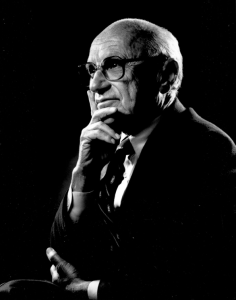
Figure 3 – Milton Friedman

In Capitalism and Freedom, Friedman made the case for relatively free markets to a general audience. He argued for, among other things, a volunteer army, freely floating exchange rates, abolition of licensing of doctors, a negative income tax, and education vouchers. His ideas spread worldwide with Free to Choose, the best-selling nonfiction book of 1980. This book made Milton Friedman a household name.                         

Although much of his work was done on price theory (the theory that explains how prices are determined in individual markets), Friedman is popularly recognized for monetarism. Opposing Keynes, Friedman presented evidence to resurrect the quantity theory of money, the idea that the price level depends on the money supply. In Studies in the Quantity Theory of Money, published in 1956, Friedman stated that in the long run, increased monetary growth increases prices but has little or no effect on output. In the short run, he argued, increases in money supply growth cause employment and output to increase, and decreases in money supply growth have the opposite effect.

Friedman’s solution to the problems of inflation and short-run fluctuations in employment and real GNP (Gross National Product) was a money-supply rule. If the Federal Reserve Board were required to increase the money supply at the same rate as real GNP increased, he argued, inflation would disappear.

Throughout the 1960s, Keynesians had believed that the government faced a stable long-run trade-off between unemployment and inflation (Phillips curve), and thus by increasing the demand for goods and services, permanently reduce unemployment by accepting a higher inflation rate. But in the late 1960s, Friedman challenged this view arguing that once people adjusted to the higher inflation rate, unemployment would creep back up. To keep unemployment permanently lower, he said, would require not just a higher, but a permanently accelerating inflation rate. The stagflation of the 1970s (rising inflation combined with rising unemployment) gave strong evidence for the Friedman view and convinced most economists, including many Keynesians.

Conclusion

The article discusses some of the main themes behind the most mainstream economic ideas, providing real-world examples for which one. Their ideas have persisted the test of time and influence economic discussion until today.


Sources:

Diogo Almeida

João Baptista

Sara Robalo

Inês Lindoso

João Correia
The Forgotten War in Ethiopia

Reading time: 6 minutes

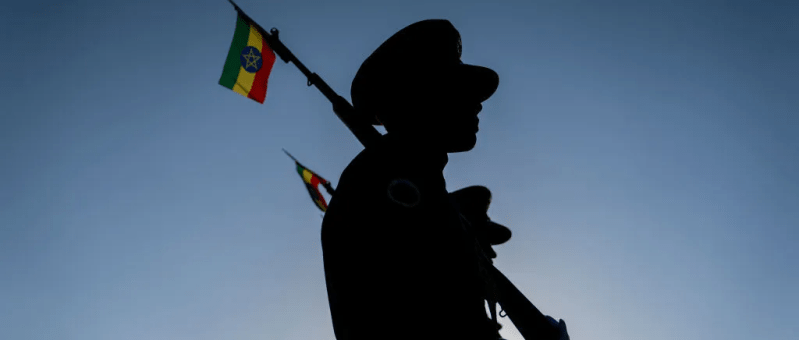
Being one of the few countries which have originally never been colonised by Europeans, Ethiopia has a rich history, one where many ethnic groups have coexisted for centuries together. This coexistence, however, has not always been peaceful. With over 80 different ethnicities living in Ethiopia today, the cultural differences within the country have caused a war in its northern regions which where historically inhabited by one of its many peoples: the Tigrayans. This war has a complex background which one must be familiar with in order to better understand the motivations that have led to its offset.

Recent History of Ethiopia and Tigray

The group at the heart of the struggle in Ethiopia is called the Tigray People’s Liberation Front, or simply the TPLF. It was founded by a dozen young men from Tigray, a mountainous northern region of Ethiopia, under the principles of Marxism-Leninism and national liberation and particularly as a force of rebellion against the Ethiopian state. Within 5 years, the TPLF grew steadily, aided by its ability to nullify other Tigrayan opposition and by the increasing dissatisfaction against the Derg, the military Junta that ruled Ethiopia at the time.

By the late 1980’s, the TPLF emerged as the leader of a political coalition formed by other dissident armed rebel factions called the Ethiopian People’s Revolutionary Democratic Front (EPRDF) and, on the 28th of May 1991, the TPLF troops, with the support of Eritrea, seized the Addis Ababa, Ethiopia’s capital. Thus, the Derg was overthrown and the 36-year-old Meles Zenawi, the TPLF and EPRDF president, became the leader of the country. This allowed the Tigrayans, a minority that today constitutes 6% of the Ethiopian population, to dominate its intelligence services and military forces.

Ethiopia and Tigray’s position in Africa

This new coalition government reformed the country by introducing an ethnicity-based federal state which saw the country develop rapidly with massive infrastructure investment and stable economic growth. In addition, the old Marxist-Leninist line was abandoned by the TPLF, as with the fall of the Soviet Union in 1991 the new government pivoted towards closer cooperation with the US. Nonetheless, there was still active suppression of dissident groups, which due to the state’s closeness to the US and the EU as an ally tended to be ignored by western institutions.

After Meles’ death in 2012, however, general dissatisfaction with the government progressively grew, especially among the two largest ethnic groups – the Oromo and the Amhara, comprising around 35% and 27% of the current Ethiopian population. Eventually, after years of protests, representatives of the two communities joined forces to remove the TPLF from power: their goal was to get Abiy Ahmed, of mixed Oromo-Amharic parentage, appointed as prime minister, which happened in April 2018. With his victory, the goal became clear: to drain the TPLF’s power and influence in Ethiopia.

In a short period of time TPLF officials were sacked from key security posts and generals were arrested with important changes being introduced to counter the Tigrayan dominance of the armed forces. Furthermore, old political prisoners who opposed the TPLF were freed from the secret prisons, exiled dissidents were welcomed home, many public enterprises were privatised and restrictions on the media were reduced.

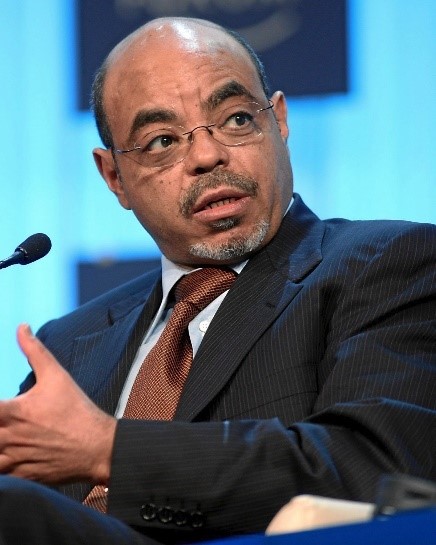
Meles Zenawi – former President (1991-1995) and Prime-Minister (1995-2012) of Ethiopia
Abiy Ahmed – current Prime-Minister of Ethiopia (2018-present)

In July 2018, Abiy Ahmed signed a peace deal with Eritrea, which was an important blow to the TPLF’s ambitions, as the old Meres government had previously engaged in conflict with the Eritreans. This deal won Abiy the Nobel Peace Prize since it not only ended the ongoing border-conflict between the nations but also allowed for the restoration of diplomatic ties and movement of goods and people between the two countries.

However, in the summer of 2020 tensions between the current government and TPLF had exponentially risen after their refusal to hand over wanted fugitives as well as to join the new political party set up to replace the old ruling coalition – the Prosperity Party. Furthermore, with the removal of Tigrayan military leaders from the federal army of Ethiopia many TPLF-influenced military battalions retreated to Tigray.

War Breakout

The increase in hostilities between the TPLF and the Federal Government lead to the war-offsetting events that occurred during the night of the 3rd of November 2020: the TPLF-lead militias launched a pre-emptive attack against multiple military bases of the Federal Government in Tigray, notably against the Northern Command Units of the Ethiopian army. The national officers and soldiers that were captured were assassinated by the TPLF militias, with the remaining troops fleeing to Eritrea causing enormous outrage across Ethiopia. It was this act of aggression that officially marked the beginning of the Tigray War.

Consequently, Abiy Ahmed’s government mobilized the Federal Army towards Tigray to try and pacify the region as soon as possible. However, less than five days into the war there were already multiple reports of ethnic killings: the Tigrayans claimed that they were being attacked by the Amhara military and the Amharas asserted that they were being targeted by the Tigrayan militias. Furthermore, on the 14th of November the TPLF fired rockets at different airports in Eritrea, bringing them into the conflict, causing more military forces to be involved in it.

TPLF’s 2021 summer offensive’s extent

Initially, it seemed that the Federal Government’s offensive had succeeded: they managed to capture Mekelle, Tigray’s capital, on the 28th of November 2020, along with the Eastern part of Tigray. However, the TPLF was able to recapture the capital on the 29th of June 2021 and they launched a vast offensive which saw them recapture most of Tigray and pushing south, seizing various Amharic cities in July.

In October 2021, the Ethiopian government launched a new offensive against the advances of the TPLF, managing to recapture the Amharic cities that had been occupied and leaving the TPLF controlled territories to almost exclusively the Tigray region. As of March 2022, this is believed to be the current state of territorial distribution.

It is also important to mention the humanitarian consequences of this conflict: over 400,000 people were thrown into famine, with approximately 2.5 million people, both Tigrayans and Amharas, being displaced of their homes in the first year alone. In Tigray, currently over 83% of the population has no food security, with many services, such as the banking and communication zones, being unavailable. Overall, it is believed that over 9.4 million people have been negatively affected by this conflict.

Rakouba refugee camp, which is housing people who fled the conflict in Tigray

A peaceful resolution?

It remains unclear whether a peaceful resolution is possible: the fierce fighting between both forces indicates that the cost of one force capitulating to another is great expenditure of military lives. However, the distrust that has been built over this year and a half regarding the accusations of atrocities and war crimes from both sides has resulted in calls for peace being barely acknowledged by the leaders of both parties.

Additionally, the introduction of a third-party mediator seems unlikely: whilst the TPLF lead-government used to be an important regional ally of the United States, Ethiopia’s recent integration into the Belt-and-Road initiative means that external geopolitical forces might already be influencing this conflict, preventing them from making an impartial assessment of it. Meanwhile, millions of lives will remain affected by this war, a war whose humanitarian impact cannot and must not be ignored. 


Sources: The Guardian, BBC, The New York Times, The Guardian, DW, Foreign Policy Magazine

André Rodrigues

Natalie Enzelmüller

Maria Mendes Silva

The climate-conflict nexus: Why armed conflict should serve as a wake-up call for global energy-security concerns in a rapidly changing climate

Reading time: 7 minutes

A few days after the Russian invasion of Ukraine, the Intergovernmental Panel on Climate Change (IPCC)  released what has been deemed as “the bleakest warning yet”, in relation to the current state of our planet (Guardian 2022). We have often learnt that the wars of the 20th century were the product of mad autocrats, dangerous ideologies, or the long-term effects of the failed colonial experiment. The past few weeks have confirmed that the 21st century, despite all its modernization and westernization of societies, and even with the unimaginable danger of nuclear weapons as a supposed deterrent, has yet to see an end to armed conflict. The new wars of the 21st century, whether economic or military, have increasingly positioned natural resources, such as coal, gas or oil, as well as access to them, at the centre of the conflict. In the face of a rapidly changing climate, it is crucial that we begin to assess energy-security concerns within a broader climate-conflict nexus.

First, let us briefly outline two broad environmental economic approaches in relation to the discussion of the climate-conflict nexus here. The neo-Malthusian interpretation would suggest that from a position of environmental determinism, natural resource related conflicts are the inevitable result of population growth, resulting in an increased strain on domestic security concerns (Kahl 2018). Such an interpretation must, nonetheless, be contested by a more critical neo-classical approach, in which it is not just the scarcity, but the actual abundance of certain natural resources that precede the outbreak of conflict (Koren 2018). In this instance, distinct attention must be paid to local political structures that continue to inform decision making behind the management of such resources. 

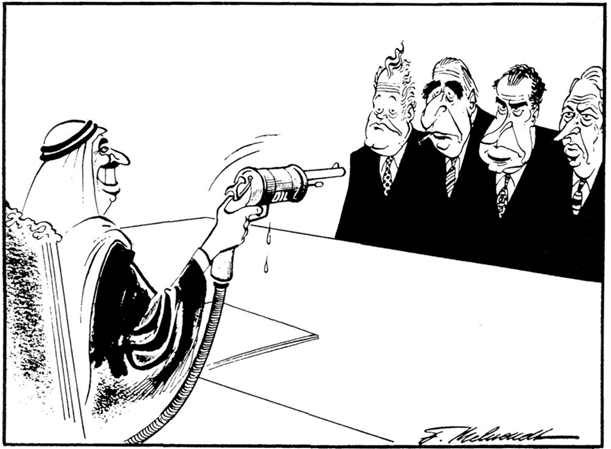
Figure 1: Western leaders blackmailed by OPEC during 1973 oil crisis” 1973 Cartoon by Behrendt on the oil crisis 
Source: CVCE

Policymaking in the west must face up to the increasingly alarming parallels between energy-security, associated with the access to natural resources for consumption (IEA 2022), and the risk of armed conflict. According to the United Nations Environment Programme, UNEP, around 40% of all interstate conflicts, over the last 60 years, have been related to natural resources, and the risk of conflict is doubled in the first five years (UNEP 2013). In the western world, energy-security concerns are generally manifested within the economic realm of sanctions or embargoes. However, in much of the developing global south, the harsh reality is that inter-communal and inter-state competition over resources has taken place in the form of violent conflict (UNEP 2013). To reduce the risk of emerging energy-security concerns becoming conflict threats, the west must transition towards more sustainable and alternative renewable energy systems in the medium and long-term, alongside diversifying more immediate short term energy requirements (Forbes 2022). History has taught us that major global energy transitions have often emerged from conflicts, such as the 1973-74 OPEC oil embargo. The latter resulted in new legislation for more efficiently run trucks and cars, a large reduction in oil as fuel in the electricity power sector, and new research into oil and natural gas alternatives (Forbes 2022). 

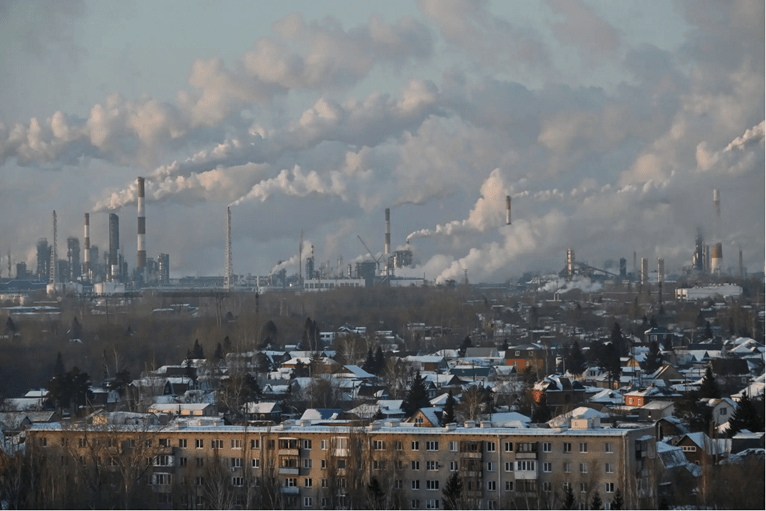
Figure 2: An oil refinery behind residential buildings in Omsk, Russia
Source: Alexey Malgavko, Reuters

Global energy-security concerns are of crucial significance in the context of global climate change, and the war in Ukraine should serve as a wake-up call for a more accelerated transition towards green energy, and departure from a dependence on fossil fuels. The current conflict has highlighted how fossil fuels can be used as both political and economic weapons of war, as demonstrated by the fact that Europe relies on Russia for 40% of its natural gas supply, or even America´s reliance on globally stable oil markets (Forbes 2022). Svitlana Krakovska, Ukraine´s lead climate scientist, who alongside her team was forced to exit the final review process of the aforementioned IPCC report, and instead head to a bomb shelter, believes the war is “a fossil fuel war” (Guardian 2022; Politico 2019). However, former energy advisor to Obama´s administration, Jonathon Elkind, has argued that “It´s a crude oversimplification to call this a fossil fuel war” (Guardian 2022), whilst still recognizing the significance of global oil and gas resources in the outbreak of the war. 

Though the conflict in Ukraine may not explicitly be a conflict over resources, the control over natural resources is increasingly at the forefront of contemporary geopolitical struggles, and climate change is serving as the invisible catalyst.

As argued by environmental correspondent Fiona Harvey, “Kremlin strategists are therefore keenly aware that in the longer term the global move to net zero threatens the whole basis of Russia’s economy and global influence.” (Guardian 2022). Climate change is forcing an extensive global change in energy systems. Russia, as a major global energy player, will surely be concerned about influencing such transitions, when considering that 40% of its federal budget is from oil and gas, comprising 60% of exports (Carnegie Europe 2022; DW 2022). 

Whilst armed conflict over resources seems to be a growing threat in the west, in many regions of the global south, it has long been a growing reality, especially in the regions that are the most vulnerable to the impacts of climate change. In 2007, Ban Ki-Moon, then UN Secretary-General, referred to the Darfur crisis and ongoing drought in Sudan as an ecological crisis and the “first climate change conflict” (Ki-Moon 2007). Such discourses often represent the relationship between climate change and conflict as one of direct causality. Contrary to a neo-Malthusian approach building on Homer-Dixon´s emphasis on environmental scarcity (Homer-Dixon 2010), it is not so much rainfall quantity but rather its unpredictability and uncertainty that has led to conflict in the region (Biasutti 2019). The same has occurred across the broader Sahelian Acacia Savanna, from Darfur to the Mopti River delta in Mali, where the early arrival of ethno-Arabic pastoralist herders on the land of ethno-African agriculturalist farmers, has resulted in violent conflict over recent years (Hiernaux, et al 2009). 

Reinforcing a neo-classical approach, the conflict also serves to remind us that, on a political level, weakened traditional political structures have also resulted in increased inter-communal conflict. In this instance, Dogon farmers have often found themselves backed by state policies through international funding, whilst Fulani herding communities have been left neglected, which in turn has resulted in heavy recruitment from emerging Islamist groups such as the Al Qaeda affiliated Macina Liberation Front MLF (Benjaminsen 2019; Raineri 2020).

Figure 3: A herder guarding his cattle
Source: African Center for Strategic Studies 2021

Long-standing cultural and political struggles may well be the most significant factors in the emergence of conflict in the Mopti river delta. Climate change, nonetheless, is indirectly accelerating the dynamics of these tense interactions through providing an added, and increasingly damaging pressure on the local farmer-herder environment and their resources. As with its growing influence on changing global energy-security struggles, relating to the conflict in Ukraine, climate change must be understood as an indirect, yet an incredibly significant player in the emergence of conflict in the Mopti region. Late last year the infamous Russian paramilitary organization, Wagner, entered Mali´s Mopti region, with the support of Russian armed forces (CSIS 2022). The provision of mineral and financial concessions in exchange for PMC (private military company) protection for a coup-proof regime is the exchange (CSIS 2022). The link between Russian PMC´s and access to rich natural resources is further evidenced by both the reported presence of Wagner associated geologists in the region, and PMC protection for Russian companies involved in mining activities in the region (CSIS 2022; Aljazeera 2021). 

If Russia´s invasion of Ukraine was a mean to further protect its energy-security concerns, through hoarding mineral and agricultural resources from Ukraine´s vast depository, this certainly resembles an already existing and more global trend. Russia should certainly not be singled out here. The United States, in particular, has long been waging warfare, both directly, and through proxy states, in asserting its own global energy dominance. Energy-security concerns have never been far from armed conflict, and climate change is increasingly narrowing the proximity of that relationship. 


Sources:

  • The Guardian, Carnegie Europe, DW, IEA, Politico, UNEP, Forbes, Aljazeera, CSIS, Africa Center, CVCE
  • Homer-Dixon, Thomas F. Environment, scarcity, and violence. Princeton University Press, 2010.
  • Biasutti, Michela. “Rainfall trends in the African Sahel: Characteristics, processes, and
  • causes.” Wiley Interdisciplinary Reviews: Climate Change 10.4 (2019).
  • Benjaminsen, Tor A., and Boubacar Ba. “Why do pastoralists in Mali join jihadist groups? A
  • political ecological explanation.” The Journal of Peasant Studies 46.1 (2019): 1-20.
  • Hiernaux, Pierre, et al. “Woody plant population dynamics in response to climate changes from
  • 1984 to 2006 in Sahel (Gourma, Mali).” Journal of Hydrology 375.1-2 (2009): 103-113.
  • Raineri, Luca. “Sahel Climate Conflicts? When (fighting) climate change fuels terrorism”
  • European Union Institute for Security Studies, December 2020.

Francis Braddell-Dawson

Slaves of the Cheap: The Labour Exploration Cycle

Reading time: 8 minutes

Mobile phones, clothes, flowers, or shoes. Many of the products we consume and use every day are produced by people trapped in what is called labor exploitation. First, what do we mean by labor exploitation and what are its principal forms and characteristics around the world? According to the International Labor Organization (ILO), labor exploitation involves workers who, against their will, accept miserable overworking conditions and receive low wages.  

In other cases, such as that of forced labor situations, workers are coerced to work due to violence or intimidation. Truth is, it is a challenge to define such complex concepts since its definition varies across the globe. There can be a lengthy debate of when a worker is acting out of free will or under coercion. People in extreme poverty may be forced by economic reasons to accept unfair working conditions. Irregular migrants are particularly at risk, as without legal documents they may put up with anything rather than risk denunciation to the authorities followed by deportation.

According to the International Labor Organization, approximately 25 million people are estimated to be within situations of forced labor, seeing their rights taken away. This translates into 5,7 victims of forced labor for every 1000 humans

Prevalence (per 1000 persons) of forced labor, by age and category

Although forced labor is more predominant in under-development countries, it can be found in every corner and industry of our globalized world.

Number and prevalence of persons in forced labor around the world

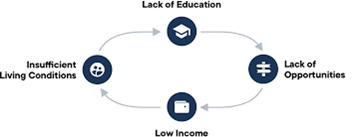
A Poverty cycle

Why would anyone willingly put themselves in a position so vulnerable to the exploitation by others? Shouldn’t they simply find a better job, perhaps pursuit higher levels of education? Surely, it should be easy…

Poverty creates vulnerability to these detrimental forms of work, which in turn contribute to perpetuate the poverty of the workers. It is not a cycle one easily escapes from. Just try and put yourself in such a worker’s shoes: to leave your exploited position (assuming you even have the option to walk away) will mean a significant reduction in income, which you may not be able to afford. Even if you managed to scrape up enough savings to put yourself and your family through a jobless period, there’s still the question of finding another job. Remember, you are a poor, likely uneducated, unskilled laborer. Do you think there are lots of opportunities available?

If the job doesn’t pay well, savings are likely to be scarce, and no company can compete for long with the low prices, achieved by those grossly underpaying for labor, leaving only the exploiters to provide work for the entire labor force. 

Increasing qualifications is also not an option: education is costly and requires time, and long hours working for little time doesn’t leave much room for personal investment.

Forced Labor in Supply Chains

We all know we live in the age of globalization. The t-shirt you are wearing right now may have been to more countries in its short existence than you have in your entire life, one land per stage of production. And yet, it still manages to make its way to you so amazingly cheap! Ever wondered how? (1)

The truth is many companies exploit their workers to cut costs

Most products go through a lengthy chain of producers, manufacturers, distributors, and retailers before they reach each consumer. Consequently, it is a challenge to control who is working where and under which conditions. Companies have a responsibility to ensure no forced labor is being used in the production of the goods they sell, playing a key role in building a sustainable economy and society. 

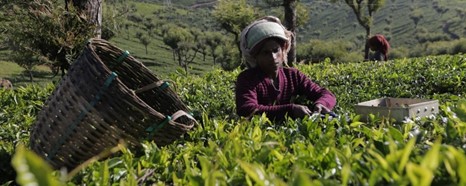
Agriculture provides the raw materials for most finished products – the sector is packed with cases of forced labor

Some companies have taken measures proactively. However, decades of “voluntary corporate social responsibility” have failed to protect people. There is a need for a higher-scale improvement that is hard to achieve with voluntary action. 

Fortunately, progressive steps have been made to combat forced labor, such as the development of modern forced labor legislation. The Introduction of the UK Modern Slavery Act required large corporations to report their efforts to tackle forced labor in their supply chains.

Additionally, at the beginning of 2022, the European Commission released its highly anticipated mandatory human rights and environmental due diligence directive to foster sustainable and responsible corporate behavior across global value chains. This is a notable moment in the history of human rights. This purpose would impose a large duty on EU and third-country companies to identify and address actual and potentially harmful impacts on human rights in the firm’s operations, as well in value chains.

Children

Children around the world are also routinely engaged in labor that is considered detrimental to their health and development. In the world’s poorest countries, slightly more than 1 in 5 children are engaged in child labor. Eastern and Southern Africa have the largest proportion of child laborers, having approximately 26 % of children aged 5-17 performing this type of activity. 

The entire exploitation chain is particularly vile when with comes to kids. Children who are forced to work (either by someone or by their circumstances) are the ones who will have more trouble breaking the cycle.

Child workers are paid even less than adults and are often preferred by employers, as they are less likely to strike or have demands. Besides that, a large pool of child labor available hurts unskilled wages, worsening the poverty issue and delaying even more technological progress. This leads to harder conditions for families, who are more likely than ever to send their children to work.

Because it is children that we are talking about, the consequences spread even further along in time. Working children are more likely to underperform academically, as shown by data from 12 Latin American countries; they find that third and fourth graders who attend school and never conduct market or domestic work perform 28% better on mathematics tests and 19% better on language tests than children who both attend school and work. Besides that, they are also more likely to drop out of school, which has negative consequences on the child’s development and their future prospects, and on the country’s chances of social and economic development.

But surely, everyone agrees child labor is bad. Why isn’t it simply forbidden? 

In most places, it is. But, again, it is not so simple as that. Even in some places where they technically can’t, children continue to work, mostly in agriculture or factories. And we must remember that many of these little workers are the sole providers, or at least a crucial part of their sustenance for their families (with their parents being unemployed or unable to work).

The ILO estimates that some 246 million children are currently involved in child labour

How to end

What if we just ended it? What would the actual impact be?

There are two major sides to consider when answering this question: these workers’ incomes and the impact on consumers of the products they contribute to.

We’ve discussed already the negative impact on these families of simply removing these exploitative jobs, namely their reduction in income. To prevent them from (further) descent into poverty, either robust welfare programs would have to be set up, were the job posts to simply disappear, or firms would keep the worker, now paying fair wages and not engaging in harmful practices for their employees. 

Either way, production costs go up, which the manufacturers can either absorb (assuming they can afford it) or pass along the production chain to the consumer. So, consumers will likely be paying more. Remember your well-traveled t-shirt? Not so cheap anymore. The same goes for your coffee, your chocolate, or your electronics.

In more concrete figures, we are talking about a practice that annually generates 150 billion USD in profits, an ILO estimate. The same organization estimates ending child labor alone to cost around 760 billion USD worldwide (including the cost of adequate schooling for all 246 million kids now working) to achieve long-term benefits worth 5.1 trillion.

How about those augmented prices? Although it is hard to estimate what that would look like, we can use products now in the market which are branded Fairtrade (meaning, among other things, that they stay clear of labor exploitation in their production chain) as a proxy of how much more the average consumer would have to pay for everyday items. A quick search online shows, for example, chocolate with a fairtrade stamp priced at 2.70€, over twice what a similar chocolate costs. A t-shirt marketed as Fairtrade can cost as much as 30€ – the same as several packs of shirts in some stores.

Fairtrade products are often more expensive

Of course, some of the disparity comes from other practices in Fairtrade (environment-friendly, etc.) or simple lack of economies of scale, but the fact remains: breaking away from this cycle will be costly. Yet, it surely is a price worth paying.


(1) To find out more about this check out our article about Fast Fashion here.


Sources: Unicef, International Labour Organization, Delta Net, The Woodgrove Outlander, BIICL, White & Case, European Commission, EY.

Constança Almeida

Leonor Cunha

The Looming Russian Default

Reading time: 7 minutes

Russia’s relationship with its debt has not been easy throughout history. In 1918, the embryonic Soviet Union repudiated the debt carried from the previous regime; in 1998, and after an attempt from the Russian Federation to gain credibility and integrate in international capital markets, Russia ended up defaulting in its domestic debt and in the Soviet-era external debt; in 2022, a Russian default seems to be looming once again.

With the Russian invasion of Ukraine, international markets price in the potential for a Russian sovereign debt default in external debt. Yields on Russian 10Y bonds, for example, have climbed vertiginously to nearly 20% since the beginning of the war.

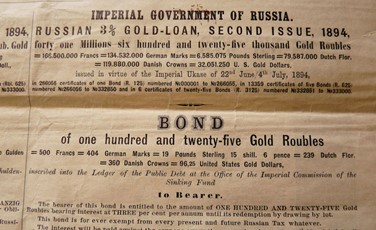
An international bond from the Tsarist regime which was repudiated by the Bolshevik Regime.

An history of missed payments

Following the Bolshevik revolution and the overthrowing of the Tsarist regime, the embryonic Soviet Union, in 1918, repudiated all the debts of the previous regime. Despite this, throughout the Soviet experiment, the Soviet Union accumulated large levels of debt up until its dissolution in 1991.

After the breakup, the newly independent, former Soviet states, had an arduous road of restructuring their systems with more market-oriented economies in their sights. At that time, the Russian Federation assumed all foreign assets and debts of the former Soviet Union, an action that it viewed to be necessary to begin to integrate international capital markets and to build a good international reputation.

However, the restructuring of the economy proved to be more challenging than expected. Russian GDP suffered large contractions, decreasing nearly by half in the following years. At the same time, fiscal policy was quite loose with the government running large deficits and real interest rates were kept high as the new Central Bank tried to rein in inflation and create credibility. Together, these factors meant that Russian debt was not on a sustainable path throughout the 1990’s. In 1998, and although Russian debt was still not very high (60% of GDP), with the Asian financial crisis echoing throughout the markets, and the exchange suffering sharp devaluations, Russia ended up defaulting on its domestic debt, as it found itself unable to rollover existing short-term debt. And although Russia did also default on foreign Soviet-era obligations it honored all the external debt it had issued after the 1991, attempting to maintain good credibility.

With this same goal in mind, following this default, Russia sought assistance from the IMF, and was able to restructure the defaulted debt and implement structural reforms that placed it on the path towards sustainable debt management.

These changes can be seen in the evolution of sovereign debt ratings, which had deteriorated significantly during this crisis (S&P – SD), but that steadily rose in the early 2000’s. S&P rated Russian debt with a B in 2001 a grade of BBB in 2008. This grade was kept quite constant until recent months. Even now, although Russia finds itself in danger of defaulting, similarly to the 1998 crisis, its debt to GDP ratio is not very high (18% of GDP in 2020).

The importance of international capital markets and the credit rating system

Countries issue bonds in external debt markets as a way to collect the necessary funds to finance their sovereign debts; the associated price and respective interest rate at which they will trade will reflect a number of conditions that determine their risk level, which usually comes attached with a given credit rating.

Credit ratings will reflect the creditworthiness of the country in question, posing as an indicative tool for investors of the possible risks that are being undertaken when investing in said debt – which in turn will be translated into the interest rate at which the loan will be repaid. This risk represents the likelihood of the government failing to make the future payments associated with its debt obligations, either because it is unwilling or unable to do so, with risky investments being linked with low credit ratings and high interest rates. The level of risk assigned to each country will be determined taking into consideration the country’s economic and political environment, assessing several important indicators such as the country’s debt service ratio, variance of its export revenue, domestic money supply growth, among others. Overall, a good or bad credit rating could make or break a country’s economy, being a key factor in attracting foreign direct investment.

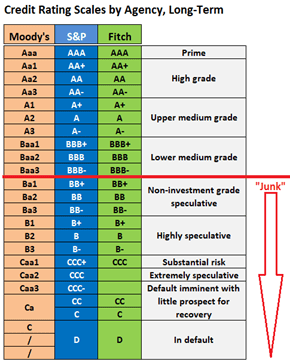
These credit ratings are assigned by independent credit rating agencies, with the three most widely known being Moody’s, S&P Global and Fitch Ratings. Each of these credit agencies will attribute a credit rating to the investment in question expressed in letter grade format, in accordance with their personal measurement scale: in alphabetical order, usually from A to D (best to worse), with specific intermediate categories for each agency. For example, S&P attributes a BBB- (or higher) rating to countries it considers to be within investment grade and Moody’s does so for Baa3 (or higher) rated bonds. Any rating of BB+ (or lower) for S&P and Ba1 (and below) for Moody’s falls to speculative grade, commonly referred to as the “junk” bonds territory.

Credit ratings are most definitely not static and may change all the time based on the newest data available on a multitude of political and economic factors, as the recent case of Russia government bonds´ credit rating steep downfall showcases. In fact, in just a few weeks, given the recent turn of events – with Russia´s economic panorama suffering a major hit facing the tight trade restrictions from the West and being essentially cut-off from Western financing – all major rating agencies have downgraded the country´s status by considerable significant notches from its secure position in the “stable” B territory, fearing Russia´s inability (and even to a certain extent its willingness) to service its debt. The situation further escalated upon President Putin´s announcement of the possibility of a “redenomination of foreign-currency sovereign debt payments into local currency for creditors in specified countries”, prompting the rating agencies to believe “that a sovereign default is imminent”, as illustrated by Fitch´s C rating and Moody´s equivalent Ca score, both only one level above default.

The impact of the Russian Invasion

The invasion of Ukraine has seriously influenced Russia’s economic and monetary landscape, mainly due to the package of sanctions applied by several European Union countries and the United States. Indeed, Putin admitted that such sanctions “effectively declare Russia default”, as they imply an increasing probability of default on its public debt (20% of its GDP). Nevertheless, what frightens Putin is not this amount, but the current lack of payment capacity.

Firstly, the sanctions applied to Russia, which include its exclusion from the SWIFT banking system and the blocked access to western financial markets, place this country in a possible economic drowning situation. In fact, according to the public finance sustainability theory, debt is only sustainable if the GDP growth rate is higher than the interest rate. Therefore, given all the economic and commercial exclusion to which Russia is currently exposed, it is possible that its GDP growth will not be satisfactory enough, consequently increasing its financial susceptibility and its risk of default. Besides the economic point of view, other sanctions applied imply the freezing of Russian assets located in institutions outside Russia, such as foreign exchange reserves and Russian bonds, which strongly limits the Russian capacity to pay its obligations.

Furthermore, apart from all the economic implications that trigger the default, another reason is closely linked with the monetary problems faced by Russia. For now, since the invasion of Ukraine, the ruble has devalued by around 40% against the dollar, once again compromising Russia’s monetary capacity to pay its debt. Then, the problem starts when its $480 billion foreign debt is denominated in US currency, so it must be paid in dollars. In fact, according to international declarations by financial institutions, the inability to pay debts in the original currency is formally considered as default. Moreover, nominally paying in rubles will get much more expensive for Russia given its huge drop in recent weeks.

Conclusion

Against the general feeling that Russia wouldn’t be able to make its next bond payment due on March 16 (with a 30-day grace period), it was able to do so. Still, it seems to just be delaying the inevitable given the weak economic outlook and the impact of sanctions.

What this will represent for the world economy is still murky but seeing as only a relatively small sum of the nation´s debt is held by foreigners; all points out to the country´s potential default not posing a major systemic risk to the global financial system.


Sources: Reuters, Fortune, IMF Elibrary, Carnegie Endowment For International Peace.

Diogo Almeida

João Baptista

Sara Robalo

Inês Lindoso

João Correia

Equal, but different: what’s up with inequality?

Reading time: 6 minutes

Concerns about inequality are not a novelty and we see signs of it everywhere. Some billionaires are flying to space while some people scramble for money to make ends meet. We see voices of support for more progressive tax systems and even talks of universal basic income to support the poor, while others claim tax burdens are already too high. Inequality is right in front of us and independently of how big we consider this to be problematic, it is endemic in the developed world.

Ever since the 1980’s there has been an increasing gap between the rich and the poor. The top 10% have been receiving more income compared to the bottom 50% of the population in North America. Without any intervention of the tax system to correct asymmetries, the top 10% in North America in 2020 earned more than the triple of what half of North Americans combined did. The data we present shows inequality has been increasing since the 80s, but in fact, this trend can be observed ever since the post-war period. Yet, albeit less serious, this is also an issue in Western Europe. In this corner of the world we see that, before intervention through the tax system, in 2020 the top 10% received already 1.75 times more than the entire bottom 50%.

Why have income inequalities increased?

Naturally, there is not one simple cause for this phenomenon. Although there might be some appeal to the idea that capital income can benefit the richest and help increase socioeconomic cleavages, it is likely that the current trend of increasing inequality is, at least for now, due to deep differences in labor earnings as well (Piketty 2006, Piketty & Saez 2014). 

 One possibility is that the technological progress of the last decades, in part caused by the introduction of information technologies, increased the demand for highly specialized skills that were then compensated with higher wages. Therefore, high-skilled wages increased at a higher pace than low-skilled wages and so the income gap between highly educated workers and the rest of the population widened. 

 Nevertheless, if we look at the very top incomes such as the top 1% we might consider other factors. Particularly in the US, top executive compensation has been increasing and even though CEOs undoubtedly have highly sought-out skills, they also have the bargaining power that regular workers do not have when negotiating their wage or accepting job offers. Standard economic theory would predict workers receive a wage equal to their marginal product of labor, but companies don’t have benchmarks on which to expect how much a CEO will contribute to their production activities. Consequently, incomplete information can leave some room for top executives to bargain greater wages (Piketty et al., 2014).

Inequality in Portugal 

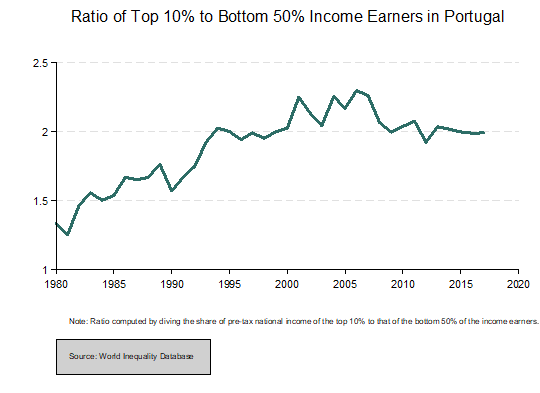
Although data stops at 2017 and from there onwards we only have extrapolated data, it seems that the Portuguese case has two relevant features. First, compared with the aggregated data for Western Europe, inequalities are greater in Portugal as in the last decade the top 10% received twice the pre-tax national income that accrued to the bottom 50%. 

However, contrarily to the aggregated data observed for the United States and Western Europe, it seems that the trend of increasing inequality in Portugal observed since the 1980s has slowed down, started falling in 2005, and has stabilized in the last decade. Whether this is a short-term phenomenon or not is still uncertain, and it will depend on the policy stance of the government. 

In short, even though a pessimistic account might identify Portugal as having inequality levels above those of Western Europe, the inequality growth spur has been calmed down for now.

Inequalities go far beyond income

It is often the case that we use income to assess inequalities because it is a unidimensional measure that is easy to understand. However, inequalities go way beyond what people receive at the end of the month. Income inequalities are associated with other asymmetries which might be even more concerning. 

Families of high socioeconomic status can often provide more stimulating environments for their children to grow. Consequently, children from disfavored backgrounds might lack resources such as cognitive stimulation and appropriate interaction with family members that are vital at early stages in life where key cognitive and behavioral traits are being developed.

One finding is that children from wealthy families have more cognitive capabilities than their peers in families of lower socioeconomic backgrounds. By age 6 socioeconomic status is already associated with math capabilities, and evidence suggests the school system is not particularly effective at fighting them over time (Heckman, 2006). If any measure needs to be taken, it might be more effective to start at a very young age. The environment in which a child grows during their first years of life has structural influences on their development and consequently on long-term life outcomes. 

Taken from Heckman (2006), using data from Carneiro & Heckman (2003)

How early is very early? As soon as the child is born, the environment is already exerting its effect. Even when kids are 3 years old, we can already see a relationship between socioeconomic status and cognitive capacities being formed. In particular, 3-year-olds from poorer families have worse verbal skills and even though attending kindergarten can help them improve their skills they still fall behind their peers (Becker, 2011). 

Inequalities in family income are also associated with different long term health outcomes. Children born in poorer families tend to have not only poorer health compared to their wealthier peers when they are young, but these differences persist and even widen in magnitude as they become older. In other words, income inequalities might not only be related to differences in health levels but might also be widening the health inequality gap even further (Case, 2002; Heckman 2007).

We can think this might lead to feedback loops, as poor families raise individuals with lower capabilities and worse health, which then makes them weaker in the labor market. As a consequence, they receive lower incomes, and the cycle continues. On the other hand, more affluent families can guarantee a better path to help their children attain higher wages in the future. Hence, it is natural to wonder if higher income inequality now will not be, in itself, a cause of higher income inequality in the future.

So what?

 We have seen that inequality in incomes has been around for the last decades and likely came to stay unless any action is taken. Moreover, even though current debates both in the media and in public society are often about differences in income, it is much more than that. Inequality is a very broad phenomenon, but indeed income inequalities are related with many other differences we observe in society. 

 Yet, we can always ask: why care? This is where no clear answer exists. We all have different preferences and views for what we consider to be tolerable levels of inequality, and so the debate can never be just about economics. Our concerns of equity and fairness must come into play too and the discussion can never be settled through facts alone. The decision of whether we want to stay in the age of inequality or leave it is not only a question of which actions to take, but also on whether there is collective will to take them.


References:

  • Becker, B. (2011). Social disparities in children’s vocabulary in early childhood. Does pre‐school education help to close the gap? 1. The British journal of sociology62(1), 69-88.
  • Heckman, J. J. (2006). Skill formation and the economics of investing in disadvantaged children. Science312(5782), 1900-1902.
  • Heckman, J. J. (2007). The economics, technology, and neuroscience of human capability formation. Proceedings of the national Academy of Sciences104(33), 13250-13255.
  • Heckman, J., & Carneiro, P. (2003). Human Capital Policy. In J. Heckman & A. Krueger (Eds.), Inequality in America: What Role for Human Capital Policies? (pp. 77–240). MIT Press Books, 1.
  • Piketty, T., & Saez, E. (2006). The evolution of top incomes: a historical and international perspective. American economic review96(2), 200-205.
  • Piketty, T., & Saez, E. (2014). Inequality in the long run. Science344(6186), 838-843.
  • Piketty, T., Saez, E., & Stantcheva, S. (2014). Optimal taxation of top labor incomes: A tale of three elasticities. American economic journal: economic policy6(1), 230-71.
  • Case, A., Lubotsky, D., & Paxson, C. (2002). Economic status and health in childhood: The origins of the gradient. American Economic Review92(5), 1308-1334.

Nuno Gomes

The uncertain end of Boris! How could it happen and what comes next?

Reading time: 6 minutes

Over the past few months, United Kingdom Prime Minister Boris Johnson has been facing intense criticism over the allegations of numerous parties being held in Downing Street while the country was in lockdown or under restrictions that banned indoor socializing between households. Johnson has tried to dampen the impact of these scandals, either by insisting that they were a work event or that he only attended for less than 10 minutes. Later on, he apologized for attending a gathering in the Downing Street Garden during the first lockdown. However, the revelation of a party that was held the night before the funeral of Prince Philip, at which the Queen was forced to sit alone due to coronavirus restrictions, has sparked nationwide outrage and increased the pressure on Johnson to resign or even be dismissed.

Boris Johnson apologizing at the House of Commons
Queen Elizabeth at her husband’s funeral

Under which circumstances may Boris Johnson be dismissed?

1. Motion of no confidence in Parliament

A motion of no confidence is a method of testing whether the Prime Minister still has the support of the House of Commons, having therefore the power to trigger a general election, which could result in a new Prime Minister appointed.

Under the current rules, if a motion of no confidence is voted favourably by the majority of the members of the Parliament, the Government will then have 14 days to try to win back the confidence of the members who voted against the government, while, at the same time, the opposition parties may attempt to form their own government. After 14 days, if neither the present Government gathers enough support from the Parliament nor the opposition parties have been able to form an alternative Government, an early general election is automatically called.

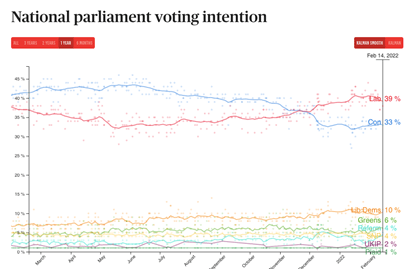
It is important to note that losing a confidence vote does not necessarily mean that the current Prime Minister will be forced out since they could once again win the general elections. Nevertheless, the current voting intentions predicted by the polls show the Labour Party beating Johnson’s Conservative Party by a significant margin, meaning that the above-mentioned most likely would not apply in this case. 

Poll by Politico: House of Commons’ voting intentions

As of the time of writing this article, a motion of no confidence on the Government of Boris Johnson has already been tabled by the Liberal Party. However, it is unlikely to succeed due to the 80-seat majority that the Conservative Party currently has in the House of Commons. Despite being very unlikely for members of Johnson’s own party to vote favourably to this motion, since MPs tend to follow party lines on a vote that can topple the government, it is not unthinkable. In fact, it did happen in 1979, when Prime Minister James Callaghan lost a confidence vote and was later beat in the general election by Margaret Thatcher. 

2. Conservative Party´s internal motion of no confidence 

Boris Johnson may also be dismissed from the Prime Minister position in the case he loses a vote of no confidence on his leadership of the Conservative Party. For this vote to be triggered, 15% of the Conservative MPs (54 currently) must write a letter to the head of the 1922 Committee, Graham Brady. Afterwards, every Conservative member of the Parliament (359) would vote on this motion, and, in the case of at least 180 favourable votes, Johnson would be forced to resign, and a new leader would be chosen by the party. 

Although it is not known by the public how many letters have already been sent to Graham Brady, as of the time of writing this article, 9 Conservative MPs have publicly announced that they have sent a letter requesting a no-confidence vote, and another 6 have called for the Prime Minister’s resignation. Furthermore, a vote has not yet been called, thus we can conclude that the 54 letters threshold has not been met yet. However, it is believed that the number of those who have written letters but have not yet disclosed is close to the 54-requirement. 

There is also a 3rd option, where Boris Johnson presents his resignation from his position as Prime Minister. However, Johnson has proven in the past to be resilient when facing calls to quit, and there are no signs from his statements regarding the scandal that he intends to resign. 

Next in line for the Conservative Party’s leadership 

In the case Boris Johnson is dismissed by either one of the above-mentioned circumstances, a leadership contest would be called. Any member of the Parliament, besides the ousted Prime Minister, can run for the party’s leadership, as long as they have the support of 8 other members of the Parliament. In the first stage of the contest, Conservative MPs will hold several rounds of votes, where the candidates with the lowest number of votes drop out until there are only two contenders left. In the second stage, all members of the party vote on the final two candidates. 

Conservative Party’s leadership contest process

According to a poll developed by YouGov, which surveyed 1005 Conservative Party members, the favorite potential candidates to be their next leader are Rishi Sunak and Liz Truss. 

Poll by YouGov: favorite candidates for the next Conservative Party’s leadership

Rishi Sunak

Rishi Sunak is seen as the rising star in the Conservative Party. He is 41 years old and is currently serving as Finance Minister. Sunak attended both Oxford and Sandford and worked in investment banking before turning into politics in 2015 when he was elected to Parliament. In case Sunak replaces Boris Johnson as Prime Minister, he would be the first person of color to hold the office. It is important to note that, despite being currently the favorite among party members to win an eventual leadership contest, Sunak is not as popular among the Conservative Party’s members that would vote on the first stage of the leadership contest – members of the Parliament.

Liz Truss

Liz Truss is 46 years old and currently holds the position of Foreign Secretary. As a member of the Conservative Party, she has served under 3 Prime Ministers: David Cameron, Theresa May, and Boris Johnson. Truss studied at Oxford University and worked in the energy and telecommunications industries before entering politics. She has been a member of Parliament since 2010. Although Truss is not the favourite contender among the wide Conservative Party membership, she is believed to be the favourite among the members of the Parliament – who vote on the first stage of the leadership contest. Tactical voting by her supporters in this stage could mean that her main opponent, Rishi Sunak, would not be able to gather enough support to reach the second stage, which seems to be the only way Trust could come out victorious in the end. 

Consequences of a new Prime Minister

According to a poll conducted by YouGov, Boris Johnson has become increasingly unpopular among the English Public since around June of 2020, which has only gotten worse with this “Partygate” scandal. Therefore, a new Prime Minister could result in a narrowing of the lead in the polls of the Labour Party.

Poll by YouGov: How well is Boris Johnson doing as Prime Minister?

Due to the Conservative Party being currently behind in the polls, it is not likely that the new Prime Minister would call for an early election once they take office, as it could result in losing seats in the Parliament or even losing the premiership to the Labour Party.

As a result, an early election should not be expected, and consequently, UK electors should only be able to actively express their view with regards to this Government’s performance until May of 2024. It remains only to be seen whether the Conservative Party can use this time to win back English people’s confidence.


Sources: Politico, The Washington Post, CNN, The New York Times, YouGov.

Scientific revision: Patrícia Cruz

André Rodrigues

João Sande e Castro

Maria Silva

The Economic Side of the Russia-Ukraine Crisis

Reading time: 7 minutes

“A Russian invasion to Ukraine seems more and more probable day after day.”

This phrase was initially written as we started to prepare this article. Time ended up confirming the worst. The conflict escalated quickly, and, on the 24th of February, Russia invaded Ukraine. This is one of the worst disputes in Europe since 1945.

In this article, we do not aim at exploring the history and motivations of the conflict. Instead, we focus on the potential economic impact of this crisis for Europe. It is important here to mention that the EU/NATO condemn the Russian military action and are providing military supplies to Ukraine. This way we can understand the motivations behind the sanctions and the importance of the commercial trading patterns between these countries.

Trade Balance

Ukraine and the EU

The EU is Ukraine’s largest trading partner, accounting for more than 40% of its trade in 2019. Total trade between EU and Ukraine reached €43,3 bn in 2019.

Ukraine exports to the EU amounted to €19.1 bn in 2019. The main Ukraine exports are raw materials (iron, steel, mining products, agricultural products), chemical products and machinery. This is a considerable increase of 48,5% since 2016.   The EU exports to Ukraine amounted to over €24.2 bn in 2019. The main EU exports to Ukraine include machinery and transport equipment, chemicals, and manufactured goods. EU exports to Ukraine have been subject to a similar impressive increase since 2016 of 48,8%.

Russia and the EU

In 2020, Russia was the fifth largest partner for EU exports of goods (4.1 %) and the fifth largest partner for EU imports of goods (5.6 %). Among EU Member States, Germany was both the largest importer of goods from and the largest exporter of goods to Russia in 2020. China is the largest Russia trading partner.

Over time the trade balance between Russia and EU has been getting closer to zero due to the decrease in imports from Russia while the exports remained steady. The balance has been always negative but is now closer to zero than ever before.

Figure 1 – EU goods trade balance with Russia from 2010 to 2020. Source: Eurostat

The more meaningful exported commodity from Russia is mineral fuels and mineral oils followed by pearls, iron, and steel. Russia also represents around 40% of Europe’s gas, being the biggest gas supplier, and for 26% of EU’s oil imports, crude oil and coal delivered through a sprawling pipeline network. This is one of the main points giving Russia bargaining power over EU. On the counterpart, the EU is the largest investor in Russia.

The Russian secret weapon

Oil (and gas) are the oil of the gears of today’s economies. No different is the case for the European machine which needs to maintain lubrification amid a period of rising oil and gas prices and rising inflation (partly driven by the increase in the price of these commodities). In addition, it needs to do all of that while attempting to punish a nation, which supplies around 35% of its oil and gas.

Figure 2 – Map of the major existing and proposed Russian natural gas transportation pipelines in Europe. Source: Samuel Bailey 

The networks of oil and gas pipelines from Russia to Europe are extensive. Main pipelines include the Yamal-Europe which travels by land across other countries and into Germany and Nord Stream 1 which crosses the Baltic Sea directly to Germany. As of recently, flows of oil from Russia have been slow. Adding to this, Europe has had a winter with especially weak wind which has made its renewable energy production weaker and its energy reliance on oil and gas bigger. Oil reserves are at low levels, all of which is contributing to higher energy prices. These high energy prices give Mr. Putin an ability to exert significant leverage on Europe with a single turning of the tap.

By its very nature, energy reliance is something that is slow to adjust: it takes time to build more diverse energy infrastructure. And, as it stands now, short-term options which may include obtaining oil and gas from other places such as pipelines from Norway (although infrastructure capacity there seems to be already near the maximum), or from the pipeline in the Adriatic Sea or the pipeline through Turkey. Switching to more usage of coal is also a potential option. The EU also has plans to deal with an oil and gas supply emergency and alleviate some of its impact.

As of the 22nd of February, the approval process of a new pipeline – Nord Stream 2, which has been criticized for contributing to more European energy dependence on Russia – has been halted following the recent actions of Russia with regards to Ukraine.

On the same day, Mr. Putin remarked that Russia planned to continue the supply of oil and gas to the markets without interruptions. Still, this remains as one of the biggest weapons that Putin has in this conflict over the EU.

The EU/NATO Economic sanctions to Russia

As a way to punish Russia from moving forward with the invasion of its neighboring country, and even looking to possibly cause a de-scalation of Russian military actions, EU/NATO applied economic sanctions. 

Figure 3: NATO members

Some of the first measures aimed at putting an immediate stop to the newly installed Nord Stream 2 pipeline, targeting “Russia where it hurts the most” given that it’s a big exporter of energy to the EU. Furthermore, the EU, the UK and the US have gone ahead with blacklisting specific individuals and companies with close ties to the governing. Adding to that, the US have acted upon its threat against Russia’s government debt by blocking the county’s access US capital and financial markets, effectively “cutting it off from western financing”, as per President Biden’s words. 

A second package of sanctions was announced later that included actions on the connection to the US financial system for Russia’s largest financial bank, Sberbank (holds nearly one-third of Russia’s banking sector assets); sanctions on Russia’s second-largest financial institution, VTB Bank (holds nearly one-fifth of Russia’s banking sector assets); similar full-blocking sanctions on Bank Otkritie, Sovcombank OJSC, and Novikombank and dozens of its subsidiaries; New debt and equity restrictions on 13 critical Russian financial entities; Additional full-blocking sanctions on Russian elites and their family members and individuals “who have enriched themselves at the expense of the Russian state”; Two dozen Belarusian individuals and entities were also sanctioned for supporting the attack on Ukraine; Russia’s military and defense ministry restricted from buying nearly all US items and items produced in foreign nations using certain US-origin software, technology, or equipment; Defense, aviation, and maritime technology subject to Russia-wide restrictions aimed at choking off Moscow’s import of tech goods.

Later, a major sanction was applied by excluding a selected group of Russian banks from the SWIFT global payment system. Swift has a total of 291 Russian members that represent 1,5% of the messages sent in the platform. This new sanction was announced together with the blocking of Russia Central Bank assets.

The impact of these sanctions does not stay restricted to Russia. Europe is in the front row of potential losers as a side effect of the sanctions. Most of the losses are tied to the energy dependency of some European countries to Russia. Other commodities that are exported by Russia will also likely see an increase in price. This side-effect is especially important given the rampant inflation in the Eurozone and US, contributing to further price increases and pressuring policy makers.

Moreover, in terms of sanctions covering the banking and financial sector, those with subsidiaries operating on Russian soil and/or with close financial ties would also fare badly under these conditions, with once again Europe as the most affected one, particularly Italy, France and Austria, being the most exposed international lenders to Russia.  

Effect on financial markets

The uncertainty that surrounds the whole conflict is being reflected in all major international financial markets which have been quite volatile in the past weeks, driven by multiple factors including geopolitical risk.

The invasion of Ukraine by Russia caused an initial panic in risk assets, including European and US equities whose main indices started the day down more than 2 or 3%. They ended up recovering intraday, with Nasdaq index closing the day up more than 1%. Also, the day saw a strong dollar (risk-off asset) and a rally in bonds. On the other side we saw the Russian Stock Market index plunging as much as 50% intraday, a weak Rubble and bond spreads exploding up for Russian debt. Commodities also rallied higher, namely oil.

Conclusion

This conflict recalls some of the darkest times in European history which has lived an extended period of peace. The true cost of this conflict goes well beyond the economic cost and is centered mainly around the lives of those fighting in this conflict. The side-effects caused on European countries by the sanctions seem to be the lowest price possible to defend democracy and liberty from those who want to take it from us.


Sources: CNN, European Commission, Politico, Reuters

Scientific revision: Patrícia Cruz

Diogo Almeida

João Baptista

Inês Lindoso

João Correia
The Inversion of the Eurodollar Yield Curve

Reading time: 6 minutes

Despite being the second biggest market in the world after the U.S. Treasury market, the truth is that you most likely haven’t ever heard of the Eurodollar system. This market, where some of the most sophisticated markets participants operate, is giving us warning signs of slowing economic growth. This might clash with some of the inflationary thesis defended nowadays.

But what is the Eurodollar system? And how does it work? What signal is this market giving us and why should we care about it?

What is the Eurodollar system?

In its simpler definition, as the name indicates, the term Eurodollar refers to US dollar deposits held at foreign banks or overseas branches of American banks, which originally operated mostly in Europe, hence the name. Indeed, while it is not entirely clear when this Eurodollar market was initiated, it is believed to date as far back as the post-World War II period, when Europe experienced a wide circulation of American dollars via the financial aid that the US provided to the war-torn continent in the form of the Marshall Plan. Thus, when the Eurodollar system began, it was mainly supported by the emergence of dollar money centers in Zurich, Munich and, of course, London.

However, what started as a fundamentally European-based independent and less regulated market of US dollar funds, rapidly spread across the globe in the next few decades, with many American branches opening operations in all continents. Therefore, as globalization grew and this “secondary” dollar market started expanding – going as far as replacing a lot of the traditional roles of global reserve currencies, such as gold – the Eurodollar system became a much more complex concept that now encompasses a much wider dimension of currencies and operations, representing one of the world´s biggest capital markets.

As Eurodollars are largely held and traded outside of US jurisdiction, they are not subject to the Federal Reserve´s regulation, particular in terms of reserve requirements, leading these deposits to be able to pay higher interests. Furthermore, by operating outside of the FED´s radar, this currency-like system of interbank liabilities allows for sophisticated financing and monetary transactions of US dollars to take place, making it so these international banks that deal with Eurodollars get to work with their own money multiplier, thus being in charge of creating and controlling their supply of US dollars.

Overall, the Eurodollar system became an alternative to traditional currency reserves, being able through its independence to provide the liquidity needed to satisfy demand in a way that, on many occasions, other systems (ex.: Bretton Woods) failed to do so, conferring the confidence that this “shadow” money would be the modern alternative to easily supply financing under the panorama of a globalizing world. This has consequently been reflected in high volume circulation of major international capital flows between countries under the Eurodollar system in the past decades, – with most transactions in this market being conducted overnight – which could potentially have significant geopolitical ramifications, seeing the power that this reserve-less, regulation-less system confers to the major international bankers that oversee it.

How does the Eurodollar work?

As mentioned previously, the offshore banks operating in the Eurodollar are not subject to regulations from Central Banks meaning that they don’t suffer from reserve requirements. This allows for a much higher flexibility to create dollars (being it a purely ledger transaction).

The deposits in the Eurodollar system have a minimum amount of $100.000 and are generally above $5 million and are priced in two different ways: either Overnight Deposits or, for longer maturities, tied to the London Interbank Offered Rate (LIBOR).

Overnight deposits are the most common transaction in this market, they mature on the next business day and usually start on the same date they are executed, with money paid between banks. The overnight bank funding rate is computed according to federal funds transactions, certain Eurodollar transactions and certain domestic deposit transactions.

Regarding longer maturities, Eurodollar is a LIBOR-based derivative. In this situation Eurodollar’s price reflects the market gauge of the 3—month U.S. dollar LIBOR, a benchmark for short-term interest rates at which banks can borrow funds in the London interbank market, interest rate anticipated on the settlement date of the contract.

Inversion of the Yield Curve

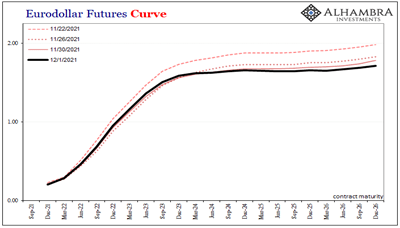
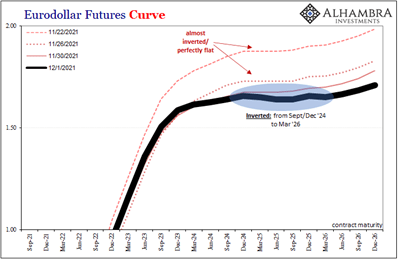
Eurodollar futures are derivative contracts that allow buyers and sellers to hedge against interest rate risk in the future. It also allows speculators to bet on the future movements of the USD LIBOR rate. In the Eurodollar yield-curve, the short-term tenors are heavily affected by the Federal Reserve actions (namely by the defined interest on reserves – IOR), while the longer tenors correspond to market expectations on inflation and economic growth.

A Eurodollar futures curve can be built similarly to the treasury rates yield curve: the different future contract maturities are plotted on the x-axis and their associated interest rates are plotted on the y-axis. Under normal conditions, the curve should be upward sloping, reflecting the expectation of economic growth further down the line.

Inversion is not a normal shape for the curve, and it has, historically, preceded turmoil periods for global markets. For example, the last inversion happened on the 13th of June of 2018 where the inversion occurred in the Dec’20 to Sept’21 contracts. This doesn’t mean that the Eurodollar market predicted the Pandemic crisis but that it rather anticipated the deflationary forces existing in 2018 to play-out, namely the collateral scarcity on the Eurodollar system.

            Figure 1 – Eurodollar Yield Curve Inversion in 13th June 2018. Source: Alhambra Investments

This same phenomenon was seen on the 1st of December of 2021, where the Eurodollar yield curve inverted between Sept/Dec’24 and Mar’26 contracts. This means, once again, that the sophisticated participants in this market expect the existing deflationary forces to impact economic growth.

Figure 2 – Eurodollar Yield Curve Inversion in 1st December 2021. Source: Alhambra Investments

The inversion of the yield curve in the maturities around 2024, 2025 and 2026, might suggest that the market doesn’t believe that the Federal Reserve will be able to maintain higher interest rates for a very long time. This could be the case because the market believes that the upcoming contractions in the supply of money in 2022 will cause a slowdown of economic activity, which would cause the Federal Reserve to cut interest rates once again.

Conclusion

The inversion of the Eurodollar yield curve, the flattening of treasury yields and the shortage of dollars in the system are some of the signs that indicate that deflationary forces are threatening economic growth. This might invalidate some of the inflationary thesis as the market participants reiterate their belief that there is no monetary inflation. This inversion might also be a response to a possible monetary policy error by Central Banks, as they plan to tighten into a seeming weak economy.


Sources: Investopedia, Alhambra Investments, Fxstreet

Diogo Almeida

João Baptista

Inês Lindoso

João Correia

Women in politics: what keeps the relationship from thriving

Reading time: 6 minutes

Did you know that only 15% of mayors across the European Union are women? And that there are 200 more male than female members in the current European Parliament? These are a few among many facts and figures that show how the underrepresentation of women in decision-making positions continues to be quite alarming these days.

Women’s representation in local politics in EU countries

Women’s equal participation and leadership in political and public life is essential to achieving the Sustainable Development Goals (SDGs) by 2030, particularly SDG 5, which focuses on Gender Equality. Still, data shows that gender parity in political life is far from being achieved and the underrepresentation of women in power continues to raise serious democratic deficits in the 21st century, which undermines the legitimacy of the contemporary democratic ideal.

Parity democracy and the promotion of women in decision-making positions are therefore important areas of action for organisations such as the European Women’s Lobby (EWL). Parity democracy implies the equal representation of women and men in decision-making positions, going further than the traditional quota system, since it is not based on the idea that women are a minority: women represent more than 50% of the world’s population and their political representation should be by now much closer to this value.

But why are the values so low?

The EWL shows some possible explanations for women’s underrepresentation, which can be summarized into the 5 C’s. First, there’s Confidence: from childhood to adulthood, women are thought to believe they are not as worthy as men, leading them to doubt their value in putting themselves up for election. Then, we have Candidate Selection: even once women agree to compete with men to be elected, it is often difficult for them to get an electable spot, being constantly passed over by men, regardless of competencies. The third reason is Culture: politics is still a men’s world, crammed with sexism and external threats to the entrance of women. Cash is also a factor that contributes to excluding women from politics, since their campaigns frequently receive less funding than their male counterparts. The last reason appointed is Childcare: across the EU, women spend, on average, twice as much as men on childcare, leading them to be half as available to carry out political positions.

But let’s look at some real-life examples of women in power.

A case of success

Jacinda Ardern is one of the most popular cases of successful women in power. The New Zealand’s politician became leader of the New Zealand Labour Party in 2017 and in the same year, at age 37, became the world’s youngest female head of government. Her time in power has been recognised around the world as a masterclass in leadership. Open, honest and authentic, Jacinda is a new type of leader, who unites strength with kindness and boldness with compassion.

In 2018, Jacinda had her first child, becoming the world’s first leader to go on maternity leave while in office. Her approach regarding motherhood and multi-tasking have been crucial in sending a powerful message about women in leadership roles. In 2019, Jacinda was praised worldwide for her rapid response to the Christchurch Mosque shooting that killed 51 people by introducing strict gun laws. More recently, she was hailed for her government’s quick action on the COVID-19 pandemic, which has helped New Zealand avoid the mass infections and deaths that devastated the world.

Over the years Jacinda has become a role model for many girls who aspire political roles.

Ardern’s career has broken stereotypes about women in power

Feminist Utopia

Rwanda stands out as what some call the “Feminist Utopia”, since around 61% of the parliament’s seats are held by women. This amount surpasses the majority of so called “developed nations”. Nevertheless, these percentages don’t translate cultural and social aspects of Rwanda that set girls back from their male counterparts for any leadership role.

Unlike other countries, Rwandan women’s access to politics was not achieved through feminist movements. Instead, policy changes were led by one man: President Paul Kagame. These changes were not resulting of change in mentalities, but rather a consequence of the devastating genocide of 1994, where women started to account for 70% of total population. As the president recognized, it was impossible to rebuild Rwanda without women’s participation in public life.

This rapid change, however, was not enough to change mentalities. While a female deputy is expected to stand up for women’s causes in the parliament, in her own household it’s a different story. In Rwanda, husbands still expect their parliamentary wives to polish their shoes, make their food, clean, and so on. And as many deputies have shared, they don’t feel safe to speak up on this matter as they fear retaliations from their partners. This sentiment of fear also comes within the Rwandan government, which is being bombarded with criticism regarding Human’s Rights violations. They have been accused of intimidating and prosecuting anyone, within their party or not, that deviates from the original government’s plan. These accusations shatter the image Rwanda had as a new democratized nation, with female inclusivity seemingly being used to hide authoritarian measures from the public international eye.

Conversely, public improvements provided unimaginable changes in women’s freedoms, such as being able to freely open a bank account without their husband’s permission. So, while mentalities take time to adjust, through education, Rwanda may grow into an equalitarian country where expectations for women and men are the same.

Rwanda is the number one country for women in power, but they still face many challenges in daily life

Dealing with sexism

Many stress the importance of female representation in politics. But is this enough to motivate women to choose leadership roles? Let’s consider an Australian example: Julia Gillard, the first female Australian Prime Minister.

Julia Gillard’s time in office was, in fact, turbulent. Not only because of the sexist treatment, but also what some claim to be “personal flaws” that impacted her leadership. The YWCA and University of Adelaide found that women with political aspirations were less likely to pursue them after witnessing how Gillard was treated. Examples are the way media focused on how she looked and the other party’s sexist jokes about her. Nevertheless, after her prime ministership, Australians find it much easier to imagine female political leaders, and Gillard can take a lot of credit for that.

This case illustrates how motivating women to join politics remains a one-sided strategy. Joining an environment that remains toxic for female deputies and leaders, in some cases, does more harm than good for the ones that follow.

Men and women politics are still differently portraited by the media

Small but the right steps towards gender equality

Although the progress regarding gender equality is clear, it is still extremely slow and uneven. Women are still underrepresented in politics, parliaments, and public life, making less than 23% of parliamentarians worldwide. As of September 2021, there were only 26 women serving as Heads of State or Government in the world. According to the UN, at the current rate, gender equality in the highest positions of power will not be reached for another 130 years.

The bright side is that there are many organizations working relentlessly trying to reverse these alarming statistics, such as the European Women’s Lobby, UN Women and Women Political Leaders. The European Parliament and the European Commission are also engaging in strategic resolutions regarding this issue, inviting EU institutions (the Council, the Commission) and national EU governments to design and implement effective gender equality policies and multifaceted strategies for achieving participation parity in political decision-making and leadership at all levels, and welcoming gender quotas for elections.

All in all, albeit some positive changes have been made, we still have a long way ahead until political equality is achieved.


Sources: The Conversation, The Guardian, Inter-Parliamentary Union, OECD, United Nations Development Programme, UN Women, The Advertiser, The Sydney Morning Herald, QUARTZ, European Women’s Lobby, Women Political Leaders, National Public Radio, Clio Visualizing History, BBC News, RFI, TRT World, NowThis News.

Madalena Andrade

Magda Costa

Scientific revision: Patrícia Cruz