The Power of 0.99$

“In my opinion, there is no better theoretical and methodological basis than behavioural economics. ”

— Dr. Florian Bauer

Alongside psychologists, behavioural economists understand that there are countless things that influence the human brain, hence there are countless ways of changing its perception. A known approach is Behavioural Pricing. By understanding what influences its customers, companies are finding ways to turn the consumer’s behaviour in their favour, under the premise that, even though they don’t behave rationally, consumers are predictable. And so, over the years, marketing has been designed with the objective of making us go down a specific, well-planned path.

         If companies were to price items only based on traditional economic models, they wouldn’t be maximizing profit margins because these models assume that consumers already know, when buying a certain product, exactly how much they’re willing to pay for it.

However, as Dr. Florian Bauer1 tells us, “Behavioural Pricing has empirically proven that the notion of people having a predefined “willingness to pay” is wrong. Rather than having a willingness to pay, people tend to develop a price acceptance throughout their decision-making process“.


Herewith, one of the most known approaches is one we all have already been a victim of: the .99$ (or .95$) phenomena. This odd way to price items is an important tool to trick our subconscious into thinking that an item is cheaper than it actually is. There are two theories (one doesn’t invalidate the other) about why this has brought such extraordinary results. On one hand, it is thought that, when reading a price tag, our brain only focuses on the first digit, so when the price is something like 29.99$, our brain tends to think of it as being “20$ and something” and not 30$. On the other hand, and quoting Tim Harford2 (Financial Times), “a price ending in 99 is simply a shorthand for good value”. 

On our day-to-day, many situations confuse our objective reasoning with this technique. For example, let’s imagine we are choosing from two exactly equal gyms, only different in price subscription. Gym A costs a straightforward amount of 31$ per month, full time. Gym B costs 65$ per month full time, but only 34,99$ if you choose a less-hour schedule (8am-12am + 2pm-5pm). Rationally, 31$ is lower than 34,99$ or 65$ and full-time is greater than part-time, so a cost-minimizing consumer would choose the cheaper gym without even pondering the other alternative option. However, in reality, consumers think greatly on the subject and even knowing the gyms are exactly equal (same chain and location), there is always the thought in our heads that, if B is more expensive, then it may be better and we can take advantage of it by choosing the part-time option for more or less the same value because 31$ and 34,99$ are both “30$ and something”.

Is this irrational? Yes. Does it make any sense? No. But does it happen? Absolutely.


Professor Kenneth J. Wisniewski3 (University of Chicago) conducted a study on this topic to test the efficacy of prices ending in 9. In a local grocery chain, he lowered the price of margarine from 0.89$ to 0.71$ and observed an increase in sales of 65%. Then, he lowered it again to 0.69$, they’re increase in sales was 222%. The difference of 0.02$ translated in an exponential increase of 157% that proved empirically that the ending number of a given price is not as relevant as the initial one (0.6$ greatly preferred than 0.7$), even though the real difference being so low. Consumers’ neurological action influences choice as much as their tastes and needs.


In order to have a better understanding on the psychological games corporations like to play, let’s take a look into the Decoy Effect. Essentially, we face this effect when companies insert irrelevant, unprioritized alternatives to a set of options to trick consumers into buying the more expensive one. Imagine the following situation:

rsfg.png

For a subscription of The Economist you have three options:

  • 59$ with access to the online journal;
  • 125$ with access to the printed journal;
  • 125$ with access to both the online and printed journal.

The behavioural economist Dan Ariely4 analysed this set of alternatives and asked his students which one would they pick. Obviously, no-one chose only the printed option since it would cost the same to have both printed and online. Although, 16% chose only the online journal, a majority of 84% of his students preferred the combo. Alternatively, when he didn’t present them the “printed only” option, only 32% chose the combo and 68% chose the “online only” version. Thus, it seems that, when presented a clearly inferior alternative, by comparison, the combo option seemed more attractive.

It is eye-opening how simple tricks can influence our choices without our conscious perception.

Unlike what we previously thought, pure rationality is reserved to mathematics whereas everything that relates to humans and how they behave has a good dose of irrationality behind.

In fact, there are already consulting companies, like Vocatus, that specialize in Behavioural Pricing and advise other multi-sector companies to implement it on their own marketing and placing agendas.

“Behavioural economics demonstrates that people do not decide rationally and are not fully informed. They often behave (and purchase) hastily, forgetfully, illogically, impulsively, emotionally, myopically, or simply with indifference. At the same time, behavioural economics experiments show us that decisions follow clear patterns. So while they are irrational, they are in fact predictable. As soon as you have really understood the decision-making process of your customers, you can begin to influence them. This will give you a clear advantage over your competitors and a lasting edge.”

— Vocatus website, Consulting Company

Overall, the question that arises from this is:

How is this knowledge going to change the way you behave? Are you going to continue being tricked by marketeers?


Simple Biographies:

1 Dr. Florian Bauer is an internationally renowned expert and speaker in pricing psychology and behavioural pricing and is the author of several books on pricing research. He has a PhD in psychology and studied on the MIT and Harvard.

2 Tim Harford, “the undercover economist” is an economist, journalist and columnist for Financial Times.

3 Professor Kenneth J Wisniewski is author of the paper “Price-Induced Patterns of Competitors” with University of Chicago’s Professor Robert C Blattberg.

4 Dan Ariely is a Professor of psychology and behavioural economics at Duke University, he is also author to the New York Times best seller “Predictably Irrational”


Sources:

  • Fast Company

  • Financial Times

  • The Economist

  • OV Blog

Article Written By:


Carmo Romão - Carmo Romão Ana Clara Malta - Ana Clara Malta João Carvalho - João Carvalho

Harmony OS

“Hongmen” is a name which can be traced back to Chinese mythology, representing the primordial chaos of the world before creation. That’s the idea beyond the new open source, microkernel-based distributed operating system (OS) being developed by Huawei, known in China by Hongmen OS and in Europe by Harmony OS.

Harmony OS has been in development since 2012. However, in May of 2019, Huawei increased its efforts in the operating system as a response to the export restrictions imposed by the United States. It was born from the war between the US and Huawei, which begun with strong suspicions by American intelligence agencies that Huawei was linked with Chinese military forces, being able to supply the Chinese government with access to data using a backdoor. For the US, it was a question of national security. Consequently, the US started imposing export restrictions to Huawei. Companies such as Google and Microsoft were prohibited of making business with the Chinese company. This created a problem for Huawei, given that the operating system used by their devices was Android, owned by Google. Within this new context, the necessity to innovate and create a solution in order to respond to the restrictions on commerce appeared. Necessity is the mother of creation, and so the Harmony OS was born. Harmony OS was announced to the world without warning at 9th of August of 2019, as a plan B to the use of Android.

Huawei’s senior vice president, Catherine Chen, said that Harmony OS was designed for any Internet of Things (IoT) hardware. This means devices such as smartphones, televisions, smart speakers, cars, computers and other connected devices will have the same OS. The creation of an ecosystem, removing barriers will make contact between devices much easier, a convenience which may be pivotal to attract consumers. Google doesn’t have such an advantage, and probably never will. It will be also an overall smoother OS, making it more appealing to app developers.


iot.png

Huawei’s Harmony was presented as being transparent, smooth, safe and unified, while Google’s Android was described as “unstable” and “fragmented”.

Although we can only trust Huawei’s words to a certain point, it is important not to forget that this is a more contemporary OS in comparison to the more modern versions of the now outdated Android.

Ready to take the market?

We already established that this new operating system is, being as euphemistic as one can be, bearable. But is it enough to compete with the leading OS’s in the market? Android absolutely dominates the market, being the OS of current Huawei smartphones, and iOS has Apple, the company with a powerful brand and the merits of having introduced smartphones to the world, as a backbone. Various OS’s supported by big companies have failed in the past. Microsoft Phone was very convenient between devices and had the fortune of Bill Gates’ support it, but lacked in practicality, becoming unattractive for consumers, which led app developers to become uninterested in developing Microsoft-supported. Samsung had the Tizen, which is still one of the smoothest OS’s ever developed. However, Google answered to this threat by limiting the access from Tizen users to the Google App store, making it rather difficult to download apps. Tizen is now restricted to Samsungs’ smartwatches and smart TV’s. In both these cases, Windows and Samsung, two gigantic players in the software industry, were strangled by this Google dominated market.

Huawei knows this, which may be the main reason that it will not use Harmony OS for smartphones, at least not immediately. Huawei is playing safe, continuing to use Android for as long as they can. However if US sanctions continue, Huawei will have no choice but to change to Harmony.

huawaei.png

Will it work?

It will be quite the challenge for Huawei, but it certainly can make it happen.

Transition will be more difficult in Western markets. It is true that Huawei is everywhere nowadays, but we are all very used to Android and we don’t see any good reason to change. Being an overall best OS is not good enough. Most western apps will take time to convert, even though they will operate smoother than in android when they do. With only the past sanctions on Huawei, there was a considerable drop in sales in Europe, but they remained the second most bought brand.

In China however, it’s a whole new world for Huawei. With all the buzz between China and the US, and after seen as such conflicts affect the smartphone industry, Huawei is considered a patriotic symbol against America. In a way, the US government helped giving the perfect environment for the home success of the company. In China, not only Google but other American apps like Facebook and Uber were banned. Years have passed and now there are homegrown alternatives. The dependence on Android weakened and Huawei might finish it for good. There are over 200 000 000 Huawei users in China. If Huawei decided to lunch Harmony OS for smartphones, and all these users potentially convert, they finally become free of any American dependence. App developers will have no problem into converting their apps to be Harmony supported as it is overall better and has a minimum of 200 000 000 users as potential customers. And from there, as more developers work to be supported by Harmony, it will become more appealing to the Western world. It will spread to the European and American markets as Huawei keeps its success as a brand.

For now, Harmony OS isn’t ready to take the world market of smartphones, but you can already find it on Huawei new Smart TV’s. If these times of uncertainty continue, who knows until where this operating system could go. Huawei already said that it will not wait much longer – it will launch Harmony to smartphones between May and August of 2020 if the sanctions do not end. Android is a dinosaur compared to this brand new OS, and it may very well become obsolete. Conquering China seems easily possible to Harmony OS, and thereafter, there will be a world for the taking.


Sources:

  • CNN Business;

  • Technode;

  • Publico;

  • Business Insider.

Article Written By:


João Mário Caetano - João Mário Caetano João Rodrigues - João Rodrigues

The Impact of 5G

Over the years, new inventions have usually impacted the world economy as well as the business environment, contributing to the so-called creative destruction. At this day and age, a new technology is about to revolutionize the way we interact with the digital world: it is the new generation of cellular network, also known as 5G. While it is true that this disruption has raised controversies regarding health issues, privacy and external political interference, the expected economic returns from the availability of mobile high-speed and low-latency connections are highly relevant, and should therefore be considered and assessed.


One of the most important and relevant impacts of this new technology is the increase in productivity derived from cost reductions or efficiency improvements, which are predicted to occur in virtually all economic sectors. For example, in industries that are directly linked with vehicles or machines of any kind that require human intervention, the possibility for remote control and monitoring of these assets allows for operational tasks to be performed by someone who is far away, thus reducing time spent and transportation costs.

Even in public administration benefits are expected, with high-speed connections allowing for faster responses of emergency services. Another case is the healthcare industry, in which the possibility for remote procedures, more effective monitoring of medical equipment and collection of data from wearable devices will reduce reduce costs and improve the quality of healthcare provided. Accordingly, this contributes to a healthier and more productive workforce, thus generating multiplying effects on the rest of the economy.

Overall, this expected increase in productivity reveals extreme importance, since it will enable a higher economic growth in the long-run.

Another positive impact foreseen from 5G is the ability to unlock the full potential of the Internet of Things. With the explosive growth in the number of connected devices and gadgets, existing networks are struggling to keep pace. Therefore, 5G’s high capacity is expected to allow seamless connections, with this product connectivity allowing firms to create and launch completely new business models, thus driving entrepreneurship and growth.

Furthermore, in remote regions where the installment of wired infrastructure is not economically viable due to low population density, 5G emerges as an alternative to offer these areas more reliable and higher quality internet connections than they currently have. This allows for the settling of businesses and job creation, with all the benefits associated with it. However, urban areas are predicted to be the first ones to receive the technology, meaning that this may only occur further in time.


Picture11.png

At such a premature stage, forecasting the economic impacts of this novelty is a quite complex task. However, all in all, 5G is expected to bring a push to economic growth and prosperity for the countries that pursue the disruption, leaving behind, in relative terms, the nations that forego the opportunity. Therefore, this may be a major source of inequality between the richer countries, which are able to implement the technology, and the poorer nations that still have to employ a significant share of their scarce resources in satisfying more crucial and basic needs, and so contributing even more for the digital divide.


Sources

  • Cnet

  • Medium

  • McKinsey & Company

Fantastic Unicorns and Where to Find Them

Unicorns: The Origin

More than a mythological creature, a unicorn has gained a new application in this century – to designate privately-held startups with a value of over $1 billion. The majority of these companies are in the vanguard of their industry, building the path for a generation of new technologies, while being considered as a bellwether of future economic development. This unique expression was created by Aileen Lee, founder of venture capital fund CowboyVC, in her article “Welcome to the Unicorn Club”, where she proceeded to study software startups founded between 2003-2010, coming to the conclusion that only a mere 0.07% of these privately-held companies would ever reach the billion-dollar valuation, realizing that finding a firm with such characteristics was as difficult as finding a mythical unicorn.


Looking back at the first decade of this century, which was analyzed in the article that created the “unicorn” concept, billion-dollar startups were generated at a rate of four per year, which amounted to 39 unicorns in total. Furthermore, San Francisco was identified as the headquarters to the vast majority of unicorns (15), followed by New York (3) and, tied in third place, Seattle and Austin (2). Lastly, the most fertile industries for unicorns were e-commerce, consumer audience, software-as-a-service (SaaS) and enterprise software.


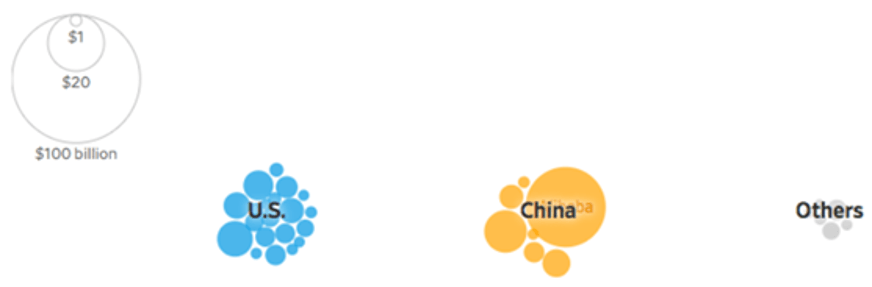
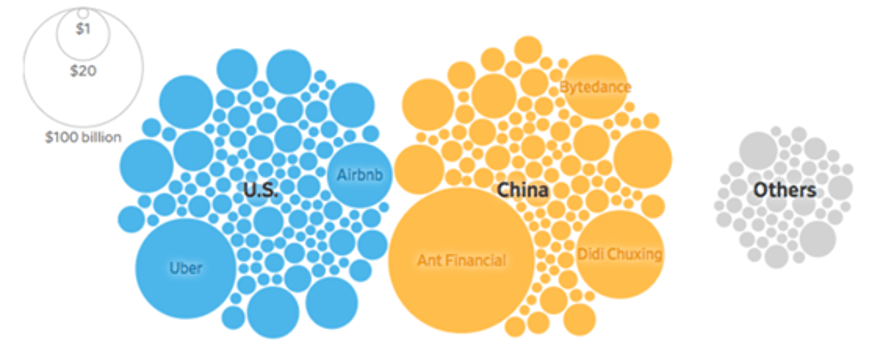
In only nine years, this landscape has changed immensely and China is to be held accountable. In 2018, a study conducted by Hurun revealed that Chinese unicorns were being conceived at a rate of one every 3.8 days, with the country owning up to 41.7% of the world’s unicorns, with a sum of 206, shortly followed by the USA, with 203 unicorns. The top three ecosystems were Beijing (82), San Francisco (55) and Shanghai (47), and the aggregated value of unicorns in the world sums up to a staggering $1.7 trillion. Lastly, the industries containing the largest percentage of unicorns are e-commerce, fintech, cloud and AI.

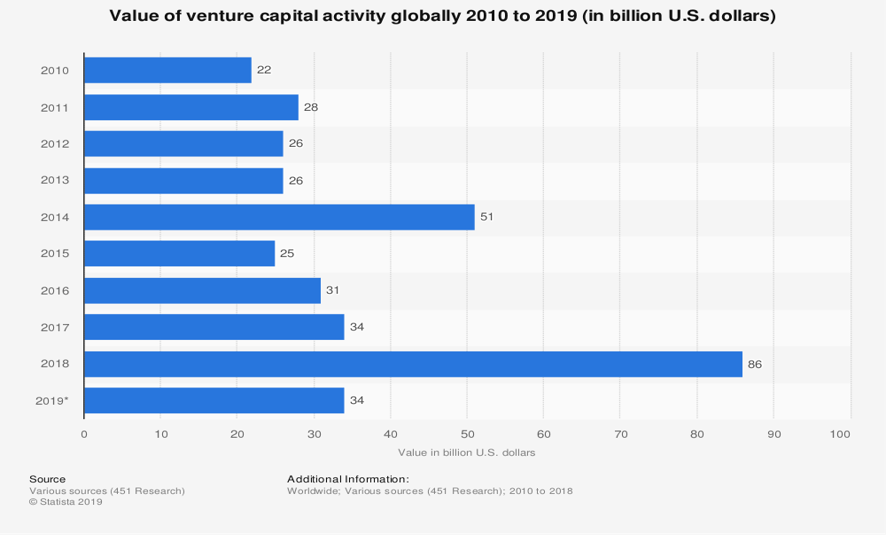
Aileen Lee mentioned disruptive technology as a conductor for the creation of unicorns. This inference still holds, as we evolve into a technology-dependant society that requires the expansion and automatization of various fields ranging from health to blockchain, which creates a need for constant technological breakthroughs and, consequently, fertilizes soil for innovative startups to blossom. Moreover, capital injection into these initiatives has been subject to exponential growth across the years through venture capital, that enables startups to raise private equity and ensure long-term growth, while allowing investors to potentially earn disproportionately high returns.


Picture4.png

Why China?

As seen, the unicorn phenomenon was most prominent in the US but, recently, China has turned into the leading country. The fast economic growth and rapid modernization of the economy play a major role in the development of newly-founded companies.

Privately held companies valued at $1 billion or more - 2012

Privately held companies valued at $1 billion or more – 2012

Privately held companies valued at $1 billion or more - 2018    Source: Wall Street Journal

Privately held companies valued at $1 billion or more – 2018

Source: Wall Street Journal


This massive growth was only made possible by the increased pace of technological innovation, as mastering the use of technology turned into the biggest source of competitive advantage for startups. In the particular case of China, around 40% of the unicorns are technology-driven, and the majority of them consider big data technology to be the biggest source of innovation and differentiation. Big data is especially relevant, as it allows tracking consumer habits and studying behaviors, thus improving overall marketing strategies adopted by the companies. This contributes to higher competitiveness and lower operating costs.

China’s capital market performance is also essential for the promotion of unicorns. The country’s capital usually arises from two forces – government policy and extremely diversified sources of financing channels. China, in particular, is living in a golden era of opportunities for startups who are looking for investors, as the CSRC (China Securities Regulatory Commission) is currently smoothing regulations for investment, hence attracting more unicorns based overseas to pursue their interests in the Chinese market. Apart from the Chinese government, the main global unicorn investors include the likes of Alibaba, Tencent and the venture-capital giant Sequoia, which has invested in 92 unicorns.


Some argue that the valuation of the Chinese unicorns might be inflated compared to the US, but the growth in investment in those firms has largely surpassed the values registered in American startups, which can be explained by the difference between the capital markets of both countries. The Chinese government ended up injecting a big dose of “Patriotism” in their market, directing resources specifically to make their firms more competitive, while the US opted for a more passive approach in terms of access to credit. Furthermore, the American system is more regulatory compared to the Chinese market, which facilitates investments in the oriental market when compared to the occidental one.


The following companies have not only been dominating the Chinese but also on a global scale, having conquered the title of China’s (and the world’s) most valuable unicorns, with a combined value close to 280 billion dollars (around 16% of all unicorns combined):

Ant Financial: This fintech company, founded just 5 years ago, is currently the highest valued unicorn in the world, with a valuation of $150 billion. The startup was spun out by the Alibaba Group, it has as subsidiaries the world’s largest online payment platform (Alipay) and the largest money-market fund (Yu’e Bao). The company views itself as “dedicated to bringing to the world equal opportunities”, while being able to answer the financial needs of society, through the use and development of innovative technologies.

Bytedance: Created in 2012 by Zhang Yiming, the internet technology enterprise gained importance through the development of AI platforms that informed and enhanced interactions between people all around the globe. Combined, all the apps and platforms of Bytedance have about 1.5 billion monthly active users (more than Instagram) as of July. Providing trustworthy information was what Zhang’s team had in mind when they created their most successful project “Toutiao”, which not only works as a news platform but, due to the complex algorithms used, is also able to provide a tailored feed to each individual user.

Didi Chuxing: Finishing the top 3, the ride-sharing company serves approximately 550 million users in over 400 cities. The 7-year-old enterprise triumphed from the moment it was launched, reaching 55% of the smartphone-based taxi-hailing market only 1 year after its creation. The founder Cheng Wei did not settle for the Chinese market, having invested in Uber and Lyft, while expanding to Japan, Brazil, and Australia. Didi was also included twice in Fortune’s “Change the World” list.


The downturn

Despite having experienced rapid growth in the number of unicorns, China’s ability to incubate billion-dollar startups has plummeted in the first semester of this year. In the first six months of 2019, only 36 unicorns were fostered in China, corresponding to a 30% drop when compared to the same period in 2018.

The development of the Chinese tech industry has put the country in the crossfire of the trade war, with the Trump administration accusing China of intellectual property theft. In May 2019, the US blocked Huawei Technologies Co. from importing American materials, and is considering doing the same for a wide variety of startups. The trade war has affected valuable startups such as smartphone-maker Xiaomi Corp. and delivery company Meituan Dianping, who saw their stocks plunge after going public, which reinforced to investors that private-market valuations are disproportionate to their real value.

The deceleration of economic growth has resulted in uncertainty in the funding market, drying up venture capital. The second quarter of this year was marked by a 77% tumble in investments in China, which translates to $9.4 billion, contrasted with the $41.3 billion investment in the second quarter of 2018, a peak for the China venture deals. Meanwhile, venture deals in the US rose about 15% and investment in Europe climbed 32%, according to Preqin.

Source: Preqin (via Bloomberg)

Source: Preqin (via Bloomberg)

The truth is that China had entered in a tech bubble, with the median tech enterprise valuation corresponding to about 31 times its EBITDA. Years of steep growth in tech investments resulted in enormous profits. Now, concerns regarding pre-IPO valuation recall the ones of the dotcom bubble. In 2017 and 2018, around 62% of venture-backed Chinese internet and software companies that filed for a public offer lost more than 30% of their values within the first 12 months after their listing.

However, valuations have not yet declined in China. The country’s startups have been resistant to down rounds (when a private company offers additional shares for sale at a lower price than had been sold for in the previous financing round). Meanwhile, venture firms are pivoting funding to alternative business models that require less capital, such as enterprise software.

This may simply be a time when Chinese venture capitalists are being more cautious, provided the volatile negotiations between Donald Trump and Xi Jinping with yet unpredictable results in the tech industry. All in all, whether the current downturn is just a setback or turns into the burst of a financing bubble depends on how venture investors, entrepreneurs and market regulators behave through this economic tension.


Sources:

  • Bloomberg

  • Preqin

  • Financial Times

  • Statista

  • Hurun

  • PwC

  • “Welcome To The Unicorn Club: Learning From Billion-Dollar Startups” by Aileen Lee

Article Written By:

Diogo Alves - Diogo Alves Lourenço Paramés - Lourenço Paramés

What Priests Should Confess: the financial schemes behind the Vatican doors

The Vatican, the world’s most powerful religious organization, has been known to spread its political influence across the globe throughout the centuries. As of recently, its involvement in several financial activities has been at the source of many fracturing scandals.

Their home in the Holy See is the Institute for the Works of Religion (IOR), commonly known as Vatican Bank. By involving many different church officials and mobilizing hefty amounts of money, its analysis has become of increasing difficulty and controversy, causing many clashes with the Italian press to arise.

For the past years, the press has been adamant on bringing the Catholic Church into the confessionary. Despite their well-known soft spot for conspiracy theories, it is undeniable that the Italian press has become a key player in the disclosure of many of the Vatican’s scams. Their involvement in the Mafia’s money laundry schemes, the misuse of funds and donations and the embezzlement of the IOR’s money are among the most relevant situations of financial misconduct.

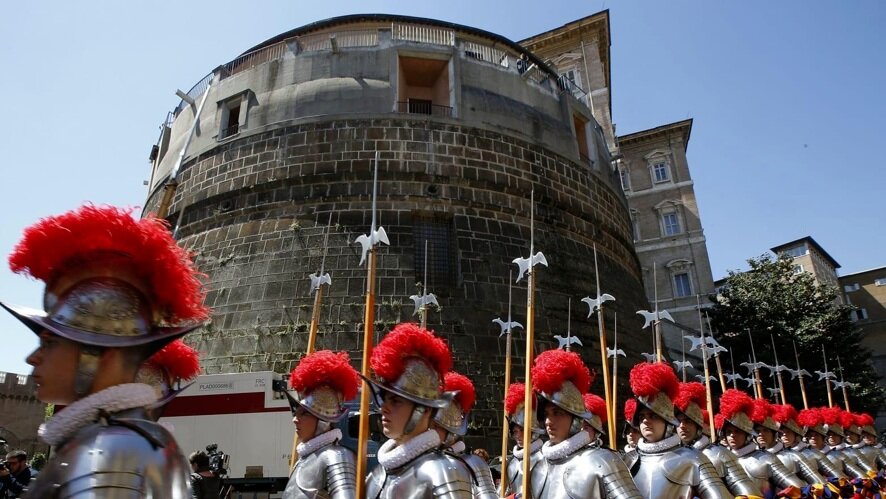
More specifically, in 2012, the Vatican spent $200 million to convert a former Harrods warehouse into luxury apartments.

This bizarre investment came out as a substitute for another peculiar project – the injection of those same funds in an Angolan offshore oil rig, then classified as unsafe. Given that 75% of the investment was sourced from a loan from the Vatican Bank itself, its Supervisory Board ended up noticing it and launched an internal investigation to clarify the situation. Despite dating back to 2012, this irregularity was only discovered in mid-October of this year. Since then, many have been wondering what led the Vatican to explore a project which deviated immensely from its institutional purpose, questioning the IOR’s legitimacy to undertake profit-making activities.

Picture1.jpg

This was one of the most striking financial scandals hitting the Holy See since the 1970s and 1980s, when the Archbishop Paul Marcinkus, as President of the Vatican Bank, engaged in perverse relationships with mobsters. Another bank, Banco Ambrosiano, was also involved in the scandal. Its mission statement claimed the goal of serving moral organizations, pious works and religious bodies set up for charitable aims. It’s main shareholder? The Vatican Bank.

Roberto Calvi, known by many as the “God’s Banker”, was chairman of the Banco Ambrosiano and had close ties with the Church. The Vatican, instrumentalizing its position as a sovereign state, was able to withhold transaction information from regulators and authorities.

This was deeply exploited by Calvi in the 1980s, who was responsible for moving the bank’s (and consequently, the Vatican’s) funds into offshore accounts, enabling Banco Ambrosiano and, therefore, the IOR to make a profit.

Ambrosiano ended up collapsing in 1982, after the authorities found a hole of around $3 billion in the bank’s finances. Roberto Calvi died hanging in London. Prosecutors believe this to have been a Mafia killing, linked to his money laundering activities via the bank.


In 2012, Father Ninni Treppiedi, priest in Alcamo, near Trapani, in the Mafia’s island stronghold of Sicily, was suspended after a series of questionable transactions of church funds and of vast sums of money passing through his personal bank accounts. Prosecutors highly suspected that this was the result of money laundering operations run by the Mafia Godfather, Matteo Messina Denaro. They investigated financial transactions that occurred between 2007 and 2009, amounting to around $1 million. Nevertheless, paperwork regarding the source of the money was said to be missing and the Vatican Bank did not want to release the records of the Father’s accounts. Ultimately, Treppiedi’s case was filed by the order of the Court of Trapani, but most people kept the suspicion about the connections with the Mafia.

The liaison between the Church and the mobsters remains until today, albeit the Vatican’s efforts to trail a path of cleaning and rebranding, focusing on increasing transparency.

Indeed, in the last decade, the Holy See has been trying to put an end to corruption in the management of the bank’s funds, through concrete reforms.

“These are scandals and they do harm.”

— Pope Francis

Thus, they need to be handled with. Accordingly, the first step towards more transparency was given with the establishment of the Financial Intelligence Authority (AIF) and with the implementation of the first anti-money laundering rules, in compliance with the European Union’s standards. These actions took place in 2009, during the Papacy of Pope Benedict XVI.

Despite some progress being made in the end of the last decade, the greatest improvements have been achieved under the control of Pope Francis, who took charge in 2013. In that same year, following a scandal of money laundering, in the value of $20 million, by Nunzio Scarano, referred to as “Monsignor Cinquecento”, the responsible for overviewing Vatican’s property holdings and investments, a Pontification Commission was established in order to review the activities of the bank. As a result, later in that year, more than 1000 customer accounts were closed.


Afterwards, in 2014, Pope Francis delivered a blunt message – the IOR would only be allowed to continue its operations as long as it committed to self-reform. In this regard, as the Holy See’s ministries, the discateries, were not controlled by the AIF (despite managing plenty of money) the Pope created the Secretariat for the Economy to keep an eye on their activity. Further policies included the transition from an internal auditing system to an external one and the requirement that the employees at the Vatican Bank worked exclusively for that institution, avoiding potentially harmful situations, such as the one involving Marcinkus in the 1970s and 1980s.

In terms of international assessment, Moneyval, a monitoring body of the Council of Europe that aims at countering money laundering practices, has praised the Vatican for its course of action in recent years in this regard.

All in all, the Holy See seems committed to carve out a new image for the Catholic Church, closer to its founding principles. Nonetheless, the Italian press argues that the increasing disclosure of scandals is instead a proof of the inefficiency of the adopted measures. Only time will tell which side the truth is on. 


Sources:

  • Crux Now

  • European CEO

  • la Reppublica

  • Organized Crime and Corruption Report Project

  • Religion News Service

  • Reuters

  • The Economist

  • The Telegraph

  • U.S. Catholic

  • Wikipedia

Article Written By:


Ana Mota - Ana Mota Gonçalo Silva - Gonçalo Silva

The Great Firewall of China

Let us say, for instance, that, with great enthusiasm to visit such wonders as the Forbidden City or to gaze at those fabled clay soldiers, someone buys a plane ticket to the ever-so-mysterious People’s Republic of China. He sallies forth towards the unknown, and embarks both on an adventure and on an airplane. Suffering from a major case of jet-lag after a 13-hour-long flight, he falls headfirst on the hotel bed. So as to take his mind off of his nausea, he connects to the hotel’s Wi-Fi and decides to check his Gmail account or to watch a YouTube video. More knowledgeable or experienced readers in this matter will undoubtedly, understand that our hypothetical subject will find himself rather flustered at what will seem, at first, shamefully poor internet speed. Eventually, he will be cursing his naivety since this encounter with Chinese censorship could have been avoided by the timely purchase of a VPN service.

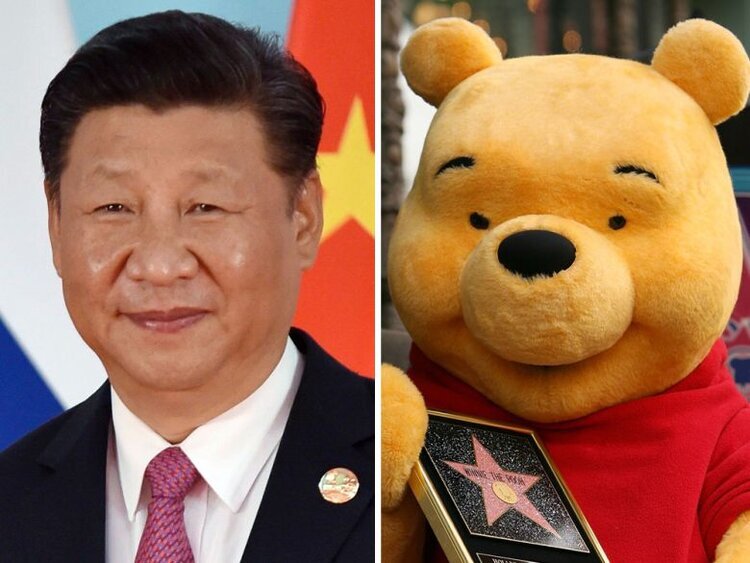
For most westerners, this reality, where a government would censor what content we can and cannot access, seems very distant. Indeed, the many humorous visual comparisons posted online between Winnie the Pooh and Xi Jinping, combined with the fact that, in 2018, the live-action movie of Winnie the Pooh was banned in China, make a lot of us laugh. However, this laughter often carries an undertone of empathy for those who live under such a regime and of relief for the fact that our country is different.

The yellow bear became, for many in China, a symbol of rebellionThe yellow bear became, for many in China, a symbol of rebellion

Those of us with a constitution that enshrined our right to freedom of speech may breathe a sigh of relief. For example, if a government operating under such constitution were to prevent a company from operating because it printed pro-opposition propaganda, this would be, undeniably, a clear constitutional violation. However, what would happen if an outside state that doesn’t respect this fundamental right was able to exert pressure on firms to self-censor and to censor their users?

China is a giant market that many tech and media firms would profit greatly in entering. However, their biggest obstacles often are the blue-pencil-wielding bureaucrats that decide what content is permissible and what is not. As such, firms wishing to expand to China or to maintain their business there may find it profitable to do some adjustments on how they operate in order to surmount this Great Wall.

For example, many Hollywood movies, competing to get into the limited number of foreign films that can be aired in China each year, are criticized for “watering-down” some more sensitive topics that, if kept unchanged, could cause the film to be struck down by Chinese censors.

And, more recently, due to the chaotic situation in Hong Kong, there have been a few incidents which have sparked outrage online: The NBA was heavily criticized for their swift condemnation of a tweet supporting the Hong Kong protesters by one of their team’s general managers. In addition, video-game company Blizzard came under fire after banning players for expressing their support for the Hong Kong protests.

Then, one might think that, perhaps, there is a normative argument to be had about whether or not a constitution that enshrines the right to freedom of speech should or shouldn’t prevent corporations from undertaking this sort of behaviour which stem, not from a nation’s own state, but, rather, from the economic pressure exerted by foreign dictatorship.

If you are opposed to this sort of behaviour, fortunately for you, there is no need to sit around demanding government intervention or naively hoping that profit-seeking companies will stop acting in a profit-seeking way. Indeed, better than trying to teach moral lessons to corporations, you are able to vote with your money. If you find it reprehensible that these companies would bow to oppressive regimes, then through the power of the boycott, you can join hands with the protesters in Hong Kong and with those unable to ungag themselves and make it so that the profitable route for companies to take is the one of defiance, not submission to evil.

Freedom of speech is of paramount importance to the development of a society. If you yearn for a society in which corporations value the protection of that fundamental right and consider it a priority to fight for, then there is already much power in your hands to contribute towards that goal.

Catalonia and Europe: What’s next?

On October 14th 2019, nine of the 12 separatist leaders of Catalonia stood trial for their roles on the referendum of 2017- declared illegal by Madrid- receiving prison sentences from 9 to 13 years. The crimes that they were trialed on included sedition, misuse of public funding and civil “disobedience”. Almost immediately after the verdict was made public, protests sparked in Barcelona and later on, across the entire region. On October 19th 2019, more than 500,000 people attended the pro-independence peaceful rallies that quickly became violent. The feeling of resentment by some Catalans towards Madrid is nothing new and thus, their reaction comes with no surprise.


Historical Context

Indeed, the richest region of Spain has always had a turbulent past with the Spanish capital’s centralism. With the Spanish Civil War, which ended in 1936 with the victory of the Nationalists over Republicans (mainly supported by Catalans) led by Francisco Franco, the region lost its autonomy, and its culture was heavily repressed by the central government: the public use of Catalan was prohibited,  only allowed to be publicly and freely spoken in the Stadium of Barcelona, and, later, at the very well-known Camp Nou, FC Barcelona’s stadium and symbol of the independentist movement. Thus, there’s a historical resentment that arises every time the central government interferes some bit on regional matters. Also, the 2008 economic crisis contributed to the bitterness towards Madrid, as Catalans felt they had given more to the central government than what they had gotten back from it. In 2017, the region represented 20 percent of Spain’s total GDP.


2017 Referendum

The increasing discontempt in the region culminated on September 6th 2017 when Carles Puigdemont, President of Catalonia, announced to the government of Catalonia that a referendum would be held on the 1st of October 2017, questioning its citizens if they wanted Catalonia to become an independent state in the form of a republic. Unlike the 2014 referendum (which was merely informative), this one would be binding and it would be done with or without the approval of the central government. This sparked tensions between Madrid and the autonomous region, with the former declaring it illegal and denouncing the lack of democratic guarantees. Nevertheless, the referendum was held, amidst Spanish efforts to stop the voting. 90% of people who voted chose independence, even though only 43% of eligible voters actually participated. As a consequence, the central government triggered Article 155, dissolving the autonomy of the region.


An Independent Catalonia?

What would an independent Catalonia mean? To Spain, this situation would imply the loss of its most prosperous, innovative region. Regarding Catalonia, even though the region has almost complete autonomy (in economic, fiscal, social and cultural terms), the path to independence would have a major impact on many levels: firstly, its relationship with the European Union; the institution has been an important supporter of Spain’s monitoring of the situation and has declared that if Catalonia became independent, it would be automatically out. If it wanted to be part of it, it would have to join through the normal lengthy process, which could take years. Consequently, it would be out of the Europe Group and could not enjoy the backing of the ECB. Thus, the economic consequences of leaving the European Union are undeniable: with closed borders, tourism could be affected, as free movement would be constrained and demand for tourist activities could shift to other places; shipping costs would increase as well as the possibilities of tariffs, if no trade deal was struck. Jobs would, therefore, be affected. Also, foreign and internal investment would decrease, as companies would re-allocate their headquarters to more stable places. Indeed, over 2000 companies have already moved their fiscal quarters to other parts of Spain, due to the instability in the region. Thus, economically speaking, it seems that the negative effects of independence outweigh the positive ones.


Catalonia and the EU

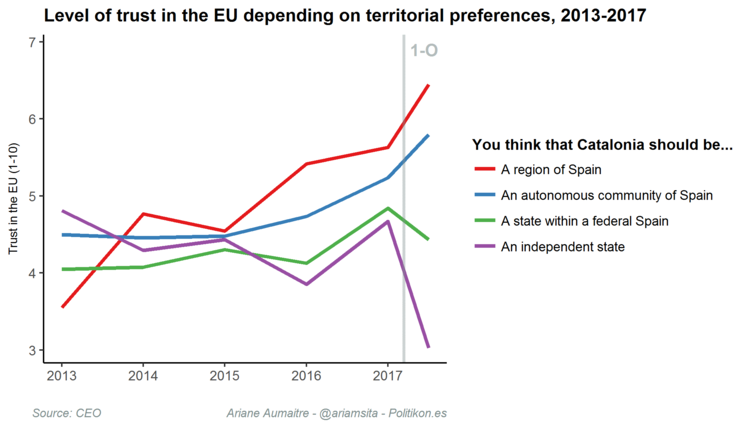
Nevertheless, independently of the negative economic impact of leaving the EU, how do Catalonians actually feel about the institution? The support (or the lack of it) from the EU has been crucial in politically dividing separatists and unionists. The EU has actively supported Madrid and legitimized its action, which many consider “undemocratic” (as the exercise of voting was denied by the Spanish central government). On the separatist side, many have called for European mediation and action to protect fundamental rights (freedom of speech, the right to vote, which the separatist faction considers that it was not respected), which was denied by the EU.  The fact that the EU has supported the Spanish central government and didn’t attend the separatist demands reflects on the trust towards the institution. Knowing this, trust in the EU has risen to those who consider that Catalonia should be a region of Spain (with no autonomy) and those who defend the current situation (as an autonomous region). On the other hand, trust in the European institution has been steeply decreasing to those who think that Catalonia should be an independent state or should be a state within Spain. Thus, as the desire for autonomy increases, so does the mistrust towards the EU and the greater is the breach between unionists and separatists. This difference was particularly sharp in 2017, especially after the referendum on October 1st. The (in)action of the EU and the Spanish authorities aggravated even more the already existent fracture in Spanish society.

1 (3).png

Also, before 2017, Catalan regionalism and “nationalism” was very pro-Europe, unlike other nationalist movements. For instance, Catalan participation in the European elections was 13 pp above the European average. However, after 2017, the relationship with Europe has bittered. As shown by the increasing of eurosceptic electorate by the party, PDeCAT (Catalan European Democratic Party), the most pro-Europe party in the region in 2016 became the third most eurosceptic, in 2017, also, newly elected Catalan Members of the European Parliament Carles Puigdemont and former minister Toni Comín were among those whose access to the EP was denied after the 2019 European elections.  With this, Catalonians felt attacked by the EU, as the MEPs chosen by 1.7 million citizens to represent them were denied accessibility to exercise their democratic rights. Naturally, this situation changed the feelings of attachment to the EU, varying among territorial preferences. Due to the events of 2017, independentists and people who identified themselves as only Catalan have naturally grown resentment towards the EU, while unionists and people who identify as only Spanish have increased their European support. Thus, the region’s relationship towards the EU has definitely depreciated.

2 (4).png


Beyond borders

Besides having consequences within its own borders, Catalonia’s pro-independence movement could also have repercussions outside. This could strengthen other separatist movements, such as in Lombardy and Venice (in Italy), Flanders (in Belgium), Scotland, Northern Ireland and Wales (UK) or the Basque country (Spain, again). This would divide Europe even more (as the unity and cohesion of the continent is constantly being threatened  over the last few years,  with the growth of right-wing nationalist parties and most recently, with Brexit).  For instance, in Flanders, the New Flemish Alliance, a nationalist, conservative party which has a relevant representation in parliament has been striving for a gradual and peaceful secession of the region from Belgium. It has been reported that the party even hung a Catalonia flag to support its pro-independence cause. In Lombardy and Venice, there’s more of an autonomy issue, as the northern regions of Italy feel that their taxpayer money is being used to support the poorer south rather than investing in the regions. In 2014, a non-binding referendum was held in Venice, with 89% of voters voting for independence. In the case of Scotland, the country also held a binding referendum in 2014, with separatists losing, having 45% of total votes. Nevertheless, with Brexit and the will of Scotland to remain in the European Union, the independence issue is constantly arising. Thus, pro-independence movements are still alive and the example of Catalonia can have a propeller effect and expand to other regions that have the same sentiment.


EU’s position


3 (1).png

Generally speaking, the EU has been regarding secessionist movements as a domestic issue,  meaning that these matters are out of the EU’s competences scope. If a region wants to emancipate as independent and wishes to remain in the EU, it must take all the steps, which can be a lingering, lengthy and costly process, to both parties. However, nowadays, this impartiality has to be questioned. With the rise of right-wing nationalism and populism (started with the refugee crisis of 2015) and Brexit, the very own existence of the Union is  threatened, as Europe is more and more divided. Thus, an independence movement would only imply, in the short-run, a greater division and a fall-out of the ideal of a united Europe . This helps explain why the EU has been a strong supporter of Madrid and “closed its eyes” to some questionable methods used by the central government. It may explain why it didn’t let Catalonia MEPs enter the European Parliament, even though it assumed itself as “impartial” regarding the whole matter. Thus, when the unity of the EU is at stake, any domestic matter becomes a European one.

As for now, protests continue in Catalonia, whether in the form of rallies at the Plaça de la Universitat or by blocking the Spain-France highway. Scots, Venetians, Flemish and all other pro-independence regions watch carefully how the Catalonian story unfolds. Nationalist societies, such as Poland, Hungarians and Russians also observe attentively the whole situation. The rise of identity politics, on both sides of the political spectrum, is a reality that the European Union cannot ignore anymore.

Meet Cyberwrite: the next step in cybersecurity

A brief introduction to Cybercrime

Crime and illicit activities exist since the beginning of the law-based society as we know it. In recent times, crime has taken a step forward in the way that, following the evolution of technology and the creation of private information networks, crime organizations found this technological revolution as a new approach to commit illegal actions. Cybercrime has developed massively in the last few years, evidenced by several cyber attacks and scandals that took place, in the Wikileaks case.

Cybercrime organizations, as Lazarus for example, intend to corrupt individual and collective networks, such as social media and bank accounts information systems. This activity is performed by Hackers, masters of computer handling and technological revolutionaries, that can work individually or for hacking organizations.

In 2012, The Wall Street Journal estimated loss to cybercrime to be $100M (although other reports placed that figure nearer to $1bn); Lloyds believed it to be $400M in 2015. In June 2017 the FBI reported losses had risen 24% in 2016 alone. A fundamental problem is that much of cybercrime goes undetected, causing regulators and financial services companies to change quickly, updating regulations and systems to improve detection rates and slowdown what is increasingly proving to be a cash cow for criminals

A recent case of cybercrime was the attack on SWIFT. Although it was stated that SWIFT provided a safe and reliable environment, over recent years, numerous hacks against SWIFT have been reported which has resulted in clients losing millions of dollars. Researchers have identified that a hacker group known as Lazarus were behind these hacks, linked strongly with North Korea. The attacks exploited vulnerabilities in the systems of member banks as the hacks allowed attackers to gain control of the banks’ legitimate SWIFT credentials. What’s more, these hacks can also implant malware which can remain hidden and allows a new resurgence of hacks later down the line. The hacks in 2015 and 2016 involved malware which issued unauthorized SWIFT messages which then concealed that the messages had even been sent. The malware, after moving the funds was designed to delete the database record of the transfers and basically leave the hackers to go undetected. A similar attack on Bangladesh’s central bank yielded $101m.

As U.S National Archives & Records Administration mentioned, “60% of companies that lose their data will shut down within six months of the disaster [i.e cyber attack].” Firms are becoming more aware of cyber risk and how destructive it can be. As a result, the number of firms contacting cyber insurance companies has been increasing and estimates suggest that the number will keep increasing in the future.


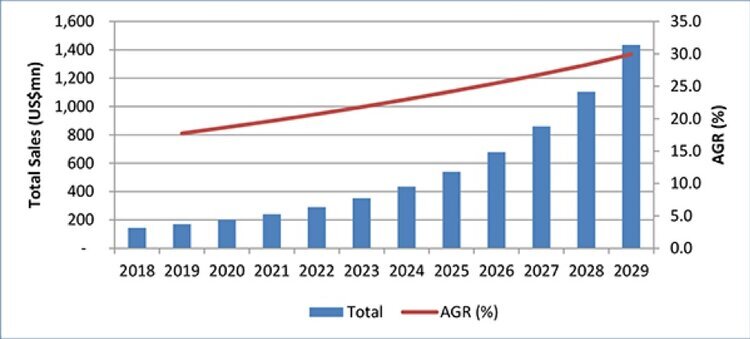
Forecast for sales of cyber insurance in South America. Taken from the cyber insurance market report 2019-2029Forecast for sales of cyber insurance in South America. Taken from the cyber insurance market report 2019-2029
The role of Cyberwrite

Given the volatile environment around cybersecurity and consistently enhanced technology, Nir Perry, Cyberwrite’s CEO and founder, acknowledged a market failure in the cyber insurance industry, with its core in two great issues:

● Small and Medium-sized Businesses (SMBs) lack the capital to contact insurance companies and, consequently, the skills to defend from a cyber attack.

● The majority of insurance companies were not exactly “cyber experts”. Meaning that they lacked the technology to underwrite their customers with due accuracy and come up with the appropriate policy. So, at the end of the day, they failed to effectively provide assistance to its customers.

Therefore, in 2016, the Israeli company was founded with the aim of helping insurance companies increase their sales through enhanced risk profiling, with a primary focus on SMBs. They are not, however, a cyber risk consultant nor a cyber insurance company. The company is financially backed by American and Israeli angel investors, as well as global investors and accelerators such as Citibank, SpeedInvest, Plug and Play and around 500 startups.

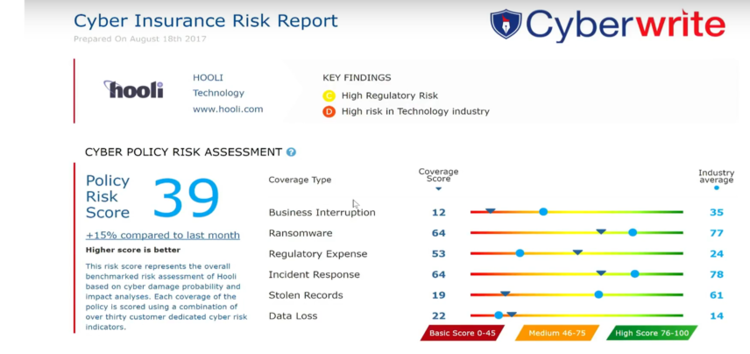
Cyberwrite develops cyber-profiling with the aid of AI algorithms to institutions such as insurers or banks in order to assess a profile of cyber insurance risks and estimate the financial impact they are exposed to, while comparing with the benchmark in a one-page “human-readable” report. The report we used is in fact an actual report, only the company’s name was changed due to confidentiality. So, their report is divided into three parts:

Cyber Insurance Coverage scores: Cyberwrite compares the risk score of the company with the benchmark of the industry. The higher the score, the better. In Hooli´s case, their risk policy score is relatively low. From the report we can check how a large share of their risk score is explained by the lack of coverage regarding Business interruption, stolen records and data loss.

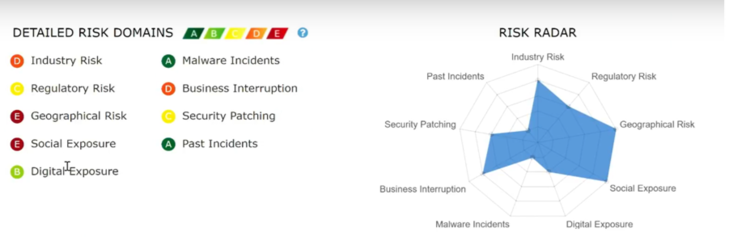
Describes the different types of cyber risk and compares with the industry benchmarkDescribes the different types of cyber risk and compares with the industry benchmark

From this specific report we can see how the high risk in industry [whichever industry Hooli belongs to] and the regulatory risk (risk that a change in laws and regulations will materially impact a business) are the major source of Hooli´s cyber risk. The risk is ranked from A [no risk] to E [extremely high risk].

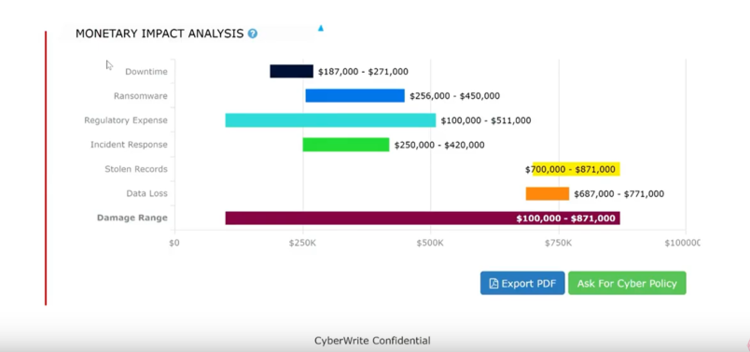
Provides a financial impact assessment (FIA) of a possible cyber attack.

Basically, it estimates in quantitative terms how much money the business has at risk. It also mentions the financial loss associated with each risk domain. The FIA is calculated through a simple questionnaire answered by the customer. Again, by checking Hooli´s FIA we can see how they can expect to lose from $100,000 up to $871,000 in case of a cyber attack. We can also check how a large share of this expected monetary loss is derived from the Regulatory expense. Which makes sense because, as we have seen before, Regulatory risk represents a large share of Hooli´s overall cyber risk.

cyberwrite4.png

It’s based on this FIA that customers can estimate how much they should pay to its insurance companies which is what, ultimately, increases cyber insurance sales.

To prepare this report, all Cyberwrite requires is the company’s name and its website. They then collect data from millions of sources all over the Internet in order to estimate the risk associated to the costumer.

This is a breakthrough in the cyber insurance industry, as it enables insurance companies to make a much more accurate estimate of how much to charge, making this market more accessible to SMBs. As a result, Cyberwrite has already received some important awards such as the UK Embassy’s British Award for Innovation in 2018 and was named a Cool Vendor in Gartner’s category “Cool Vendors in Insurance, 2018” being one in four insurtechs to ever receive this nomination.


Final comment

All in all, the insurance market is growing at a fast pace. Big budgets have been invested to ensure market-leading insurers are positioned at the forefront of change. It is estimated that approximately $1.7bn was spent in insurtech in 2016. A market that was previously known as change-averse is now developing rapidly with the aid of monetary expenditure and big data, which improves the creation and constant update of insurance models tailored to each business, as is the case of Cyberwrite. What we can expect is a continuous evolution of insurtech that is likely to improve market conditions for small and medium enterprises to emerge and grow and for big companies to continue thriving without safety constraints.

Veganism Impact on the Environment

In recent years, there has been a growing concern on the way we eat, being it motivated by health concerns, animal welfare or the environment. It is impossible not to have noticed the rising popularity of vegetarianism. Our generation is being strongly marked by change and the fight for what we believe in.

“Where millennials lead, businesses and governments will follow.” – The Economist

And so, markets adjusted to these growing demand for veg-friendly products. From the increasing supply of vegetarian products with even specific store sections, to the change in menus in your usual restaurants, to the emergence of new veg-friendly businesses, the change is visible everywhere. Even policy has changed. In 2017, the Portuguese Parliament approved a law making mandatory that every canteen and public cafeteria offers a vegetarian meal option.

When did this change happen?

According to Associação Vegetariana Portuguesa (AVP – Portuguese Vegetarian Association), this emerging market has increased 514% from 2008 to 2018. In this 10-year period, the number of veg-friendly stores increased 323%, existing now, in Portugal, 172 businesses of this kind (both restaurants and stores).

In Portugal, 120 000 people follow a vegetarian diet, representing 1.2% of the population. According to a study by Nielson, women and people between 25 and 34 years old are the ones representing a higher percentage of non consumption of meat, fish and dairy.

In touristic regions, vegetarianism has become a business opportunity, since these regions are not only searched for its traditional food, but more and more for the vegetarian offer, attracting a new type of consumers.

Nonetheless, there is a huge and worrying consumption of meat and fish in Portugal. Regarding meat consumption, according to Instituto Nacional de Estatística (INE – Nacional Statistics Institute), in 2018, the average Portuguese consumed 114 kilos of meat. Portugal is also the European country that registers the highest consumption of fish per capita, consuming 55 kilos, on average, per person each year.

The situation in Europe is not that different. The European Union accounts for only 6.8% of the world’s population, but are responsible for 16% of the world’s total meat consumption.

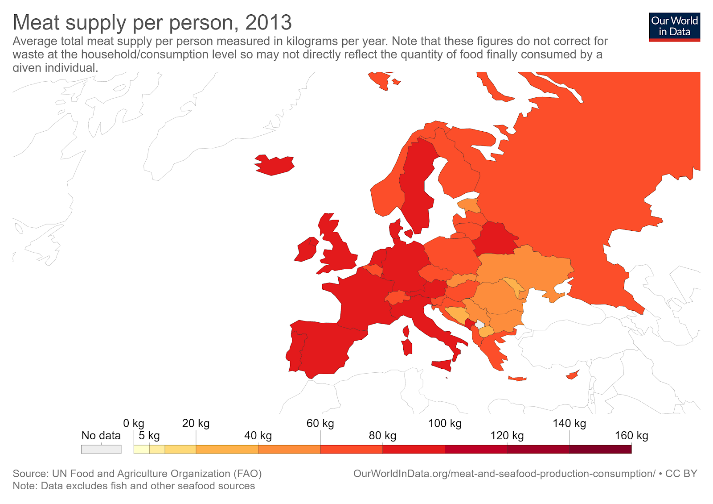
Analyzing the most recent available data (2013) from the UN Food and Agriculture Organization (FAO), Spain is the country registering the highest meat consumption per capita (94 Kg) and Georgia the lowest (28 Kg). In 2013, the average Portuguese consumed 88Kg of meat.  East countries registered much lower consumption per capita, when compared with western countries, which can be a consequence of average income, since consumption of meat is socially associated with a higher purchasing power.


dfbh.png

The impact of meat on the environment

What we eat has a huge impact on the environment, avoiding meat consumption is one of the most efficient ways to reduce the negative damage causing climate change. The amount of carbon in the atmosphere is rising every day and beef production is one of the main contributors. For every gram of protein, beef production releases 221.6 g of CO2  into the atmosphere. .

The impact of meat consumption is not limited to carbon emissions; producing beef also requires a lot of space and water. Every kg of beef requires 15 400 liters of water, lamb consumes 8 736 liters, while pig and chicken consume 6 000 liters. Vegetables, on the other hand, consume only 300 liters per kg. Furthermore, livestock provides only 18% of the calories we eat, farming them uses 83% of farmland.

A study by the University of Oxford, showed meat and dairy produces 60% of agriculture’s greenhouse gas emissions and takes ups 83% of farmland, but delivers just 18% of daily calories and 37% of protein. On top of that, early this year, Greenpeace stated that over 70% of EU farmland is used to feed livestock which means, for the production of meat and dairy.

A major downside of meat production occurred during the 1990’s, when 94 000 square km of forests a year were destroyed to plant crops for livestock, according to FAO. This has dangerous consequences for the environment. Nowadays, land retains just 1% of total CO2, while in the past, it was able to retain 7%. The UN recalls the importance of stopping deforestation, one of the causes of erosion and climate change.

The impacts of consuming meat are huge, starting by greenhouse emissions, passing through the large amount of natural resources needed, and ending with pollution. In fact, water pollution is one of the main consequences of meat production. Besides, animal waste and fertilizers end up degrading water suppliers, which causes severe negative impact on biodiversity.

BBC states that, eating a steak a day, in one year, is equivalent  to driving 11 571 km or taking 8 flights from London to Malaga, and it uses the space equivalent to 31 tennis courts. 

What can we do about it?

United Nations agencies such as Food and Agriculture Organization and the World Health Organization recognize that decreasing meat consumption would positively impact the environmental problems. Furthermore, the European Union agriculture outlook showed a study pointing out that reducing 50% of meat consumption as well as dairy products and eggs, would allow for a reduction of around 25% to 40% of agriculture greenhouse gas emissions.

For this ending, there are several movements promoting a lower meat consumption. One of them is the Meat Free Mondays movement, which was occurring in 29 countries worldwide in the beginning of 2014. Plus, there are several organizations established around the world with the purpose of promoting a Meat Free life and animal welfare. Some names to consider are Eurogroup for Animals and People for the Ethical Treatment of Animals which are directed to the developed countries, mostly the wealthy and middle-class citizens. However, there are also organizations whose target involves worldwide population and which promote sustainable agriculture and food consumption such as La Via Campesina in 79 countries within 5 continents worldwide, such as More and Better, and Food Sovereignty Movement.

Another major contribution to reduce the negative impact of meat on the environment is the protein substitution. This is a solution mostly targeted at the wealthy and middle-class populations who are typically more concerned about having a healthy diet and who can afford for these alternative products. To reduce this impact created, there are several protein alternatives to opt for such as tofu, quinoa, lentils, nuts and nut butters, seeds and tempeh; other than that, there are also high protein vegetable sources which are affordable to everyone such as some vegetables (spinach, broccoli) and legumes (beans, chickpeas). An interesting example is South Korea, a country where plant protein is highly demanded through the consumption of aquatic plants.

Nowadays, it is even easier to avoid meat consumption since there are several companies creating alternatives. Examples are Tofurky with a wide range of plant-based proteins such as beef, chorizo, sausages, or non-beef burgers from Beyond Meat and Impossible Burger. In fact, the demand for plant-based foods has grown from 8% in 2017 to 20% last year in America.

“If the average American cut just a quarter pound of beef a week from their diet, it would be the equivalent of taking 10 million cars off the road for a year”.

— Bergen Sujatha

Lastly, the promotion of local feed production also decreases ecological footprint: it does not only avoid the transport of live animals and the typically highly and unhealthy processed meat products, but also has a lower impact on the environment than the mass production of the meat industry.

Studies show that in the United States food typically travels up to 4000 km before getting to one’s plate and in the UK, food is traveling 50% farther than it used to twenty years ago.

The number of vegetarians has been rising since the last decade. It shows that society is becoming more aware about how we can tackle the issue of climate change. The way we eat has a huge impact on the environment.  It is one of the most powerful drivers behind most of the world’s major environmental issues, whether it’s climate change or biodiversity loss. Changing your diet can make a big difference on your personal environmental footprint, from saving water to reducing pollution and deforestation.  It is imperative to do something to stop greenhouse gas emissions and it can start from small changes. Every small change has a huge impact if we’re all committed to a bigger cause. Together we can cut our footprint just by doing small changes in the way we eat.  It is in our hands to stop climate change.

Sources:O Jornal Económico, Público, BBC News, Euronews, The Guardian, The Conversation, Vegetarian Center, New Food Economy, Portuguese Vegetarian Association, Medium


Untitled.png

Making Money in a Recession

Despite not agreeing exactly when will the next recession hit, most economists agree that it isn’t far in the future. The longest Bull Market is coming to an end, so investors should transform their portfolios to gain or reduce losses during the next economic downturn. The options are diverse, and we tried to narrow them down to the most common and effective.

Short selling

Everybody has heard of the renowned movie Big Short and how rich Michael Burry and Steve Eisman (known in the movie as Mark Baum) got, but few understand what a short sale is.


Michael Burry: The genius behind the Big Short Source: CNBC

This investment mechanism consists in selling an asset or stock that the investor doesn’t own. Anticipating a price decline, an investor sells the previously borrowed securities having to return the same number at a later date, meaning that he intends to sell when the price is high and buy back when the securities are cheaper. The lender of the securities is the broker-dealer that the investor relies on to place a sell order. This trade is made on the margin and is leveraged, meaning an investor can make much more money than the amount of the securities, but it also represents a risk if the price increases instead of declining. This type of investment requires that 150% of the value of the securities stays in an account.

Due to its risks and margin requirements, short selling is not adequate for amateur investors or small investors due to its raised expenses: costs of borrowing the security to sell, the interest payable on the margin account that holds it, and  high trading commissions.

In times of recession, short selling poses high returns, particularly for experienced investors that predict Bear Markets before they happen. Overpriced securities are the most targeted by short sales since they fall the most in an economic downturn.

Gold

Gold has been perceived has a safe haven investment for hundreds or even thousands of years, especially in times of uncertainty in the financial markets similar to the ones we live today.

Historically it has always been used as a physical store of value due to its rarity and traded back and forth to protect value in times of war, recession, political turmoil, etc. Since gold cannot be printed and its price is resistant to changes in interest rates, gold has tended to maintain its value throughout time.

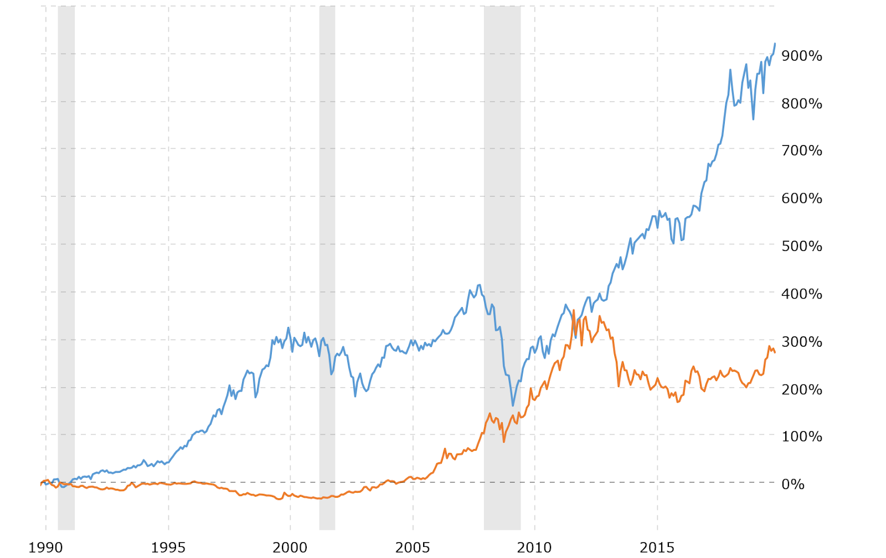
When we compare it with stock indexes (S&P 500 or Dow Jones Industrial Average), it is evident that the price of gold has continuously increased, but with much lower variations. Another aspect that stands out is the negative correlation between stocks and gold notably in times of recession: in the Dot Com Bubble in the 2000’s and in the Subprime Crisis of 2008, investors withdrew their money from stocks and stockpiled it in gold and gold derivatives. This last statement can be verified in the graph when the stock market takes a dip, gold prices raised especially before and during periods of recession. 

But how do we invest in gold? The easiest way is to buy physical gold or goods made using this rare mineral, like jewellery or coins, in the private market. But the amount we can buy this way is very limited and may not be correctly priced. Therefore, to bet on the variation of gold’s price or of other physical commodity in the public market, an investor can buy/sell Gold Futures, ETFs, Mutual Funds or stocks belonging to Gold Companies.

Even during bull markets, gold-related assets are essential in a well-diversified portfolio to guarantee stability and steady returns.


Variation in Dow Jones Industrial Average (Blue) and Gold’s Price (Orange) Source: Macrotrends

What are consumer staples?

Consumer Staples are everyday used products by households that will continue to be used regardless of their cost or the state of the economy. These types of products are unlikely to be cut from any individual budget as the consumer is unable or unwilling to do so. The level of demand on these products tends to be rather constant. Consumer staples go from foods, beverages and drugs to basic household goods like hygiene products.

These type of good are less volatile during economic cycles (non-cyclical) due to its high demand and level of utility, revealing its constant level of demand. Hence, sales and earnings growth in the consumer staples sector tend to remain constant both in good and bad times. Price elasticity of demand is very low, as the demand in this type of product doesn’t react much from changes in the prices of these goods.

What are utility stocks?

Well, utility stocks are stocks related to firms in the Utility sector, a sector in which companies provide basic amenities such as gas, water, electricity or even renewable energies. Investors often include these types of stocks in their portfolio due to their relative stability. Thus, like consumer staples, these utility goods are less volatile during economic turmoil due to their necessity and utility provided.

Utilities are often associated with stable and consistent dividends and the betas of these type of companies are usually less than 1 due to their ability to be less volatile than the equity markets. Hence, during economic slowdowns or even recessionary times of the economy, utilities tend to perform well under these hard circumstances. However, in the opposite case of an expansionary period, utilities might be stocks that will underperform the average. Not only because of the beta’s value but also because utility companies usually have high levels of debt (due to infrastructure needs) and during economic improvements, interest rates increase and investors are able to find better yielding in other alternatives such as Treasury bills. Therefore, utilities perform well under economic slowdowns since interest rates decrease and the yield related to utility stocks is greater than the risk-free assets.

What are healthcare stocks?

Healthcare stocks are stocks in this case related to firms in the Healthcare Sector which consists of businesses that provide medical services, manufacture medical equipment or drugs and/or provide medical insurance to patients. In the U.S., the healthcare sector is one of the largest accounting for one fifth of the total annual GDP. Healthcare services are associated with highly price inelastic meaning changes in prices have a little effect have on the quantity demanded.

Holding an all-stock portfolio such as the S&P 500 index fund can be improved by simply adding a value-weighted healthcare portfolio, resulting in both a higher return and a lower standard deviation (diversification-effect). Healthcare stocks were the strongest performer in this index in 2018. However, this sector is becoming more volatile with the slowing of corporate earnings, trade wars and rising interest rates.

ETF

An Exchange-trade fund is a security made of a basket of different securities combined in a single entity, which then gets traded like an ordinary stock in the major stock exchange markets.

The ETFs generally can track an infinite range of benchmarks, from commodities to every possible stock, with the purpose of getting has much return has possible in all the different segments of the markets chosen. They are most usually focused on the same type of security and so they can be characterized as Stock, Bond or Commodity ETFs. 

To invest in an ETF, you first need to choose the benchmarks you are willing to risk your money on as the economies they’re in, while also bearing in mind the proportion each company takes on that ETF.

ETFs have its pros and cons which, on the good side, offer horizontal diversification of securities and transparency, since with the help of the internet we can see its true value based on what’s inside of it, but on the other side you have trading costs related with expense ratios and commissions to brokers and the fact that very specific ETFs may not have high demand levels, making it harder to sell it in the short-run and so, less liquid.

Some of the most well-known can be the SPDR S&P 500 ETF that replicates the famous S&P 500 index, which is the general overlook of the biggest 500 public companies in the world, the SPDR Dow Jones Industrial Average ETF and the Invesco QQQ, which also track the Dow Jones and the Nasdaq-100 indexes, respectively, both providing the industrial and technological overlook of the US economy. These three ETFs have positive correlations with the evolution of most relevant global economies and so, they deal with a great variety of market segments, making you invest not in any particular benchmark but in an economy, which is not the case for the majority of them.

REITS

A real estate investment trust (REIT) is a corporation that owns and manage income-producing properties

They can be characterized in three different ways, them being:

  • Equity REITS

It is the most common one, which owns and manages real estate directly, being the revenues from the leasing and rents of tenants the primarily form of income and not the reselling of portfolio.

  • Mortgage REITS

It is mainly focused on financing real estate and the revenues are generally made by what’s earned from the interests of those mortgage loans. Also, they invest in and own residential and commercial mortgage-backed securities for their portfolios.

  • Hybrid REITS

It performs both equity and mortgage operations.

REITS can either publicly traded or private whilst the traded ones provide more liquidity to the investor than the private ones.

Investing in REITS may have its risks and most of them are directly related with the real estate current market: if property assets start to lose value, their investor will be harmed with that.; the volatility of interest rates, given that a decline in them will consequently give an opportunity to decline as well the assets rate of return; and the fact that real estate isn’t a liquid asset; However, this market shows that real estate tends to appreciate over time. In most cases there are steady flows of income from tenants if the properties are being rented and that in the long-term real estate tend to be quite profitable.

US Treasury Bonds (T-Bonds)

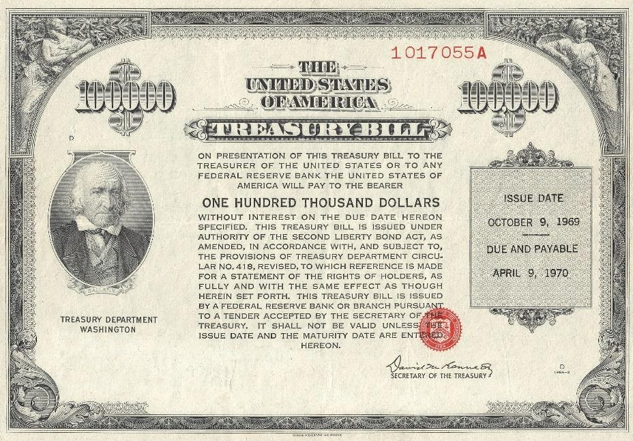
A US Treasury bond (T-bond) is a government debt security that ranges from 10 to 30 years maturity wise and it is known to be one of the safest investments worldwide.

The US Treasury has been around since 1776 and not once has failed to pay its lenders. Also, given that this security is backed by the “Full Faith in Credit“ clause of the United States, it faces a default risk of almost nothing, so, if the main goal to invest is to not lose money, then they are the right security to invest.

However, although being acknowledged as a risk-free asset, there are still some factors that need to be accounted before investing in it.

  • The Opportunity Cost

Considering T-Bonds are evaluated as AAA assets (risk-free), then, that will have an effect on its yields, which will consequently be lower than other potentially profitable assets with higher defaulting risk. The urge to not lose any money may let investors ignoring other safe and with high returns investments.

  • The Inflation Risk

If the T-Bond is not linked with a TIPS (Treasury Inflation-Protected Securities), the inflation risk must be acknowledged by the investor. For example, if the security provides a return of 3% and 5% inflation is occurred, then the investor will come out short since the return is not keeping up with inflation.

  • The Interest Rate Risk


Picture15.png

If the investor hopes to hold the bond until its maturity, then this risk does not need to be accounted. However, if that is not the case, then the investor may have serious problems to liquidate its investment if the Fed decides to increase the interest rates. This happens because, if new bonds are being issued at higher levels of return, then the demand for the original ones will fall causing the price of the bond to follow that same direction.


Martim Leong - Martim Leong Francisco Nunes - Francisco Nunes

João Ribeiro - João Ribeiro