
Should We Fear the Next Recession?

The past weeks have been tense for the financial markets, with the stock market reacting negatively to the inversion of the Yield curve, one of the most preeminent indicators of recession in the past, which adds up to the failures registered in the last two years in making the economy dynamic again (via extremely low interest rates).

The truth is that the alarms are starting to ring in several fronts. Tensions between the US and China increased concerns among investors, and may deteriorate the whole economy, taking another step towards the recession. Investors have started to leave the common equities to take refuge in sovereign debt and gold, with the latter one being traded at around 1500 dollars (28.3% increase in the last 52 weeks according to Bloomberg), the highest since 2013.


Germany

Financial data about Germany, the strongest economy in the eurozone, also shows that an economic breakdown could be just around the corner with the country’s interests in sovereign debt negative in all the available periods (including the 30 years bonds) helping keeping the country slightly above the recession line.

The PMI (Purchasing Managers’ Index), a widely used economic activity indicator, stated a decrease in the country’s performance (43.5 in a scale from 0-100 where values below 50 indicate an expected retraction) and the industrial production registered the biggest fall of the last ten years (being affected by the US-China trade war in the exports field).

If we add up all this data to the fact that in the last year the country barely avoided a technical recession (GDP contraction for two consecutive quarters), it might be possible that the recession in the eurozone’s biggest economy is close to happening and with that its main traders will suffer repercussions.

To support this opinion, the reading of this year’s data about Germany’s economic performance is recommended, since this last quarter (April-June) the economy sank 0.1%. Next quarter prospects are not that good as well, but will depend on the markets’ reactions to the new quantitative easing programme (which will be launched in November).


Monetary Policy

Negative interest rates? Once seen as an anomaly, negative interest rates are becoming increasingly more common since the last financial crisis. Among the countries/monetary unions with «subzero» interest rates we have Denmark, Japan, Sweden (the first to adopt the strategy), Switzerland and the Eurozone.

Mainly used as an extension of the traditional monetary policy tools to avoid deflation, encourage lending and promote economic growth, these policies have lost their catalyst power, with the economy being “trapped” into an inefficient mechanism that contributes more to feed the Assets and Real Estate “bubble” than to give a temporary stimulus for a sustainable growth in the future. (Housing prices in the US are 8% higher than at the peak of the real estate bubble in 2006, and the CAPE ratio, Cyclically Adjusted Price to Earnings Ratio, that is generally applied to broad equity indices to assess whether the market is undervalued or overvalued, is also higher than in 1929 and 2008).

In fact, the bond market with negative yields already reached 17 trillions, roughly 30% of its entirety, which reveals the uncertainty amid the remaining market (not to be confused with the bond market, which is historically safe), with people willing to lose some money in order to avoid major losses.

It is also worth mentioning that these measures do not give signs of stopping, since Mario Draghi decided to restart ECB’s economic stimulus efforts with a quantitative easing programme of €2.6 tn, an act heavily contested by some of his peers in the Central Bank such as Klaas Knot, Dutch Central Bank governor, who said “this broad package of measures, in particular restarting the asset purchase programme, is disproportionate to the present economic conditions” and also “there are increasing signs of scarcity of low risk assets, distorted pricing in financial markets and excessive risk-seeking behaviour in the housing market”.

The Central Banks of Thailand, New Zealand and India have also started to cut heavily on the interest rates, more than investors were expecting, putting the monetary policy concerns into a globalised proportion.


Trade War

In the geopolitical arena, we have another big threat to the current weak balance of the worldwide economy: the worsening of the commercial tensions between the US and China, which has been speculated to degenerate into a currency war. This derives from China’s reaction to the implemented tariffs in every Chinese product applied by the US, that resulted in the devaluation of the Renminbi, with all the consequences that this measure means for the trade balance. Also regarding this topic, it is important to mention that China’s economy grew at its slowest pace in almost three decades in the second quarter of this year, as the trade war with the US took its toll on exports. Despite remaining with relatively good income and consumer spending growth rates, the year on year growth rate was “only” 6.2%, the lowest since 1992.

Maybe it is only one more episode in an endless novel, with both sides continuously failing to find a solution to their divergences, but as the time passes and the patience burns out, this might escalate into even more serious issues, with Bloomberg predicting a 0.6% decrease in global growth if the two countries expand their tariffs to all goods and services.


1.png

2.png

Yield Curve Inversion

Even more distressing is the inversion of the Yield curve of US Treasuries, that basically retracts the evolution of the 3 months interest rate versus the 10 years’ one (we can compare several periods within this range), meaning that the cost of borrowing long term is falling below that of borrowing short term, which is the opposite of what it should be. This phenomenon reflects investors’ collective uncertainty towards the current economic outlook and is thought to be the biggest warning to the markets since the 2007 recession, with investors turning to safer assets, such as the 10-year treasury bonds.

This is supported by the fact that the last 5 recessions were all preceded by one of these inversions (approximately between 12 to 18 months after). Despite this historical data, it is also important to bear in mind the economic environment we face today, since the extremely low interest rates in the eurozone and Japan and the mistrust of the investors are increasing the demand for US treasury bonds.

Naturally, and following Alfred Marshall’s law (Demand and Supply), the prices of the bonds are increasing and consequently the yields are decreasing in the same proportion, contributing for the inversion of this curve.


Counterarguments

Nonetheless, it is important to mention that there are also positive signs within the economy that might, at least for a while, dispel the recession. These signs include the fact that the low bond yields are widely explained by the aggressive monetary policy stimulus, that might distort a little bit the effectiveness of its predictions. Also, in the yield curve “field”, its small amplitude when compared with the likes of mid 70’s and early 80’s in terms of percentage, until a certain extent reduces the urgency of the warning.

The fact that the S&P 500 is just a few points below July all-time high,which signals goods expectations among the investors in what concerns corporate earnings.

Lastly, and perhaps one of the most important indicators, the fact that wages are growing strongly and the spectrum of deflation, characterized by a general decrease in the prices of goods and services with its implications in terms of wages, is for now a distant reality. This is of huge importance for the US, given that their economy is based 70% on consumption. (Wages grew 4.7 percent annualized in the second quarter of the year, US poverty rate has fallen to its lowest level since before the last financial crisis and Bloomberg Consumer Comfort index that assesses buying climate and personal finances reached an 18 year high, motivated by the good atmosphere that surrounds both the job and equity markets, with its value being fixed in 67.4 by 14th July.)


Conclusion

The past and the economic background that comes with it tell us that the inversion of the yield curve should be considered a serious foreshadowing of a recession, although the current economic atmosphere might have until some extent distorted the trustworthiness of this predictions. It is also important to state that a recession is not necessarily dreadful or horrific, it is indeed natural and takes part in all economic cycles.

However, alongside with continuous decreases in interest rates, trade wars, China’s growth deceleration, wealth and income inequality and others, a recession can be indeed “horrific” and “dreadful”, since it might trigger a more serious economic and political crisis, posing important challenges to government policies, that each day are getting more exposed with the decreasing power of one of its major mechanisms, the monetary policy.


Behind the Portuguese Miracle

As is commonly known, the Portuguese economy has been appearing to turn itself around quite remarkably in the last 5 years.

The unemployment rate in Portugal has been going down considerably, being now at 6.3%. The unemployment rate reached its peak of 16.2% in 2013 after a big economic slowdown due to the international crisis of ‘08, that led to the sovereign debt crisis in Europe [PORDATA].

At present times, Portugal’s unemployment rate is at 6.3% [STATISTICS PORTUGAL].  Portuguese wages also appear to be improving, the minimum nominal wage went up from €485 per month in 2014 to €600 in 2019 [PORDATA]. In the past 5 years, the average Portuguese nominal monthly wage went up from €1,120.4 to €1,170.63 [Gabinete de Estratégia e Planeamento].

Not so long ago, GDP growth in Portugal was negative and now is higher than the European Union’s average. In 2012, GDP growth in Portugal was -4.0% and in 2018 was recorded to be 2.1%, higher than the EU´s growth of 1.8% [Banco de Portugal]. It is expected that in future years Portugal´s GDP growth will continue to surpass Europe´s average growth.

Portugal´s budget balance in past decades has been a dreadful number to look at, it has always been negative and since 2008 has reached incredibly low numbers, coming to a very big trough of -11.2% of GDP in 2010 [EUROSTAT]. However, outstandingly, Portuguese deficit had a big upturn in the past recent years. In 2018, deficit was only 0.5% of GDP and according to the Portuguese government and it is forecasted to be 0.2 % of GDP in 2019 and the budget balance is expected to have a surplus of 0.3% in 2020.

Looking at this numbers, one would think the Portuguese economy is growing at quite an outstanding pace for a developed country after suffering such a hard-economic recession. One would also think that the Portuguese economy has showed the capability to turn itself around. However in order to understand this big “economic upturn “, one needs to look beyond the appealing numbers and analyze the “not so great“ numbers behind them.

Portugal´s Nominal GDP was around €201 billion in 2018, the highest number since 2011 [INE]. However, Portugal´s nominal public debt is already at 252 billion euros, the highest ever on the history of Portugal [Banco de Portugal].

In the present economic cycle, interest rates have been something to worry less and less about since they have been going down on most bonds and in some they are even negative. Currently the Portuguese yield curve is in negative territory until 8 years of maturity. Portugal´s budget balance has certainly benefited from this, since interest expense has gone down outstandingly in the past year. In August 2019 interest on public debt on 3 years bonds was -0.43%, on 5 years bonds was -0,262 % and on 10 years bonds was 0,2 % [Bloomberg].

Tax revenues in Portugal are higher than in the past two decades, being 35,4% of GDP [INE]. Although wages are higher, so are taxes, especially indirect taxes, creating amongst the people an illusion of higher consumer power than reality upholds.  

Noticing the outstanding growth of tax revenues and the big decrease on interest expense, the big improvement on the Portuguese budget balance doesn´t seem that miraculous anymore. 

Even though deficit is now lower and GDP is higher, public debt keeps growing at an outstanding pace. This economic cycle in which interest rates are negative or extremely low hasn´t come to stay and once it leaves it will generate a big financing problem. Since taxes are the government’s main revenue and are as high as they can be there will be no sustainable way to finance the Portuguese economy when interest rates rise.

In an open economy like the Portuguese’s, fiscal revenues tend to be very elastic and expenses quite rigid. In 2008/2009 after the recession, tax revenue went down 14%, and if there is another slowdown in the economy most likely fiscal revenues will go down extremely. The big problem Portugal faces is that in a recession, current expenses will remain pretty much the same or even increase due to jobless claims and therefore deficit will tend to increase.

Still it is questionable how a country that has been increasing its debt year after year has also been decreasing its public investment. Portugal´s public investment has gone down on average 12.28% in the past three years, showing that Portugal is not generating future sustainable income [INE].

It is safe to say, that even though Portuguese economy looks as if it has turn itself around, Portugal´s economy is without a helmet and once it trips the fall is bound to be a hard one.

“Whatever it takes” until when? ECB monetary policy of the last 10 years

On the 12th of September, the European Central Bank (ECB) decided, after three years of unchanged monetary policy, to cut the interest rate on deposits to -0.5% and to restart, although with small dimension, Quantitative Easing in November with purchases of 20 billion euros of bonds. At the end of his mandate, Mario Draghi, the ECB president, does a last attempt to fulfill the ECB objective: price stability. In this article, on the one hand, we explain how these two measures will fulfil the ECB’s goal and, on the other hand, possible outcomes for the European economy.


An expansion for the last 10 years

The objective of the Central Bank is, indeed, to ensure price stability, that materializes in having the inflation rate below, but close, to 2%. Since the creation of the ECB, and up until the Great Recession of 2008, this goal was achieved, with some minor exceptions. However, since this major event, the achievement of this goal has been more problematic; in particular, in the last 7 years, the inflation rate was consistently below the target, with some years registering a negative inflation rate (meaning prices were falling). Furthermore, looking to the last year, we observe a fall in the inflation rate.

A Central Bank, and in particular the ECB, has several instruments to execute monetary policy. The conventional ones are the interest rate on the main refinancing operations (MRO), which provides the bulk of liquidity to the banking system; the rate on the deposit facility, which banks may use to make overnight deposits with the Eurosystem, and the rate on the marginal lending facility, which offers overnight credit to banks from the Eurosystem. Besides that, the ECB also has unconventional instruments, from which the most famous is the Quantitative Easing programme that consists in the Central Bank buying government securities from the market, thus increasing the money supply, as an attempt to “directly” inject liquidity into the economy, thus encouraging lending and investment. This is an efficient alternative when short- term interest rates approach zero, and open market operations lose their effectiveness. During the last decade, the ECB has been decreasing their interest rates persistently and it was in 2014 that the deposit facility interest rate became negative for the first time.

In fact, Mario Draghi’s popular speech in 2012, when he said that he would do “whatever it takes” to battle deflation, has been the perfect representation of the dovish behaviour of the Central Bank.

This conduct has prevented economic slowdowns in the recent years and, again, it is being used right down to prevent the recession that is expected by the markets in the future, although this is out of the scope of the ECB, the latter being the major difference between the European Central Bank and the North American Federal Reserve.

Euro Zone Inflation rate (HCPI) and GDP real growth rateEuro Zone Inflation rate (HCPI) and GDP real growth rate

The implications of an Expansive Monetary Policy

However, there is a lot of controversy around the stimulus presented by the ECB. On the one hand, by decreasing even more the deposit interest rate, the ECB discourages banks to deposit their money in the Central Bank and, therefore, encourages them to lend it to their customers more easily or to invest it in financial markets. In fact, it is important to have larger amounts of currency in circulation, since this way, households will spend more because they feel wealthier and investors will have more funds to allocate in their portfolios. In other words, the goal is to stimulate consumption and investment and, hence, economic growth.

Moreover, the banks themselves also have greater incentives to invest their surplus (this is, the amount of money they have besides the minimum reserves stipulated by the ECB) since, with negative deposit rates at the Central Bank, investments in financial instruments that are considered nearly as safe as deposits (for example, German bunds) yield a better return, and thus are seen as better investment opportunities. In this way, also the financial markets are stimulated and there are more flows of capital for investment. With the purchase of assets through QE, the ECB can, effectively, when the financial system is under stress and risk premia are high, raise prices of assets, reducing their yields. Consequently, governments have more incentives to increase public investment. This is, indeed, a concern of the ECB, as it has been demanding, from national governments, more fiscal stimulus.


Problems of a long-lasting monetary policy

There are also several problems associated not only with negative rates, but also with the asset-purchase program. Given that rates are at historic lows, each additional stimulus will have to be reduced and, therefore, the effect will not be sustainable enough to provide economic growth; instead, may have adverse effects on fragile banks of the Eurosystem, taking into account that banks are forced to reduce interest rates on deposits for their customers and, as such, suffer great reductions in their profits. Furthermore, the ECB already has 25% of the bonds issued by Eurozone governments, which means that the values of these assets are superficially higher and as such, the balance of the assets of euro area banks does not reflect their true value, which at the end of the QE program will cause major problems for banks. Something to also keep in mind is the risk of being at the famous “zero lower bound” (also known as “liquidity trap”) when the next recession hits. If the interest rates set by the ECB are still this low when the European Economies start really slowing down, the monetary policy will have no room to stimulate the economies and have them grow again. In an era where the southern European countries are still plagued by the large debt levels from the aftermath of the Great Recession, and thus have limited capacity to conduct expansionary fiscal policies, stimulating methods could very well be running short.

Finally, another problem underlying the ECB’s policy is that this is not a normal central bank, but a central bank that serves a confederation of countries and, as such, is subject to conflict of interests from each part in their decision process. In recent years, it has been evident a big difference between the northern countries (such as Germany and the Netherlands), who do not want more stimulus since their inflation figures are above the Euro-area average levels and not so far from the 2%; and the countries of the south, such as Spain and Italy, facing situations of political instability and inflation figures close to zero and needing that extra help to see their economic output grow. As such, the President of the ECB must consider a wide range of realities and, consequently, the decision process results in delays and half measures and the effect is not as substantial and immediate as it should. One example is that this announcement lead to the decrease of more than 20 basis points of the Italy’s 10 years bond yield.


Where will policy be heading next

Currently, it seems that there is no reason for worries and no need to anxiously implement stimulus in the economy since, although economic activity has weakened in recent quarters, it is still much better than in March 2015, when the ECB introduced the QE program. Headline and core inflation are also at higher values as well as inflation expectations from customers. As said by the Dutch central bank chief Klaas Knot, “the only observation [about the Euro Area economy] is currently that the inflation outlook lags behind the ECB’s aim”. However, there are, undeniably, some international threats as such the trade war which may affect some sectors of activity (mainly, manufacturers) in the euro system economies; Brexit, whose future is still very uncertain and entails mistrust for firms and investors; and, among others, political instability in Italy. Hence,

European countries will go through unknown paths in the next months and the future of the economy is quite unpredictable nowadays.

This is why Mario Draghi decided to bring back in the end of his mandate the monetary weapons, that allowed him to win some battles in the past and called governments to action by saying that monetary policy alone is not enough and fiscal policies are also important to keep economies moving in the right way.

Tiago Bernardino Tiago Bernardino Diogo Costa Diogo Costa


Big Brother is watching us. Should we be scared he has started talking?

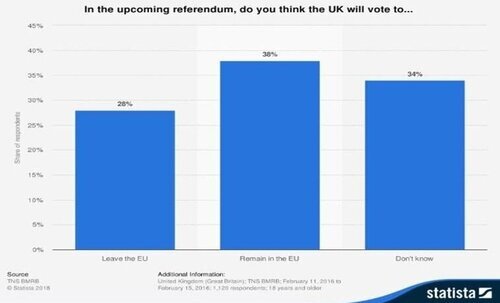
The Brexit Campaign left Europeans at the edge of their seats. At the dawn of the conversation, the result was completely uncertain. Polls gave a solid 10% lead to the remain vote, however, there was a strong candidate in this referendum – “I don’t know”. This uncertainty was immune to traditional political advertising, which by using billboards and TV, failed to target specific audiences, feeling quite disconnected and generic. This void was what its online version came to fill. Online political advertising is the medium by which existing or insurgent parties and movements attempt to gather votes or increase their following through untraditional media forms, such as social networks or online ads.


In the upcoming referendum, do you think the UK will vote to…In the upcoming referendum, do you think the UK will vote to…

Technological advancements have made social media and the internet in general the most accessible forms of mass-communication, creating fertile soil for the creation of targeted ads. Political parties took advantage of big data harbored by digital giants such as Facebook and Google to dig out the political concerns of billions of individuals,1 which allowed political parties to, better than ever, know the following things: the main topics of concern, which groups worry about them the worst, how these groups feel about the parties that currently address them, and, perhaps most importantly, the forms of media they are most susceptible to.

The European Union has seen an extreme growth in the use of online political advertising in the last half of the decade. In the UK, for example, spending on digital ads as a proportion of total ads increased from 1.7% in 2014 to 23.9% in 2015, reaching 42.8% in 2017.

This tool has become increasingly dominant in an ever-more polarized and competitive landscape, in which the traditional parties have started to come under threat by the insurgence of new movements, many of which wouldn’t have come into the spotlight if not for hefty media investments.

The association of microtargeted political advertising with the advent of new, extremist movements is not at all unreasonable. The rise of Alternative für Deutschland (AfD) in Germany, for example, can largely be attributed to an extensively developed social media micro-targeting strategy conducted with the help of Texas-based advertising firm Harris Media, who had successfully ran campaigns for Donald Trump and Marine Le Pen. 3 AfD managed to become, in a short time, the countries’ third political force, with 12.6% of votes in 2017’s national elections.4 Spanish party VOX, which gained 6.21% of votes in most recent elections,5 also had an aggressive online marketing strategy, having become the most followed Spanish political party on Instagram.6

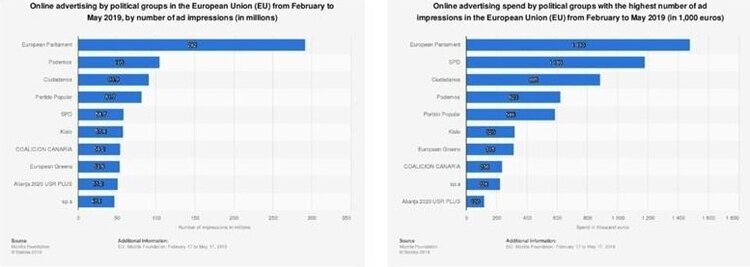
Interestingly, however, the highest investments in online political advertisements came not from these sunrise parties, but from traditional ones. As can be seen in the graphs below, the highest outreach and investments in online political advertising in 2019 came from traditional parties in countries such as Spain, who has yet to form government, and Germany, whose election results made a complicated coalition necessary. In fact, we can assume that this aggressive allocation of these parties’ sizeable advertising budgets aimed at opposing the imminent threat of new, populist movements and posed as an attempt at regaining political trust and credibility in the general audience, who with them has become out of touch.


Online advertising by political groupsOnline advertising by political groups

However, there is a clear front-runner in the use of this media form – the European Parliament. In spite of, in principle, not making use of microtargeting, this shift to a more prominent online presence makes sense when faced with the enormous apathy towards EP elections shown by voters. In the 2014 elections, abstention won with a staggering absolute majority – 57.39%.7 This obviously worried the EP, who launched online programs such as This Time I’m Voting and multiple Instagram, Facebook and Twitter campaigns which did not go unnoticed. The extent to which this affected the decrease in abstention to 49.38% is,8 however, a matter of debate.

Nonetheless, this comes to show that online political advertising, due to its outreach, has the potential to be used towards more universal causes such as the need for political engagement and to raise awareness for environmental concerns, and less such as a tool of tailored manipulation. However, the statistics regarding the first presented example, the Brexit referendum, present a hard truth. In 2016, “Leave” groups spent £ 4.45 million in online campaigning and microtargeting, with “Remain” investments far behind at £1.91 million. This leaves room to wonder – had things been more balanced, would the outcome have been radically different?

More recently, this year, Britain’s Future, a no deal Brexit group flaunted the highest number of political ads of any UK party, at an impressive 2.354 figure, meaning they had ads for every possible consumer. In addition, they spent 366 thousand pounds against Theresa May’s Brexit Deal on Facebook, money which has no known source. This comes to show the most pressing issue with this form of advertisement – regulation. As of September 2018, the European Commission approved a package which aims at protecting personal data in election times, in particular from foreign interference in national and European elections.9 However, even though 76% of Europeans view this as an imperative necessity,10 the organization has failed to assure transparency and to oblige online political advertising to follow the same rules as it’s traditional format. As of today, they have merely managed to advise national governments to “ensure citizens can easily recognize online paid political advertisements and communications” and “make information about [political parties’] spending for online activities on their websites” available, having passed no strong bill on the matter.

Big Brother has been watching us for quite a while now. He has all our life’s data stored in millions of databases. We know that. The problem is that now, he has started talking back.

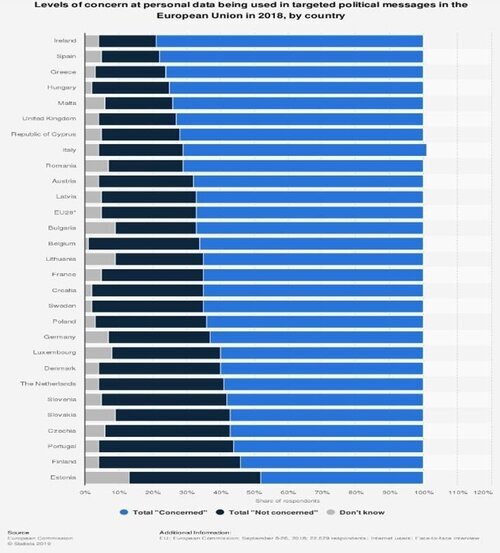
Levels of concern at personal data being used in targeted political messagesLevels of concern at personal data being used in targeted political messages

Behind the mask of a concerned movement or party, we are manipulated into thinking that we are finally understood, and forget we are the victims of what is possibly humanity’s greatest publicity stunt. Although some more than others, Europeans are concerned that the use of their once-promising data is turning against them. The need for transparency is pressing, but the long-lasting effects of this capitalization on democracy is something only time will tell.

Who will survive? Fintechs, traditional banks or both?

Do Revolut or N26 sound familiar? They are some of the most known fintechs in Europe. Both present themselves as alternatives to the traditional banking sector. The first is from the United Kingdom and the latter is based in Germany.

If you’re Portuguese, you are probably familiarized to MB Way and have heard about PPL Crowdfunding, a crowdfunding platform as its name suggests.

Fintech’s are revolutionizing modern banking, among other financial services.

Briefly, “fintech” stands for financial technology and represents the term used to name companies that exploit technological advantages to provide more efficient, lower cost and more user-friendly financial services.

Revolut is maybe the most known example of a fintech unicorn [term used to name tech companies valued above $1 billion].

Without a physical presence (it doesn’t have any bank infrastructure like Barclays or BBVA), this fintech is able to provide most of the financial services offered by the big banks at a lower cost and with a more user-friendly interface. You may transfer money between two different country-based banks without any intermediation fees for example. In this case, the United Kingdom’s based unicorn is clearly a Competitive Fintech Venture as it competes with the traditional banking sector.

Another type of fintech is what may be called a Collaborative Fintech Venture: this kind of company aims instead at complementing the traditional financial services. An example of these ventures is the MB Way service, provided in Portugal by SIBS, a company mainly held by the national big banks. It initially enabled consumers to easily transfer money between different bank accounts, using only the client’s phone number. This way, consumers have an additional feature linked to their bank account and are therefore more pleased with their banking services.


So, should the big banks feel threatened by fintechs?

Fintech is creating opportunities for customers and businesses alike, Bank of England Governor Mark Carney said.

“In the process, however, it could also have profound consequences for the business models of incumbent banks,” said Carney. So, should the big banks feel threatened by fintechs?

The BoE, in its 2017 stress test, said the tested major banks (HSBC, Barclays, Lloyds, RBS, Santander UK, Standard Chartered and Nationwide) concluded that they could withstand continued low growth and fintech competition without making big changes to their business models or taking on more risk.

[Reuters] However, the BoE stated that the fintechs’ competition could cause “greater and faster disruption” to these banks’ business models than even these institutions project.

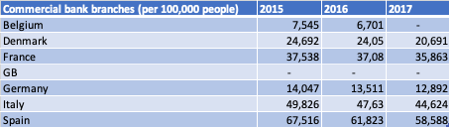
Number of commercial bank branches in Europe (per 100,000 people)Number of commercial bank branches in Europe (per 100,000 people)

Also, as digital payments gain terrain over the use of bank notes and coins, the ATM network in these same countries has dropped on average 2.5% since 2015, which leaves room for fintechs in the payments’ sector, like Stripe, based in San Francisco. Stripe started as a service to help small online sellers process payments and now serves tech giants like Amazon and Microsoft. It now presents other products, like a credit card issuing technology and its latest valuation, dated from Jan. 2019 was $22.5 billion.

As shown by Revolut, fintechs may weaken the relationship between customers and the banks. “For instance, in the future, it may be possible for a customer to manage their finances with only minimal direct engagement with their banks.” This will certainly make it harder for banks to maintain their high margins and profits.

Moreover, as digital banking wins over the traditional one, bankers as we know them are also at risk. According to the World Bank, the number of commercial bank’s branches per 100,000 people in developed countries like Belgium, France, Denmark, Germany, Italy or Spain have dropped an astonishing average of 5.9% since 2015 (to the last recorded year-worthy of data), which coincides with the foundation year of Revolut.

To cope with this already existing and growing competition, the big banks have to take one of two alternatives: to design on their own innovative alternatives and technologies that bring more value to customers as fintechs do; or to integrate these upcoming firms in their ecosystem, as it may be easier for these start-ups to be more agile and disruptive than for the “too big to fail” banking institutions. Otherwise, if these financial organizations also show themselves as “too big to innovate”, they are condemned to fail, to be replaced and outperformed by the upcoming fintech companies or even by big technological conglomerates like Apple, who are rapidly taking over some financial services (e.g. Apple Pay).

One thing is for sure: this competition will certainly benefit consumers and possibly even the whole economy, in which the new blockchain technology may have a relevant role to play.