Risk Repriced: How Political Instability Reshapes Market Confidence and Sovereign Costs 

Reading time: 8 minutes

When Markets Look At Politics 

We are used to thinking of financial markets as driven only by economic principles such as inflation, interest rate expectations, and growth forecasts. In this context, politics is background noise: unpredictable, difficult to quantify, and irrelevant to asset pricing. Yet this perception increasingly misrepresents reality. 

Political developments have become central to how markets interpret risk, reprice assets, and allocate capital.  

Nowadays, headlines from governments regularly trigger revaluations. Political uncertainty is growingly emerging as a source of volatility and a key determinant of sovereign borrowing costs. Every new cabinet announcement, legislative halt or budget negotiation is a signal investors have to price, quickly and with little margin for error.  

The uncertainty about future government actions may have a dual effect on market prices. In rare cases, it may represent policy flexibility against shocks. But in the majority of cases, it may actually reflect growing doubts about institutional resilience and future fiscal tracks. 

The market impact is clear: as stock prices respond to political news, political uncertainty leads to higher equity risk premium, increased asset correlation and consequently lower diversification benefits. 

To better understand how political turmoil can flow into financial markets, we can have a look at the most recent case: France. 

The French Distress 

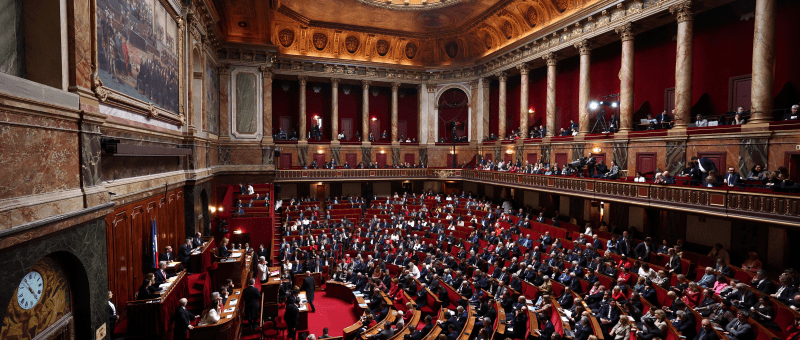
In October 2025, France dived into a serious political turbulence after the resignation of Prime Minister Sébastien Lecornu just one day after announcing his cabinet. It’s the collapse of the fifth prime minister in just two years, a statistic that points out not just instability but a deeper fracture in the French political system. 

Public surveys reveal despair, pessimism and distrust as the prevailing feelings in French citizens. Worrying symptoms representing the profound current democratic crisis, not even two years ahead of the next presidential election.  

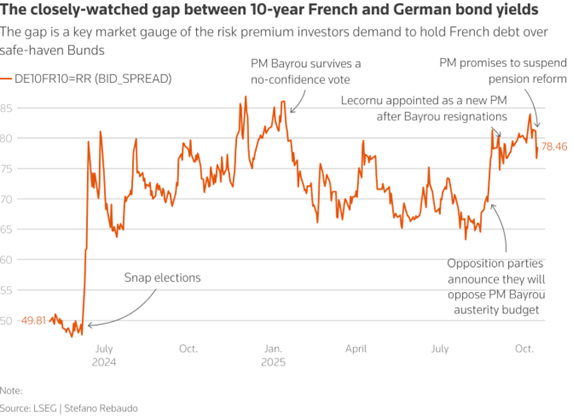
Financial markets, never known for patience but for how quickly they react, are clearly reflecting investors’ sentiment. Not surprisingly, French equity indices dropped, and bond markets did not do differently. For instance, yields on the 10-year French government bonds skyrocketed by 7-8 basis points, reaching around 3.58%.  The spread between French and German bond yields broadens as investors demand a premium for holding what they see as riskier sovereign debt.  

Figure 1: The yield gap widened sharply amid French political turmoil, reflecting rising investor risk premia on French debt. 
Source: LSEG via Reuters. 

The reason for this reaction? The answer is not that straightforward. No single event triggers the repricing by itself, but the clear loss of confidence in France’s fiscal policies plays an unequivocal role. The situation in France is getting complicated, both politically and economically.  

The general feeling speaks loud: France looks unable to find its way out of this malaise.  

Shifting Benchmarks 

Historically, France was perceived as relatively safe within the Euro area bond markets. Italian bonds, instead, have been telling a different story so far. Yet, trends are changing.  

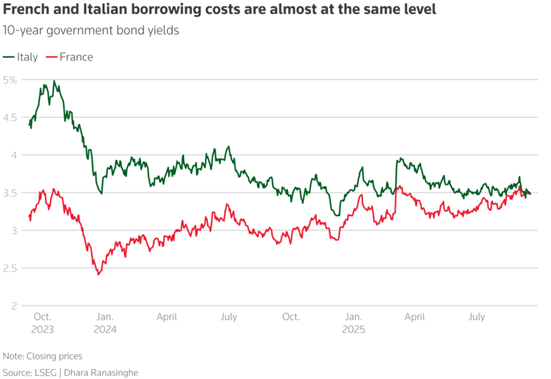
Figure 2: French (red) and Italian (green) 10-year government bond yields nearly converged in late 2025, reflecting France’s political turmoil (rising yields) versus relative stability in Italy (falling yields). Source: LSEG via Reuters. 

As French borrowing costs have risen, Italian yields have followed the opposite direction. This shows how perceptions around France, once considered a core market, and Italy, long seen as one of the weakest ones instead, have radically changed. Investors are concerned that France will not be able to improve its fiscal position due to its political instability, thus pushing up its bond yields. Different story for Italy, where relative political stability and downward debt forecast have caused its bond yields to decrease.  

But be careful. For some, the narrowing of the French-Italian bond spread has more to do with French fiscal and political distress than an improvement in Italy’s market.  

Italy has been afflicted by chronic problems that will take a long time to fix. We are still talking about the euro zone’s second-largest debt as a percentage of GDP after Greece, with a growth of the economy being obstructed by a concerning falling population and low female employment.  

Still, the convergence of French and Italian bond yields serves as a striking illustration of the implications of political stability and credible budgeting on investors’ confidence.  

Indeed, global investors nowadays look at governance quality in advanced economies pretty much as economic principles to adjust their required returns. 

Impact On Growth And Market Confidence 

Beyond market volatility, political instability carries important long-term economic costs. Empirical research on advanced economies has demonstrated that an uncertain politics can cause delayed investment decisions, hard policy execution, and undermined growth prospects. In fewer words, high levels of political instability can overall cause worse economic output. 

The reasons are pretty intuitive: when governments are fragile or policy direction is unclear, businesses and consumers lose confidence. Private sectors struggle to create expectations, while public institutions turn less effective in providing structural reforms.  

But as fragmented governments are not able to enact reform, public finances deteriorate. In France, the continuous change in leadership has paralysed the adoption of a new fiscal regime, delaying important decisions on expenditure and taxation. This creates a dangerous loop: as fiscal negligence decreases investor confidence, sovereign borrowing costs increase, which displace public spending, which in turn further constrains the ability to enact future reforms.  

France, for instance, has gone through five prime ministers in just two years, its national debt exceeding €3 trillion, and it seems unable to create a credible path towards fiscal balance.  

Figure 3: France holds the third-highest debt burden in the EU, after Greece and Italy, exceeding 110% of GDP. 
Source: Eurostat.

Globally, the political instability of an advanced economy as France can have both negative and positive spillover effects on other regions as well. On one hand, investors may require higher risk premiums also from other countries perceived as politically vulnerable. On the other hand, such instability may cause a flight-to-quality flows, as capital would flow towards safer bonds such as Germany Bunds or U.S. Treasuries.   

However, the coincident fiscal crises in multiple large economies, might result in a broader reallocation of global capital away from equities and emerging markets, thus potentially threatening global growth. 

Institutions such as the IMF and OECD have pointed out how political stability and consistent fiscal policies are not only priorities at the domestic level, but also the foundations of international market confidence and macroeconomic resilience. 

Conclusion 

What France is going through right now is not just a domestic drama. We are using this case as an understanding of what can be the costs of institutional fragility in a period of high debt and fiscal uncertainty. When governments and their reforms falter, consequences can be urgent: higher borrowing costs, downgraded credit ratings, eroded currencies, and constrained growth.  

If investors would once see political risk as background noise, now they price it in their models and we need to discuss it. The bond market has become a criterion of credibility, which rewards discipline and punishes obstructions.  

The message to policymakers is clear: good governance is capital. Stability, transparency, and consistency are no more mere abstract democratic values, but economic assets bringing yield. We are still in a post-pandemic context with high interest rates and insecurities, and policy incoherence is no longer tolerated. 

Preserving market trust is vital. Governments must now handle both budgets and expectations. Credibility can be the cheapest form of stimulus for those countries facing high debt and structural change. And as France is showing, once lost, it becomes the most expensive asset to restore. 

Sources: Reuters; Euronews; Financial Times; Fitch Ratings; Eurostat; LSEG via Reuters; IMF; OECD; ECB; Political Uncertainty and Risk Premia, by Lubos Pastor & Pietro Veronesi; European Journal of Political Economy; Political Instability and Economic Growth: Causation and Transmission, by Maximilian W. Dirks & Torsten Schmidt.

Rebecca Fratello 

Writer

The Impact of Donald Trump’s Tariffs on Markets and International Trade 

Reading Time: 5 minutes

Tariffs have always been a contentious tool in global economic policy, and former President Donald Trump’s administration relied heavily on them to reshape America’s trade relationships. Trump’s approach to tariffs was characterized by the belief that they would protect American industries, reduce the trade deficit, and pressure foreign partners into negotiating more favorable deals for the United States. However, the actual effects of these tariffs have been complex and far-reaching, influencing everything from global supply chains to consumer prices. This article explores the potential and actual impacts of Trump’s tariffs on markets and international trade, offering examples, economic analysis, and perspectives from multiple sources. 

What Are Tariffs and Why Did Donald Trump Use Them? 

Tariffs are taxes imposed on imported goods. By making foreign goods more expensive, tariffs are intended to encourage consumers to buy domestic alternatives. Trump saw tariffs as a tool to reduce America’s trade deficit, particularly with China, and to protect domestic industries like steel, aluminum, and technology manufacturing. 

Key Examples of Trump’s Tariffs: 

  • In 2018, Trump imposed a 25% tariff on steel imports and a 10% tariff on aluminum. 
  • In the same year, the administration slapped tariffs on $250 billion worth of Chinese goods, leading China to retaliate with tariffs on American products like soybeans, cars, and airplanes. 
  • In 2020, Trump threatened additional tariffs on European Union exports such as wine, cheese, and aircraft parts in retaliation for EU subsidies to Airbus. 

How Tariffs Affect Domestic Markets 

1. Higher Costs for Consumers 

While tariffs target foreign producers, the actual cost burden often falls on domestic consumers. Importers pass higher costs onto consumers, making everything from cars to electronics more expensive. A study by the Federal Reserve Bank of New York estimated that by the end of 2019, Trump’s tariffs cost the average American household about $831 per year due to higher prices.  

Example: When tariffs were imposed on washing machines in 2018, prices jumped nearly 12% within months, according to research published by economists at the University of Chicago and the Federal Reserve.  

2. Disruption of Supply Chains 

Many U.S. industries depend on imported components and raw materials. Tariffs on Chinese technology parts, for instance, disrupted the electronics and automotive sectors, which rely heavily on Chinese factories for affordable parts. This forced companies to either raise prices or absorb losses, weakening profit margins and investment. In the long run, some firms moved production out of China, but this led to higher transition costs and inefficiencies.  

Impact on International Trade 

1. Retaliatory Tariffs and Trade Wars 

When the U.S. imposed tariffs, trading partners retaliated with their own tariffs. China targeted American agricultural exports, including soybeans, corn, and pork, hurting U.S. farmers who relied on the Chinese market. By mid-2019, U.S. agricultural exports to China had fallen by 53% compared to 2017. 

Example: The American soybean industry suffered particularly harsh consequences. Before tariffs, China imported about $12 billion worth of U.S. soybeans annually. By 2019, that number dropped to under $3 billion. The U.S. government ended up subsidizing farmers to offset their losses, costing taxpayers billions. (Source: Bloomberg, 2019) 

2. Erosion of Trade Alliances 

Trump’s unilateral use of tariffs alienated key allies, including the European Union, Canada, and Mexico. When Trump imposed steel and aluminum tariffs, both Canada and the EU retaliated with tariffs on iconic American products, from Harley-Davidson motorcycles to bourbon whiskey. This strained long-standing trade relationships, particularly within the World Trade Organization (WTO) framework, which is built on predictable, rules-based trade.  

Effects on Financial Markets 

1. Market Volatility 

Trump’s tariff announcements often led to immediate stock market swings. When tariffs on China were announced in March 2018, the Dow Jones Industrial Average plunged 724 points in a single day, reflecting investor fears of a full-blown trade war disrupting global economic growth.  

2. Sectoral Winners and Losers 

Some sectors benefited from protectionism, particularly domestic steel producers. However, industries reliant on steel (like automotive and construction) faced rising costs, eroding their competitiveness. Agricultural stocks, particularly in soybeans and pork, plummeted due to lost export markets.  

Long-Term Economic Impacts 

1. Reshoring vs. Offshoring Diversification 

One goal of the tariffs was to bring manufacturing back to the U.S., a process called reshoring. Some companies did shift production, but many opted to diversify away from China to other low-cost countries like Vietnam, Mexico, and Thailand instead. This resulted in a fragmentation of global supply chains, increasing overall uncertainty.  

2. Reduced Global Trade Growth 

The uncertainty surrounding U.S. trade policy under Trump contributed to slower global trade growth. According to the World Bank, global trade growth fell from 5.4% in 2017 to just 1.1% in 2019, with tariffs playing a significant role.  

Case Study: The U.S.-China Trade War 

The most high-profile example of Trump’s tariff policy was the U.S.-China Trade War, which began in 2018. It involved escalating tariffs on hundreds of billions of dollars in goods on both sides. The conflict led to: 

  • Higher costs for American businesses and consumers. 
  • Reduced Chinese investment in the U.S.. 
  • A reshaping of Asian supply chains, with companies shifting production to Southeast Asia. 

Ironically, despite Trump’s goals, the U.S. trade deficit with China actually increased in some sectors, as American companies stockpiled Chinese goods before tariffs took full effect.  

Trump’s tariffs were a bold attempt to reset global trade dynamics, but the unintended consequences were significant. While they did pressure China into signing Phase One of a trade deal in 2020, they also: 

  • Raised prices for American consumers 
  • Hurt American exporters through retaliation 
  • Increased market volatility 
  • Weakened global trade growth 
  • Undermined trust in the international trade system 

As the world moves with the Trump era, policymakers face the challenge of rebuilding stable trade relationships while addressing the legitimate grievances about unfair trade practices, especially concerning China’s industrial subsidies and intellectual property violations. Whether tariffs were the right tool for this job remains hotly debated, but their lasting impact on markets and international trade is undeniable. 

Sources

BBC, 2018; Peterson Institute for International Economics, 2020; Federal Reserve Bank of New York, 2019; Flaaen et al., 2019; Harvard Business Review, 2020; Congressional Research Service, 2020; CNBC, 2018; Reuters, 2018; Brookings Institution, 2020; Bloomberg, 2019; World Bank, 2020; Peterson Institute for International Economics, 2020.

Afonso Freitas

Research Editor & Writer

Financial literacy: The overlooked one 

Financial literacy springs as a cornerstone of responsible and efficient financial management and entails one’s capacity to comprehend financial concepts to make informed decisions regarding money, budgeting and investment.  

Typical household activities like going to the supermarket for monthly shopping. This simple action encompasses numerous integral financial concepts, such as budgeting, basic asset pricing, and price variation, that is, inflation. In accordance with the ubiquity of such concepts in one’s everyday life, statistics conducted amid the Plano Nacional de Formação Financeira for “Todos Contam”, show that around 81% of Portuguese respondents evidence concern about household budgeting and personal finances. However, despite its relevance, many individuals still struggle with basic concepts, such as inflation, as more than one in three people in the EU do not understand how inflation erodes their purchasing power. 

Why is it important? 

As introduced, financial concepts are ever-present in daily lives as these serve as a safeguard against excessive borrowing, unforeseen expenses, and foster conscious financial planning and stability. Financial literacy is a fundamental competency for families to sustainably improve well-being and quality of life, even more so when assessing the current inflation rate variations and, consequently, increased interest rates and decreased household purchasing power.  

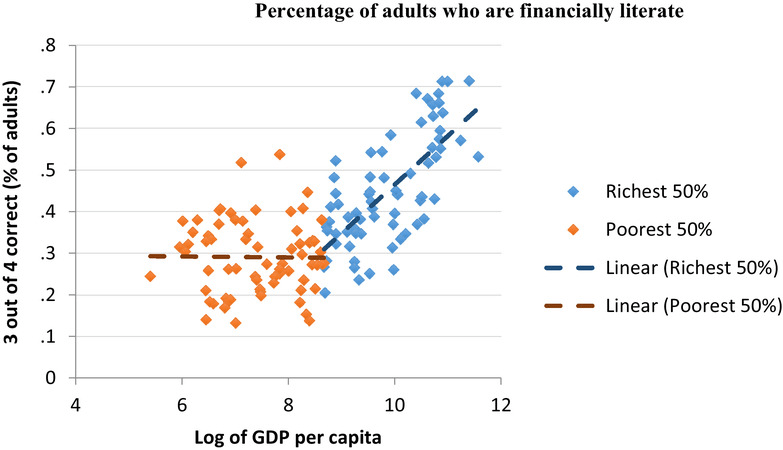
A solid understanding of concepts such as the link between interest rates and bond prices, asset diversification, and time value of money, is associated with improved management of household savings and investments. Conducted studies show that households which hold more financial knowledge have greater tendencies to, for instance, allocate resources more efficiently, plan retirement savings, and contain debt (Demertzis at al. 2024). This relationship raises the question of whether wealth derives from general financial literacy or the opposite. Well, by using GDP per capita as a proxy for income, a positive relation between income and financial literacy is displayed among the richest 50% countries and around 48% of the variation in financial literacy rates can be explained by differences in income across countries (Kapper et al. 2024). However, the same is not evidenced in the poorer half of countries, where a correlation is not shown.  

Source: S&P Global FinLit Survey and World Bank–World Development Indicators (http://data.worldbank.org) 

Furthermore, as the world experiences a rapid technological development, digital literacy also plays a role in financial decisions being made, as overwhelming amount of information is progressively more accessible for the public. This heightens the risks of navigating the digital financial landscape and further increases the vulnerability of less informed groups, including the youth and elderly. As Eurostat’s data reveals that, in 2022, the average age at which young people left their parents’ home was 26.4 years. Coupled with this, in recent years, there has been a striking surge in the promotion of young individuals accounting for their own financial decisions, with the 3rd conducted inquiry on Portuguese Literacy, for Plano Nacional de Formação Financeira in 2020, indicating a significant increase, from 20% in 2015 to around 45% in 2020 of people ranging from 18 to 24 years old. This emerging trend suggesting that younger generations are assuming financial decisions progressively earlier, further emphasizes the importance of financial literacy, and the fundamental impact its lack of could have in these generations’ life. 

Financial Knowledge in Portugal   

Financial literacy not only encompasses knowledge, but also practices in accordance. In Portugal, financial literacy stages a rather complex picture since, while efforts are being developed to improve literacy, challenges impose themselves which foment the need for more comprehensive educational initiatives. These, for example, include Portugal’s position in financial literacy as 26th in 2023’s Eurobarometer, surpassing only Romania. Despite this lagging position in performance, Portugal is 13th in OCDE/INFE’s inquiring (out of 39 countries), 7th regarding financial attitudes and habits and 21st in terms of financial knowledge. The latter explains an existing deficit financial literacy when it comes to financial numeracy, computation of compound interest and the importance of asset diversification. Additionally, as formerly tackled, the digital age has brought its own set of challenges, namely regarding information overload and unfiltered misinformation, from which Portugal is no exception. 

Addressing these challenges requires a multifaced approach whereby financial concepts should not only be taught but applied effectively as well. Despite Portugal’s lack of literacy, there is still optimism in initiatives such as “Digital Financial Literacy Strategy for Portugal”, designed with support from the OECD and the European Commission, bringing about meaningful change, by providing low-income families, middle-aged individuals and young adults crucial skills and fundamentals to enhance their quality of life and financial health. 

Financial Knowledge in the European Union 

More than a decade ago, indicators of financial literacy established low financial knowledge among a large world share, even in countries with well-developed financial markets, such as European Union (EU) countries (Lusardi and Mitchell 2011 cited in Demertzis et al. 2024). However, the will of refining financial literacy has rose globally.  

In 2021, the European Commission (EC) carried out a survey that aimed to access the level of financial knowledge of the EU population. Demertzis et al. 2024 show that, on average, just over 50 percent of the respondents answered correctly to at least three of the five knowledge questions, suggesting that financial knowledge continues to be low despite the increased interest in it. Particularly, only one in five respondents correctly answered questions regarding the relationship between interest rates and bond prices, on average. In this context, it is also relevant to state the presence of a gender gap in financial knowledge, such that more men than woman answer at least three out of five questions correctly, with 18 percentage points of difference, on average in the European Union. This study also assesses that more financial knowledge is linked to higher financial inclusion, as EU countries with higher levels of financial knowledge have greater percentages of adults saving with and borrowing from financial institutions.  

A graph with a pink circle and a pink circle

Description automatically generatedBruegel based on European Commission (2023a) 

Over-Indebtedness: Private, Public, Global  

Most commonly, over-indebtedness refers to the situation in which the monthly earnings of a family are not enough to contemplate both essential expenses and the credit instalments, implying a lack of space for savings. In such a situation, it is said that families face a high debt burden. Besides the obvious hazards of excessive debt, that are translated into reduced living standards, it can be detrimental to the mental health of individuals, thus affecting personal relationships and stimulating isolation. According to experts, here, the role of financial literacy becomes particularly evident, not only as a prevention mechanism, but also as a key first step into debt-freedom.  

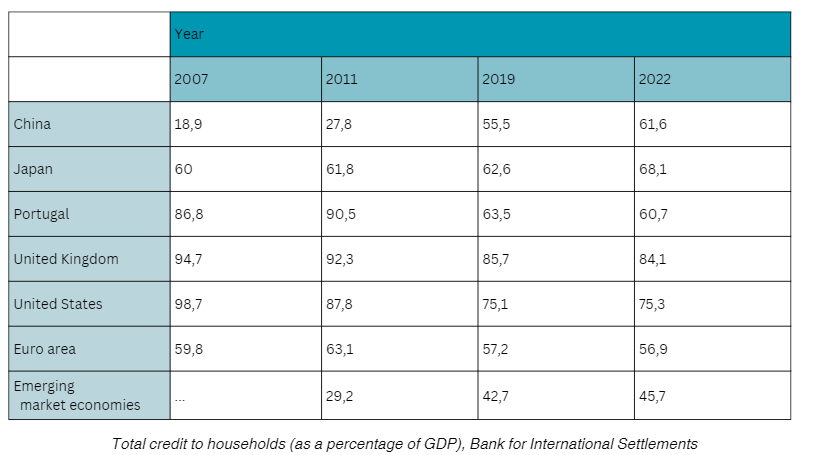
According to the OECD database, household debt (all liabilities of households that require payments of interest or principal by households to creditors, as a percentage of net household disposable income) has been registering a negative trend in Portugal since 2011, despite a slight increase in 2020 at the hand of the global pandemics. Total credit to households as a percentage of GDP as also been diminishing since the period around the Sovereign Debt Crisis, with Portugal foll  owing the EU area movement. On the other hand, emerging economies have been registering a great increase in the credit to households.  

Household debt, OECD 

Excessive amount of private debt is not only a concern for individuals, but also for the whole economy. There is evidence that private “credit booms” many times culminate in either financial crisis or economic underperformance (Dell’Ariccia et al. 2012). Until the Great Recession in 2008, policy paid limited attention to the situation. The economic intuition for the question of underperformance is that when private debt is high, agents divert a large portion of their income to the payment of interest and principal on that debt, ending up spending and investing less. High debt can make borrowers more reluctant to spend or take on more debt. Additionally, there is research that establishes a link between private and public debt, such that the excess of the first systematically turns into more of the second, regardless of whether the credit boom resulted in a crisis or a more orderly deleveraging process (Mbaye et al. 2018).  

“Finanças Para Todos” 

With the conviction that university poses a fundamental role in providing services to the civil society, “Finanças Para Todos” comes as free training program on the subject of financial literacy, with a particular focus on low income and lower education individuals. Throughout five enlightening sessions, diversified speakers cover subjects that go from family budget to investment and retirement. Created with the contribute of Nova SBE Finance Knowledge Center, “Finanças Para Todos” has now registered around eleven thousand applications, with its second edition counting with more than two thousand online participants and almost than five hundred on a presential regime (on the Nova SBE campus).  

Additionally, there are many online resources available, from articles to videos or even interviews, always keeping in mind the ever-present goal of raising awareness to the subject of financial literacy while demystifying finance theory and enhancing the importance of conscious and informed decision-making.  

The Nova Awareness Club was very pleased to have joined two sessions, so as to get a better grasp on the intricacies of each session, the dynamics of the program and the strong class interaction, as well as extend our financial education, that many times lacks a more practical component.  

To conclude, as economic landscapes evolve, promoting a financially literate population becomes increasingly imperative as it paves the way for prosperity and financial security among families. 

From the supermarket aisles to the corridors of academic institutions, the impact of financial literacy acutely resonates not only with households’ lifestyles, but with the broader economic landscape. As the world navigates the complexities of private and public debt, digital footprint and global economic trends, the need for further investment on financial literacy across countries grows progressively evident to ensure a financially sustainable future. 

Maria Francisca Pereira

Madalena Rosário

Microfinance Interventions and Their Impact on Women´s Empowerment and in Developing Countries 

What is Microfinance? 

Microfinance is a financial service that provides small loans, savings accounts, insurance, and other financial products to individuals who typically lack access to traditional banking services. It targets low-income individuals, particularly in rural and underserved areas, who may not have collateral or a credit history to qualify for loans from commercial banks. It has gained attention as a tool for inclusive finance and sustainable development, with initiatives implemented worldwide to expand access to financial services for marginalized and vulnerable populations. The service has the potential to empower individuals, particularly women, by giving them the means to create livelihoods, build assets, and improve their standard of living. Thereby, it aims to alleviate poverty by providing financial resources to support income-generating activities, such as starting or expanding small businesses, purchasing livestock or equipment, or investing in education and healthcare.  

How can it be bearer of importance to women? 

Its relevant and important for women’s empowerment, especially in rural areas, due to several reasons, such as financial inclusion, economic empowerment, poverty alleviation, social impact, and risk mitigation.  An undeniable proof of that is the fact that by 2006 microfinance services had reached over 79 million of the poorest women (Daley-Harris 2007 cited in ILO 2008). 

Financial inclusion  

Women, particularly in developing countries, often face barriers to accessing formal financial services such as bank accounts, loans, and savings. Microfinance provides them with access to financial resources that they may not otherwise have, empowering them to participate in economic activities and make financial decisions. 

Economic empowerment 

Microfinance enables women to start or expand small businesses, generate income, and become economically self-sufficient. By providing them with loans, savings accounts, and other financial services, microfinance helps women to invest in income-generating activities, improve their livelihoods and support their families. 

Poverty alleviation  

Women constitute a significant proportion of the world´s poor population. Microfinance programs specifically targeting women can contribute to poverty alleviation by providing them with the means to lift themselves out of poverty. By investing in women’s economic activities, microfinance helps to create opportunities for income generation and asset accumulation, ultimately improving their living standards. 

Women´s Empowerment 

Access to financial resources through microfinance can enhance women’s autonomy and decision-making power within their households and communities. As women become financially independent, they gain greater control over household finances, education, healthcare, and other important aspects of their lives. This empowerment can lead to positive social outcomes, such as improved gender equality and women´s rights. 

Social impact  

Investing in women’s economic empowerment through microfinance can have broader social benefits. Studies have shown that when women have control over household income, they tend to prioritize spending on the well-being of their families. Consequently, microfinance programs targeting women can have ripple effects on community development and poverty reduction. 

Risk Mitigation 

Women often face greater financial vulnerability due to factors such as lower incomes, limited access to formal employment, and social and cultural constraints. Microfinance can help mitigate these risks by providing women with financial tools to cope with emergencies, smooth consumption and build resilience against economic shocks. 

Microfinance in developing countries 

Microcredit programs have been implemented in developing countries such as Bangladesh, India, or Cambodia since 1976 and its relevant to understand if and how it’s a beneficial initiative. To answer this concerns, it was conducted a study focused on the development of microfinance programs in Ethiopia and how it changed the lives of who was targeted. Ethiopia is known for being one of the poorest and underdeveloped countries (68.7% of the population, 82,679 thousand people in 2021, is multidimensionally poor while an additional 18.4% is classified as vulnerable to multidimensional poverty, 22,076 thousand people in 2021). 

For the past two decades, microfinance institutions have held significant sway as a pivotal development initiative in Ethiopia. The genesis of this movement and its subsequent expansion in the country can be traced back to the enactment of legislation postulated after the 1996 proclamation. This legislative milestone stands as a cornerstone in the inception and evolution of microfinance across this country. Notably, there has been a steady escalation in female engagement within the microfinance sphere. All microfinance enterprises share a unified aspiration towards ameliorating poverty and fostering the economic empowerment of women.  

The main aim of the inquiry is to analyse the impact on microfinance programs on women´s economic empowerment. A sample of 346 women that were clients of those initiatives were questioned and examined for a deeper understanding of the debate in question. With the help of tools such as multiple regression and sampled t-test data analysis, was revealed that age, marital status, education level, credit amount, and number of trainings have a significant impact on women’s economic development. 

The results of the paired sample t-test unveiled noteworthy disparities in mean values pre- and post-engagement with microfinance services, particularly concerning income, asset accumulation, and savings. Microfinance interventions evince a discernible positive impact on women’s economic empowerment, manifesting through augmented independent income streams, heightened asset portfolios, and increased monthly savings. Furthermore, the investigation underscored the constructive role of microfinance in nurturing women’s entrepreneurial acumen and fostering their exposure to business opportunities. 

Despite this article being more focused on the effects of microfinance in developing countries, because of how the impact is noticeable, it’s also important to emphasise the fact that also it has also reached and in a growing scale, developed countries, like Spain, that you can read more about in one of the links in the references focused on the Barcelona case. 

Conclusion 

Overall, by addressing the unique financial needs and challenges faced by women, microfinance plays a crucial role in promoting women´s economic empowerment, reducing poverty, and advancing gender equality with the help of its programs that promote an inclusive and sustainable development. Also, it has been proven to be beneficial to countries in development, being a fundamental tool for growth, prosperity, and equality of opportunity. 

References: 

ILO. 2008. “Small change, Big changes: Women and Microfinance”. Geneva, ILO.  wcms_091581.pdf (ilo.org) 

Leight Lebos, Jessica. 2022. “How microfinance supports livelihoods in developing countries”. Kiva. Consulted in 01/05/2024. https://www.kiva.org/blog/how-microfinance-supports-livelihoods-in-developing-countries 

Lorenzo Vidal, Raquel, and Julia Soler Agustí. 2017. “Microcredit in the developed countries: the case of Barcelona”. https://migrant-integration.ec.europa.eu/sites/default/files/2019-10/EWI05-Microcreditinthedevelopedcountries_thecaseofBarcelona.pdf 

Mengstie, Belay. 2022. “Impact of microfinance on women’s economic empowerment”. J Innov Entrep 11 (55). https://doi.org/10.1186/s13731-022-00250-3 

Raid, Dr. Moodhi, Nisar Ahmad, Dr. Hisham Alhawal, and Dr. Jumah Ahmad Alzyadat. 2023. “Impact of Microfinance on Poverty Alleviation in Developing Countries: The Case of Pakistan”. http://dx.doi.org/10.2139/ssrn.4402017 

Laura Casanova

Understanding Ponzi Schemes: A Tale of Investment Fraud

Reading time: 6 minutes

Ponzi schemes have a notorious history of preying on investors’ desires for quick and substantial returns. From the infamous exploits of Charles Ponzi in the 1920s to modern-day scandals like that of Bernard Madoff, these fraudulent schemes have left a trail of financial devastation in their wake. In this article, we delve into the intricate workings of the first Ponzi scheme, exposing its goals, deceptive mechanisms and exploring their profound implications.

What is a Ponzi Scheme and How they Work?

At its core, a Ponzi scheme is an investment scam that relies, not on genuine business activities or profits, but on the funds provided by new investors. Named after Charles Ponzi, who famously executed such a fraud in the 1920s, these schemes are dangerously seductive as they promise high returns with little to no risk, appealing to the financial desires of almost any investor. However, underneath the attractive facade lies a fundamental deception: no real investment is taking place.

The mechanism of a Ponzi scheme is relatively straightforward. Initially, the organizer will collect money from new investors by promising them a lucrative return on their investment. Instead of engaging in any legitimate business activities or investments, the organizer uses the money from incoming investors to pay returns to earlier participants. This cycle continues with new investors funding payouts to earlier ones.

This system depends entirely on a steady flow of new investments. Without it, the scheme cannot continue because there are no actual profits being made. The moment it becomes challenging to attract new investors, or when too many participants attempt to withdraw their funds, the scheme collapses.

The Origin of Ponzi Scheme

The origin of the term “Ponzi scheme” traces back to Charles Ponzi, whose early 20th-century scam involved exploiting the pricing of International Reply Coupons (IRCs). Ponzi discovered that IRCs could be bought at a lower price in Europe and redeemed in the U.S. for a higher value of postage stamps, theoretically allowing him to profit from the arbitrage.

Figure 1: International Reply Coupons

Encouraged by this discovery, Ponzi started soliciting funds from investors in 1919, promising them a 50% profit within 45 days, and established the Securities Exchange Company to manage these investments. Initially, Ponzi paid early investors using the funds from new investors, creating the illusion of a successful business venture. As word of these high returns spread, more and more people were drawn to invest, and Ponzi’s operation seemed to thrive, rapidly escalating as investments grew from $5,000 to millions of dollars within months.

This exponential growth was marked by Ponzi’s ability to pay initial investors promptly, which further fuelled the trust and influx of new funds.

The Unravelling of Ponzi’s Scheme

Charles Ponzi’s scheme, initially perceived as a rapid path to wealth, quickly revealed its inherent flaws due to logistical challenges and the sheer impossibility of leveraging International Reply Coupons for promised returns. To sustain the investments made with the Securities Exchange Company, a staggering 160 million postal Reply Coupons would need to be in circulation; however, only about 27,000 were actually available. It was becoming increasingly clear that Ponzi could not deliver on his promises.

Figure 2: Charles Ponzi

The intense scrutiny by The Boston Post, led by Richard Grozier and aided by financial journalist Clarence Barron, played a critical role in exposing the scheme. Barron’s investigation revealed a stark discrepancy between the number of coupons needed to fulfill Ponzi’s promises and the actual number available, illustrating not only the operational impossibility, but also raising significant ethical questions about the legitimacy of exploiting governmental mechanisms for profit. This damning revelation began to unravel the truth behind Ponzi’s spectacular claims.

Postal inspectors, unable to reconcile Ponzi’s promised returns with the actual volume of International Reply Coupons in circulation, grew increasingly suspicious. Despite lacking concrete evidence of fraud, their investigations cast a shadow over Ponzi’s enterprise. Meanwhile, a series of exposés by The Boston Post shed light on the dubious nature of Ponzi’s operations, triggering panic among investors.

Facing mounting pressure, Ponzi attempted to reassure investors by offering to halt new investments during an audit. However, this gesture backfired, sparking a wave of withdrawals, and ultimately exposing Ponzi’s insolvency. With regulators closing in and banks freezing his accounts, Ponzi’s empire crumbled. Ponzi’s investors were practically wiped out, receiving less than 30 cents to the dollar. They lost about $20 million in 1920 dollars (approximately $230 million in 2023 dollars).

Despite being acquitted in two state trials, Ponzi was convicted in a February 1925 trial, receiving an additional seven to nine years behind bars. While out on bail, Ponzi returned to his fraudulent activities in Florida, earning himself a jail term for violating securities laws before vanishing during an appeal process. After being located months later, he was extradited back to Boston to finish his sentence before being deported to Italy on October 7, 1934.

Ponzi Scheme Legacy

Ponzi pioneered a business model that inspired numerous imitators, each promising lucrative returns through seemingly ingenious investment strategies. The allure of quick and substantial profits led many to overlook the inherent risks and ethical dilemmas inherent in such schemes.

In Portugal, the most well-known Ponzi scheme is that of Dona Branca. Maria Branca dos Santos promised monthly returns of 10% to those who entrusted her with their savings. These interest rates far exceeded those offered by the banking system, earning her the nickname “Banqueira do Povo” (Banker of the People). By the end of the 1980s, after she began failing to meet payments, she was sentenced to 10 years in prison for aggravated fraud.

Bernard Madoff orchestrated the largest Ponzi scheme in history, originating from Wall Street. It involved at least $17.3 billion in investments with guaranteed returns unrelated to market performance, which, despite triggering numerous complaints to U.S. regulators, only collapsed in 2008. Madoff is serving a 150-year prison sentence after pleading guilty in 2009. The proceedings estimate losses of $65 billion for the victims.

Ponzi’s Scheme Takeaways

In the intricate tapestry of financial markets, Ponzi schemes stand out as cautionary tales of unchecked greed and deceptive promises. The unravelling of Ponzi schemes serves as a sobering reminder of the importance of robust regulatory frameworks and diligent oversight. It underscores the need for investor education to empower individuals with the knowledge to discern between legitimate investments and fraudulent scheme.

By fostering transparency, accountability, and resilience within our financial systems, we can mitigate the risks posed by Ponzi-style operations. Through collective efforts to fortify regulatory measures and enhance investor awareness, we can strive towards a future where the promise of prosperity is built on a foundation of integrity and trust.


Sources: National Post Museum, EisnerAmpers, Jornal de Negócios

Beatriz Gomes

Reddit’s IPO: Was The Buzz Really Worth The Hype? 

Reading time: 7 minutes

INTRODUCTION 

The debut of a company on the stock market through an Initial Public Offering (IPO) is a momentous occasion that captivates the attention of investors, business enthusiasts, and the wider public. The excitement surrounding an IPO is palpable, driven by a convergence of factors that elevate it beyond mere financial transactions to a symbol of innovation, growth, and opportunity. From the allure of exclusive investment opportunities to the potential for substantial returns, and from media attention to the economic impact and innovation potential of newly public companies, the commotion of an IPO transcends traditional market dynamics to embody the spirit of entrepreneurialism. All aspiring companies want to be the next Saudi Aramco or Alibaba, however, this time, we will take a deeper look at Reddit. Was the buzz worth the hype? 

A BRIEF HISTORY OF REDDIT 

First and foremost, Reddit operates as a platform where registered members can submit content, such as text posts or direct links, and engage in discussions through comments. The content is organized into “subreddits,” which cover a wide range of topics, from niche hobbies to global news. What sets Reddit apart is its emphasis on user-generated content, fostering a sense of belonging and authenticity among its users. 

In 2005, Reddit was created by two programmers from Virginia University, Steve Huffman and Alexis Ohanian, in the aftermath of attending a lecture by programmer-entrepreneur Paul Graham, leading to Huffman taking charge of coding the site, using Common Lisp, and launching Reddit in June of that year. As the platform gained traction, Christopher Slowe was welcomed onboard and eventually merged with Aaron Swartz’s company, Infogami. Swartz played a crucial role in revamping Reddit’s software by implementing his web framework, web.py, thus leaving a lasting mark on Reddit’s technical evolution and the broader web development community.       

The following year, Reddit was swiftly acquired by Condé Nast Publications for a raging sum ranging from $10 million to $20 million, thus, prompting the team to relocate to San Francisco. Afterward, both Huffman and Ohanian departed Reddit’s helm in 2009. Since then, Reddit gained operational independence from Condé Nast in 2011 and many years as well as CEOs later, the original co-founder, Huffman, returned as the Chief Executive Officer. 

REDDIT’S REVENUE SOURCES 

Reddit earns money primarily through advertising, premium memberships, and partnerships

When it comes to advertising, Reddit has a unique system that allows advertisers to target specific subreddits or communities, making it attractive for those aiming to reach niche audiences. These offer both managed and self-serve ad options, with prices varying based on the audience targeted. In recent years, Reddit’s ad revenue has seen significant growth, with increasing projections indicating substantial earnings: about $119 million in ad revenue in 2019, which skyrocketed the following year by 52.4%, to $181.3 million. 

Picture 1: Reddit’s co-founders Steve Huffman and Alexis Ohanian 

Reddit Gold, a premium membership, offers users extra features and benefits for a fee. This includes an ad-free experience and several other perks. The revenue from these memberships has been steadily increasing, showing that users are willing to pay for additional benefits. For example, in 2021, about 344,000 Reddit users brought in a staggering value of $17.21 million in revenue for the platform, considering that in 2020 it had only generated 12.38 million. Moreover, Reddit partners with other companies to provide sponsored content and promotional opportunities, thereby assisting the company in generating revenue while also offering value to its users. 

THE IPO BUZZ: EXCITEMENT AND EXPECTATIONS 

The IPO buzz can be traced back to 2021. However, one of the main reasons why this IPO gained so much attention was due to the introduction of AI.  

Reddit disclosed its plans to allow third parties to access its data for purposes like training artificial intelligence models, as the company has already entered into data licensing agreements worth $203 million. From these agreements, Reddit anticipates earning at least $66.4 million in revenue this year. 

Additionally, Reddit has partnered with Google, allowing Google’s AI products to utilize Reddit data to enhance their technology. This collaboration underscores the growing importance of original human-generated content, particularly, as AI-generated content becomes more prevalent on a day-to-day basis. 

THE INITIAL IPO: TRIUMPHS AND CHALLENGES 

On the morning of March 21, 2024, Reddit debuted on the stock market with the ticker symbol RDDT

Reddit Inc.’s shares surged an astonishing 48% above their initial public offering price, which reflected the investors’ enthusiasm for the company’s futures secured around artificial intelligence. The San Francisco-based firm’s stock closed at $50.44 each on Thursday in New York, following a successful offering where the company and some of its shareholders raised $748 million, pricing it at the top end of the marketed range. Furthermore, Reddit’s IPO now stands as the fourth largest on a US exchange, demonstrating a revival in the market for initial public offerings after a two-year sluggish period. This successful listing is expected to encourage other tech companies that had delayed their plans to go public. 

With a fully diluted valuation nearing $9.5 billion, Reddit falls just short of the $10 billion mark it achieved in a 2021 funding round. Analysts, including Mandeep Singh, senior industry analyst for Bloomberg Technology, had suggested even before pricing that Reddit could be valued at as much as $10 billion. 

Reddit’s IPO pricing implied an enterprise value-to-sales multiples positioned between Meta Platforms Inc.’s higher multiples of eight times and the lower multiples of smaller digital advertising peers like Snap Inc. and Pinterest Inc., according to Singh. He emphasized that investors are willing to pay for growth, particularly given Reddit’s accelerated growth in the past six months, making a strong case for a premium valuation. Hence, it is worth mentioning that Reddit’s IPO surpasses notable listings in September by US tech firms Instacart and Klaviyo Inc., both of which raised substantial amounts. 

THE FALL: UNFORESEEN OBSTACLES AND MARKET VOLATILITY 

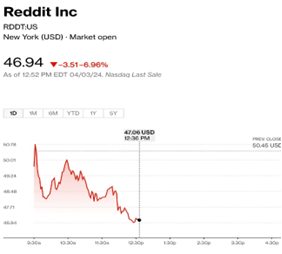
Following a report by Hedgeye Risk Management suggesting Reddit Inc.’s stock should decline by about 50%, Reddit shares experienced their largest one-day drop since their trading debut. The stock fell 11% on Wednesday, closing at $57.75 per share, its lowest since March 22. While Reddit shares had surged more than 90% since the IPO on March 21, Hedgeye deemed the stock “grossly overvalued” and recommended it trade closer to its IPO price of $34. 

Reddit is set to report its first-quarter 2024 results in late May. While Hedgeye anticipates positive momentum in the first report, they caution potential weaknesses in future reports, particularly expecting a slowdown in user and revenue growth in the second half of 2024 and the first half of 2025. The company also disclosed in a corporate filing that Huffman (the CEO) sold 500,00 of his shares and that the Chief Operating Officer, Jennifer Wong, sold 514,000. Furthermore, Bloomberg interviewed Omar Abbasi, a 34-year-old software engineer in the Bay Area, who received a job offer, partly due to his unpaid work as a moderator for Reddit’s gaming communities. However, he declined the offer, citing concerns about the risk involved, drawing a parallel with Facebook’s stock stagnation post-IPO in 2012. Abbasi’s views and worries are most likely shared with many others. 

Picture 2: Reddit Inc market data on 03/04/2024 

CONCLUSION 

In a nutshell, it is still not clear if the buzz was really worth the hype, considering that the market is showing volatile behavior. Nevertheless, it is worth noting that Reddit posted a net loss of $91 million last year, while still having more than $700 million of cumulative losses. Therefore, the company has to make some drastic changes for their situation to turn around. Furthermore, it is remarkable that this website is very community-oriented. In fact, Reddit’s most loyal users were able to buy 8% of the shares at IPO price, but users could prove tricky to monetize since there’s opposition to intrusive advertising. Hence, Reddit has a difficult ride ahead in trying to appease their tight-knit community of “redditers” and manage to make a profit. 


Sources: Business Insider; Bloomberg; Financial Times 

Alegra Maza

INVESTING IN GOOD FAITH: THE ISLAMIC FINANCIAL SYSTEM 

Reading time: 8 minutes

 Have you ever looked at something, and imagined what it would be like if it were… different? Say, what would the education system look like without the written word, or arithmetic without the concept of zero? Or what would the financial system be without interest? Many centuries ago, in Europe and all the Christian world, collecting interest was forbidden by the Church on the grounds of immorality, being universally recognized as a sin – the sin of Usury.  

Nowadays, the official stance of most western nations with respect to interest is significantly different – not only is it not condemned, but is actually regarded as a vital part of our economies. And it definitely is. It is impossible to imagine how our current financial system would ever work without this tool. Interest is a crucial part of loan taking, house buying, and savings. Politicians talk about it, economists worry about it, investors use it to generate returns. The concept of interest is inseparable from the concept of money itself. In most of the world, at least. 

Like the Catholic Church once did, some still consider interest to be immoral, or simply impossible to reconcile with their religious beliefs. Such is the case of the Islamic Faith.  

THE ISLAMIC VIEW 

Before we look at how this financial system is different from the main one, it is worth spending some time understanding its foundations.

  Text Box

A member of the Islamic community is supposed to comply with certain rules and guidelines, living their lives according to the teachings of the Faith in order to lead a moral life. To this code of conduct, we call Sharia (or Shari’ah) Law. Sharia is a complex subject. It requires interpretation of the will of God, something that has divided humankind for millennia. We are not likely to solve it in 1400 words. It is not the purpose of this article to explore the religious and legal complexities of Muslim-majority countries. Sharia law exists, and millions of people in the world follow it. Our focus is on how Sharia, and by extension the individuals that try to guide their actions by it, think of financial transactions

The Institute of Islamic Banking and Insurance states the objectives of Islamic Financial Transactions (i.e. Sharia compliant financial transactions) as follows: 

  • To be true to the Sharia principles of equity and justice
  • Should be free from unjust enrichment
  • Must be based on true consent of all parties; 
  • Must be an integral part of a real trade or economic activity such as a sale, lease, manufacture or partnership. 

The first three points can be considered more or less subjective – what constitutes equity, injustice or true consent are open for debate. Interesting as that debate may be, it falls out of our scope today. Let us then look at the fourth point. 

Sale, lease, manufacture and partnerships are no strangers in the traditional financial system. The key is the one missing – can you spot it? That’s right – debt! Debt-based instruments, so common in traditional financing, don’t have the same centrality in its Sharia compliant counterpart. Why is that? Well, we’ve stated the reasoning before: the Islamic Financial System absolutely prohibits paying/receiving “any predetermined, guaranteed rate of return”, that is, interest.  

Text Box

But why does the Islam forbid someone to be compensated for departing from their capital for a period? Doesn’t it recognize the Time Value of Money (the notion that having money right now is more valuable than the promise of the having money in the future)? As a matter of fact, it does! The difference is in understanding what constitutes capital. Ask any non-Islamic banker, investor or economist, and they will almost surely tell you that money is capital – a production factor, something that can be used to create more wealth. Islamic thinking draws a line: money is only seen as potential capital. It is only considered actual capital when it is employed in an actual productive activity together with other resources. Simply put, money sitting still is not productive, so you are not entitled to any compensation for lending it to someone who will actually put it to use. 

PRINCIPLES AND INSTRUMENTS 

So, what can actually be done inside this system? Well, any activity that complies with some basic principles

As previously discussed, interest (riba) is forbidden. It is regarded as an “unjustifiable increase of capital whether in loans or sales”. This is the central principle ruling mutual dealings. Borrowers and lenders should equally share the profits and risks – profits are a symbol of a successful enterprise, while interest is a cost independent of success, only on the side of the borrower. A supplier of funds is not a creditor, but an investor. Since money has no purpose unless tied to a real asset, speculation and gambling (maysir) are forbidden. Uncertainty or asymmetrical information (when one of the intervenients possesses information that the other one has no access to) are also prohibited in any transaction – contracts are sacred, and agents have a duty to disclose all relevant information beforehand. Hoarding is also not permitted, as well as trade in forbidden commodities (pork, alcohol, dealings with casinos, etc.).  

Many instruments that are present in the traditional financial system are also used by the Islamic Financial System. The most basic ones, which can then be combined to create more complex products, are cost-plus financing, profit-sharing, leasing, partnership and forward sale

APPLICATIONS 

As you can see, Islamic Financing is no more than a selection of the financial instruments and products that comply with certain religious and, especially, moral principles. If you think about it, it is not so different from how a food restriction works – if you and your friends go to dinner, the vegan friend will order something with no meat, the one with a seafood allergy will probably not get the shrimp, and some may choose to get water instead of wine or other alcoholic drink. And, of course, you are perfectly free to order a salad if you’re not vegan, or to ask for no peanuts in your dessert even if you have no allergy. And you are equally free to partake in a Sharia-compliant financial transaction, whether you are a Muslim or not

People can invest in an Islamic Financial Product regardless of their faith 

Islamic finance has been growing, and not only inside the Muslim Community. Its principles appeal to many, and it does have some advantages over the traditional system: as interest is forbidden, predatory loans can’t happen at all; income and wealth are more equally distributed, as every intervenient receives a part of the profits, regardless of how much capital they had at the beginning of the enterprise; speculation is forbidden, meaning the system is not so exposed to market bubbles (goodbye, 2008-like financial crisis!); and it is significantly more transparent and accessible. Many argue that it can help lift many out of poverty, especially if combined with ideas like Microfinancing. These characteristics indicate that Islamic Finance may be better equipped for sustainable development, a point that may prove to be of great importance in the years to come.  

Of course, it has some significant disadvantages too: it does not provide funds for all businesses (religious prohibitions prevent it from dealing with pork, alcohol and gambling firms) and, for all its efficiency in allocating resources to businesses with a greater chance of success and encouraging money to be fueled into real and productive activities, it can be argued that it does not maximizes investment profits (as interest is not charged). 

There is another detail that is worth pointing out: Islamic Finance comes with a moral compass (or at least a baseline). Whether this is a positive thing or not will probably depend on the degree to which you agree with the moral principles it is rooted in, but it is, undoubtedly, a point of difference between this system and the traditional one. 

The islamic Financial System serves millions of people worldwide

It is easy for some to look at the presented characteristics and to regard this system as limiting. We cannot argue it may not be limiting, but it is so in order to provide an option that answers the needs of millions of people, who do not wish to compromise their faith in exchange for a piece of wealth. Different cultures have different approaches, and we live in a wonderfully differentiated world. Imagine how boring it would be otherwise. 


Sources: Institute of Islamic Banking and Insurance, Corporate Finance Institute, Investopedia, World Bank, Blossom Finance, Wikipedia 

Joana Brás

Leonor Cunha

The Collapse of SVB: A Cautionary Tale for the Financial Sector 

Growing concerns on the stability of the financial sector 2023 has seen a wave of bank failures, from Credit Suisse in Switzerland to Signature and Silicon Valley Bank (SVB) in the United States (US). These recent collapses of prominent banks have sparked concerns about the stability of the financial sector, leading to a surge in Google searches for “financial crisis” not seen since 2008.  Given the already-present fears of a recession, the collapses only added to the public’s anxiety, shaking consumer confidence in the economy. While the situation is unsettlingly familiar, the uncertainty and fear of contagion remain daunting. This latest banking crisis highlights the potential side effects of financial disarray and underscores the need for swift and effective intervention to restore stability. To exemplify the bank failures and bankruptcy, this article will focus on the case of SVB.  

A perfect combination of events leads the “bank of start-ups” to collapse 

Known as the “bank of start-ups”, especially for those in the tech sector, California-based SVB was established in 1983, with the mission of helping “individuals, investors and the world’s most innovative companies achieve their ambitious goals”, counting as their clients start-ups and tech companies of the likes of Shopify or Insight Partners. In 1988, they went public through an IPO on Nasdaq and, in 2008, they went international. But how did a bank that was the 16th largest bank in the United States, reporting, in Q4 for 2022, $212B in assets, $342B in total client funds and $74B in total loans, collapse on the 10th of March? 

Silicon Valley Bank

The short answer to this question revolves around the typical suspect when referring to the failure of banks: bank runs, which are a self-fulfilling prophecy. However, in the case of SVB, it can be seen as a perfect combination of events which led to this disastrous outcome. The first motive can be linked to the Federal Reserve’s decision to increase interest rates to fight the increasing inflation rates, which are corroding American consumers’ purchasing power. This macroeconomic environment would lead SVB’s long-term investments in government bonds to be eroded as SVB had $21 billion invested with an average yield of 1.79%, as they had been purchased when interest rates were near the zero-lower bond. In comparison, currently, a 10-year Treasury bond has a yield of around 3.9%. Simultaneously, startups were raising fewer rounds of venture capital investment, due to the current economic environment, which decreased the amount of deposit inflows and increased the outflows. So, SBV’s cash decreased, such that the bank had a lower amount of resources to finance its operations. Consequently, in order to raise funds, SVB resorted to the sale of their government bonds. However, as they were yielding a lower interest than those that investors had access to if they bought directly from the government, this led SVB to sell a portion of said bonds at a discount to compete with the competitive market, resulting in a loss of $2 billion. The ultimate blow to SVB’s credibility would be the capital raise announcement, resulting in a generalised panic amongst SVB’s depositors, as more than 90 percent of them exceeded $250,000 in guaranteed Federal Deposit Insurance Corporation (FDIC). At the end of last year, according to the Wall Street Journal, SVB had over $150 billion in uninsured deposits. Fear led to large withdrawals, with depositors pulling out $42 million, in just one day alone. Consequently, SVB’s stock plummeted.  

To avoid a widespread panic and broader contention, despite appearing that SVB’s problems spilt over to Signature Bank, the government intervened in the form of California regulators shutting the bank down and placing it in receivership under the FDIC with SVB’s senior managers, including its CEO, Greg Becker, being removed. SVB’s collapse has been deemed as the 2nd largest in American history, only losing to Washington Mutual which collapsed in the 2008 Financial Crisis. Furthermore, in an unusual decision, the FDIC agreed to guarantee all SVB deposits, even those above the $250,000 per account threshold.  

SVB stock price performance month-to-date in US dollars
Annual nº of US commercial bank failures and total associated assets

What else is being done? 

Deputy Treasury Secretary, Wally Adeyemo, sought to reassure the public about the health of the banking system after the sudden collapse of SVB, in an exclusive interview to CNN, stating: “Federal regulators are paying attention to this particular financial institution and when we think about the broader financial system, we’re very confident in the ability and the resilience of the system”. In reality, the 2008 financial crisis prompted stricter regulations in the United States and around the world. In response, regulators imposed more rigorous capital requirements on American banks, with the aim of preventing the collapse of individual banks from having a ripple effect on the wider economy and financial system. 

Following the collapse of SVB, federal regulators acted promptly to mitigate depositors’ losses and restore trust in both the banking system and the broader economy. To achieve this, they put into effect a series of measures aimed at reassuring the public and bolstering confidence in the financial sector. The government introduced a program called the Bank Term Funding Program (BTFP) – a lender of last resort facility- which serves as a safety net for financial institutions. This program, which is backed by the Federal Reserve, provides loans to banks, credit unions, and other deposit-taking institutions in times of need. The loans can last for up to one year and enable these institutions to meet the needs of their depositors without having to resort to selling their high-quality securities at short notice.

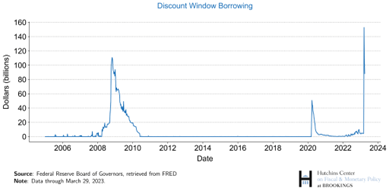
Discount Window Borrowing

Another way the government relied on to regulate the financial industry differently was through a discount window, a facility that offers banks the option to borrow cash on a permanent basis, typically for short periods, such as a few days or weeks. From March 9 to March 15, borrowing at the discount window escalated from $4.6 billion to $152.9 billion, before declining to $88.2 billion by March 29. However, the decrease was mostly offset by augmented borrowing through the BTFP. 

Numerous banks overseas borrow and lend in U.S. dollars. Although foreign central banks possess the capability to print their own currencies, like Euros, Yens, and British pounds, to lend to their struggling banks, they do not have the authority to print U.S. dollars. In response to the Global Financial Crisis, the Federal Reserve initiated a sequence of agreements with foreign central banks, whereby it would exchange U.S. dollars for foreign currencies with other central banks. On March 19, 2023, the Federal Reserve announced that it would conduct daily swaps at least until the end of April to enhance the efficacy of the swap lines.

In the end, the FDIC’s race to find another bank willing to merge with SVB to safeguard unsecured deposits was successful as First Citizens Bank purchased SVB’s remaining assets, deposits, and loans. 

Conclusion 

Bank failures like this have happened before—there were more than 550 banks shut down between 2001 and the start of 2023. But this one was particularly newsworthy due to its dimension, being the second-largest bank failure in US history. 

There is now less anxiety about the stability of the banking sector due to the significant regulatory reforms put in place after the crisis in 2008 and the steps taken by the Federal Reserve following the collapse of SVB to improve confidence in the banking system and prevent future banking failures. The risks of broader contagion are thought to be limited for now but, even if a recession occurs, analysts don’t think it would be as long lasting as the Great Recession. 

According to Mike Mayo, a senior bank analyst at Wells Fargo, back in the prior crisis “Banks were taking excessive risks, and people thought everything was fine. Now everyone’s concerned, but underneath the surface the banks are more resilient than they’ve been in a generation.” 


Sources: The Economist, TIME, Silicon Valley Bank, Wall Street Journal, CNN, The American Prospect, CNN Business, Investopedia, Brookings, Expresso 

Hannah Ribeiro

Pedro Teixeira

The Looming Russian Default

Reading time: 7 minutes

Russia’s relationship with its debt has not been easy throughout history. In 1918, the embryonic Soviet Union repudiated the debt carried from the previous regime; in 1998, and after an attempt from the Russian Federation to gain credibility and integrate in international capital markets, Russia ended up defaulting in its domestic debt and in the Soviet-era external debt; in 2022, a Russian default seems to be looming once again.

With the Russian invasion of Ukraine, international markets price in the potential for a Russian sovereign debt default in external debt. Yields on Russian 10Y bonds, for example, have climbed vertiginously to nearly 20% since the beginning of the war.

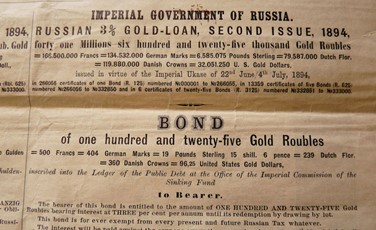
An international bond from the Tsarist regime which was repudiated by the Bolshevik Regime.

An history of missed payments

Following the Bolshevik revolution and the overthrowing of the Tsarist regime, the embryonic Soviet Union, in 1918, repudiated all the debts of the previous regime. Despite this, throughout the Soviet experiment, the Soviet Union accumulated large levels of debt up until its dissolution in 1991.

After the breakup, the newly independent, former Soviet states, had an arduous road of restructuring their systems with more market-oriented economies in their sights. At that time, the Russian Federation assumed all foreign assets and debts of the former Soviet Union, an action that it viewed to be necessary to begin to integrate international capital markets and to build a good international reputation.

However, the restructuring of the economy proved to be more challenging than expected. Russian GDP suffered large contractions, decreasing nearly by half in the following years. At the same time, fiscal policy was quite loose with the government running large deficits and real interest rates were kept high as the new Central Bank tried to rein in inflation and create credibility. Together, these factors meant that Russian debt was not on a sustainable path throughout the 1990’s. In 1998, and although Russian debt was still not very high (60% of GDP), with the Asian financial crisis echoing throughout the markets, and the exchange suffering sharp devaluations, Russia ended up defaulting on its domestic debt, as it found itself unable to rollover existing short-term debt. And although Russia did also default on foreign Soviet-era obligations it honored all the external debt it had issued after the 1991, attempting to maintain good credibility.

With this same goal in mind, following this default, Russia sought assistance from the IMF, and was able to restructure the defaulted debt and implement structural reforms that placed it on the path towards sustainable debt management.

These changes can be seen in the evolution of sovereign debt ratings, which had deteriorated significantly during this crisis (S&P – SD), but that steadily rose in the early 2000’s. S&P rated Russian debt with a B in 2001 a grade of BBB in 2008. This grade was kept quite constant until recent months. Even now, although Russia finds itself in danger of defaulting, similarly to the 1998 crisis, its debt to GDP ratio is not very high (18% of GDP in 2020).

The importance of international capital markets and the credit rating system

Countries issue bonds in external debt markets as a way to collect the necessary funds to finance their sovereign debts; the associated price and respective interest rate at which they will trade will reflect a number of conditions that determine their risk level, which usually comes attached with a given credit rating.

Credit ratings will reflect the creditworthiness of the country in question, posing as an indicative tool for investors of the possible risks that are being undertaken when investing in said debt – which in turn will be translated into the interest rate at which the loan will be repaid. This risk represents the likelihood of the government failing to make the future payments associated with its debt obligations, either because it is unwilling or unable to do so, with risky investments being linked with low credit ratings and high interest rates. The level of risk assigned to each country will be determined taking into consideration the country’s economic and political environment, assessing several important indicators such as the country’s debt service ratio, variance of its export revenue, domestic money supply growth, among others. Overall, a good or bad credit rating could make or break a country’s economy, being a key factor in attracting foreign direct investment.

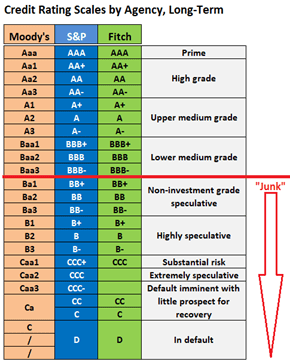
These credit ratings are assigned by independent credit rating agencies, with the three most widely known being Moody’s, S&P Global and Fitch Ratings. Each of these credit agencies will attribute a credit rating to the investment in question expressed in letter grade format, in accordance with their personal measurement scale: in alphabetical order, usually from A to D (best to worse), with specific intermediate categories for each agency. For example, S&P attributes a BBB- (or higher) rating to countries it considers to be within investment grade and Moody’s does so for Baa3 (or higher) rated bonds. Any rating of BB+ (or lower) for S&P and Ba1 (and below) for Moody’s falls to speculative grade, commonly referred to as the “junk” bonds territory.

Credit ratings are most definitely not static and may change all the time based on the newest data available on a multitude of political and economic factors, as the recent case of Russia government bonds´ credit rating steep downfall showcases. In fact, in just a few weeks, given the recent turn of events – with Russia´s economic panorama suffering a major hit facing the tight trade restrictions from the West and being essentially cut-off from Western financing – all major rating agencies have downgraded the country´s status by considerable significant notches from its secure position in the “stable” B territory, fearing Russia´s inability (and even to a certain extent its willingness) to service its debt. The situation further escalated upon President Putin´s announcement of the possibility of a “redenomination of foreign-currency sovereign debt payments into local currency for creditors in specified countries”, prompting the rating agencies to believe “that a sovereign default is imminent”, as illustrated by Fitch´s C rating and Moody´s equivalent Ca score, both only one level above default.

The impact of the Russian Invasion

The invasion of Ukraine has seriously influenced Russia’s economic and monetary landscape, mainly due to the package of sanctions applied by several European Union countries and the United States. Indeed, Putin admitted that such sanctions “effectively declare Russia default”, as they imply an increasing probability of default on its public debt (20% of its GDP). Nevertheless, what frightens Putin is not this amount, but the current lack of payment capacity.

Firstly, the sanctions applied to Russia, which include its exclusion from the SWIFT banking system and the blocked access to western financial markets, place this country in a possible economic drowning situation. In fact, according to the public finance sustainability theory, debt is only sustainable if the GDP growth rate is higher than the interest rate. Therefore, given all the economic and commercial exclusion to which Russia is currently exposed, it is possible that its GDP growth will not be satisfactory enough, consequently increasing its financial susceptibility and its risk of default. Besides the economic point of view, other sanctions applied imply the freezing of Russian assets located in institutions outside Russia, such as foreign exchange reserves and Russian bonds, which strongly limits the Russian capacity to pay its obligations.

Furthermore, apart from all the economic implications that trigger the default, another reason is closely linked with the monetary problems faced by Russia. For now, since the invasion of Ukraine, the ruble has devalued by around 40% against the dollar, once again compromising Russia’s monetary capacity to pay its debt. Then, the problem starts when its $480 billion foreign debt is denominated in US currency, so it must be paid in dollars. In fact, according to international declarations by financial institutions, the inability to pay debts in the original currency is formally considered as default. Moreover, nominally paying in rubles will get much more expensive for Russia given its huge drop in recent weeks.

Conclusion

Against the general feeling that Russia wouldn’t be able to make its next bond payment due on March 16 (with a 30-day grace period), it was able to do so. Still, it seems to just be delaying the inevitable given the weak economic outlook and the impact of sanctions.

What this will represent for the world economy is still murky but seeing as only a relatively small sum of the nation´s debt is held by foreigners; all points out to the country´s potential default not posing a major systemic risk to the global financial system.


Sources: Reuters, Fortune, IMF Elibrary, Carnegie Endowment For International Peace.

Diogo Almeida

João Baptista

Sara Robalo

Inês Lindoso

João Correia

The Inversion of the Eurodollar Yield Curve

Reading time: 6 minutes

Despite being the second biggest market in the world after the U.S. Treasury market, the truth is that you most likely haven’t ever heard of the Eurodollar system. This market, where some of the most sophisticated markets participants operate, is giving us warning signs of slowing economic growth. This might clash with some of the inflationary thesis defended nowadays.

But what is the Eurodollar system? And how does it work? What signal is this market giving us and why should we care about it?

What is the Eurodollar system?

In its simpler definition, as the name indicates, the term Eurodollar refers to US dollar deposits held at foreign banks or overseas branches of American banks, which originally operated mostly in Europe, hence the name. Indeed, while it is not entirely clear when this Eurodollar market was initiated, it is believed to date as far back as the post-World War II period, when Europe experienced a wide circulation of American dollars via the financial aid that the US provided to the war-torn continent in the form of the Marshall Plan. Thus, when the Eurodollar system began, it was mainly supported by the emergence of dollar money centers in Zurich, Munich and, of course, London.

However, what started as a fundamentally European-based independent and less regulated market of US dollar funds, rapidly spread across the globe in the next few decades, with many American branches opening operations in all continents. Therefore, as globalization grew and this “secondary” dollar market started expanding – going as far as replacing a lot of the traditional roles of global reserve currencies, such as gold – the Eurodollar system became a much more complex concept that now encompasses a much wider dimension of currencies and operations, representing one of the world´s biggest capital markets.

As Eurodollars are largely held and traded outside of US jurisdiction, they are not subject to the Federal Reserve´s regulation, particular in terms of reserve requirements, leading these deposits to be able to pay higher interests. Furthermore, by operating outside of the FED´s radar, this currency-like system of interbank liabilities allows for sophisticated financing and monetary transactions of US dollars to take place, making it so these international banks that deal with Eurodollars get to work with their own money multiplier, thus being in charge of creating and controlling their supply of US dollars.

Overall, the Eurodollar system became an alternative to traditional currency reserves, being able through its independence to provide the liquidity needed to satisfy demand in a way that, on many occasions, other systems (ex.: Bretton Woods) failed to do so, conferring the confidence that this “shadow” money would be the modern alternative to easily supply financing under the panorama of a globalizing world. This has consequently been reflected in high volume circulation of major international capital flows between countries under the Eurodollar system in the past decades, – with most transactions in this market being conducted overnight – which could potentially have significant geopolitical ramifications, seeing the power that this reserve-less, regulation-less system confers to the major international bankers that oversee it.

How does the Eurodollar work?

As mentioned previously, the offshore banks operating in the Eurodollar are not subject to regulations from Central Banks meaning that they don’t suffer from reserve requirements. This allows for a much higher flexibility to create dollars (being it a purely ledger transaction).

The deposits in the Eurodollar system have a minimum amount of $100.000 and are generally above $5 million and are priced in two different ways: either Overnight Deposits or, for longer maturities, tied to the London Interbank Offered Rate (LIBOR).

Overnight deposits are the most common transaction in this market, they mature on the next business day and usually start on the same date they are executed, with money paid between banks. The overnight bank funding rate is computed according to federal funds transactions, certain Eurodollar transactions and certain domestic deposit transactions.

Regarding longer maturities, Eurodollar is a LIBOR-based derivative. In this situation Eurodollar’s price reflects the market gauge of the 3—month U.S. dollar LIBOR, a benchmark for short-term interest rates at which banks can borrow funds in the London interbank market, interest rate anticipated on the settlement date of the contract.

Inversion of the Yield Curve

Eurodollar futures are derivative contracts that allow buyers and sellers to hedge against interest rate risk in the future. It also allows speculators to bet on the future movements of the USD LIBOR rate. In the Eurodollar yield-curve, the short-term tenors are heavily affected by the Federal Reserve actions (namely by the defined interest on reserves – IOR), while the longer tenors correspond to market expectations on inflation and economic growth.

A Eurodollar futures curve can be built similarly to the treasury rates yield curve: the different future contract maturities are plotted on the x-axis and their associated interest rates are plotted on the y-axis. Under normal conditions, the curve should be upward sloping, reflecting the expectation of economic growth further down the line.

Inversion is not a normal shape for the curve, and it has, historically, preceded turmoil periods for global markets. For example, the last inversion happened on the 13th of June of 2018 where the inversion occurred in the Dec’20 to Sept’21 contracts. This doesn’t mean that the Eurodollar market predicted the Pandemic crisis but that it rather anticipated the deflationary forces existing in 2018 to play-out, namely the collateral scarcity on the Eurodollar system.

            Figure 1 – Eurodollar Yield Curve Inversion in 13th June 2018. Source: Alhambra Investments

This same phenomenon was seen on the 1st of December of 2021, where the Eurodollar yield curve inverted between Sept/Dec’24 and Mar’26 contracts. This means, once again, that the sophisticated participants in this market expect the existing deflationary forces to impact economic growth.

Figure 2 – Eurodollar Yield Curve Inversion in 1st December 2021. Source: Alhambra Investments

The inversion of the yield curve in the maturities around 2024, 2025 and 2026, might suggest that the market doesn’t believe that the Federal Reserve will be able to maintain higher interest rates for a very long time. This could be the case because the market believes that the upcoming contractions in the supply of money in 2022 will cause a slowdown of economic activity, which would cause the Federal Reserve to cut interest rates once again.

Conclusion

The inversion of the Eurodollar yield curve, the flattening of treasury yields and the shortage of dollars in the system are some of the signs that indicate that deflationary forces are threatening economic growth. This might invalidate some of the inflationary thesis as the market participants reiterate their belief that there is no monetary inflation. This inversion might also be a response to a possible monetary policy error by Central Banks, as they plan to tighten into a seeming weak economy.


Sources: Investopedia, Alhambra Investments, Fxstreet

Diogo Almeida

João Baptista

Inês Lindoso

João Correia