A New Era for Development Economics
Reading time: 7 minutes

Economics is commonly seen as a theoretical branch of the social sciences – one of its own branches, however, is not. Development economics, which deals with growth of lower income countries, provides, in contrast, a very hands-on approach to the application of its models. Central to this branch of economics is the last mile problem. 
The Last Mile Problem 

Many fail to understand the obstacles towards providing supplies to remote areas in underdeveloped countries. Medical supplies, schoolbooks, and transportation of essential goods (all of which are the basis of human development) cannot be sent to their destinations due to a lack of supporting infrastructure. To illustrate this, let us take the example of a shipment of vaccines to a village in Africa: while it certainly is possible to get the vaccines to the closest regional capital, many times, there is no infrastructure that can safely transport from the capital to the village. This last stretch is the crux of the last mile problem. 

Fig. 1 – Illustration of the Last Mile Problem

Theory vs Experience  

Older development economics theories have sought to fight the last mile problem (decades before the term was even coined), but in a standoffish, figure-it-out-yourselves way, post-WWII economists such as Ragnar Nurske saw that development was to be overseen by the nation’s government, investing in many different industries, rejecting trade with other countries. Others preferred neoclassical models, where a laissez-faire market approach would of most benefit, the government interferes the minimum in economic affairs of both individuals and society. However, what most economists from this era failed to understand were the underlying issues that were at the heart of these countries’ underdevelopment: disease prevention and education. These were crucial points that not just theory could solve. They had to be tested on-field. 

A revolutionizing and experimental approach to Development Economics was introduced to us in 2019 by Michael Kremer, Esther Duflo and Abhijit Banerjee, awarding them the Nobel Prize in Economics. This innovative approach implemented Randomized Control Trials (RCT) experiments, a reliable way to infer and confirm causality relationships, and so much was achieved. When faced with a certain question/concern, through randomised allocated regions or groups of people, experiments are assigned, tackling the problem in many ways. Afterwards, the outcomes between the different trials with or without interventions are compared. With this experimental process one can assess the impact of social policies on poor and middle-income countries.  

Process of Randomized Controlled Trials

So, if in the past, most development economists created their work tucked away in the comfort of their offices, many have now started to complement and base their ideas and deductions in experimental on-field work. In special focus on the work of these three pioneers, their trials were mainly conducted in India and Africa, striving to find new and innovative ways to fight poverty and improve people’s living standards. Some of the problems tackled regarded important old concerns such as health and education.  

The impact of randomized controlled trials 

When it comes to health, immunization rates are the most predominant issue. According to UNICEF, to this day, around 27 million children and 40 million pregnant women are not provided with a basic package of immunizations, yearly. This leads to many deaths that could have been prevented by more efficient practice and supply of incentives for vaccination.  

In India, although vaccination services are offered exempt of any charge, in public health facilities, the immunization rate still remains low in some areas, specifically the more rural and poorer. As a response to this, Duflo and Banerjee randomly grouped 134 villages in rural India into 3 groups: one in which there was a monthly reliable mobile immunization camp, where a nurse and an assistant went to the villages, providing easier access to vaccination services in those villages; another with the same immunization camp, but for each completed immunization, the children’s households received incentives (raw lentils and metal plates); and finally the control group (i.e. with no intervention done).  

The results showed that the second group had the most positive outcome, increasing vaccination rates by six times more than before. This was a result of people having easier access to getting vaccinated and incentives that gave a reason to not postpone their immunization. In fact, it ended up being less costly per vaccination to provide these incentives, since the medical professionals needed to be paid regardless of the services being provided or not.  

Moreover, efficiency in education, in terms of incentivizing children to attend school, was also empirically studied by these three economists. They started by discarding previous objectives/solutions that came from the assumption that the problem was centred around the poor management and inefficiency of teachers, curriculums, and pedagogy programs, and instead focused on the design of the educational system itself. Thus, in contrast, Pathram and J-PAL, the research organisation founded by Banerjee and Duflo, studied a practical and innovative way to teach primary grade children which prioritized and assessed their actual learning levels (not the specific class year they were in). Instead of constantly flunking children that lacked specific knowledge from previous school years, they undertook another methodology, which was evaluated and found effective, known as “Teaching at The Right Level”. Such method grouped students into the same learning levels and provided them with targeted resources to achieve higher levels. This ended up showing that children were capable of learning fundamental skills such as how to read and basic math in just 30-45 days.  

At a 2010 Ted Talk event, Esther Duflo also shed light on how to subsidize education by observing in which interventions a 100$ grant would be more effective in incentivizing extra years of education. Surprisingly, it turned out that just by explaining to people the benefits of education, something inexpensive to do, it increased school attendance by 40 extra years in that community. Furthermore, based on a past field study by Kremer, in regions where it is common to have worm infections, offering deworming treatments to children in schools added up to 28.6 more years, being the second most effective intervention. 

A step in the right direction 

All in all, the world of development economics was forever changed with the introduction of experimental research. For years, most economic reasoning and foreign aid has derived from a neo-classic economic approach in which it was believed that by increasing GDP per Capita through improvements in market structure, technology and public goods would make people automatically behave in a more socially beneficial way. As a result, the impact of this help was never capable of being accountable or fully efficient and most poor countries remained in the same situation. 

However, as one can imagine, these small and geographically exclusive experiments are also restricted by some issues. The broader is the problem we want to solve, the harder it is to draw a specific and effective resolution for it, so this field of study needs to be continuously evolving. Nevertheless, a new collaboration with behavioural economics and experimental approach, through Randomized Control Trials, opened the doors to new ways of unconventional thinking, providing life changing solutions and helped development economists improve substantially causality reasoning.


Team’s note

Dear reader, as we have reached the end of the article and being RCT a very broad topic, if you would like to further explore RCT in the context of economics, then take a look at this article. If you also wish to know what Nudging and RCTs have in common, check this article.


Sources: Brookings, ResearchGate, Journal of African Economies, Habitat for Humanity, Great Britain, J-Pal, MIT News, The Conversation, TED Talk Ideas Worth Spreading, Firstpost, Thebmj, Hindustan Times 

Benedita Elias

Guilherme Barroca

Economic and societal effects of military conscription

Every once in a while, there comes a time when the debate of whether we should bring back obligatory military service resurfaces in the mainstream societal discourse. However, opinions aside, what are the economic and societal effects of a conscription system?

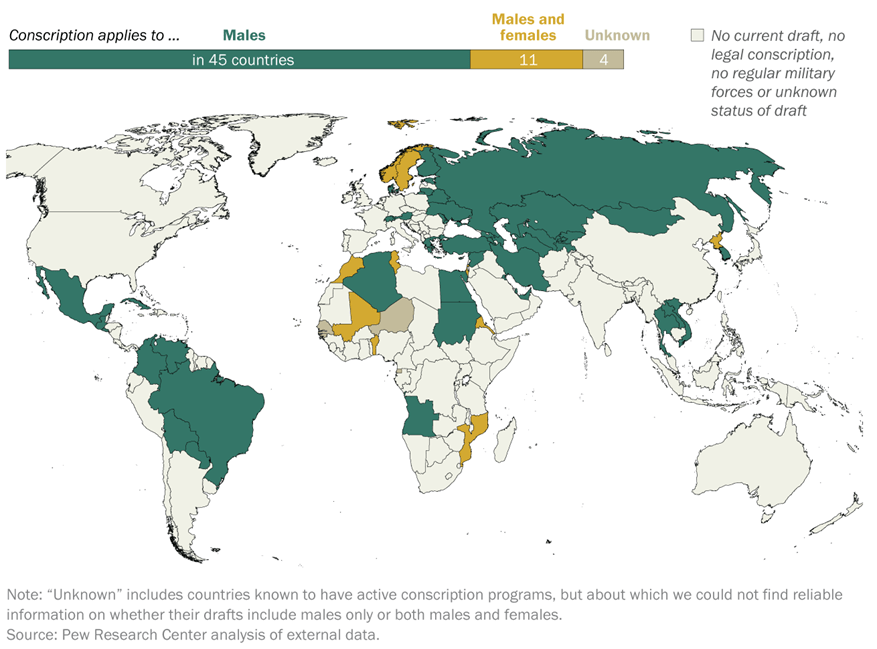
Following the end of the Second World War, the number of countries that implement conscription (also referred to as the draft, or obligatory military service) has declined considerably. While most OECD countries have transitioned to all-volunteer militaries, many countries still have active conscription programs. In Europe, for instance, countries like Greece, Denmark, Austria, Lithuania, and Switzerland have some degree of mandatory service for males. Even as recently as 2017, Sweden reintroduced conscription due to fears caused by the Russian annexation of Crimea and its military exercises conducted at the border of Baltic states.

Figure 1 – Distribution of countries that still have some sort of conscription system; Source: Pew Research Center

Although the effect of geopolitical threats on reintroduction/continuation of conscription regimes in Europe is an interesting topic, we would like to take a broader look at some of the economic and societal consequences of obligatory service and discuss some of its advantages and disadvantages.

The true costs

 Proponents of conscription argue that a draft lowers personnel costs considerably, when comparing with an all-volunteer military. While it is true that the budgetary costs of conscription-based militaries are lower, this ignores all the economic costs that are imposed by this regime.

 In fact, the economic costs of drafting an individual will be equal to the value of his foregone production, were he not drafted, in addition to any disutility that may be caused to him by his service. These economic costs can be sizeable and even exceed the budgetary costs of a conscription-manned military. According to a paper that analysed the now-extinct Belgian draft, the authors estimated economic costs to be at least double the budgetary costs.

 In general, manning a country’s armed forces with conscription amounts to front-loading much of the costs onto the conscripts, as opposed to spreading costs more evenly and equitably through taxes, as it is done with an all-volunteer military. Furthermore, the artificially lowered price of draftees’ labour can lead to an inefficient organization of the armed forces, due to unduly high labour-to-capital ratios. These high ratios can manifest themselves as excessively manned army-units, for example.

Effects on human capital

We should also keep in mind that the economic costs that we previously mentioned were merely static (relating only to the time an individual spends in obligatory service). There are also dynamic effects caused by the draft (which relate to effects on periods after the draft). This is because drafting occurs at a very specific period of the lives of individuals (18-26 years of age) when they are making decisions about their education and when they begin to accumulate work experience. In essence, drafting coincides with a crucial period for the accumulation of human capital, which will have ramifications for the rest of the individual’s life. Therefore, conscription can have a negative dynamic effect on society in so far as it jeopardizes individuals’ accumulation of human capital.

 This is where advocates of the draft may argue that conscription, in fact, allows conscripts to accumulate valuable human capital due to the development of soft skills, such as team-work or personal discipline during their service. This argument has some merit. Indeed, a paper that studied the effect of the Portuguese peacetime draft found a positive impact of 4-5% on wages of conscripted men with only primary education.

 Furthermore, Israel’s military became a catalyst for the creation of specialized start-ups in fields like cyber-security, since it allows for the development of important technical skills and serves as a networking place, important for the creation of these new companies.

 Both examples illustrate the potential for the military to be a place for the accumulation of human capital by its service members.

 It is true that the military, as in the case of Israel, can be a good place for the acquisition of specialized skillsets that allow individuals to be more productive and innovative. It is also true that conscription can benefit low-education individuals by providing them with opportunities to accumulate human capital that they might not have access to otherwise.

 However, most conscripts never reach a level of specialization close to the one that is needed to create a start-up like the ones in the Israeli example. Furthermore, as economic activities evolve, and the jobs associated with them become more complex, educational requirements become longer and harder to achieve. This means that, going forward, the potential benefits of conscription will increasingly be overshadowed by the value of the education/experience that conscripts are forced to forego, and which they need to stay competitive in an ever more educated world.

 Also worth mentioning is a Dutch study that took advantage of a change in the drafting age of young men, which had the effect of exempting an entire birth cohort from obligatory military service in the Netherlands. The authors found that the draft had negative effects on individuals’ educational attainment and earnings.

 Contrary to the findings of this previous study, an interesting effect that the draft can have on educational choices and attainment is reported by a paper that analyses the effects of Germany’s re-introduction of conscription in 1937. The authors found a positive impact of conscription on the probability of individuals getting a college degree. The authors argue that this is likely due to draft-avoidance behaviour. Indeed, it was possible for young men to enrol in college in Germany, as a temporary safe-haven from the draft. After finishing their degree, the now-older men would be much less likely to be drafted. These types of effects of conscription on educational demand have also been documented in the United States and France.

Conscription does not reduce conflict

Supporters of the draft may also argue that an army manned by conscripts will decrease unnecessary belligerent behaviours by states, as this would impose casualties on all groups of society. However, this argument is empirically unsubstantiated. As Poutvaraa and Vagener, in their analysis of the economics and politics of conscription, put it:

Between 1800 and 1945, basically all wars in Europe were fought with conscript armies, and democratic countries like the U.S. and France even later used conscript military in unpopular colonial wars in Vietnam and Algeria.

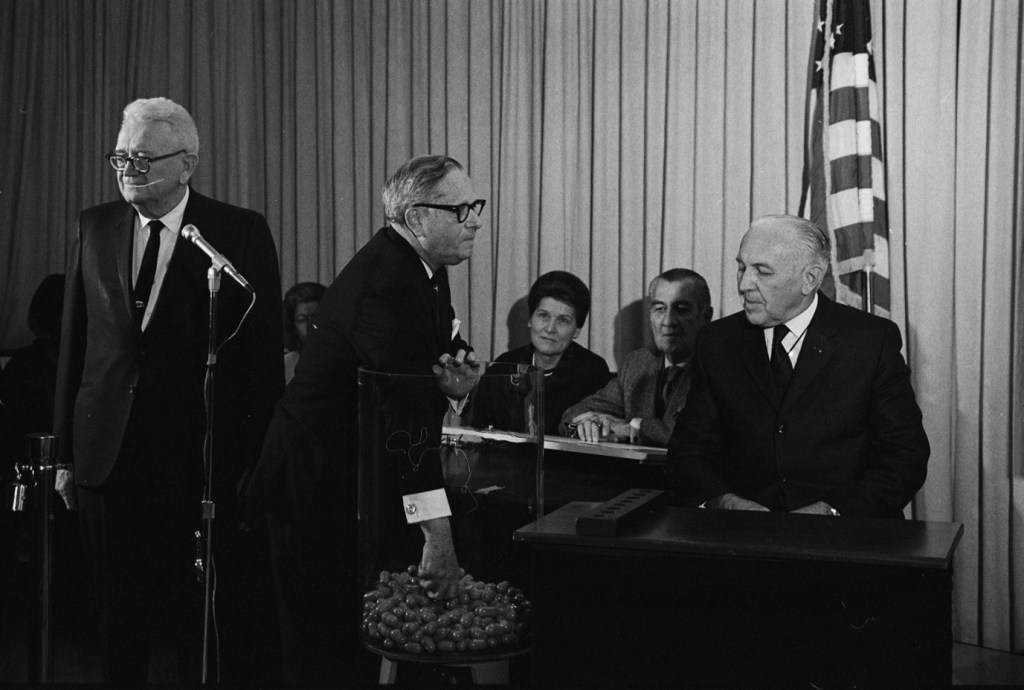
Figure 2 – U.S. congressman drawing the first capsule for the Selective Service draft, during the Vietnam War, Dec 1, 1969; Source: Wikipedia

Final Remarks

There are many more economic and political dynamics related to this topic that could be discussed, though at the expense of making the article too long. However, we can say with some confidence that, all in all, peacetime conscription has a negative effect on economic performance in countries, and that this effect will, most likely, become more pronounced as time goes on.


Sources: Bloomberg, Bauer, Paloyo & Schmidt (2014), Card & Cardoso (2012), Financial Times, Hubers and Webbink (2015), Keller, Poutvara & Wagner (2006) Meyersmans & Kerstens (1991), Poutvaara & Wagener (2007).


Rodolfo Carrasquinho

João Baptista

Raquel Novo

Alexandre Bentes

Brazil, a story of socio-political divide

THE BACKGROUND: A (quick) political overview

Brazil’s past is no fairy tale. From 1964 to 1985, the country was governed by a military dictatorship. Although promised to last a few years, it took two decades for the nation to freely choose its leaders once again. The long years of authoritarianism left, however, a deep footprint difficult to cover in the transition towards democracy.

Instability is at the heart of a country whose motto reads “Order and Progress”. The men and women, that once promised to serve the country, have failed. Historically, elected presidents had a certain pattern: wealthy, full of promises’ mandates marked by economic distress but, mostly, corruption. The hopes (and fears) of the nation focused on Lula da Silva, a working-class man, that promised to save Brazil from corruption and poverty. In the latter, he saw a slight success, but in the former, he saw himself and his protected successor Dilma Roussef being involved in the greatest corruption scheme in Brazil.

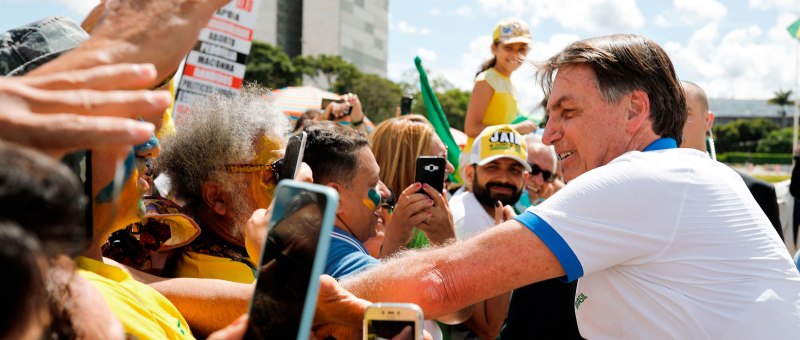
In 2018, the elections shone a light on how Brazil had become divided. Those who remembered the dictatorship, feared the return of authoritarianism, while others had had enough of the system and rallied behind Jair Bolsonaro. In the end, Bolsonaro emerged as the 38th president with 55,1% of the votes. Now we ask ourselves how this once marginal political figure ended up winning half of the country’s trust, and how his influence evolved throughout the mandate and the current pandemic.

Source: Brasil de Fato, Bolsonaro greets demonstrators in Brasilia

THE CAUSES: What led Brazil to its current state?

I. A Never-ending Internal Battlefield

In 2017, Brazil was facing a record-breaking number of around 65.000 homicides; a country representing 8% of the world’s population accounted for 33% of all murders. This ever-growing trend of violence, stemming largely from drug gang rivalries, was further aggravated by the ill-management of security funds, which left police forces underpaid and underprepared. The established chaos fuelled police violence, including extrajudicial executions, which only undermined public security and further endangered the lives of police officers.

This incited support for the far-right candidate, who praised the armed forces and promised loosening gun laws and making the police force more affirmative. For many, this stuck a chord and Bolsonaro became a champion of law and order, most notably for a young core of supports, to whom the thought of oppression and violence of the military regime had faded into history.

At the end of 2019, Bolsonaro had seemed to uphold his campaign promise. Killings were down 19% from the previous year, reaching the lowest number since 2007. There were, however, doubts regarding his involvement in this feat, as the number had already begun to fall in early 2018 and the leader had signed an anti-crime bill at the end of 2019. Reports of a militia-run Rio de Janeiro – organized crime groups that control entry into neighbourhoods, run extortions and drug trade, i.a. – only seem to disprove this claim.

II. A Never-fully-honest Government

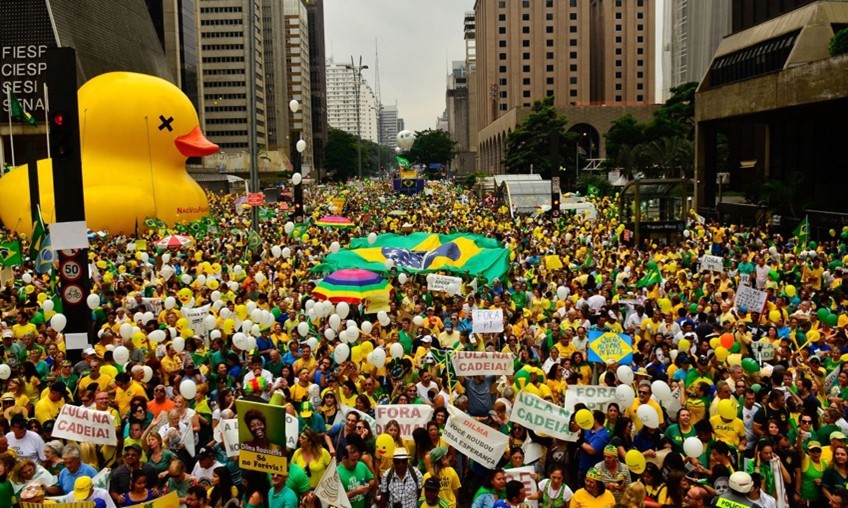
Though the war on violence gathered a large following, what secured Bolsonaro’s candidacy was the conviction of his strongest opponent, Lula da Silva, which barred him from the presidential race. The former president of Brazil was, however, only one of several convicted in one of the biggest corruption investigations of the recent ages, “Operation Car Wash”. It uncovered a laundry scheme that funnelled billions into politicians’ and big companies’ pockets. According to a Datafolha study, the general public’s faith in Brazilian institutions had eroded over the years, with trust in the presidency and congress falling below 40%. Bolsonaro seized this opportunity to emerge as an outlier and promised to end corruption.

Source: Agência Brasil, demonstrators take the streets to protest against Dilma Roussef’s government and the corruption scandal

Almost two years later, both the president and his family have been ensnared in corruption scandals. Most notably, his oldest son and former senator of Rio de Janeiro, Flávio Bolsonaro, was charged this past November of embezzlement, money laundering and criminal association.

The very probe, that shed light on the institutional corruption in Brazil via “Operation Car Wash”, has now wound down following pressure from parts of Congress as well as the Bolsonaro administration. The outbreak of the Coronavirus has only helped Brasilia in sweeping any talk of corruption under the rug.

III. A Never-stable Economy (in the heat of a pandemic crisis)

Social and political instability were not all that troubled the nation, which was coming out of the worst recession in its recent history. The economy had barely grown for almost a decade, incurring even in contractions. Both the commodities’ boom and tourism, one of the country’s largest economic motors, had collapsed. Inflation and unemployment had risen significantly, the former reaching 10.7%, in 2015, and the latter reaching a century-high value of 12.82%, in 2017.

Efforts of Bolsonaro’s administration to depart from the status quo of deep recessions were cut short as Brazil was hit severely by the global pandemic. Today, the country has the second highest death toll in the world and more than 2,000 daily deaths from Covid-19, which might be higher due to lack of reporting. In a country struggling with inequality, the disease has struck distinctly among social classes, affecting mostly people living in extreme poverty, who are less able to follow social distancing and other health norms. There are more than 14 million people unemployed, an astonishingly high number, since 40% of the workforce depends on daily wages to eat and survive.

Source: Market Watch, Workers bring the coffin of a police sergeant deceased from Covid-19 to the cemetery in Brasilia

At the beginning of the pandemic, a stimulus package of 50 bn$ was widely credited for Bolsonaro’s popularity and for boosting the economy. However, the president continued to dismiss and even mock health measures, while strongly questioning official statistics. He incited public disrespect of curfews and fired those who did not agree with him, such as the health minister.

Now, there is a new smaller stimulus package on its way. The package enables Bolsonaro’s administration to relaunch a cash transfer scheme to the nation’s poorest during the next four months, while limiting the impact on fiscal accounts, since investors are worried with debt rising above 90% of GDP. There are, nonetheless, questions as to whether they will be able to keep people from hunger.

IV. A Never-equal society and a Never-prioritized Environment

Bolsonaro’s mandate is full of controversies created by strong statements of the president against the LGBTQ+ community, black minorities, and women. His promise to make “Brazil safe for all its people” might not be real after all, as, socially, he turned out to be polarising, and excluding minorities. In addition, Bolsonaro and his government’s denialism of climate change remains unchanged. As widespread fires hit the Amazon forest last summer, the president intends to exploit deforested lands, rather than preserve them, which will severely affect indigenous communities.

Brazil: A Never-united country?

Source: LatinAmercian Post, A country divided in two by Bolsonaro

As the 2022 presidential elections draw ever closer, it seems the division that plagued the country four years ago has only deepened. Despite unfulfilled promises and mismanagement of the ongoing health crisis, Bolsonaro has managed to maintain a significant following.

New developments have seemed, albeit, to undermine his re-election campaign. Former president Lula da Silva has been released by the supreme court of justice, which decided to overturn graft convictions. While the decision has yet to be finalized, it has set the scene for a contest between opposite sides of the political spectrum in next year’s presidential race.

As the emerging candidate once said, “We all know that, all over the world, never did the workers’ win a single thing without fighting, without perseverance.” It remains to be seen who the nation will be fighting for.


Sources: BBC, Britannica, CSIS, Financial Times, Folha de S.Paulo, Forbes, the Guardian, Latin America Reports, Open Democracy, Vox, FRED, Human Rights Watch, Abc News

Afonso Monteiro

Pedro Estorninho

Maria Mendes

Anchoring: What strands your preferences in a sea of option

Reading time: 5 minutes

Imagine yourself in a clothing store. You find the perfect pair of jeans but, unfortunately, they’re WAY above your budget. However, the store saleswoman says that right now it’s at 35% off. Joyfully, you might think it’s a bargain and you might agree to buy it. Now, picture yourself waiting in the entrance of a restaurant.  You are told to wait 30 minutes but when the 30 minutes are up, your name isn’t called. However, when the host says it’ll be just 5 more minutes, rather than complaining about it, you start getting excited that it’s almost your turn. Do you notice a pattern? In both situations, your expectations before deciding were strongly influenced by the information you received and that served as reference point for your actions (the 35% off doesn’t seem expensive in comparison with the full price and a 5-minute wait is nothing compared to half an hour). 

Is a good deal always a good deal?

This phenomenon is known as anchoring. It is a type of cognitive bias,1 where a person is exposed to (typically) a first piece of information (whether it be a number, an idea, a belief, etc.) and that piece of information (this is the anchor) will be the reference point for all subsequent decisions. Once the value of the anchor is set in stone, all future negotiations or arguments are discussed in relation to that anchor. We invite you to explore this intriguing psychological effect, learning more about how exactly it manifests and how we can outsmart it. 

A very common anchoring effect can come in the form of numbers.  An experiment has been used to measure the strength of an arbitrary anchor when judging house prices using a group of college students. The students were first given an introductory 10-minute presentation on facts and figures regarding the housing market in the beginning of the experiment. After the presentation ended, they were asked to write down the last three digits of their phone and then multiply that three-digit number by one thousand. Finally, when asked to estimate the house prices, the results showed that the student’s estimates were strongly influenced by the arbitrary number or rather anchor, despite going through the presentation. Notice how the number was completely randomised. There is no correlation between your phone number and the housing prices, yet the effect was still present. Therefore, irrelevant information can appear “relevant” even when it is completely nonsensical. 

Would you predict the housing price of your local neighbourhood with just a phone number? 

The effect can also be present in negotiations. During courtroom proceedings, an attorney and prosecutor might discuss the sentencing of a defendant in hopes of achieving a fair trial. However, these discussions might not always be fair. For example, when looking at the news about the results of a court case, you might notice that people charged with very similar, if not, equal crimes are sentenced differently. This can be explained by the anchoring bias. In the research paper, “Heuristics and Biases in Judicial decisions”, Eyal Peer and Eyal Gamliel found that judges were highly susceptible to this effect! Both novice and experienced judges were given two different demands for a sentence by an alleged prosecutor. One sentence was 12 months, and the other was 34 months. The results showed that when given the 12-month demand, the judges requested more information that was consistent with this sentence and the same was done for the 34-month demand. Rather than using their own judgement, they used the number as a reference point despite it not being legally relevant to the actual crime.

Even highly qualified judges can be swayed by the anchoring effect

Businesses also are known for taking advantage of the “first impressions” felt by their clients through their marketing campaigns. Let’s look back to the release of the original iPad. After Steve Jobs listed the iPad’s amazing features, he asked the audience how much they think it should cost. He initially said that the price was $999 and left the number there for a few moments. Afterwards, he concluded that Apple was able to meet its cost goals and so the actual starting price of the iPad was $499. In the presentation, the number $999 was destroyed by a falling number $499. In that exact moment, we can see that the iPad was perceived as “cheap” because the previous price became the anchor.  

Steve Jobs announcing the “cheaper” price during his presentation of the iPad

Of course, anchoring can come also extend past the numbers. We can easily be influenced by opinions or ideas and set those as our anchors.  For example, let’s suppose that your parents lived well into their 90s or even 100s. You might expect that, being their son/daughter, you will also live a long happy life. However, this anchor can lead you to ignore the fact that your parents lived a much healthier and more active lifestyle that could’ve helped them reached a very old age while you may eat poorly or lead a sedentary lifestyle. Again, we can see how the anchoring effect can not only be inaccurate but also lead us to think poorly and not reconsider the repercussions. In a more serious situation, let’s say that you are feeling ill, and you consult a physician in order to take a better look at you. While the person examining you is indeed a licensed physician, their first impressions of you regarding your symptoms inevitably will create an anchor point for them while will impact every examination or assessment you do with them.  

There are various ways that help mitigate the influence of the anchoring effect. Two studies have shown that before accepting an anchor, it’s important to list the cons or arguments on why that anchoring point is disadvantageous. Thomas Mussweiler, a professor of organizational behavior expressed the following: “In a real-world setting using experts as participants, Study 1 demonstrated that listing arguments that speak against a provided anchor value reduces the effect. Study 2 further revealed that the effects of anchoring and considering the opposite are additive”. Another way to reduce the impact of anchoring is by “dropping you own anchor”. For example, when looking for a home. Do not simply stick by one desirable price point. You’re better off finding a home with similar features, similar square foot, similar price points, etc. The more you research, the easier it is to determine a reasonable anchor. In case of any doubt, the last step would be to simply know when to walk away. When for example determining your salary for a job, if you find that the employer is giving you a salary below the average and refuses to budge from it, it’s not a bad idea to respectfully decline and/or walk away.  

From the convenience store around the corner, to the courthouse, or even passing through the most mundane interactions we have, anchoring is everywhere we look. It´s a fascinating phenomenon that is bound to be part of nearly every decision we make. Anchoring is a mental shortcut that allows our brains to make comparisons and value the numerous items we see every day, however, as any other shortcut in life, it has its risks. With the help of this article, we hope that you, as, a judge, an entrepreneur, or simply a consumer, can harness the advantages of this effect, but at the same time, be AWARE, of its dangers. 


Daniel Calado

Afonso Serrano

Mariana Gomes


Commodities Super Cycle: Are We Entering One Now?

Reading time: 7 minutes

Over the last few months, commodity prices have been on the rise, and increasingly more market participants are suggesting a new commodity super cycle. But what is this?

The United Nations (UN) describe it as a “decades-long, above-trend movements in a wide range of base material prices”, which differ from short-term fluctuations, in terms of span, with trough-to-trough cycles usually lasting 20 to 70 years, and in terms of range, affecting a broader spectrum of commodities, mostly inputs for industrial production and urban development.

Historical Super Cycles

Comparable previous Super Cycles include the mid 1940’s and 1950’s super cycle, during the reindustrialization and reconstruction of Europe and Japan (after World War II) and, later, aided by fears over the Korean War and its effects on South and East Asian trade, both of which led to a greater demand and a build-up of strategic inventories. As an example, the price of copper per long ton rose from $62.10 during WWII to $420 by 1954, an appreciation of 580% in 15 years.

More recently, in the beginning of the present millennium, commodities also saw their prices spiking, starting in 2000, up until 2013 (though a dip occurred between 2008 and 2010), mainly due to the rising demand from Emerging Markets, such as the BRIC countries, particularly China, which could not be accompanied by the supply side: the price of oil rose 1,062%, copper rose 487% and corn rose 240% from 1999 to 2008. It began showing slowdown signs after the great financial crisis and the Euro crisis in 2008 and 2011, while finally winding up during the 2015 Chinese Stock Market Crash, caused by the deceleration of the Chinese economy.  

Figure 1: GMO Commodity Index 1900-2013
Source: A roadmap for a smart Artic specialization

What is going on with Commodities

This present run, however, has started in March 2020, when markets reached their lows, with commodities’ prices plunging due to lockdowns and global stoppages of industrial activities. Since then, all major commodity indexes have recovered from their losses last year, mainly dragged by the momentum of Oil (up more than 180%), Gold (up more than 15%) and other specific metals, such as Copper and Silver (up more than 100%).

What are the factors driving this new commodity Spike?

The current commodities appreciation, and prospects of a new super cycle since the election of Joe Biden, have been caused mainly by three different forces. Two coming from short-run scenarios: Future Shortages of Supply and Inflation Expectations; and one from a long-run trend:  The Green Transition.

Starting off with the hypothesis of Future Shortages of Supply, this event is expected to be triggered as mass vaccinations and reopening of economies boosts the demand of multiple commodities, whose capacity has been depressed after the 2020 reductions in Capital Expenditure (CapEx), -25% on average for Oil and Gas companies.

Nevertheless, corporations from many other industries, that were forced to divest their activities during the demand crisis last year, are now about to be blessed by worldwide pandemic relief programs that have promised public large-scale infrastructure projects, such as the $10 billion Highway Infrastructures Program in the US and the $26 billion Investing in Canada Infrastructure Program.

Figure 2: CapEx cuts on the largest Oil and Gas companies
Source: Bloomberg

Secondly, the US loose monetary and fiscal policies, alongside a foreseen economic expansion, has left space for concerns regarding a prolonged inflationary and currency devaluation period that will highly benefit investors holding commodities on their portfolios. This asset class may have played a very timid role last decade, but with the Fed targeting an average of 2% inflation, instead of having this value as a threshold, and with investors looking to hedge their Fixed Income and Speculative positions, a commodities momentum has been building recently.

If we look at historical data, there has been a positive correlation between commodity prices and the CPI, with an increase of 1% in inflation resulting, on average, in a subsequent 3.5% appreciation of the BCOM (Bloomberg Commodity Index)

Figure 3: Scatter plot of the quarterly returns of the BCOM and changes in US CPI
Source: Bloomberg, NN Investment Partners

Finally, the transition for environment-friendly alternatives and new technologies, starting this decade, is likely to reshape the near-future of many commodities. On one side, the promotion of renewable energies from the US, Europe and China is going to require large investments for the creation of solar panels and wind turbines, which will pump up demand for metals such as Silver and Copper. Then, the incentives for an EV transition are also going to further risen the demand for other metals, such as Lithium, Cobalt and Nickel, required for its batteries.

However, on the other side, this transition is likely to have a contradictory effect on oil prices. Whilst these are expected to decrease in the Long-Run (given the decarbonisation process), the US re-entry into the Paris Agreement, in which it will agree to decrease its oil production by millions of barrels, will give the OPEC+ the opportunity to control even further the price of worldwide crude. Furthermore, as these countries seem to show no interest in the subject of climate change, they are set to leverage on what might be the last decade of strong demand for this commodity, thus pushing prices as high as they can.

Impact of a super cycle in the Economy              

Fluctuating commodity prices have a significant impact on business, but they also impact markets and the overall economy. Generally, the impact of commodity price fluctuations depends on whether that economy is a net importer, which typically benefits from the reduction in prices, or net exporter of commodities, which should be better-off with price increases.

Oil is the most important commodity for most economies worldwide.It is crucial, because it plays an important role in power generation, logistics and industry. If the price of oil increases due to higher demand, it is a good sign for the global economy, which will continue to expand alongside with the oil price. The intuition behind is that the increased production and consumption in the economy will generate the demand for oil. On the other hand, when the increase in price is due to a supply deficit, it normally means a potential contraction in the economy. Most of these shocks are associated with natural disasters or agreements by oil producers to fix the price.

Copper is sometimes named “Dr. Copper” for its ability to predict where the global economy is heading. When its price increases, the economy is normally on an uptrend. Other commodities, such as Timber, Cotton, Wheat, Corn and Coffee are broadly used throughout the economy. An increase in their price means that the prices for the products they input will increase.

Lastly, it is important to mention Gold, given its special characteristics. It is used in various sectors across the economy and its price also depends on the value of the US Dollar. Contrary to other commodities, gold price normally goes up when the economy is in bad shape, since it is seen as a stable investment.

Future Perspectives

As the world re-opens, demand for commodities has surged throughout countries. Combining this with rising inflation, a weaker dollar and low interest rates, resulting from the highly expansionist monetary policies in response to the pandemic crisis, it might create a new super cycle in commodities in the US, as investors and businesses demand commodities either to hedge these risks or for production. Also, as the US looks to join the Paris agreement, infrastructure will have to be built to meet the requirements.

Overall, the conditions seem favourable for a new super cycle to be starting. Nevertheless, some of the drivers might not play out as expected or even be a temporary glance that won’t be able to impact commodities price on the long run and sustain the cycle over time.


Sources: Australian Financial Review, Blackwell Global, BRINK, Business Insider, NN Investment Partners, The Economic Times, United Nations Industrial Development Organization

Scientific revision: Patrícia Cruz

Francisco Nunes

Jorge Lousada

Diogo Almeida

Israel’s [uncertain] future

On March 23rd  2021 Israel held its fourth legislative elections in two years. No candidate was able to secure enough parliamentary seats to stay in power, meaning Israel’s political crisis will remain unsolved in the months to come.

Following the 2009 legislative elections, where Benjamin Netanyahu’s Likud party finished second, Netanyahu was able to create a majority coalition with several other right-wing parties. He formed a new government and was nominated Prime Minister. This was his second term as Israel’s head of government, following his 1996-1999 term that ended with a vote of no confidence by the parliament. Netanyahu managed to win both the 2013 and the 2015 elections, securing his stay in power by forming coalitions with smaller right-wing parties.

In 2016, Israeli prosecutors started investigating Netanyahu on charges of corruption, and on November 21st 2019 the Israeli attorney general formally indicted Netanyahu on charges of bribery, fraud and breach of trust in three separate cases. If convicted, the sitting Prime Minister could face up to 13 years behind bars.

Netanyahu’s charges

Benjamin Netanyahu is involved in three court cases, known as 1000, 2000 and 4000. Case 1000 concerns the Prime Minister’s relationship with two businessmen. Netanyahu allegedly received from these businessmen a quasi-continuous supply of cigar boxes and cases of champagne. These gifts amounted to almost €170,000, and Netanyahu is accused of fraud and breach of trust.

Likewise, Case 2000 also sees the incumbent Prime Minister charged of fraud and breach of trust, but these charges regard Mr. Netanyahu’s meetings with Israeli media mogul Arnon Mozes. Both are alleged of striking an agreement, where Mozes’s media group would improve their coverage of Mr Netanyahu, in exchange for restrictions on the Israel Hayom newspaper, Mozes’s competitors. The attorney general has also charged Mr. Mozes with bribery.

Case 4000 concerns what attorney general Mandelbilt called a “reciprocal agreement” between Prime Minister Netanyahu, who at the time was also the communications minister, and Shaul Elovitch, the controlling shareholder of Israel’s largest telecommunications company, who also owned the news website Walla. Netanyahu is accused of using his powers and authorities as a public servant to promote matters of substantial financial value pertaining to Mr. Elovitch’s businesses, dealing on several occasions with changes in regulatory frameworks. In exchange, Mr. Elovitch and his wife exerted continuous pressure on the director-general of the news website Walla, to change their coverage to be aligned with Mr. Netanyahu’s demands.

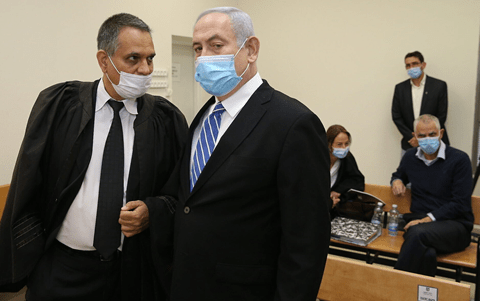
Benjamin Netanyahu in his second court appearance

Israel’s political crisis

With the investigation and indictment of Prime Minister Netanyahu came a clear rise in “anti-Netanyahu parties”, whose main campaign goal centred around deposing the Prime Minister. The largest contender to Netanyahu’s power was Benny Gantz, who had the support of the Blue and White political alliance. Gantz managed to tie Netanyahu in terms of parliamentary seats in the April 2019 elections, preventing Netanyahu’s coalition from obtaining a majority in parliament and forcing renewed elections in September 2019. In the September rerun both main parties lost seats, making considerable efforts to form a new coalition. Netanyahu approached his religious and ultra-orthodox allies, and Gantz the liberal aisle of the parliament. Nonetheless, those efforts fell short, and new elections were yet again scheduled for March 2020.

Benny Gantz managed to secure a parliamentary majority, but his coalition parties failed to agree on a government program and refused to sit together in government. The Covid pandemic led to the need of an emergency coalition, and Gantz felt forced to break his campaign promise and form a coalition government with Netanyahu and other smaller parties. This decision severely affected Gantz’s popularity, both inside his party and among voters. This, together with disagreements between Gantz and other parties in the coalition, led to the collapse of the government, when it did not manage to approve a state budget before the end of 2020. According to Israeli law, this calls for the dissolution of the parliament, and the scheduling of elections within 90 days, resulting in the March 21st elections.

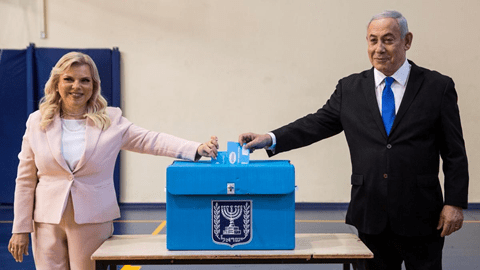
Sara and Benjamin Netanyahu casting their vote

Political deadlock

With all votes now counted, no party can be considered a clear winner. Netanyahu’s opponents hold 57 seats of the parliament, while Netanyahu and his coalition partners solely hold 52. 11 seats are still up for grabs as two parties are yet to commit to either side, the United Arab List and Anthony Bennett’s Yamina. The decisive party may well be the United Arab List, a small Islamist party that won four seats. Their leader, Mansour Abbas, has openly stated his willingness to negotiate with both sides of the aisle. For Netanyahu to secure a majority, he would need his former aide turned critic Naftali Bennett and the United Arab League. However, to balance a coalition with nationalists, ultra-orthodox members and an Islamist party seems like an impossible task.

The anti-Netanyahu camp, however, only needs the United Arab List’s four seats to secure a parliamentary majority and oust Benjamin Netanyahu. Benny Gantz already tried to form a coalition with Islamist parties following the last elections, to no avail, citing disagreements with the Islamist party’s leadership over national and security issues.

President Rivlin is trying to solve this deadlock by holding consultations with each party in the coming weeks, but it is far from clear what the outcome of this stalemate will be. If a coalition fails to be formed, the President will be forced to dissolve the Knesset and call new elections, the fifth legislative elections in two years, leading to further political instability in a country that has been plagued by it throughout the last two years.


Sources: Al-Jazeera, BBC, CNN, Deutsche Welle, Reuters


Hugo Canau

Manuel Barbosa

António Payan Martins

Christian Weber

Ukraine: 21st Century Cold War

Reading time: 6 minutes

The War in Donbass

More than six year have gone by, around five thousand people have died and more than twelve hundred have been wounded. The conflict in the Donbass region has yet to subside. As of July 27th, the 29th attempt at a “full and comprehensive” ceasefire came into effect, with number of attacks and deaths dropping and a renewed hope of the end of this conflict.

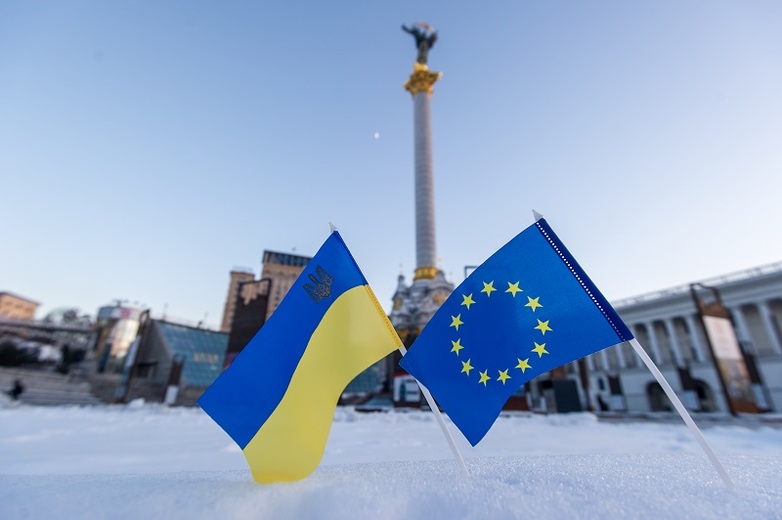
To understand its origin, we must take a step back to November 2013, with a heavily indebted and corruption-filled Ukraine in need of help. Both the EU and Russia seek to help, the former promising strong ties in the long-run at a cost of tough conditions in the short-run and the latter offering a seemingly more lenient offer of a $15bn loan to be paid out over the course of several years and the prospect to join the Eurasian Union. Preferring the Russian bailout to an agreement for further integration with the European Union, which many saw as a way out from the deep economic problems, president at-the-time Viktor Yanukovych stirred unrest in the population. This led to protests in Kyiv’s Maidan Nezalezhnosti (Independence Square), the “Euromaidan”. In February of the same year, Parliament voted to remove him forthwith.

Viewing these protests as an opportunity and on the pretext that Russian speaking minority was being threatened, Moscow invades Crimea in Spring of 2014. Not long after, pro-Russian separatists seize the cities of Luhansk and Donetsk and declare them independent from the Ukraine. The national army moves to regain the cities, but Russian soldiers covertly join the rebels. Thus, a war is sparked in the Donbass region between the separatist forces of the self-declared Donetsk and Luhansk People’s Republics and the government.

Source: Foreign Policy

In February 2015, both sides settle on a peace agreement called Minsk II, detailing a ceasefire and withdrawal of armed groups and weapons from the border region. Nonetheless, neither side respects the agreement, and 28 failed ceasefires ensue.

Only one question comes to mind: Why did this conflict come to be?

Russia’s ambitions in Ukraine

Since its recognition as an independent state, Russia has attempted to shape Ukraine’s foreign policy choices, using hard power, negative externalities and coercion, while capitalizing on existing energy and trade interdependencies.

There is large debate, as to why Russia seeks to gain control over Ukraine.

Some believe, the geostrategic importance of Ukraine’s gas transit infrastructure has prompted Kremlin’s drive to gain control over it. Until the Crimean invasion, Russia supplied most of Ukraine’s gas, and, though imports have since stopped completely, it still relies heavily on Ukrainian pipelines to pump its gas to customers in Central and Eastern Europe and pays billions in transit fees to Kyiv.

Others argue Moscow seeks to restore Russian hegemony and have it recognized by the Ukrainian people, that the post-Cold War enlargement of NATO, viewed by it with increasing distress, is the major reason for this assertive policy. When intent to bring Ukraine into the organization was made clear, Putin declared it “would be a hostile act towards Russia.”

Finally, comes Putin’s fear of losing power at home. After anti-government protests in 2011 and a steady decline in ratings, Putin claimed U.S. actors were sowing unrest and began to rally his political base by antagonizing them. His intervention in Ukraine propelled scaled ratings above 80%.

Regardless of the cause, its leverage over Kyiv has been exercised for years, via multiple security challenges and interdependencies, especially economic. Russia currently holds a 3bn dollar bond from the Ukrainian government and its heavy industry was, for years, largely dependent on energy imports and low prices from the former. The fear of being in a subordinate position vis-à-vis Russia has defined the evolution of Ukraine’s foreign policy during the past quarter-century.

US and EU policy

Following the Soviet collapse, Washington was the first to recognize Ukraine’s independence: “If we believe in the principle of sovereignty of nations on which our security and the security of our friends and allies depends, we must support Ukraine in its fight against its bullying neighbor. Russian aggression cannot stand.”, Bill Taylor, former US ambassador to Ukraine.

Focused on the denuclearization of the former Soviet Union, priority was set in leading Ukraine to forfeit its nuclear arsenal and in 1994 the US, the UK, and Russia pledged, via the Budapest Referendum, to respect Ukraine’s sovereignty in return for it becoming a nonnuclear state. Thereafter, the US has been worked towards safeguarding Kyiv’s independence, in favor of its integration into NATO since 2009 and, in June 2020, announcing a 250 million dollars military aid.

Similarly, the European Union has laid heavy interest in guaranteeing stability, freedom and prosperity in its neighboring regions, by supporting good governance standards and the European rule of law being applied to this area.

Source: giz.de

Energy transit, environmental issues and border security represent the EU’s major concerns in Ukraine, assisting in reforms and cooperating on projects tackling joint problems. The Union is developing tighter cooperation with Ukraine in policy areas, marked by a greater level of interdependencies. Financial bonding examples, majority of which with the purpose of border protection, include projects such as TACIS National Program and Nuclear Safety.

Twenty years later, with the Crimean Annexation, restoring and strengthening Ukraine’s sovereignty reemerged as a top U.S. and EU foreign policy priority, as well as rooting out corruption, strengthening the rule of law, and encouraging privatization of businesses, particularly in the energy sector.

Ukrainian perspective

Before diving into Ukraine’s stance in this conflict, it is important to give some historical context. Since the mid 11th century Ukraine has had a long history of foreign dominance and its subjugation to Russian ruling can be dated as far back as the 18th. In the following centuries, there was a rise in the national cultural identity but only in 1918 did the Ukrainian People’s Republic successfully proclaim independence from the Russian Soviet Republic. This was, however, short-lived and the nation was once again conquered by the Russian Red Army. In 1991, it declares independence, formally recognized by Russia in the 1997 Treaty of Friendship.

The post-soviet era marked, nonetheless, no end to foreign influences as, on the one hand, Euro-Atlantic integration constituted an appealing path but, on the other, Russia still exercised leverage via the above-mentioned interdependencies. The “European Choice” has been a major priority from the onset, every new stage towards closer cooperation has been seen as a step closer to membership status. Nevertheless, maintaining a friendly relationship with Russia came to be a must for its feasibility.

Former president, Leonid Kuchma, summarized this vision of a multivectoralist foreign policy stating: “Being located at the European crossroad, in a complicated system of international axes, being at the same time pivotal for central, western, and southeast Europe, our country cannot afford not to have tight relations with these countries.”

Being located at the European crossroad, in a complicated system of international axes, being at the same time pivotal for central, western, and southeast Europe, our country cannot afford not to have tight relations with these countries.

Leonid Kuchma, former president, summarized vision of a multivectoralist foreign policy

The nation itself is divided regarding the East-West debate. A high number of ethnic minorities, including Belarussian, Hungarian and Russian at 17.3%, and a significant Russian influence on language, with circa 25.7% of the population considering it to be their mother tongue, stirred all but unity regarding foreign vision. Whilst the northwestern region of the county is pro-European integration and has adopted, in part, a strong nationalist position, the southeastern region still tipped heavily in favor of Moscow.

In recent years, however, public support has been galvanized pro-West due to Russia’s more aggressive behavior. The election of Petro Poroshenko and Volodymyr Zelensky have signaled, more than anything, the deep discontent and dissatisfaction with the political establishment and its handling of the conflict. Zelensky campaigned combating corruption and oligarchic economy, it is yet to be seen whether he will be the solution to Ukraine’s deep-rooted problems or another corrupt politician.


Sources: BBC news, The Guardian, CBS news, Vox, The Economist.

Afonso Monteiro

Raquel Novo

Teresa Thomas

Hugo Canau

Maria Mendes

Is London’s status as Europe’s main financial hub under threat?

Reading time: 6 minutes

For years, London has been the primary financial centre in Europe, but Brexit may allow Amsterdam and others to have a go at that title.

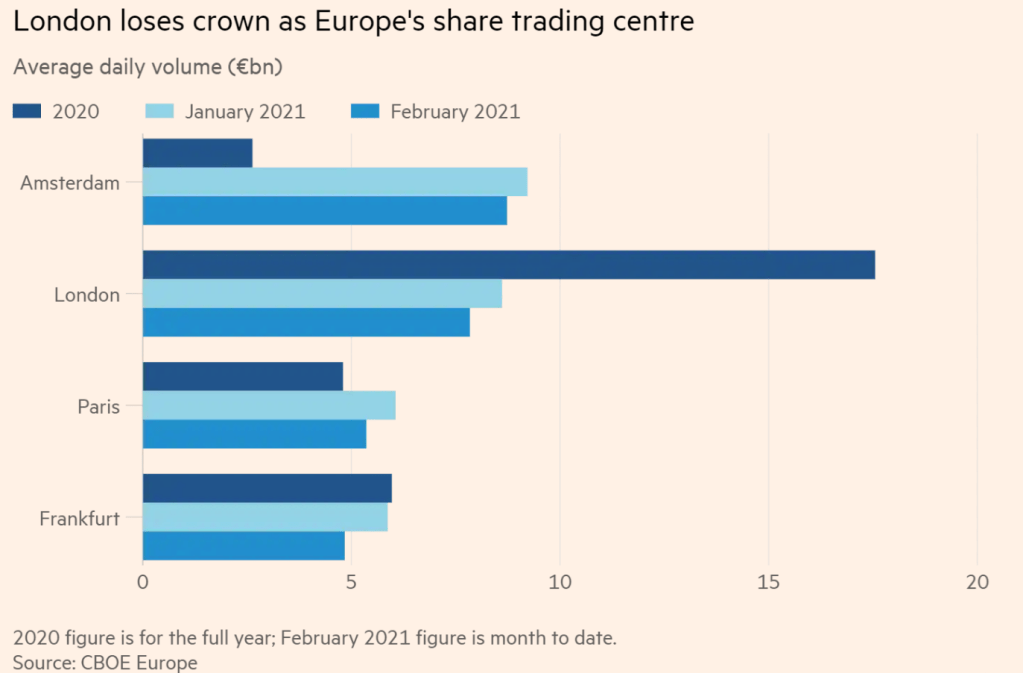
On the 1st of January of 2021, the United Kingdom (UK) finally left the EU. Immediate consequences could already be seen in the first days of UK’s exit. However, only now are we starting to have enough data to assess the true consequences of Brexit. One of the most interesting is the fact that London is no longer the largest share trading centre in Europe, having been surpassed by Amsterdam in January, which begs the question: “Is London’s status as the continent’s main financial hub under threat?”.

Before delving into the question, it is important to understand why London has been the dominant financial centre in Europe in the first place.

How did it happen?

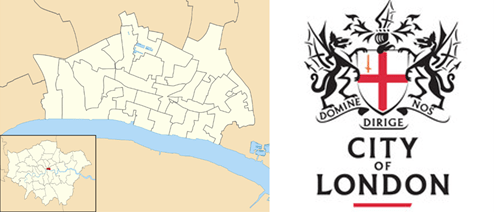
First, it is worth disclosing that the city has always been an important trading hub, ever since the Roman founding, and, in the 19th, century, it was the political centre of the largest empire in History. But this is where most people get something wrong, as London is the composition of two cities that have their own two, distinct political entities. There is London, the one everyone thinks of as London, and then there is the less well-known City of London which is entirely surrounded by the former. The latter was founded by the Romans, and it has acquired a myriad of special privileges throughout its existence, due to its importance to the various kingdoms and nations that followed the collapse of the Roman Empire, privileges that it maintains to this day. In fact, the City had so much influence that, in the Middle Ages, Edward, the Confessor, built a new seat of royal power around an abbey he had founded in Westminster, in order to draw away power and wealth from the City. For centuries, the two cities were geographically quite distinct, only becoming indistinguishable in the 16th century.

Figure 1 – Map showcasing the City of London being surrounded by its wider sister, London. Source: Wikipedia

However, the old city of London still maintains some privileges, some of them being that certain laws passed in Parliament do not apply to it. This special status is one of the reasons why so many financial services concentrate in this small area, as it has much more friendly business regulations than the rest of Europe.

On top of that, business regulations in the UK are more like the US’s than those in continental Europe, allowing for different practices in the Private Equity market, for example, and more easily attracting the financial juggernauts across the Atlantic. Combined with the language bridge, it is almost as if they are doing business in America, whilst being in Europe. Furthermore, its location allows for investors and traders to catch the end of the Asian trading day and the beginning of Wall Street’s, a privileged position in terms of currency exchange trade. Moreover, the fact that so many financial institutions decide to operate in London only attracts more institutions, as they can better harness economies of scale, by having almost all necessary complementary services and skilled human resources concentrated in the city.

The Impact of Brexit

Now, Brexit is threatening London’s envied position, as it is putting more constraints in the flows of capital and financial assets to and from the European bloc. In fact, the EU expects banks to move their euro denominated trades into the bloc by 2022, and some have already complied.

Furthermore, the UK’s financial services sector was able to provide these services to their many clients in the EU, thanks to the system of passporting for members of the European Economic Area (EEA), until Brexit was concluded.

This system consists of several different passports for various service categories that financial institutions can apply for and that allow them to provide these services to any member of the EEA. These passports also allow institutions to setup branches in the territory of other member states with much greater ease and simplicity than would otherwise be possible. Many financial institutions rely on several different passports at once to provide the range of different services that their clients depend on.

After Brexit, with the UK’s exit from the single market, the passporting system is no longer available to the UK’s financial institutions. Instead, they will need to depend on individual licensing in each EEA country they wish to operate in. These licenses, often, are not as comprehensive or as easy to obtain as the previous passporting system. Furthermore, it forces institutions to setup branches in other countries that they might not otherwise need, creating needless costs and inefficiencies.

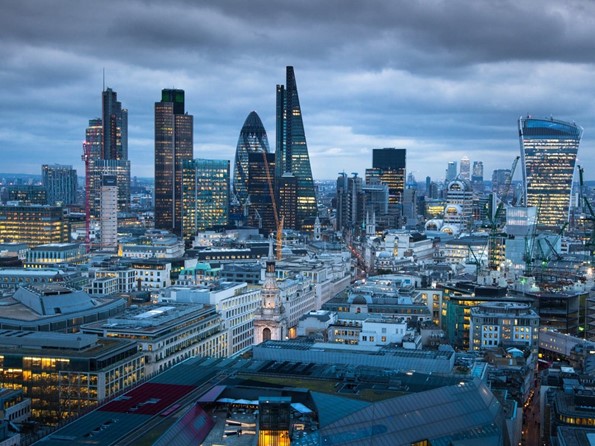
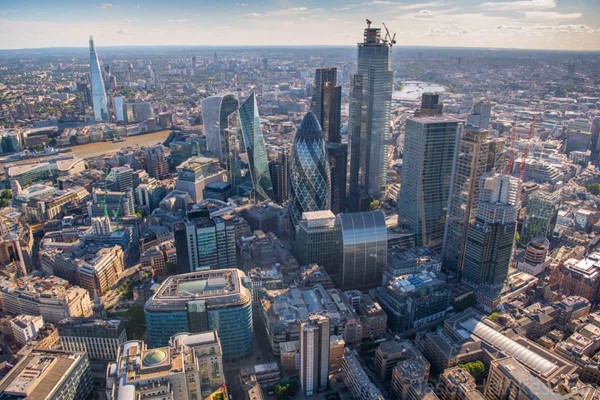
Figure 2 – Areal picture of the City of London and its surroundings. Source: Evan Evans Tours

Nevertheless, there is a potential agreement that would solve some of the problems the loss of passporting brings, which is an “equivalence” agreement in which Brussels and London would both agree to recognize some aspects of the other party’s financial supervision rules as equivalent to their own, and that would alleviate some of the frictions that have been registered since the start of the year. However, so far, there has been no agreement on equivalence.

Due to this, London’s trading markets of shares were hurt in January, as EU-based financial institutions were unable to trade, due to the lack of equivalence. Subsequently, trading of shares and other instruments has been flowing out of London into other European and American markets, with Amsterdam emerging as a clear winner and surpassing the City in share trading volume. “The city’s sudden dominance in European equity transactions goes back to Brexit contingency plans drawn up months ago. Both Cboe and the London Stock Exchange Group Plc’s Turquoise platform chose the Netherlands as their alternative site for EU share trading”, Bloomberg states, which is likely due to its business-friendly environment. Notwithstanding this, the more probable outcome in the long run is that many of the European operations that were previously done in London will be spread out through many cities besides Amsterdam, such as Frankfurt, Milan, Paris, Madrid. There probably won´t one single winner.

Figure 3 – Average daily trading volume per city in billions of euros. Source: Financial Times

A potential agreement on equivalence would not return to the City the ease of access to EU markets it had with the passporting system, as it covers fewer areas and services and is a unilateral agreement that could be withdrawn by the EU at any time. But even the prospect of full equivalence that many UK-based financial firms are hoping for is unlikely, since the EU wants to assert its financial independence and fears the UK may try to deviate its financial rules from those of the EU.

Still, even though it may seem that the EU can only gain with this outcome, one cannot forget that the EU’s financial activities were mainly conducted in London for a reason, and, with Brexit, firms’ access to capital markets and liquidity will not be as straightforward as it was prior to it. These added inefficiencies could hurt the EU, but the extent of the harm is still uncertain.

Final remarks

Despite Brexit, London will most likely remain a very important financial centre, perhaps even maintaining the status as Europe’s main financial hub, but the gap between it and its rivals will be smaller. Moreover, an agreement on equivalence in certain specific sectors is a likely option, but, given the more protectionist attitude of the EU, it is not probable this will be an agreement that ensures full equivalence.

All in all, the fears of London’s financial centre disappearing altogether are a bit exaggerated, but the city will also not come out unscathed, as many would hope. London is not just an important financial hub for Europe. It is important for the whole world, forming a crucial part of the current daily financial cycle of the globe, that encompasses other squares, like Tokyo and New York. But its importance for Europe will most likely decrease in the long run. As usual, reality is neither black nor white, but greyish.


Sources: Bloomberg, Financial Times, Investopedia, Marketplace.org, The New York Times, Wikipedia.

Rodolfo Carrasquinho

João Baptista

The Inevitable Side of Decision Making: Sunk costs Explained

Reading time: 3 minutes

Have you ever wanted to quit something, but you weren’t able to do it because there was already too much money, effort or time invested into it? Well, you are not alone! This quite common phenomenon is known as the sunk cost fallacy. The concept follows the idea that a person or a group of people choose to intentionally pursue further investments or commitments based on the aversion to waste the resources that were previously invested. One might ask, why do we incur in this fallacy in the first place? We’ll explore different concepts that might help us answer this question. 

The first concept to analyse is loss aversion. Loss aversion is usually related with investors, but it can apply to anyone. It’s the tendency to have a stronger preference in avoiding losses rather than acquiring the equivalent gains, simply because the “pain” of the loss is higher than the reward felt from a gain. In situations of loss aversion, three regions of the brain are activated: the striatum, which processes losses, the amygdala, which processes fear, and the insula, which makes individuals avoid some behaviours; neuroscientists also noted that this last region is much more activated in situations that might be a loss when comparing with the equivalent gain. This will make most individuals carefully consider risky actions and try to avoid losses. Additionally, as explained above, since the costs in our minds weigh more than the benefits, we might have the urge to make the most out of our resources and stay away from wastefulness. 

The different regions of the brain and their respective functions 

For example, when we are in the middle of a book that we hate, we often keep reading it until the end, just because we don’t want to waste the time or the money that we already invested in that book. This just goes to show that, sometimes we continue to put effort into something when we might be better off leaving it, just because we don’t want to feel like we are losing or quitting on the costs that we already incurred despite, most of the times, those costs being unrecoverable. 
As the writer and comedian James Colley revealed to The Guardian, “At some point it becomes a calculation of ego. When a book is finished it becomes a trophy. When it’s left half-finished it becomes an albatross. It occupies your mind like the tell-tale heart, mocking you, symbolising your failure”. 

This fallacy, however, doesn’t only affect individual decisions but can also have considerable proportions by affecting governments and larger projects. One example of this is the development of the airplane Concorde, which resulted in the partnership between the UK and France and had an initial cost of 100 million dollars. However, as the project developed, more costs accumulated, having a final value of 1.6 billion dollars. Even though it was a technical improvement, it reveals the sunk cost fallacy because, as the costs were incurred, they realised that it wouldn’t pay off, but they continued with the project.  This plane was retired after only 34 years, and it was so expensive that was never profitable. In this example, the governments of France and the UK were victims of the sunk cost fallacy, as despite the understanding of the unprofitability of the project they continued it. This could be justified not only by the feeling of wasted resources but also by the pressure that could arise from the bad investments of taxpayers ‘money. 

The Airplane Concorde being fully operational despite costly drawbacks 

This example illustrates the second concept, escalation of commitment. This tendency happens when some individuals might stick with a decision previously made because they feel the pressure to remain and to “honour” that commitment, such as in the case referred above, where even after new information notifies them that the previous decision might not be the best to follow.  

Another application of the sunk cost fallacy is related with the third concept called gambler’s conceit. This idea expresses that a gambler believes that he will be able to stop his risky behaviour while still engaging in it. Let’s say that you went to a casino and lost 100 dollars gambling. Your odds remain the same as when you started. Despite this, the tendency is to keep gambling until you recover from that loss because you already risked that money into the game, and you might experience loss aversion (feeling of loss greater than the one of gain). Besides that, according to the gambler’s conceit, while you are playing, you believe that you are still able to stop and that you will do it once you achieve gains, but when that happens, results show that you are unlikely to stop. 

In this illustration, you are also letting your past actions and losses influence your recent decisions leading to irrational behaviour, and it can be described as an entrapment situation, in which we endure the losses, in the hope of a later rescue and success by further investment. 

As seen throughout this article, it is rooted in our brains a powerful loss aversion. This neurological feature might have had a significant role in assuring our survival as a species, as it allowed us to avoid risky behaviour. However, it is also at the core of the sunk cost fallacy, not allowing us to put our rationality into practice and leaving us stranded to our past and immutable actions. 

Whether you are in the middle of a boring book, in a losing streak at the casino or you simply invested too much in a project that no longer makes sense, we hope this article can help you. 

Sources: The Guardian, Forbes & Corporate Finance Institute


Afonso Serrano

Daniel Calado

Mariana Gomes


European Budget

Reading time: 6 minutes

What is the EU Budget?

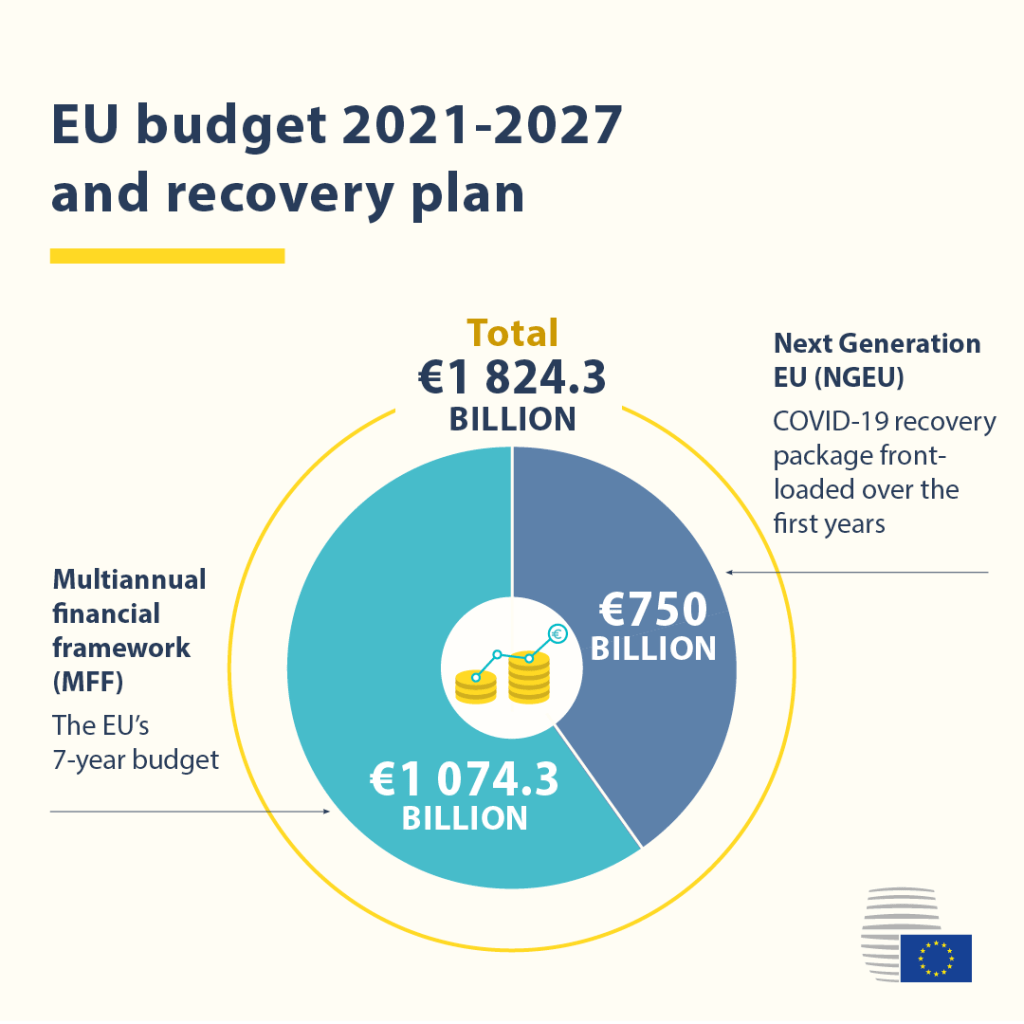
The annual budgets of the European Union (EU) are regulated by the Multiannual Financial Framework (MFF) – a long-term budget set to plan the application of EU’s money and distribute it among several EU policies in the long-run (five or more years). The 2021-2027 long-term budget has just entered into force and it is the largest in EU’s history. It will provision 1.8 trillion euros of funding to, firstly, help rebuild member states socially and economically, and secondly, build a network of infrastructures that aim at helping younger generations after the pandemic crisis. The long-term EU budget for 2021-2027 differs significantly from the previous one (2014-2020), in part due to the Covid crisis. The EU has created, alongside the MFF, a temporary recovery instrument, NextGenerationEU, to help countries face the economic consequences of the pandemic and lockdowns. This is a 750-billion-euro package financed through common debt.

Graph 1 – The MFF and NextGenerationEU (European Commission)

The Recovery and Resilience Facility (RFF) is responsible for applying most of the funds from the NextGenerationEU programme. It provides financial support for member states to rebuild their economies in the post-pandemic, specifically in green and digital projects. The RFF will support member states by handing out €312.5 billion in grants and €360 billion in loans. The receiving countries will have to negotiate their share of the budget with the EU, which will be allocated following several criteria, such as GDP per capita, unemployment levels and the impact of the pandemic. Before receiving their share of the fund, member states first need to submit their resource allocation plans to be assessed by the European Commission and approved by the European Council.

Besides, the primordial goals of the EU to modernize and digitalize Europe, fight climate change, and give continuity to cohesion policies still dominates a large share of the long-term budget. Horizon Europe (scientific research and innovation programme), the Just Transition Fund (climate transition programme), and the Digital Europe programme, together with the Recovery and Resilience Facility (RFF), account for 50% of the total budget. Policies related to the digital transformation account for 20% of the budget.

Examining the budget by policy areas, this is notably the first budget where new and reinforced priorities have the largest share of the budget (31,9%). These not only include the aforementioned programs like Horizon Europe, Digital Europe, and Just Transition Fund, but also a new EU4Health programme as well as initiatives for young people, like Erasmus+. The Common Agricultural Policy, historically the largest spending area of the Union, maintains its decreasing trend, administration expenses hold steady, and cohesion policies see a small decline.

Graph 2 – Share of the main policy areas in the Multinannual Financial Framework (European Commission)

This budget also includes the largest share ever towards the fight against climate change: 30% of the long-term budget, including the MFF and NextGenerationEU.

To face the common EU debt generated by NextGenerationEU, the European Union intends to establish new sources of revenue, namely a contribution based on non-recycled plastic waste, a new carbon border adjustment mechanism, a digital levy, and the EU Emission Trading System. The Commission will also propose, by 2024, some new source of revenue linked to the corporate sector or financial transactions.

The budget also includes a 5-billion-euro Brexit Adjustment Reserve, to help countries affected by the UK’s exit of EU.

Negotiations on the Multiannual Financial Framework (MFF) – 2021-2027

The MFF starts with a proposal by the European Commission, being then discussed by member states on the European Council until there is a unanimous agreement. Lastly, the European Parliament votes to endorse it.

In May 2018, Jean-Claude Juncker, former President of the Commission, unveiled a €1.135 trillion proposal for the EU’s MFF for 2021-2027. It not only “filled the 13-billion-euro annual hole” left by Brexit but was also a significant increase from the previous 2014-2020 MFF’S 959-billion-euro budget (2011 prices). The proposed budget increased the MFF to 1.14% of EU’s GNI, which breached away from the traditional cap of 1% of EU’s GNI.

In July 2020, the President of the EU Council, Charles Michel, presented a MFF 2% lower than the initially proposed, two years prior, by the European Commission. To please the ‘Frugal Four’[1], Charles Michel also proposed the rebates maintenance that have allowed the countries who are net contributors to get some of their membership fee back. Previously, the European Commission and the ‘Friends of Cohesion’[2] had attempted to scale back this mechanism.

The “Frugal Four,” led by the Prime-Minister of the Netherlands, Mark Rutte, refused the budget proposed by Michel as it would put the MFF above traditional cap of 1% of the Union’s GNI. These countries believed they should not have to pay for the financial hole left by Brexit.

In May 2020, the European Commission proposed a new MFF with a projected €1.1 trillion in spending for the 2021-2027 period. However, once again, this proposal failed to reach a unanimous agreement in the European Council.

In July 2020, Michel presented a compromised MFF of 1.074 trillion euros, which was lower than both the EU’s Commission proposal and his own proposal from February. He hoped the new reduced MFF would allow for more money to be spent on the EU’s recovery package. This new MFF would be agreed by all member states at the budget summit.

In November 2020, negotiators from the European Parliament and EU ambassadors introduced the Rule of Law mechanism, which would restrict EU countries who do not respect the “EU values” from receiving money from the MFF and from the recovery package. Therefore, both Poland and Hungary are being subjected to EU disciplinary procedures over their governments’ breaches of the rule of law in their countries. For this reason, these two member states threatened to veto the EU budget previously if this mechanism was not dropped.

In early December 2020, both Hungary and Poland agreed to the rule of law mechanism imposed by the European Parliament. However, the EU Commission will refrain from using it until the European Court of Justice has decided if it is legal, which could delay its implementation by many years. The new mechanism would also only be applicable to funds from the MFF 2021-2027 and the recovery package, but not for “for projects committed to under the current budgetary framework”. Lastly, in the case where a member state is facing penalties under this new mechanism, the European Council commits itself to apply it in a fair manner.

On December 16th 2020, with 548 votes in favour, 88 against, and 66 abstentions, the European Parliament approved the MFF, along with the Rule of Law Mechanism. These documents will set up the course of the European economy and EU’s finances, for the next seven years.


[1] Austria, Netherlands, Denmark, and Sweden (i.e. part of the largest net contributors)

[2] Bulgaria, Croatia, Cyprus, the Czech Republic, Estonia, Greece, Spain, Lithuania, Latvia, Malta, Poland, Portugal, Romania, Slovakia, Slovenia, Hungary and Italy. (i.e. net-beneficiary)

Sources: EURACTIV, European Council, European Commission, jornal Expresso, Instituto Superior Técnico, Jornal Económico, Politico, TLDR News EU


João Sande e Castro

António Martins

Manuel Barbosa

Pedro Estorninho