Taiwan’s Search for Status

Taiwan in the Past

The island of Taiwan was first settled by the Chinese in the 7th century AC. Its early history is intertwined with that of mainland China. The Portuguese reached the island in 1590 and named it Formosa, “beautiful”, it was then known by this name in the West for the following centuries. Taiwan was once a colony of the Netherlands and Spain, until mainland China regained control in 1683, under the Qing Dynasty.

In 1895, after the Sino-Japanese War, the island was ceded to Japan, who retained it until the end of the Second World War. After Japan’s defeat, the Allies conferred Taiwan to the Republic of China (ROC), a democratic republic that had replaced the Qing Dynasty in 1912.

However, at the time the ROC was fighting a civil war against Communist rebels in the mainland. Even Though the Nationalists, or Kuomintang, led by General Chiang Kai-shek, and the Communist Party of China, led by Mao Zedong, had made a truce during WWII to fight the Japanese invasion, after the war, hostilities resumed. In 1949, after losing four successive capitals in the mainland, General Chiang took refuge in Taiwan and declared Taipei the temporary capital of the Republic of China. He was followed there by two million people – mostly soldiers, members of the Kuomintang intellectual and business elites – and brought with him many Chinese national treasures and much of China’s gold reserves.

Henceforth, Taiwan was ruled as a single-party autocracy under martial law.

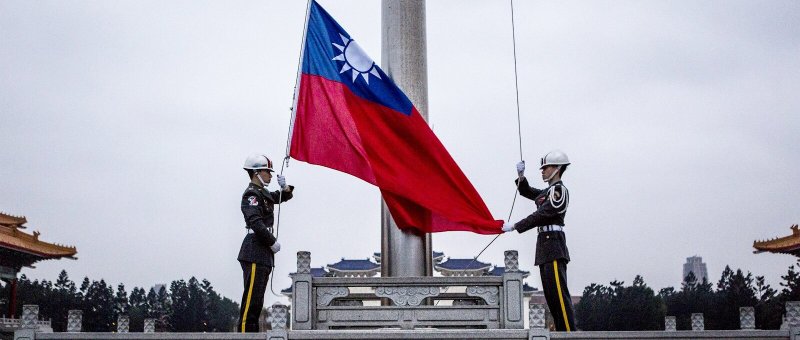
General Chiang regarded himself as the legitimate ruler of China, promising to one-day reconquest the mainland. His government retained China’s seat in the UN General Assembly and on the Security Council until October 1971, when both were transferred to the People’s Republic of China. Along with Richard Nixon’s 1972 visit to Beijing recognizing the PRC, this marked the end of the ROC’s plans to reconquer the mainland.

In 1987, martial law in Taiwan was lifted, opening the doors to democracy. In 1988, Lee Teng-hui became the first Taiwan-born president. Lee continued democratic reforms and replaced many mainland-born high officials with ones born in Taiwan. He promoted Taiwanese culture and held the first legislative elections in four decades. The old Parliament, elected in 1947, still had representatives of mainland China; the new Parliament only represented Taiwan, acknowledging it had no control over the mainland.

Throughout the 1990’s, Taiwan continued to move towards democracy and away from its territorial pretensions. A constitutional amendment in 1991 designated Taiwan as the “Free Area”, the only area under the government’s jurisdiction.

Taiwan Currently

Despite operating independently since 1949, China still regards Taiwan as a rebel region that they urge to recapture.  Plus, due to Chinese pressure, merely 15 countries have official diplomatic ties with Taiwan, and though the US is not among them, they provide Taiwan with military support, serving as their grand ally and protector. Therefore, the China-Taiwan relationship is somewhat combative. However, it has been improving: transport, trade and communications were restored between the countries in 2008.

Though initially deep-seated in Chinese tradition, Taiwan has been able to move far enough from the Chinese core ideals for them to be differentiated. For instance, even though their official language is Mandarin, they have also developed their own dialect, Min Nan Chinese. Moreover, they have their own currency, and their political system is visibly disparate from the mainland´s.

The current Taiwanese president, Tsai Ing-wen, became Taiwan’s first female president, after winning the 2016 elections with 56% of the votes in favour of her traditional, Democratic Progressive Party (DPP), 16 years after the party’s first presidential victory. Tsai’s vision has always empowered the idea of an independent, Taiwanese identity, while putting democracy at the country’s steering wheel. 

While Tsai devotes her political involvement to Taiwanese sovereignty, she must mind the consequences of her actions, in order to prevent estranging China, and throwing to waste the 8 years of friendly ties, under the former President, President Ma Ying-jeou.

In defiance of China’s oppression, Taiwan ranks among the world’s leading computer technology producers, with Foxconn Technology Group as its leading firm, netting an income of 4.24 Billion US Dollars in 2018, making it a major economic player in Asia. In addition to that, it has marked its presence globally, as one of the freest places to live, despite the uncertainty surrounding it being an independent nation.

Freedom, according to data, is correlated with the political system – democracies seem to provide freer living standards. In a report done by the Cato Institute, the Fraser Institute and the Liberales Institut at the Friedrich Naumann Foundation for Freedom, the Human Freedom Index (HFI) represents the state of human freedom globally, to what pertains personal, civil and economic freedom. It is estimated that Taiwan has an HFI of 8.4, ranking closely to Nordic countries in terms of freedom; while China merely has an HFI of 6.17, which ranks closer to less developed countries, such as Libya (4.64) and Iraq (4.34). This could be rooted in their different political systems, though other factors contribute too.


democracy index 2019 graphdemocracy index 2019 graph

Taiwan in the future

Taiwan’s future remains uncertain. The last elections were the result of Taiwan’s will to remain detached from China. Tsai Ing-Wen, the re-elected president from the democratic progressive party, had an expressive victory, in the 2020 presidential elections, over the second favourite pro-China candidate. He is the only hope, for many citizens, to maintain and reaffirm Taiwan’s sovereignty.

China, however, doesn’t seem to give up on Taiwan that easily. President Xi Jinping has already clearly stated that Taiwan’s issue “should not be passed down generation after generation”. China’s plan to finally solve Taiwan’s question seems to be near. Many doubts arise from this desire. How will China accomplish the so-called Chinese reunification, after already having retrieved Macau and Hong Kong territories?

Many say that Taiwan will not be able to manage China’s growing diplomatic and military pressure. Others argue that Taiwan is willing to fight for their recognized independence, at whatever costs. The truth is that military investment from both countries has been growing during the past years: In 2020 Taiwan announced that military expenses would amount to 11.9 billion dollars, roughly 2% of their nominal GDP. China’s army, on the other hand, will have a budget of 180 billion dollars, corresponding to 1,3% of their GDP.


chinese military superiority taiwanchinese military superiority taiwan

An obvious interrogation arises:

Can we be witnessing the escalation of an unavoidable war?

Sources: BBC, Statista, Taiwan Government Website, CATO Institute, Economist Intelligence Unit, Financial Times, Council on Foreign Relations

European (Dis)Union: North vs South

The health crisis

The current public health crisis, which has put the world on pause, is a test to human beings and to societies in general. It’s one of the biggest challenges faced by humanity since WWII (as stated by Germany’s chancellor Angela Merkel) and has put in check all structures of society and their response to the unknown. With that being said, the Coronavirus crisis has also been a test to the European Union (particularly, the Eurozone) and its unity.

Since the beginning of the crisis, the unity has been questioned as there wasn’t a prepared common strategy to deal with it.  Indeed, borders started to shut down individually rather than collectively, which didn’t make much sense as it affected the free movement of people, a key pillar in European unity; Italy, which was the first European country severely affected with the virus, appealed to its neighbours for medical equipment and aid, which was promptly denied, further increasing the division and loss of faith in the EU; the question regarding coronabonds re-woke the mutualised debt discussion in the Eurozone and increased pre-existing tensions, with southern countries strongly defending this mutualised debt instrument to respond to the crisis and others (Germany, the Netherlands, Finland and Austria) initially denying it, reopening the old gap between North and South.

Productivity

Indeed, every major crisis becomes a challenge to the EU (more specifically, to the Eurozone) and to its continuity and reinforces core differences between these “two regions”.

One key difference that cannot be ignored is productivity. On average, the “North” is much more productive than the “South”. According to OECD data, in 2018, countries like Germany, Netherlands, or Austria presented a higher GDP per hour than the average GDP per hour in the Eurozone ($59.64/hour); on the other hand, southern Eurozone countries such as Portugal, Spain, Italy or Greece had a lower productivity, below the Eurozone’s benchmark. This productivity division exists for a while and has impacted how countries experience economic growth and thus, their position as economic powers in the EU. Over the years, productivity has been increasing in both regions, with North above and the South always below the benchmark.


1.jpg

This difference has given space for some remarks throughout the EU’s history, with Southern nations being perceived as lazy by some Northern nations (let us remind some unfortunate comments made by former Dutch Finance Minister and president of the Eurogroup, who stated that crisis-hit countries, which were mainly Southern countries, spent their money on “drinks and women”). As shown in the graph, these comments are somewhat unsubstantiated, as Southern European countries work more hours yearly than Northern countries, reducing productivity, a complex and broad concept, often inherent to cultural characteristics. This serves only to further increase tensions between the two regions and further divide the EU, more noticeably in moments of crisis.


2.png

European Debt Crisis

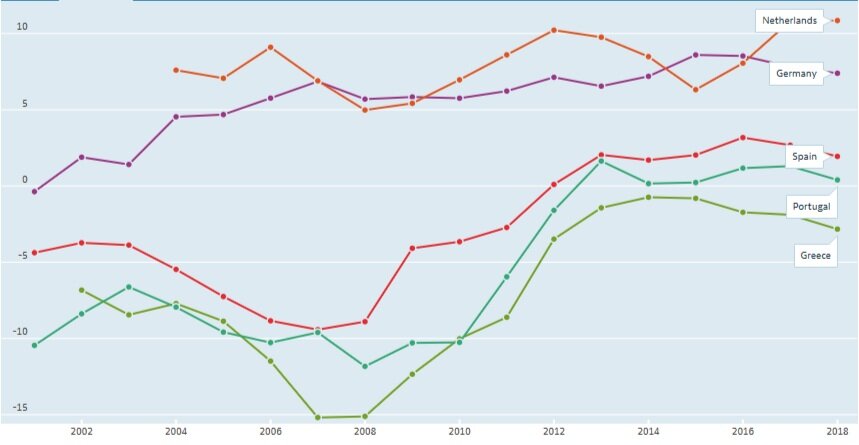
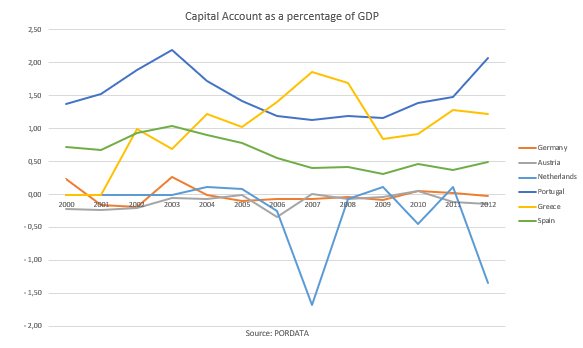
Another moment of division in the Eurozone dates back to 2008, when the Great Recession led to the European Debt crisis, resulting in the collapse of financial institutions and high government debt. This occurred due a high fiscal divergence between the member states, with Northern countries lending intensively to the South, creating an imbalance of capital flows.

 Indeed, in years prior to the crisis, current accounts of the two “regions” were symmetric, with Germany, Austria or Finland experiencing positive values, while Portugal or Greece had negative accounts. Also, capital accounts presented a similar pattern, with the North experiencing much lower values than the South. Instead of promoting structural change in the economy (greater capital accumulation) to converge with the richer countries, the South channelled capital flows from the North to non-tradable goods, i.e., having no export value and created both consumption and investment bubbles (due to low interest rates). Following the 2008 financial crisis, this led to an unbearable situation that culminated in the financial rescue of many southern countries.


3.jpg


Sem Título.png

Who is to blame?

From the North’s point of view, the South was living above its means and was not taking essential structural fiscal measures: while Germany was promoting fiscal discipline (surplus over deficit), the South was excessively expanding domestic demand to raise consumption and investment, unprecedentedly. Southern countries argued that this crisis was a double-edged sword, as creditors were lending at their own risk (low interest rates) and thus, they also had some responsibility for the imbalances in the eurozone.

The lack of common analysis on the crisis encouraged division and the financial rescue packages (based on strict conditionality and fiscal consolidation, dictated by the North) generated political and public criticism in the South, as austerity was deteriorating socio-economic structures and life conditions. The South blamed Germany for imposing its domestic preferences, with major protests against austerity, criticizing what they called the “German-run” Europe.

Nevertheless, while Portugal, Greece or Cyprus were tightening their budgets to repay the debt plus interests, with low investment and unemployment was peeking, Northern countries, like Germany or Austria, benefited from the shift of investment from the south, improving borrowing conditions for their companies (for instance, in 2014, Portugal’s yield of its 10 year bonds were at 5.675%, while Germany’s were 1.944%) and hence, promoting their economic growth, further deepening the division.

Coronabonds

In order to respond to this pandemic crisis, eurozone members discussed possible emergency economic solutions for 10 days, reaching a consensus. The coronabonds, a jointly issued bond, was one of the possible solutions, which intensified the friction between “North” and “South”. The eurobonds were mainly defended by Southern countries because it would be less costly to their governments to pay back the debt, also given the considerable amount of debt that they already have, as they would have easy access to credit at low rates. However, countries in the North, led by the Netherlands (and Germany), declined the idea of a eurobond because it would mean that their own taxpayers would be on the hook for the benefit of other countries, who they claim to have lived beyond their means, raising concerns of moral hazard. This divergency is not new; in 2008, in the financial crisis, the idea of eurobonds also emerged and was not applied. Unlike the previous crisis, where one can argue was caused by financial misbehaviour of some countries (endogenous factors), the current crisis is an exogenous shock that doesn’t discriminate based on cultural and fiscal differences, meaning that there should be a common solution rather than trying to blame countries on something that it’s not their own making.

Even though the EU has reached a short-term agreement worth over €500 billion to respond to the crisis, it hasn’t yet agreed on a common economic recovery, which is still a source of division. The real test will be when the economy slowly starts the path to normality. Meanwhile, populist, right-wing forces and eurosceptics observe, with discontent, how this crisis unfolds.

It’s up to the European Union to stay together.


0.jpg

Sources: Financial Times, Time, Público, OECD, Pordata, Expresso, npr, NAC, Euronews, The balance


Raquel Novo - Raquel Novo Teresa Thomas - Teresa Thomas

Behavioral economics in action: the role of behavioral units in politics

In this era of social networks, communication has reached new levels of virality. The Network of Networks – the Internet – has facilitated the creation of a new status quo: from governments and businesses to common citizens, each piece of information inserted and shared in the Web has the potential (given some very small probability factors) to become viral. If that happens, it cannot be stopped. No matter how far you are from the formal location where the original information fluctuates you will know about it. And it only needs a fraction of seconds.

How should people be in such an environment?  At the current speed at which media spread, even words have tremendous impact when misused. Likewise, silences also have a tragic impact when speech is needed. There is a need to be fast and ready to process information. In the case of politicians, words mean actions, words mean decisions, and these decisions impact much more than themselves: they affect millions of lives.

One lesson that Behavioral Science has taught well is how it is human nature to systematically make mistakes in evaluating circumstances. This comes with no shame: our ancestors needed to make decisions quite fast, and that led us to develop mechanisms to quickly judge whether a shadow was one of a rock or say, a lion. This is no different at this time, as we are still required to make these fast decisions. Politicians, corporate top management, governmental bodies’ leaders, some people’s job is to make decisions better than others for others. Yet, very often is forgotten how even our leaders are human. As so, they are equally prone to the same heuristics of anybody else. Yes, they may be more aware, and yes, they are skilled decision makers (usually), but emergency situations require quick reactions.

Our brain is programmed to follow a more rational, logic system (lets call it system 2) when decisions are complicated and require abstraction. However, most is processed by a quick, instinctive mechanism (that we call system 1). The latter, is the one responsible for both convenient intellectual shortcuts as well as for all of our biases and heuristics.

Availability is the name for the heuristics that describes how we evaluate situations based on examples that come up to our mind. This is among the main reasons why people are more scared about a plane crash when the news has reported one unlucky case, ignoring how many flights are done daily, yearly, with virtually no accident.

For the same reason, when something has never happened (or, to better put it, has never happened while we were conscious and alive…), we fail to capture the potential consequences of that event dramatically. We human beings are simply very bad at evaluating probabilities. Again, this is true even for the most capable, skilled leaders! (see our article on Nudging for more insights)

The work of behavioral economists has helped highlight this condition. Starting from the first inception with the research of psychologists and Nobel prize recipient Daniel Kahneman and his fellow Amos Tversky, the more recent work of economists such as Richard Thaler and Dan Ariely (author of the acclaimed Nudge and Misbehaving, among others), helped spreading awareness about the potential benefits of the behavioral science among various high ranks. President Obama himself has been a perpetrator of the nudging theories in his second mandate; yet, it is a case rather than the norm.


2.png

Availability heuristics, Groupthink (the tendency of believing something just because others believe it), Inertia and many other cognitive and emotional biases, help us explain why governments failed to evaluate the Covid-19 threat on a systematic, large scale. Why did this happen, despite early warnings and examples by the first victims, from China to South Korea? No simple answer is the right answer: many actors from different contexts with different interests likely lead to an environment where cooperation and mission alignment is tough to achieve. But one thing we can be sure: we are all humans, and as such, as scientific research has demonstrated, we are all prone to biased decision making. Through this, perhaps we could find a common denominator, a common ground for global discussion, from individual to country level.

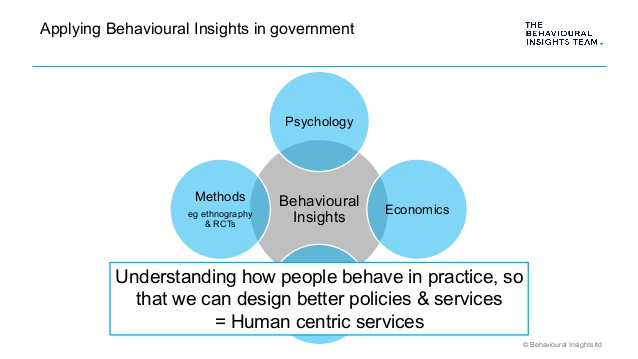
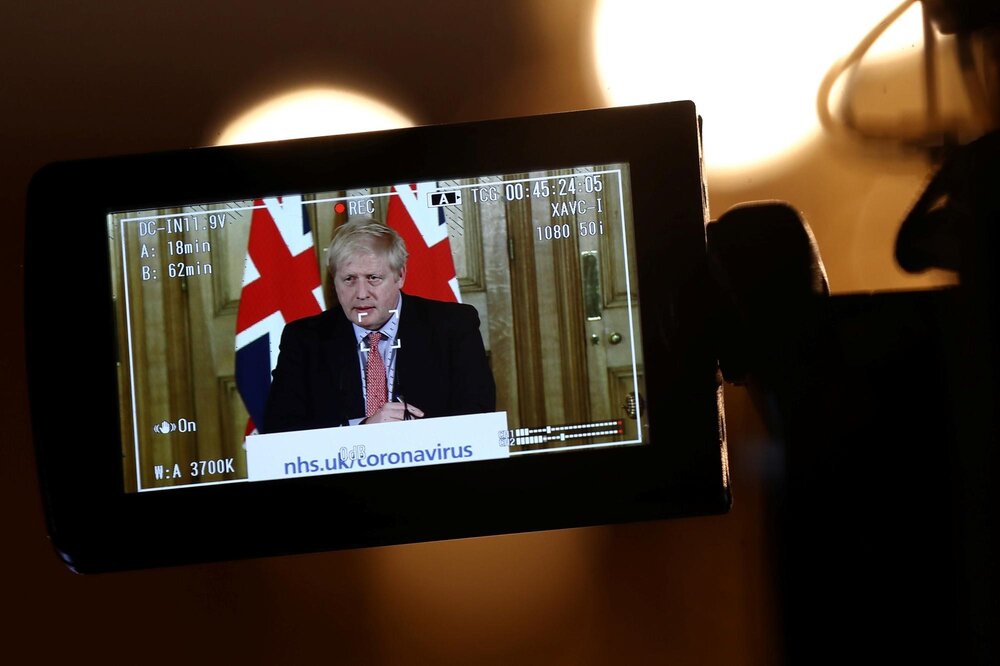
The current situation shows how the role of behavioral science is still unclear. As an example, the UK has indeed a behavioral insights team operating. In the last days, the debate is around the decision of prime minister Boris Johnson not to enforce quarantine measures but rather “nudge around” the situation. Is it the right choice? Is it the right time to act like this? Is behavioral science going to be blamed in case the decision doesn’t have the hoped results? Still, the ultimate decision power doesn’t lie in behavioral units, but in politicians. Takes unbiased foresight for a leader to understand when a threat has to be taken seriously despite no direct consequence can be observed in his/her community. In this case, we should keep in mind that it is the prime minister’s decision on when to take action and who to ask for collaboration from.


1.jpg

Should perhaps behavioral science be first a way to improve decisions at a widespread individual level, before becoming a toy at disposal of biased leaders? Behavioral units are still scarce, with a bunch of countries actively using them. We shall see how events unfold…

Take this little quiz to test which system you’re naturally relying on to read a piece:

1-A bat and a ball cost 1.10€ in total. The bat costs 1.00€ more than the ball. How much does the ball cost? … cents

2-If it takes 5 machines 5 minutes to make 5 widgets, how long would it take 100 machines to make 100 widgets? …Minutes

3-In a lake, there is a patch of lily pads. Every day, the patch doubles in size. If it takes 48 days for the patch to cover the entire lake, how long would it take for the patch to cover half of the lake? …days

To check your answers go to our instagram/web page. Did you get them? Maybe just some? If you’re interested in exploring more of the research behind “clever formulations” and its applications, consider the read of “Nudge”, by Richard Thaler and Cass Sunstein.

Sources: The Guardian, Politico, Apolitical, The conversation, Behavioural Economics.com, Springer

QUIZZ SOLUTIONS:
1- (5 cents)
2-(5 minutes)
3-(47 days)

The Federalist Papers: Short overview and considerations about the future of fiscal federalism in the EU

“After full experience of the insufficiency of the existing federal government, you are invited to deliberate upon a New Constitution for the United States of America. The subject speaks its own importance; comprehending in its consequences, nothing less than the existence of the UNION, the safety and welfare of the parts of which it is composed, the fate of an empire, in many
respects, the most interesting in the world.”

— Alexander Hamilton as Publius, Federalist No. 1

Following the American Revolutionary War, and the drafting and ratification of the Articles of Confederation by the 13 states, it soon became obvious that the young confederate government was severely hindered in its functioning by an overall lack of power. Indeed, without an executive or judicial branch, the new government lacked the power and authority to tax, for example. Since it could only request money from states but didn’t have any ability to enforce these requests, both the government and the U.S. army were majorly underfunded.

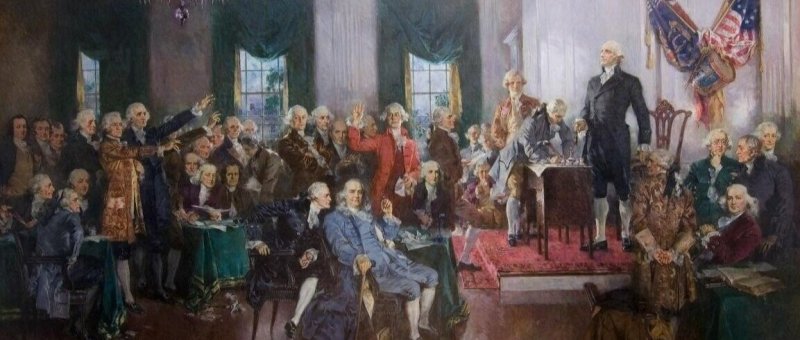
It was, therefore, to evaluate and, possibly, amend the Articles of Confederation and improve the current situation that delegates from the 13 states gathered in Philadelphia, in 1787, in what was called the Philadelphia (or Constitutional) Convention. Even though a new constitution was drafted and signed in this convention, it was not with this goal in mind that these delegates joined in assembly. However, since many were convinced of the inadequacy of the current system, the convention soon evolved into an effort to redesign and rebuild the whole political structure of the union from a loose confederacy into a more solidly cemented federal union.


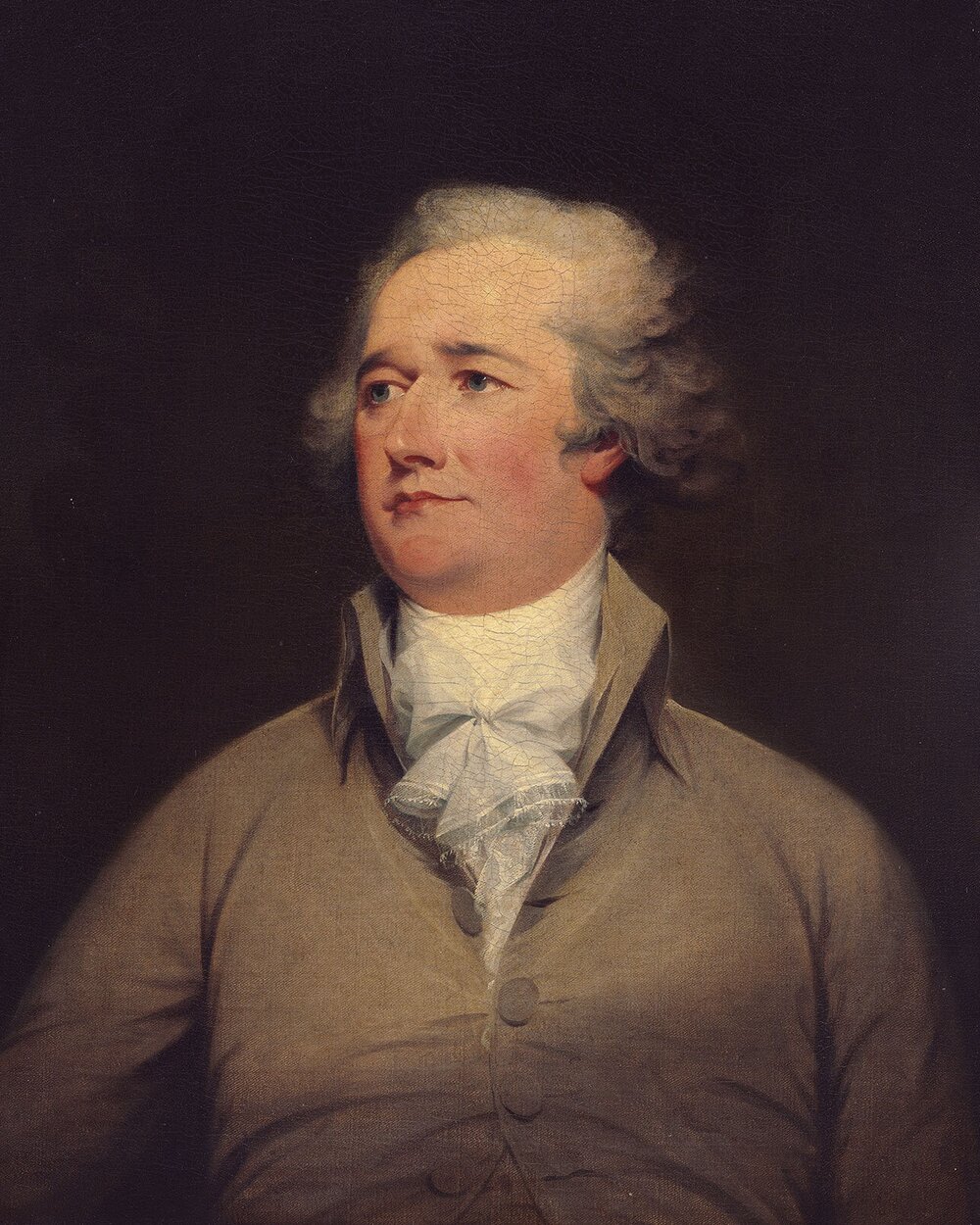
However, the drafting of the new constitution and its signing in the convention was only the first step. Next, and most critically, to enter into force, the new Constitution needed to be ratified by 9 of the 13 states. It was to lobby votes in favor of ratification that Alexander Hamilton, one of the convention delegates from the state of New York and the 1st Secretary of Treasury of the United States of the future government, wrote, along with James Madison, one of the most central figures in the drafting of the new Constitution and the Bill of Rights and future president of the U.S., and with John Jay, future 1st Chief Justice of the Supreme Court of the new government, a series of essays whose collection is referred to as The Federalist Papers.

Alexander Hamilton

Alexander Hamilton

The Federalist Papers

The Federalist Papers

James Madison

James Madison

These essays, 85 in total (1), were published as serial installments in newspapers and discussed topics ranging from the benefits of a federal union under the Constitution on matters of war and taxation to the discussion of the principles of separation of powers, how it is upheld by the Constitution and how the system of checks and balances between the three branches of government works under the Constitution, all the while attempting to refute many of the anti-ratification arguments of the time.

Although their effect in promoting the ratification of the Constitution is unverifiable, they certainly are a window into the political and historical framing of the federalists vs anti-federalists debates of the time and can prove useful in understanding some of the debates and arguments employed with regards to federalism in the European Union.


In Federalist No.11, Hamilton talks about the advantages of a common commerce policy, as achievable by federalization with, for example, the ban on inter-state tariffs, echoing many of the free-trade ideas that helped create and develop today’s European Union’s common market.

In Federalist No.30, Hamilton describes the poor situation of the government’s revenues under the Articles of Confederation and argues, namely, that the state of public debt of such a government will be extremely precarious. Indeed, while talking about the future creditors of the government he says:

“to depend upon a government, that must itself depend upon thirteen other governments, for the means of fulfilling its contracts, (…) would require a degree of credulity, not often to be met with in the pecuniary transactions of mankind”

— Alexander Hamilton as Publius, Federalist No. 30

The solution to such a problem, he argued, lied in giving the new Congress the general power to tax and levy tariffs.

However, federal revenues were mainly dependent on tariffs until the beginning of the 20th century, before the creation of the income tax (2). As this new tax was being levied and grew in size, federal fiscal policy also grew in scope, with the creation of the New Deal during the Great Depression, for example.


Both Hamilton’s arguments at the time for a more energetic government, empowered by the power to tax, and the expansion of the scope of federal fiscal policy after the Great Depression timed with the creation of the income tax provide insights into the current discussions on the expansion of centralized fiscal responses by the European Union.

Indeed, for the central institutions of the European Union to be able to provide a more timely and powerful response to a crisis such as the present one, they must also be able to access bigger sources of revenues.

If we want more powerful central institutions in the EU their budgets must also increase.

In 2017, EU budget expenditures were about €137,000 million. These paled in comparison to the U.S federal government’s almost $4,000,000 million in outlays. In Europe, where countries’ governments are already very fiscally active, it is hard to imagine a scenario where an increase of the central EU budget to levels more comparable to those of the U.S. federal government would not come at the cost of shrinking national government’s budgets.

Whether a more centralized response by the EU would, then, be net-beneficial is not something I’m arguing for or against. Indeed, the question that I desire to pose is whether this response, at the expense of member-states’ fiscal power, is politically achievable. Such a question is impossible to definitively answer. On one hand, emergency situations, like the Great Depression in the U.S., seem to be breeding grounds for centralization, on the other, the shifting political landscape in Europe, namely with the rise of Euro-skeptic parties, may foresee a grimmer fate for European federalism.


(1) You can find The Federalist Papers at: https://www.congress.gov/resources/display/content/The+Federalist+Papers or listen to public domain recordings of it by LibriVox at: https://librivox.org/the-federalist-papers-by-alexander-hamilton-john-jay-and-james-madison/

(2)-  Even though Clause 1 of Section 8 of Article 1 of the U.S. Constitution gave Congress the ability to levy taxes it was only with the creation of the 16th Amendment to the U.S. Constitution that Congress was able to levy country-wide income taxes.

Africa’s Endless War

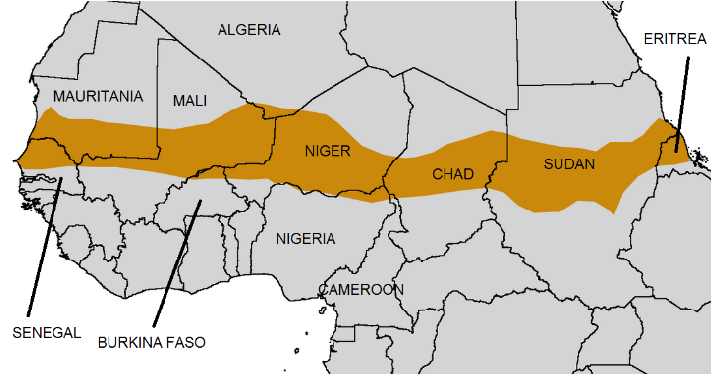
The Sahel is a narrow semi-desert region located south of the Sahara Desert. It stretches from the Atlantic coast to the Red Sea. The region comprises parts of Mauritania, Mali, Burkina Faso, Niger, Nigeria, Chad, Sudan, and Eritrea. In broad terms, we can think of the region as consisting of authoritarian states, with great difficulties to assert their authority inside their borders – in some cases, they are simply failed states.

Although all these countries suffer in various degrees from terrorism and related problems, our piece will focus on the key geopolitical security threat faced by the  more western countries. We will also explain how and why the USA and some European countries have been involved there.

Map of the Sahel region

Map of the Sahel region


Conditions for violence

The entire  region offers the same suitable conditions to the spread of terror. Being one of the poorest in the world, the countries located there are impoverished and underdeveloped;. Furthermore, it is subject to severe food shortages and the effects of climate change, which deepen the problems.

Although these countries are, theoretically, democracies, mistrust in the political classes is widespread, and rightly so. As it is frequent in many African countries, corruption is common and the institutions are generally frail. Governance is poor, agriculture will continue to have problems and security forces and foreign military are as feared as they are welcomed. The states are ill-prepared to meet the challenges their populations face.

All  governments failed to have a meaningful presence there,  as these zones are far away from their capitals. Islam being the dominant faith, Islamist radicals have no difficulties in spreading their violent message coupled with solutions to some basic problems, such as water supply and food administration. The region’s chronic poverty and poor education system helps it gain new recruits. Terrorists and radical groups exploit every local problem and conflict in order to expand their reach. The same logic applies to the expansion of terrorist groups in other zones, like Somalia or Mozambique.


Examples of terror

The countries in this part of Sahel have been the stage of various forms of violence in the past decades, described as a “fireball of conflict” that involves multiple armed groups, military campaigns by national armies and international partners as well as local militias. Conflicts have been constant, arising for many different reasons. The recent peak in violence has drawn the attention of both al-Qaeda and ISIS, among several local groups who fight between themselves as well as against local governments. There are constant news and reports of military operations and attacks, and 2019 was the deadliest year so far, with over 4000 deaths.

We will focus on the most recent events, starting with the most important Islamist terrorist group, Boko Haram. It is the strongest and deadliest, but by no means the sole actor in the conflict.

Boko Haram’s roots can be traced back to the early 2000s, but it started gaining attention in 2009, with a series of attacks in Nigeria. At the same time, the Arab Spring in the northern African countries and the violence that ensued further destabilized the area. Later in 2014, the group pledged allegiance to ISIS and proclaimed a caliphate in the region. This led to the intervention of a regional military coalition in 2015, (Benin, Nigeria, Cameroon, Chad and Niger, backed by the US, UK, and France) which regained the Nigerian territory previously controlled by the terrorists.

Following this, Boko Haram’s new core presence was in the Lake Chad region, one of the poorest regions of Africa and an ungoverned territory in the frontiers of Chad, Cameroon, Nigeria and Niger, where it still operates and was able to extend its reach in other anarchic frontier regions.

Following Boko Haram’s example, jihadists in northern Mali also proclaimed a caliphate in 2014. A quick military intervention led by France, authorized by the United Nations and supported by several non-African countries, regained the territory they controlled. France is the region’s former colonial power, and even though there is a pervasive anti-French sentiment,, it has been long involved.

In 2013, the French government expected to conduct only a short intervention in Mali. Seven years later, it remains there. The United Nations, the African Union and the European Union have also intervened, engaging many countries, with western military operations expected to increase in number and dimension in the next years. This will likely happen even though the Trump administration, that last month nominated a special envoy to the Lakes Region, seems keen to reduce their presence there, in contrast to its European allies.


UN forces in Mali

UN forces in Mali


European and American involvement

João Gomes Cravinho, the Portuguese Defense Minister, said last January:

“It is absolutely fundamental to be present in Sahel. We cannot let the deterioration of the situation in Sahel continue because the result will have an impact on Europe […] It would be irresponsible to turn our backs.”

— João Gomes Cravinho

The support is indeed needed because the military of these Western African countries lacks resources, material, training, and education. They could not win the conflict only by themselves,  and stability in the region is the main goal for Europe. Endemic violence and no state control will increase the flow of drugs, arms and human trafficking, illegal migrants and refugees and  terrorist threats against the continent. European countries would pay a high price for not intervening.

The western countries have the resources to militarily destroy much of these groups, but as recent interventions in the Middle East and Afghanistan proved, strength is insufficient. A full-out war would in the middle run fail to fill the power vacuum in the Sahel, and other Islamist groups would likely arise. There is a political and diplomatic front as well in this war, and the European Union starts to be aware of that, with commissioner Borrell repeatedly asking for a greater diplomatic and military involvement in  Sahel.
There is a broader political mission to face, which constitutes the hardest challenge. It is about stabilizing communities with a basic step that simply has seldom been undertaken: broad, local dialogues among community groups, police forces and officials can prevent radicalization. Local governments and institutions, the civic groups and the foreign actors should all step in this task. At the same time, poverty has to be mitigated and economic development aided.

However, the prospects are not good. In fact, European presence is vital to defend the European countries from security reasons and can mitigate various threats to the continent. Nevertheless, there are no easy ways to counter the underlying challenges that bolster terrorism and violence in Sahel. As The Economist put it: “unless local governance improves, [the military interventions] will not eliminate the jihadist threat”. Poverty and anarchy seem to be there to stay, and where they are, terrorist groups will too.
Sources: ABC news, Al Jazeera, BBC, Financial Times, Guardian, Institute for Security Studies, jornal I, New York Times, Observador, Politico, Reuters, The Economist, The Telegraph, United States Institute of Peace, Vox.

The Cloud Wars: AWS Vs Azure for the Control of Your Internet

Late last year, on October 25th, the United States Department of Defence announced that they would award a contract worth $10 billion dollars – the Joint Enterprise Defence Infrastructure project, henceforth referred to as JEDI – to Microsoft’s cloud computing business – the Microsoft Azure.

In the larger picture, the JEDI contract is but a small drop in the ocean of public contracts. According to the United States themselves, the federal government spends roughly $500 billion dollars on contracts every year. At face value, it was just another story of a tech-related government contract being awarded to the company with the most competitive bid.

Figure 2 - AWS Logo , Source: Amazon

Figure 2 – AWS Logo , Source: Amazon

But Amazon would contest the decision soon after, claiming errors in the process and political interference by President Trump. Like Microsoft, Amazon Web Services (AWS) – a subsidiary that provides cloud computing services – was in the run for the JEDI contract, and was even considered to be a frontrunner. By February of this year, Microsoft’s work had been halted, and the Pentagon was reconsidering the decision, as shown by court documents.

Though this story has taken an acrimonious turn, pitting Amazon against the Executive Branch of the United States with allegations of political interference, the competition between Microsoft and Amazon is not unlike that of any other two companies fighting for market dominance. The reason why President Trump allegedly interfered with the process is because cloud computing is a nascent, rapidly growing field that both companies – Microsoft and Amazon – have deemed crucial in strategic terms. So, he hit Amazon and its founder, with whom he has had public spats in the past, where it hurt.

Ultimately, this begets the question:

What is cloud computing, and why are the stakes so high?

Cloud computing is the delivery of computing services such as servers, databases, storage, software and analytics through the internet (the cloud = the internet).

Cloud computing services offer several benefits to clients:

  • No capital expenditures – You don’t have to buy your own physical assets, you rent them via the “cloud” instead. Like retail chains that started to lease and rent property instead of buying it.

  • Scale & Flexibility – The cost of the rent is proportional to the size of the business and traffic and it is very easy to increase your capacity. In other words, as your computing power needs increase with business and traffic, you are unconstrained by current equipment.

  • Speed & Performance – Your only limitation is your internet connection. Cloud services run on the latest high-tech hardware, so you are not limited by outdated hardware and you don’t have to constantly update your devices.

  • Security and Reliability – Cloud computing services come with automatic backups and disaster recovery, as your data is in many places instead of a single server. Cloud service providers also come with the latest network security methodologies, which would be too expensive for a single business to implement on its own.

These services can be split into three types:

  1. Infrastructure as a service (IaaS) – the most basic version where you rent IT infrastructure such as servers for storage.

  2. Platform as a service (PaaS) – Services that supply on demand environment for developing and testing software applications, such as mobile apps.

  3. Software as a service (SaaS) – delivery of software over the internet, on demand, often requiring only a terminal (no need for installation).

Cloud computing has provided a unique benefit to society in general – it makes it much easier to launch a tech start-up, as the start-up costs are almost non-existent when compared to the 90s. Cloud computing was a major enabler in the tech boom of the last decade.

Cloud-computing-000088211771_Medium-1024x682.jpg

Amazon was the first of the two to launch their cloud computing business via AWS, back in 2006. The story of AWS is interesting. Initially, before 2006, what would become AWS was a private cloud system within Amazon to support data collection and server management across the entire company. Only after using and developing AWS for four years before offering AWS to the market. AWS was not planned and was born of Amazon’s culture of innovation and experimentation.

Microsoft would follow suit in 2010, at the time launching “Windows Azure”.

Today, these companies take up 70% of the market share valued at 227 billion dollars in 2019 (with Amazon being the market leader at 40%).

And seamlessly, without us ever noticing, they power many of the platforms and companies that we use in our day-to-day.


Figure 2 - Netflix Logo , Source: Wikipedia

Figure 2 – Netflix Logo , Source: Wikipedia

Consider Netflix, one of AWS’ high profile clients. In 2009, they opted to migrate from their physical data centre to the cloud, moving thousands of terabytes of data into Amazon owned servers, data that has to be accessed tens of thousands of times per second by 160+ million subscribers in all parts of the world.

Figure 2 - HP Logo , Source: Wikipedia

Figure 2 – HP Logo , Source: Wikipedia

Alternatively, consider HP, one of Microsoft Azure’s high-profile clients. According to HP, they handle more than 600 million technical support contacts each year. The accumulated data points for each of these contacts was used to build an AI assistant via one of the solutions provided by Microsoft Azure.

Either of these examples illustrate different services provided under the same umbrella term of “cloud computing”. Both cloud computing platforms ultimately aim to help businesses develop and meet their organizational goals: they offer many tools and frameworks to build an «on your own terms» platform.


But how would a manager choose between them? If a company already works with a platform, why consider getting a service from a competitor?

Part of the answer lies on the many different services they supply, as well as the current data infrastructure of the company in question. Microsoft is ubiquitous to any company in the world, but AWS seems to be more advanced in the cloud computing game as of right now (hence its frontrunner status in the JEDI contract). Regardless, none of the cloud suppliers offer the same service in the exact same way, or with the same value proposition. For a manager, choosing between AWS and Azure might be a balancing act, and they might end up using both.

Ultimately, the Cloud consumes our day-to-day lives. From the political contrivances as seen in the JEDI contract to the shift in paradigm that directly affects decision-makers, both high and low in a company, articles much like these are but a warning sign of a braver new world to come.


Sources: US Department of Defence, US Datalab, NY Times, Gartner, Microsoft Azure, AWS, Wikipedia


João Vaz Guedes - João Vaz Guedes Maria Mendes - Maria Mendes

Daniel André - Daniel André

The Impact of Globalization on Inequality

Since the European discoveries, several waves of globalization have shaped the way we live today. The most recent one started around the 80s/90s of the previous century and was pushed by several circumstances. First of all, the economic reforms implemented in China around that time by Deng Xiaoping, who ruled the country as paramount leader* between 1978 and 1992 and the fall of the USSR in 1991 brought economic development and openness to vast territories, changing its interaction with the rest of the world. In addition to these two events, the improvements in communication and transportation technologies were key aspects that enabled all the process, boosting global trade and movement of capital between countries. For instance, according to the World Bank, exports of goods and services grew from US$4.1 trillion in 1980, to US$23 trillion in 2015, at constant on 2010 prices

Since the beginning of the process until now, globalization is said to have taken a lot of people out of poverty due to those infusions of foreign capital and technology in less privileged areas of the globe, bringing them economic development and spreading prosperity. Stil according to the World Bank, the global population living with less than US$1.90 per day in this condition decreased from 36% in 1990 to 10% in 2015. The two countries that most contributed to this outcome were China, where this indicator fell from around 66% to 1% in the same time-frame; and India, where poverty affected almost 49% of the population in 1987, shrunk to 21.2% in 2011. Undoubtfully, this is clearly positive and a major advance towards the United Nations’ sustainable development goal of eradicating poverty.

However, even though poverty has shrunk at a global level, the fact is that the increasing wealth that is created and the benefits of globalization are said not to be distributed fairly.

Global real income growth (1988-2008)

Source: Equitymaster

Source: Equitymaster

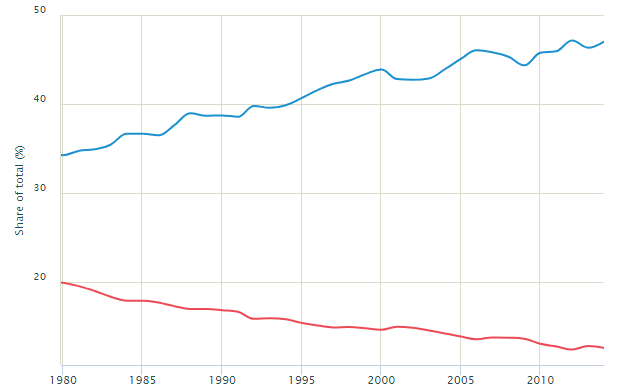
This chart was elaborated by Branko Milanovic, an economist recognized for his work and research in inequality and income distribution, and depicts the variation in real income according to each percentile of the global income distribution between 1988 and 2008. It can be clearly seen that, during this time frame, the ones who saw their income increase the most was the population living in emerging countries and also the richest citizens of the world. On the other hand, the middle classes of developed countries and the extremely poor virtually remained the same, with some even getting worse off. 

When looking for answers that may explain why this has happened, the novelties brought by this recent wave of globalization should be taken into consideration. The reductions in transportation costs and trade barriers created an atmosphere of incentives for capital owners to move the production segment of the supply chain from developed countries to others with better cost advantages, mainly regarding labor, in order to pursue competitiveness. Therefore, these new opportunities have benefited the global elite, as well as the population of where these jobs were created. On the other hand, this has led developed countries to experience major job losses and its working class to see their real wages/income stagnated overtime, and even decreased.

Even though globalization may have contributed for more inclusiveness and less poverty at a global level, smoothing differences between the richer and the poorer countries, the fact is that, when considering the internal situation of each nation, it may be a different story. 


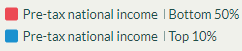
Distribution of pre-tax national Distribution of pre-tax national income in the United States income in China

bvf c.png
c vb.png
Source: World Inequality Database

Source: World Inequality Database

These graphs clearly show that inequality in the United States as well as in China increased. In both countries, independently of whether real incomes increased or not, the share of national income received by the bottom 50 percent of the population fell, while the top 10 percent saw their share of income increase. This being said, it is quite clear that inequality should be a priority for national governments.


*Paramount leader: informal term for the most prominent political leader in the People’s Republic of China, not necessarily involving an official position.


Sources: Forbes, The World Bank Data, Equitymaster, World Inequality Database


Oil War 2020

Oil, a three-letter word that embodies the most important source of energy since the 1950s, the lifeblood of modern societies. As the main energy supply, this commodity reshaped not only the power industry, but also how we live, supplying 40% of the world’s energy demand. Therefore, oil continues to survive the constant attempts to shift energy consumption into more sustainable alternatives based on renewable sources, remaining the most-traded non-financial commodity worldwide. The fact that, nowadays, one cannot imagine a world without crude oil, and its inexistence would lead to a screeching slump in modern societies, increases its value, emphasizing its prominence in the global economy.

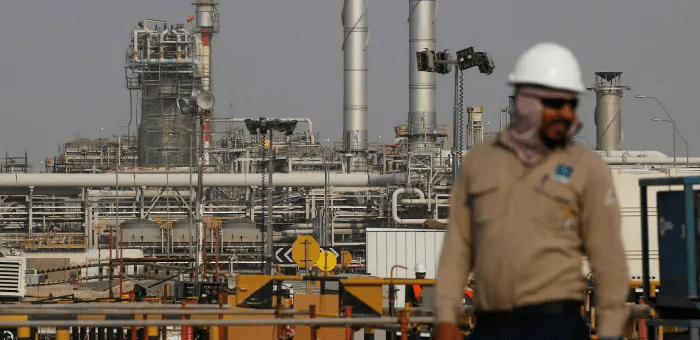
The United States, Russia and Saudi Arabia arise as crude oil’s largest producers and, in 2019, jointly produced approximately 33 million barrels per day, 54% of total world production. According to IBISWorld, a leading Business Intelligence company, the oil and gas sector’s revenues amounted to approximately $3.3 trillion last year, and with a 2019 Global GDP of around $87 trillion, the oil and gas drilling sector by itself represents around 3,8% of the world economy. It is evident that the 3 main players in this complex industry compete for the monopoly of one the most profitable markets, but one cannot enter this game without caution, since the oil’s biggest sharks will be ready to counter-attack.

With the world markets slowing down due to the most recent crisis caused by the coronavirus pandemic, demand on crude oil has decreased drastically, as isolation measures have tightened around the world.

The members of the Organization of the Petroleum Exporting Countries (OPEC) and the invited country Russia, gathered in a meeting concerning the market demand on the industry after the virus situation. Russia has been allied with Saudi Arabia and the organization since 2016 with the aim to balance its production levels with other countries and keep prices relatively stable.

In this meeting, Saudi Arabia positioned itself and suggested cutting production levels in order to hedge price decreases during these times. However, Putin’s nation was against the proposed measure as they believed it was too early to cut production, the organization failed to reach an agreement between the parties involved, effectively ending the partnership. Some insist that the country is availing oneself of the Asian demand to increase its market share, others agree that it wants to keep prices low to fight the American shale oil industry, which has been growing in the past years. One thing is certain, Russia is indeed worried about its market share and believes that at the moment it is better to be against the Saudis than opting to cooperate. Saudi Arabia counterstroke, announcing they would increase their production to its highest, almost 13 million barrels per day, as well as price discounts in Europe and the United States.

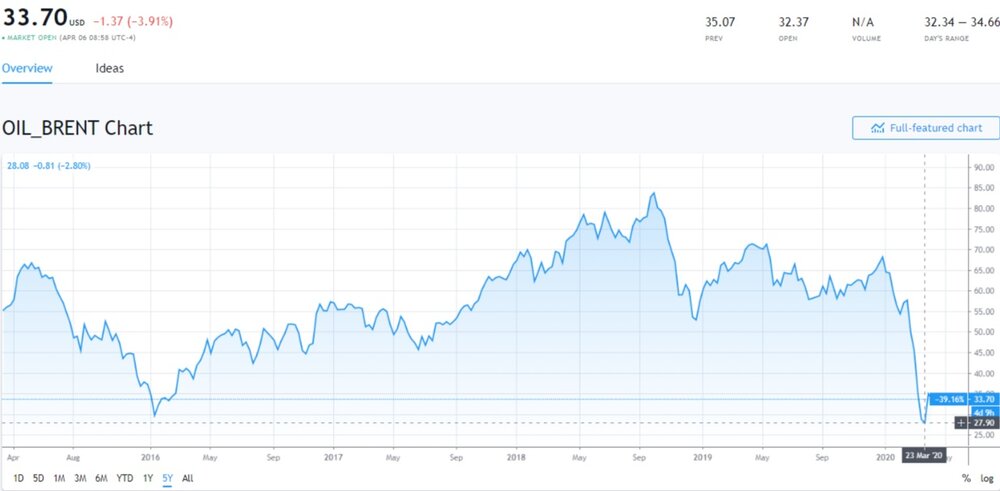
On the 8th of March, the prices started to tumble and the next day they plummeted more than 30%, the worst loss since 1991, and the Russian currency depreciated to its lowest since 2016. For now, the Saudi-Russian alliance is paused, and the war has begun. The Saudis believe they will be able to sustain profits, as their production costs are very low, while Russia claims the ability to sustain prices between 25$ and 30$ for several years due to its National Wealth Fund. Nevertheless, these countries will now experience a thinner margin, despite gaining some revenues alongside customers. From a game theory perspective, we are assisting a prisoner’s dilemma situation where either party may end up hurt after this move since market share will not necessarily be gained and cooperation would better position themselves.

On the 2nd April, Donald Trump claimed that a deal was expected to be reached soon and that production cuts were already in order after affirming that he talked with the leaders of both countries. This prompted a one-day rally in oil futures of 10%, but neither countries committed to supply cuts and the Russian Government denied the claims made by the US President.

On Sunday, April 5th, Saudi Arabia, Russia and other giant oil producers from OPEC made progress in reaching a deal to stem oil prices, despite the difficulty in arranging a meeting and the continuous exchange of accusations between the two leaders. This deal would also involve the US, as they became the biggest oil producer of the last years since the shale revolution and have a great impact on this industry. Together, the members would be proposed to cut their oil production by 10%, but Donald Trump has shown little willingness to do so. The US has even threatened the use of sanctions and tariffs to push the two countries to solve the conflict.

“If the Americans don’t take part, the problem which existed before for the Russians and Saudis will remain — that they cut output while the U.S ramps it up, and that makes the whole thing impossible”

— Fyodor Lukyanov, head of the Council on Foreign and Defence Policy


Source: Trading View

Source: Trading View

Energy companies are suffering the most from oil wars and this may have a damaging effect on the credit markets as well, since they have been very active in the bond market in the past decade and investors were always keen to lend more and more. This borrowing was done using junk-rated bonds and it is remarked that these companies account for 11 per cent of the US high-yield market. Being rated BB or lower, these issuers are at higher risks of default and the current oil war aligned with a decreasing global demand may cause further downgrades and raise the costs of borrowing. With such a heavy representation on the junk bond market, this shock may not stop at low-rated debt and even impact “safer” debt.

Investors reacted as they have been adjusting to the coronavirus outbreak and shifted funds for the usual safe havens. On the 9th March, the sharp oil price drop prompted a decrease of 7% in the S&P 500 in the first minutes of trade. This sell-off was accompanied by a raise in the price of gold and related ETFs and an increase in the purchase of US Treasury Bonds, represented by a decrease in the US Treasury yields.


Source: Bloomberg

Source: Bloomberg

At this stage it is quite unclear to predict any short-term agreement between both parties, however, what is clear is that current prices are bad for producers whilst being well received for consumers. What this means is that, in theory, oil importing countries will benefit from this price decrease, considering that one of their main raw materials used, became drastically cheaper. However, this benefit will obviously not be maximized due to all constraints being imposed by governments worldwide during the COVID-19 pandemic, which, ultimately will make this decrease in prices a small tool to respond to the economic impact caused by the viral disease. Furthermore, not everything is bright for importing countries. Let’s take Portugal as an example, which has Galp, which refines imported Brent oil from Brazil and Angola before selling the final good to retailers, as one of its largest companies. Galp had set an average break-even price of 25 € and is still able to sell at current prices, however, as seen in the last few weeks, its price has been right around that value, even reaching the 21€ quotation. As seen, Portugal is not a producer nor an exporter of the raw material, yet, by having companies in its manufacturing chain like Galp, is still exposed to this war that influences prices worldwide and can lead to lay-offs and even shutdowns.

On the other hand, we have the petroleum exporting countries being harmed by not only the influx of supply as the decrease in demand. Some are being forced to decrease prices while also increasing production, to not lose their market share, while others are considering a step-back in production until prices begin to rise. One example being the case of the US which produces, in mass, Shale Oil, which is more expensive to produce. Also, countries that cannot step-back due to an already unstable financial situation as Venezuela, Ecuador and others third-world countries are being dragged into a fight they just cannot handle, especially considering that, unlike Russia, they do not hold a meaningful foreign exchange reserve to back up these abnormal losses, so, debt defaults are beginning to look a reality.

The markets and investors are not happy having to deal with an oil war and a virus outbreak and, if Russia and Saudi Arabia take long to solve this conflict, Governments and Central Banks may not be able to save world economy.

Sources: CNBC, Investopedia, TIME, Bloomberg, Financial Times, Vox, ABC news

State of emergency: What now?

On the 18th of March of this year, Portugal’s President Marcelo Rebelo de Sousa declared the state of emergency, immediately, to the extent of all Portuguese territory, following other European countries that also opted to declare it, such as Spain, France, Italy and Germany (to name a few from the total of 25 countries that already announced it worldwide).

Since November 1975, after a revolutionary attempt from communist forces to implement a far-left dictatorship, the State of Emergency hasn’t been declared in Portugal. 45 years elapsed and due to the COVID-19 pandemic, Portugal was forced to announce the State of Emergency, in order to restrict the spread of the virus.


What measures can Portugal take to face national catastrophes?

There are 4 mechanisms, consecrated in the Portuguese Law, in order to deal with national catastrophes. From the least to the most severe, we have the state of alert, last used in the summer of 2019 during the protests of truck drivers of hazardous content, which only means that national civil protection and national security forces are ready to attain any request from the government. The state of public calamity, announced two weeks ago by the municipality of Ovar, implies a reduction of economic activity, limitations to the number of inhabitants in public places and the establishment of a safety perimeter. Lastly, the two most severe mechanisms, the state of emergency and the state of siege.

After all, what does the state of emergency imply? What’s the constitutional interpretation? What are the boundaries that define it and that distinguishes it from the state of siege?

What is the state of emergency?

The state of emergency allows the government to suspend certain rights, freedoms and guarantees in order to deal with an exceptional situation. In Portugal, the state of emergency is declared by the President, initially requiring permission from Parliament and then approval from the Council of Ministers. According to the Constitution, it cannot last more than 15 days (although it can be renovated) and it cannot suspend certain rights, such as the right to life or the right to defend oneself in court.

transferir.jpg

In this particular emergency – an epidemic – there are two particular rights whose suspension could be useful: The right to free movement and the right to private initiative. Suspending the right to free movement allows the government to impose quarantine and curfews, to forbid people from leaving their houses for non-essential trips (or to forbid elderly people from leaving their houses for any reason), and to limit entry and exit in Portugal, by cancelling flights to and from critical countries and controlling the border. Suspending the right to private initiative allows the government, among other things, to forbid non-essential commercial establishments from opening, to force essential ones (such as pharmacies, supermarkets or medical supplies factories) to stay open, and to take control of private companies (for example, to temporarily integrate private hospitals in the public healthcare system). The state of emergency declared in Portugal also suspends the freedom of assembly, allowing the government to forbid large public gatherings such as protests, concerts or religious ceremonies.

gvb n.png

Criticism

Some have opposed the declaration of the state of emergency, fearing that the President is opening a dangerous precedent for the suspension of rights and freedoms. These worries are not unwarranted: historically, there are many incidents in several different countries of the state of emergency being abused. For example, in Germany between the two world wars, the state of emergency was declared quite often, usually by governments who didn’t have a majority in Parliament and used the state of emergency to legislate without democratic control. This culminated when, after a fire destroyed the German Parliament, Adolf Hitler blamed the fire on communist rebels and used it as an excuse to declare the state of emergency, imposing the dictatorial regime that lasted until the end of WWII. This is only one of many historical examples of the state of emergency being the start of a dictatorship. While it is difficult to argue that Portugal is currently facing any risk of that nature, these historical examples are the reason why many people are very cautious about supporting the declaration of the state of emergency.

State of siege

On the opposite end of the spectrum, some have claimed that, in Portugal’s current situation, a state of emergency is not enough, and a state of siege should be declared. The state of siege is one degree of severity above the state of emergency. According to Portuguese Law, the state of emergency can be declared due to any public calamity or threat of public calamity, while the state of siege can only be declared in the event of acts of force (such as military invasions) or rebellions. In a state of emergency, rights and freedoms can only be partially suspended, while in a state of siege they can be completely suspended – for example, the current state of emergency suspends the right to strike only for workers in healthcare and vital sectors of the economy; in a state of siege, all strikes could be forbidden. In a state of emergency, the powers of civil authorities can be reinforced, and the armed forces can be tasked with supporting those authorities; in a state of siege, all police forces are put under the authority of the Chief of the General Staff of the Armed Forces, and all civil administrations must provide the armed forces any information they request.

cng.png

Portugal is facing one of the moments of greatest uncertainty in its modern history.

Fighting an unknown enemy poses difficult challenges and raises important questions. Only in the end will the country be capable of scrutinising the choices made and to discuss a future approach towards a similar crisis. Until then, we shall stand as one.


Sources: Observador,Jornal Sol, ECO

Portuguese Law (in Portuguese):

Constituição da República Portuguesa (Portuguese Constitution), namely articles 19 and 138 

Regime do Estado de Sítio e do Estado de Emergência – Lei n.º 44/86, de 30 de setembro 

Decreto do Presidente da República n.º 14-A/2020 


Afonso Botelho - Afonso Botelho Manuel Barbosa - Manuel Barbosa
Nuno Sampayo - Nuno Sampayo

Europe’s man on the moon moment: the Green Deal

The creation

First presented in December 2019, the European Green Deal is the EU’s current most ambitious project or, as Ursula von der Leyen – European Commission’s President – called it, “Europe’s man on the moon moment”. Aimed at transforming Europe into the first climate neutral continent by 2050, simply put, the Green Deal is the EU’s new growth strategy. It’s designed to transform Europe into a modern, resource-efficient and competitive economy, a roadmap to make the EU’s economy sustainable.

[Read more about the policies that are being adopted here]. 

But what’s so different from all the previous attempts to tackle climate change?

  1. The EU is finally transforming all its climate promises into legal obligations for member states (European Climate Law)

  2. It was finally understood that, rather than being mitigated by focusing only on certain industries and a few isolated measures, climate change requires an articulated and integrated system that considers a product’s life cycle, strengthens competitiveness while protecting the environment, gives new rights to consumers and tries to ensure that the resources used are kept in the EU economy for as long as possible (Circular Economy Action Plan)

  3. Because it’s imperative that all European countries take part in this initiative, the Green Deal predicts financial assistance to those countries that face various limitations in the green transition, (European Green Deal Investment Plan and the Just Transition Mechanism) in an attempt to ensure that everything runs smoothly and that all member states are on board.


The  transition 

Despite its idealistic goals, the Green Deal has been suffering severe criticism and has been presented with various obstacles to its achievement. 

What was initially designed as an incentive to make industrial and coal-intensive countries (e.g. Poland, Romania, Germany) sign up the EU’s 2050 climate targets, turned now into one of the most defining features of the European Green Deal: the Just Transition Mechanism, designed to help coal-dependent workers and regions transition to new areas of economic activity. Still, Poland has repeatedly refused to sign the climate targets and take part in this environmental initiative, thus jeopardizing its eligibility to the financial aid provided through this Mechanism.

 A list of 100 regions eligible for this financial aid has already been published, with Germany topping the list, followed by Poland.  These regions meet criteria based on carbon-intensive jobs, fossil fuel industrial activity and GDP per capita. But another potential threat arises: how can the EU guarantee that funds aren’t misused by national governments in projects that serve their own interests, risking these regions’ access to the funding? 

Even though the Green Deal is a priority for the EU, it certainly isn’t for some relatively poorer member states, such as Romania, whose priorities concern infrastructure, education and health systems. Other countries might feel the same way, leading to tensions and conflicts of interest inside the Union, with the possibility of not being able to cope with targets (and most likely sanctions) imposed by the EU later on. 

Unfortunately, this doesn’t stop here. Between extractive, energy-intensive and automobile industries, 11 million jobs will be directly impacted by this Deal, even if they don’t necessarily disappear. Clear directions and measures are needed (which don’t yet exist), especially if most of these jobs are concentrated in Eastern Europe, which could cause a migration wave in the next decades, possibly deepening the existing gap along the East-West divide, increasing social and economic discrepancies and escalating tensions inside Europe. On the other hand, the reality is that markets are changing – and fast. A new green industry revolution is coming and the likelihood of coal mining in Europe being economically viable by 2050 is indeed very small. 


The funding

No matter how badly the European Commission wants to achieve carbon-neutrality while leaving no  country behind, it’s not possible to do so without funding. Essentially, this financing would come from five different sources: 

a) EU budget: the Commission will allocate 25% (compared to the previous 20%) of its budget to climate and environmental expenditures, aiming to raise approximately €503 billion in this decade. 

b) National co-financing: the Commission hopes that this money mobilization will trigger national governments to unleash an additional €114 billion on environmental projects over the next ten years. 

c) InvestEU: It’s estimated to raise around €279 billion, throughout this decade, through private and public investments, thanks to an EU Budget guarantee to the European Investment Bank and other national promotional banks when they invest in “green” projects. 

d) EU Emissions Trading System funds: the Union proposes to devote 20% of the revenues from the auctioning of EU Emissions Trading System (ETS) to the EU budget, for an estimated value of €25 billion over the next 10 years.

e) Just Transition Mechanism: it’s expected to generate around €145 billion until 2030, plus there’s €7.5 billion of “fresh money” already available. 

However much the European Commission is moving in the right direction, it may have been too unrealistic when presenting these numbers: many specialists agree that €500 billion is a bit of a stretch and an amount that couldn’t possibly close the investment gap. Some even believe that this can hardly be called “investment” since much of the funding will be spent on traditional policies (such as farm subsidies) and there is little oversight and almost no room for innovation in this budget. On top of that, the current methodology of how expenditures are accounted for as contributing to climate targets is very flawed and needs to be reviewed.

 InvestEU- the Green Deal’s main funding source- possesses some hitches worth highlighting: given that the EIB has already committed to increase its climate-related financing from 25% to 50%, it’s worth considering the opportunity cost in allocating further funds to it, as these funds could be better used by other EU programmes. Let’s also not forget that there is always the possibility that carbon financiers game the system, meaning EU cash fails to trigger truly green investment from the private sector. 

Finally, as for national co-funding, there might not be many incentives for countries to increase their financing towards green projects. If countries are finding it hard to stay on track with the 2050 climate neutrality objective, how will they be able to divert funds to co-fund the Green Deal? 

Overall, by itself, the plan will most probably not be sufficient to deliver the investments needed for the European Green Deal. Nevertheless, the Green Deal is still a work in progress and in a very early stage of implementation; only the next months will tell how the Commission will further develop, adapt and implement this initiative. Until then, stay tuned, stay informed, stay aware.  

Sources: Euractiv, Bruegel, The Guardian, Financial Times, European Commission