
Belarus: rigged elections and a struggle for national identity

Looking at footage from the recent protests in Belarus, following the August 9th presidential elections, one observes a wavy sea of red and white flags, instead of the official red and green flag. Understanding this discrepancy in symbols is essential to acknowledge what is happening in Belarus because it illustrates a major factor behind the current crisis: the existence of divergent views on how the future of Belarus should look like.


Historical context

Before the late 18th century, what is now the territory of Belarus belonged to the Grand Duchy of Lithuania. However, in 1795, after the joint efforts of Prussia, the Habsburg monarchy, and the Russian Empire, the land of modern Belarus was absorbed into the Russian Empire. The Belarrusian state emerged in 1918, only after the Russian monarchy collapsed under the Bolsheviks, and after the Russian forces retreated from the Germans in Minsk, the Belarusian Democratic Republic – or the Belarusian National Republic (BNR) – was created, and independence was declared. Yet, the flags waved by the protesters today are those that were used by the BNR.

However, the Belarusian National Republic was short-lived. Some months later, the government of the BNR[1] was overthrown by Russian Bolshevik forces, and the Belorussian Socialist Soviet Republic (BSSR) arose. In 1921, Belarus was divided in half between Poland and the Bolsheviks and, in 1922, the BSSR became one of the founding members of the Soviet Union. Belarusian intellectuals and national activists faced authoritarianism and political repression in the West by Poland and in the East by the Soviet Union. This, alongside Soviet historic propaganda, stifled the potential development of a Belarusian national identity to a greater extent.

It is no wonder that, in 1991, with the collapse of the Soviet Union, 69% of Belarusians described themselves as “Soviet citizens”, while only 24% identified themselves as “citizens of their republic”.

In 1994, in what is considered the only fair elections of the Belarus’ nation after the collapse of the Soviet Union, Aleksandr Lukashenko was elected the country’s president. Previously to the election, Mr. Lukashenko, a former state farm director, served as chairman of the anti-corruption committee of the Belarusian parliament. Vowing to destroy high-level Belarusian corruption and to forge closer ties with Moscow, he rode on a pro-Soviet sentiment that longed for a Soviet’s golden age as the one experienced in the post-WWII reconstruction period.


Referendums, fraudulent elections, and Russia

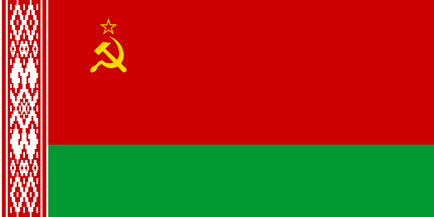
In 1995, a referendum held in Belarus altered the national symbols, changing the BNR flag, which was adopted in 1991, to the red and green flag, the one used by the Byelorussian Soviet Socialist Republic. This referendum also increased the power of the president over the legislature and green-lit economic integration with Russia. The Organization for Security and Co-operation in Europe (OSCE) declared that the referendum did not meet the international election standards.


The flag of the Byelorussian Socialist Soviet Republic. The current flag of Belarus is, essentially, identical, without the hammer and sickle.

The flag of the Byelorussian Socialist Soviet Republic. The current flag of Belarus is, essentially, identical, without the hammer and sickle.


In the following year, 1996, Belarus and Russia founded the Union State, creating a customs union and free-movement area between the two nations. Indeed, the Belarusian economy is extremely dependent on Russia, not only as its main exports and imports’ partner but also due to the energy subsidies[2] which make up a very large part of Belarus’s GDP: around 12% in the last two decades. Due to these ties with Russia and Russia’s support, Lukashenko registers a political advantage.

However, recently, these ties have soured somewhat, with Putin pressuring Lukashenko, on the Union State, by denying Belarus access to previous energy discounts until Belarus commits to deepen the ties between the two nations and to increase the scope of the Union State, something that Lukashenko is reluctant to do.


Russian subsidies as a % of Belarusian GDP

Russian subsidies as a % of Belarusian GDP


In 1996, there was another referendum which further increased president Lukashenko’s powers and extended his first term to 2001. Once again, the OSCE stated that it had failed to meet international election standards. The same happened with the 2004 referendum, which removed the president’s two-term limit.

Indeed, every election and referendum since 1994 has been delegitimized by international election fairness organizations, such as the OSCE. They note, among other things, the political suppression and persecution of opposition candidates, the channeling of state-funds to the incumbent’s campaign, the lack of opposition observers at polling stations, strong media bias in favor of the incumbent, among other factors.

“In four PECs [Precinct Election Commission], all of them in Brest region, observers who were able to view ballot boxes closely enough reported multiple ballots emerging from ballot boxes folded together in wads, suggesting ballot stuffing.”

— OSCE’s report on the 2015 presidential election


Economic stagnation and the protests

However, the dissatisfaction of Belarusians with president Lukashenko is not limited to social and political issues. An economy with a low level of productivity and inefficient state-owned enterprises, associated with a potential hard hit from the Coronavirus’ pandemic are some of the other causes of dissatisfaction with the current president. The Lukashenko government’s blunder of increasing the average salary by printing money, that led to a devaluation of the currency and high levels of inflation in 2011, also left many wishing for change. Furthermore, Lukashenko’s joking dismissal of the pandemic, advising people to go to saunas and to drink vodka to stay healthy, further decreased his popularity.

And so, the population that identified itself as from the Soviet Union, and who gave power to Lukashenko, was now replaced by a younger generation. The Belorusians of today no longer share the fondness for a Soviet Union they never lived in, and they are turning to the streets in giant protests, showing their discontent towards the dictator. Waving the non-Soviet Belarusian flag, 100.000 people gathered in Minsk to protest against political imprisonments of opposition candidates and election rigging. Almost 7,000 people were arrested during the protests and several allegations of torture and human rights abuses.


EU’s reaction and Russian interference

On the 9th of August, the Central Election Commission announced that Lukashenko won 80% of the vote and was re-elected for his sixth term in office. The opposition candidate, Svetlana Tikhanovskaya, fled the country out of fear of persecution. Not only the EU and the U.S. rejected the election results, but the EU also announced its intentions to impose sanctions on the Belarusian’s government officials.

However, on the 21st of September, Cyprus vetoed the impositions of these sanctions, arguing that penalties against Turkey, relating to the gas conflict in the eastern Mediterranean, should be imposed first. This highlights a major obstacle to the EU’s effectiveness on the world stage, since members are able to veto decisions on important matters to gain leverage on other issues.

Even if the sanctions were levied, skepticism on their effectiveness is still granted, given that almost after every election, since 1996, the EU imposed sanctions on Belarusian officials only to relax them later.

Belarus is a crucial stage for EU-Russia tensions. Putin, so far, has supported Lukashenko because the latter appears to be the best option to keep Belarus close to and dependent on Russia. Given this, Putin has prepared a police force to aid Lukashenko if civil unrest spirals out of control and also provided a loan of $1.5bn. With this, Putin is undoubtedly gaining leverage on Minsk to move forward with Union State integration. Putin’s support for the last dictator of Europe, is bad news for the EU, given its geographical proximity to member-states.

Despite the EU’s ill-timed response, the opposition will continue to grow, and, as Lukashenko is backed by Putin, it is unlikely that the course of Belarus towards democracy is changed.


[1] This BNR government went into exile and still exists as an advocate for Belarusian democracy and as the oldest existing government in exile.

[2] Belarus is able to buy very crude oil from Russia, which it then refines and exports.


Sources: Aljazeera, Financial Times, NY Times, OSCE, Politico


Teresa Thomas - Teresa Thomas João Oliveira - João Oliveira
 
Ana Terenas - Ana Terenas João Baptista - João Baptista


The exuberant IPO (Snowflake Part II)

Snowflake started trading on the 16th September 2020 on the New York Stock Exchange (NYSE) and it could not have a been a more successful Initial Public Offering (IPO). Under the ticker SNOW, the company took the central stage in the largest IPO of an American software firm.

Goldman Sachs was the investment bank responsible for Snowflake’s IPO and it left some people wondering if the respectable Wall Street institution had not made a huge mistake and mispriced this IPO. And the reason was the first day of trading: Snowflake’s shares were priced at $120 and they increased more than 160% reaching $315, before closing at $253.93, which is still almost 112% higher than the IPO price.

Although this is not unheard of, since we have the case of LinkedIn and dozens of examples during the dotcom boom, only a very small percentage of IPOs tend to double in value in their first day. But there is a better explanation than the fact that Goldman Sachs and Snowflake failed to correctly assess the company’s market value. There were several institutional investors that traded the company’s shares for a quick profit and others that just held their position, but the real main drivers of this one-day bubble were retail investors that traded over and over the same number of shares similarly to what has happened in the recent “tech bubble”.

The bottom line is that Snowflake was able to raise $3.4 billion and, by the end of its first day of trading, it displayed a $70.4 billion valuation, which is more than five times its private valuation in February of the same year.


A “sell” rating from Summit Insights Group marked the first analyst rating of Snowflake, earning the title of “the most expensive name in all tech”, despite its impressive debut in the public market. Srimi Nandury, analyst at Summit Insights Group, expressed concerns about Snowflake’s valuation stating that combined with its “limited differentiation” from company’s such as Google’s BigQuery, and Amazon’s Redshift, “For the stock to work from the current levels, Snowflake needs to execute flawlessly quarter after quarter, and have to live up to lofty expectations and grow into its valuation”. Indeed, Snowflake shares are considered to be at risk of a sharp reversal, stepping into bubble territory. Moreover, the tremendous run presented by the stock placed SNOW as an unstable stock, yet investor’s enthusiasm is undeniable and, as previously mentioned, retail investors were primarily responsible for the gains, rather than institutional players.


 If the hype for the cloud-based data provider was already high, news that an unprecedented move coming from Berkshire Hathaway, the half a trillion-dollar company that put Warren Buffet on the map, caught every investor by surprise, sending demand even higher.

The 90-year-old investor is known for its aversion to tech companies, which he has stated of failing to see their potential where there is one. Moreover, the fact that this is a high-growth, money-losing and expensive-looking stock, news stating that Berkshire was investing as much as $250 million in the IPO, plus a 4.04 million shares (at debut price $120) bought from Berkshire directly to a stakeholder (a total investment of $730 million) caught everybody off guard. And if this was seemingly confusing to investors who have followed the investing rationale chosen over the years by Berkshire, the fact that Buffet has been a criticist over the years of investing in new issuers, comparing it mostly to gambling, created the speculation that the decision behind this investment was being made by Buffet’s lieutenants: Todd Combs (also CEO of GEICO) and Ted Weschler, who manage about $14 billion each worth of Berkshire Hathaway’s portfolio.

In fact, in an interview given to CNBC in May 2019, after asked on whether he would be interested in buying Uber’s IPO, Buffet responded saying “ In 54 years, I don’t think Berkshire has ever bought a new issue (…) The idea of saying the best place in the world I could put my money is something where all the selling incentives are there, commissions are higher, the animal spirits are rising, that that’s going to better than 1,000 other things I could buy where there is no similar selling enthusiasm and the desire to get the deal done… we like to buy things where nobody is making a dime”

Right philosophy or not, Berkshire had a return of around 110% just in the first trading day, profiting an absurd amount of around $800M on one stock which, at the end of the day, is a huge outsider under the holding company’s portfolio.


A study conducted by Harvard Business School professor Malcom Baker and New York University finance professor Jeffrey Wurgler uses the first-day return of IPOs as an indicator to quantify investors exuberance and explains “ because it is impossible to short-sell IPOs, the first-day returns are driven by sheer speculation and optimistic buyers who may or may not do their homework on any given deal”. If we calculate the average of the first-day returns of IPOs so far this year we get a value close to 42% – the highest percentage since the internet bubble in the late 1990s. Particularly in the sector to which Snowflake belongs, this year already 12 technology IPOs in the US have priced above their initial range and increased their value since they went public – as an example, take a look at Shrodinger Inc. (229.7%), BigCommerce Holdings Inc. (212.3%) and nCino Inc. (143.7%).

Therefore, it is important to understand the factors in the origin of all this enthusiasm around cloud-software companies. One of the explanations was given by Jacob Shulman, the chief financial officer of JFrog, another company from the software sector which debuted this year on Nasdaq. For Shulman, which defended that the COVID-19 pandemic strengthened the existing relationships between costumers and companies that can help employees maintain productivity while working for home. For Shulman, software is becoming an integral part of our lives and the pandemic just crystalized the need for digital transformation. Indeed, if we take a look at the development of Zoom which increased 1100% since its IPO in 2019, Shulman could be right. Also, some specialists argue that recent enterprise technology companies take into consideration the fact that being a public company enhances their credibility when selling to new costumers – one more possible explanation to the recent increase in the number of IPOs in the tech sector.


However, back to the study of Baker and Wurgler, evidence was found that the stock market historically has produced below-average returns when investors are exuberant. Thus, should we fear a bubble burst like the one back in 2000? For Jay Ritter, a scholar from the department of finance at the University of Florida, defends that new conditions exist nowadays, making a crash less likely. For instance, the decline in the stock market during February and March could have created such fear and uncertainty that IPO underwriters have been reluctant on setting too high an initial offering price. Therefore, as a consequence of setting low prices, IPOs enjoy bigger first-day bumps after going public. Furthermore, nowadays firms have also some differences when compared with tech companies from the 1990s. The new tech companies now go public relatively later and have already demonstrated that their products or services have demand and many of them have inclusively significant sales.

Authors:

Snowflake, the special one (Part I)

Snowflake, the cloud data platform based out of San Mateo, California, achieved worldwide notoriety following its record-breaking IPO which resembled some of the dotcom IPO’s of the early 2000’s, as well as raising over $3 billion in a busy week for the IPO industry, with several other eye-catching newly listed companies, namely Unity, the 3D game development platform, and Disrupt, the first ever online IPO.

The cloud data company more than doubled its market capitalization in its first session on NYSE and managed to get the interest of iconic investor Warren Buffet, who does not fancy tech stocks.

Snowflake Inc. provides a cloud-based data platform. The company’s platform enables customers to store and consolidate data in a single location (data warehousing), generate meaningful business insights, build data-driven applications, and share data with other parties.

How it all started…

Snowflake Inc. was founded in 2012 by three data warehousing specialists, the French-born Benoit Dageville, President of Product Division, and Thierry Cruanes, Chief Technical Officer, together with Marcin Zukowski, Vice-President of Engineering, later joined by investor Bob Muglia, who took up the role of CEO from 2014 to 2019.

The company set out to create the first data platform fully envisioned for the cloud, rather than traditional on-premise data warehousing. The benefits rely on the possibility for corporations to fully mobilise the data they can access from internal and external sources, orders of magnitude faster than previously possible.

Since its inception in 2012, the company raised $1.4B until its Series G round earlier this year, among the most important Venture Capital firms to have invested in Snowflake are Sutter Hill Ventures, which held more than 20 percent of its shares before the offering, Sequoia Capital and Redpoint. Another key investor is Berkshire Hathaway, the company led by Warren Buffet purchased $320m from the company’s previous CEO Bog Muglia, in addition to a $250m stake alongside the flotation. Much of the money raised was burned buying market share, and although the company records triple digit revenue growth, the same cannot be said for profits as it continues reporting losses.

In 2019, Frank Slootman , the man who coined the term data cloud, joined as new CEO with the mission to take Snowflake public, with him brought the experience of having led two companies’ IPO, ServiceNow and Data Domain, both in the cloud computing segment. Slootman was also expected to focus on large customers, helping snowflake take on bigger rivals such as Amazon, Microsoft and Oracle, at which he has been successful.


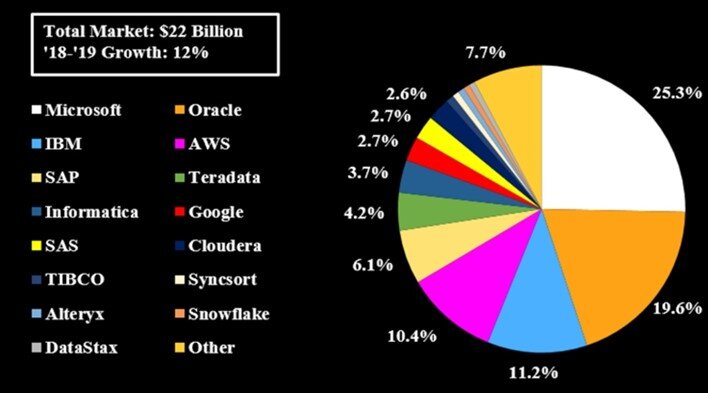
Data Warehouse Software Market Share. Source: IDC, Bloomberg Intelligence

Data Warehouse Software Market Share. Source: IDC, Bloomberg Intelligence

The Business Model…

Data is becoming paramount to business success and the explosion of data collected worldwide is allowing for rich insights. Data has been compared to oil, and snowflake is to data what a refinery is to oil. When choosing where to store and manage large amounts of data, companies have historically done so on premise, investing large amounts in on-premise infrastructure. The improvement in communications technology is enabling data to be transferred, stored, and manipulated in the cloud, at a low cost, and the adoption of cloud services is therefore accelerating.

Legacy on premise appliance providers such as Oracle, Teradata and HP Enterprise are set to lose market share to Snowflake due to these trends, as they suffer from a series of problems which Snowflake solves, the main problem being data silos, a collection of data that is held by one group in a particular location and is therefore not easily accessible to other groups, resulting in the same data being stored many times in different locations. Legacy databases are expensive to maintain, difficult to use, don’t allow for seamless data sharing, require investment if volume of data is significantly increased and it is hard to implement a multi-cloud, cross region, data management strategy.

Snowflake is threatened mainly by other cloud services providers such as Microsoft Azure (MSA) and Amazon Web Services (AWS), although it can also be complementary to these providers, acting as the single data warehouse that shares the data to be analysed by data analytics applications offered by AWS or MSA.


Snowflake, like other cloud-based platforms, offers services ranging from data storage and processing, to accessible computing power, while making the most of technology in relation to computer resources, facilitating decision-making and providing solutions to issues each one of their users may encounter. However, as the success of its initial public offering (IPO) may indicate, they are set apart by key characteristics that enhance users’ experience.

An indispensable advantage, in the cloud-based platform’s possession, is the fact that it optimizes its clients’ performance in relation to their costs while using their platform. That is, through the separation of data storage to its computational capabilities, it is able to scale up or down (add or remove information) when necessary, in order to ensure no irrelevant information is being considered when complex objectives are being pursued. Given Snowflake charges for storage based on terabytes stored per month, and computation on a per-second basis, the fact that they’re separate appeals to firms who do not partake heavily in both activities, as they are able to only pay for what they use, as opposed to bundled services offered by competition.

Furthermore, another advantage of keeping storage and compute separate is data sharing. In other words, users can share their data with entities that are Snowflake customers as well as those who are not, in real time. This is particularly relevant for those who are accustomed to share data through File Transfer Protocol (FTP), for Snowflake provides a competitive service which is more efficient yet better protected and audited.

Finally, its unique, patented multicluster architecture which addresses concurrency issues is a big pro for the company, when compared to its competitors. It ensures queries from one virtual warehouse never clash with ones being carried out in another virtual warehouse, therefore users never have to wait for other loading processes to be completed before they find what they need.

Snowflake’s vision of the “Data Cloud” is also a differentiating factor from their competitors.  Their focus on allowing their customs and partners to share data with each other creates a powerful network effect. The more customers adopt our platform, the more they can share data with, or receive data from, other Snowflake customers, partners, and data providers. For example, on the 18th of March 2020, Starschema Inc made its Covid-19 epidemiological data available on Snowflake’s data marketplace. Hundreds of Snowflake customers then used this data to analyse the impact of the outbreak.

Coming up for Snowflake…

Though Snowflake’s future is uncertain, and it is operating at a lossmaking pace, it has also raised $3.4 billion with the IPO. The cloud-based storage firm’s financial statements are making a stride in a favourable direction, with the last quarter’s revenues of $133 Million (121% of its revenues this time around last year), and its losses are curtailing. Besides the numerical indications of possible prosperity, it is a firm that is perfectly placed in space and time, as firms transfer from on-premise data to cloud data storage.

Despite competition not being null, Snowflake has other industry giants invested in their service – the likes of Nike, Apple, CapitalOne, among several others. Moreover, it enjoys solid relations with the 3 largest cloud providers in the US (Amazon’s AWS, Microsoft’s Azure and Google Cloud Platform). In addition to that, they boast a customer retention rate of 158%, suggesting their existing clients are spending 58% more than previously.

Finally, according to research carried out by the world’s premier global market intelligence firm, IDC, within 3 years, the cloud market will be valued at 84 Billion US Dollars, promising room for growth for existing firms, with Snowflake definitely not being an exception.


Customer Base, Growth. Source: IDC, Bloomberg Intelligence

Customer Base, Growth. Source: IDC, Bloomberg Intelligence

If you enjoyed reading about Snowflake, make sure to check out Finance Team’s article on their IPO coming out on October 2nd 

Authors:

Abe’s Lasting Legacy

Shinzo Abe was born in 1954 in Tokyo. He grew surrounded by political affairs as he was the son of a former member of the House of Representatives and minister of foreign affairs (1982-1986) and grandson of a wartime cabinet minister who became prime-minister of Japan (1957-1961).

Political Ascendence

In the early 1980s, Mr. Abe joined the right-wing Liberal Democratic Party (LDP) and is currently a member of the Mori Faction of the latter, one of the most influential and conservative party’s factions.

Mr. Abe was first elected to the House of Representatives in 1993 and integrated the government for the first time in 2005 as Chief Cabinet Secretary.  He is also a member of the Nippon Kaigi (“The Japan Conference”) organization, Japan’s largest ultra-conservative and far-right organization whose foundational aims are revising the Japanese constitution, promoting patriotic education, and incentivizing official visits to Yasukuni Shrine, a temple that pays tribute to Japanese citizens who lost their lives fighting for Japan in major wars, including WWII.

Mr. Abe also led the Japanese Society for History Textbook Reform that brought highly controversial changes to history textbooks, namely by trying to devalue the atrocities committed by Japanese forces in the Korean peninsula and China during the 20th century. Mr. Abe’s stances on Japan’s history damaged multiple times his popularity near its electorate.

Mr. Abe’s first term as prime-minister occurred between 2006 and 2007. He replaced the existing prime-minister Junichiro Koizumi as leader of the LDP and became, at the age of 52, the youngest post-war Japanese prime-minister. In his first term as prime-minister, his popularity reached rock bottom not only for having to deal with corruption scandals involving two of his government ministers but also for opposing the possibility of a Japanese female monarch ascension to the throne. Following the high rates of disapproval, Abe resigned in 2007 as head of government and president of LDP alleging health issues.

However, in 2012, he reappeared as a candidate for LDP’s presidency and was re-elected. For his run, he used the motto “Take back Japan” to show his approach to the economic, demographic, and sovereignty constraints.

During the following 8 years as head of government, Mr. Abe was able to produce dramatic changes at all levels in Japan. He amended almost all the 103 articles of the heavily American written Japanese constitution, weakening the protection of individual rights, reinforcing the importance of public order, and conceding great power to the army. In 2013, he announced a five-year plan of military expansion described as “proactive pacifism”. A year later, Abe took the initiative to reinterpret Japan’s constitution to grant the right for “collective self-defense”, which allows the Japanese Armed Forces to aid allies under attack, whereas the previous interpretation of the constitution only allowed the use of force for self-defense purposes.

In 2014, to reverse Japan’s decreasing tendency of birth rate, Mr. Abe unsuccessfully allocated millions of dollars to the “marriage support program” that helped single individuals find potential mates.

By the end of 2014, the government was able to pass a bill in the House of Representatives that established which information constituted a state secret and increased penalties for those who leak such information. The approval of such law turned out to be highly controversial, making the Cabinet Office’s approval rating fall below 50% for the first time.

In 2018, his public image suffered another hit after he held a drinking party with LDP lawmakers while disastrous floods were affecting western Japan. Also in 2019, controversy grew around the cherry-blossom-viewing party, an official government event, given accusations of growing extravagance. When confronted by the opposition about the party’s list of attendees, the Cabinet Office shredded the documents.

This year, following the high disapproval rates on the government’s management towards the Coronavirus crisis, Mr. Abe announced his resignation as prime-minister and president of LDP, alleging, again, health issues.

Foreign Policy

Concerning foreign policy, Mr. Abe followed a “proactive search for peace” approach. With the American withdrawal from the Trans-Pacific Partnership, Japan took a leadership position to save the agreement, strengthening Japan’s alliance with Donald Trump. Diverging from the protectionist policies that were common in the Japanese economy, Mr. Abe created an 11-nations’ free-trade zone.

Shinzo Abe also made an effort to expand Japan’s relationship with China, holding a historic phone call with Xi Jinping, the Chinese leader, in 2018. The reinforcement of the Trans-Pacific Partnership, also settled financial and developed agreements with China.

Strategic alliances with rising powers such as Australia and India were also celebrated by Abe, specifically in military collaboration.


Source:  Bloomberg

Source: Bloomberg

Some critics suggest that Abe failed by deteriorating relations with the Japanese neighbors, South Korea – a relationship that experienced its peak in 2012, just before his mandate. Beside supporting right-wing nationalists who defended Japan’s colonial legacy in the peninsula, in October 2018, Abe declared a trade war with South Korea when the Japanese companies that used slave labor from Korea, during World War II, were sentenced to indemnify the harmed. This led the Japanese-South Korean relationship to reach rock bottom.

Economic Policy

In 1992, the Japanese economy suffered the burst of an economic bubble, which led the country into the Lost Decade – ten years of economic stagnation. The Japanese government attempted to revive the economy with extensive public works programs, which failed to stimulate growth and greatly increased public debt. In the early 2000s, the Bank of Japan started using quantitative easing to spur economic growth, with success, but these policies failed to generate healthy levels of inflation.

Therefore, when Shinzo Abe entered office in 2012, he faced a deflation problem that threatened to stagnate the economy again and high levels of public debt. Mr. Abe thus developed an economic policy strategy that became known as Abenomics, consisting of “three arrows” (a reference to an old Japanese story where three arrows separately could be broken, but together were strong).

The first arrow consisted of monetary policy, aimed at reaching 2% inflation. The plan was to intensify the Bank of Japan’s quantitative easing program to increase the money supply and thus spur inflation.

The second arrow consisted of fiscal policy, namely several stimulus packages implemented over the years. These were mostly composed of public works and various forms of incentives for private investment. Several of Mr. Abe’s budgets have also included increases in military spending and cuts on foreign aid, according to his economic as well as foreign policy objectives.

The third arrow was broadly defined as a strategy for economic growth. In 2013, Abe announced the first measures in the third arrow, which consisted of cuts in economic regulation, particularly around the country’s largest cities. These measures disappointed analysts and the stock market, who were hoping for structural reforms, namely in the labor market and business law. In 2014, Abe announced more comprehensive reforms, including corporate governance reform, more openness to immigration, liberalization of the health sector, and a cut in corporate taxes to under 30%.

Abenomics have achieved moderate success. Since Mr. Abe entered office, Japan has seen modest GDP growth – between 0,5% and 2,5% per year. But the 2% yearly inflation target was only achieved in 2014, averaging around 0,5% over Mr. Abe’s term. Also, the Japanese public debt remained very high – 237,6% of GDP, in 2017.


Successor’s Challenges

Yoshihide Suga was chosen on September 14th as the new prime-minister, and now faces the economic and demographic challenges Abe’s administration failed to tackle. At present, Japan’s birth rate is one of the lowest in the world with the country’s population shrinking by 400.000 people per year, which threatens the sustainability of future pensions and public health care systems. The Fitch Ratings have also predicted the Japanese public debt will surpass 240% of GDP by 2021, due to the current pandemics.

Mr. Shinzo Abe leaves behind an important legacy, but certainly not an easy one.


Source:  Inside Asian Gaming

Source: Inside Asian Gaming


Sources: BBC, CNN, Financial Times, Foreign Policy, NewStatesman, New York Times, The Economist


Manuel Barbosa - Manuel Barbosa Raquel Novo - Raquel Novo


Afonso Botelho - Afonso Botelho

Are central banks still capable of influencing economic activity?

In the past decades, monetary policy has played a major role in addressing macroeconomic fluctuations. Recently, interest rates have dropped to historically low levels, turning negative in some countries, calling into question the most basic foundations of economics. But how have we come this far and what can we expect? 

The goal of lowering interest rates

Central banks act as smoothers of the economy. When it gets overheated, they can, for instance, increase reference interest rates, making credit more expensive and slowing down economic activity. Contrariwise, in times of little confidence, they lower interest rates, facilitating access to loans and stimulating consumption and investment. Even though their action may jeopardize growth in expansion times, it is essential to avoid heavy recessions. Therefore, central banks are key in keeping stable confidence levels.

They can impact the economy by directly changing reference interest rates, reserve requirements or performing open-market operations. In this regard, they may engage in expansionary monetary policy (Image 1), in which case they might, for instance, buy assets, through open-market operations, from financial institutions, injecting liquidity in markets. As aforementioned, this suits recession times and has been taken to extraordinary levels since the COVID-19 outbreak started to dent economies across the globe. Contractionary monetary policy works the other way around, but it is far from being a reality during these times. So, the focus of this article will be on the expansionary side, trying to figure out whether or not monetary policy will be effective in smoothing the economic catastrophe brought by the pandemic, taking the past into account.

Image 1: Expansionary monetary policy tools    Source: Corporate Finance Institute (adapted)

Image 1: Expansionary monetary policy tools

Source: Corporate Finance Institute (adapted)

Monetary policy and how it has changed over time

Adequate management of money supply has not always been the main driver of policy-making towards achieving economic growth. As a matter of fact, Monetarism, as this school of thought later became known, only grew dominant in the 1980s, when inflation and unemployment rising together raised some skepticism about Keynesianism. It was applied by Paul Volcker, Fed’s chairman, as a remedy to slow down inflation in the USA, during Jimmy Carter’s presidency. Similarly, it was put into practice with Margaret Thatcher in the UK. In both countries, the decrease in money supply prevented prices from continuing their seemingly unstoppable escalation.

Image 2: Milton Friedman, the father of Monetarism    Source: Hoover Institution

Image 2: Milton Friedman, the father of Monetarism

Source: Hoover Institution

Nonetheless, as alternative regimes had and have their shortfalls, Monetarism also presented downsides. On the one hand, tackling inflation came at the cost of high unemployment (correlation coefficient between both variables of -0,62) (Graph 1). On the other hand, in 1980 and 1981, money growth targets in the UK were largely missed, worsening monetarism’s reputation, as (Pepper, 1998) noted in his book Inside Thatcher’s Monetarist Revolution.


Data source: World Bank

Data source: World Bank

These attempts to tie monetary policy to nominal anchors (being them money growth, as discussed, or gold and fixed exchange rates) and the fact that they failed proved that economic relationships (such as between inflation and unemployment or money growth) are often too unstable to serve as drivers of policy-making. Acknowledging their limitations in understanding the economy, most central banks devoted their efforts into keeping low and stable inflation, avoiding setting a particular exchange rate or money growth rate. Adopting this approach, they found out they had more flexibility to adapt their policies in the pursuance of their inflation target, which is set at just below 2% by the ECB.

Since the full adoption of the euro took place back in 2002 and until the outbreak of the 2008-2009 financial crisis, the ECB had been relatively successful in achieving close to 2% inflation (Graph 2). Nonetheless, in 2009, inflation accompanied the drop in Euro Zone GDP and decelerated significantly, with prices rising only marginally. In 2010 and 2011, inflation recovered a bit, responding to economic growth, but it would end up slowing down dramatically with the aftermath of the sovereign debt crisis, even when the economy started accelerating again.


Data source: World Bank

Data source: World Bank

As a result, in March 2015, the ECB engaged in non-standard monetary policy measures, implementing Quantitative Easing (QE), hoping to bring inflation back to the target and to enhance economic growth. The program is similar to the one tried by the Fed in the US or the Bank of Japan, being based on the acquisition by the ECB of financial assets (namely, bonds) from banks, which will increase their prices and consequently decrease yields. This decreases funding costs for both individuals and corporations, which is expected to stimulate consumption and investment. In the medium term, inflation should speed up and follow economic growth. Nevertheless, this shifts risk to central banks, whose balance sheets inevitably spike (Graph 3).

Data source: OECD

Data source: OECD

Looking at Graph 2 and considering its time frame, this program seems to be linked to economic growth. However, it is difficult to establish causation, as QE coincides with the recovery from the sovereign debt crisis, which by itself should have a positive impact on GDP. However, when it comes to inflation, success is yet to be a reality. This can be a result of two factors. On the one hand, the liquidity trap environment (interest rates close to 0% since 2009 and lately even lower) makes monetary policy less effective – the ECB cannot drop interest rates much further to stimulate  the economy. On the other hand, uncertainty – which has risen to another level with the pandemic – leads to higher investment/savings rather than greater consumption – instead of reaching the real economy, inflation is deviated to financial markets, as it will be further developed in the next section.

Monetary policy by the ECB and the Fed during the pandemic and how it has been impacting economic recovery 

The COVID-19 economic shock is one of the biggest since the Great Depression of the 1930s (Graph 4). It is particularly meaningful in the sense that the world as a whole – and not just some economies, as during the financial crisis of 2008-2009, for instance – has been heavily impacted. Supply-related disruptions and a substantial fall in demand led governments across the globe to design never-before-witnessed stimulus packages. At the same time, central banks have been engaging in an even more expansionary policy, reflected in their financials (Graph 4).


Data sources: European Central Bank, Federal Reserve Board

Data sources: European Central Bank, Federal Reserve Board

In the words of the former ECB’s President Mario Draghi, both the ECB and the Fed have been doing “whatever it takes” to help the European and American economies during such hard times. On the one hand, the ECB, besides loosening reserve requirements and setting lower interest rates, has launched its Pandemic Emergency Purchase Program (PEPP) (similar to QE), amounting to 1.35 trillion euros in the purchase of assets, just since March 2020. On the other hand, the Fed has also been undertaking a massive asset purchasing program, alongside direct support to mutual funds, banks, corporations and state and local governments.

The main problem stemming from monetary policy during these past few months is that, as briefly mentioned in the last section, it has not been particularly efficient in addressing supply and demand issues, since the high level of uncertainty channels funds to financial markets instead of the real economy. Especially in the US, this has induced an extreme asset overvaluation – the American stock market is worth, as of September 17, 2020, more than 175% of the US GNP (Graph 5).


Graph 5: Buffet Indicator     Source: GuruFocus

Graph 5: Buffet Indicator 

Source: GuruFocus

More evidence on the ineffectiveness of monetary policy in facing the wreak havoc by the pandemic is provided by the relationship between money stock and money velocity – despite the quantity of money has soared, the velocity at which it circulates struggles to increase, reflecting very low economic activity (Graph 6).


Graph 6: Money stock  versus  money velocity (US)    Source: Federal Reserve Economic Data

Graph 6: Money stock versus money velocity (US)

Source: Federal Reserve Economic Data

What lies ahead?

Monetary policy has faced complex challenges throughout time. Nowadays, policymakers are being forced once again to think outside the box, which has resulted in the non-standard measures discussed above. For now, policy transmission seems to be struggling, which may lead central banks to increase their stimuli, but maybe this is the time to focus on increasing efficiency rather than on pure money printing.

Sources: Corporate Finance Institute, European Central Bank, Federal Reserve Board, Federal Reserve Economic Data, GuruFocus, Investopedia, OECD, SpringerLink, The Brookings Institution, World Bank

The new era of Business: Exploring consumer-firm interactions

The corporate world is well-known by many as a “battleground” where firms compete for market power, higher profits and better public opinion.The search for the competitive edge has led companies to specialize and improve every aspect of their organizations, striving for differentiation in every front.As ideas start to run out and specialization reaches sky-high levels, firms are starting to realise that there is one area in particular that has both much room for improvement and the capability of providing the advantage they look for: the consumer approach.This phenomena is not only embraced by firms simply because they enjoy helping the community. Even though consumers benefit from it, these measures also allow firms to increase their profits. In fact, the consumer service has improved a lot over the years and the saying “The client is always right” has gained special attention from companies. Ever since trades started to occur, the idea of a consumer and a producer being two separate identities only linked by the currency exchanged has been rooted in our minds. However, as stated, firms are now shifting their focus towards the people who are the reason why they exist in the first place. More and more, organizations are trying to end this notion of separation and starting to approach customers with the goal of breaking barriers and gaining trust.One way to do so lies in customization. The development of the trend where buyers customize their own product according to their tastes and preferences has increasingly brought gains for firms. On the one hand, consumers become emotionally attached to the products as they feel like, by being responsible for part of the creative process, the resulting product becomes part of themselves, boosting positivity towards the merchandise and the brand. On the other hand, firms also have the opportunity to receive massive feedback about consumer taste, transforming the otherwise “passive customer” into an “active customer”, transforming the whole decision process – a win-win situation one could say.

The head of the Center for International Manufacturing at the University of Cambridge, Jagjit Singh Srai, even said that he believed most major companies would have customization operations in place within the next 5 years.

Nike is one of the most famous brands that embraces product customization

Nike is one of the most famous brands that embraces product customization

Another way to build consumer trust relies on brand development. Through jingles, logos, catch phrases and multiple initiates firms’ main goal is not only capturing a bigger audience, but also promoting brand loyalty among the regular consumers.It is with no shame that everyone can remember at least a handful of commercials or jingles from their favourite brands, even if they don’t want to. It is actually not our fault that the themes are so catchy that our brains cannot detach from them, or that we are exposed to the same commercial so many times that it sticks. It is a great investment of time and money on the behalf of firms to improve our perception of their reality.

Moreover, brand image is also boosted by campaigns related to events occurring in the world where brands decide to take a stand and defend a certain point of view in order to send a message to their customers, showing what ideals they support. As an example, multiple brands like Nike, Netflix, Ben & Jerry´s and Amazon, decided to make a stand against racism in light of the recent protests “Black Lives Matter” through financial contributions, social media posts and advertisements.


Part of Nike´s “For once, don´t do it.” Campaign.

Part of Nike´s “For once, don´t do it.” Campaign.

With all these measures the firm´s main goal is to be seen as much more than a company that trades a specific product or provides a service and more as an entity  linked with ways of living and thinking, wanting to sell an experience which their customers can identify themselves with and embrace. It is of great importance to feel part of a family that shares their same interests as it drives loyalty and brings security while promoting and expanding companies’ perception within the market.However, it is also very important to notice that by doing so, firms are now starting to interact more and more with social norms and less with market norms. That is, firms, by trying to reach an emotional attachment with consumers, start to fill an enlarged pool of expectations that if they are not able to fulfil, might generate disappointment among the loyal customers that saw them as more than a brand.


Picture this situation:

For years, you only buy shoes of a certain brand, either because you like the design better or simply because you really like the brand’s message. Imagine that you like it so much that you even have posters on your bedroom wall and stickers on your laptop of commercials and slogans by that specific brand. Well, it’s safe to say you have an emotional connection with this brand.

Suppose now, that you made your first order online and the product is nothing like what you expected and so you complain, calling and sending emails to the “Consumer  Help Service”. After hours waiting on the phone and a couple of sent emails, you receive no answer by the company you liked so much.

Now, you have a strong dislike towards this brand, you have been personally disappointed and it is very likely that you will not shop there again and will persuade your friends to do the same by telling them all about your experience. This feeling of betrayal would not exist if the emotional connection had never been established. Firms should have this in mind when they decide the type of image they want to send to the public.


To sum up, building an emotional connection with customers has numerous advantages and is a very prosperous way to gain market power and brand loyalty, but it is also a potentially dangerous measure that has the possibility of backfiring and having the opposite effect if the expectations are not met. This being said, emotional connections are a significant way to achieve consumer loyalty, but building an image that cannot be achieved can also greatly damage a firm’s reputation.


Sources: NY Times, The Guardian, Forbes Magazine

Scientific revision: Ana Clara Malta (Behavioral Economics Team Leader)

Populism: Will it stay in lockdown?

In periods of economic distress, politicians who find scapegoats for the current situation are usually acclaimed by citizens that once might have felt discouraged to vote. However, the rhetoric used works as an attempt of dividing the population in native members and non-native members and minorities (cultural populism); honest members of the working class and big business owners (socio-economic populism) and victims of corruption and politicians (anti-establishment populism). Given that these arguments exploit societal concerns, they may pose a threat to democracy, by claiming that their opponents do not have people’s best interests in consideration and by excluding from “the people” each and every person whose support is not guaranteed.

In the past three decades, this trend has risen exponentially, even in countries with the most solid economies. According to Tony Blair’s global institute, in 2018, there were 20 countries with presidents or prime ministers that were considered populists, as shown in the graph below. Besides this, 40% of Asia’s population is governed by Populists.


Source: Tony Blair Institute for Global Change

Source: Tony Blair Institute for Global Change


Will populism thrive in the pandemic?

Before the global health crisis, the forecasts for 2020 were the continuous bet in dealing with inequalities and environmental issues. Although companies are increasingly investing in Environment, Social and Governance (ESG), that is not governments’ main concern anymore. The world leaders are trying to prevent the spread of the virus while attempting to reduce the economic implications that will arise. It is difficult to measure populists’ responses to this crisis as each country is adopting different policies and their role depends on whether they are in the office or in the opposition.

The graph presented above illustrates the idea that the rise in populism was hastened by the 2008 financial crisis. Research conveys that there is a significant correlation between the level of unemployment and the popularity of these parties. The virus has also helped uncover structural problems, such as an inefficient health care system or a dysfunctional government, which are likely to sustain populists’ arguments.

Hungary’s Prime Minister, Viktor Orban, is an example of a politician that is availing the pandemic to reinforce its position. After declaring a state of emergency, the government started to attribute the blame to illegal migration and eventually arrested students that were legally studying in the country, just for protesting. By taking immediate measures, Mr. Orban gained trust from the population, which allowed him to extend his mandate to an indefinite period to deal with the current crisis.

Another politician who has climbed in polls is Angela Merkel, for imposing mass testing and effective lockdown restrictions, thus controlling the death toll. Jair Bolsonaro, on the other hand, has made declarations underestimating the threat of the virus, just like Donald Trump, and has not taken any protective measures to ensure its civilian’s health, making him lose supporters.

In times of uncertainty, people look for the answers in their leaders. They prefer someone that actually deals with the situations and takes action from the beginning, whether he is populist or not, given that both populist (Victor Orban) and non-populist (Angela Merkel) politicians have surged in approval ratings.

Another factor that might influence the polls is data manipulation that misrepresents the hard times that the country is facing, or even the control of media pluralism. Besides the fact that populists’ arguments dismantle their opponents with ad hominem fallacies, some of these politicians live in countries with a low level of democracy, allowing them to promote their ideals even further, as it is depicted in the graph below.

Source: BTI Transformation Index

Source: BTI Transformation Index


Will populism stay in lockdown?

Despite the ability that populism has of growing and marching to brand new territories during economic and political setbacks, there are also some particularities in the pandemic that may constrain it.

Firstly, the strategy that most non-populists are using is the inclusion of messages of union in their speeches. The virus affects all social classes, races, ethnicities and orientations and there is no benefit in exclusion as everyone is working towards the same goal.

Secondly, the only way of tackling a problem is by not ignoring its existence. It comes as no surprise that the electorate demands experienced leadership with concrete goals and actions instead of mere comments, when faced with a recession. The anti-intellectualism promoted by some populists may also be in danger as it is not that appreciated when the entire world is waiting for the creation of a new vaccine and relying on doctors and governments to reduce the potential aftermath.

Lastly, with the increase in the level of unemployment and the decrease in aggregate demand, countries will not be able to survive by themselves. In the case of EU members, they will need financial aid from the European Union to combat this crisis, trying to fight the economic fallout. Thus, the nationalism nurtured by populists may no longer be welcome.


What can we expect?

There could be a significant decrease in populism in Europe if European citizens recognize EU’s assistance and realize the importance of inclusion and union, disregarding the priorly felt nationalist sentiments.

There is also the possibility of a second wave of infections. The sudden increase in cases would prove that the previously taken measures were inefficient and would decrease population’s support of their leaders. As the majority of the politicians haven’t got a secure spot in the office, some current populists might lose its power. However, they usually last longer in the government than the rest of the people and this might be an opportunity for a new brand of populists to arrive with an improved rhetoric that meets the new economic challenges.

India: the biggest lockdown in the world

The COVID 19 pandemic stopped the world. Most of the globe entered in quarantine to prevent the spread of the new coronavirus, some with great success, others not so much. Now, we witness the consequences of the pandemic  in one of the most populated countries in the world: India. The country is famous for its colossal population growth, low living standards, questionable working conditions and a bad public health system. A terrible recipe to face an epidemic.

The first confirmed case was reported on the 30th of January and  many others in the months that followed. . It was on the 24th of March that the government implemented a countrywide lockdown, with 519 confirmed cases, forcing 1350 million people to stay at home in quarantine. Out of those, 280 million live under the poverty line.

Everyone is highly advised to stay indoors and commuting between and within cities or villages is  either greatly conditioned or prohibited. Some neighbourhoods in big cities are completely blocked by fences. Even movement of goods, some essentials like food, are conditioned.

A great number of Indians lost all sources of income due to the confinement. It wasn’t long when people started disobeying it. Not because they do not fear nor understand the threat of the virus, but because they have no other choice. If the markets do not open, suppliers can’t sell their products and  earn the little income they need to survive, and consumers are unable to obtain essential goods like food and health protection equipment. Also, because of the movement restrictions, the markets that do open have a shortage in supply. Therefore, prices for food and masks have inflated by around 30% according to Público.

Citizens are desperate as they can’t lose their sources of income as, if they do, they’ll most likely starve. Nevertheless, the lockdown and confinement are being enforced by the police, many times resorting to violence. There are reports of police forces beating up big crowds and drivers that are passing where they shouldn’t. They were probably just trying to deliver food to shops or driving to the only market opened for miles.


In the big cities, the situation is much worse. In Mumbai, for example, there are 27000 people per square kilometre. Many live in slums: enormous neighbourhoods with streets no more than 3 meters wide and exposed sewers, where many houses are just composed of one room. Families of 5 members cook, eat and sleep in that one room. How did they get there? Most of them are people from rural areas, brough to the city to work. They accept the job for a low salary and one of those houses in the slums that are generally provided by the company.

During this crisis, the majority either lost their jobs, did not receive the full monthly wages or both. These people now have no income, no home, and no food supplies, being their survival very dependent on food charities. This is the reality for a great number of Indians,  having the unemployment rate reached 23.5% last April, according to the Centre of Monitoring Indian Economy (CMIE).


Unemployment rate in India (Source: CMIE)

Unemployment rate in India (Source: CMIE)

Some try to leave the city on foot  as trains and buses are non-operational. If found, the police will beat them and force them to go back, which they do, just to try again by a different route. When they are able to pass, these families carry their children for hundreds, sometimes thousands of miles to return to their home regions. They walk right next to the highways. 180 people, including a 2 years old girl,  already died on these routes, either by exhaustion or run over by a passing car. When they reach another settlement, the police will probably try to keep them out.

In the middle of all this, the government has tried to help, but with no success. It has provided buses and train rides between cities, but there aren’t enough for so many. It correctly informed the population about the threat of the virus and why it is so important to stay at home, and acted quickly when more positive cases were being confirmed. But instead of sustaining the confinement by supplying the population, they lockdown cities by all means necessary.

Everything they have to show for their hard efforts, both from part of the government and the people, are the statistics. By the time that this article was written, India had a number of confirmed cases and confirmed deaths that put the mortality rate in 0,03%. Relatively speaking, that is not bad. Many call it a miracle or, at the very least, a mystery. It also has a great number of recovered people. It is true that India has a young population and a generally hot climate, both factors contributing positively to ease the severity of the proliferation of the virus. But that does not tell the full story.

Testing in India has not been enough in comparison with the rest of the world. The hospitals seem completely full of COVID-19 cases. Some became so restricted that other patients cannot get treatment for other diseases, like HIV/AIDS. India is also full of other dangerous illnesses. Pulmonary Tuberculosis, a disease eradicated in so many countries, still exists there and has very similar symptoms as the coronavirus like persistent cough, fever, fatigue and breathlessness. Of all deaths in India, only 22% are medically certified, and wrong diagnosis are often. Hence, many deaths are not being registered as COVID-19 caused, when some most likely are. Many deaths happen at home in India. A family member reports it by phone, and then authorities conduct a “verbal autopsy”.

“Counting deaths has always been an inexact science in India.”

— BBC

Under-reporting of COVID-19 cases and deaths is not uncommon amongst infected countries, but India already has a reputation of a terrible account of its diseases and deaths. All of this makes you wonder: how viable are those “miraculous” statistics?


Map of cases per million in India by states (source: Ministry of Health and Family Welfare)

Map of cases per million in India by states (source: Ministry of Health and Family Welfare)

What is more dangerous, the disease or the lockdown preventing it?

Many specialists are studying to get an answer for this question, but for the time being, we just don’t know. Until we have a better understanding and a better system to deal with the pandemic in India, the disease will continue to spread and people will die, let it be by the disease, starvation or another cause related to the lockdown. And as it was shown to us this year, the world can always get worse. A new strain of the coronavirus was found in India, resulting from a mutation, that experts say there is still no reason for alarm, but it can lead to the ineffectiveness of a potential COVID-19 vaccine. Not only that, but the strongest storm ever recorded in the Bay of Bengal, the Cyclone Amphan, is about to hit India and Bangladesh.

The people of India are in need of international help now more than ever. If you think you can help, please consider donating to a charity institution, such as Kolkata Relief.

Site: https://www.kolkatamonsoonrelief.org/
Instagram: @kolkatarelief https://www.instagram.com/kolkatarelief/


Sources: Público, RTP, ABC, South China Morning Post, BBC, CNN, CMIE, MoHFW.

Margarida Gomes - Margarida Gomes João Rodrigues - João Rodrigues

Is TAP worth taxpayers’ money?

The nationalization of TAP Air Portugal (hereby simply referred to as TAP) has been a hotly discussed topic recently. In this article, the major pros and cons of such a move by the Portuguese government are put into perspective, during a time in which taxpayers cannot afford to cover a bad decision from those in charge.

Founded back in 1945, under the Estado Novo dictatorship, TAP was initially a private company. During the first three decades of existence, its development occurred at a slow pace, mainly due to the fact that Portugal was a poorly internationalized country by the time. With the deposition of the regime, which led to the nationalization of the company (along with many other businesses), and a further global integration of the country, TAP could grow, expanding its routes and reaching more points on the globe. The fact that TAP took almost 20 years to reach the one million passengers milestone, compared to the 17 million attained in 2019, is a proof of the tremendous development registered not only by the company, but also by the sector as a whole.

What’s the company’s current situation?

Despite the pronounced long-term growth of the aviation industry, TAP exhibits long-lasting liquidity/solvency problems, presenting, year after year, worrying financial statements. As a matter of fact, the incapability of the firm to deliver sustainable results throughout decades led to its reprivatization (2015) in the aftermath of the financial crisis that hit Portugal.

Before diving into the numbers, let us proceed with a brief characterization of the firm’s organization nowadays. In fact, the aviation company itself, TAP SA, belongs to a holding, TAP SGPS, founded in 2003. Besides TAP SA, the group owns eight additional subsidiaries working on related businesses, such as catering, maintenance, cleaning services and computer engineering.

In 2015, under Pedro Passos Coelho’s government, the group was privatized and the Atlantic Gateway consortium, headed by David Neeleman and Humberto Pedrosa, acquired a participation of 61%. Later, in 2016, António Costa’s office partially reverted the process and secured a 50% share to the state, assuring an even split across private and public ownership. This ended up translated into an ambiguous shareholder structure, which has remained unchanged since then. But for how long?

TAP SGPS is in severe financial distress. The graph below says it all. In 2008, owners’ equity became negative and net income simply disappeared, almost never to be seen again. To make things even worse, the level of indebtedness is currently at dangerous levels (above 200%) and, even though the expansion of the aircraft fleet has been contributing to increased assets, liabilities struggle to be reduced. In finance, such analysis should ideally be conducted via peer comparison, but the values presented (namely, those relative to income) are intrinsically poor and are a good portrait of the group’s frightening financial situation.


Data Source: Sabi Nova SBE

Data Source: Sabi Nova SBE

Should TAP become a state-owned company again?…

In this dramatic scenario, one may wonder what factors could be a justification for state ownership, as the financial situation does not seem to be one. Consequently, on the one hand, nationalization’s supporters argue that private management would only care about profit and this would potentially mean the elimination of important routes for the Portuguese community, such as the links with Guiné-Bissau or Cabo Verde. On the contrary, the state would defend the best interests of citizens, even if they led to inefficient outcomes. In this domain, the fact that most European countries have state-owned airlines is often used as an authority argument to back nationalization.

Another idea in favor of state control is the role of ambassador of the Portuguese culture that TAP is believed to play abroad. The defendants of this thesis argue that, by becoming private, the brand would lose connection to its Portuguese background and start to be seen as just another airline, which would harm Portugal’s international exposure. In fact, this is one of the main concerns of António Costa’s government, which considers TAP as a «strategic company». Taking into account that the aviation industry is among the most affected by the COVID-19 pandemic, he says that the government will avoid its bankruptcy at all costs. Also, TAP employs more than 10,000 people nowadays and many believe that privatization, a merger or an acquisition by a competitor would mean many jobs lost.


Could thousands of employees fill unemployment claims in case of privatization? 

Could thousands of employees fill unemployment claims in case of privatization? 

… Or should it be effectively privatized?

On the privatization side, people argue that the state has no right to arbitrarily inject taxpayers’ money into a company near bankruptcy and which can well be run by a private entity with no prejudice for national interests. If for a bank that is admissible due to systemic risk, an airline company is not believed to be worth of taxpayers’ effort, especially considering that there are loads of similar companies providing the same kind of services, many times at a lower cost for the client.

An interesting counterargument to that of national interests is precisely that, as opposed to the theorized, TAP does not defend the interests of Portuguese citizens, but rather those of Lisbon. The company is accused of regionalism, namely owing to the fact that it announced the re-establishment of more than 70 routes from Lisbon and just 3 from Oporto after the lifting of containment measures. So, if the company only serves one city, it is argued not to be fair that all taxpayers are equally liable for it.

To rebut the vision of job posts loss, the apologists of privatization argue that, if TAP goes bankrupt, other companies will come over and fill its place. This would mean that, despite scale advantages, most workers will not lose their jobs, but will rather be hired by other companies. In the context of Lisbon’s airport, given TAP’s large share, this could mean lower fees in case of bankruptcy, as competition would increase. The case of the United States of America seems to support this theory. After World War II, the country deregulated airlines market and, despite Pan American (their public company by the time) went bankrupt, the increase in competition led to lower fees and routes’ expansion.

What does the future hold?

At this moment, there is no certainty about the future of TAP and, even though state’s help (through convertible bonds, for instance) is a possibility, nationalization is unlikely to happen, as the burden it would imply on households during these times would be massive. Extraordinary times demand extraordinary policy action, but taxpayers could well not be able to deal with a questionable public rescue to TAP.


Sources: ECO, Jornal de Negócios, NiT, Notícias ao Minuto, Sabi Nova SBE, Showbiz Cheat Sheet, TAP, Wikipédia

The German clash with the EU

In 2015 the German Constitutional Court received a request from a group of 1750 german citizens, raising some doubts about the public debt purchase program undertaken by the ECB near its member states, claiming this to violate article 123 of the Treaty on the Functioning of the European Union. The article states that the ECB does not have the power to directly finance its member states, either through credit concessions or direct purchase of public debt. At the time, the ECB argued the validity of their operations given the legal support from the European Court of Justice.

On the 5th of May of the present year, the German Constitutional Court analyzed once more the 2018 response from the Court of Justice of the European Union in relation to the doubts raised in 2015 by a group of German citizens, and demanded that the ECB deliver, within a 3 months deadline, an analysis of the proportionality of its monetary policies. That is, the German Court does not question whether the monetary policy undertaken by the ECB violates article 123 of the TFUE, it rather wants to infer whether the public debt buy program complies with the principle of proportionality to which the ECB is obliged to stick. The German judges consider that the monetary policies led by the ECB are followed with disregard towards the consequences that those policies may have, and that this approach constitutes a violation of the principle of proportionality. Until the report is delivered, the German Constitutional Court  has used its power to prohibit the Bundesbank (the German central bank) from buying any more foreign debt and it has even allowed the Bundesbank to sell the securities it is holding, if it wishes to do so.

Germany being the strongest economy of the European Union, the decision taken by the German Constitutional Court represents a serious drawback in the monetary goals established by the ECB. The decision gets even more preoccupying given that currently all Europe is combining efforts in trying to tackle the major economic crisis striking European economies.

While the German Constitutional Court claims to have power over national institutions, the CJUE already condemned the Court`s decision claiming this to seriously affect the European monetary policy strategy and the latter not to have the right to jeopardize or to contradict ECB measures that are backed by the CJUE, given that the principle of proportionality was always taken into account. CJUE also claims precedence in matters that involve the European Union and, therefore, does not acknowledge the legitimacy of the decision taken by the German Constitutional Court. Isabel Schnabel, member of the executive committee of the ECB, said that the public debt buy program will continue to happen, “regardless of the decision of the German Constitutional Court, given that CJUE has exclusive jurisdiction over BCE and its actions”. The fact that European legislation is above national legislations was not a part of treaties, it merely came into play in 1964 when the European Court of Justice (ECJ) decided so.

3.jpg

Is this the first time that a member state clashes with EU justice?

This is not the first time there is a clash between national courts and European law. A few countries have sought to mitigate this by enshrining the primacy of EU law in their constitutions. And most national constitutional courts have, at some point, declared that, based on article 6(3) of the Treaty on European Union, EU law takes primacy over national law as long as it doesn’t violate the human rights protected by their national constitutions. Constitutional courts have addressed these conflicts in different ways.

One alternative is to interpret constitutional law more broadly, so as to accommodate European law. For example, in 2011, the Greek Council of State recalibrated its interpretation of article 14(9) of the Greek Constitution. This article had previously been understood to prohibit owners of media corporations from applying for government contracts in other areas. But the Council of State decided that, according to the European principle of proportionality, this interpretation was doing more than what was necessary to ensure the objective of the law: transparency in public contracts.

The second alternative national judges have is to interpret European law in accordance with their national constitutional law, assuming the former cannot contradict the latter. This is based on the idea that the national constitution protects certain rights and freedoms that cannot be violated by any law, local, national or European. Few cases like this have appeared so far, but several national supreme courts, namely in Germany, Italy and Spain, have asserted that they have the power to review European law in this way and check if it complies with their constitutions.

A third possible alternative is for national judges to convince the Court of Justice of the European Union to change its interpretation of European law, so that the new interpretation is compatible with their national constitution. For example, in Taricco I, the CJEU held that the statutes of limitations in the Italian penal code violated European law, because they harmed EU financial interests (1). The Italian Constitutional Court then asked the CJEU for an opinion, arguing that complying with their decision would force the Italian penal code to contradict the Italian constitution. The CJEU granted their point and clarified their decision in Taricco I in a more relaxed way.

The fourth alternative national judges have is disobedience, or non-compliance with European law as the CJEU interprets it. This is, of course, an option of last resort. It occurred, for example, when the CJEU declared that a Social Security rule in the Czech Republic that gave an old age benefit only to Czech nationals in Czech territory violated the rights of EU nationals from other member states living there. The Czech Constitutional Court decided it would not apply the CJEU decision and would allow the rule to remain unchanged. The arguments were that the CJEU had exceeded its powers and that the CJEU had failed to take into account the historical fact that that rule was related with the dissolution of Czechoslovakia.


2.jpg

While in many cases national and European justice reach a consensus, it is unavoidable that other cases, like the German Constitutional Court one, will continue to happen. Some consider that these persistent challenges towards European Law from national courts undermine the strength and credibility of the European institutions. Others say that the preference from European Law over National one was a severe and non-democratic imposition over its member states. Nonetheless, this is an important question that urges to be answered in order to better define the future of the European Union: What are the limits, if any, that Europe wants to impose over National Courts in their interference on European policies?


(1) The European Union is partly financed by a share of member states’ VAT. The statutes of limitations for fiscal fraud in the Italian penal code, in the CJEU’s opinion, did not give people enough incentives to not commit fiscal fraud, and therefore harmed the EU’s financial interests.

Sources: Euronews, Expresso, Observador, Renascença, EUR-LEX