
Moore’s Law

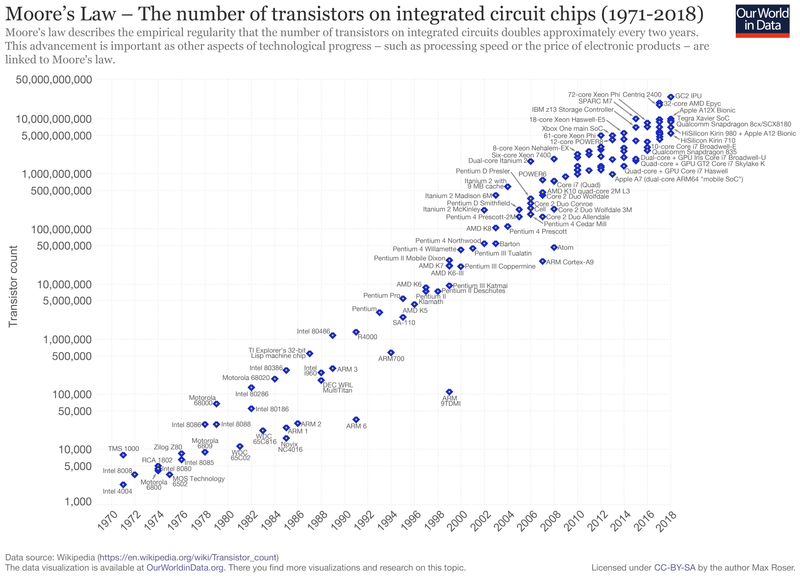
In 1975, Gordan Moore was asked to write for a special Edition of Electronic Magazine about the future of silicon components during the next decade. Integrated circuits (we explain what these are below), known today as computer chips, were discovered in the late 1950s and had just begun being tested. When analysing the achievements made by his  company, Intel, and others in the previous years, Moore observed that the number of transistors per microprocessor, as well as other electronic components, had doubled each year, and he __projected that this rate of growth would continue into the future. This prediction became known as Moore’s Law, which states that the number of transistors in an integrated circuit doubles about every 2 years.

1.png

Moore’s main goal was  to transmit the idea that integrated circuits would lower the costs of technology: the larger the number of components, the lower the cost per component, therefore decreasing the price of computers and other electronic devices. According to the law, which became an industry goal and consequently a self-fulfilling prophecy, processor speeds would increase exponentially, because transistors would scale down so that more units could be packed together on a computer chip. The more transistors, the easier and quicker electrons could move between them, therefore increasing a computer’s efficiency and speed. So as the number of transistors on an integrated circuit has doubled every 24 months, computing power has doubled about every 18 months.

Moore’s Law was regarded as a «Rule of Thumb», rather than a Law: the technological industry intended to keep up with its growth rate and so settled a road map based on the continuous innovation of transistors and chips in line with Moore’s Law. Because of the increasing demand for devices, manufacturers and producers strive to innovate and create next-generation chips, less they become obsolete in the face of innovating competition.
2.png

Many devices that we use nowadays owe their existence to the evolution of integrated circuits; Moore himself stated that «Integrated circuits will lead to such wonders as […] personal communications equipment», currently known as mobile phones. Our laptops and electronic wristwatches, medical imaging and digital processing technologies were made possible because of Moore’s Law. In fact, it has been argued that Moore’s Law is one of the main drivers of the economic growth seen in the last 50 years, as it has led to tremendous gains in productivity.

However, over the past decade the pace innovation has slowed down, with Moore himself predicting the end of his law by 2025. To explain why, here is a small primer on transistors:

A transistor, while a simple invention in concept, is one of the foundations of our modern technological society. Without it, you would not be reading this article. Your phone probably has more than 1 Billion transistors, which are microscopic and manufactured with incredible precision on a thin wafer of silicon. A transistor is like a switch, or gate, that either blocks or lets a small current of electrons pass through it. It’s the billions of combinations of these gates opening and closing that permits a computer to perform all its tasks from basic arithmetic calculations to displaying this text on your screen.

Transistors today are around 10 to 20 nanometres. That’s only around 100 times larger than an oxygen molecule so small that engineers have run into problems that they cannot economically fix – quantum tunnelling. At sizes so small, the laws of quantum mechanics take hold and electrons start to obey different rules, where sometimes they simply cross a closed transistor, corrupting the data in the process. This problem has no economical solution now and so we have reached the death of Moore’s Law.

The end of Moore’s Law has long been considered an inevitability. Gordon Moore himself set a conservative timeframe in his original 1965 paper, estimating that his observed rule would remain “constant for at least ten years”. And its death has been proclaimed many times since. Only the ingenuity of the industry has kept it alive for so long.

But this endgame does not signify an end for the advancement of computational power. Several alternative possibilities lie on the horizon, and these range from the simple and intuitive to the fantastical possibilities brought by the advent of quantum computing.

On the intuitive side, we could focus on creating specialized chips for certain tasks. The processor that powers your device (smartphone or computer) is a “beefy” unit, capable of undertaking a wide variety of tasks, albeit at the cost of efficiency. For very specific tasks, specialized chips may be created.  Other solutions may lay anywhere, from finding other materials to creating improvements in software to take advantage of current architecture – did you know that Excel does not take advantage of the extra cores in your computer to handle those heavier, 20.000 row tasks? Although these types of improvements can still take us a long way, at least a forty-fold increase in computing power (around 5 years of innovation), they can only take us so far. When it comes to transitioning to other materials, Graphene has been touted as a possible replacement, but the research is still in the early stages.

On the more futuristic side, quantum computing could usher a new age of technology to rival that of the integrated circuit. Last year, Google published a paper on Nature claiming to have solved a task in under 4 minutes that would have taken a modern supercomputer, the processing equivalent to “around 100.000 desktop computers”, over 10.000 years. There are also studies looking into conceptually abstract possibilities like using DNA to perform arithmetic and logic operations, as well as storage.

Although we will probably never have personal quantum or “DNA” computers, because their upkeep costs and upfront investment are prohibitively high, a world in which a handful of companies offer processing solutions to anyone via cloud computing, much like we see today, sounds plausible.

What impact could the end of Moore’s Law have on the economy? How can we bring about the age of AI if we do not have the hardware to support software innovation? We can only wait and see what happens.

Sources: Intel, Washington Post, Nature, 311 Institute, MIT Technological Review, NY Times, Wikipedia

From flies in urinals to higher savings rates: How nudging influences our decisions

“A choice architect has the responsibility for organizing the context in which people make decisions.”

— Richard H. Thaler, Nudge: Improving Decisions About Health, Wealth, and Happiness

Nudging has been the start point of many economic studies, in particular in the area of behavioral economics as it explores the way people´s decisions could significantly change in a predictable way by modifying the context of such decisions in a very subtle form. The concept was first introduced by the Nobel Prize winner Richard Thaler and Professor Cass Sunstein. Thaler, however, stressed the point that nudging should be used for good, with the goal of improving society’s welfare, but has his wish become a reality?

It all started at Amsterdam’s Schiphol Airport where Thaler´s discoveries were first explored by a simple experience aiming to solve a very real problem: the cleaning manager intended to reduce the “spillage” around urinals in order to reduce the cleaning expenses on the airports´ bathrooms.

Where does Thaler´s nudging theory come into play? Well, to the surprise of many the solution suggested was to “paint” a small fly near the drains of the urinals. Many may (and did) find it ridiculous and childish but actually it was a very credible and simple solution following the reasoning of human (particularly, men’s) behaviour. The goal was to “guide” men in to reducing spillage (without even noticing) and the results were an impressive 80% reduction in spillage and a consequent 8% reduction in cleaning costs. The raw truth is that men can’t help themselves and start aiming at the fly.

Fly painted in Urinal

Fly painted in Urinal

This is one of the most famous examples of the nudge theory, as it respects the most important principles that guide its use. Firstly, all nudging should be transparent and never intended to mislead (a common prevented practice – just like with publicity & advertisements since it can in fact be used to manipulate human behaviour). Secondly, it should be really easy to opt-out of the nudge (it is not mandatory for anyone). And thirdly, the behaviour encouraged should aim at improving the welfare of those being nudged (once more, no harm is intended).

Not only relevant for small problems, but also in various other areas, this theory has impacted and been adopted by governments all over the world. Over the last decade, many countries have seen and tested the effects of nudging – aiming at lower costs and better exploitation of long-lasting benefits – and the results have been astonishing. Whether the goal is to promote a healthier lifestyle by displaying healthy food at eye level in supermarkets – the impact of ordering and context framing – or increasing the savings rate of the population by automatically enrolling people in a savings plan, the results have been mostly  positive.


Another example that illustrates the impact of a nudge lies in organ donations: In countries where enrollment is necessary for those who want to donate organs after dying, the percentage of people that go through with the process is very low. On the other hand, in countries where organ donation is an opt-out option (that is, people are automatically enrolled), the acceptance rates are extremely high.

Effective consent rates, by country. Explicit consent (opt-in, gold) and presumed consent (opt-out, blue)

Effective consent rates, by country. Explicit consent (opt-in, gold) and presumed consent (opt-out, blue)


This enormous difference can be explained by what is called the default effect. Socially speaking, people tend to be change averse and avoid anything that poses extra effort and so accept the proposed default option even though they have the ability to reject it at any time.

This being said, one can probably anticipate that Thaler´s wish to use nudge for good, isn’t entirely respected as private entities are also trying to explore human psychology and use the nudge effect for profit purposes, appealing consumers to either buy or to use their products more often.

Think about these two cases in particular, Spotify and Netflix. If you don’t have a premium subscription in Spotify you may be tired of listening to something like “Don’t have premium? Try now a 1-month free trial!”. As you may know, this very tempting offer requires the allured clients to give their credit card information to be saved for the period after the free trial. Surely, after the free month, the consumer is given the choice to give up the premium account and not pay anything, but the statistics prove that many stay immersed in the inertia of the default effect and simply don’t have the energy to quit, leading them to a monthly payment that they wouldn’t otherwise have if Spotify hadn’t given the nudge. In the Netflix case, their nudge is even more camouflaged. By simply having an automatic count down to the next episode, they encourage people to go for the path of least resistance and keep watching.

Netflix automatic queue

Netflix automatic queue

It is important to highlight that in both cases, consumers weren’t forced to do anything, they were simply guided towards an option. Notwithstanding, this suggested (consumerist) human behaviour falls a bit short on doing good and has been a matter of concern to the authors of the theory.

“Whenever I’m asked to autograph a copy of Nudge, the book I wrote with Cass Sunstein, the Harvard law professor, I sign it, Nudge for good. Unfortunately, that is meant as a plea, not an expectation”

— Thaler to confess to the New York Times

Whether we notice it, or not, nudging is present in many of our daily lives and its influence can lead us to make choices that we wouldn’t otherwise. One could consider nudging anything like a simple buzz from a phone, a “ding” from a microwave or even a jingle played by the washing machine, warning and leading us to its use. The effects, however, go way beyond mere sounds and as people start realising that they could be being manipulated without even noticing, they start to distrust even the things that lead them to better choices, harming, this way, the true purpose of the theory. Regardless, it will continue to be part of our lives and it is our role as citizens to be aware of its potential but also of its limitations, so that we can make the most of such a powerful tool.


Sources:

  • Financial Times

  • NY Times

  • Washington Post

  • Book “Nudge” by Richard Thaler and Cass Sunstein

Scientific Revision: Ana Clara Malta, Behavioral Economics Team Leader

Political Polarization in the U.S.

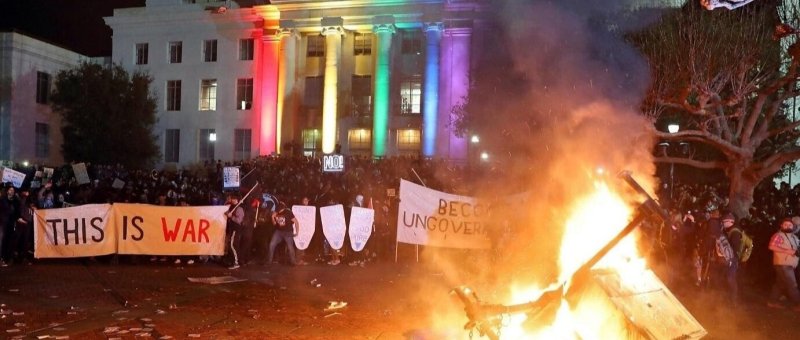
Aftermath of Antifa protests that led to the cancellation of right-wing Milo Yiannopoulos’s talk at UC Berkeley on the 1st February, 2017.

“(…) each individual among the many has a share of virtue and prudence, and when they meet together, they become in a manner one man, who has many feet, and hands, and senses (…) Hence the many are better judges than a single man of music and poetry; for some understand one part, and some another, and among them they understand the whole.”

— Aristotle, Politics

In his work Politics, Aristotle, while discussing whether the supreme power in the state should belong to the multitude or to the few, argues that the principle of predominance of the many, as opposed to an oligarchy, is, even with all its flaws, grounded in an idea which often presents itself almost self-evidentially to us: that good-faith deliberation of many people is worthwhile since individuals can share knowledge and incorporate the best arguments of every side and, thereby, reach a conclusion/judgement which is more in accordance with reality.

Is it reasonable to expect that all deliberation will have this constructive, moderating effect on what people believe? In a group of people in which participants are exposed to a plurality of views and opinions, the necessary weighing of different arguments can occur.  However, groups can be homogeneous in opinions; what will be the outcome of deliberation then?


An interesting study by the University of Chicago Law School on group polarization had several groups of individuals from two counties in Colorado (one majority conservative and one majority democrat) deliberate on certain issues (such as affirmative action and global warming) and ranked their pre- and post-deliberation opinions. It found a consistent tendency for individuals to move toward their group’s pre-deliberation tendency, i.e. liberals became more liberal and conservatives more conservative.

The researchers argue, for instance, that informational influences are one of the factors that can explain this behavior. These come about due to the fact that, in any group with an initial pre-disposition, the number of arguments presented in favor of that the initial tendency will be bigger than those in the opposite direction; due to this biased argument pool, individuals are more likely to polarize and, with that, become more confident in their views. Adding to this, corroboration by like-minded people further increased individual’s assurance in their world-view. Factors like reputational concerns are likely also at play; usually, people care about being perceived favorably by others and may adjust their beliefs, even if only slightly, to better fit in with the group. (see Asch Conformity Experiment)

What are the implications of these results?

As it turns out, the geographical political segregation we see in the U.S. would seem to indicate that polarization will, as a matter of course, occur. Indeed, with large proportions of democrats in urban centers and with republicans dominating less densely populated areas, the above-described dynamics will occur and we would expect to see an increase in the opinion divide between liberals and conservatives. The data bears this out:

The Pew Research Center publishes many polls and reports on U.S.’ public opinion, political polarization and partisan divide; In addition to their 2017 report, which shows many metrics detailing the increasing divide between parties and people, they published an interactive chart very clearly corroborating our expectations.

Source: Pew Research Center. If you have trouble viewing the chart please visit the original website.


While geographical political segregation is undoubtedly a large potentiator of these tendencies, and certainly worrying due to the vicious cycle it creates, there’s another more recent factor worth mentioning: The Internet. At a first glance, one might think that, by freeing people’s interactions from the shackles of distance, the arrival of the world wide web could work against polarization. However, this effect will be lessened and perhaps completely nullified if people choose to isolate themselves on partisan lines online.

The question arises:

Are human beings’ homophilic tendencies observed online?

We should first understand that, with the spread of the Internet came the ability to access inordinate amounts of information; thereby, its selection became all the more vital. Of course, even before the arrival of the web, you could select what newspaper to read but information personalization was exponentiated greatly in the digital age. It is, as such, possible for individuals to cocoon themselves in informational and ideological bubbles where polarization can occur, just like what was observed in Colorado. Let’s look at a real example:

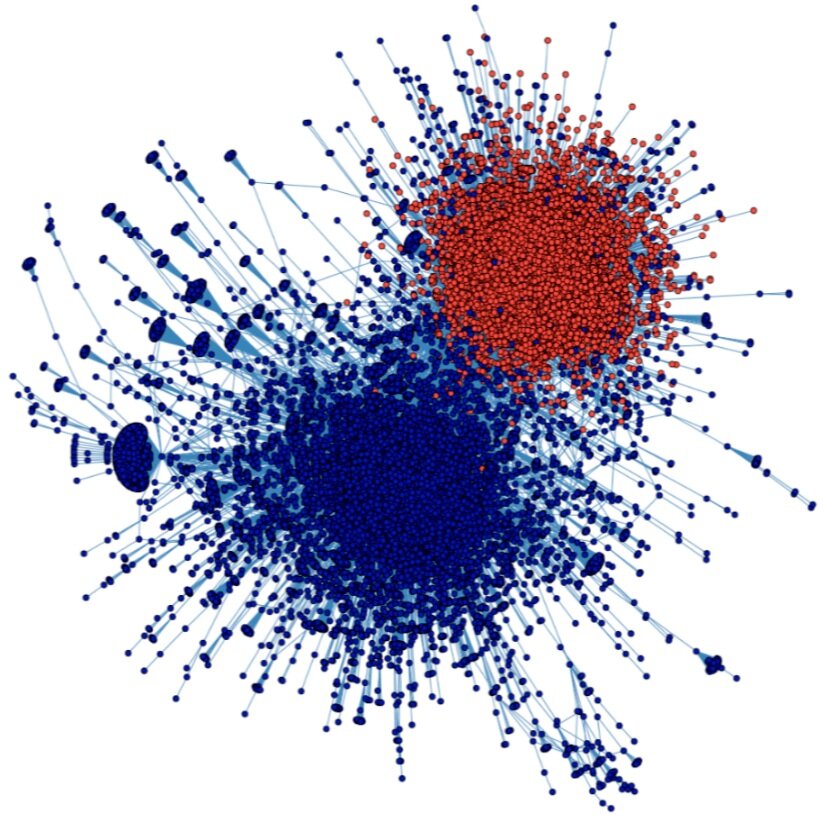
A study on Twitter’s political polarization gathered data on many users’ political interactions and analyzed the retweet and mentions networks that existed. It found two separate communities in the retweet network with a high degree of partisan division:

A    2019 poll from Berkeley IGS    shows that conservatives living in California (a very democrat-leaning state) are much more likely to having considered leaving the state than liberals; one of the most stated main reasons for this is the state’s political culture. Conservatives leaving the state, therefore, will make it more likely that other conservatives also move out.

A 2019 poll from Berkeley IGS shows that conservatives living in California (a very democrat-leaning state) are much more likely to having considered leaving the state than liberals; one of the most stated main reasons for this is the state’s political culture. Conservatives leaving the state, therefore, will make it more likely that other conservatives also move out.

On the other hand, when analyzing mentions, they found that this network did not reveal, as seen in the case of retweets, an obvious political division. Instead, there was a higher degree of heterogeneity. However, the researchers contend that, even though ideologically-opposed individuals interact with each other through the mentions network, this should not be interpreted as a cure for the issue of Twitter polarization. Indeed, since political discourse on the platform is already highly partisan and disconnected from normal, face-to-face interactions, they argue that “these interactions might actually serve to exacerbate the problem of polarization by reinforcing pre-existing political biases”.

The potential consequences of an increasing ideological divide between members of a society might warrant worry. For example, animosity between republicans and democrats in the U.S. has been increasing, as shown by a recent Pew Research Center report.


urdhjj.png

This, combined with the occurrence of events such as the Charlottesville protests or the UC Berkeley protests, hints at a weakening social fabric as a symptom of the widening chasm.

Considering what we’ve seen so far, it would seem that polarization is fated to continue its course, especially since it is not clear what can and should done at an institutional level to face this problem. However, one thing is for sure: fomenting a culture in which individuals understand the benefits of learning from each other and, therefore, value meaningful, mutually-advantageous discourse can certainly go a long way in countering the above-described trend. Furthermore, crisply distinguishing between political disagreements/arguments and normal social interactions is of the utmost importance if we want to maintain cohesion in a society afflicted by a large ideological split.


Sources:

  • CNN

  • abc News

  • Pew Research Center

  • FiveThirtyEight

  • What Happened on Deliberation Day, University of Chicago Law School Chicago Unbound, Journal Articles

  • Political Polarization on Twitter, M. D. Conover, J. Ratkiewicz, M. Francisco, B. Gonc¸alves, A. Flammini, F. Menczer

  • Leaving California: Half of State’s Voters Have Been Considering This, Berkeley IGS Poll

Yemen’s Forgotten War

Over 100.000 people killed since 2015

Over 2.2 million children malnourished

Over 19.000 airstrikes

Historical Background

In 1990, the Republic of Yemen was formed through the unification of the People’s Democratic Republic of Yemen (South) and the Yemen Arab Republic (North), under the joint governance of Ali Abdullah Saleh of North Yemen and Ali Salim al-Beidh of South Yemen. Since then, there has been persistent political and social unrest, predominantly in the northern provinces.

In 1993, al-Beidh left the new government claiming the latter marginalized and ignored the needs of the southern people, leading, in 1994, to the rise of a Civil War. He tried to cease the unification by reinstating the Democratic Republic of Yemen, an attempt that failed within less than two months and led to his expulsion from Yemen. After the Civil War, national unity was maintained under the presidency of Saleh, until a 2011 Arab Spring’s(1) popular revolution led to his resignation a year later, leaving power to Abdrabbuh Mansour Hadi, the vice-president.


The 2015 ongoing Civil War

While peace was expected to be restored, President Hadi faced Al-Qaeda attacks, military loyalty to Saleh, corruption, food insecurity and the South separatist movements. After the 2014/15 coup d’état(2), Hadi became an ally of the separatist movement to fight the Houthis, a broad tribal alliance belonging to the Shia minority, which emerged in the 1980s and later developed into a militia. This militia firmly opposed former President Saleh’s rule up to his resignation in 2012, yet joined forces with him and his troops to depose President Hadi.

The Saudis, who supported the presidency of Hadi, found this transfer of power illegitimate and formed a coalition consisting of nine West Asian and African countries (3).  The main objectives of this coalition were to restore the presidency of Hadi, preventing Yemen from fragmenting under factions, and controlling the growing influence of Iran in the region. The Saudi-led intervention consisted in bombing suspected rebel hideouts. The US and UK have assisted the Saudi led coalition via intelligence briefings, military supplies and some drone attacks. Western involvement has the goal of preventing terrorism. The “War on Terror” has been the US’s main diplomatic goal in the Middle East, with Josh Earnest, Obama’s White House Press Secretary, saying back in 2015:

“… the goal of US policy in Yemen is to make sure that Yemen cannot be a safe haven that extremists can use to attack the west and to attack the United States”

An airstrike hit a school bus filled with children

An airstrike hit a school bus filled with children

UN reports have verified the death of at least 7500 civilians as of September 2019, most of them caused by coalition air strikes. Some estimates indicate a death toll of civilians of approximately 12,000, while 100,000 people have been killed since the beginning of the war. Houthi rebels have also been accused of using banned antipersonnel landmines, recruiting children, killing and wounding civilians by firing artillery indiscriminately at cities such as Taizz and Aden. These numbers, however, do not reflect people who have died as a result of starvation and illness brought on by the on-going humanitarian crisis.

Yemen’s Houthi rebel group has recruited more than 30,000 child soldiers 

Yemen’s Houthi rebel group has recruited more than 30,000 child soldiers

The UN considers Yemen to be the largest humanitarian crisis in the world, with 14 million people at risk of starvation, 2.2 million children being acutely malnourished, as well as 462,000 children suffering from severe acute malnutrition, according to UNICEF. There have been repeated outbreaks of deadly diseases such as cholera and all sides in this conflict have blocked and impeded access to humanitarian aid. The Saudi-led coalition has delayed and diverted fuel tankers, closed critical ports and stopped goods from entering Houthi-controlled areas. By doing this, fuel needed to power generators and pump water to homes has not reached its destination, worsening the already dire conditions within Yemen. Houthi forces have also been accused of confiscating food and medical supplies destined for the Yemeni population. Burdensome restrictions on aid workers have also interfered with the delivery of foreign aid.


There are also instances of aid workers being arbitrarily detained, kidnapped and killed while performing humanitarian operations throughout Yemen.

A quarter of all civilians killed in air raids were women and children

A quarter of all civilians killed in air raids were women and children


 Saudi Arabia and Iran’s involvement

Western involvement is not of the same kind as previous military interventions in the Middle East. Therefore, the most important presence in the war comes from the two biggest middle-eastern powers: Iran and Saudi Arabia. The two countries have been bitter rivals since the Iranian Islamic Revolution of 1979. Although they never entered into direct military confrontations, they engaged in various proxy wars.

What is happening in Yemen is similar to what happened in Iraq during the American invasion of 2003. With the power vacuum, the country became a stage for a proxy war between the two regional powers. Yemen is a neighbor and a former satellite of Saudi Arabia. Iran backed the Houthi coup d’état in 2014-2015 and their militias, whereas the Saudis helped the central government.

Saudi Arabia hopes to keep Iran out of the Arabian Peninsula and to stop the increasing influence Iran seems to be gaining all over the Middle East.


Consequences of a forgotten war

The chaos in Yemen has resulted in two migrant flows into neighboring countries, that has spilled violence and refugees into the Arabian Peninsula and the Horn of Africa.  Refugee flows coming from Africa have reversed, which in turn has only fragilized even further these countries that are already extremely impoverished and dealing with their own internal political conflicts.

The possibility of a break-up of the country is very likely, as the Iranian backed separatists have managed to achieve a strong enough position to force the remaining powers to accept it.

The war has also increased the hostilities between Iran and Saudi Arabia, worsening the stability of the regions’ security, which was already extremely fragile.

For peace to be a realistic goal, there needs to be agreements among national and international players involved in the war. This political settlement, can only be created through extensive dialogue, not continued warfare. To resolve Yemen’s multi-sided civil war, players with polarizing and conflicting interest will have to compromise for the greater good of the Yemeni population, which does not seem very likely in a near future.

While no compromise is made, the ones who suffer are the civilians in Yemen, specially the children who have been witnessing the terrors of war their whole lives, plagued by famine, diseases, poverty and the constant fear of being hit by an air strike or artillery shell. These people have lived in a continuous state of warfare for the last 5 years, with no foreseeable end in sight, and must continue with their daily lives, hoping one day they can return to normality.


(1) The Arab Spring is the name given to a series of protests and revolts spreading through many North African and Middle Eastern countries, starting in 2011, with the goal of establishing democratic regimes. The revolts lead to several regime changes. However, the outcomes were more instability, war and the persistence of repression in the region.

(2) 2014/15 coup d’état: An alliance between the Houthis and forces loyal to former president Saleh took control of the Yemeni capital Sana’a and deposed the interim president Hadi, who was forced to flee to Saudi Arabia.

(3) This coalition, also called Arab coalition, includes forces from Saudi Arabia, Egypt, Morocco, Jordan, Sudan, UAE, Kuwait, Qatar and Bahrain. Djibouti, Eritrea, Somalia made their military bases, airspace and territorial waters available for the coalition, while the US and UK have provided intelligence and logistical support.


Sources: BBC, Yemen Data Project, Anadolu Agency, The Bureau of Investigative Journalism, Reuters, DW, United Nations, Al Jazeera, Human Rights Watch.

Corona, an Economic Virus

As it is noticeable, we have just entered a downturn cycle in the economy. The uncertainty on the markets, the general panic, sudden decrease in consumption, production and investment are primary presages of economic dark times, and it is up to all of us to prepare for the upcoming storm. The next months won’t be easy and irreversible economic losses have already contributed to an approaching feasible collapse in the global economy.

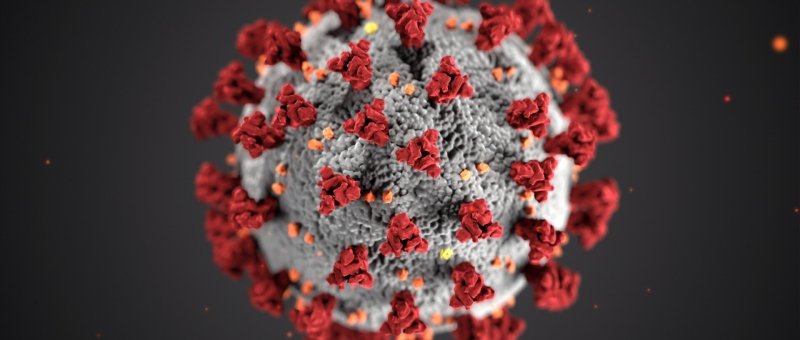
The coronavirus isn´t only responsible for contaminating our health, this contagious virus has and will certainly play a big role in the future of worldwide economies.

e784671a-c780-46e6-878b-057b08d007fe.jpg

EU’s real GDP was expected to grow around 1,4% in 2020, after the hit of the pandemic COVID-19 EU´s output may fall to 0% or even reach a negative growth. Even the Chinese economy, which has been continuously growing in the past decades, was anticipated to grow around 2% more than what it will predictably grow after the spread of the virus and the USA’s real GDP may grow less 1% than previously expected. Overall global GDP growth may fall from 2.5% to between 2% and -1.5%, depending if there is a quick recovery on the economy or a global slowdown.


All industries in the global economy are being contaminated by the virus and the duration of the predicted recovery fluctuates, depending on the economic sector.

As expected, tourism will take the longest time to recover.It is foreseen that it will only restart in the 4th quarter of 2020 (in October), imposing a threat for various countries. A good example is Portugal, whose GDP is highly dependent on the industry, having represented 14,6% of the portuguese GDP in 2018. On the other hand, consumer electronics and consumer products are the sectors that are anticipated to have the fastest economic recovery. Their  global downturn reversal is estimated to be in the 2nd quarter of 2020 (April).

105f450e-ece7-4f67-89ae-3b8e8562d6c3.jpg

Even though there will certainly be an economic global slowdown in the economy many specialists argue that the economic incidence of covid-19 is merely conjunctural. Since it´s repercussions aren’t enrooted in the economy, a severe recession isn’t bound to happen, “markets will recover”.

If we reflect on it, an appearance of the epidemic coronavirus will pose as a temporary shock in the economy and it is one that is far from being neglected. 

Let us take into consideration the 08 financial crisis, a great recession derived from an inundation of continuous bank runs, lack of credit crunch and condensed investment in toxic assets. Within the recession downtimes there was a high level of leverage in the financial market which turned rather more difficult the monetary response of the central banks. Many even argue that the prolonged and inaccurate response of Central Banks took a big part in the colossal breakdown of the economy.

 In the feasible upcoming coronavirus crisis, governments and central banks are already concerned with how to prepare for it, how to mitigate the alarming consequences this global pandemic seems to be able to induce in the economy, and how to aim for a “surely recovery”.

a31f663b-7505-4c79-b7da-c1db7c10b6e4.jpg

It is definitely extremely hard to predict the right measures to fight such an erratic enemy, thankfully many allies have already started to plan ahead.


Central banks are taking out the big guns. The Fed just announced this last Sunday, March 15, 2020 , that it will lower interest rates to 0%, the first time since the financial crisis of 08, and that it will buy at least $700 billion in government and mortgage-related bonds.The drastic low interest rates are expected to remain until the US economy recovers from the coronavirus economic slowdown.

The ECB is also expanding money supply in the economy, buying financial assets with newly created money. However, their fixed interest rates have been on negative territory since 11 of june of 2014, therefore the central bank has no room to lower interest rates.

It becomes clear that European government’s fiscal policy will play a big role in safeguarding the economies. For the approaching months it will definitely be crucial that assertive fiscal policies are created, in order to safeguard employment and ensure direct credit to companies, with the intent that solvency and liquidity issues are avoided.

Acknowledging that the coronavirus outbreak is an exogenous temporary shock in the economy and that global entities are already taking measures to safeguard its repercussions, independently if the recovery process may elongate, there is hope that our economy won’t suffer an irreversible collapse and fall into the next big recession. Nonetheless, we should be aware that an economic downturn is advancing,  it is time for governments to strengthen their weapons and get ready for the shooting.

RTS31D32-Social-Media-Comp-768x512.jpg

Sources:

  • European Commission, McKinsey & Company, Washington post, BBC news, INE, NY Times, Economic Times, European Central Bank- Euro system

The Portuguese Environment for Startups

Portugal lists as one of the European countries most severely hampered by the 2008 global recession. Following the austerity measures implemented in 2011 as a consequence of the country’s economic precarity, unemployment boomed and triggered all-time high emigration in the following years, particularly among younger and highly qualified people, leading to the so-called brain drain. This phenomenon greatly dampened Portugal’s more innovative sectors, making the country lag other economies regarding innovation, and consequently the startup ecosystem.

More recently, in 2016, the Portuguese government implemented StartUp Portugal, a startup acceleration initiative aimed at rejuvenating the country’s industries, boosting economic growth and fostering foreign investment, as well as creating an international hub for innovation.

Still in 2016, Prime Minister António Costa announced in the first edition of Web Summit in Lisbon a €200M fund to co-invest alongside VCs (venture capital) in local startups and foreign enterprises that reallocate to Portugal. Moreover, this event alone (which has been contractually ensured to remain in the country until 2028) has been creating fiscal revenue of over €45M and stimulating venture capital injection into local initiatives. This resulted in venture capital investments of around €44M in that year which, despite not being comparable to the vast majority of the top entrepreneurial countries, was a big increase from the €29M in 2015.

Indeed, a report conducted by Startup Europe Partnership stated that the Portuguese startup ecosystem is growing twice as fast as the European average. The cases of unicorns Farfetch, the online luxury retail platform, the cloud-based call-centre software Talkdesk or the low-code platform for private application creation Outsystems, reiterate the fertility of the Portuguese soil for the creation of valuable global market conquerors.

This month, the American startup accelerator Techstars partnered up with Semapa Next, in order to invest and enhance ten Portuguese newly founded companies that are bringing digital transformation to the areas of Industrial & Environmental Tech and Smart Transportation. This program clearly depicts how accelerators and venture-capital investors are increasingly focusing their efforts on startups that seek competitive advantage through the development of innovative technologies. Among the chosen are “Apres”, a data-driven company that focuses on providing AI solutions to enterprises, and “Qsee”, which devotes itself to the development of advanced analytics to address critical challenges in quality and productivity throughout the production process of firms.

Today, Portugal has a more developed entrepreneurial ecosystem and as a result is becoming a hub for innovation and startups, ranking at #31 on the Global Innovation Index. This progress is a consequence of factors such as Education, Expertise, and Support. The startup ecosystem benefits from a qualified workforce, as well as high quality Universities, with special focus on business and science, also emphasising on entrepreneurship. In fact, Portuguese universities such as Nova SBE, Universidade Católica SBE and Instituto Superior Técnico are ranked amongst the best in their areas of expertise.

Furthermore, partnerships between universities and their respective sectors, which provide students with a more “hands-on” experience, benefit not only students, but also startups, especially those in the growth stage, as more often than not they need access to specialist knowledge, which they lack in-house.

When it comes to support for startups, Portugal is characterised by a great number of initiatives. The number of incubators and accelerators, for instance, has grown to more than 150 throughout the country. They prove to be successful as well: the Lisbon Challenge was named as one of the top accelerators in Europe, and incubators like Startup Lisboa are also key players. Besides the typical startup amenities, there is a wide offer of services for starting and growing companies, ranging from co-working spaces and support services for intellectual property and product development. Consequently, Lisbon is listed in the top 5 best performing startup communities in Europe.

Despite the support in non-financial resources, the country still lacks monetary investment. Difficulty in raising funds helps to explain the higher percentage of startups in the earlier stages of development and the fewer in more advanced stages, in comparison with the European average.

Distribution of startups by development stage, 2018. Source: Statista

Distribution of startups by development stage, 2018. Source: Statista

So far, remarkable improvements have been observable in the startup ecosystem in Portugal, but there is still a long way to go until we reach the same level of entrepreneurship development as our European peers. Venture capital is a valuable source of investment for newly founded companies and, as of 2019, Portugal was still ranked at the bottom (out of 28 countries) in VC funds raised per capita, at only $4 per capita, This value doesn’t even come close to the $771 per capita raised by Luxembourg. In terms of job creation, on average, each Portuguese startup employs 8.8 people, when the European average is 12.8. This fact may compromise the growth of the national enterprises.

Evaluating the stage of development of Portuguese recently-founded companies, the majority of them (51.3%), are in the “Startup stage”, meaning they have completed a marketable product or service and report first revenues/users, and that is the most prominent stage of development for a large proportion of European countries. It is also noticeable that there are still many companies in early stages of development, the “Seed stage”, which accounted for 16.7% of the startups in 2018. These values follow the European trend.


5 startups to look out for

This atmosphere has resulted in a myriad of exciting innovation. As a result, Tech5 was created, with the aim of serving as a community for the most promising startups in Europe and Israel. Each year, the top 5 startups of each participating country are chosen  and brought to Founders Day, an event that brings these companies, top-tier investors and global press altogether. The criteria for selection are based on performance, investment rounds, growth, media coverage and social impact, among other factors. This year’s finalists were:

  • 20tree.ai (founded in 2018, raised $120k): with resort to satellite imagery, AI and computing power, 20tree.ai provides an in-depth analysis of natural resources to companies, in order to ensure a sustained and productive exploration of such resources. From their platforms, they are able to provide insights on growth predictions, harvesting analysis, plagues, damages, predictions on short and long-term impacts, as well as asset monitoring and much more.

  • Barkyn (founded in 2017): an e-commerce website focused on man’s best friend. The platform allows for the creation and purchase of food adapted solely for each dog’s needs with the aid of an expert. Moreover, online veterinary appointments are also a feature of the startup.

  • DefinedCrowd (founded in 2015, raised $12.9M): DefinedCrowd is an artificial intelligence service to train and accelerate data through a combination of human-in-the-loop procedures and machine-learning techniques.

  • Jscrambler (founded in 2014, raised $2.3M): the startup serves the purpose of bringing security solutions for webpages and apps, ensuring tailor-made decisions based on data extraction to ensure maximum compatibility, performance and protection.

  • SWORD Health (founded in 2013, raided $14.1M): the first digital therapist ever, this program allows for physical therapy to be performed at home, while ensuring real-time feedback from the digital therapist and analysis of the rehabilitation process from clinical teams.


Conclusion 

Despite Portugal’s initial setback, due to the community and government’s hard work, what was once the country’s Achilles heel is now one of its most attractive factors. The startup ecosystem improved considerably, more and more money is being invested and, consequently, that hard work is beginning to show results. As the country starts to roll out its first unicorns, the future looks promising…

Sources: “An overview of the Portuguese Entrepreneurship Ecosystem”, Halbe & Koenraads. Financial Times, Startup Europe Partnetship, Dealroom.co, OECD, Tech5, Statista.

Does a flat tax on personal income make sense?

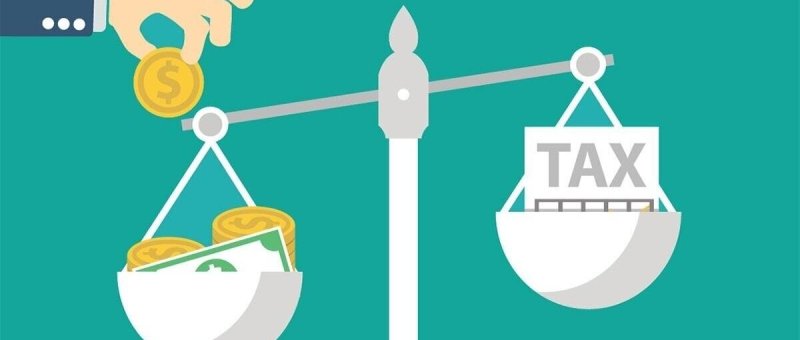
Throughout history, disparities about the definition of social justice, across regions, led countries to adopt different income-tax systems (1). Despite being the most accepted, the progressive way of taxes has been increasingly questioned by academics and political leaders, arguing that a flat-tax system would be a better fit for countries regarding fairness and economic dynamics.

What distinguishes a flat rate from a progressive rate?

Simply put, a flat income-tax system applies the same income-tax rate to all taxpayers, regardless of their income level. Contrarily, a progressive system increases the rate as the income level increases, where the income range can vary greatly, depending on the country.

On the one hand, those who defend the first method argue that it is unfair to charge higher-income individuals a greater tax rate. The rationale behind this position is that they should not be penalized for adding more value to the economy. On the other hand, supporters of the progressive system believe that income distribution before taxes is not fair, i.e., earnings do not necessarily match economic contribution. Furthermore, wealthier households are considered to have the moral duty to aid those struggling. In their view, adjustments are needed and desirable.

Historically, the progressive system has been prevailing in most developed Western countries. In the USA, for instance, only 9 states (Colorado, Illinois, Indiana, Kentucky, Massachusetts, Michigan, North Carolina, Pennsylvania and Utah) out of 50 have a flat income-tax. In turn, only 8 of the 36 OECD member countries currently have a somewhat flat system (Czech Republic, Denmark, Estonia, Hungary, Iceland, Ireland, Poland and Sweden) (2).

In order to accurately address the origins and the main effects of a flat-tax system, some of the referred countries will be used as case-studies in this article.

What caused some countries to adopt a flat-tax system?

It is not a coincidence that most European countries which adopted a flat-tax system were once part of a bigger state. Estonia, for instance, which is perhaps the successful case in the adoption of a flat-tax (1994), was part of the USSR until its breakup in 1991, as well as Latvia (1994), Lithuania (1995) and Georgia (2005). In turn, Serbia and Montenegro, which adopted a flat tax in 2003 and 2007, respectively, are former members of Yugoslavia.

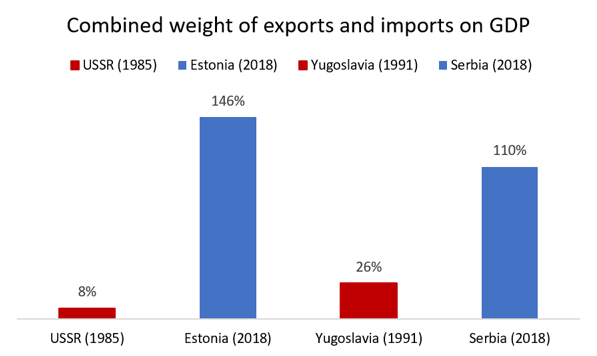
What these countries have in common is the lack of openness of their economies prior to their independence, as seen in the graph. Nowadays, approximately thirty years after the breakup of their previous federations, countries like Estonia and Serbia have shown an intensive internationalization process. Indeed, economic history tells us that global trade increases the welfare of nations. Therefore, it seems logical that former USSR and Yugoslavia members would aim at opening their economies so that they could thrive and catch up with Central and Western European more developed states.

Data source: The Global Economy

Data source: The Global Economy

In a report for The Heritage Foundation, Mart Laar, former liberal-conservative Prime Minister of Estonia (1992-1994; 1999-2002), explained that, when the USSR broke up and the country conquered its independence, the Russian ruble no longer had any value, Estonian industrial production declined by more than 30%, real wages fell by 45%, while inflation was running at more than 1000%. GDP per capita in the country was at $2,000, compared to the $14,370 attained by the Finnish neighbours. This Baltic country was totally devastated, after being pushed to the limit by Moscow, hence lacking urgent and impactful policies to invert its economic path.

Among a set of important measures to stabilize and boost the economy such as the introduction of an own currency (the kroon) which was pegged to the German mark, and balanced Government budgets, openness to global markets also played a significant role by fostering competition and attracting direct foreign investment. Nonetheless, the decisive move «to achieve a lasting breakthrough in Estonia’s development» would be the flat tax.

In the words of Laar, it was all about providing the right incentives to people:

“when people who had started companies realized that the tax system punished success, their enthusiasm to persevere and determine their own future declined considerably”

— Laar

Similarly, in Lithuania and Latvia, nations that share many characteristics with Estonia (these three would become known as Baltic Tigers), the flat tax was introduced to improve the economic outlook after Soviet ruling. Besides, they had to compete with Estonia for foreign investment, for which fiscal policy was a powerful tool. On the other hand, in Russia and Ukraine, the flat-tax was introduced mainly to incentivize higher-income households not to evade their taxes.

How does flat taxation impact economies and societies?

Despite all the positive results political leaders aimed at achieving with a flat-tax system, do/did they really happen? Looking at tax revenue, GDP per capita, income reporting and tax compliance and Gini Index, we can take some conclusions.

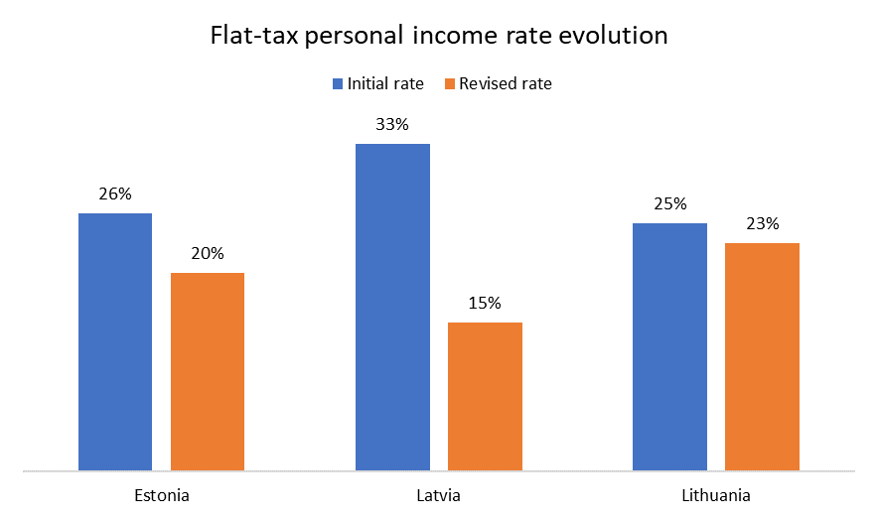
Regarding tax revenue, the year immediately after Russia changed from progressive (12%, 20% and 30% rates) to flat taxation (13% in 2001), personal income-tax revenues increased 26% in real terms and 2% as a percentage of GDP, a working paper of the IMF from 2005 concluded. In the case of all Baltic Tigers, Deena Greenberg, despite finding out in the paper The Flat Tax: An Examination of the Baltic States that tax revenue increased after the adoption of a flat tax, could not conclude that both were linked, leaving space for ambiguity as for the effect of flat taxation on personal income-tax revenue. Nevertheless, the fact that these countries decreased their tax rate after some years raises doubts on the effectiveness of this method.

Data source: Taylor & Francis Online

Data source: Taylor & Francis Online

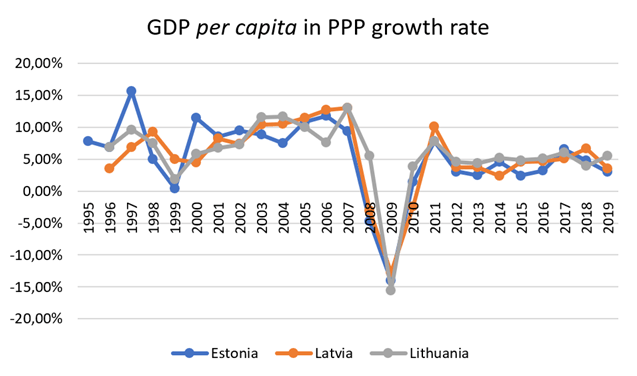
Analysing the evolution of real GDP per capita of some European countries with flat taxation, there is a clear trend: all of them grow significantly in the first years after its introduction, but then growth rates slow down. However, this has more to do with their historical precedents and consequent policies (macro stabilization, property reforms, openness to trade) than with the adoption of the flat tax itself. They happened simultaneously, which may induce misleading conclusions. So, it doesn’t seem to be enough evidence that GDP per capita improvements in these countries over time are due to flat taxation.

Data source: AMECO

Data source: AMECO

In terms of income reporting and tax compliance, it is not clear that a flat tax improves the standards, as the study ‘Flattening’ tax evasion? (2019) concludes by analysing a set of transition European countries. The already referred working paper from the IMF (2005), though, points out that tax compliance in Russia increased after the introduction of a flat tax. Therefore, despite not being totally clear, we could admit some positive impact of a flat tax in tax compliance, especially in less developed countries, in which standards are low.

From an inequality point of view, the Gini Index gives us an accurate insight. The higher the index, the higher the inequality. In this regard, findings are that flat taxation is positively correlated with income inequality, as the following table shows.

Data source: World Bank

Data source: World Bank

All in all, income inequality ends up being a determinant when it comes to deciding which taxation system to use. Despite being correlated with economic improvements, there is no clear evidence that flat taxation plays a role in them. The fact that Slovakia (2013) and Latvia (2018) have recently abandoned their flat systems in favour of the progressive method should be a matter of reflection. Even though the social justice argument is debatable, the economic side does not seem to support flat-tax admirers.


(1) For the sake of this article, only personal income was considered.

(2) Although only Estonia has a perfectly flat tax system, the remaining countries are included in the list either because they consider very few income ranges or because higher tax rates are charged only to abnormally wealthy individuals.


Sources:

AMECO, Deena Greenberg, European Central Bank, European Commission, Global Tax News, International Monetary Fund, LSE Blogs, ProPublica, Taylor and Francis Online, The Balance, The Global Economy, The Heritage Foundation, The Slovak Spectator, Verena Fritz, World Bank

Is the Global Economy Infected? Part II

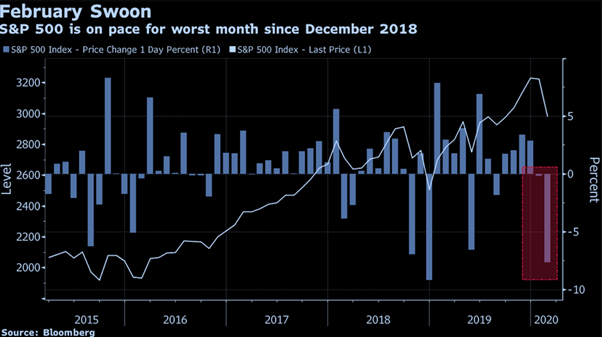
Despite the world’s biggest central banks intentions to deliver monetary policy in order to soften COVID-19’s impact on the economy, markets continue to fall sharply in an irrational manner. On the last week of February, the major financial indexes showed startling results registering their biggest fall since 2008, with the S&P 500 dropping 11%, its worst weekly decline since the financial crisis,  the Dow Jones Industrial Average crashing 12.4% and the PSI-20, the main Portuguese index, registering its worst result since Brexit.

february swoon.png


How are investors reacting?

A few stocks managed to escape the sentiment of fear by investors. Evidently biotech stocks, particularly the ones involved with the production of vaccines and antivirals, were one of the main class of stocks that rose in recent weeks. A particular example was Zoom, as investors are already pricing an expected period in which people will be forced to work from home and must use systems like the ones this company develops.

Investors quickly ran to the “safest” asset in the financial markets with US Government Bonds surging and dropping the 10-year US Treasury yields below 1%, an all-time low, also as a result of the interest rates cut by the Fed.

The yen is another traditional safe harbour being perceived as one of the most stable currencies amid market uncertainty and, at the time this article is being written, stands at 108.20 yen a dollar. Gold reached a seven-year high last week with investors using the precious metal as a haven from the meltdown in Wall Street. But, in these last few days, gold’s price plummeted with the biggest one-day decline since 2013. Gold dropped 4.5% on the 28th February as investors are selling it to cover margin calls as needs for cash arise due to the sell-off in stocks and fear is rising that China’s demand for gold is severely weakening.

However, ETF investors seem to be the exception in a week of pure panic in Wall Street. When we take a closer look at ETFs linked with the stock market indexes, we observe that the players that shifted higher amounts of cash from SPY have been institutional investors that are being faced with liquidity concerns, it was not a panic move. Another trend is the outflows from funds related to Japan who are in the frontline of the virus and shifts to European markets, for example. At the same time, with the decrease of interest rates and the continuous inversion of the yield curve, investors dumped financial ETFs like the XLF (an ETF that tracks an index of S&P 500 financial stocks) and again it was a very rational decision. Contrary to what is being seen in other markets, even amid uncertainty, there is still a strong demand for ETFs.

Short sellers on the US stock market, that predicted overvaluation and were expecting a period of correction, got a big help from the outbreak of the virus and managed to make $105 billion in a week. This has also prompted a raise in short selling since some believe the bottom has not yet been achieved.

Employees wear face masks as they stand in a reopened Apple Store in Beijing last week. Source: Associated Press

Employees wear face masks as they stand in a reopened Apple Store in Beijing last week. Source: Associated Press

Moreover, some of the world’s biggest enterprises are suffering at the hands of this illness. Dow Inc., Goldman Sachs Group and Intel, alongside Apple, were the sum of main victims as “24 of its 30 components finished in the red”. For instance, Apple expressed its concerns of not being able to fulfil its second-quarter financial guidance since the outbreak has led to a cut in the production of iPhones and the firm heavily depends on factories in Shenzhen, China, and its Chinese customers. Therefore, the American multinational technology enterprise joined the number of companies that are expected to reach the bottom line caused by this pandemic.


What are the main global institutions doing to fight the coronavirus’ economic and social shock?

Governments and Central Banks have been trying to stabilize the markets and diminish the economic effects of the virus before an increase in infection cases cause tougher impacts.

Central Bankers around the world are decreasing rates or acting to ensure liquidity in the financial markets. This support has been the cause for some rallies along these weeks, keeping investors hopeful that the effect of COVID-19 in the world economy will be diminished in some part. At the start of March, the Fed moved from hinting to making an emergency interest rate cut of half a percentage point, its biggest cut in more than 10 years. As of the 3rd of March, interest rates now sit between 1% and 1.25% as Jerome Powell states that the central bank is “prepared to use our tools and act appropriately, depending on the flow of events”. Despite this action, markets reacted negatively hinting that stimulus may make borrowing cheap, but the economic menaces come from a decrease in consumption and an infected workforce. Besides the Fed, the Reserve Bank of Australia has cut interest rates to 0.5% and the Bank of England and the Bank of Japan pledged to use every mechanism in their hands to “ensure all necessary steps are taken to protect financial and monetary stability.” Even the initially sceptical ECB joined other central banks in recognizing the threat and taking arms against it.

The People’s Bank of China was the first to cut its rates and the Chinese Government is expected to increase fiscal stimulus as worries about reaching its economic targets are surging. This fiscal stimulus will probably consist in investment in infrastructure to deter the slowing in economic activity shown in recent reports.

On the other side of the Atlantic, President Trump and the government’s health-care authorities have been releasing contradictory statements in what concerns the extent of the threat this pandemic represents. While the major figure of the United States disregards the impact of the virus, stating that the risk is low and assuring Americans that they’re unlikely to die from an infection, the CDC (Centre for Disease Control and Prevention) has publicly detailed that “an American outbreak would likely cause widespread disruptions in everyday life, including closed schools and cancelled business meetings”.

On the other hand, the Chinese power aggressively acted in order to slow the spread of COVID-19, establishing a Central Leadership Group for Epidemic Response and the Joint Prevention and Control Mechanism of the State Council. Moreover, the General Secretary Xi Jinping personally directed and deployed the prevention work, making the control of the COVID-19 outbreak the top priority of the government at all levels, closing schools and other public facilities, asking overseas Chinese to reconsider travel plans and advising citizens to quarantine. Nevertheless, the attempt to silence whistle-blowers distorts the real figures of the impact the virus has had on China.


What’s next for this pandemic?

Undoubtedly, if the virus continues to spread at this pace, its impacts will reach a greater dimension. Jobs are in danger and most firms’ supply chains are jeopardized, rocking financial markets and tumbling the global economy. Some believe the worst is yet to come. It is also important to remember that the American elections are taking place in November and may have a big impact on investors sentiments. We could see trade wars between China and the US worsening if Trump gets re-elected. The world economy is in a very tight deadlock and the next months will dictate its future outcome. Is this just a glimpse of what awaits us? Either way, not much is within our reach. So, let’s just wash our hands and wait as we watch 2020’s soap opera unfold.

Sources: Bloomberg Intelligence, Market Watch, The Washington Post, CNBC, Financial Times

Is the Global Economy Infected? Part I

The world is on red alert and has “Coronavirus” as its watchword. But what is exactly this virus that has caught everyone’s attention in the past weeks? This so-called coronavirus disease 2019 (COVID-19) is identified as a new type of coronavirus that belongs to a family of viruses that cause illness such as common cold, severe acute respiratory syndrome (SARS) and Middle East respiratory syndrome (MERS). Despite its scientific definition, not much is known about it yet. Nevertheless, its contagiousness is undeniable and, despite having started in China, according to the World Health Organization, “the number of infections outside China has outpaced those inside the country”, raising the world’s concern about the rise of a pandemic that has made, until now, 3555 victims.  Yet, another question arises: is this mysterious virus only a well-being subject? As a matter of fact, this highly contagious virus is spreading beyond healthcare fields, shaking economies and tumbling global markets.


Hit-hard industries by COVID-19

Closed stores, travel bans, or cancelled conferences are some of the measures imposed in order to combat the spread of the virus of 2020. Plenty of businesses are struggling to get back on their feet and consumers’ worries keep rising after new cases emerge. China is one of the main concerns among industries, as the virus concentration is much greater in this country and the number of stores closing and shoppers sheltering at home are increasing. However, the initially-Wuhan epidemic has now expanded far beyond the Chinese city.

The travel industry is one of the largest industries in the world, with revenues around $5.7 trillion. But now, it’s being hit by travel restrictions and cancelled trips prompting a crisis towards this industry and dragging down the global economy. The international Air Transport Association, IATA, warned that global demand for air travel could fall in as much as $30 billion in revenues, the first time in 10 years. These would correspond to a 4.7% hit in global demand levels, corresponding to a 0.6% global contraction given the 4.1% expected growth for 2020.

Many big shows have been cancelled already, in an attempt to control the outbreak of the virus. Among them are Geneva Motor Show, Facebook’s F8 conference or ironically enough the leading trade show for the travel industry itself, ITB Berlin. Many companies’ business trips are also on hold, concerned about the employee’s exposure. British Airways, Ryanair, Lufthansa and EasyJet have already been forced to cancel hundreds of flights, as the airlines industry body has already warned of a falling number of passengers. Some of them are resorting to price cuts on short-haul flights, in order to dodge demand breaks.

In the tech industry, companies are already sensing the damages being caused by COVID-19 as well. The first ones being those with direct exposure to China, the supply chain of which is so dependent on this country, causing several companies to have issued a financial warning regarding the consequences of the pandemic.

Moreover, shortages in supply are expected in various products ranging from smartphones, headsets or even cars. The manufacturer Foxconn, known to be the main assembler of Apple, has stopped almost all of its production in China, who’s accountable for 75% of the production capacity of the firm. Foxconn’s revenues are down 10% compared to last year’s period. The disruption in the company’s operations has prompted questions regarding the dependence on this geographic location.


Why can this affect the global economy?

The reason is simple: China. Bear in mind that we are talking about the second biggest economy in the world and the world’s largest manufacturing and exporter of goods. Besides losses in China due to decreases in consumer spending and stores closing, the impact will extend beyond the Wuhan province.

Since the outbreak of the COVID-19 virus, there has been a tremendous amount of stoppages and even lockdowns in China’s factories, as only about 50% of them haven’t yet been harmed by the spread of the virus. This not only affects production, but also sales, since people are forced to stay at home, hence, not spending money on a wide variety of products. Furthermore, sales in China are not the only ones doomed to failure this first trimester, as sales in a lot of different sectors outside China are now compromised due to the disruption of supply chains created by all the lockdowns that have been occurring. So, basically, any company directly working with China, as for raw materials or any work in progress goods, is most likely being impacted since, a lot of companies in Europe and the United States are receiving their orders with weeks of delay and some of these can’t even sail through the Ocean due to requirements of a minimum amount of goods to fill the ships, which are simply not coming through.

View fullsize


pasted image 0.png

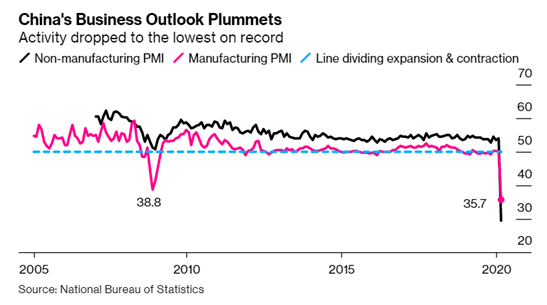
By looking at the Purchasing Managers’ Index (PMI), we can understand how severe the coronavirus has been to China’s economy given the fact that in 2008’s global recession this index had hit a low of a 38.8 score (to provide some insight, any score below 50 shows that there are more purchasing managers, in the manufacturing sector, indicating a contraction in this sector). Besides this concerning value, the IMF stated that the global spread of COVID-19 will damage economic growth for 2020. After the easement of the US-China trade relations, growth for this year was expected to surpass 2019 , whereas now Global growth in 2020 will dip below last year’s levels, but how far it will fall and how long the impact will be is still difficult to predict as the Managing Director of the IMF Kristalina Giorgieva said last week. This means a revision of 0.4% or higher compared to the values expected in January.

Although it is to be known at what extent, we can definitely agree that COVID-19 is taking a toll on the economy and may even have lasting effects in our lives. What remains to know is how Governments and Central Banks will react and how are investors limiting losses and even making gains during this period.

Sources: Bloomberg Intelligence, Market Watch, The Washington Post, CNBC, Financial Times

Where will Portugal’s next airport land?

Humberto Delgado Airport is an international airport serving the Portuguese capital of Lisbon. However, it has reached its maximum capacity, and the country must now consider the construction of a new airfield.

This is not a new discussion. Humberto Delgado Airport (Lisbon’s Airport) was first opened in 1942. In 1969, when Portugal wasn’t yet a democracy, the discussion surrounding the possibility of a new airport in Lisbon was first officially launched, when the Prime Minister at the time, Marcello Caetano, established a committee to develop an expansion project. However, reaching a solution was a lengthy procedure.

In 2008, the Sócrates government presented a project for an airport in Alcochete. This airport would cost approximately 4.9 billion euros and would entirely replace the existing Humberto Delgado Airport, in response to complaints of how this airport was too close to the city and causing excessive noise pollution. However, the project was suspended in 2010 due to the financial crisis.

The next government then started looking for a cheaper alternative: a smaller airport that would complement, not replace, the existing one. Thus, in 2011, the Montijo idea was born.

In January 2017, the current Socialist government introduced a project for the airport in Montijo. The new airfield would increase the number of aircraft movements per hour from 48, solely supported by the Lisbon airport, to 72 movements, taking both airports into account. It will also be able to draw 8 million passengers each year, providing the Portuguese capital with the capacity to annually receive roughly 40 million air travellers.

Image 1: The Montijo Airport Project

Image 1: The Montijo Airport Project

A study of environmental impact presented by ANA – the Portuguese authority responsible for managing the country’s airports – concluded that the establishment of an airport in Montijo would not have a large environmental impact, although it would induce some territorial changes in the future urban expansion of the area the planes will fly over. APA – the Portuguese Environmental Agency, involved in the elaboration of the study – concluded that a new airport does not constitute a serious threat to birdlife in the surrounding area and acknowledges that future actions may be undertaken in order to minimize those impacts. Also, the study states that birdstrikes (collisions between birds and aeroplanes) are not likely to happen.

For the 94,000 citizens living near the future airport, the study points out that the noise can induce severe exasperation to 12% of the citizens, 17% of them can suffer from moderate exasperation and it can cause sleeping disorders to 3% of the community.

The conclusions of the report didn’t seem to please all specialists. 11 of them presented a study which reveals that in 50 years-time, a significant portion of the landing track will be flooded due to rising sea levels. This study further states that greenhouse gas emissions have been underestimated by the former report. The environmental association ZERO also poses serious doubts in regard to the real impact that the new airport will have in the area’s wildlife, therefore demanding a new environmental evaluation using different techniques in order to better grasp the consequences that the project will have on those natural habitats.

Image 2: How rising sea levels are expected to affect the new airport

Image 2: How rising sea levels are expected to affect the new airport

In 2019, the government tried to sign a contract to start construction in Montijo in 2020, but it ran into some legal problems. A government decree from 2007 regarding the construction of airports in Portugal established, among other things, that no airport could be built without the consent of all municipalities affected by it – the ones where the airport was located, the ones the airspace of which would be affected and any others that would suffer environmental impacts.

This raised a problem when several city councils in the south bank refused to give permission to the construction of the airport, citing environmental reasons. The mayors of Moita and Seixal have since headed the campaign against the new airport in Montijo and in favour of the Alcochete solution. The mayors, both members of the Portuguese Communist Party (PCP), have been accused of rejecting the project for partisan reasons – the Communist Party has long defended the Alcochete alternative, instead of Montijo.


The Minister of Infrastructure, Pedro Nuno Santos, has already stated that the decree could be altered by the government to remove this impediment, but that change could be brought to a vote in Parliament if any party requests it – and the Communist Party is likely to.

Then, the government would have to find a majority in Parliament that would change the decree. The Communist Party, as mentioned above, is opposed to the Montijo solution, and so is the Left Bloc, which also favours Alcochete. The government would then need the support (or at least the abstention) of PSD, the main opposition party. But Rui Rio, leader of PSD, has already stated that his party will not change the law for a specific situation and that the government should follow the law, negotiating with the city councils that raised objections to the airport in Montijo.

Amidst this deadlock, many people have looked for alternatives to the airport in Montijo. Former Prime Minister José Sócrates, in an opinion article in Expresso, argued again for the Alcochete solution developed by his government. He points out that, according to European Union noise and nature conservation regulations, an international airport should not be built too close to a city or next to a protected environmental area. Sócrates further points out that, unlike Montijo, the Alcochete project is already prepared, the environmental impact has been studied, and permission from all city councils affected has been obtained.

In response to the main argument favouring Montijo over Alcochete – the idea that Alcochete is more expensive – Sócrates states that the initial phase of the Alcochete project (which would allow it to complement, not replace, the existing airport) is not significantly more expensive than Montijo. However, he bases these statements about costs on articles written by engineer Matias Ramos, which have never been refuted or confirmed by other sources.


Image 3: The Beja Airport

Image 3: The Beja Airport

Another airport alternative defended by some, would be to capacitate Beja Airport to serve Lisbon. Beja Airport has no regularly scheduled flights and is mostly used by the Maltese airline Hi Fi to store airplanes, so it is free to receive more flights to Lisbon. It is already fully built, and there are plans to connect it to Lisbon by highway, a car trip that would take around two hours.

Modernising the existing train line between Beja and Lisbon to allow the fastest trains operating in Portugal, the Alfa Pendular, to use it would require a significant investment, but it still wouldn’t be able to make the trip between Lisbon and Beja Airport in less than 85 minutes. This can be compared to the 50-minute train trip from the centre of London to Stansted Airport, for example.

Besides, critics point out that Beja Airport was built with the intention of attracting low cost airlines serving Lisbon and the Algarve, but it never succeeded, and it never had any regularly scheduled services.

Another proposed alternative would be to build an airport in Alverca, in a military aerodrome. This aerodrome served as Portugal’s first airport in the 1930’s, before Humberto Delgado Airport was built. However, adapting it to receive modern airplanes has never been studied, in terms of costs or environmental impact.

So, there seem to be several alternatives to solve the saturation of Lisbon Airport. Their costs, their environmental impact and political circumstances will determine where the new airport in Lisbon will be built, changing the face of the city and the region for decades to come.


Sources:

  • Público, Observador, RTP, Jornal de Negócios, Expresso, Diário de Notícias


Manuel Barbosa - Manuel Barbosa Nuno Teixeira de Sampayo - Nuno de Sampayo
Afonso Silveira Botelho - Afonso Silveira Botelho