
Portugal’s Pride or Saudi Arabia’s Asset? The New Identity of Cristiano Ronaldo 

Reading time: 8 minutes

Cristiano Ronaldo is indisputably the most recognized Portuguese person in the world. Thanks to his abilities and performances in football, as well as the global brands he and his name have created, owning more than five companies, from clothing to hotel chains, he is an influential personality who makes an impact wherever he appears, whether on the pitch or at the White House, as he did last week. Since 2002, when he joined Sporting, he began stepping onto the world stage, carrying Portugal’s name to all corners of the globe. But can Ronaldo be considered a Portuguese ambassador, or is he a brand that can be bought and owned by others? 

Image 1- CR7 in an Al-Nassar game 

Ronaldo’s impact extends far beyond the football pitch, he has become an unofficial ambassador for Portugal, shaping how the world perceives the country. His success brought unprecedented visibility to Portuguese culture, language, and identity, often sparking global curiosity about his origins and upbringing. Tourism campaigns have leveraged his image, and Madeira, his birthplace, has experienced a noticeable increase in international visitors partly due to the global popularity he helped generate. This was evident in a study published in 2021 by the researchers in the Centre for the Study of Geography and Spatial Planning of the Faculty of Arts of the University of Coimbra (FLUC), the study emphasizes that Madeira Island “was consecutively elected” as “Best destination Island in Europe” between 2013 and 2021 (only with the exception of 2015) and, cumulatively, “Best Island Destination in the World” between 2015 and 2020. Adding that “the notoriety of Cristiano Ronaldo influences a whole chain of attitudes, reactions and personal and social behaviours with a positive impact on tourism in Madeira”. The study conclusion was that Ronaldo contribution was important for the island and that he should be used as a role model for other known Portuguese figures to promote their Portuguese home cities and regions. Even in moments of tragedy, Ronaldo image was spotted and helped to raise awareness to the cause. This is the example of “Martunis” an Indonesian boy that was found alone and malnourished in a beach in Indonesia, after the 2004 tsunami that hit Indonesian. The boy was spotted using a Portuguese jersey with the name Ronaldo in the back, the story gains immense media coverage and raise a lot of attention to Indonesia, even leading to CR7 to visit the country and becoming “godfather” of the little boy “Martunis”, sponsoring his studies and career.  

Image 2- Ronaldo meeting Martunis

However, in recent years, Ronaldo’s move to Al Nassr also placed him at the centre of Saudi Arabia’s ambitious global rebranding efforts. Beyond playing football, he has become one of the country’s most visible cultural promoters, appearing in campaigns that encourage tourism and international investment. While this is part of his contractual obligations as a global athlete, it inevitably raises questions about how far a personal brand can be integrated into the strategic interests of a nation. The scale of his salary and commercial responsibilities suggests that Saudi Arabia did not just sign an athlete, they acquired a symbolic asset capable of shifting global narratives. These suggestions came since Saudi Arabia has been attempting to reshape its global image amid international criticism of certain policies, such as restrictions on civil liberties, the treatment of dissidents, and human rights concerns frequently raised by global organizations. These issues have at times overshadowed the Kingdom’s efforts to present itself as a modern, forward-looking nation. Ronaldo’s visibility, charisma, and global following provide Saudi Arabia with a powerful cultural tool that can redirect attention toward tourism campaigns, entertainment initiatives, and economic reforms presented under Vision 2030. While Ronaldo himself is primarily fulfilling the professional and promotional obligations of his contract, his presence inevitably becomes part of a wider attempt to soften international criticism and project a more positive image. 

Although, joining Al-Nassar in 2023, the past week Cristiano Ronaldo made headlines by visiting the White House alongside Saudi Arabia prince Mohammad bin Salman and his delegation. The visit aimed to formalize the trade deal between the U.S. and Saudi Arabia of 300 U.S. made tanks and the 1 trillion investment guarantees from the Saudi’s. Nevertheless, what was most reported from the meeting between the two countries was the dinner, that featured Cristiano Ronaldo as an ambassador of Saudi Arabia. Ronaldo’s presence blurs the line between being an ambassador by choice and being a figure whose image has been strategically “purchased” to serve broader political and economic objectives. In Portugal, a heated debate arises. For some Portuguese, like the President of the Regional Government of Madeira, Ronaldo´s trip brought pride to Madeira, since he represented the region and Portugal near the most powerful men of the free world. Nonetheless, some political commentators wrote and openly stated that the visit was an “embarrassment” for them as Portuguese people, with Elma Aveiro, Ronaldo’s sister, responding to the criticism from commentators like João Maria Jonet that said live in “SIC Notícias” that he was “shocked” with Ronaldo visit. Even Ricardo Araujo Pereira ironically commented on the situation, saying in his Sunday show: “What would D. Afonso Henriques, founder of Portugal, that fight the moors to gain independence, say seeing Portugal biggest personality in the white house representing Saudi Arabia, home of the founder of Islam”.  
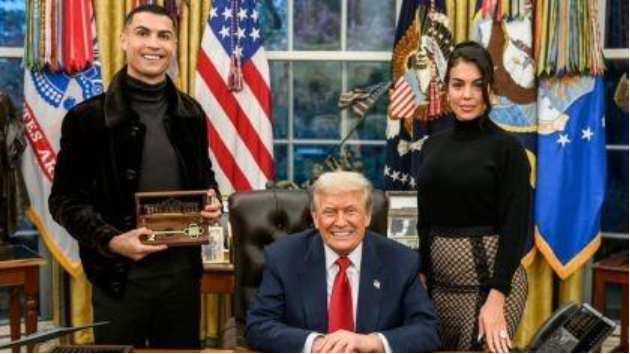
Image 3- Ronaldo receiving the White House Key 

To conclude, Cristiano Ronaldo’s trajectory from global sports icon to a figure intertwined with Saudi Arabia’s political and economic ambitions illustrates the increasingly complex relationship between celebrity, national identity, and international power. His presence at events of geopolitical significance shows how his image now functions far beyond the boundaries of sport, becoming a tool capable of lending visibility and legitimacy to the agendas of states. This dual role has intensified debate within Portugal, where admiration for Ronaldo’s achievements coexists with discomfort over the symbolic weight his endorsements carry. Ultimately, Ronaldo’s case exposes the delicate line between personal success and political appropriation, raising broader questions about how much control public figures retain over their own narratives once they become global brands embedded in international strategies. 

Sources :

Guilherme Mendonça  

Writer

Zohran Mamdani: A New Order? 

Reading time: 8 minutes

Zohran Mamdani was recently elected as the first socialist mayor of New York City last month. The city of Wall Street, billionaires and neoliberal globalization has just chosen a man who ran on a platform of housing justice, public transit, and redistributing wealth. “This isn’t just about New York,” Mamdani said during his victory speech in Queens. “It’s about imagining a different kind of future” (The New York Times, 2025). 

NYC’s position as the United States’ largest city, and  one of the world’s financial centers, is a strange bedfellow for an openly socialist politician. Some claim Mamdani’s victory represents the end of the neoliberal order within its home, yet others see it as a temporary response to exhaustion and inequality. However, it has opened a cultural conversation that stretches across the nation.   

Mamdani outside a New York bodega. Credit: Getty Images 

A Socialist in Finance’s Capital 

New York has always been a paradox: the home of billionaires and of the homeless, of high art and unpaid internships. Its contradictions are almost part of its brand. Yet it has recently gone through rapid change. The global financial center of the 1990s, of hopeful entrepreneurs and mid-western dreamers who wanted to make it big, has been lost. In its place is an almost dystopian reality: crime, economic hardship for most, abusive rents with frozen salaries, and an air of tension and distrust of institutional change. Yet here was Mamdani.     

Mamdani, born outside the US to an immigrant family, has spent years advocating for tenants’ rights and public housing (Burgis, 2025). His campaign focused on simple and popular ideas like rent freeze, free public transport, and reorienting city budgets towards public welfare (Reuters, 2025). In many ways, his election is the culmination of a cultural shift rather than a sudden revolution. Young voters, especially those under 35, have grown tired of capitalism’s unfulfilled promises. Rising costs of living, precarious work, and the digital age have made “socialism” no longer sound like a dirty word for American citizens (Pew Research Center, 2022). But was this truly a vote for socialism? Or simply a rejection of what came before? 

Exhaustion and its Opportunity 

Political scientist Michael Sandel once wrote that “populism arises when people feel humiliated by meritocracy” (Sandel, 2020). In New York, that humiliation took the form of unaffordable rent, crumbling infrastructure, and the sense that “success” was something reserved for the already successful. Analysts at The Atlantic argued that Mamdani’s victory was not a pure ideological triumph, but a reaction to systemic fatigue (The Atlantic, 2025). After decades of centrist mayors managing the city like a corporation, voters simply wanted something different. 

Even Mamdani’s critics concede that his authenticity played a role. He biked to campaign events, and refused large corporate donations (The Guardian, 2025). Instead, he built a strong grassroots support, being present in communities, engaging with his support base directly, and being present. For many disillusioned citizens, he felt real. This presence helped bridge the gap between the voters’ perception of socialism. Mamdani’s win reflects that broader transformation. He talks less about class war and more about “belonging”. An emotional register that resonates in a fragmented digital age, especially with younger voters. 

According to The New Yorker, his speeches mix activist language with pop-cultural references, a blend that feels “as Brooklyn as it is Marxist” (The New Yorker, 2025). This approach has helped him reach not only traditional leftists but also creative professionals and students who see themselves as progressive but not radical.  

Mamdani at his election rally, November 2025. Credit: Victor Llorente for The New Yorker 

A Collapse or a Shift? 

Is this the collapse of neoliberalism? Probably not. Neoliberal logic of competition, privatization, individualism still runs deep in American institutions. But culturally, the conversation has shifted, at least in urban areas. Mamdani’s rise suggests that alternative narratives are gaining legitimacy, especially among younger generations who grew up during crises rather than booms. 

When news of Mamdani’s election started appearing, some warned of market instability. Yet the stock market barely moved (Bloomberg, 2025). Finance is apparently extremely pragmatic: as long as Mamdani doesn’t impose sudden regulation, Wall Street stays stable. So far, his administration has taken a targeted approach by ending some luxury tax breaks, introducing rent caps, and expanding public transport funding (City Journal, 2025). These policies are ambitious but far from revolutionary. 

The US is still the economic powerhouse of the West, yet it is more apparently buckling under its own weight. Political tension is the highest it has been in the last 50 years, and it seems like something is brewing. Yet at the same time, its liberal institutions function in a similar way to capitalism: they allow voters to set the stage. The liberal order is strong in that way, it allows slightly different political ideas to test themselves in localised regions, before reabsorbing them into the fold. Mamdani’s politics are more democratic than socialist, and will not break with the Democratic’s party line of liberal democracy. Instead, he will serve as a political counterpart to conservatives in Washington DC: the new wunderkind, the shining light for democrats to follow.  

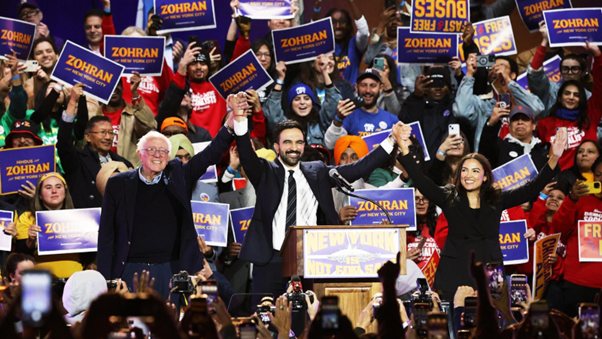
Bernie Sanders, Zohran Mamdani and Alexandria Ocasio-Cortez, the most prominent left-wing politicians of the Democrat Party, holding hands at a rally. Credit: ABC News 

Zohran Mamdani’s victory might not herald a new economic order, but it undeniably represents a new cultural mood: one where ideals of solidarity, justice, and public life are being reimagined. Can capitalism be “reformed” from within? Or must it be replaced by something else? Mamdani ‘s New York will prove a natural experiment for both questions. 

Sources:

Lucas Bernal  

Writer

Another War Arriving

Reading time: 8 minutes

Since the beginning of the year, relations between the United States and Venezuela have entered a particularly volatile phase. What began as U.S. efforts to counter alleged drug-trafficking networks operating out of Venezuela has escalated into a broader strategic standoff. Accusations, military posturing, and legal claims about sovereignty and intervention have sharpened the conflict and raised questions about international law, regional stability, and the future of U.S.–Venezuela diplomacy.

Image 1- Protest in Venezuela against U.S. actions. 

How the Crisis Started 

Since the beginning of his term, the Trump administration has linked Maduro’s regime to drug trafficking into the United States and the related problems these substances cause, such as crime and the growing influence of cartels. In 2020, during Trump’s first term, the Department of Justice issued a press release charging Nicolás Maduro and other senior Venezuelan officials with narco-terrorism, drug trafficking, and corruption. This shows that since his first term, Trump has associated Maduro with the drug trade and its consequences for the American population. This year, the White House decided to take more serious action regarding Venezuela. In August, Attorney General Pam Bondi decided to double the reward for information leading to Maduro’s arrest to $50 million. Soon after that, a stronger stance was adopted: an attack. On September 2, the U.S. Navy announced a strike on a vessel allegedly departing Venezuela and engaged in drug smuggling. The attack resulted in the deaths of 11 people and was seen as the first warning to Venezuela. Since then, the U.S. government has significantly expanded its operations in the Caribbean region, especially near Venezuela. For example, the Pentagon deployed an aircraft carrier group and other naval assets to the southern Caribbean as part of what the U.S. frames as “anti-narcotics operations.” 

The goals of the Trump administration 

As mentioned before, the U.S. describes the goal of this operation as a firm and protective stance against drug and crime cartels operating in the country. However, there might be other motives. Intelligence agencies—especially the National Intelligence Council—report that there is no conclusive evidence directly linking Maduro’s leadership to a centralized trafficking network. They also point out that Venezuela is neither a major cocaine nor fentanyl producer, nor a key transit point in narco-trafficking routes to the United States. This suggests that the White House has additional goals behind the operation. In addition to attempting to oust Maduro and push for regime change—intentions already hinted at publicly by the U.S.—two other motives stand out: asserting American strategic influence in Latin America and trying to gain leverage over Venezuela’s natural resources. The first comes from the growing Chinese economic and diplomatic involvement in the region. This has unsettled the Americans, and they have now adopted a new approach: align with Washington and receive benefits (as in Argentina’s case) or deviate and face costs, as happened with both Venezuela and, to some extent, Colombia. The second motive comes from suggestions that access to Venezuela’s vast oil and mineral resources is a secondary but key motive for this posture toward the South American country. For example, discussions allowing U.S. companies to regain access have appeared in reports surrounding the escalation. 

Image 2- Oil Reserves possessed by Venezuela

Venezuela’s reaction  

The Venezuelan government, led by Nicolás Maduro, has reacted strongly to all the U.S. moves and operations so far, treating them as a direct threat to national sovereignty and hinting at possible retaliation. Caracas has accused Washington of seeking regime change under the cover of a drug-war campaign. Seeing the need to be prepared, Venezuela is reportedly seeking military assistance from countries such as Russia, China, and Iran, requesting radar systems, aircraft repairs, and missile supplies to bolster its defenses. Maduro justifies these measures as necessary and has deployed warships, surveillance drones, and over 15,000 troops along Venezuela’s Caribbean coast and its border with Colombia. He has even called on civilian militias to enlist and train as part of a national defense posture, declaring, “In the face of this maximum military pressure, we have declared maximum preparedness for the defense of Venezuela.” Maduro also added that this was in response to the “eight military ships with 1,200 missiles and a submarine targeting Venezuela.” His Foreign Minister, Yván Gil, brought the matter to international forums, telling the United Nations that the U.S. deployment is “an illegal and completely immoral military threat hanging over our heads.” Caracas is thus positioning itself as being under siege by U.S. power, shifting the narrative away from drug trafficking and toward foreign aggression. He added that, according to UN data, only about 5% of cocaine exports allegedly pass via Venezuela, calling the U.S. narrative a “false narrative” aimed at regional destabilization. 

Image 3- Members of the Venezuelan army in a protest near UN headquarters in Caracas

International Reaction and Regional dilemma  

From the United Nations to Russia, these tensions have prompted a wide range of responses. The United Nations has repeatedly urged restraint by both the U.S. and Venezuela, warning that the military build-up and strikes risk regional peace and stability. For example, the UN noted that U.S. military deployments began in August 2025 and said any measure to counter trafficking must respect international law. In addition, at a UN Security Council meeting, multiple member states voiced concern; even some U.S. allies, such as France, Denmark, and Greece, joined the call for de-escalation and dialogue with Venezuela. Beyond the UN, both Russia and China have strongly condemned the U.S. military actions near Venezuela, calling them an “excessive use of force” and a violation of international law while reaffirming support for Venezuela’s sovereignty. Both countries maintain strategic energy and military ties with Venezuela, seeing the country as an important ally in the geopolitical chess of the region. Other reactions have come from the Caribbean states caught between support for U.S. anti-drug efforts and concern about militarization near their region. For example, Trinidad and Tobago’s Prime Minister aligned with U.S. security rhetoric, which drew both domestic support and regional unease. Brazil, for its part, is attempting a delicate balancing act: on one hand, it criticizes Venezuela’s democratic shortcomings (especially regarding elections and human rights), while on the other, it opposes external military intervention—such as by the U.S.—emphasizing sovereignty and the potential destabilization of the region. 

To sum up, the U.S.–Venezuela confrontation in 2025 has evolved from economic and diplomatic pressures into a much more confrontational and militarised phase. While the United States frames its actions as part of a fight against narco-trafficking and terrorism, Venezuela regards them as imperialistic and aimed at toppling the regime. With legal, military and diplomatic stakes rising, the risk of miscalculation or escalation is significant. All now turn to South America, a continent that has not seen an interstate military conflict since the 1990s, as it faces the alarming prospect of becoming the next front in this war-torn world. 

Sources:


Guilherme Mendonça  

Writer

Risk Repriced: How Political Instability Reshapes Market Confidence and Sovereign Costs 

Reading time: 8 minutes

When Markets Look At Politics 

We are used to thinking of financial markets as driven only by economic principles such as inflation, interest rate expectations, and growth forecasts. In this context, politics is background noise: unpredictable, difficult to quantify, and irrelevant to asset pricing. Yet this perception increasingly misrepresents reality. 

Political developments have become central to how markets interpret risk, reprice assets, and allocate capital.  

Nowadays, headlines from governments regularly trigger revaluations. Political uncertainty is growingly emerging as a source of volatility and a key determinant of sovereign borrowing costs. Every new cabinet announcement, legislative halt or budget negotiation is a signal investors have to price, quickly and with little margin for error.  

The uncertainty about future government actions may have a dual effect on market prices. In rare cases, it may represent policy flexibility against shocks. But in the majority of cases, it may actually reflect growing doubts about institutional resilience and future fiscal tracks. 

The market impact is clear: as stock prices respond to political news, political uncertainty leads to higher equity risk premium, increased asset correlation and consequently lower diversification benefits. 

To better understand how political turmoil can flow into financial markets, we can have a look at the most recent case: France. 

The French Distress 

In October 2025, France dived into a serious political turbulence after the resignation of Prime Minister Sébastien Lecornu just one day after announcing his cabinet. It’s the collapse of the fifth prime minister in just two years, a statistic that points out not just instability but a deeper fracture in the French political system. 

Public surveys reveal despair, pessimism and distrust as the prevailing feelings in French citizens. Worrying symptoms representing the profound current democratic crisis, not even two years ahead of the next presidential election.  

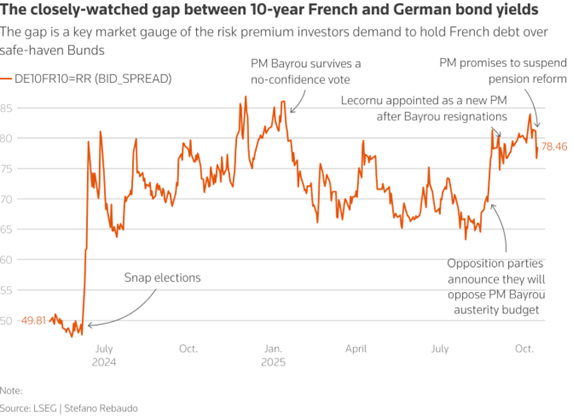
Financial markets, never known for patience but for how quickly they react, are clearly reflecting investors’ sentiment. Not surprisingly, French equity indices dropped, and bond markets did not do differently. For instance, yields on the 10-year French government bonds skyrocketed by 7-8 basis points, reaching around 3.58%.  The spread between French and German bond yields broadens as investors demand a premium for holding what they see as riskier sovereign debt.  

Figure 1: The yield gap widened sharply amid French political turmoil, reflecting rising investor risk premia on French debt. 
Source: LSEG via Reuters. 

The reason for this reaction? The answer is not that straightforward. No single event triggers the repricing by itself, but the clear loss of confidence in France’s fiscal policies plays an unequivocal role. The situation in France is getting complicated, both politically and economically.  

The general feeling speaks loud: France looks unable to find its way out of this malaise.  

Shifting Benchmarks 

Historically, France was perceived as relatively safe within the Euro area bond markets. Italian bonds, instead, have been telling a different story so far. Yet, trends are changing.  

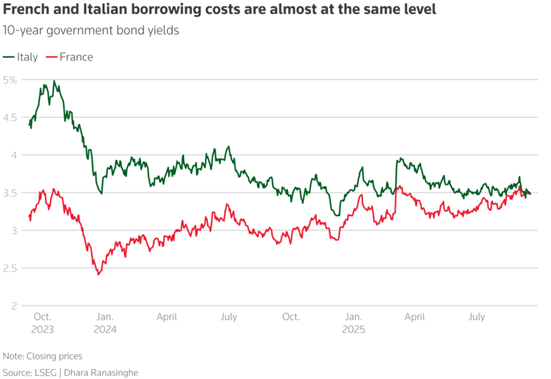
Figure 2: French (red) and Italian (green) 10-year government bond yields nearly converged in late 2025, reflecting France’s political turmoil (rising yields) versus relative stability in Italy (falling yields). Source: LSEG via Reuters. 

As French borrowing costs have risen, Italian yields have followed the opposite direction. This shows how perceptions around France, once considered a core market, and Italy, long seen as one of the weakest ones instead, have radically changed. Investors are concerned that France will not be able to improve its fiscal position due to its political instability, thus pushing up its bond yields. Different story for Italy, where relative political stability and downward debt forecast have caused its bond yields to decrease.  

But be careful. For some, the narrowing of the French-Italian bond spread has more to do with French fiscal and political distress than an improvement in Italy’s market.  

Italy has been afflicted by chronic problems that will take a long time to fix. We are still talking about the euro zone’s second-largest debt as a percentage of GDP after Greece, with a growth of the economy being obstructed by a concerning falling population and low female employment.  

Still, the convergence of French and Italian bond yields serves as a striking illustration of the implications of political stability and credible budgeting on investors’ confidence.  

Indeed, global investors nowadays look at governance quality in advanced economies pretty much as economic principles to adjust their required returns. 

Impact On Growth And Market Confidence 

Beyond market volatility, political instability carries important long-term economic costs. Empirical research on advanced economies has demonstrated that an uncertain politics can cause delayed investment decisions, hard policy execution, and undermined growth prospects. In fewer words, high levels of political instability can overall cause worse economic output. 

The reasons are pretty intuitive: when governments are fragile or policy direction is unclear, businesses and consumers lose confidence. Private sectors struggle to create expectations, while public institutions turn less effective in providing structural reforms.  

But as fragmented governments are not able to enact reform, public finances deteriorate. In France, the continuous change in leadership has paralysed the adoption of a new fiscal regime, delaying important decisions on expenditure and taxation. This creates a dangerous loop: as fiscal negligence decreases investor confidence, sovereign borrowing costs increase, which displace public spending, which in turn further constrains the ability to enact future reforms.  

France, for instance, has gone through five prime ministers in just two years, its national debt exceeding €3 trillion, and it seems unable to create a credible path towards fiscal balance.  

Figure 3: France holds the third-highest debt burden in the EU, after Greece and Italy, exceeding 110% of GDP. 
Source: Eurostat.

Globally, the political instability of an advanced economy as France can have both negative and positive spillover effects on other regions as well. On one hand, investors may require higher risk premiums also from other countries perceived as politically vulnerable. On the other hand, such instability may cause a flight-to-quality flows, as capital would flow towards safer bonds such as Germany Bunds or U.S. Treasuries.   

However, the coincident fiscal crises in multiple large economies, might result in a broader reallocation of global capital away from equities and emerging markets, thus potentially threatening global growth. 

Institutions such as the IMF and OECD have pointed out how political stability and consistent fiscal policies are not only priorities at the domestic level, but also the foundations of international market confidence and macroeconomic resilience. 

Conclusion 

What France is going through right now is not just a domestic drama. We are using this case as an understanding of what can be the costs of institutional fragility in a period of high debt and fiscal uncertainty. When governments and their reforms falter, consequences can be urgent: higher borrowing costs, downgraded credit ratings, eroded currencies, and constrained growth.  

If investors would once see political risk as background noise, now they price it in their models and we need to discuss it. The bond market has become a criterion of credibility, which rewards discipline and punishes obstructions.  

The message to policymakers is clear: good governance is capital. Stability, transparency, and consistency are no more mere abstract democratic values, but economic assets bringing yield. We are still in a post-pandemic context with high interest rates and insecurities, and policy incoherence is no longer tolerated. 

Preserving market trust is vital. Governments must now handle both budgets and expectations. Credibility can be the cheapest form of stimulus for those countries facing high debt and structural change. And as France is showing, once lost, it becomes the most expensive asset to restore. 

Sources: Reuters; Euronews; Financial Times; Fitch Ratings; Eurostat; LSEG via Reuters; IMF; OECD; ECB; Political Uncertainty and Risk Premia, by Lubos Pastor & Pietro Veronesi; European Journal of Political Economy; Political Instability and Economic Growth: Causation and Transmission, by Maximilian W. Dirks & Torsten Schmidt.

Rebecca Fratello 

Writer

US Aid Cuts Jeopardize Global HIV Prevention Efforts

Reading time: 3 minutes

In early 2025, the Trump administration implemented significant cuts to U.S. funding for HIV prevention programs, both domestically and internationally. These reductions have raised alarms among global health experts, who warn of potential setbacks in the fight against HIV/AIDS.

Impact on Global HIV Prevention

The U.S. President’s Emergency Plan for AIDS Relief (PEPFAR) has been a cornerstone in the global response to HIV/AIDS, providing two-thirds of international financing for HIV prevention in low- and middle-income countries. Since its inception in 2003, PEPFAR has saved over 26 million lives by investing in critical HIV prevention, treatment, care, and support programs across 55 countries.

However, a 90-day pause in U.S. foreign development assistance, initiated on January 20, 2025, disrupted these efforts. Although a waiver was issued to allow the continuation of life-saving humanitarian assistance, including HIV treatment, the pause created confusion and disrupted services at the community level. In Ethiopia, for instance, 5,000 public health worker contracts and 10,000 data clerk positions, crucial for HIV program implementation, were terminated.

The Global HIV Prevention Coalition warns that if U.S. funding is not restored, there could be an additional 8.7 million new HIV infections among adults, 350,000 among children, 6.3 million AIDS-related deaths, and 3.4 million additional AIDS orphans by the end of 2029.

Domestic Consequences

Domestically, the Centers for Disease Control and Prevention (CDC) has faced significant budget cuts, particularly in its Division of HIV Prevention. An analysis by amfAR indicates that increased funding to this division was associated with a nearly 20% reduction in new HIV infections across the U.S. between 2010 and 2022.

The proposed cuts threaten to reverse this progress. The CDC’s HIV prevention funding, which totaled about $1 billion in FY2024, supports state and local jurisdictions in conducting health surveillance and targeting communities effectively. Reductions in this funding could lead to increased HIV incidence, with negative implications for individual well-being, public health, and healthcare costs.

Organizational Restructuring and Layoffs

The administration’s broader restructuring efforts have also impacted HIV prevention. The CDC is undergoing a major reorganization, with several divisions, including those focused on HIV, set to become part of a new entity, the Administration for a Healthy America (AHA). This move follows significant downsizing, with the CDC workforce reduced by 3,500 to 4,000 through early retirements and layoffs.

Additionally, the Presidential Advisory Council on HIV/AIDS (PACHA) is being overhauled, with all members removed and no timeline provided for appointing new ones. These changes have raised concerns about the continuity and effectiveness of U.S. HIV policy.

Global Health Community’s Response

The global health community has expressed deep concern over these developments. UNAIDS Deputy Executive Director Christine Stegling emphasized that while treatment continuation is vital, prevention efforts are equally crucial to controlling the epidemic. She highlighted that the funding pause has led to the closure of many drop-in health centers and the termination of outreach workers’ contracts, depriving vulnerable groups of support.

The World Health Organization (WHO) also warned that prolonged funding cuts could reverse decades of progress, potentially taking the world back to the 1980s and 1990s when millions died of HIV each year globally.

Conclusion

The U.S. has played a pivotal role in global HIV prevention efforts. The recent funding cuts and organizational changes threaten to undermine years of progress, both domestically and internationally. Restoring and maintaining robust support for HIV prevention is essential to prevent a resurgence of the epidemic and to continue the global fight against HIV/AIDS.

Sources

https://www.reuters.com/business/healthcare-pharmaceuticals/trump-administration-plans-remove-all-members-hiv-advisory-council-2025-04-09

https://www.them.us/story/pepfar-hiv-aids-africa-marco-rubio-donald-trump

https://apnews.com/article/cdc-hiv-administration-for-a-healthy-america-8309109b91e6e4025878f335ea15dc96

https://www.ungeneva.org/en/news-media/news/2025/01/102724/unaids-welcomes-us-decision-keep-funding-life-saving-hiv-treatment

Afonso Freitas

Research Editor &Writer

Friendship and Social Capital

Reading Time: 5 minutes

Human Features as Capital? A brief history 

    In 1776, Adam Smith wrote, in An inquiry into the nature and causes of the wealth of nations, that “The acquisition of talents during education, study, or apprenticeship, costs a real expense, which is capital in a person. Those talents are part of his fortune and likewise that of society”. This idea might seem quite intuitive for an inhabitant of the world in the 21st century, and even the greenest economist would associate these words with the foundation of Human Capital.  

    However, until the last century, this concept was actually quite unpopular. As Theodore Shultz points out in Investment in Human Capital (1961), investment in human is not devoid of moral and philosophical issues. His words, “It seems to reduce man once again to a mere material component, to something akin to property”, are especially evocative, considering the 13th Amendment to U.S. constitution, which abolished slavery, had entered into force not even one century before.  

    With the advent of statistics and nation-level measurements in the period of WW2, researchers started to observe that increases in national output could not be fully explained by increases in physical capital. It became possible to link the accumulation of skills, capabilities and knowledge humans with these unexplained variations in growth.  

    Today, the World Bank defines Human Capital as “The knowledge, skills, and health that people invest in and accumulate throughout their lives, enabling them to realize their potential as productive members of society.” 

    But what aspects of the multifaceted human being are included in this definition? Reading further, the WB specifies: “Investing in people through nutrition, health care, quality education, jobs and skills helps develop human capital, and this is key to ending extreme poverty and creating more inclusive societies.”  

    Human Relationships as Capital  

      After accepting the “capitalization” of individual’s traits, a more recent step has been recognizing that humans are social animals, and therefore, their relationships are a fortune too. The concept of Social Capital generally refers to social relationships between people that have productive outcomes. In a nutshell, Portes (1998) explains it as “whereas economic capital is in people’s bank accounts and human capital is inside their heads, social capital inheres in the structure of their relationships”.  

      Social capital is for sure a peculiar form of capital: it does not reside in any individual entity, but it’s embedded in society, it lies in relationships, it’s rooted in networks. However, just like any other type of capital, it requires investment and maintenance to yield returns. 

      If defining the determinants of human capital is not an obvious task, defining those of social capital is even more challenging. The Institute for Social Capital indicates a range of dimensions including trust, togetherness, volunteerism, generalized norms, everyday sociability, and neighborhood connections.

      In essence, applying this theory, helping an old lady cross the street, having a neighbor who looks after your child when you’re sick, or trusting the police—all of these actions contribute to a web of reciprocity that will eventually benefit either the individual or the broader society. 

      Just as human capital was initially controversial, social capital was—and perhaps still is—a contested concept. For sure, its reputation increased after the publication of Making Democracy Work: Civic Traditions in Modern Italy by the political scientist Robert Putnam. Focusing on Italian regional governments, he found how government performance was strictly linked to traditions of civic engagement.  

      Friendship as Social Capital 

        Within this broader framework, friendship emerges as a particularly powerful and personal expression of social capital — one that not only supports emotional well-being but also shapes long-term economic and social outcomes. 

        If friendship is part of human capital, then it somehow has impacts that extend beyond the individual to society at large. And it might be more powerful than one can think. In a 2022 study on networks and friendships, Raj Chetty’s and colleagues found that education, racial segregation, education, and family structure were not as important as cross-class connections in determining upward social-mobility. In fact, among all observed components of social capital, friendship across socioeconomic lines was the only one driving mobility. Social cohesion and civic engagement, by contrast, did not seem to play a role.  

        The relationship between friends also shapes the social tissue of communities. In Bowling Alone, Putnam describes how American society, one strong and civic engaged, is now degrading through the whimsical metaphor of bowling. The evocation of many lonely bowlers, with a nostalgic comparison to bowling leagues playing together, reflects the individualist derive of society.  From this point of view, friendship and social interactions are a sort of public good, and not just a private comfort. The weaking of these relationships has consequences that go beyond individual loneliness, but undermine the health of society. 

        Relationships and Policy Makers 

          Friendships, connections, networks, and trust — they all contribute to both individual well-being and a healthier, more cohesive society. Yet we rarely hear politicians or policymakers address these topics directly. In an era where society is becoming increasingly individualistic, the case for investing in social capital becomes even more urgent. Urban planning, for instance, can be intentionally designed to promote cross-class connections and neighborhood friendships. The creation of public and recreational spaces that facilitate meeting and incentive people to socialize, promotion of sports and community strengthening activities can be impactful policies for boosting social capital. Reinvesting in friendships and ways of making them happen it’s not just about enhancing well-being, it’s a necessary step to rebuild a strong social fabric, that can sometimes be as important as and educated or healthy community. 

          Sources:

          Chetty, R., (2022). Social capital I: measurement and associations with economic mobility https://www.nature.com/articles/s41586-022-04996-4 

          Goldin, C. (2016). Human Capital. https://scholar.harvard.edu/files/goldin/files/goldin_human_capital.pdf

          Institute for Social Capital. https://www.socialcapitalresearch.com/literature/evolution/

          Putnam, R. D., Leonardi, R., & Nonetti, R. Y. (1993). Making Democracy Work: Civic Traditions in Modern Italy. Princeton University Press. https://doi.org/10.2307/j.ctt7s8r7 

          Putnam, R. D., “Bowling Alone: America’s Declining Social Capital” Journal of Democracy, January 1995, pp. 65-78. 

          Schultz, T. W. (1961). Investment in Human Capital. The American Economic Review, 51(1), 1–17. http://www.jstor.org/stable/1818907 

          World Bank: The Human Capital Project https://www.worldbank.org/en/publication/human-capital 

          Veronica Guerra

          Research Editor & Writer

          The Impact of Donald Trump’s Tariffs on Markets and International Trade 

          Reading Time: 5 minutes

          Tariffs have always been a contentious tool in global economic policy, and former President Donald Trump’s administration relied heavily on them to reshape America’s trade relationships. Trump’s approach to tariffs was characterized by the belief that they would protect American industries, reduce the trade deficit, and pressure foreign partners into negotiating more favorable deals for the United States. However, the actual effects of these tariffs have been complex and far-reaching, influencing everything from global supply chains to consumer prices. This article explores the potential and actual impacts of Trump’s tariffs on markets and international trade, offering examples, economic analysis, and perspectives from multiple sources. 

          What Are Tariffs and Why Did Donald Trump Use Them? 

          Tariffs are taxes imposed on imported goods. By making foreign goods more expensive, tariffs are intended to encourage consumers to buy domestic alternatives. Trump saw tariffs as a tool to reduce America’s trade deficit, particularly with China, and to protect domestic industries like steel, aluminum, and technology manufacturing. 

          Key Examples of Trump’s Tariffs: 

          • In 2018, Trump imposed a 25% tariff on steel imports and a 10% tariff on aluminum. 
          • In the same year, the administration slapped tariffs on $250 billion worth of Chinese goods, leading China to retaliate with tariffs on American products like soybeans, cars, and airplanes. 
          • In 2020, Trump threatened additional tariffs on European Union exports such as wine, cheese, and aircraft parts in retaliation for EU subsidies to Airbus. 

          How Tariffs Affect Domestic Markets 

          1. Higher Costs for Consumers 

          While tariffs target foreign producers, the actual cost burden often falls on domestic consumers. Importers pass higher costs onto consumers, making everything from cars to electronics more expensive. A study by the Federal Reserve Bank of New York estimated that by the end of 2019, Trump’s tariffs cost the average American household about $831 per year due to higher prices.  

          Example: When tariffs were imposed on washing machines in 2018, prices jumped nearly 12% within months, according to research published by economists at the University of Chicago and the Federal Reserve.  

          2. Disruption of Supply Chains 

          Many U.S. industries depend on imported components and raw materials. Tariffs on Chinese technology parts, for instance, disrupted the electronics and automotive sectors, which rely heavily on Chinese factories for affordable parts. This forced companies to either raise prices or absorb losses, weakening profit margins and investment. In the long run, some firms moved production out of China, but this led to higher transition costs and inefficiencies.  

          Impact on International Trade 

          1. Retaliatory Tariffs and Trade Wars 

          When the U.S. imposed tariffs, trading partners retaliated with their own tariffs. China targeted American agricultural exports, including soybeans, corn, and pork, hurting U.S. farmers who relied on the Chinese market. By mid-2019, U.S. agricultural exports to China had fallen by 53% compared to 2017. 

          Example: The American soybean industry suffered particularly harsh consequences. Before tariffs, China imported about $12 billion worth of U.S. soybeans annually. By 2019, that number dropped to under $3 billion. The U.S. government ended up subsidizing farmers to offset their losses, costing taxpayers billions. (Source: Bloomberg, 2019) 

          2. Erosion of Trade Alliances 

          Trump’s unilateral use of tariffs alienated key allies, including the European Union, Canada, and Mexico. When Trump imposed steel and aluminum tariffs, both Canada and the EU retaliated with tariffs on iconic American products, from Harley-Davidson motorcycles to bourbon whiskey. This strained long-standing trade relationships, particularly within the World Trade Organization (WTO) framework, which is built on predictable, rules-based trade.  

          Effects on Financial Markets 

          1. Market Volatility 

          Trump’s tariff announcements often led to immediate stock market swings. When tariffs on China were announced in March 2018, the Dow Jones Industrial Average plunged 724 points in a single day, reflecting investor fears of a full-blown trade war disrupting global economic growth.  

          2. Sectoral Winners and Losers 

          Some sectors benefited from protectionism, particularly domestic steel producers. However, industries reliant on steel (like automotive and construction) faced rising costs, eroding their competitiveness. Agricultural stocks, particularly in soybeans and pork, plummeted due to lost export markets.  

          Long-Term Economic Impacts 

          1. Reshoring vs. Offshoring Diversification 

          One goal of the tariffs was to bring manufacturing back to the U.S., a process called reshoring. Some companies did shift production, but many opted to diversify away from China to other low-cost countries like Vietnam, Mexico, and Thailand instead. This resulted in a fragmentation of global supply chains, increasing overall uncertainty.  

          2. Reduced Global Trade Growth 

          The uncertainty surrounding U.S. trade policy under Trump contributed to slower global trade growth. According to the World Bank, global trade growth fell from 5.4% in 2017 to just 1.1% in 2019, with tariffs playing a significant role.  

          Case Study: The U.S.-China Trade War 

          The most high-profile example of Trump’s tariff policy was the U.S.-China Trade War, which began in 2018. It involved escalating tariffs on hundreds of billions of dollars in goods on both sides. The conflict led to: 

          • Higher costs for American businesses and consumers. 
          • Reduced Chinese investment in the U.S.. 
          • A reshaping of Asian supply chains, with companies shifting production to Southeast Asia. 

          Ironically, despite Trump’s goals, the U.S. trade deficit with China actually increased in some sectors, as American companies stockpiled Chinese goods before tariffs took full effect.  

          Trump’s tariffs were a bold attempt to reset global trade dynamics, but the unintended consequences were significant. While they did pressure China into signing Phase One of a trade deal in 2020, they also: 

          • Raised prices for American consumers 
          • Hurt American exporters through retaliation 
          • Increased market volatility 
          • Weakened global trade growth 
          • Undermined trust in the international trade system 

          As the world moves with the Trump era, policymakers face the challenge of rebuilding stable trade relationships while addressing the legitimate grievances about unfair trade practices, especially concerning China’s industrial subsidies and intellectual property violations. Whether tariffs were the right tool for this job remains hotly debated, but their lasting impact on markets and international trade is undeniable. 

          Sources

          BBC, 2018; Peterson Institute for International Economics, 2020; Federal Reserve Bank of New York, 2019; Flaaen et al., 2019; Harvard Business Review, 2020; Congressional Research Service, 2020; CNBC, 2018; Reuters, 2018; Brookings Institution, 2020; Bloomberg, 2019; World Bank, 2020; Peterson Institute for International Economics, 2020.

          Afonso Freitas

          Research Editor & Writer

          Trump’s USAID Cuts: Humanitarian Disaster Or A Step Toward Self-Reliance? 

          Reading Time: 5 minutes

          On March 10th, the Trump Administration announced that 83 percent of the programs run by the U.S. Agency for International Development (USAID) would be canceled. This decision follows a series of actions targeting USAID, including placing its officials on paid leave, discussing the agency’s potential shutdown, and labeling it as being run by “radical left lunatics” and a corrupt institution that misuses taxpayer money. The first major move came with a freeze on approximately 90% of USAID grants and contracts worldwide—making the latest cuts less surprising. 

          Feb. 28, 2025, Washington. A senior advisor at USAID, is consoled by a co-worker after having 15 minutes to clear out her belongings from the USAID headquarters, Friday. (AP Photo/Jacquelyn Martin) 

          In a speech to Congress on March 4th, Trump outlined his reasoning behind these decisions. Reducing “the flagrant waste of taxpayer dollars” is part of his broader strategy to combat inflation, purpose for which the DOGE, the brand-new Department Of Government Efficiency headed by Elon Musk, was created. Trump listed several specific cuts, such as “$8 million to promote LGBTQI+ initiatives in Lesotho, which nobody has ever heard of,” and “$250,000 to increase vegan local climate action innovation in Zambia.” He also mentioned “$47 million for improving learning outcomes in Asia,” sarcastically noting that “Asia is doing very well with learning. You know what we’re doing—could use it ourselves.” Many other initiatives were dismissed as “scams.” 

          However, while some projects may be debated, the impact of these cuts extends to critical humanitarian aid programs. Initiatives preventing malnutrition and combating diseases such as malaria, polio, and AIDS have been shut down, leaving millions vulnerable around the world. 

          From a broader perspective, the decision aligns with a reshaped U.S. national interest—one that takes a narrower, more domestic-focused approach. While foreign aid cuts may contribute to reducing inflation, they also risk undermining stability in conflict-prone regions and weakening diplomatic relations. It remains to be seen what the long-term consequences of this decision will be for the US. 

          Impact on Developing Countries 

          But what can poor countries’ economies expect from such an abrupt dismantling of USAID?  

          It is inevitable that many African countries will face a profound distress, especially in the healthcare sector. For instance, in South Africa, 17% of funding for AIDS treatment comes from PEPFAR (the President’s Emergency Plan for AIDS Relief), which also supports the salaries of more than 15,000 healthcare workers. The situation could be even more critical in Ethiopia, USAID’s largest beneficiary, which receives over $200 million annually to support its healthcare system. 

          However, some argue that heavy reliance on foreign aid is not beneficial for recipient countries. There is no consensus on its overall impact on economic development. Some scholars argue that aid fosters growth through infrastructure improvements, pioneering investments, and attracting foreign capital. Others counter that it distorts labor markets and fosters dependency. Some have also compared foreign aid effects on local economies to the ones of natural resources revenues: these inflows can lead to currency appreciation, making locally produced locally produced tradable goods relatively more expensive and less competitive internationally, triggering the so-called “Dutch Disease” and weaking local manufacturing. 

          Foreign Aid Received in 2023, in US Dollars and adjusted for inflation. Source: OECD, 2025.

          The Debate on Foreign Aid 

          Criticisms against aid arrive also from other Global South Activists, who claim that aid is just charity covering social injustice and perpetuating the colonialist “civilizing mission”.  

          One of the most prominent critics is Dambisa Moyo, a global economist born in Zambia and naturalized as an American. In her 2009 book, Dead Aid – Why Aid Is Not Working and How There Is a Better Way for Africa, she challenges the “greatest myths of our time: that billions of dollars in aid sent from wealthy countries to developing African nations has helped to reduce poverty and increase growth”. Moyo argues that foreign aid fuels corruption, distorts local markets, and creates a vicious cycle of dependency—ultimately increasing poverty rather than alleviating it. Moyo proposes the stop of aid funding, throughout the over a period of five years, as a solution to reduce poverty and improve economic growth and development in African countries.  

          Although Moyo’s plan differs significantly from Trump’s approach and underlying motivations, her perspective raises the question: Could these cuts ultimately push aid-receiving countries toward self-reliance? 

           Regardless of the answer to this question, Trump’s decision carries profound economic and humanitarian consequences for developing nations reliant on these funds, and challenges the West’s long-standing role in Global South development. If these cuts lead to reduced dependence on Western aid, they could open the door for alternative models and standards—ones that might ultimately foster more sustainable growth for recipient countries and prompt a reevaluation of an international cooperation system that has long been in need of reform. 

          Sources

          Al Jazeera, Trump’s USAID freeze must serve as a wake-up call for Africa, available at https://www.aljazeera.com/opinions/2025/3/13/trumps-usaid-freeze-must-serve-as-a-wake-up-call-for-africa 

          Al Jazeera, Why some in the Global South are not mourning the demise of USAID, available at https://www.aljazeera.com/opinions/2025/3/3/why-some-in-the-global-south-are-not-mourning-the-demise-of-usaid 

          AP News, USAID cuts are already hitting countries around the world. Here are 20 projects that have closed, available at https://apnews.com/article/usaid-cuts-hunger-sickness-288b1d3f80d85ad749a6d758a778a5b2 

          Arellano, C., Bulíř, A., Lane, T., &Lipschitz, L. (2009). The dynamic implications of foreign aid and its variability. Journal of Development Economics, 88(1), 87-102. 

          Our World in Data, Foreign Aid Received, available at https://ourworldindata.org/grapher/foreign-aid-received-net 

          The Guardian, Rubio says 83% of USAid programs terminated after six-week purge, available at: https://www.theguardian.com/us-news/2025/mar/10/marco-rubio-usaid-funding 

          The Guardian, ‘The impact has been devastating’: how USAid freeze sent shockwaves through Ethiopia, available at https://www.theguardian.com/global-development/ng-interactive/2025/feb/21/the-impact-has-been-devastating-how-usaid-freeze-sent-shockwaves-through-ethiopia 

          The New York Times, All of the Trump Administration’s Major Moves in the First 5151 Days, available at https://www.nytimes.com/interactive/2025/us/trump-agenda-2025.html?categories=Foreign+policy 

          The New York Times, U.S. Terminates Funding for Polio, H.I.V., Malaria and Nutrition Programs Around the World, available at https://www.nytimes.com/2025/02/27/health/usaid-contract-terminations.html 

          Cao, W., & Du, D. (2024). Does foreign aid play a role in promoting economic development? Evidence from US aid. Applied Geography, 171, 103394. 

          Zambisa Moyo, Dead Aid, https://dambisamoyo.com/books/ 

          Veronica Guerra

          Research Team Editor & Writer

          The national and international consequences of Donald Trump winning the US elections 

          Reading time:8 minutes

          As you might have read, Donald Trump has been elected President of the U.S. for the second time. This was a very impactful decision not only in the country but also around the world. What are exactly the changes expected to happen once he is in charge and how are they going to affect us? 

          At a national level, these are the main affected sectors: 

          Economic and Financial Policies 

          Trump is expected to push for additional tax cuts, including reducing corporate taxes from the current 21% to possibly 15%, and lowering individual income tax rates for high earners. This could lead to larger deficits, impacting long-term funding for social programs like Medicare and Social Security. 

          Likely areas of deregulation include banking, where Trump could roll back Dodd-Frank reforms, allowing banks to take on more risk. In agriculture and industry, Trump might also remove environmental or labor regulations, potentially lowering costs for businesses but at the risk of worker protections and environmental quality. 

          His strategy might involve tariffs on Chinese goods, impacting electronics, textiles, and machinery imported from China. This could increase prices for American consumers and lead to retaliatory tariffs on U.S. exports, affecting farmers and manufacturers reliant on Chinese markets. 

          Domestic Governance and Judicial Appointments 

          Conservative judges would be appointed to the Supreme Court and there would be lower federal courts, creating a judiciary inclined to uphold conservative stances on abortion restrictions, gun rights, and states’ rights. 

          More agency staff would possibly be under direct presidential control, a move that could result in the firing or replacement of career civil servants in agencies like the DOJ, FBI, and EPA. This restructuring would likely favor agency heads and employees loyal to his administration’s goals, reducing independence within federal agencies. 

          Lastly, stricter voting regulations might lead to new laws requiring voter IDs and limiting mail-in ballots. These changes could affect voter turnout, particularly among minority and low-income communities, impacting election outcomes at state and federal levels. 

          Social Issues and Civil Rights 

          Trump suggested supporting a national abortion ban after 15 weeks, which would limit access to reproductive healthcare for millions, particularly in conservative states. Also, his administration previously used family separation as a deterrent. His re-election could see a return to this policy, potentially leading to increased numbers of families and children held in detention centers. Moreover, he consistently opposed Deferred Action for Childhood Arrivals (DACA) and may seek to end protections for “Dreamers,” potentially impacting the legal status of around 600,000 young immigrants

          Past policies included banning transgender people from military service. A return could see attempts to allow businesses to deny services to LGBTQ+ individuals based on religious beliefs, affecting areas like employment, housing, and healthcare access. 

          Environmental and Energy Policies 

          As previously, the US might be withdrawn from the Paris Agreement, weakening international climate commitments. His administration could also cut funding for renewable energy programs, including solar and wind, in favor of expanding oil drilling and fracking. 

          Energy dominance” might be achieved by expanding drilling in federal lands and waters, including the Arctic. This could result in rising carbon emissions, negatively impacting U.S. air and water quality, and exacerbating climate change effects. 

          Healthcare and Public Health 

          Trump has called for replacing the Affordable Care Act but has not provided a specific replacement plan. If he succeeds in dismantling it, around 20 million Americans could lose health insurance, leading to higher rates of uninsured individuals and increased pressure on emergency services and hospitals. 

          Trump’s criticism of agencies like the CDC could lead to reduced funding and influence for public health experts, impacting future responses to health crises and making the U.S. less prepared for pandemics

          Technology, Media, and Cybersecurity 

          Section 230 of the Communications Decency Act protects tech platforms from liability for user content. Changes to this law may perhaps force social media companies to alter how they moderate content, leading to more limited or more regulated user expression online. 

          Furthermore, his support for conservative media outlets can shift public reliance away from traditional news sources. This would increase the influence of platforms like Truth Social or OANN, impacting how Americans access and interpret news and information. 

          National Unity and Social Polarization 

          Trump’s rhetoric often appeals to a specific base, which may lead to heightened polarization among urban vs. rural, conservative vs. liberal, and racial or ethnic groups; more protests, counter-protests, and confrontations between political factions, possibly heading to public safety challenges. 

          Claims about “fake news” and “election fraud” have reduced trust in the electoral system and media. A second term could deepen this mistrust, with Americans increasingly questioning the legitimacy of elections, judiciary decisions, and federal agencies, which could destabilize democratic norms. 

          Education and Curriculum Standards 

          Trump has been vocal about removing what he calls “wokeideologies from schools. His administration could push for more conservative curriculum standards, potentially restricting lessons on systemic racism, gender identity, and LGBTQ+ history. This could lead to lawsuits and increased politicization of educational content. 

          School choice initiatives might be expanded, pushing for vouchers that allow students to attend private or charter schools with public funding. While this could provide more educational options, it may divert resources from public schools, impacting their quality and equity, especially in low-income areas. 

          What are the possible consequences for international politics and economics? 

          Turning to the consequences of Trump’s second term for international politics and economics, some drastic changes can be anticipated based on Trump’s announcements and promises during his election campaign. 

          Tariffs and a return to protectionism 

          During his campaign, Donald Trump promised to increase U. S. tariffs on all goods imported from China to 60% and from all other countries to 10%. Once, he even threatened Mexico with 100% tariffs. These protectionist measures are aimed at domestic companies outsourcing parts of their business to other countries or foreign firms with a key market in the United States, in hopes of “bringing back” manufacturing to the country and growing the economy through a strong industrial landscape. International companies such as car manufacturers from other countries now worry about losing the U. S. as a crucial market in their segment and might need to fundamentally adjust their strategic plans for the future. Trump tariffs could spark trade wars with other industrial nations and raise consumer prices around the world, lowering the living standard for the middle and lower class in industrial market economies. 

          NATO-Skepticism and “stop the wars” 

          Governments and citizens around the globe are watching with chattering teeth what Trump’s exact plans are for NATO and its members. Some are even worried the United States will exit NATO altogether. Trump has previously stated he wouldn’t protect a NATO member against a Russian invasion if they don’t pay at least 2% of their GDP on defense, which jeopardizes the fundamental purpose and integrity of the alliance. Also, he has pledged to negotiate and settle the conflicts in Ukraine and Israel to stop the wars and achieve peace. Many fear this strategy will lead to advantageous outcomes for Russia and a detrimental result for Gaza and the Muslim population in and around Israel. Conversely, Trump has vowed to establish a military defense shield around the U. S. to protect it, should a third world war begin to escalate. This blatant approach to foreign policy could strengthen Russia in its imperialist undertakings, essentially showing how an invasion in contravention of international law can be pursued without punishment. 

          Immigrants facing discrimination and deportations 

          President-elect Trump has said he will pursue mass deportation during his presidency to counteract President Biden’s alleged laissez-faire immigration policy, that has led to millions of criminals from insane asylums storming the country, according to Donald Trump. Despite the refutation of these claims, a surge in deportations is projected to impact the construction, housing and agriculture industry negatively, which all depend on migrant workforce. Trump has also stated he would reinstate a travel ban that used to ban people from mostly Muslim countries from visiting the U. S. and extend it by refugees from Gaza. This could foster the global conflict between religions and islamophobia. 

          Conclusion 

          It has become evident how Donald Trump seeks to fundamentally reshape U. S. politics to provide more influence on himself and his allies, while embedding republican values and beliefs into law and everyday life. With his economic policy, Trump wants to reinstate the United States as the manufacturing powerhouse it once was, and abolish all factors inhibiting that dream, including social benefits or climate protection efforts. The same holds for foreign economic policy, where he resorts to pre-war mercantilism by applying heavy tariffs on foreign goods and exporting as much as possible. Regarding diplomacy, he outlines short-term resolutions to ongoing battles, likely to the delight of his voters, but might risk destabilizing global international politics altogether along the way. It is ultimately left to the individual to decide on whether the changes in tone in U. S. politics will have positive or negative consequences for one’s personal life, but it is safe to assume the second Trump presidency will test core democratic values and shake up the current global political agenda. 

          Disclaimer: It is important to note that Donald Trump has previously not delivered or changed his stance on numerous election campaign promises, signaling that the implications stated in this article might not come into effect in the very form Trump sketched them out during his rallies. 


          Sources: Brookings, Reuters, Cato Institute, The Heritage Foundation, Pew Research Center, The Atlantic, Council on Foreign Relations, The New York Times, The Washington Post, The Verge, Forbes, The Economist

          Teresa Catita

          Bent N. Eisheuer

          Navigating Nuclear Dilemmas 

          The Unfolding Debate Amid Russia-Ukraine Tensions 

          The nuclear weapons debate has seen a resurgence amid Russia-Ukraine tensions, with Vladimir Putin pressuring to test atomic bombs, ultimately heightening Western concerns. The international community, including the US, UK, France, and even China, has expressed concern and warned against the use of nuclear weapons in the conflict, and there has been a clear shift in Russia’s approach to nuclear deterrence.  

          As these problems arise in the landscape of international security, the enduring debate on whether to develop nuclear weapons, and what protects the international status-quo, remains. 

          International Relations Background 

          In the relentless pursuit of military superiority, nations have historically engaged in continuous innovation to develop advanced weapons capable of overcoming adversaries during times of conflict. However, the advent of nuclear weapons marked a paradigm shift in warfare, distinguishing them from conventional tools of combat. As observed by Bernard Brodie, one of the first military theorists of the atomic age: 

          “Thus far the chief purpose of our military establishment has been to win wars. From now on its chief purpose must be to avert them. It can have almost no other useful purpose”. 

          This statement encapsulates the paradoxical nature at the heart of the nuclear revolution.  

          Nuclear weapons as deterrence 

          In the post-Cold War era, multiple nations have acquired nuclear capabilities. In this scenario, the concept of Mutual Assured Destruction (MAD) renders it challenging to justify or comprehend the meaningful purpose behind engaging in an all-encompassing nuclear conflict, or even a “limited” one. 

          Mutual Assured Destruction 

          In that case, if nuclear weapons are not useful as “instruments of war”, what is their purpose? The simple answer would be deterrence. In this hypothesis, states use the threat of possible nuclear retaliation to deter other states from attacking them.  

          Nuclear Proliferation: More is better or worse? 

          In his 1981 publication, “The Spread of Nuclear Weapons: More May Be Better”, political scientist and international relations scholar, Kenneth Waltz, argued that nuclear proliferation could foster peace and stability as a deterrent. He contended that possessing nuclear power would heighten a nation’s awareness of the catastrophic consequences of a nuclear war, prompting caution and responsibility among nuclear-armed states. Would the Bush administration have invaded Iraq, in 2003, if Saddam Hussein had even a small number of nuclear weapons? He asserted that the presence of nuclear weapons would have led the United States to reconsider its actions, given the risk of a retaliatory strike.  

          Waltz also addresses a Western bias regarding nuclear-armed Iran or North Korea, challenging the perception that these nations would act irresponsibly. He cites China as a precedent: despite being deemed revolutionary in the 1950s and 1960s for acquiring nuclear weapons, China has maintained responsibility, refraining from their use. Today, it could hardly be defined as an “irresponsible state”, defying initial concerns. 

          On the other hand, renowned scholar Scott Sagan, specialized in nuclear weapons policy and disarmament, contends that nuclear proliferation heightens global instability: “More will be worse”, emphasizing that new nuclear states lack robust organizational structures for secure weapon control. Sagan challenges Waltz, pointing out the unpredictability of leaders and governments acquiring nuclear arms, especially in states lacking stable, civilian-run governments, amplifying dangerous circumstances: nuclear weapons are controlled by “imperfect human beings in imperfect organisations”. 

          He argues that deterrence depends on the state’s second strike capabilities, this is, the capabilities of that state to inflict unacceptable damage on an adversary, even after the adversary hits first with its best nuclear attack. Lastly, he also mentions the possibility of a nuclear accident, which increases with the nuclear proliferation: 

          “Common biases, rigid routines, and parochial interests of military organizations will lead to deterrence failures and accidental uses of nuclear weapons despite national interests to the contrary.” 

          Vladimir Putin’s Nuclear Rhetoric 

          Vladimir Putin (Source: Financial Times) 

          While Putin has dialled down on explicit nuclear threats, recent simulations of a massive retaliatory strike and other manoeuvres serve as reminders of Russia’s nuclear capabilities. Western analysts caution that despite toned-down rhetoric, the nuclear threat persists.  

          Rather than overt threats, Russia has explored other ways to use its nuclear arsenal as a deterrent. This includes revoking the ratification of the Comprehensive Nuclear Test Ban Treaty (CTBT), conducting tests on new missiles with potentially unlimited range, deploying tactical nuclear weapons to neighbouring Belarus, and suspending participation in the New Start Treaty. Podvig, a senior researcher at the UN Institute for Disarmament Research in Geneva, said: 

          “There was an understanding that Russia won’t gain any friends by putting emphasis on its nuclear weapons, so the de-ratification of CTBT was a kind of compromise, if you will, between those who want a strong stick and those who realise it would be counterproductive.” 

          Within Russia, there are differing views on the use of nuclear weapons, with this internal debate reflecting concerns about Russia appearing weak without a credible atomic threat. While some suggest that Russia might consider heightened nuclear containment as part of its overall strategy in the conflict, others advocate for pre-emptive nuclear strikes as a means to halt Western support for Ukraine, with a few figures within Russia’s propaganda machine going as far as suggesting extreme measures such as detonating a thermonuclear weapon in the atmosphere, amplifying nuclear rhetoric: “Less talk, more action”, asserted Dmitry Trenin, a prominent foreign policy academic who supports nuclear sabre-rattling as a strategy to “bring back fear” to Western capitals. 

          Conclusion 

          While nuclear weapons offer a stabilizing effect through deterrence, the prospect of other states obtaining these weapons raises concerns about potential escalation into devastating conflicts. While these weapons may reduce the likelihood of war, they also amplify the potential for unparalleled destruction.  

          It is important to note the intricate dynamics involving nuclear weapons in the ongoing conflict and the potential impact on the geopolitical landscape, especially in Europe. The situation remains complex, and ongoing developments should be closely monitored to understand the evolving nature of the conflict and its broader implications.  

          The ongoing discourse on nuclear proliferation and deterrence remains crucial, aided by insights from international relations to enhance our understanding of this complex issue. 

          Sources: UN News; The Autralian; Financial Times; “Introduction to International Relations” Joseph Grieca, G.John Ikenberry, Michael Mastanduno 

          Catarina Franco